
A CrossLayer Architecture to Exploit MultiChannel Diversity Jay
![Routing t 1 A [s 2] C [s 0] t 2 t 4 B](https://slidetodoc.com/presentation_image_h2/50ad3ed2a37bbd5c473d842a81474473/image-9.jpg "Routing t 1 A [s 2] C [s 0] t 2 t 4 B")

- Slides: 20
A Cross-Layer Architecture to Exploit Multi-Channel Diversity Jay A. Patel, Haiyun Luo, and Indranil Gupta Department of Computer Science University of Illinois at Urbana-Champaign Distributed Protocols Research Group http: //kepler. cs. uiuc. edu/ 1
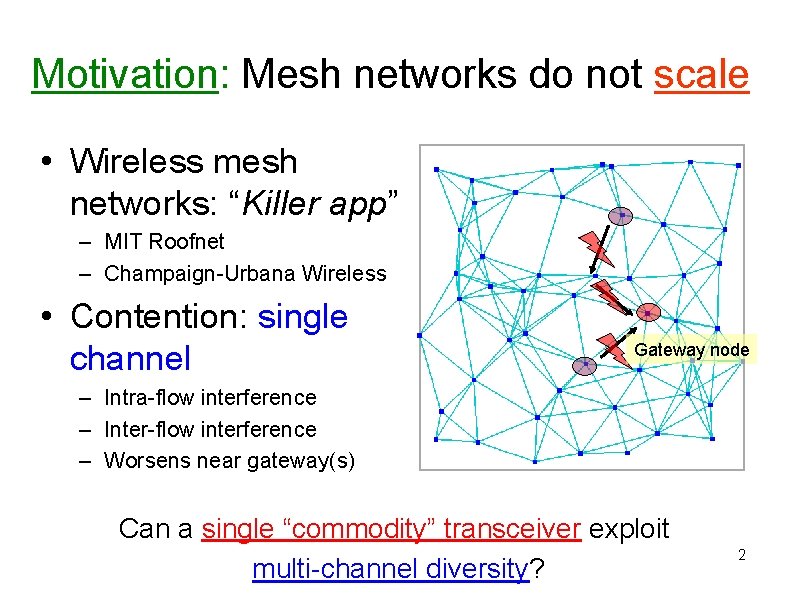
Motivation: Mesh networks do not scale • Wireless mesh networks: “Killer app” – MIT Roofnet – Champaign-Urbana Wireless • Contention: single channel Gateway node – Intra-flow interference – Inter-flow interference – Worsens near gateway(s) Can a single “commodity” transceiver exploit multi-channel diversity? 2
Challenges + Prior Work • Neighbors must converge to exchange data – While exploiting multiple channels • Locally opportunistic channel hopping – Multi-channel MAC [So: Mobi. Hoc 04] – Seeded Slotted Channel Hopping [Bahl: Mobi. Com 04] • Limitations – Leads to node synchronization problem – MAC Approach: Probable implementation issues 3
Our Contributions • Dominion: A cross-layer architecture – Simple MAC + Intelligent routing – Key decisions shifted up, i. e. , in to the software stack • Deterministic channel hopping MAC protocol – Eliminate locally opportunistic behaviour • Improves fairness • Core logic resides at the routing layer – Graph-theoretic model: extensible and flexible – Multi-path routing 4
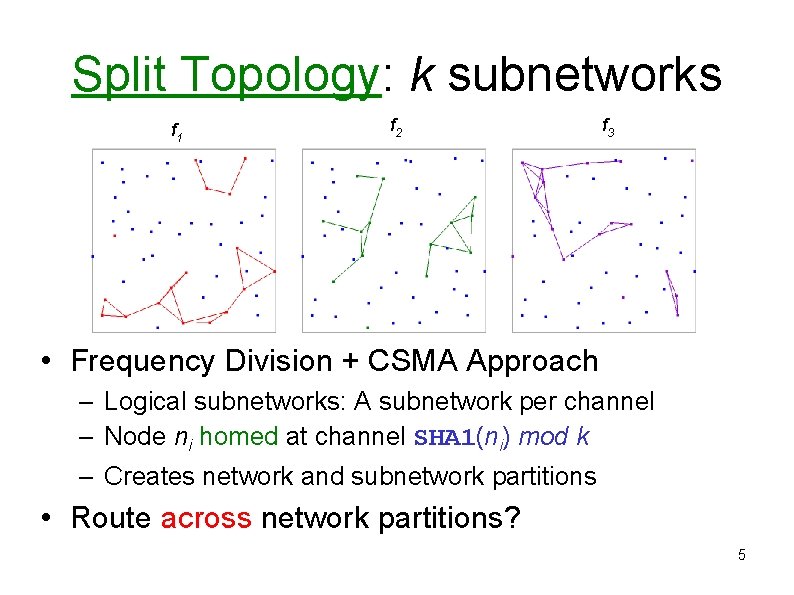
Split Topology: k subnetworks f 1 f 2 f 3 • Frequency Division + CSMA Approach – Logical subnetworks: A subnetwork per channel – Node ni homed at channel SHA 1(ni) mod k – Creates network and subnetwork partitions • Route across network partitions? 5
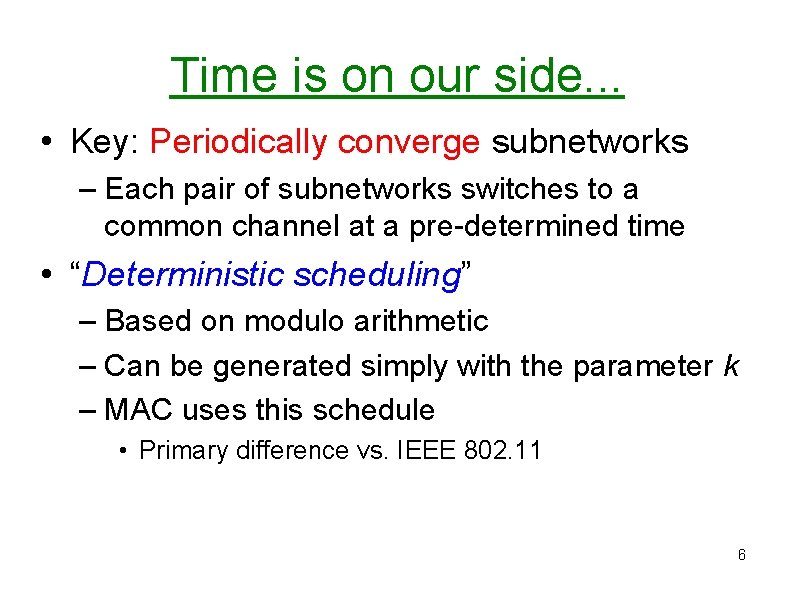
Time is on our side. . . • Key: Periodically converge subnetworks – Each pair of subnetworks switches to a common channel at a pre-determined time • “Deterministic scheduling” – Based on modulo arithmetic – Can be generated simply with the parameter k – MAC uses this schedule • Primary difference vs. IEEE 802. 11 6
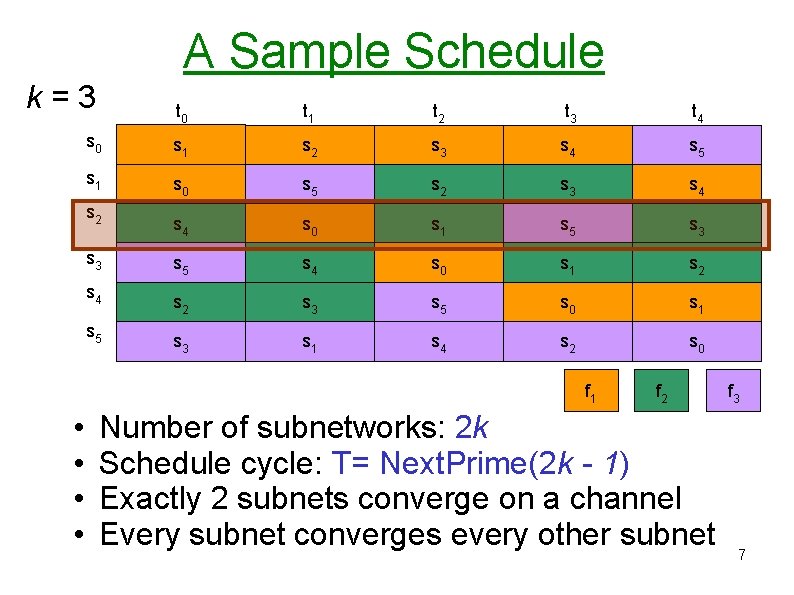
A Sample Schedule k=3 t 0 t 1 t 2 t 3 t 4 s 0 s 1 s 2 s 3 s 4 s 5 s 1 s 0 s 5 s 2 s 3 s 4 s 0 s 1 s 5 s 3 s 5 s 4 s 0 s 1 s 2 s 3 s 5 s 0 s 1 s 3 s 1 s 4 s 2 s 0 s 2 s 3 s 4 s 5 f 1 • • f 2 Number of subnetworks: 2 k Schedule cycle: T= Next. Prime(2 k - 1) Exactly 2 subnets converge on a channel Every subnet converges every other subnet f 3 7
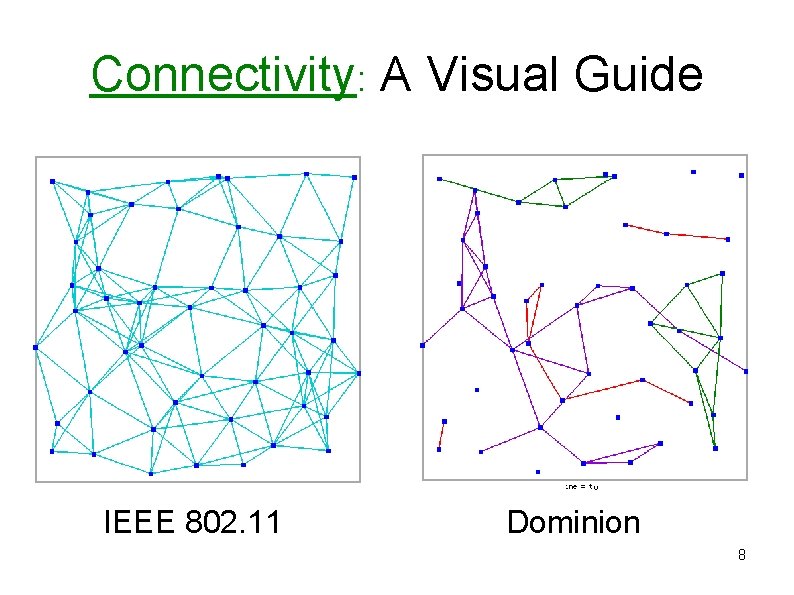
Connectivity: A Visual Guide IEEE 802. 11 Dominion 8
Routing t 1 A [s 2] C [s 0] t 2 t 4 B [s 3] • Best route for A -> B? – Two routes: AB (direct) and AC -> CB (indirect) • Which is the better route? It depends – Throughput-wise: AB • Can we do better? YES! with multi-path routing – Latency-wise: is time-variant • Addressed in a follow-up paper 9
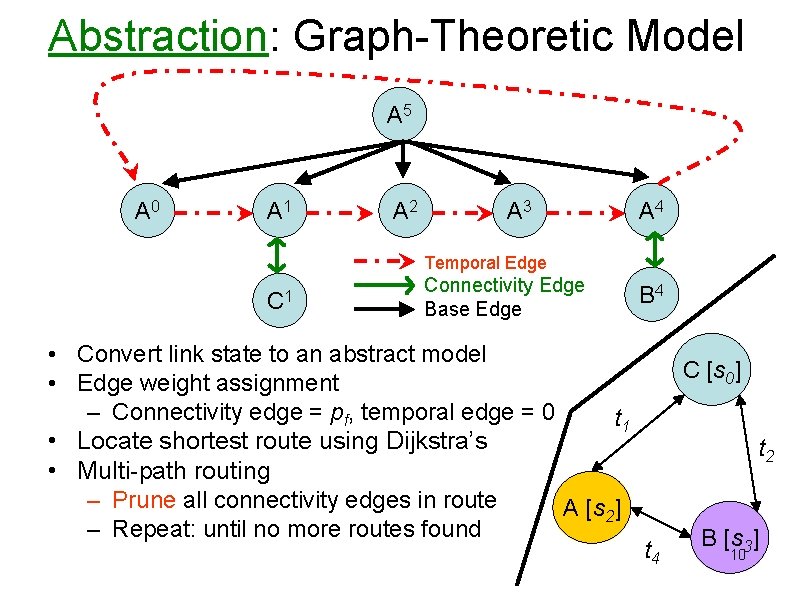
Abstraction: Graph-Theoretic Model A 5 A 0 A 1 A 2 A 3 A 4 Temporal Edge C 1 Connectivity Edge Base Edge • Convert link state to an abstract model • Edge weight assignment – Connectivity edge = pf, temporal edge = 0 t 1 • Locate shortest route using Dijkstra’s • Multi-path routing – Prune all connectivity edges in route A [s 2] – Repeat: until no more routes found B 4 C [s 0] t 2 t 4 B [s 3] 10
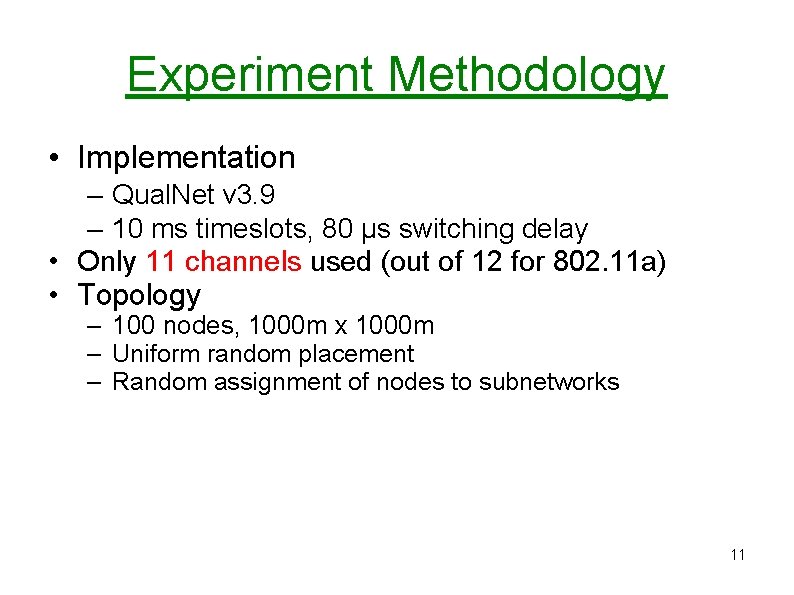
Experiment Methodology • Implementation – Qual. Net v 3. 9 – 10 ms timeslots, 80 µs switching delay • Only 11 channels used (out of 12 for 802. 11 a) • Topology – 100 nodes, 1000 m x 1000 m – Uniform random placement – Random assignment of nodes to subnetworks 11
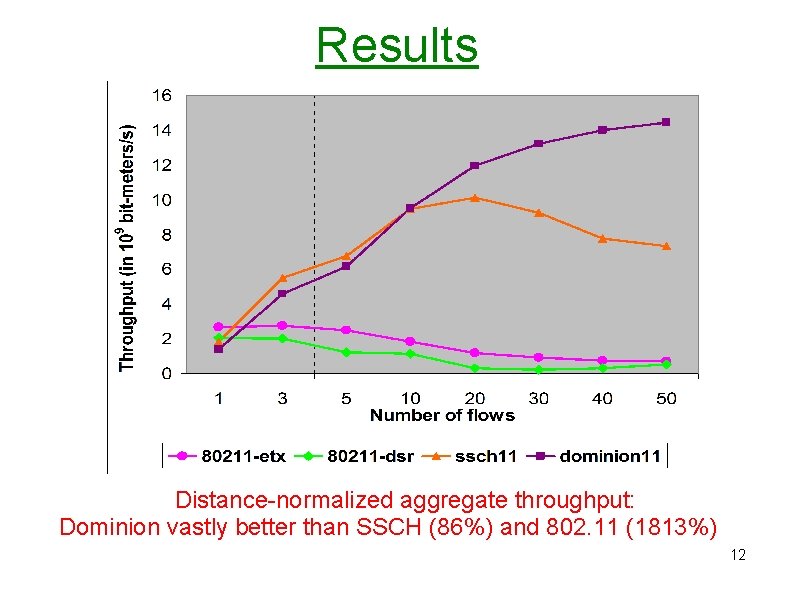
Results Distance-normalized aggregate throughput: Dominion vastly better than SSCH (86%) and 802. 11 (1813%) 12
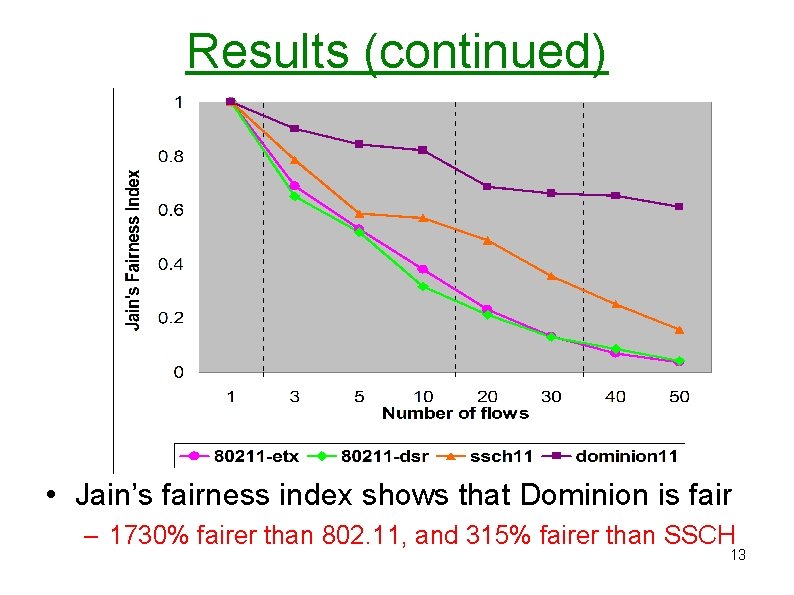
Results (continued) • Jain’s fairness index shows that Dominion is fair – 1730% fairer than 802. 11, and 315% fairer than SSCH 13
Conclusion • New cross-layer architecture – Dominion exploits k channels with only 1 radio – Eliminate locally opportunistic behavior • Simple MAC: deterministic schedule – Intelligence shifted upwards • Suitable for static, wireless mesh networks – Excels in non-disjoint multi-flow scenarios Distributed Protocols Research Group http: //kepler. cs. uiuc. edu/ 14
Questions 15
Future Work • Dynamic subnetwork assignment – Based on two-hop “neighborhood” • Extend the Graph-theoretic model – Optimize on end-to-end latency • TCP improvement – Multiple routes leads to out-of-order packets • Broadcast packets – Probabilistic approach – Allow efficient dissemination of link-state at run-time 16
Implementation • • Qual. Net v 3. 9 10 ms timeslots, 80 µs switching delay Source routing Per-flow, per-timeslot queuing – prevents head-of-line blocking • Warnings reduce buffer overflow at intermediate nodes • Attempts only 1 DCF transmission per packet at a time – Allows for on-time switching • A packet is dropped after 14 DCF failures – akin to two 802. 11 retries 17
Experiment Methodology • Implementation – Qual. Net v 3. 9 – 10 ms timeslots, 80 µs switching delay • 100 nodes, 1000 m x 1000 m – Uniform random placement – Random assignment of nodes to subnetworks • Bootstrap process: measure quality of each link – 802. 11 and SSCH: used to calculate static ETX routes – Dominion: network link-state • Results are average of 5 independent trials – Only 11 channels used (out of 12 for 802. 11 a) 18
Multi-Path Routing • Using Dijkstra, locate shortest route • Prune all connectivity edges in route – Reduces or eliminates inter-flow interference • Repeat: until no more routes found 19
Outline • • Motivation Related Work Dominion: Key Contributions Deterministic Scheduling Routing Intelligence Experimental Results Conclusion 20