
A Crash Course in Reinforcement Learning Oliver Schulte
- Slides: 19
A Crash Course in Reinforcement Learning Oliver Schulte Simon Fraser University
Outline • • • What is Reinforcement Learning? Key Definitions Key Learning Tasks Reinforcement Learning Techniques Reinforcement Learning with Neural Nets
Learning To Act • So far: learning to predict • Now: learn to act – In engineering: control theory – Economics, operations research: decision and game theory • Examples: – fly helicopter – drive car – play Go – play soccer
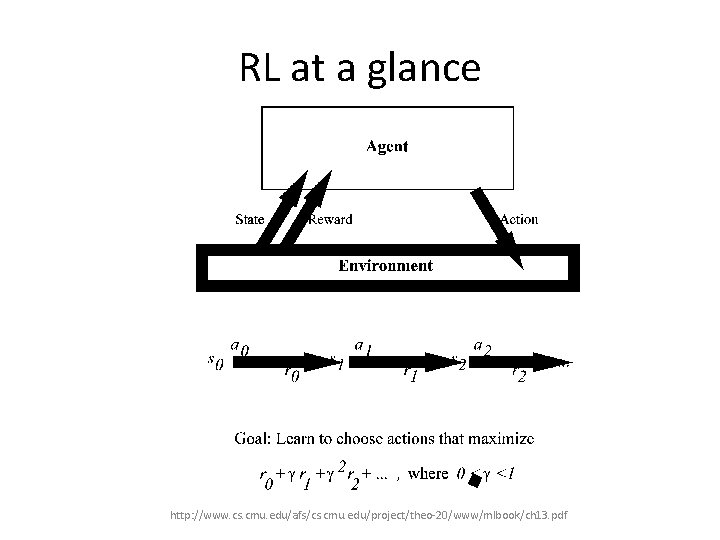
RL at a glance http: //www. cs. cmu. edu/afs/cs. cmu. edu/project/theo-20/www/mlbook/ch 13. pdf
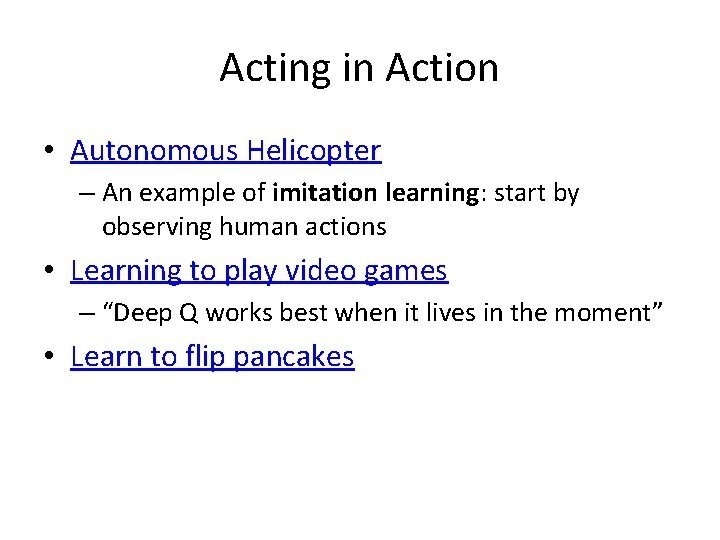
Acting in Action • Autonomous Helicopter – An example of imitation learning: start by observing human actions • Learning to play video games – “Deep Q works best when it lives in the moment” • Learn to flip pancakes
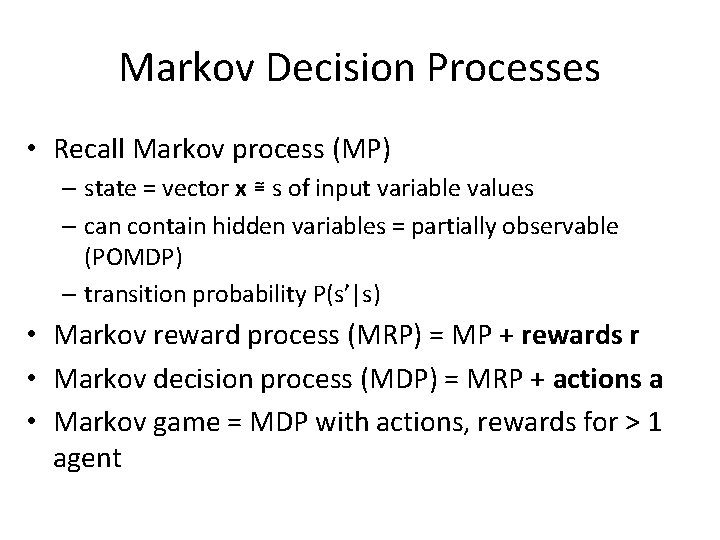
Markov Decision Processes • Recall Markov process (MP) – state = vector x ≅ s of input variable values – can contain hidden variables = partially observable (POMDP) – transition probability P(s’|s) • Markov reward process (MRP) = MP + rewards r • Markov decision process (MDP) = MRP + actions a • Markov game = MDP with actions, rewards for > 1 agent
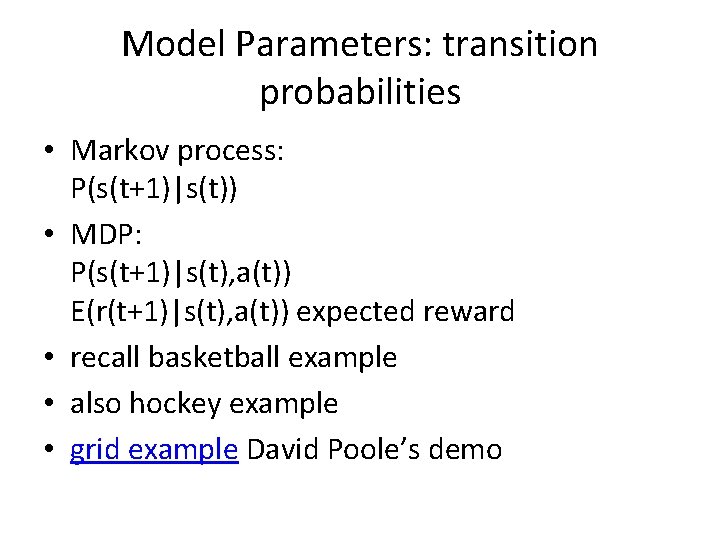
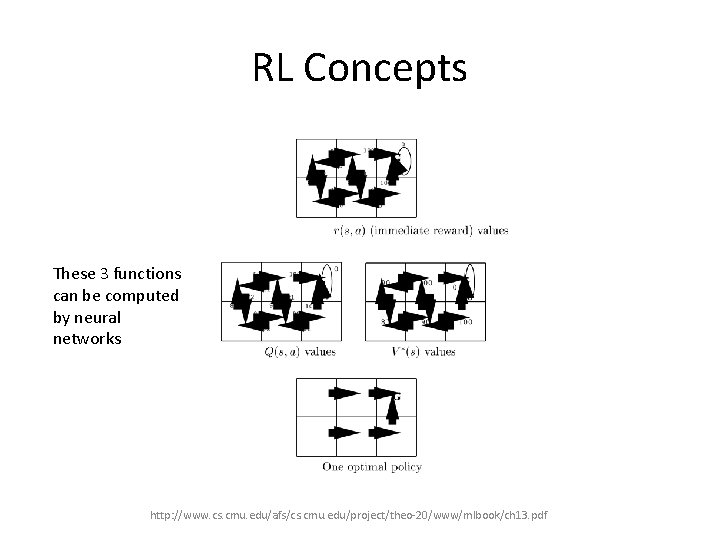
Model Parameters: transition probabilities • Markov process: P(s(t+1)|s(t)) • MDP: P(s(t+1)|s(t), a(t)) E(r(t+1)|s(t), a(t)) expected reward • recall basketball example • also hockey example • grid example David Poole’s demo
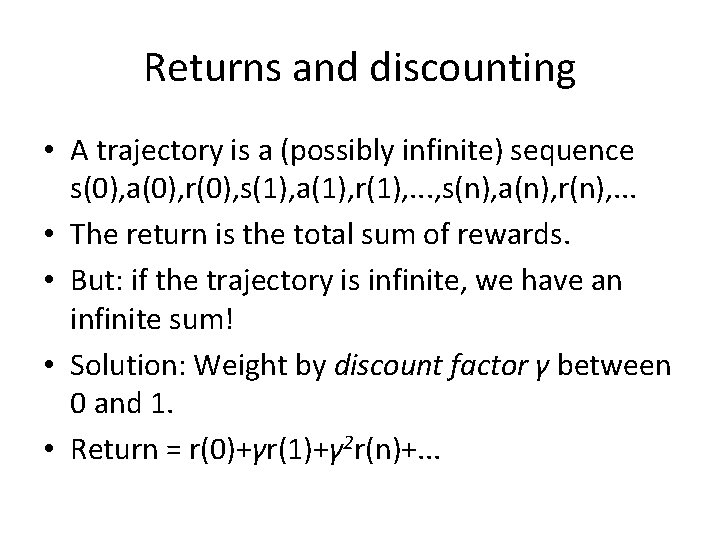
Returns and discounting • A trajectory is a (possibly infinite) sequence s(0), a(0), r(0), s(1), a(1), r(1), . . . , s(n), a(n), r(n), . . . • The return is the total sum of rewards. • But: if the trajectory is infinite, we have an infinite sum! • Solution: Weight by discount factor γ between 0 and 1. • Return = r(0)+γr(1)+γ 2 r(n)+. . .
RL Concepts These 3 functions can be computed by neural networks http: //www. cs. cmu. edu/afs/cs. cmu. edu/project/theo-20/www/mlbook/ch 13. pdf
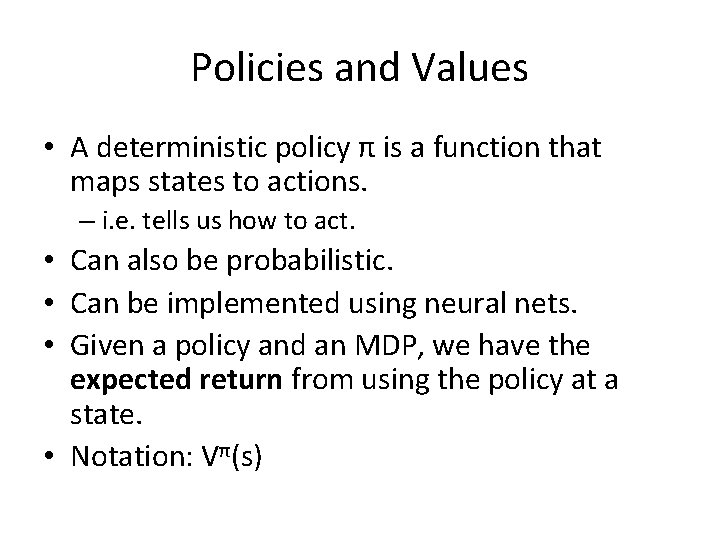
Policies and Values • A deterministic policy π is a function that maps states to actions. – i. e. tells us how to act. • Can also be probabilistic. • Can be implemented using neural nets. • Given a policy and an MDP, we have the expected return from using the policy at a state. • Notation: Vπ(s)
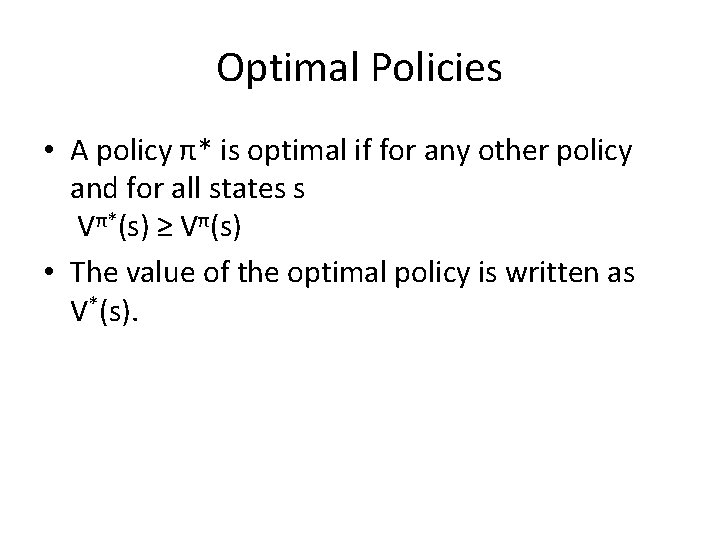
Optimal Policies • A policy π* is optimal if for any other policy and for all states s Vπ*(s) ≥ Vπ(s) • The value of the optimal policy is written as V*(s).
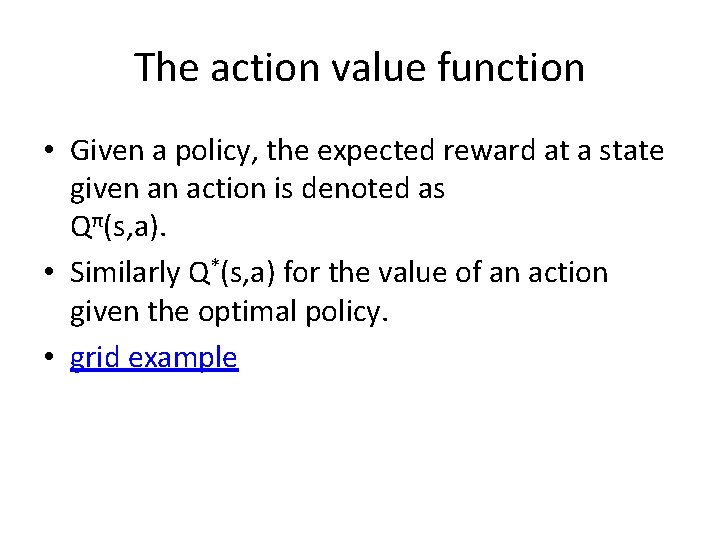
The action value function • Given a policy, the expected reward at a state given an action is denoted as Qπ(s, a). • Similarly Q*(s, a) for the value of an action given the optimal policy. • grid example
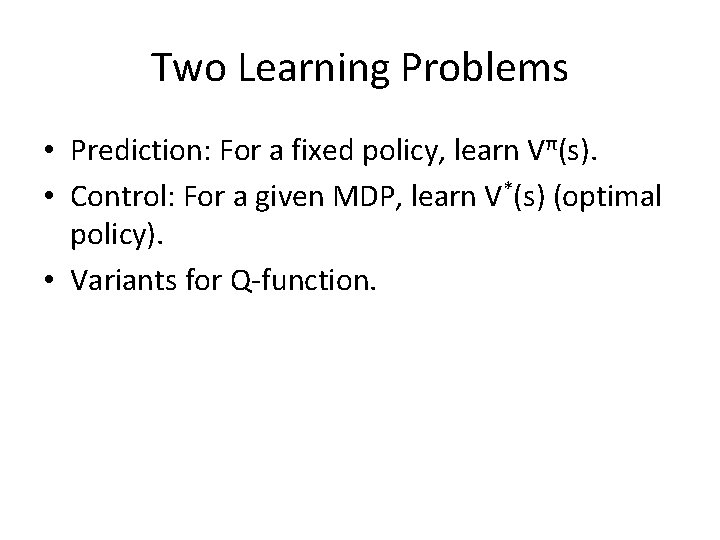
Two Learning Problems • Prediction: For a fixed policy, learn Vπ(s). • Control: For a given MDP, learn V*(s) (optimal policy). • Variants for Q-function.
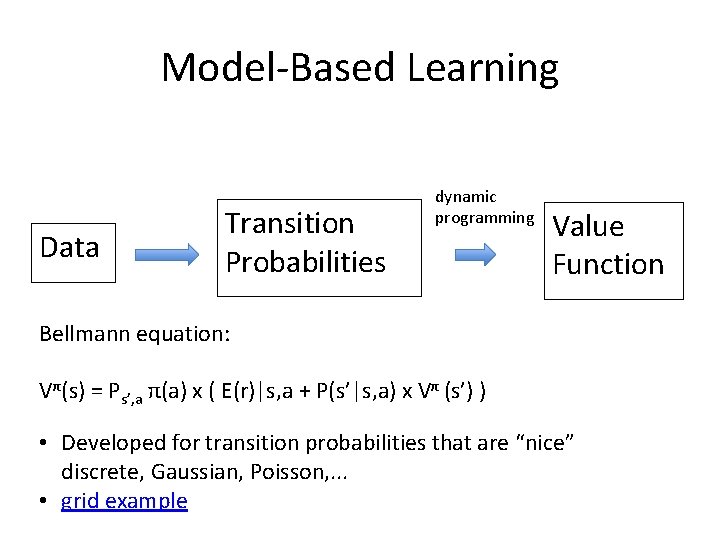
Model-Based Learning Data Transition Probabilities dynamic programming Value Function Bellmann equation: Vπ(s) = Ps’, a π(a) x ( E(r)|s, a + P(s’|s, a) x Vπ (s’) ) • Developed for transition probabilities that are “nice” discrete, Gaussian, Poisson, . . . • grid example
Model-free Learning • By-pass estimating transition probabilities • Why? Continuous state variables, no “nice” functional form. • (How about using LSTM/RNN dynamic model? deep dynamic programming? )
Model-free Learning • Directly learn optimal policy π* (policy iteration) • Directly learn optimal value function V*. • Directly learn optimal action-value function Q*. • All of these functions can be implemented in a neural network. Ø NN learning = reinforcement learning
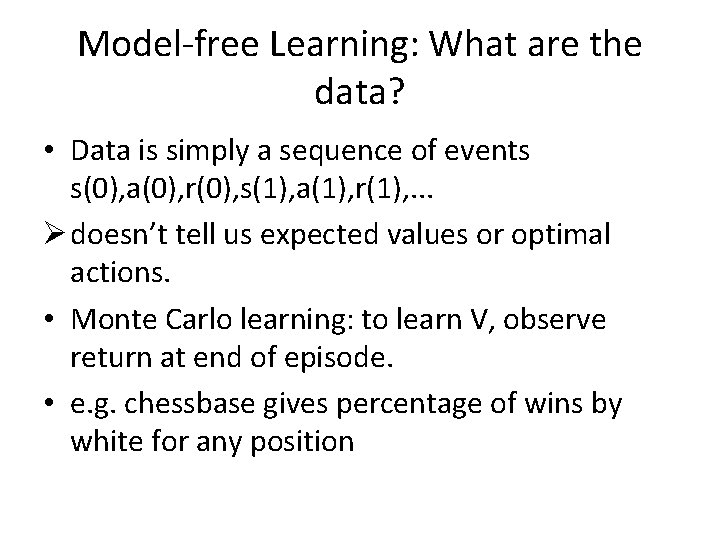
Model-free Learning: What are the data? • Data is simply a sequence of events s(0), a(0), r(0), s(1), a(1), r(1), . . . Ø doesn’t tell us expected values or optimal actions. • Monte Carlo learning: to learn V, observe return at end of episode. • e. g. chessbase gives percentage of wins by white for any position
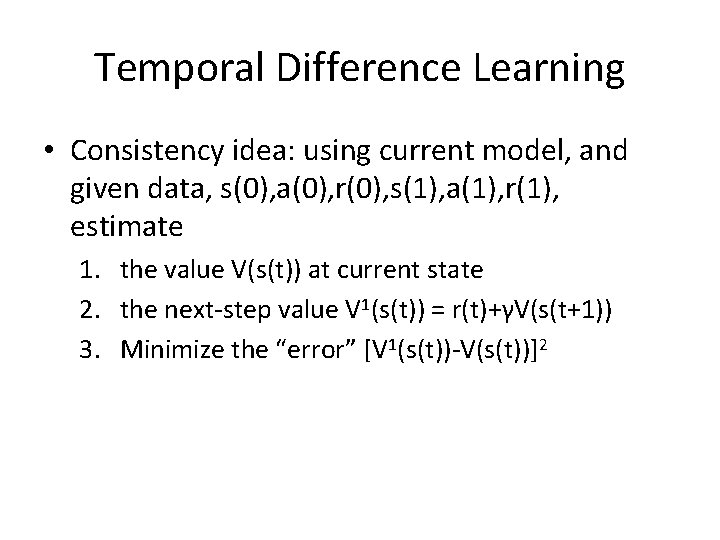
Temporal Difference Learning • Consistency idea: using current model, and given data, s(0), a(0), r(0), s(1), a(1), r(1), estimate 1. the value V(s(t)) at current state 2. the next-step value V 1(s(t)) = r(t)+γV(s(t+1)) 3. Minimize the “error” [V 1(s(t))-V(s(t))]2
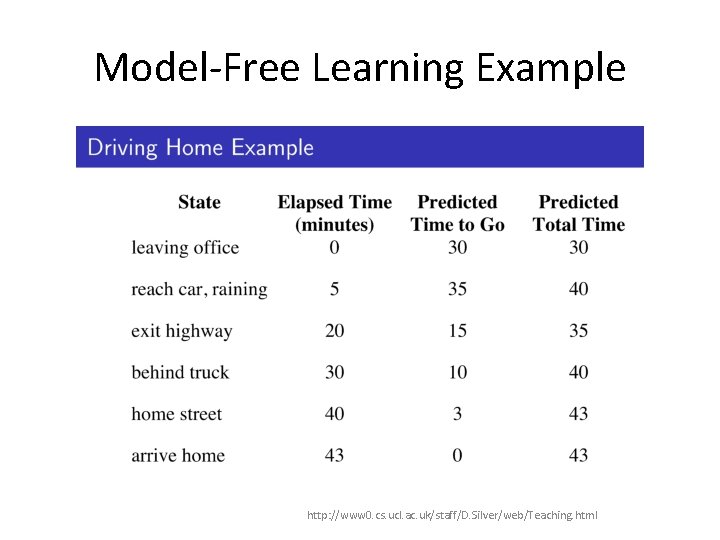
Model-Free Learning Example http: //www 0. cs. ucl. ac. uk/staff/D. Silver/web/Teaching. html