
A Course in English Language Teaching Unit 8































- Slides: 49
A Course in English Language Teaching Unit 8 Teaching vocabulary
Vocabulary is a weak area for many students, much “vocabulary instruction” ends up being handwriting practice. "Without grammar very little can be conveyed; without vocabulary nothing can be conveyed. " "When students travel, they don't carry grammar books, they carry dictionaries. ” Vocabulary teaching is an indispensable part of English curriculum.
I. The importance of vocabulary ●The singular importance of vocabulary has become a powerful insight to raise achievement. ● The words we know help us organize our learning. ● The creation of words is our tool for increasing learning. ● Vocabulary instruction should be a focal point of learning, especially for students impacted by poverty. ● Vocabulary instruction is an excellent advance organizer but also must be taught in context.
Introduction of This Unit To discuss how to teach vocabulary. Although vocabulary is usually integrated with the teaching of reading, we still consider it necessary to introduce ways to learn and consolidate vocabulary.
Teaching Content How to teach vocabulary ● What students need to know ● Presenting vocabulary ● Consolidating vocabulary ● Developing vocabulary building strategies ●
1. Introduction Vocabulary plays an important part in learning to read. Beginning readers must use the words they hear orally to make sense of the words they see in print. With 100, 000 words in the English language, teaching vocabulary can seem like a very daunting prospect. The average native speaker uses around only 5000 words in everyday speech. Your students won't need to produce every word they learn, some they will just need to recognize.
2. Ways for Teaching n n Teachers should choose proper ways to instruct words. Many teachers often write new words they want to teach on the blackboard, then explain them one by one. The way is easy for teachers to teach, while it isn't interesting for students to learn.It makes students feel bored. Selecting what to teach, based on frequency and usefulness to the needs of your particular students is therefore essential.
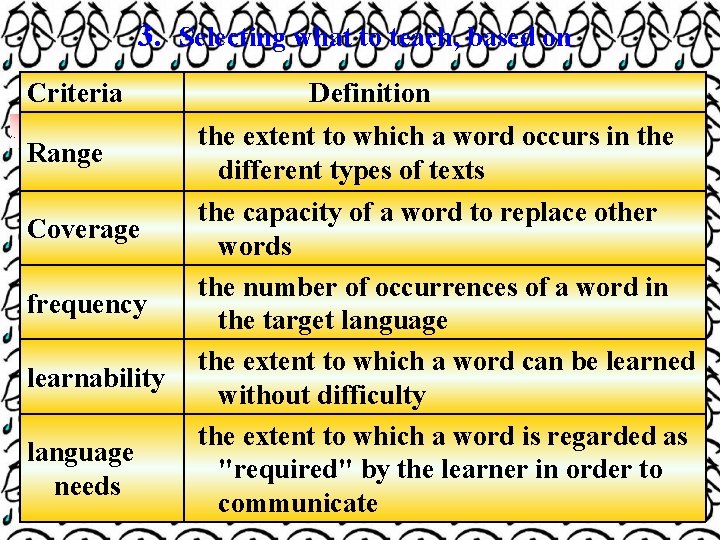
3. Selecting what to teach, based on Criteria Range Coverage frequency learnability language needs Definition the extent to which a word occurs in the different types of texts the capacity of a word to replace other words the number of occurrences of a word in the target language the extent to which a word can be learned without difficulty the extent to which a word is regarded as "required" by the learner in order to communicate
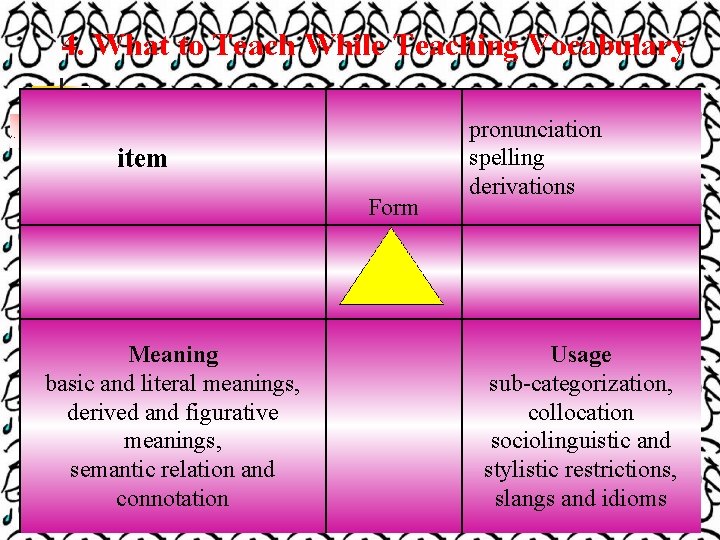
4. What to Teach While Teaching Vocabulary item Form Meaning basic and literal meanings, derived and figurative meanings, semantic relation and connotation pronunciation spelling derivations Usage sub-categorization, collocation sociolinguistic and stylistic restrictions, slangs and idioms
II. How To Teach Vocabulary 1. The most effective way is teaching vocabulary IN CONTEXT. There are two advantages: 1) students remember the words better. 2) students see HOW the words are used. 2. Use all kinds of stories: children's stories, news stories, jokes, magazine articles. 3. Teaching by using word-formation:
4. Model the activities first. 5. Keep an ongoing list prominently posted. 6. Go beyond the definitions of the words. 7. Most work with vocabulary should be done with the meanings available. 8. Incorporate multisensory learning from the beginning. 9. Have structure and organization behind the words you present.
n 10. offering words which have the same semantic field of function. n 11. offering different parts of speech. n 12. making sentences. n n n 13. asking students to read additional English articles. 14. learning texts in English textbooks. 15. listening to the tapes for English textbooks
III. What a student may need to know ? 1. Item-----What it means n It is vital to get across the meaning of the item clearly and to ensure that your students have understood correctly with checking questions.
2. The form Words can be classified into many parts of speech: noun, verb, adjective, adverb and so on. Students need to know what form it is to be able to use it effectively. For example, water (n. )— water (v. )
3. How it is pronounced This can be particularly problematic for learners of English because there is often no clear relation between how a word is written and how it is pronounced. It is very important to use the phonemic script in such cases so the Ss have a clear written record of the pronunciation. Don't forget also to drill words that you think will cause pronunciation problems for your students and highlight the word stresses.
4. How it is spelt This is always difficult in English teaching. Remember to clarify the pronunciation before showing the written form.
5. The connotations that the item may have Bachelor is a neutral /positive word whereas spinster conjures a more negative image.
6. The situations when the word is or is not used Is it formal/neutral/informal? ----spectacles/glasses/specs. Is it used mainly in speech or in writing? -----To sum up is usually written whereas mind you is spoken. Is it outdated? -----Wireless instead of radio.
7. How the word is related to others Synonyms---- words different in sound and spelling but most nearly alike or exactly the same in meaning. There are two kinds of synonyms. (1) Absolute synonyms; (2) Relative synonyms. Antonyms--- words which are opposite in meaning. They can be classified into three major groups. (1) Contradictory terms; (2) Contrary terms; (3) Relative terms. lexical sets---words that belong to a particular group. (1) Semantic group; (2) Syntactical group; (3) Functional group.
8. Collocation or the way that words occur together You describe things ‘in great detail’ not ‘in big detail’, and to ask a question you ‘raise your hand’, you don't 'lift your hand'. It is important to highlight this to students to prevent mistakes in usage later.
9. What the affixes may indicate about the meaning? (the prefixes and suffixes) Prefixes --- change the meanings of roots. (1) Negative prefixes:dis-, non- un-. (2) Prefixes of degree or size:micro-, over-, under-. Suffixes---change the grammatical function of roots. (1) noun suffixes: -er, -ese, -tion. (2) verb suffixes: -fy, -ize. (3) adverb suffixes: -ly, -wards. (4) Adjective suffixes:-able, -al, -ful, -y. This is particularly useful at a higher level.
Which of these areas you choose to highlight will depend on the item you are teaching and the level of your students. Now it's time to think about how to present vocabulary.
IV. Ways to present vocabulary n There are lots of ways of getting across the meaning of a lexical item.
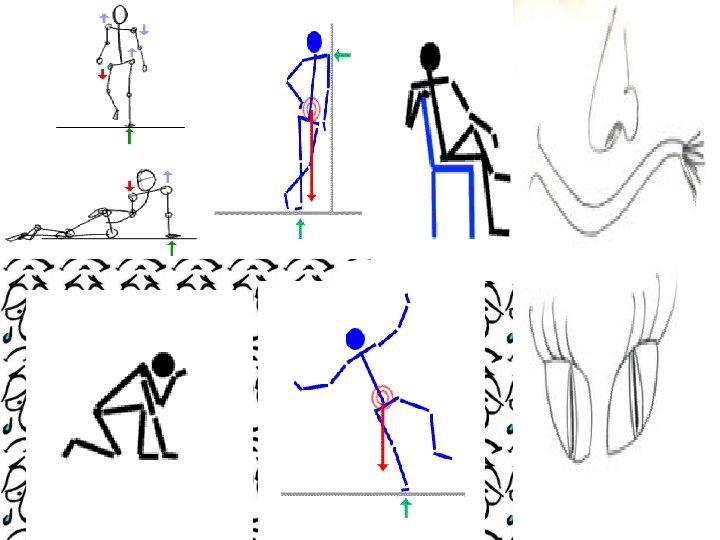
Ways to present vocabulary n 1. Presenting vocabularies by stick drawings, models, slides, films, videotapes, radios and TVs.
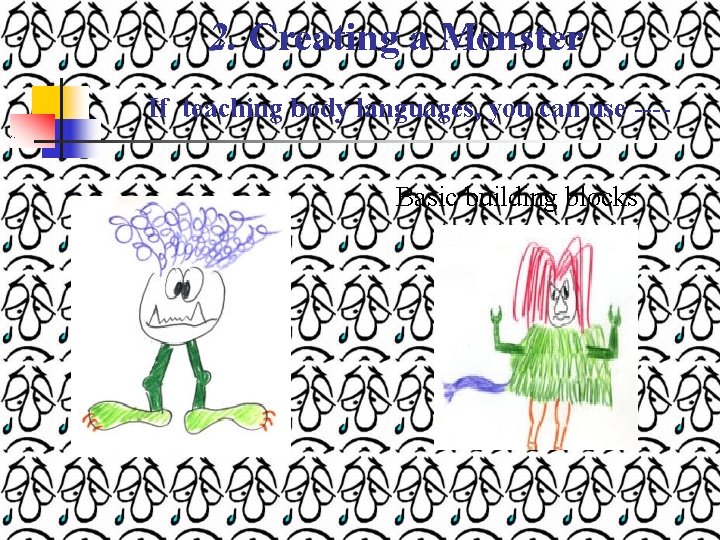
2. Creating a Monster If teaching body languages, you can use ---Basic building blocks
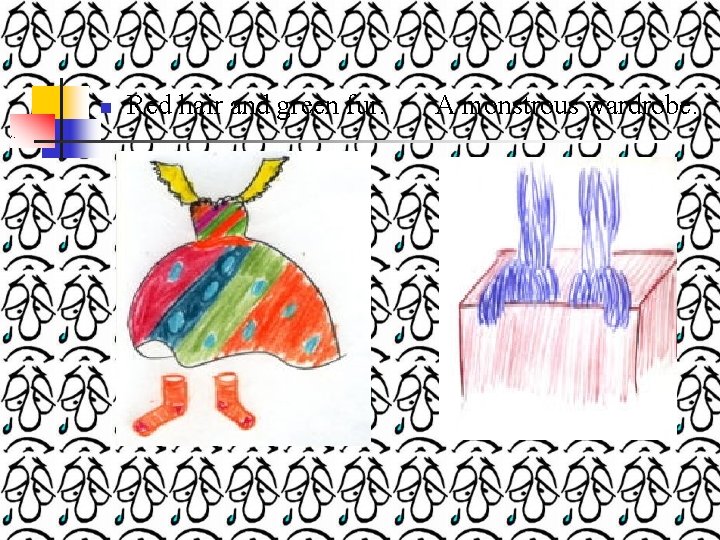
n Red hair and green fur. A monstrous wardrobe.
Do you know where your monster is? Five eyes and two fangs. Two claws.
n 3. Illustration This is very useful for more concrete words (dog, rain, tall) and for visual learners. It has its limits though, not all items can be drawn. n 4. Mime This lends itself particularly well to action verbs and it can be fun and memorable. n 5. Synonyms/Antonyms/Gradable items Using the words the students already know can be effective for getting meaning across.
n n n 6. Definition Make sure that it is clear (maybe check in a learner dictionary) before the lesson if you are not confident. Remember to ask questions to check they have understood properly. 7. Translation If you know the students' L 1, then it is fast and efficient. Remember that not every word has a direct translation. 8. Context Think of a clear context when the word is used and either describe it to the students or give them example sentences to clarify meaning further.
n Again which you choose will depend on the item you are presenting. Some are more suitable for particular words. Often a combination of techniques can be both helpful and memorable
VI. Consolidating vocabulary n n n n 1. Labeling; 2. Spot the differences; 3. Describe and draw; 4. Play a game; 5. Use a word thermometers; 6. Use word series; 7. Word bingo; 8. Word association; 9. Odd man out; 10. Synonyms and antonyms; 11. Using word categories; 12. Using word net-work. 13. Using the internet resources for more ideas
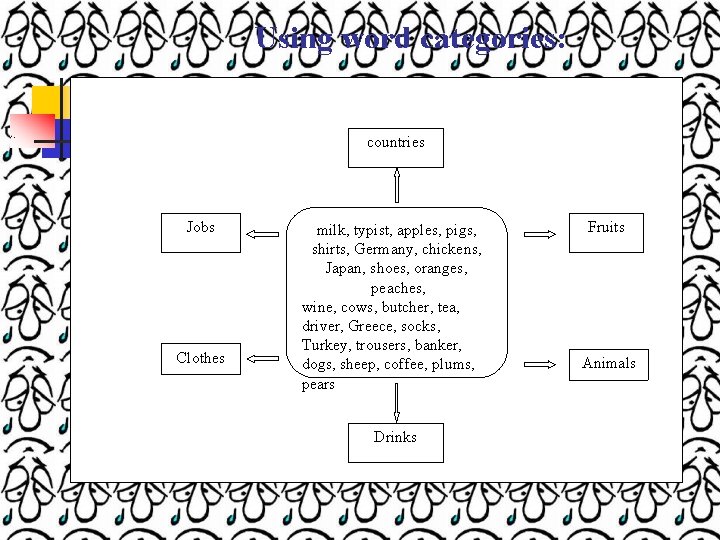
Using word categories: countries Jobs Clothes milk, typist, apples, pigs, shirts, Germany, chickens, Japan, shoes, oranges, peaches, wine, cows, butcher, tea, driver, Greece, socks, Turkey, trousers, banker, dogs, sheep, coffee, plums, pears Drinks Fruits Animals
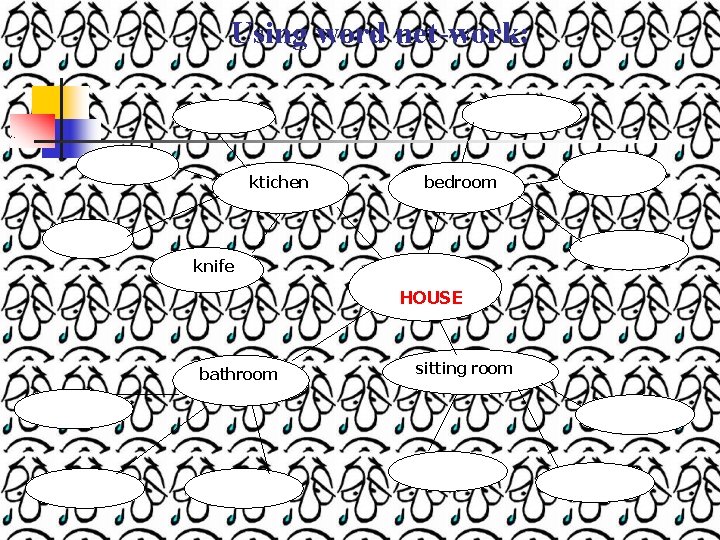
Using word net-work: ktichen bedroom knife HOUSE bathroom sitting room
VII. Developing vocabulary building strategies n n n 1. Review regularly 2. Guess meaning from context 1) synonyms or antonyms in the context 2) reference words 3) collocations between words 3. Organize vocabulary effectively 1) images and associations 2) grouping (semantic meaning, use, collocation, synonyms) 4. Use a dictionary 5. Manage strategy use 6. Use learned vocabulary
VIII. Alternative ways of teaching vocabulary n n 1. Give your students a few items of vocabulary and tell them to find the meaning, pronunciation and write an example sentence with the word in. They can then teach other in groups. 2. Prepare worksheets and ask your students to match words to definitions. 3. Ask students to classify a group of words into different categories. For example, a list of transport words into air/sea/land. 4. Ask students to find new vocabulary from reading homework and teach the other students in the class.
IX. Other things to consider n n n 1. Review the vocabulary you teach through a game or activity and encourage your students to do the same at home. 2. Encourage autonomy in your learners. Tell them to read, watch films, listen to songs etc. and note the useful words. 3. Have a section of your board for vocabulary items that come up as you are teaching. Use different colors for the word / the phonemics / the prepositions / the part of speech.
Riddle
We’re the winner. Climbing the ladder
Pass the picture and repeat the word
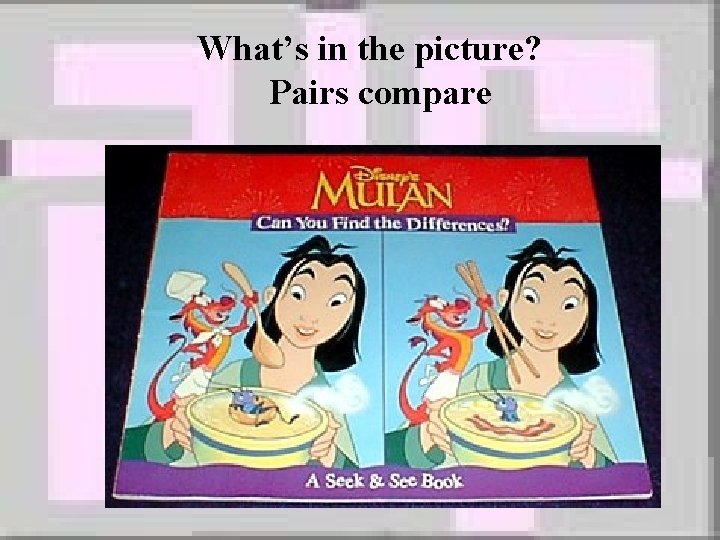
What’s in the picture? Pairs compare
Picture A Picture B
Using a rhyme One potato, two potatoes, three potatoes, four; Five potatoes, six potatoes, seven potatoes, more.
4. It is a good idea to teach/learn words with associated meanings together. n n n 5. Encourage your students to purchase a good dictionary and use class time to highlight the benefits of one. 6. Teach your students the grammatical names for the parts of speech and the phonemic script. 7. Always keep a good dictionary by your side in case a student asks about a word you don't know.
n n 8. If you don't and have never heard of the word, tell the student you will check and get back to them. Do get back to them 9. Give extra example sentences to the students if they are unsure and encourage them to write the word in an example sentence (maybe for homework)
Vocabulary teaching is not an isolated activity. Vocabulary teaching is also a cooperation The purpose of English vocabulary teaching is to help students develop the abilities of using English for communication and of acquiring knowledge in the future.
Questions: n n n 1. What do students need to know about vocabulary? 2. How to present new words (real life practice)? 3. Many Ss today seem to believe that vocabulary learning is the most important thing when one is learning English. Do you agree? What is your view of the relationship between the three components?