
A COREM I C TRU math Deep Dive


- Slides: 61
A CORE/M. I. C. TRU math “Deep Dive” Harold Asturias Phil Daro David Foster Alan Schoenfeld
The Goal: Building Classrooms that Produce Students who are Powerful Mathematical Thinkers
Our Marching Orders Explain TRU, with a deep dive on TRU dimension 4 (Agency, Authority and Identity) Work with TRU tools, including the classroom observation rubric Provide you with things you can take back home (Compare and contrast TRU with other perspectives & tools: 5 x 8, MQI, CEL’s 5 D + Teacher Eval Rubric, Danielson’s Ff. T, 8 Teaching Practices from “Principles to Action”)
One of our goals is to get us all on the same page, with the same tools. We know that many of you have seen some of these things in various contexts… So in the words of PDQ Bach… Prepare to hear some things you’ve heard before. . .
How can we think about what really matters in math classrooms?
Can we identify a manageable number of things to focus on… So that if these go well in a classroom, the students will be really good at math?
You’re about to meet the Teaching for Robust Understanding of Mathematics (TRU Math) Framework
What’s a framework?
It’s much more than a set of tools. It’s a way of thinking, seeing, and focusing on what counts – with tools that help you get better at those things.
So today we’re going to work on developing a shared vision and then look at some tools that can help make progress toward it.
Today’s Agenda 1. Look at 2 “bookend” videos, to develop a framework for talking about what counts. 2. Look at 2 videos of representative practice and teacher growth, using the framework (and a bonus video). 3. Discuss some additional tools, and how they might be used for ongoing improvement.
So… What really matters in classrooms?
Part 1: Developing the Framework Let’s look at 2 videos and discuss what we see in them.
Tape 1: The TIMSS Geometry Video This is a typical U. S. lesson about finding the values of complementary, supplementary, and vertical angles.
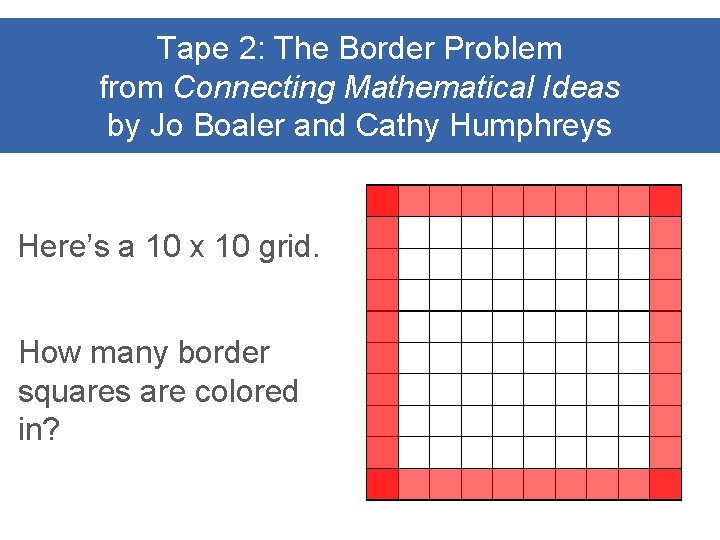
Tape 2: The Border Problem from Connecting Mathematical Ideas by Jo Boaler and Cathy Humphreys Here’s a 10 x 10 grid. How many border squares are colored in?
Let’s talk about what you saw in each of the videos. Feel free to compare and contrast – but make sure to focus on what the experience looks like from the point of view of the students.
Now, let me see if we can organize what we’ve just discussed in a way that makes it easier to focus on what happened.
Here are the key dimensions of the Teaching for Robust Understanding of Mathematics (TRUMath) Framework.
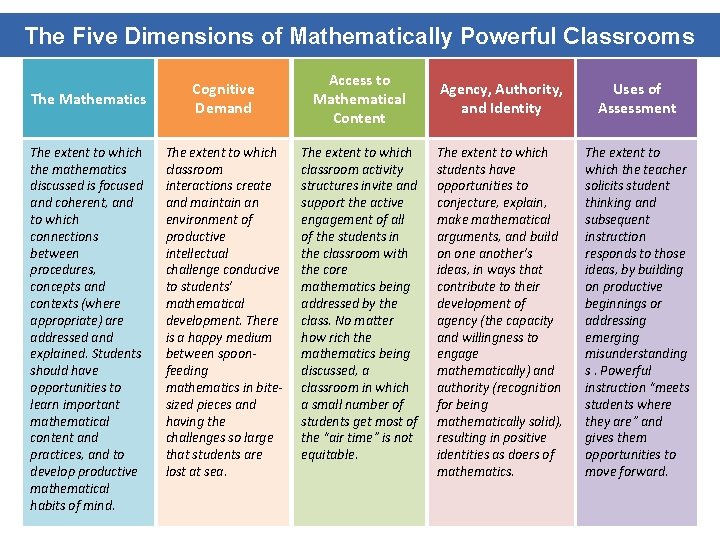
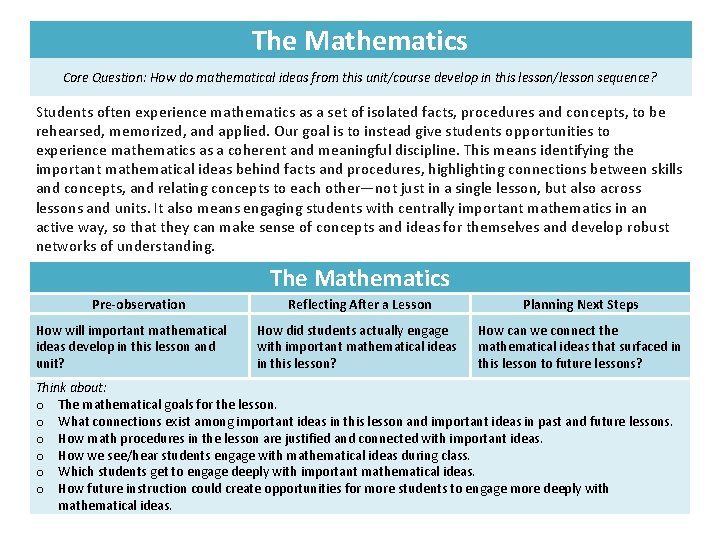
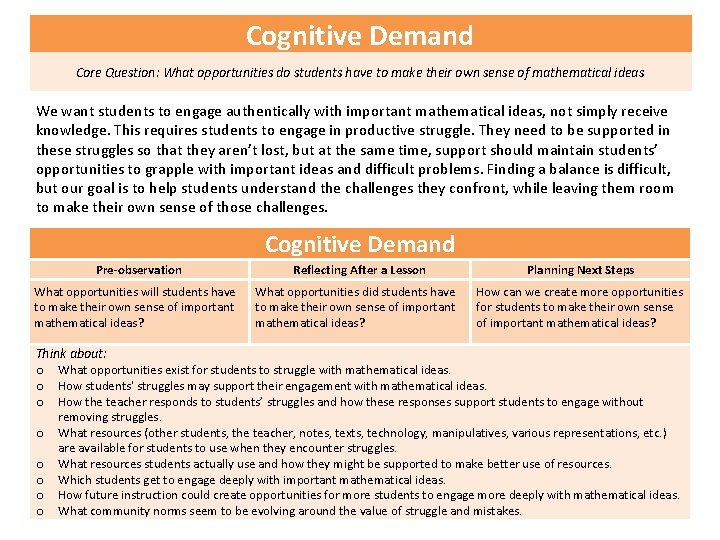
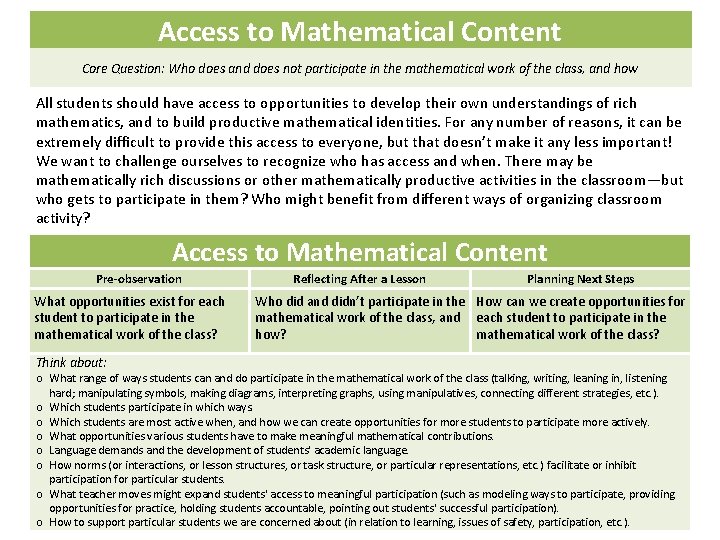
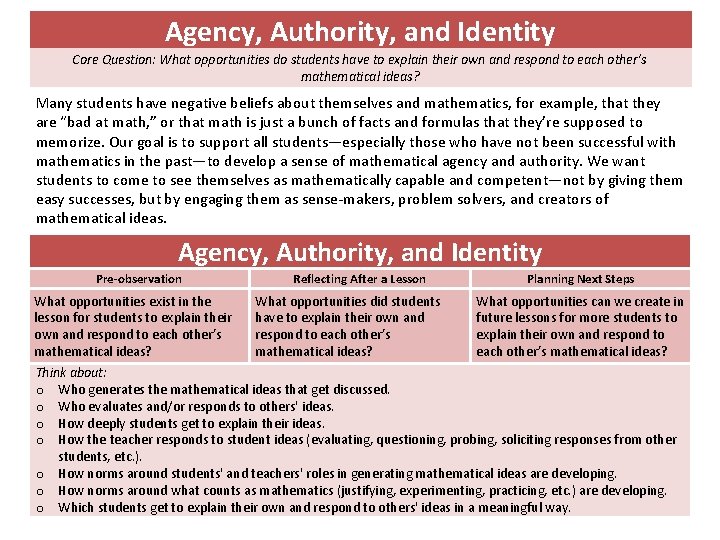
The Five Dimensions of Mathematically Powerful Classrooms The Mathematics The extent to which the mathematics discussed is focused and coherent, and to which connections between procedures, concepts and contexts (where appropriate) are addressed and explained. Students should have opportunities to learn important mathematical content and practices, and to develop productive mathematical habits of mind. Cognitive Demand The extent to which classroom interactions create and maintain an environment of productive intellectual challenge conducive to students’ mathematical development. There is a happy medium between spoonfeeding mathematics in bitesized pieces and having the challenges so large that students are lost at sea. Access to Mathematical Content The extent to which classroom activity structures invite and support the active engagement of all of the students in the classroom with the core mathematics being addressed by the class. No matter how rich the mathematics being discussed, a classroom in which a small number of students get most of the “air time” is not equitable. Agency, Authority, and Identity Uses of Assessment The extent to which students have opportunities to conjecture, explain, make mathematical arguments, and build on one another’s ideas, in ways that contribute to their development of agency (the capacity and willingness to engage mathematically) and authority (recognition for being mathematically solid), resulting in positive identities as doers of mathematics. The extent to which the teacher solicits student thinking and subsequent instruction responds to those ideas, by building on productive beginnings or addressing emerging misunderstanding s. Powerful instruction “meets students where they are” and gives them opportunities to move forward.
You Asked: What’s New, What’s Different?
What’s New? In a sense, nothing.
That is, You should recognize and resonate to everything in TRU. It captures what we know is important. It doesn’t offer any “magic bullets” or surprises.
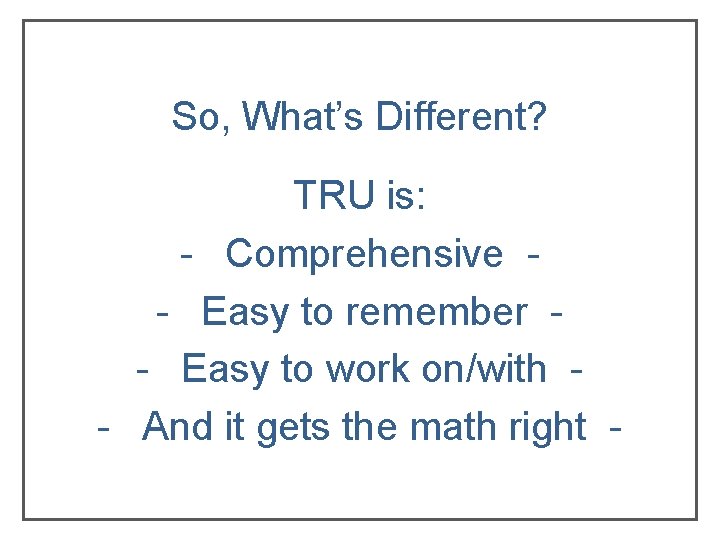
So, What’s Different? TRU is: - Comprehensive - Easy to remember - Easy to work on/with - And it gets the math right -
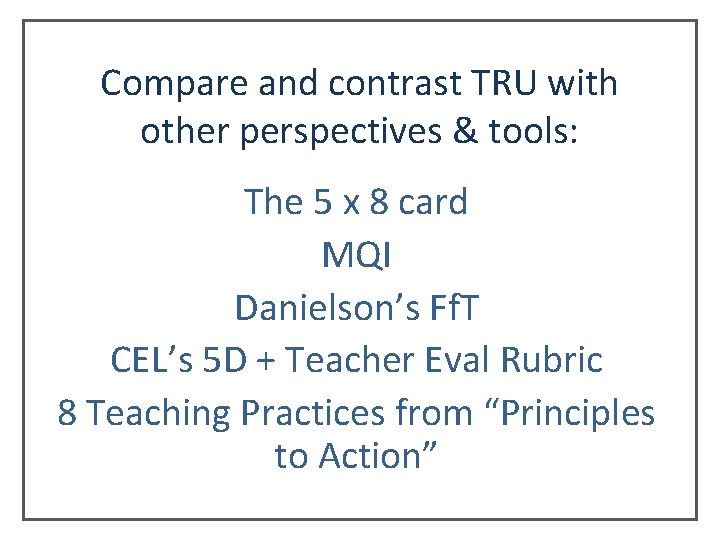
Compare and contrast TRU with other perspectives & tools: The 5 x 8 card MQI Danielson’s Ff. T CEL’s 5 D + Teacher Eval Rubric 8 Teaching Practices from “Principles to Action”
I want to introduce some tools, then look at some more videos. (That’s where we do the deep dive. )
A Tool for Reflecting on Teaching The TRU Math Conversation Guide is designed to help teachers, coaches, and Professional Learning Communities (PLCs) work on each of the 5 dimensions in some depth. The goal is to support planning and reflection.
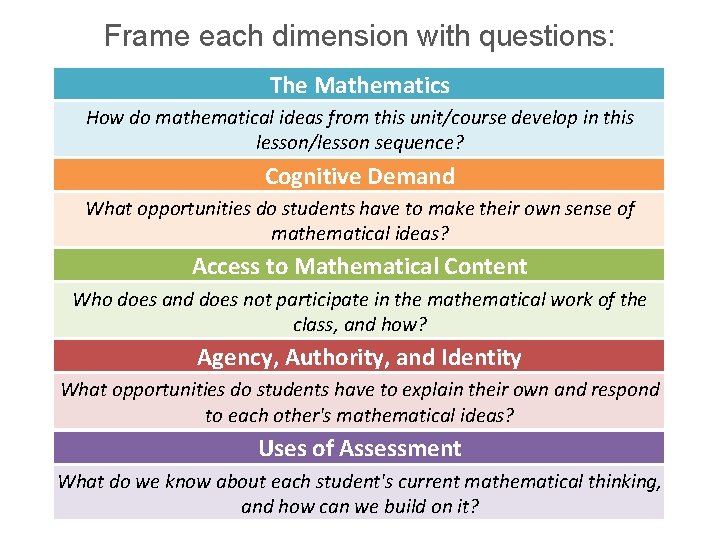
Frame each dimension with questions: The Mathematics How do mathematical ideas from this unit/course develop in this lesson/lesson sequence? Cognitive Demand What opportunities do students have to make their own sense of mathematical ideas? Access to Mathematical Content Who does and does not participate in the mathematical work of the class, and how? Agency, Authority, and Identity What opportunities do students have to explain their own and respond to each other's mathematical ideas? Uses of Assessment What do we know about each student's current mathematical thinking, and how can we build on it?
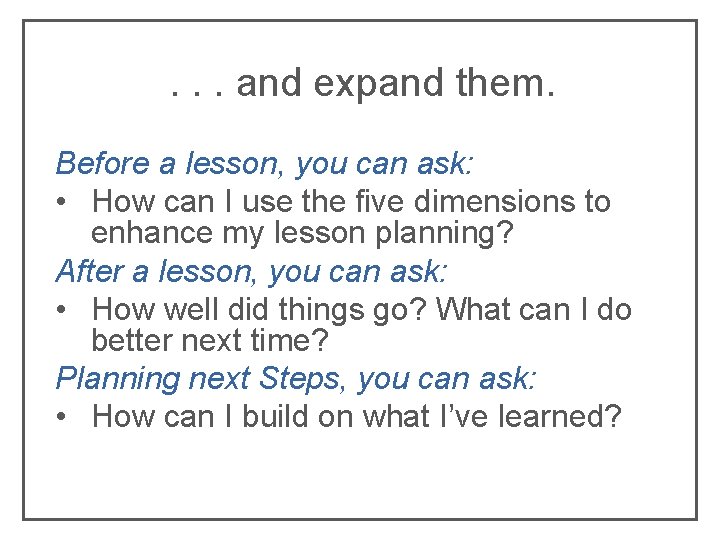
. . . and expand them. Before a lesson, you can ask: • How can I use the five dimensions to enhance my lesson planning? After a lesson, you can ask: • How well did things go? What can I do better next time? Planning next Steps, you can ask: • How can I build on what I’ve learned?
The Mathematics Core Question: How do mathematical ideas from this unit/course develop in this lesson/lesson sequence? Students often experience mathematics as a set of isolated facts, procedures and concepts, to be rehearsed, memorized, and applied. Our goal is to instead give students opportunities to experience mathematics as a coherent and meaningful discipline. This means identifying the important mathematical ideas behind facts and procedures, highlighting connections between skills and concepts, and relating concepts to each other—not just in a single lesson, but also across lessons and units. It also means engaging students with centrally important mathematics in an active way, so that they can make sense of concepts and ideas for themselves and develop robust networks of understanding. The Mathematics Pre-observation How will important mathematical ideas develop in this lesson and unit? Reflecting After a Lesson Planning Next Steps How did students actually engage with important mathematical ideas in this lesson? How can we connect the mathematical ideas that surfaced in this lesson to future lessons? Think about: o The mathematical goals for the lesson. o What connections exist among important ideas in this lesson and important ideas in past and future lessons. o How math procedures in the lesson are justified and connected with important ideas. o How we see/hear students engage with mathematical ideas during class. o Which students get to engage deeply with important mathematical ideas. o How future instruction could create opportunities for more students to engage more deeply with mathematical ideas.
Cognitive Demand Core Question: What opportunities do students have to make their own sense of mathematical ideas We want students to engage authentically with important mathematical ideas, not simply receive knowledge. This requires students to engage in productive struggle. They need to be supported in these struggles so that they aren’t lost, but at the same time, support should maintain students’ opportunities to grapple with important ideas and difficult problems. Finding a balance is difficult, but our goal is to help students understand the challenges they confront, while leaving them room to make their own sense of those challenges. Cognitive Demand Pre-observation Reflecting After a Lesson Planning Next Steps What opportunities will students have to make their own sense of important mathematical ideas? What opportunities did students have to make their own sense of important mathematical ideas? How can we create more opportunities for students to make their own sense of important mathematical ideas? Think about: o What opportunities exist for students to struggle with mathematical ideas. o How students' struggles may support their engagement with mathematical ideas. o How the teacher responds to students’ struggles and how these responses support students to engage without o o o removing struggles. What resources (other students, the teacher, notes, texts, technology, manipulatives, various representations, etc. ) are available for students to use when they encounter struggles. What resources students actually use and how they might be supported to make better use of resources. Which students get to engage deeply with important mathematical ideas. How future instruction could create opportunities for more students to engage more deeply with mathematical ideas. What community norms seem to be evolving around the value of struggle and mistakes.
Access to Mathematical Content Core Question: Who does and does not participate in the mathematical work of the class, and how All students should have access to opportunities to develop their own understandings of rich mathematics, and to build productive mathematical identities. For any number of reasons, it can be extremely difficult to provide this access to everyone, but that doesn’t make it any less important! We want to challenge ourselves to recognize who has access and when. There may be mathematically rich discussions or other mathematically productive activities in the classroom—but who gets to participate in them? Who might benefit from different ways of organizing classroom activity? Access to Mathematical Content Pre-observation What opportunities exist for each student to participate in the mathematical work of the class? Think about: Reflecting After a Lesson Planning Next Steps Who did and didn’t participate in the How can we create opportunities for mathematical work of the class, and each student to participate in the how? mathematical work of the class? o What range of ways students can and do participate in the mathematical work of the class (talking, writing, leaning in, listening hard; manipulating symbols, making diagrams, interpreting graphs, using manipulatives, connecting different strategies, etc. ). o Which students participate in which ways. o Which students are most active when, and how we can create opportunities for more students to participate more actively. o What opportunities various students have to make meaningful mathematical contributions. o Language demands and the development of students' academic language. o How norms (or interactions, or lesson structures, or task structure, or particular representations, etc. ) facilitate or inhibit participation for particular students. o What teacher moves might expand students' access to meaningful participation (such as modeling ways to participate, providing opportunities for practice, holding students accountable, pointing out students' successful participation). o How to support particular students we are concerned about (in relation to learning, issues of safety, participation, etc. ).
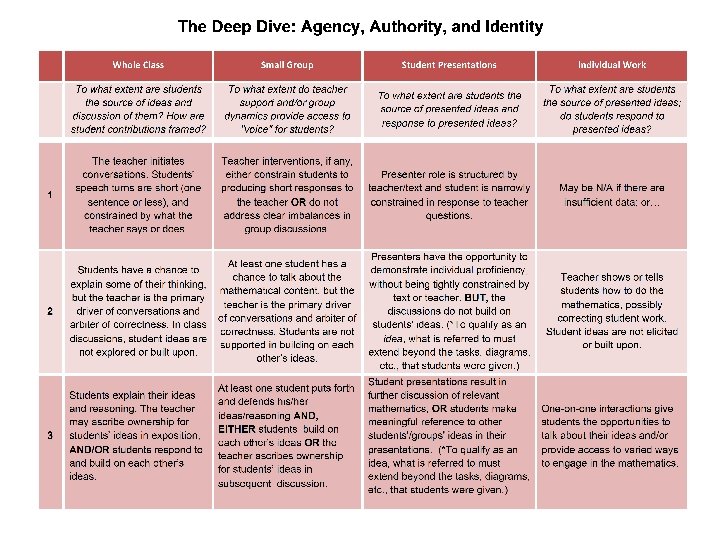
Agency, Authority, and Identity Core Question: What opportunities do students have to explain their own and respond to each other’s mathematical ideas? Many students have negative beliefs about themselves and mathematics, for example, that they are “bad at math, ” or that math is just a bunch of facts and formulas that they’re supposed to memorize. Our goal is to support all students—especially those who have not been successful with mathematics in the past—to develop a sense of mathematical agency and authority. We want students to come to see themselves as mathematically capable and competent—not by giving them easy successes, but by engaging them as sense-makers, problem solvers, and creators of mathematical ideas. Agency, Authority, and Identity Pre-observation What opportunities exist in the lesson for students to explain their own and respond to each other’s mathematical ideas? Reflecting After a Lesson What opportunities did students have to explain their own and respond to each other’s mathematical ideas? Planning Next Steps What opportunities can we create in future lessons for more students to explain their own and respond to each other’s mathematical ideas? Think about: o Who generates the mathematical ideas that get discussed. o Who evaluates and/or responds to others' ideas. o How deeply students get to explain their ideas. o How the teacher responds to student ideas (evaluating, questioning, probing, soliciting responses from other students, etc. ). o How norms around students' and teachers' roles in generating mathematical ideas are developing. o How norms around what counts as mathematics (justifying, experimenting, practicing, etc. ) are developing. o Which students get to explain their own and respond to others' ideas in a meaningful way.
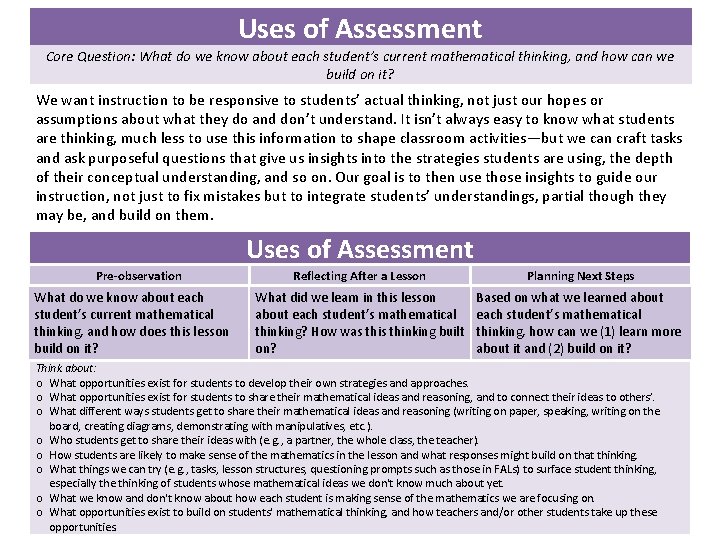
Uses of Assessment Core Question: What do we know about each student’s current mathematical thinking, and how can we build on it? We want instruction to be responsive to students’ actual thinking, not just our hopes or assumptions about what they do and don’t understand. It isn’t always easy to know what students are thinking, much less to use this information to shape classroom activities—but we can craft tasks and ask purposeful questions that give us insights into the strategies students are using, the depth of their conceptual understanding, and so on. Our goal is to then use those insights to guide our instruction, not just to fix mistakes but to integrate students’ understandings, partial though they may be, and build on them. Uses of Assessment Pre-observation What do we know about each student’s current mathematical thinking, and how does this lesson build on it? Reflecting After a Lesson Planning Next Steps What did we learn in this lesson about each student’s mathematical thinking? How was thinking built on? Based on what we learned about each student’s mathematical thinking, how can we (1) learn more about it and (2) build on it? Think about: o What opportunities exist for students to develop their own strategies and approaches. o What opportunities exist for students to share their mathematical ideas and reasoning, and to connect their ideas to others’. o What different ways students get to share their mathematical ideas and reasoning (writing on paper, speaking, writing on the board, creating diagrams, demonstrating with manipulatives, etc. ). o Who students get to share their ideas with (e. g. , a partner, the whole class, the teacher). o How students are likely to make sense of the mathematics in the lesson and what responses might build on that thinking. o What things we can try (e. g. , tasks, lesson structures, questioning prompts such as those in FALs) to surface student thinking, especially the thinking of students whose mathematical ideas we don't know much about yet. o What we know and don't know about how each student is making sense of the mathematics we are focusing on. o What opportunities exist to build on students' mathematical thinking, and how teachers and/or other students take up these opportunities.
Although they can be used by individuals, in the best of all possible worlds the conversation guide and other TRU tools are intended for use in professional learning communities. Imagine teachers and coaches planning together, watching each other teach, and debriefing using these ideas. We have plans for building this kind of practice in partnership with OUSD. Ask me for details later.
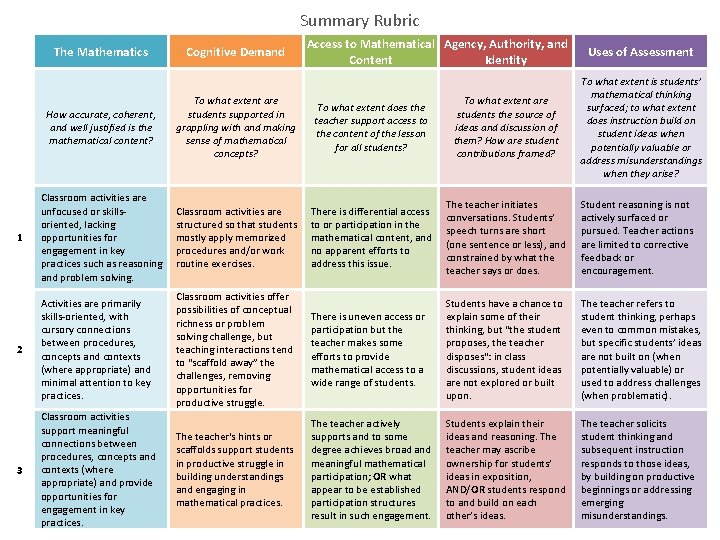
A Tool to Capture Classroom Practice The TRU Math Classroom Observation Rubric was designed to capture the richness of classroom interactions along the five dimensions in the TRU Math framework. It can help to locate where a teacher’s current practices are, and identify where to go next. (It lays out a developmental trajectory along the 5 dimensions of TRU).
Summary Rubric The Mathematics Cognitive Demand Access to Mathematical Agency, Authority, and Content Identity Uses of Assessment How accurate, coherent, and well justified is the mathematical content? To what extent are students supported in grappling with and making sense of mathematical concepts? To what extent does the teacher support access to the content of the lesson for all students? To what extent are students the source of ideas and discussion of them? How are student contributions framed? To what extent is students’ mathematical thinking surfaced; to what extent does instruction build on student ideas when potentially valuable or address misunderstandings when they arise? 1 Classroom activities are unfocused or skillsoriented, lacking opportunities for engagement in key practices such as reasoning and problem solving. Classroom activities are structured so that students mostly apply memorized procedures and/or work routine exercises. There is differential access to or participation in the mathematical content, and no apparent efforts to address this issue. The teacher initiates conversations. Students’ speech turns are short (one sentence or less), and constrained by what the teacher says or does. Student reasoning is not actively surfaced or pursued. Teacher actions are limited to corrective feedback or encouragement. 2 Activities are primarily skills-oriented, with cursory connections between procedures, concepts and contexts (where appropriate) and minimal attention to key practices. Classroom activities offer possibilities of conceptual richness or problem solving challenge, but teaching interactions tend to "scaffold away” the challenges, removing opportunities for productive struggle. There is uneven access or participation but the teacher makes some efforts to provide mathematical access to a wide range of students. Students have a chance to explain some of their thinking, but "the student proposes, the teacher disposes": in class discussions, student ideas are not explored or built upon. The teacher refers to student thinking, perhaps even to common mistakes, but specific students’ ideas are not built on (when potentially valuable) or used to address challenges (when problematic). 3 Classroom activities support meaningful connections between procedures, concepts and contexts (where appropriate) and provide opportunities for engagement in key practices. The teacher's hints or scaffolds support students in productive struggle in building understandings and engaging in mathematical practices. The teacher actively supports and to some degree achieves broad and meaningful mathematical participation; OR what appear to be established participation structures result in such engagement. Students explain their ideas and reasoning. The teacher may ascribe ownership for students’ ideas in exposition, AND/OR students respond to and build on each other’s ideas. The teacher solicits student thinking and subsequent instruction responds to those ideas, by building on productive beginnings or addressing emerging misunderstandings.
Remember: The most important use of a yardstick is to measure growth.
Part 2: A focus on Agency, Authority, and Identity Two videos that are more reflective of regular practice and professional growth
Video 3: Mr. J, Year 1
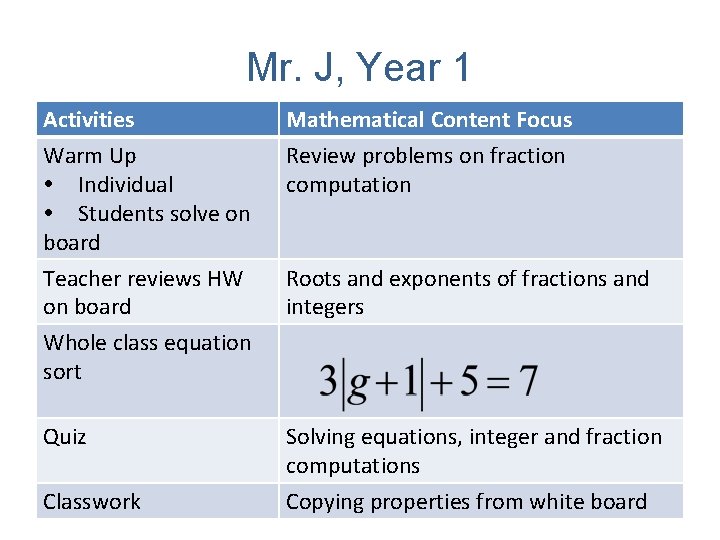
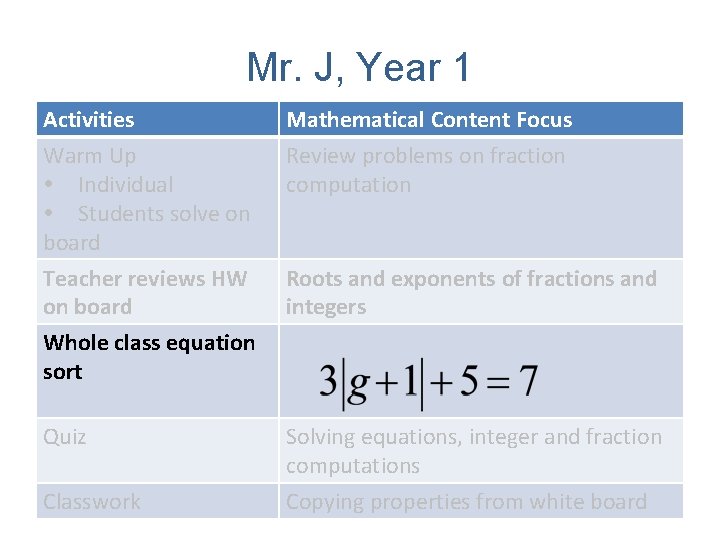
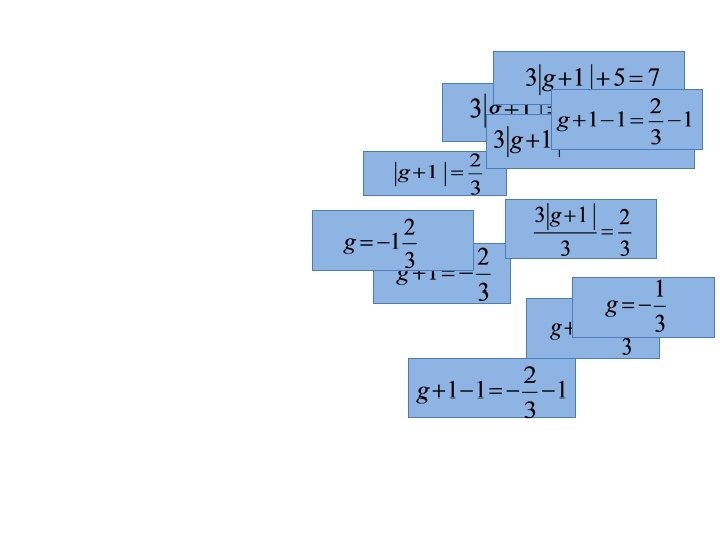
Mr. J, Year 1 Activities Warm Up Individual Students solve on board Mathematical Content Focus Review problems on fraction computation Teacher reviews HW on board Whole class equation sort Roots and exponents of fractions and integers Quiz Solving equations, integer and fraction computations Copying properties from white board Classwork
Mr. J, Year 1 Activities Warm Up Individual Students solve on board Mathematical Content Focus Review problems on fraction computation Teacher reviews HW on board Whole class equation sort Roots and exponents of fractions and integers Quiz Solving equations, integer and fraction computations Copying properties from white board Classwork
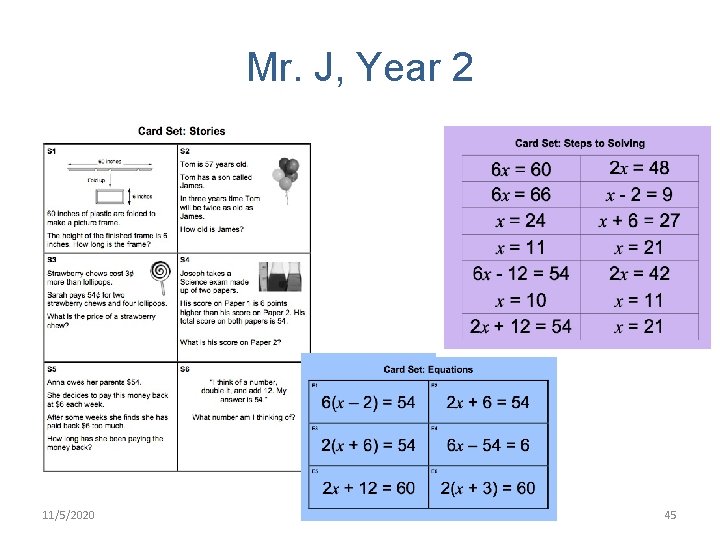
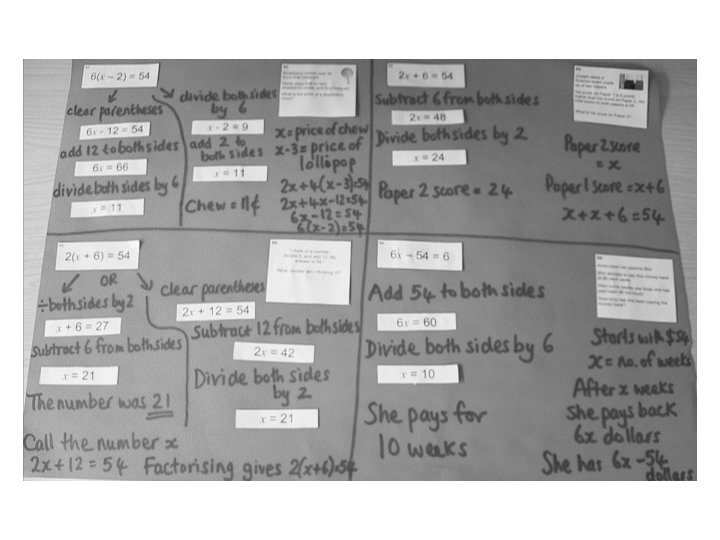
Video 4: Mr. J, Year 2
Mr. J, Year 2 11/5/2020 45
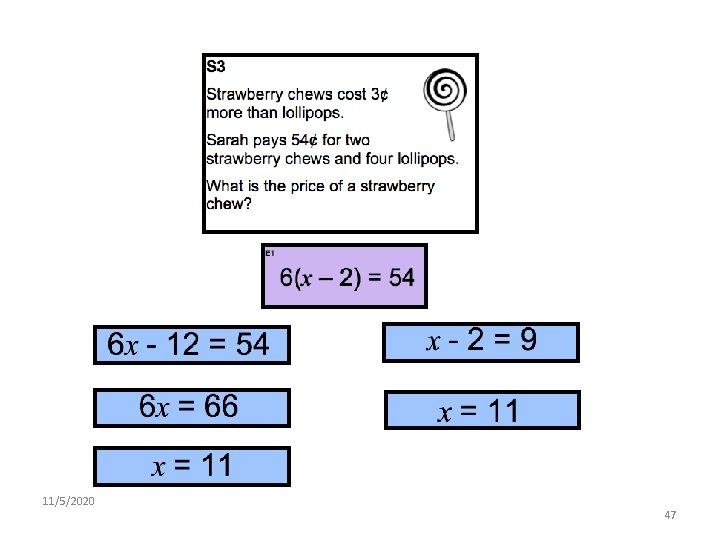
11/5/2020 47
Let’s talk about what we just saw. Think Pair Share
Video 5: Where’s the ten? Unfortunately, we don’t have the permissions that would allow us to give you this video.
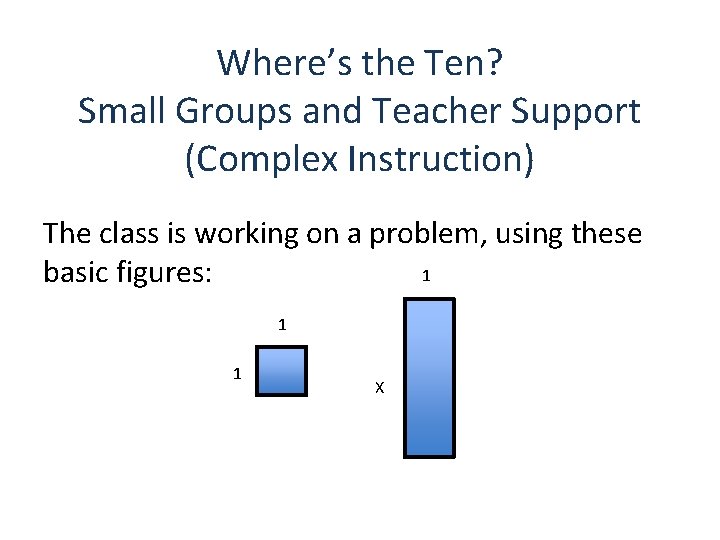
Where’s the Ten? Small Groups and Teacher Support (Complex Instruction) The class is working on a problem, using these 1 basic figures: 1 1 X
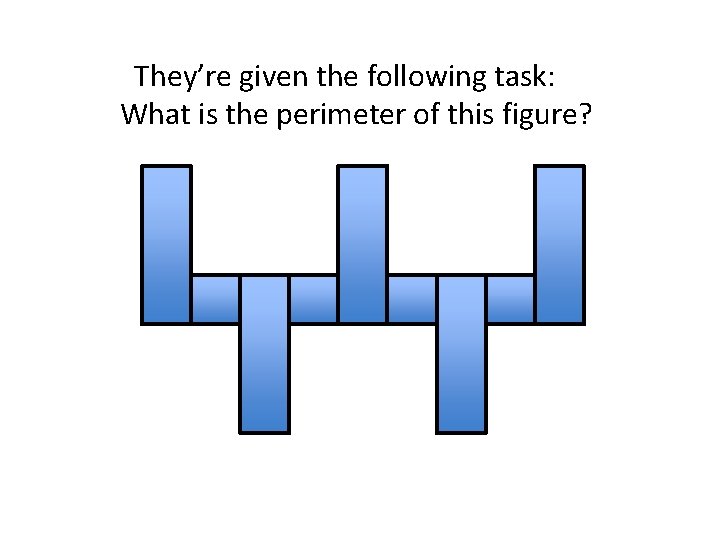
They’re given the following task: What is the perimeter of this figure?
Here, let’s discuss issues of 1. Agency, Authority, and Identity 2. The ways the dimensions intertwine in powerful instruction
And Finally, How can you do TRU-intensive work district-wide?
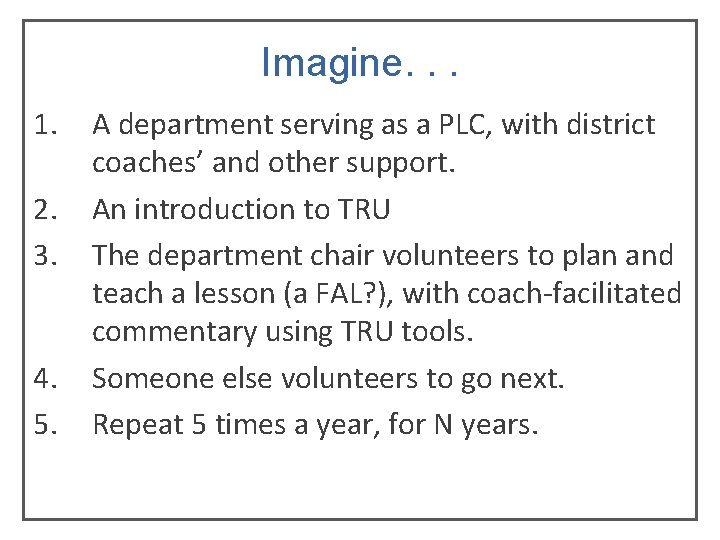
Imagine. . . 1. 2. 3. 4. 5. A department serving as a PLC, with district coaches’ and other support. An introduction to TRU The department chair volunteers to plan and teach a lesson (a FAL? ), with coach-facilitated commentary using TRU tools. Someone else volunteers to go next. Repeat 5 times a year, for N years.
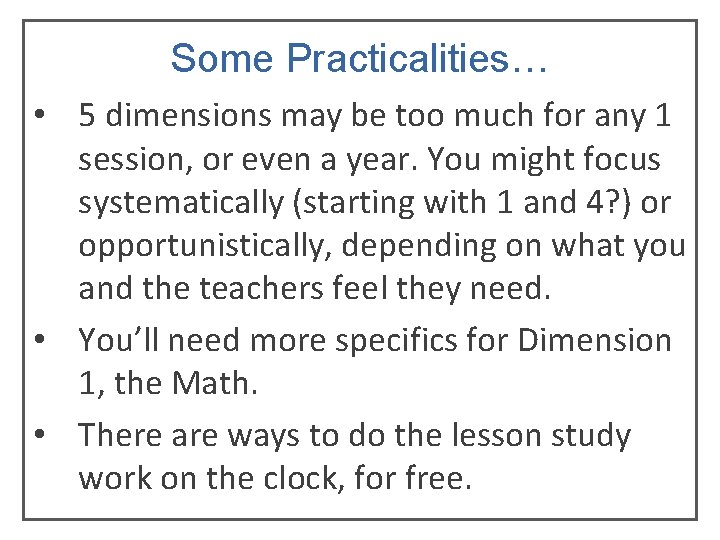
Some Practicalities… • 5 dimensions may be too much for any 1 session, or even a year. You might focus systematically (starting with 1 and 4? ) or opportunistically, depending on what you and the teachers feel they need. • You’ll need more specifics for Dimension 1, the Math. • There are ways to do the lesson study work on the clock, for free.
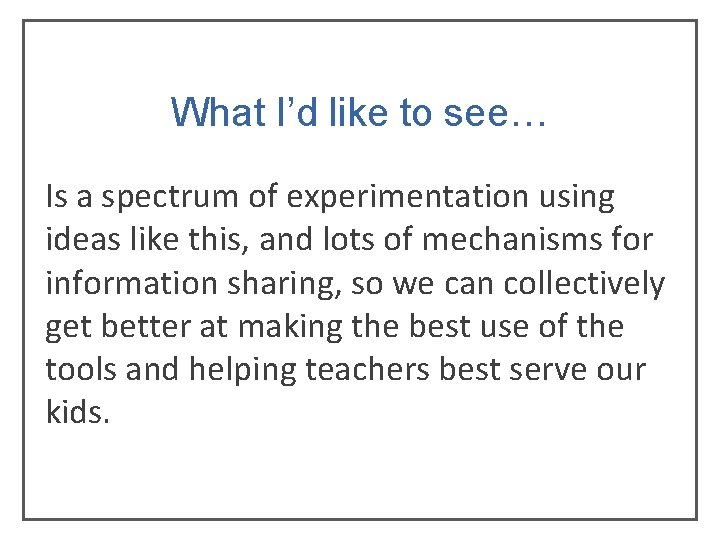
What I’d like to see… Is a spectrum of experimentation using ideas like this, and lots of mechanisms for information sharing, so we can collectively get better at making the best use of the tools and helping teachers best serve our kids.
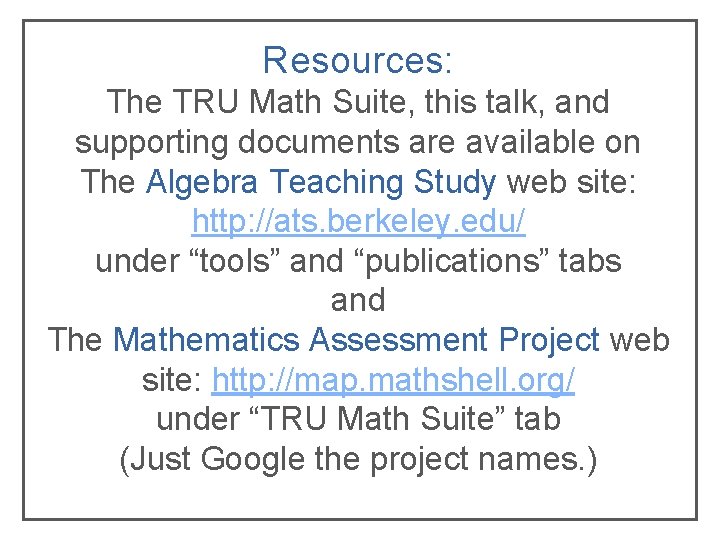
Resources: The TRU Math Suite, this talk, and supporting documents are available on The Algebra Teaching Study web site: http: //ats. berkeley. edu/ under “tools” and “publications” tabs and The Mathematics Assessment Project web site: http: //map. mathshell. org/ under “TRU Math Suite” tab (Just Google the project names. )
That all seems so big, and formidable. But there are manageable steps that help make progress.
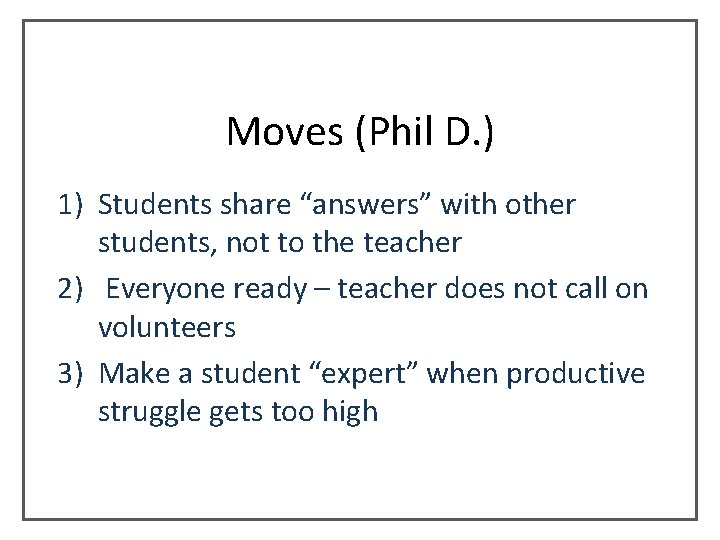
Moves (Phil D. ) 1) Students share “answers” with other students, not to the teacher 2) Everyone ready – teacher does not call on volunteers 3) Make a student “expert” when productive struggle gets too high
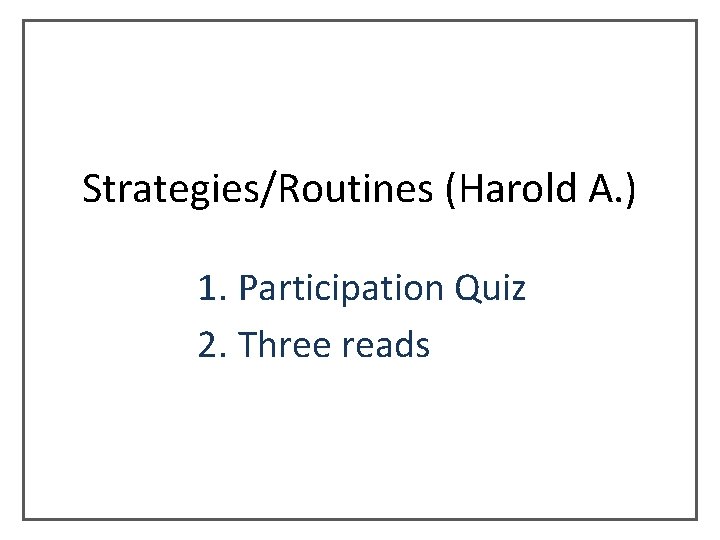
Strategies/Routines (Harold A. ) 1. Participation Quiz 2. Three reads
Thanks!