
A Contribution to the Empirics of Economic Growth

A Contribution to the Empirics of Economic Growth PSME M 1 Economic Growth Tutorial
Contents � Introduction ◦ ◦ Review of Classic Solow Model Shortfalls of Solow Human Capital Accumulation Convergence Theory and Model Prediction � Theoretical Solow Model ◦ Estimation results of Classic Solow Model and Analysis ◦ Augmented Solow Model and its Predictions ◦ Estimation results of Augmented Solow Model and Analysis � Endogenous Growth and Convergence
Introduction � Paper by Mankiw, Romer and Weil in The Quarterly Journal of Economics, Vol 107, No. 2, 1992, pg 407437 � Published � Paper examines whether the Solow growth model is consistent with international variation in the standard of living
� Paper aims to fill up some shortfallings of the Solow model � Solow model is augmented with human capital as well as physical capital accumulation � An augmented Solow model is a better representation of cross-country data � Prediction of the model is that by holding the population growth and capital accumulation constant, countries converge in terms of standards of living at a given Solow convergence rate
Review of Classic Solow Model � Standard neoclassical production function with decreasing returns to capital (and labor) � Treat savings and population rate as exo (s and n are given) �s and n determine the steady-state level of income per capita [(f(k*)] ={(n+δ)/s} k*) � If s is higher, then f(k*) is larger -> the higher the saving rate, the richer the country � If n is higher, then f(k*) is smaller –> the higher the pop rate, the poorer the country
Shortfalls of Solow � Using cross-country data, paper finds that s and n affect income in the directions predicted by Solow � Problem coherant � Might is that the magnitudes are not be omitted variables so need to include human capital accumulation
Human Capital Accumulation � For any given rate of human capital accumulation, higher s or lower n leads to higher f(k*) and thus a higher level of H* � Human capital accumulation may be correlated with s and n, leading to omitted variable bias � According to paper, the augmented Solow model provides an almost complete explanantion (80% of country income variation is explained) of why some countries are rich and others are poor
Convergence Theory and Model Prediction � The article argues that there is no absolute convergence (countries need not converge in per capita income) � Rather, there is conditional convergence (countries generally converge to their respectively different steady state incomes) � Finally, the model predicts that poor countries tend to have higher rates of return to physical and human capital
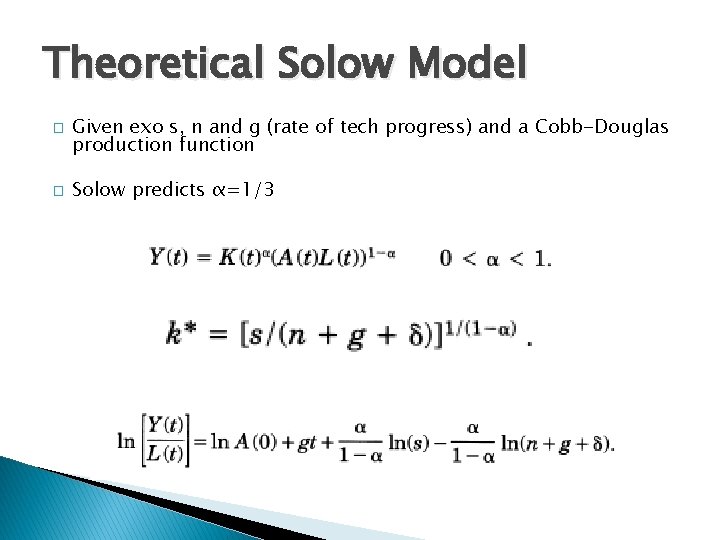
Theoretical Solow Model � � Given exo s, n and g (rate of tech progress) and a Cobb-Douglas production function Solow predicts α=1/3
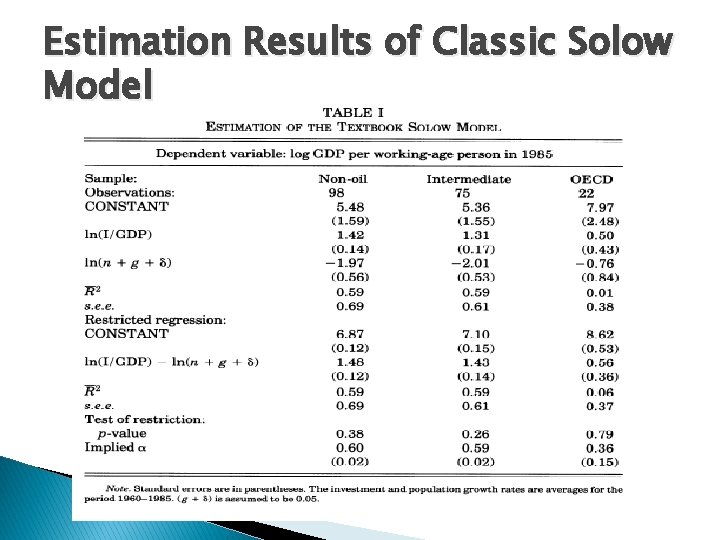
Estimation Results of Classic Solow Model
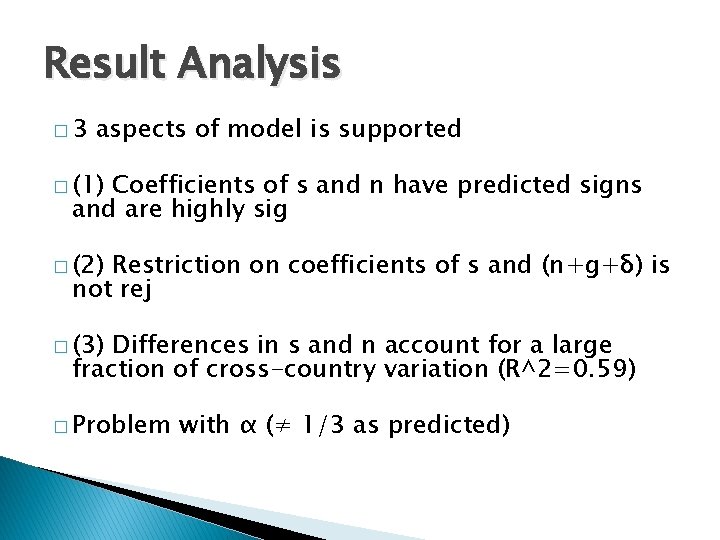
Result Analysis � 3 aspects of model is supported � (1) Coefficients of s and n have predicted signs and are highly sig � (2) Restriction on coefficients of s and (n+g+δ) is not rej � (3) Differences in s and n account for a large fraction of cross-country variation (R^2=0. 59) � Problem with α (≠ 1/3 as predicted)
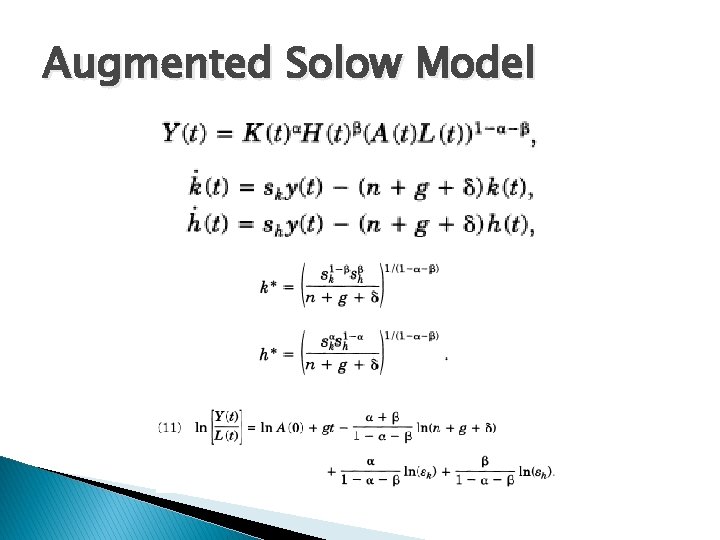
Augmented Solow Model
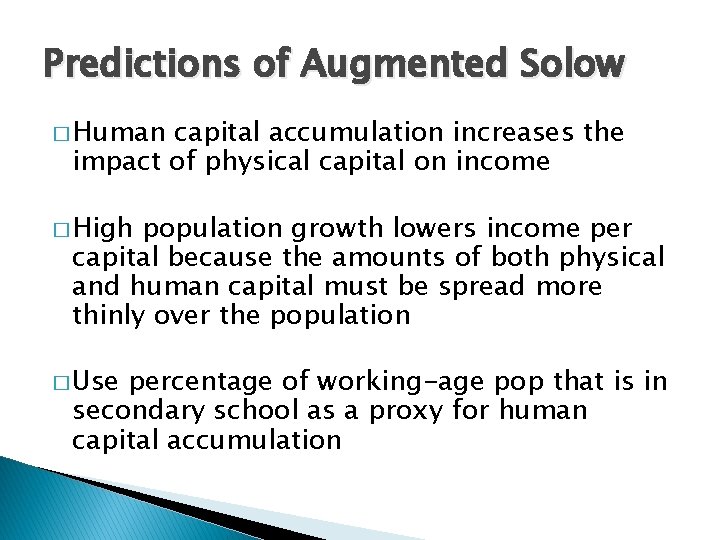
Predictions of Augmented Solow � Human capital accumulation increases the impact of physical capital on income � High population growth lowers income per capital because the amounts of both physical and human capital must be spread more thinly over the population � Use percentage of working-age pop that is in secondary school as a proxy for human capital accumulation
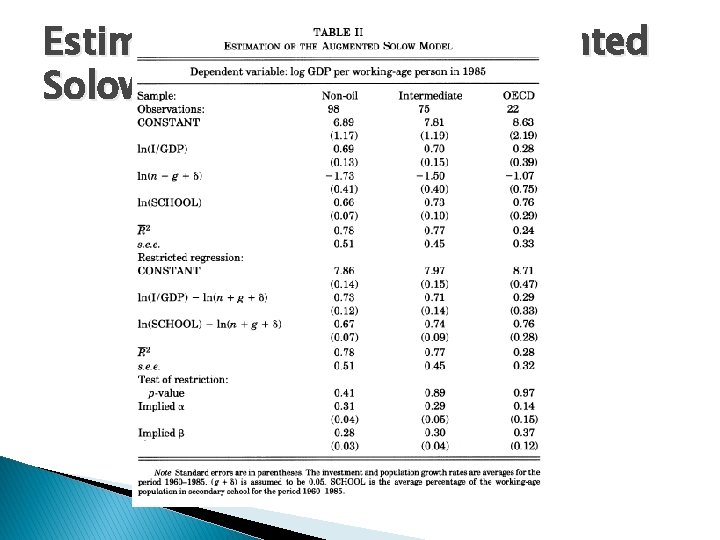
Estimation Results on Augmented Solow Model
Result Analysis � Human capital is significant is all three samples � Size of coefficient on physical capital accumulation is reduced � Fit of regression is improved � The paper concludes that adding human capital to the Solow model improves its performance
Endogenous Growth and Convergence � Endogenous growth models are characterized by non-decreasing returns to inputs � Implies that countries that save more grow faster indefinitely and countries need not converge in income per capital even if they have the same preferences and technology � The Solow model predicts that countries reach different steady states (conditional convergence at the rate the model predicts)
Conclusion � The paper argues that the Solow model is consistent with the international evidence when augmented with human and physical capital � The augmented Solow model says that differences in saving, education and population growth should explain cross-country differences in income per capita � Direct further research on exo variables that vary across countries eg diff in tax policies, education policies, etc
- Slides: 17