
A Constraint Generation Approach to Learning Stable Linear
A Constraint Generation Approach to Learning Stable Linear Dynamical Systems Sajid M. Siddiqi Byron Boots Geoffrey J. Gordon Carnegie Mellon University NIPS 2007 poster W 22
Objective • Learn parameters of a Linear Dynamical System from data while ensuring a stable dynamics matrix A more efficiently and accurately than previous methods
Our Approach • Formulate an approximation of the problem as a semi-definite program (SDP) • Start with a quadratic program (QP) relaxation of this SDP, and incrementally add constraints • Because the SDP is an inner approximation of the problem, we reach stability early, before reaching the feasible set of the SDP • We interpolate the solution to return the best stable matrix possible
Outline • Linear Dynamical Systems • Stability • Convexity • Constraint Generation Algorithm • Empirical Results • Conclusion
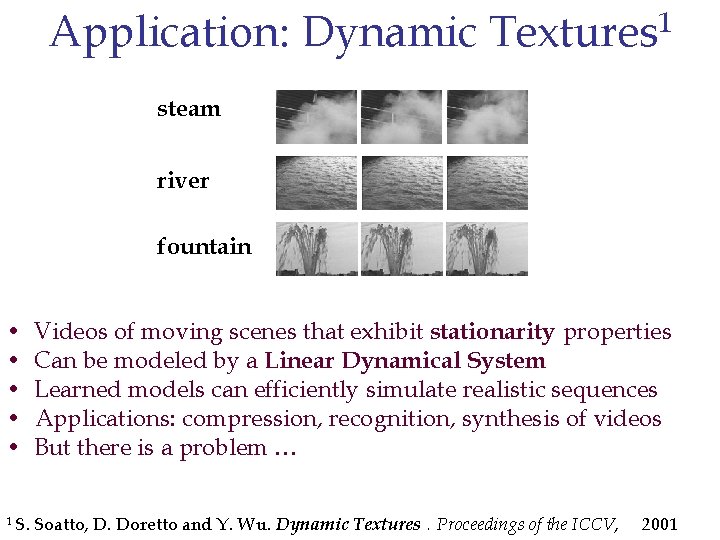
Application: Dynamic Textures 1 steam river fountain • • • Videos of moving scenes that exhibit stationarity properties Can be modeled by a Linear Dynamical System Learned models can efficiently simulate realistic sequences Applications: compression, recognition, synthesis of videos But there is a problem … 1 S. Soatto, D. Doretto and Y. Wu. Dynamic Textures. Proceedings of the ICCV, 2001
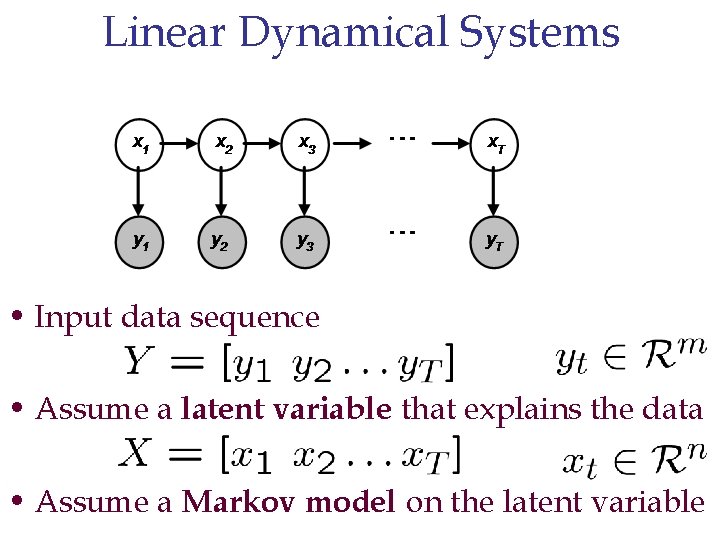
Linear Dynamical Systems • Input data sequence • Assume a latent variable that explains the data • Assume a Markov model on the latent variable
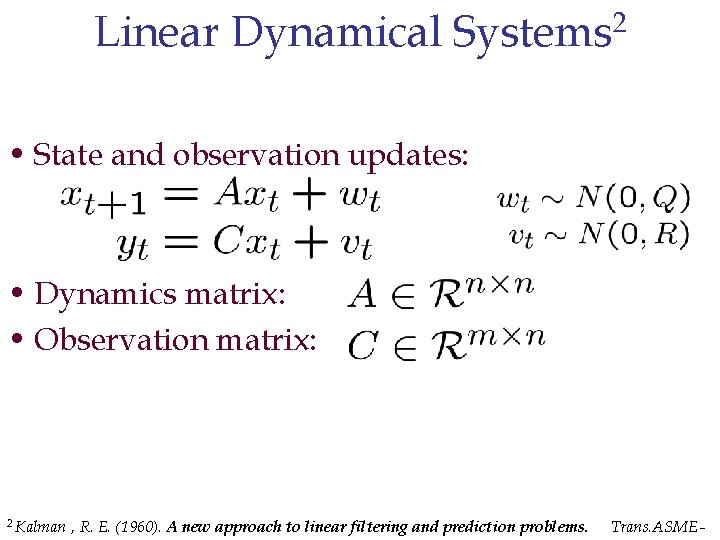
Linear Dynamical Systems 2 • State and observation updates: • Dynamics matrix: • Observation matrix: 2 Kalman , R. E. (1960). A new approach to linear filtering and prediction problems. Trans. ASME -
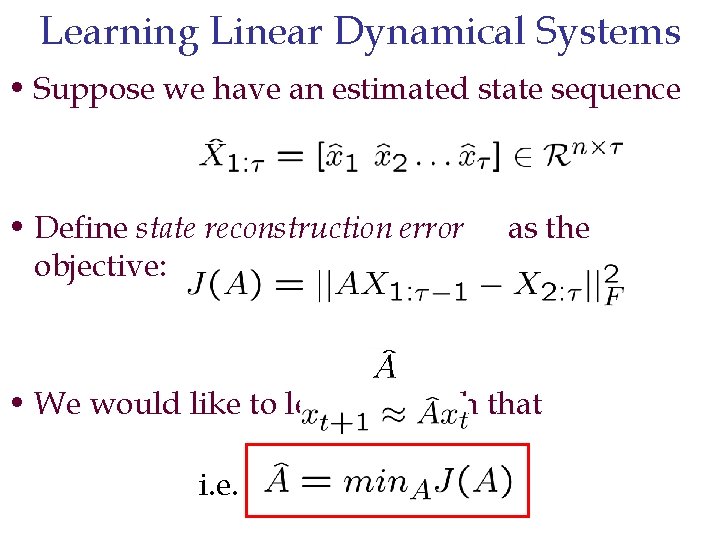
Learning Linear Dynamical Systems • Suppose we have an estimated state sequence • Define state reconstruction error objective: • We would like to learn i. e. as the such that
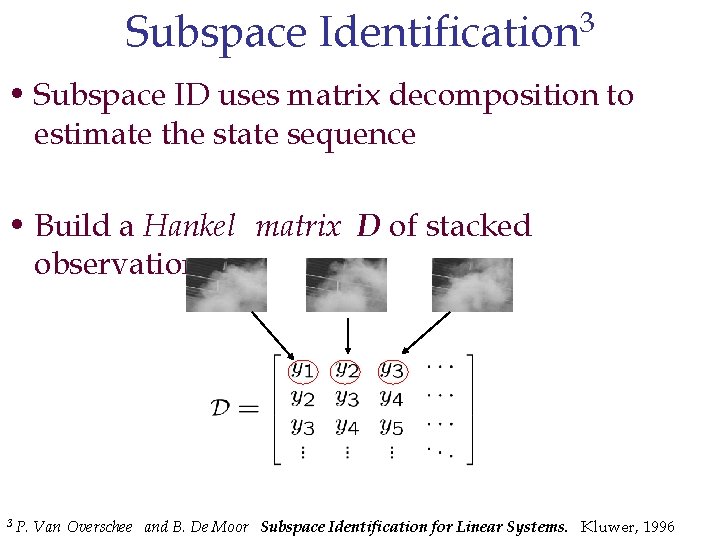
Subspace Identification 3 • Subspace ID uses matrix decomposition to estimate the state sequence • Build a Hankel matrix D of stacked observations 3 P. Van Overschee and B. De Moor Subspace Identification for Linear Systems. Kluwer, 1996
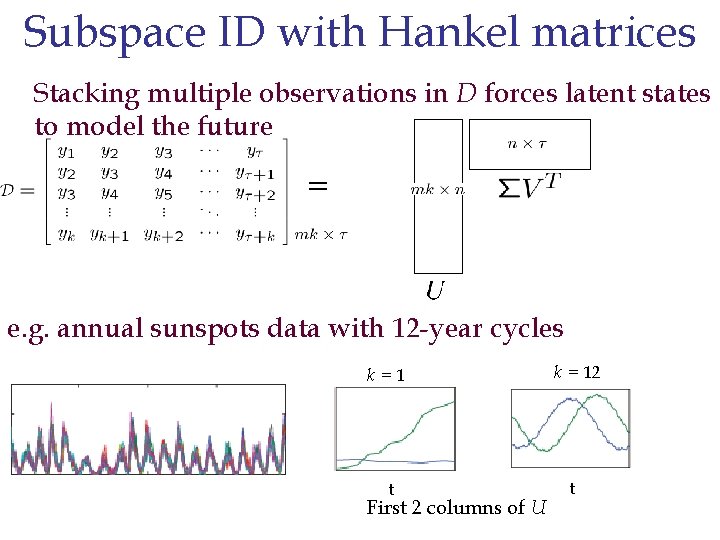
Subspace ID with Hankel matrices Stacking multiple observations in D forces latent states to model the future = e. g. annual sunspots data with 12 -year cycles k =1 t First 2 columns of U k = 12 t
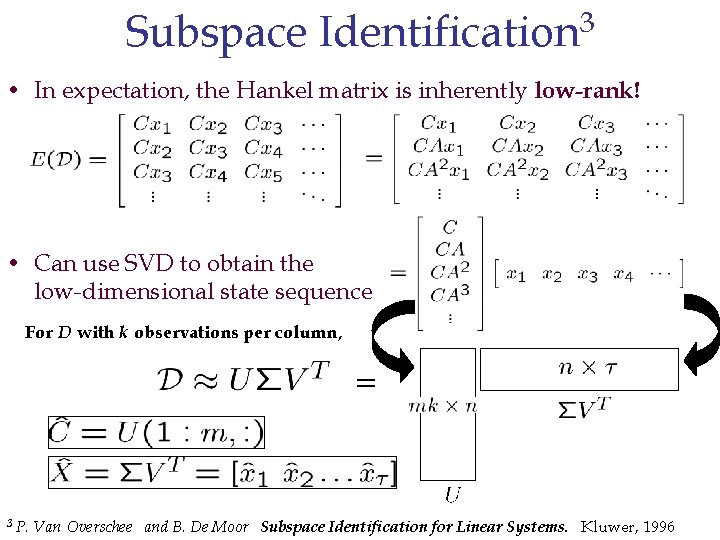
Subspace Identification 3 • In expectation, the Hankel matrix is inherently low-rank! • Can use SVD to obtain the low-dimensional state sequence For D with k observations per column, = 3 P. Van Overschee and B. De Moor Subspace Identification for Linear Systems. Kluwer, 1996
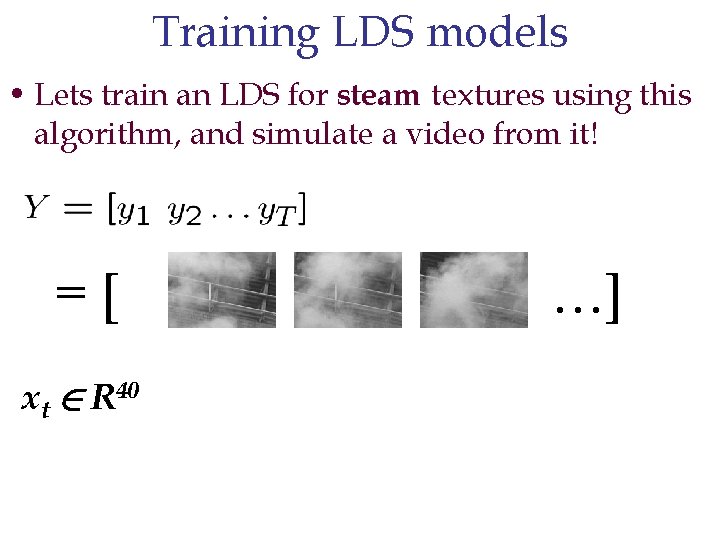
Training LDS models • Lets train an LDS for steam textures using this algorithm, and simulate a video from it! =[ x t 2 R 40 …]
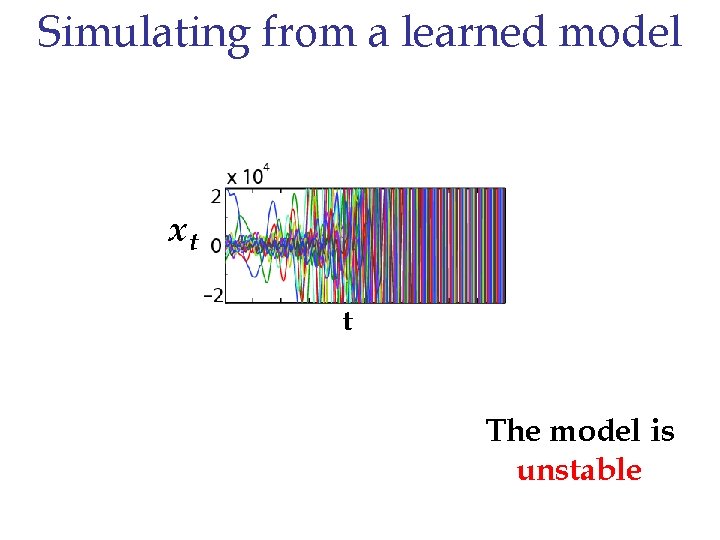
Simulating from a learned model xt t The model is unstable

Notation • 1 , … , n : eigenvalues of A (| 1| > … > | n| ) • 1, …, n : unit-length eigenvectors of A • 1, …, n : singular values of A ( 1 > 2 > … n) • • S S : matrices with | 1| · 1 : matrices with 1 · 1
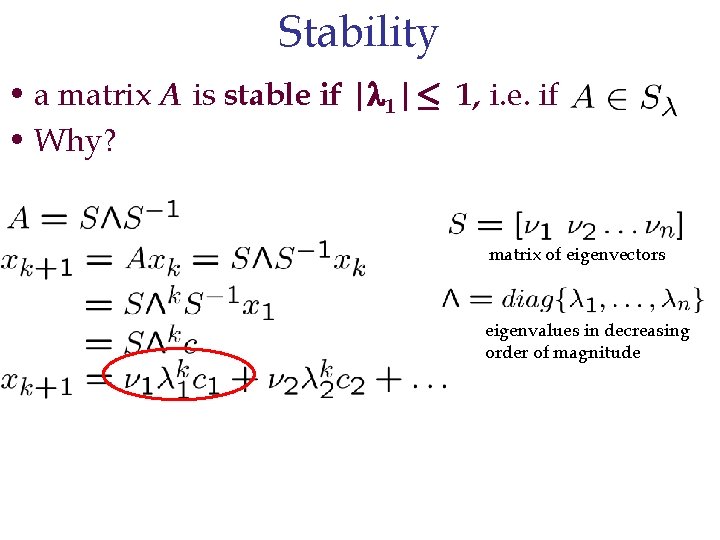
Stability • a matrix A is stable if | 1|· 1, i. e. if • Why? matrix of eigenvectors eigenvalues in decreasing order of magnitude
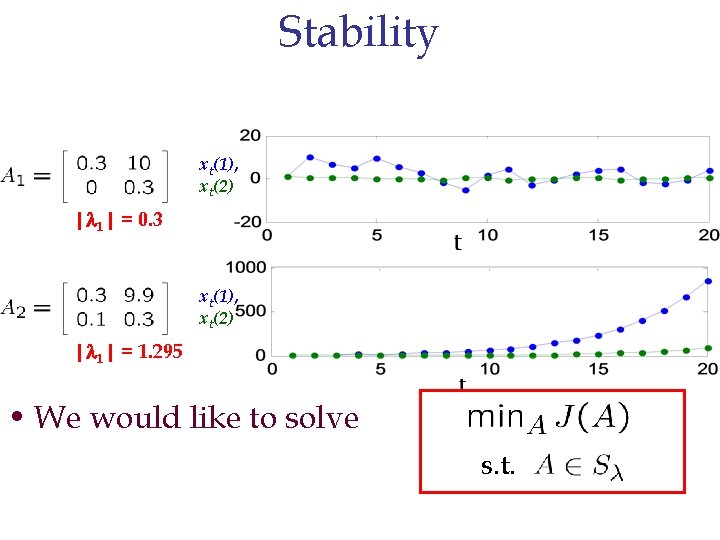
Stability x t(1), x t(2) | 1| = 0. 3 x t(1), x t(2) | 1| = 1. 295 • We would like to solve s. t.

Stability and Convexity • The state space of a stable LDS lies inside some ellipse • The set of matrices that map a particular ellipse into itself (and hence are stable) is convex • If we knew in advance which ellipse contains our state space, finding A would be a convex problem. But we don’t • …and the set of all stable matrices is non -convex ? ? ?
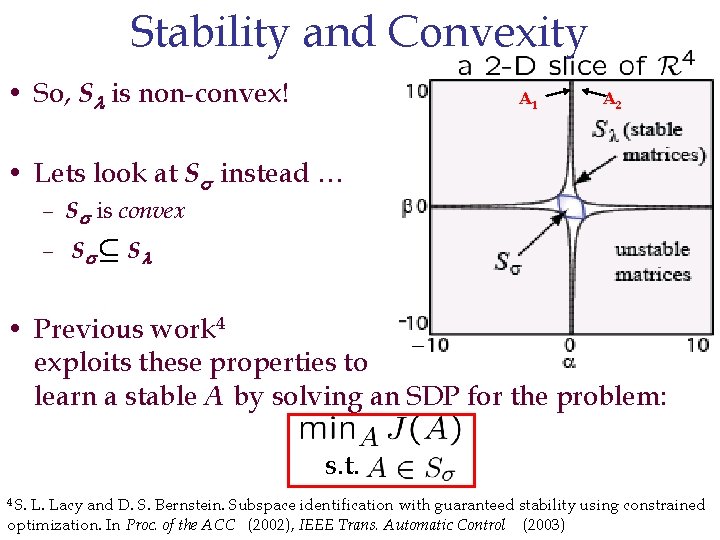
Stability and Convexity • So, S is non-convex! A 1 A 2 • Lets look at S instead … – S is convex – S µ S • Previous work 4 exploits these properties to learn a stable A by solving an SDP for the problem: s. t. 4 S. L. Lacy and D. S. Bernstein. Subspace identification with guaranteed stability using constrained optimization. In Proc. of the ACC (2002), IEEE Trans. Automatic Control (2003)
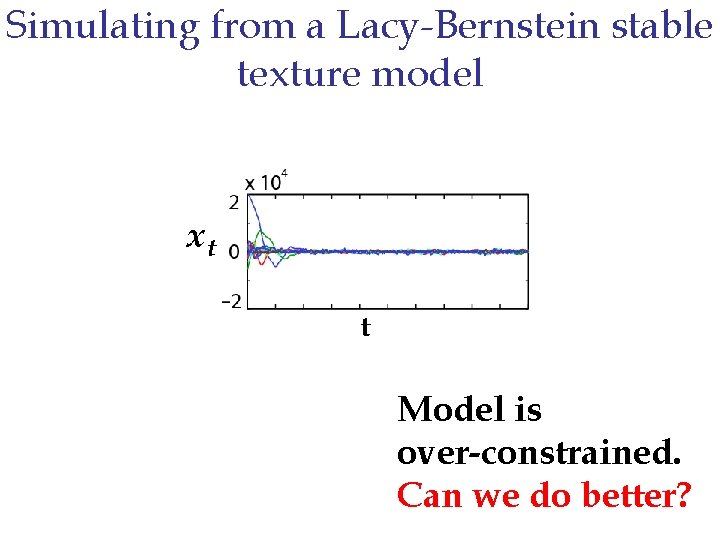
Simulating from a Lacy-Bernstein stable texture model xt t Model is over-constrained. Can we do better?
Our Approach • Formulate the S approximation of the problem as a semi-definite program (SDP) • Start with a quadratic program (QP) relaxation of this SDP, and incrementally add constraints • Because the SDP is an inner approximation of the problem, we reach stability early, before reaching the feasible set of the SDP • We interpolate the solution to return the best stable matrix possible
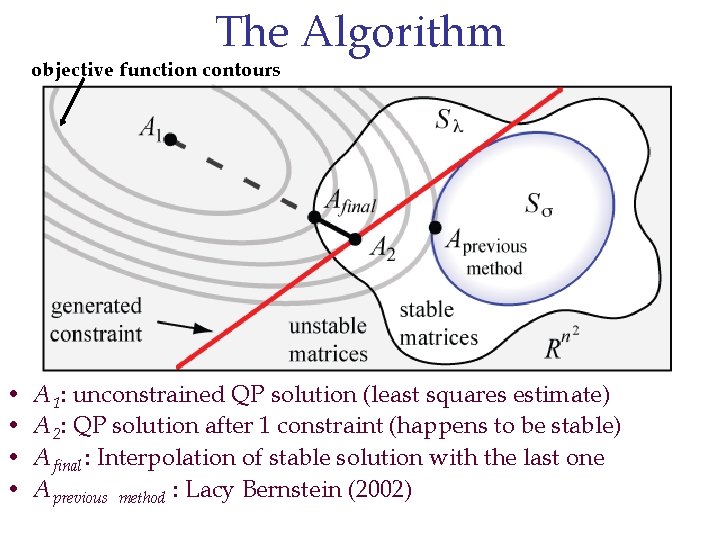
The Algorithm objective function contours • • A 1: unconstrained QP solution (least squares estimate) A 2: QP solution after 1 constraint (happens to be stable) A final : Interpolation of stable solution with the last one A previous method : Lacy Bernstein (2002)
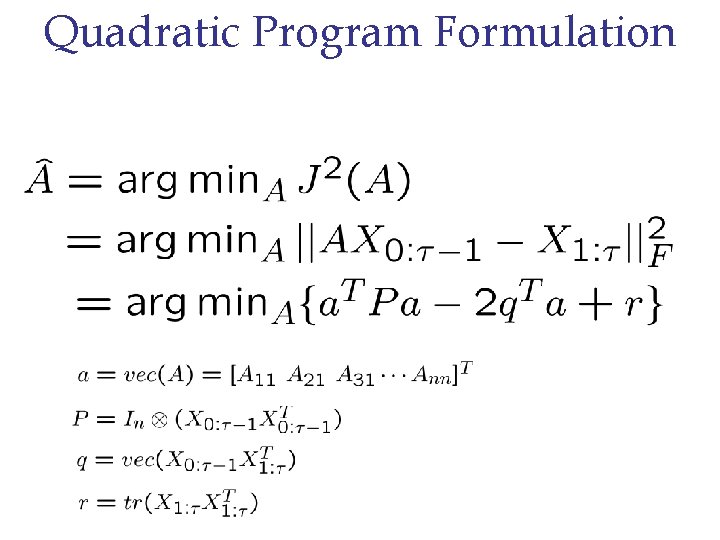
Quadratic Program Formulation
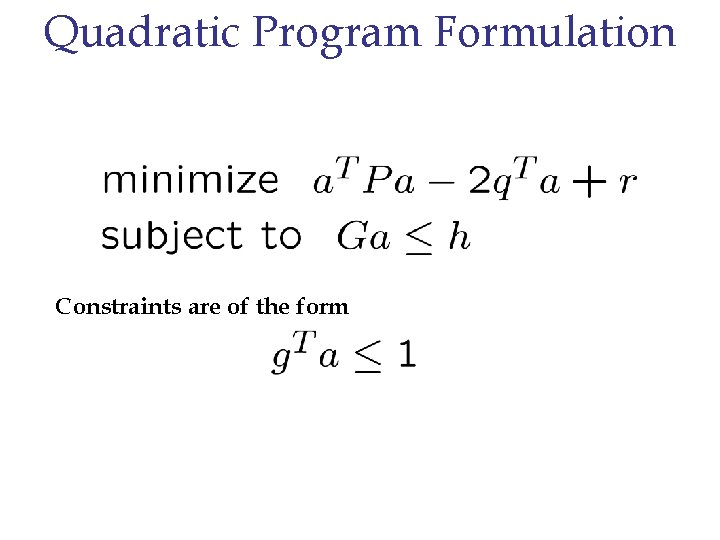
Quadratic Program Formulation Constraints are of the form
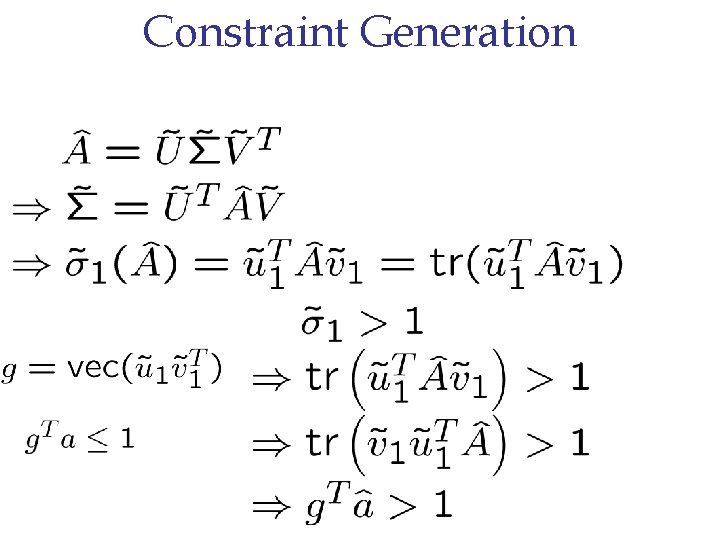
Constraint Generation
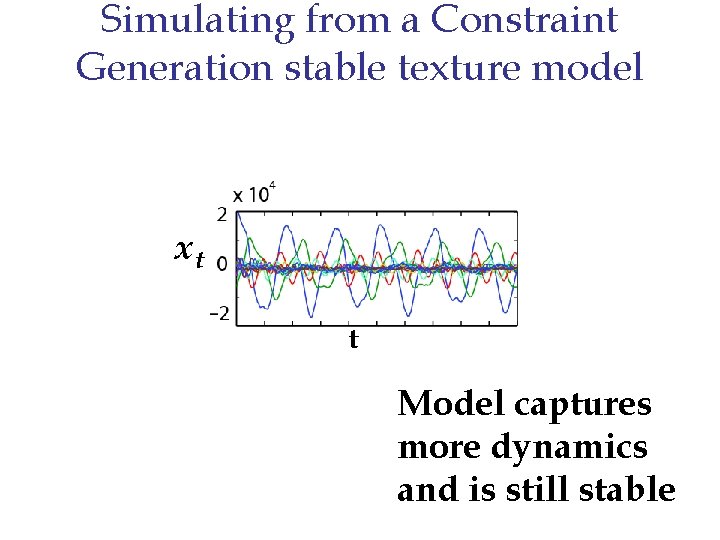
Simulating from a Constraint Generation stable texture model xt t Model captures more dynamics and is still stable
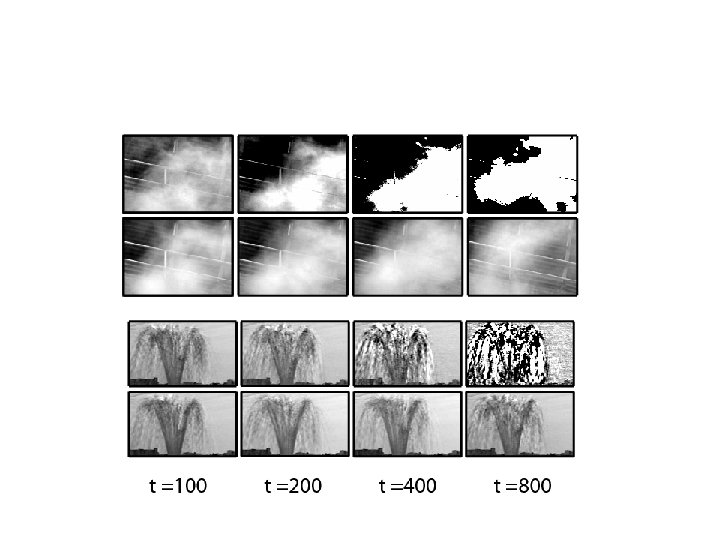
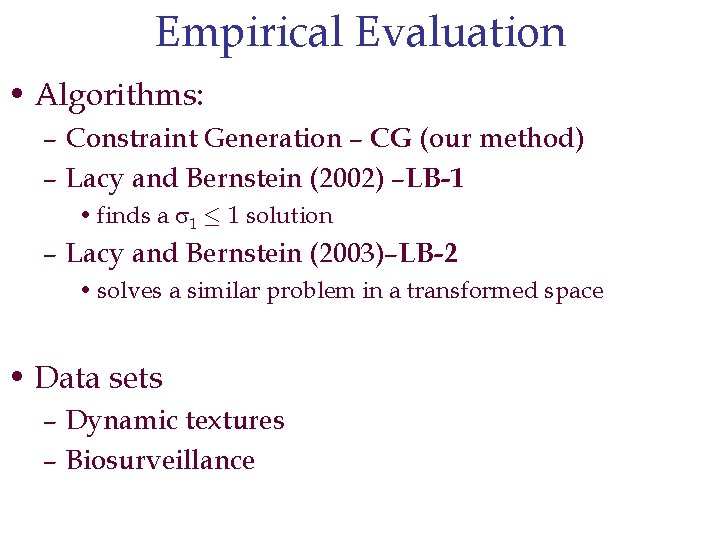
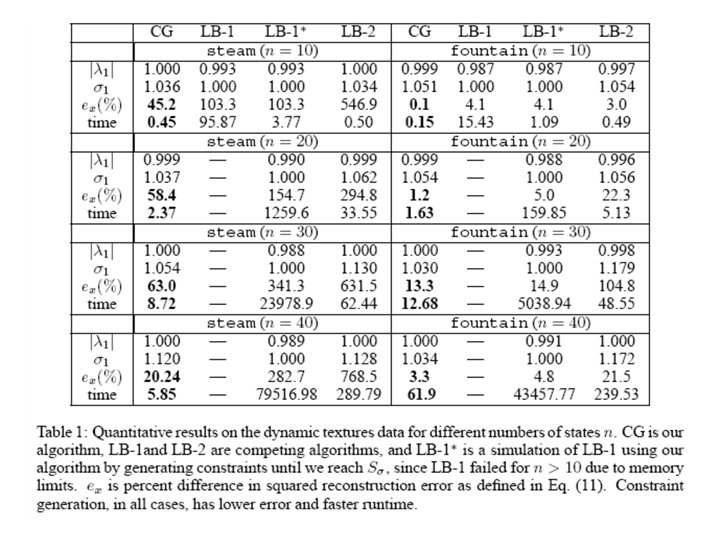
Empirical Evaluation • Algorithms: – Constraint Generation – CG (our method) – Lacy and Bernstein (2002) –LB-1 • finds a 1 · 1 solution – Lacy and Bernstein (2003)–LB-2 • solves a similar problem in a transformed space • Data sets – Dynamic textures – Biosurveillance
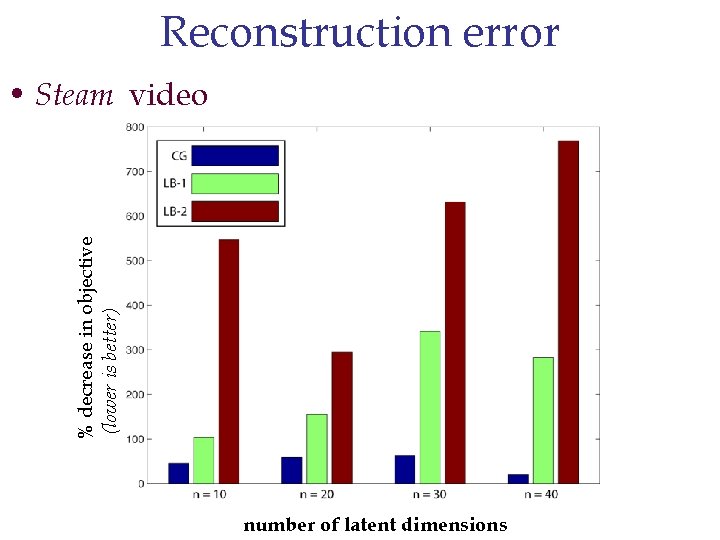
Reconstruction error % decrease in objective (lower is better) • Steam video number of latent dimensions
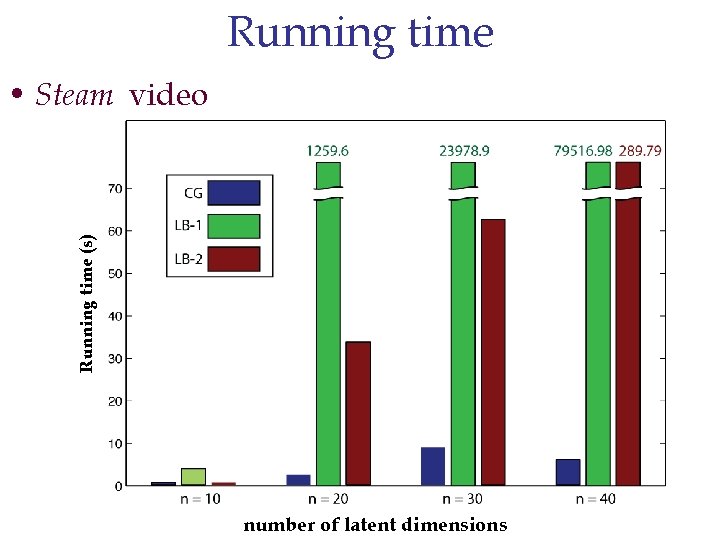
Running time (s) • Steam video number of latent dimensions
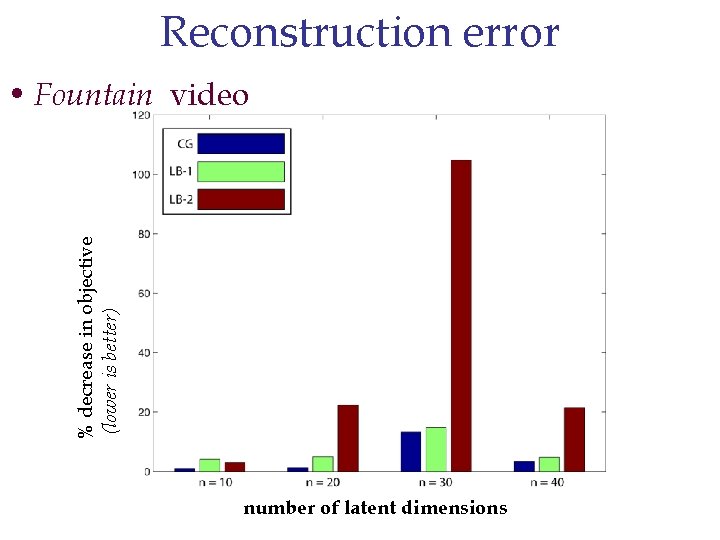
Reconstruction error % decrease in objective (lower is better) • Fountain video number of latent dimensions
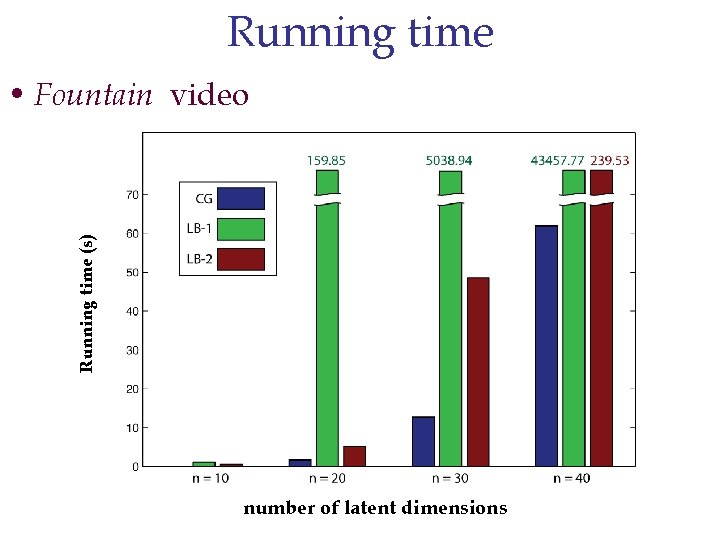
Running time (s) • Fountain video number of latent dimensions
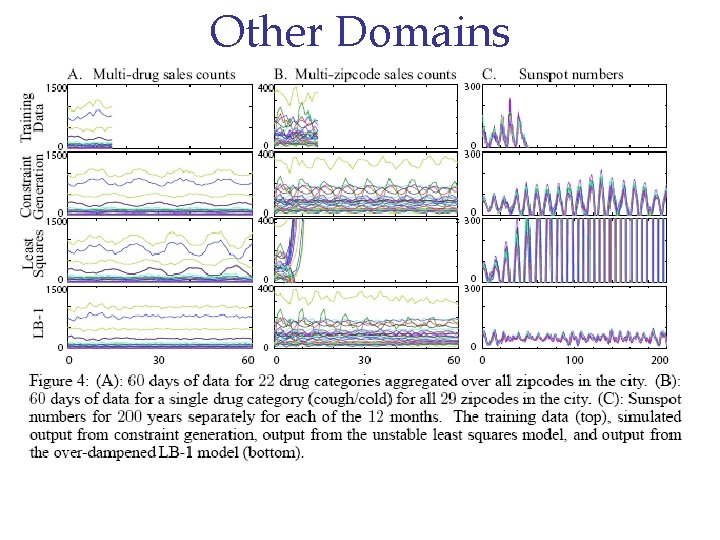
Other Domains
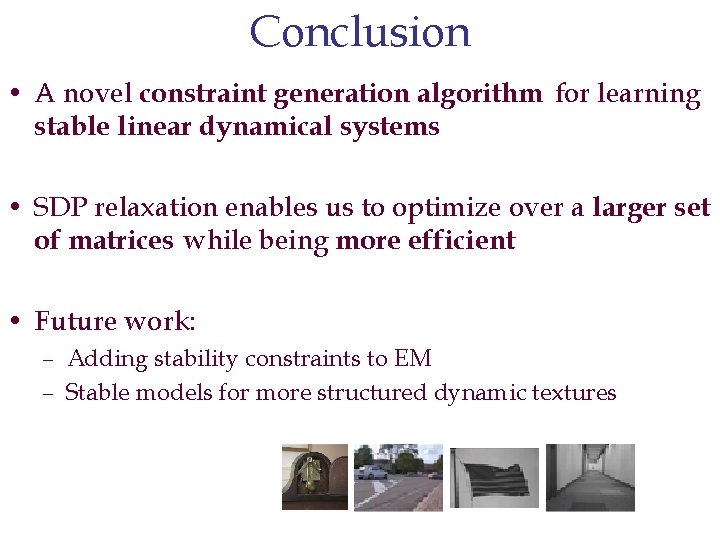
Conclusion • A novel constraint generation algorithm for learning stable linear dynamical systems • SDP relaxation enables us to optimize over a larger set of matrices while being more efficient • Future work: – Adding stability constraints to EM – Stable models for more structured dynamic textures
- Slides: 34