
A ConstantFactor Approximation Algorithm for the Asymmetric Traveling

![2 -edge-weights ATSP general ATSP [Svensson’ 15] 2 -edge-weights Local-Connectivity ATSP general Local-Connectivity](https://slidetodoc.com/presentation_image_h/ca98fbdf3e828947e679a5821826f0c8/image-12.jpg "2 -edge-weights ATSP general ATSP [Svensson’ 15] 2 -edge-weights Local-Connectivity ATSP general Local-Connectivity")

![Find min-cost cycle cover Repeated cycle cover [Frieze, Galbiati, and Maffioli’ 82] “Contract“ Repeat](https://slidetodoc.com/presentation_image_h/ca98fbdf3e828947e679a5821826f0c8/image-18.jpg "Find min-cost cycle cover Repeated cycle cover [Frieze, Galbiati, and Maffioli’ 82] “Contract“ Repeat")


- Slides: 48
A Constant-Factor Approximation Algorithm for the Asymmetric Traveling Salesman Problem Ola Svensson, Jakub Tarnawski and László A. Végh
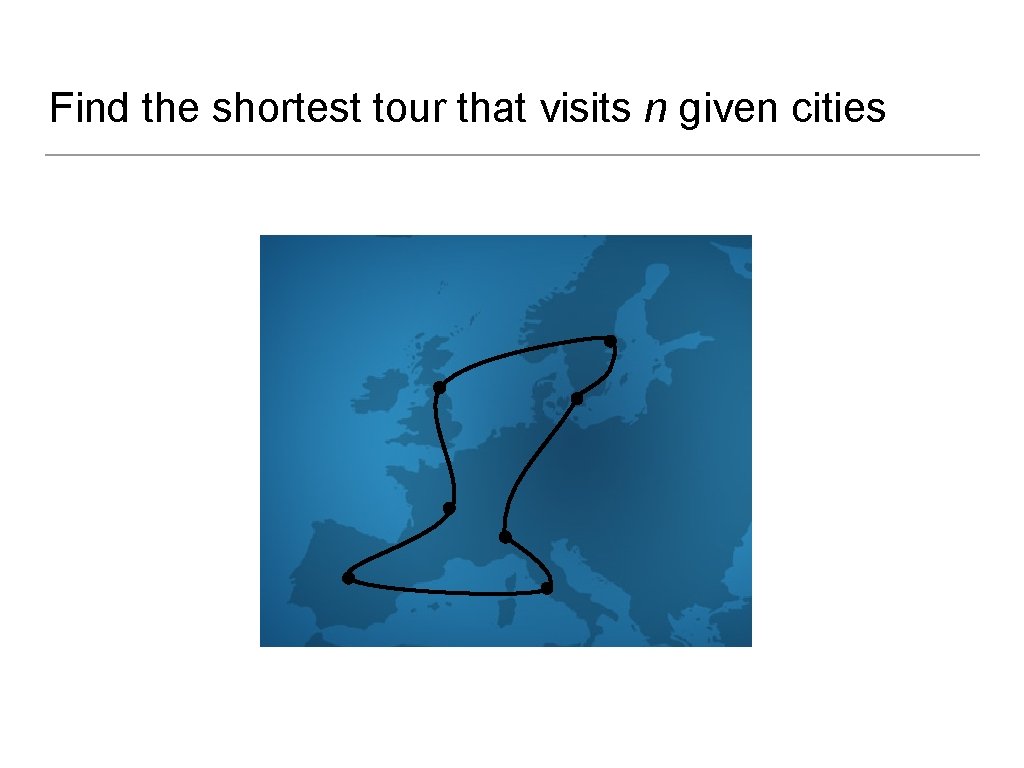
Find the shortest tour that visits n given cities
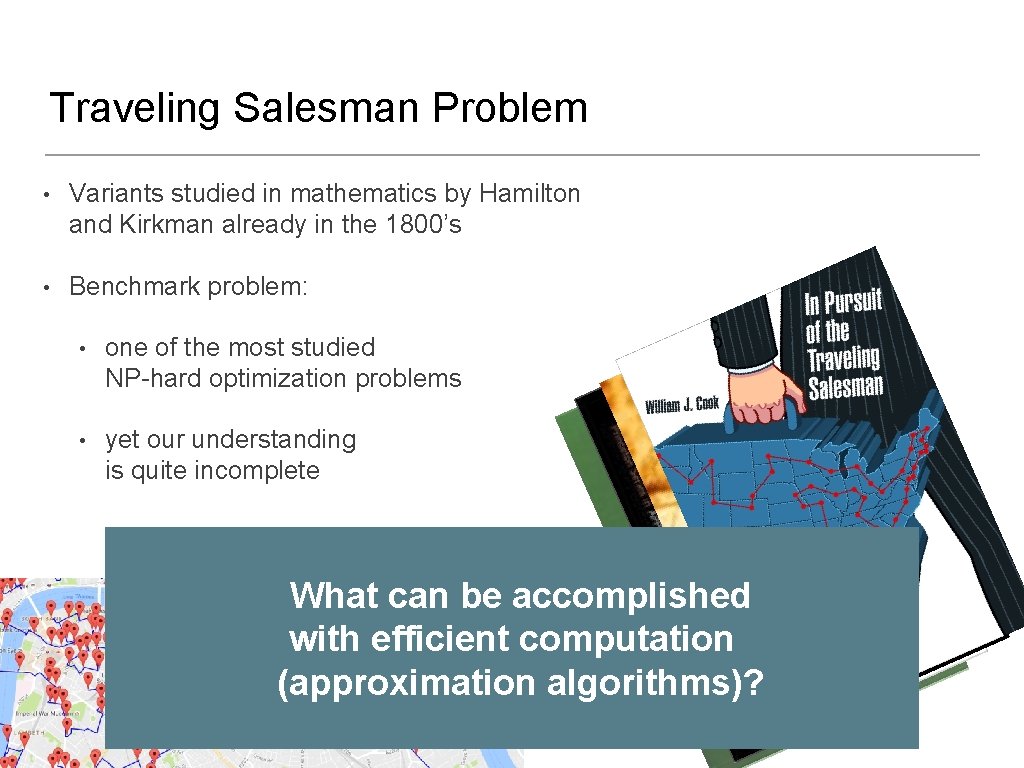
Traveling Salesman Problem • Variants studied in mathematics by Hamilton and Kirkman already in the 1800’s • Benchmark problem: • one of the most studied NP-hard optimization problems • yet our understanding is quite incomplete What can be accomplished with efficient computation (approximation algorithms)?
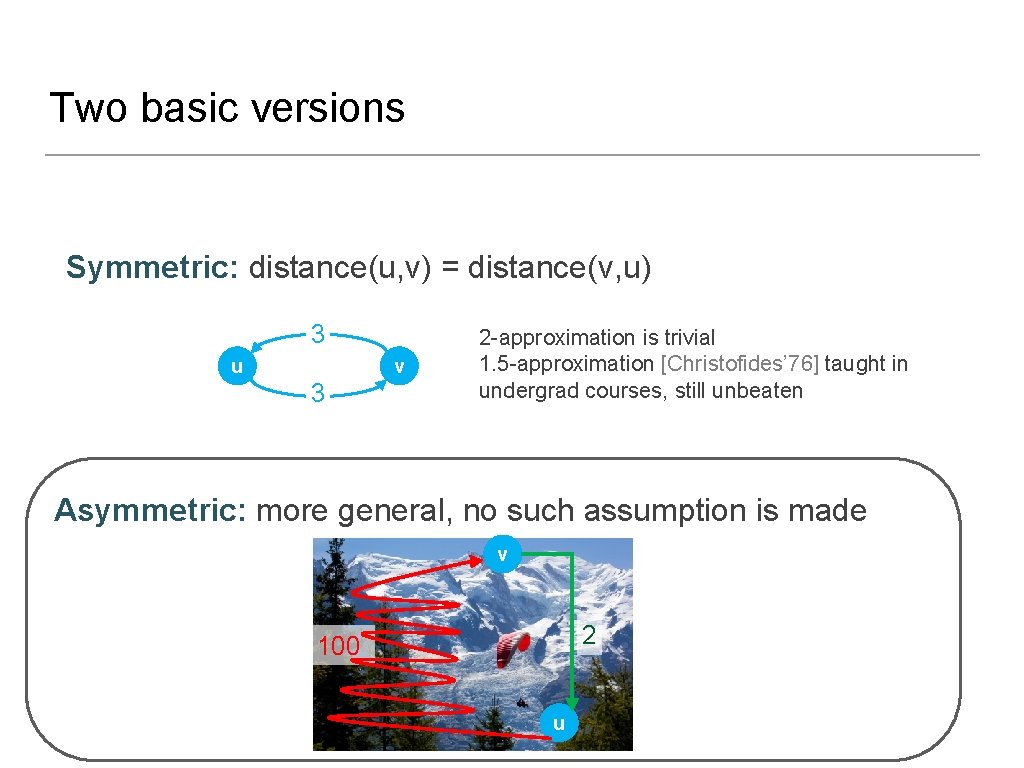
Two basic versions Symmetric: distance(u, v) = distance(v, u) 3 u v 3 2 -approximation is trivial 1. 5 -approximation [Christofides’ 76] taught in undergrad courses, still unbeaten Asymmetric: more general, no such assumption is made v 2 100 u
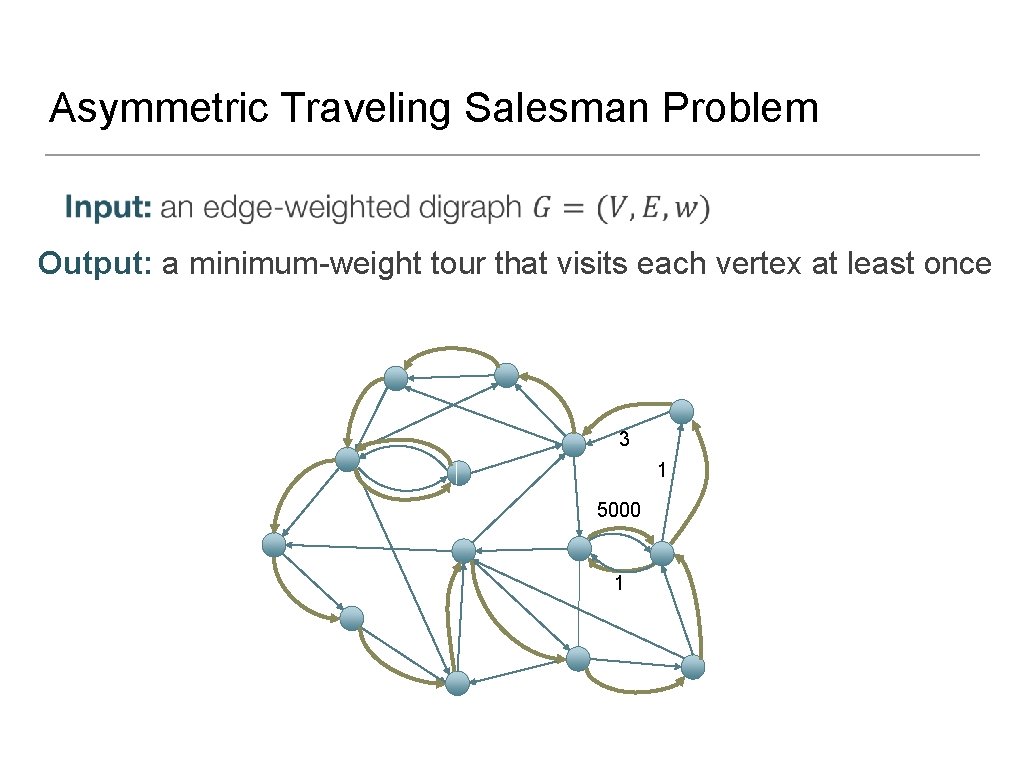
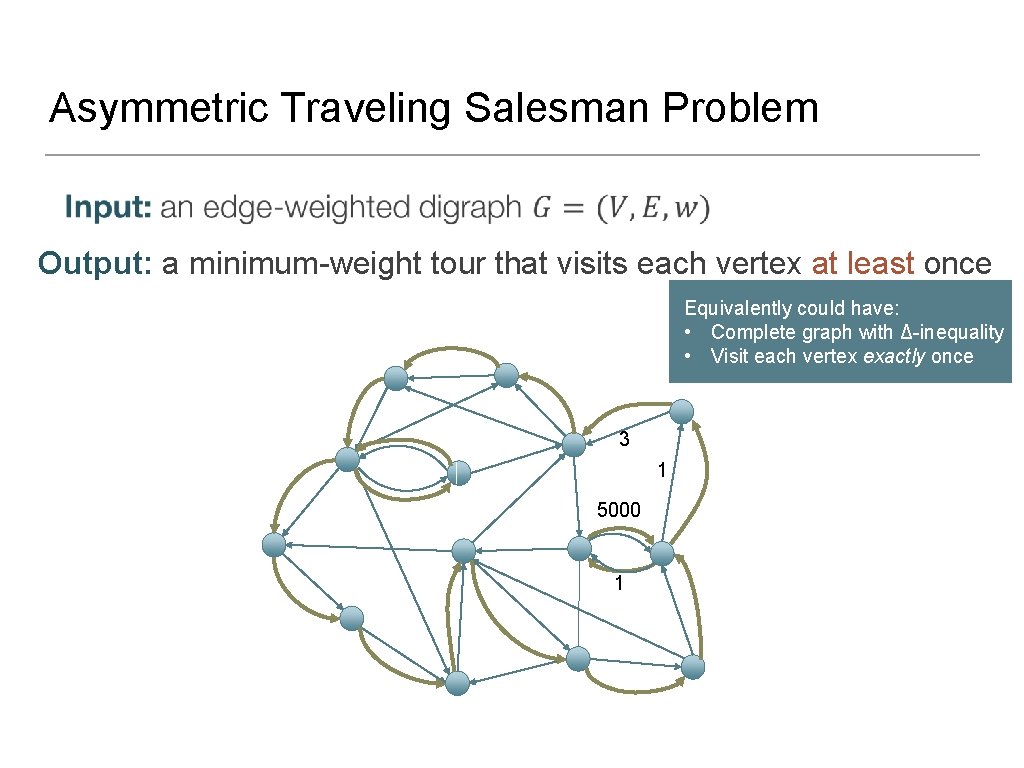
Asymmetric Traveling Salesman Problem Output: a minimum-weight tour that visits each vertex at least once 3 1 5000 1
Asymmetric Traveling Salesman Problem Output: a minimum-weight tour that visits each vertex at least once Equivalently could have: • Complete graph with Δ-inequality • Visit each vertex exactly once 3 1 5000 1
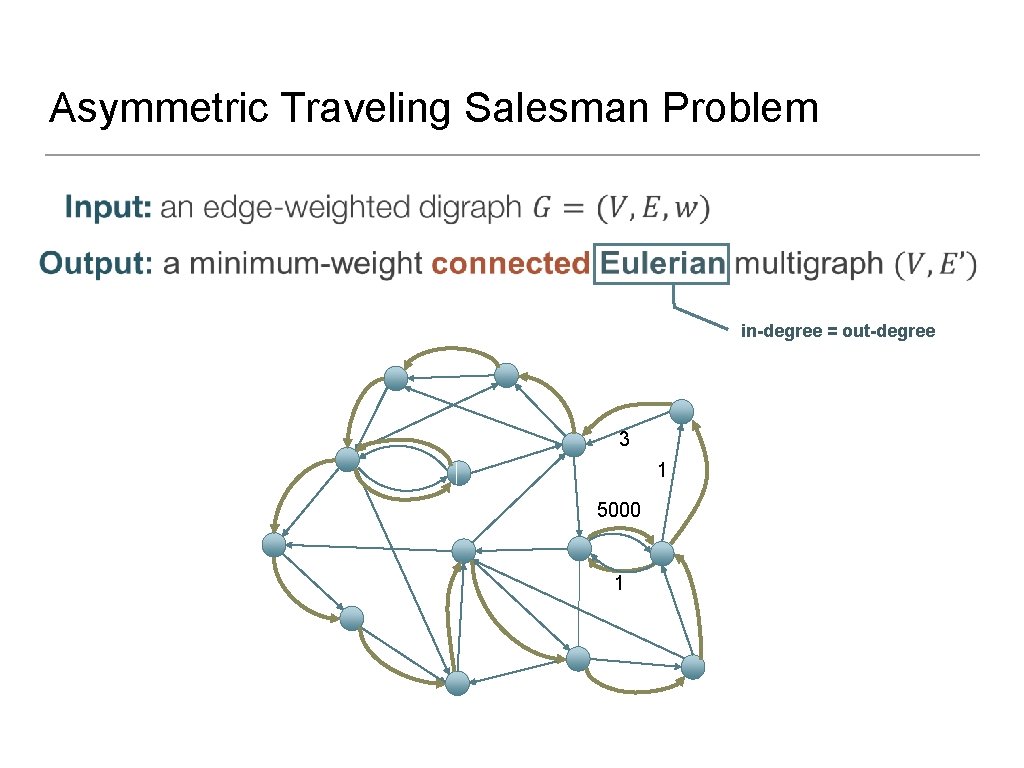
Asymmetric Traveling Salesman Problem in-degree = out-degree 3 1 5000 1
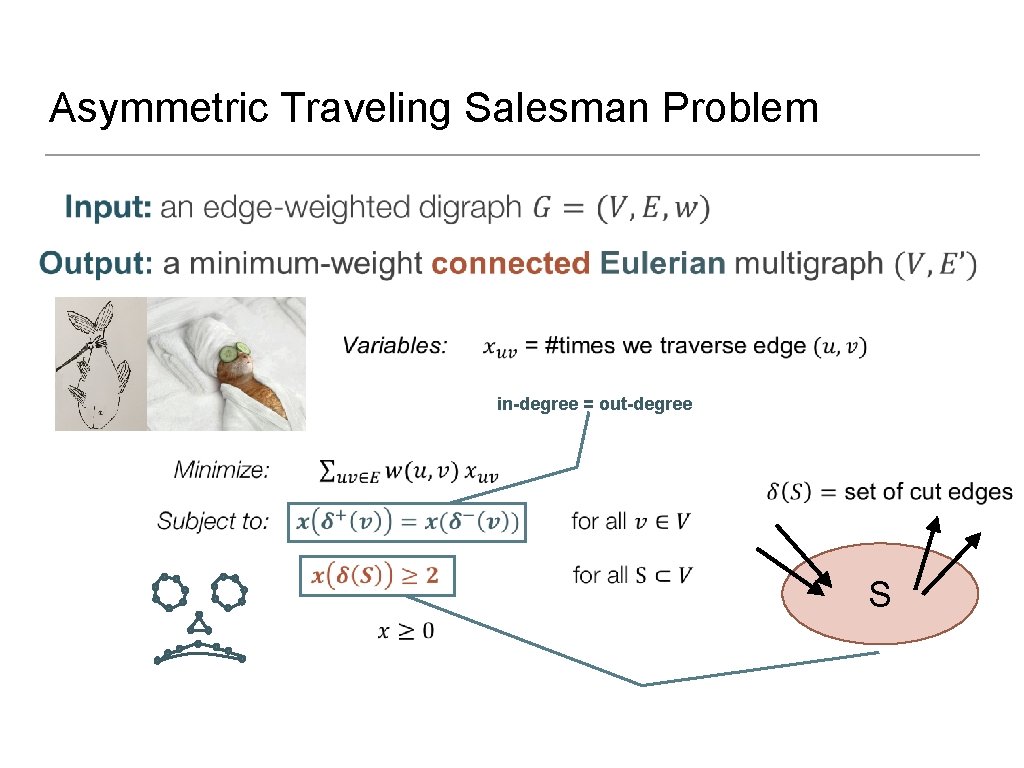
Asymmetric Traveling Salesman Problem in-degree = out-degree S
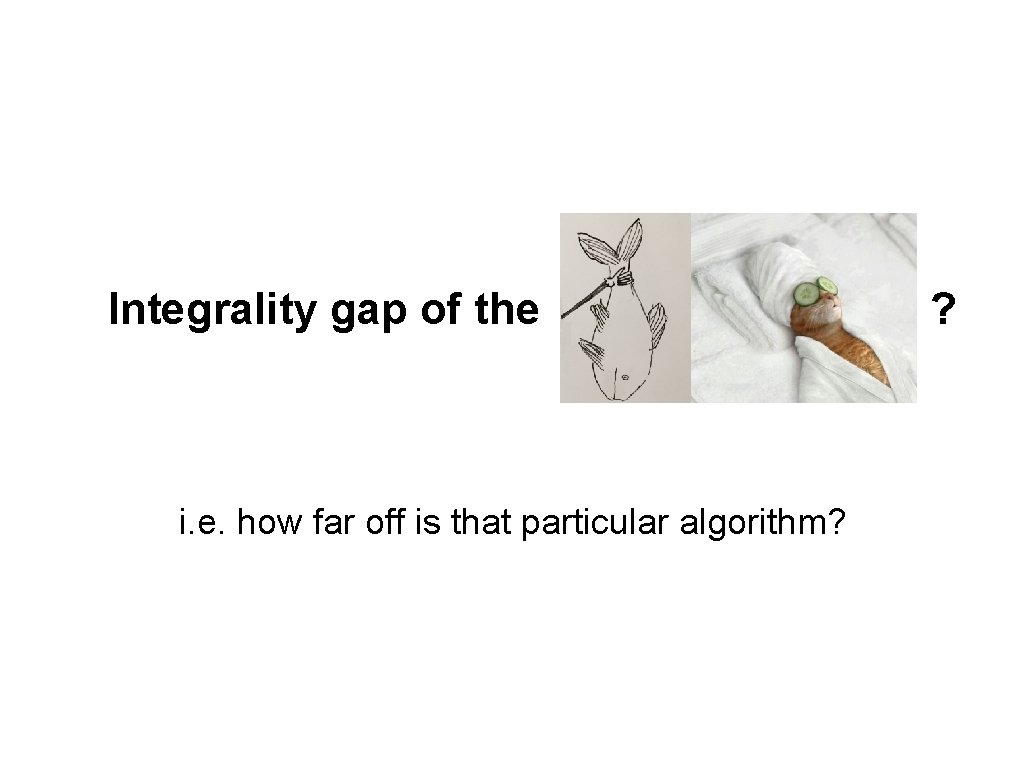
Integrality gap of the i. e. how far off is that particular algorithm? ?
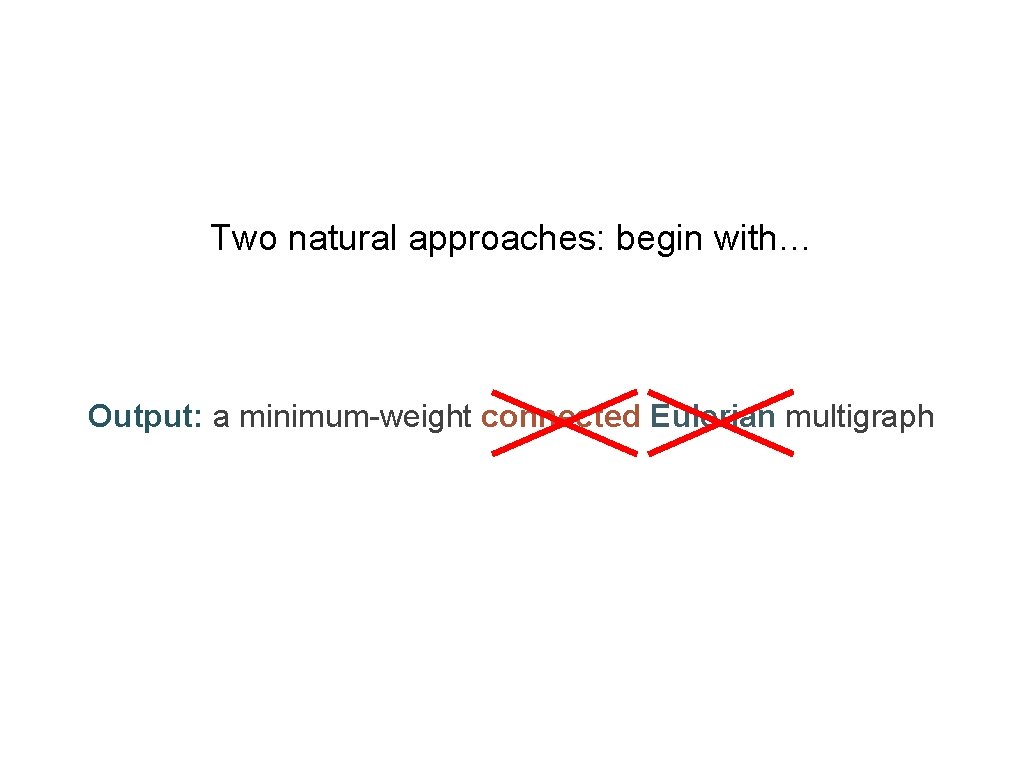
Two natural approaches: begin with… Output: a minimum-weight connected Eulerian multigraph
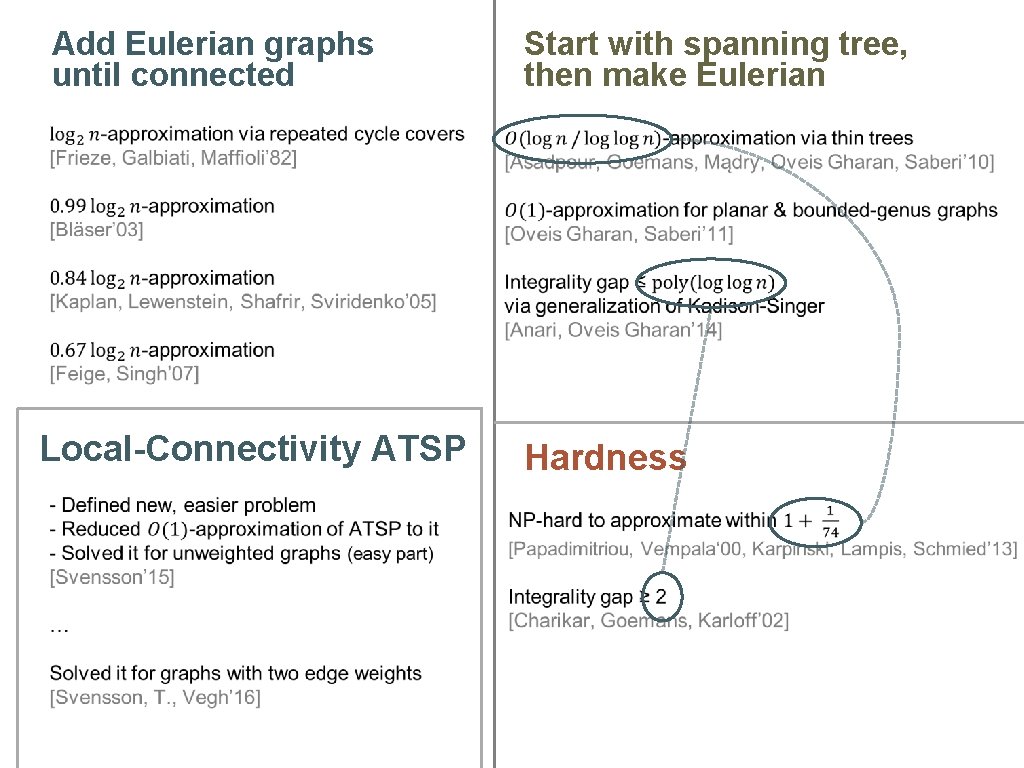
Add Eulerian graphs until connected Start with spanning tree, then make Eulerian Local-Connectivity ATSP Hardness
2 -edge-weights ATSP general ATSP [Svensson’ 15] 2 -edge-weights Local-Connectivity ATSP general Local-Connectivity ATSP structured ATSP this talk more structured ATSP Solve [Svensson, T. , Vegh’ 16] really structured Local-Connectivity ATSP Solve [Svensson’ 15] really structured ATSP
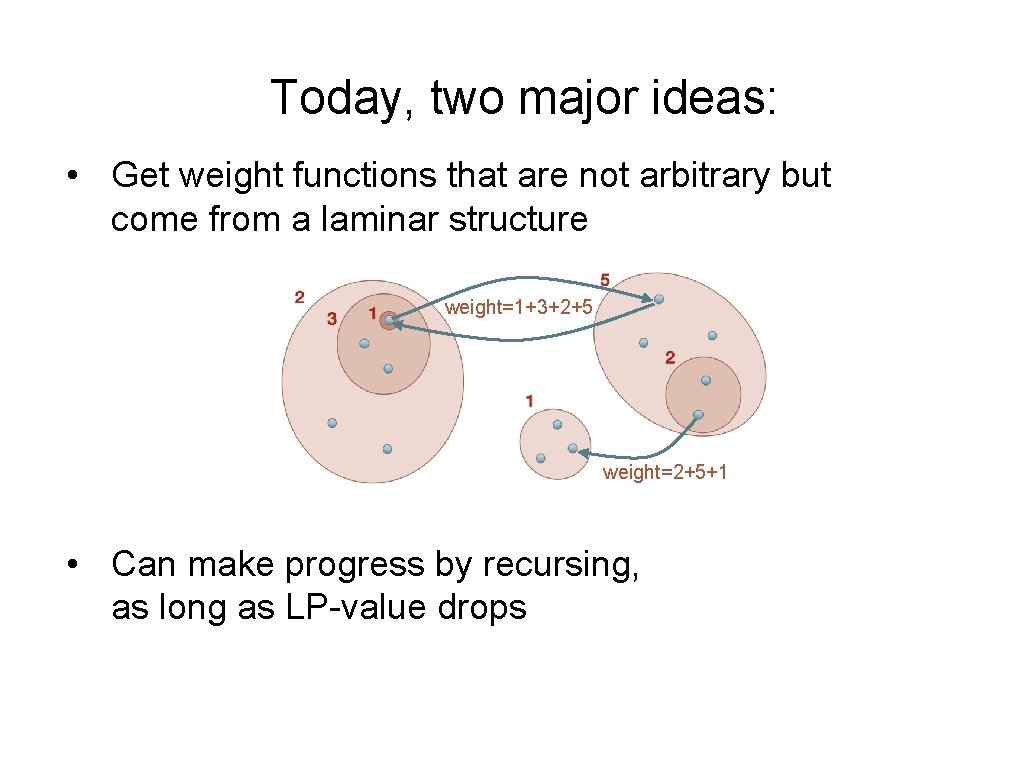
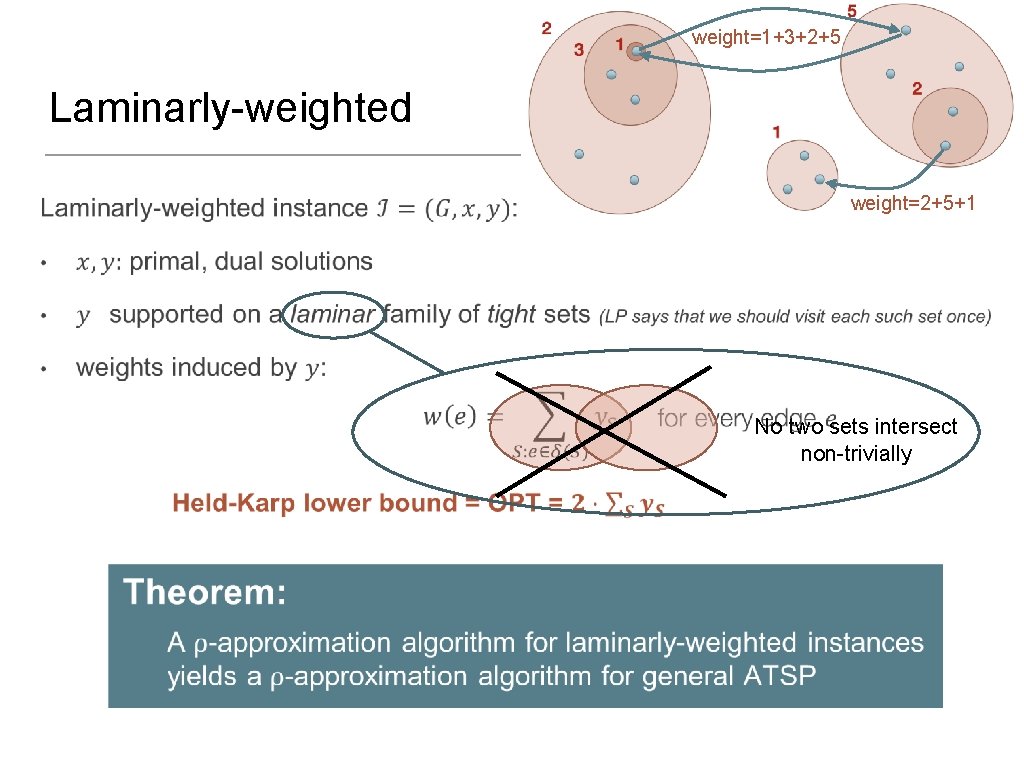
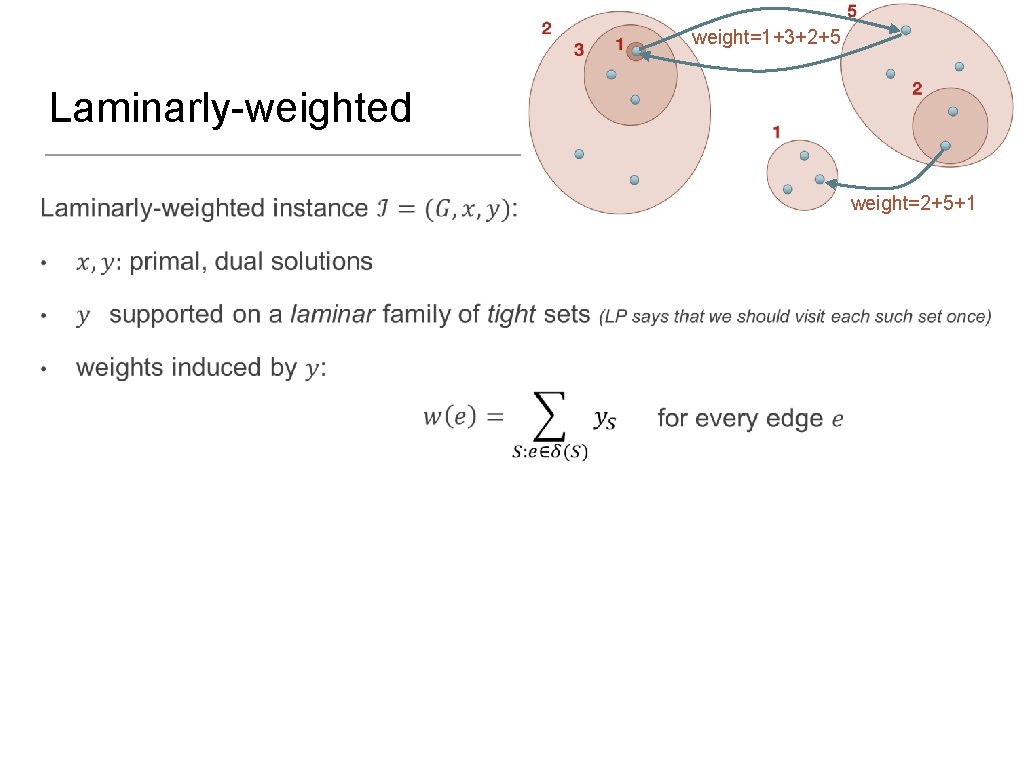
Today, two major ideas: • Get weight functions that are not arbitrary but come from a laminar structure weight=1+3+2+5 weight=2+5+1 • Can make progress by recursing, as long as LP-value drops
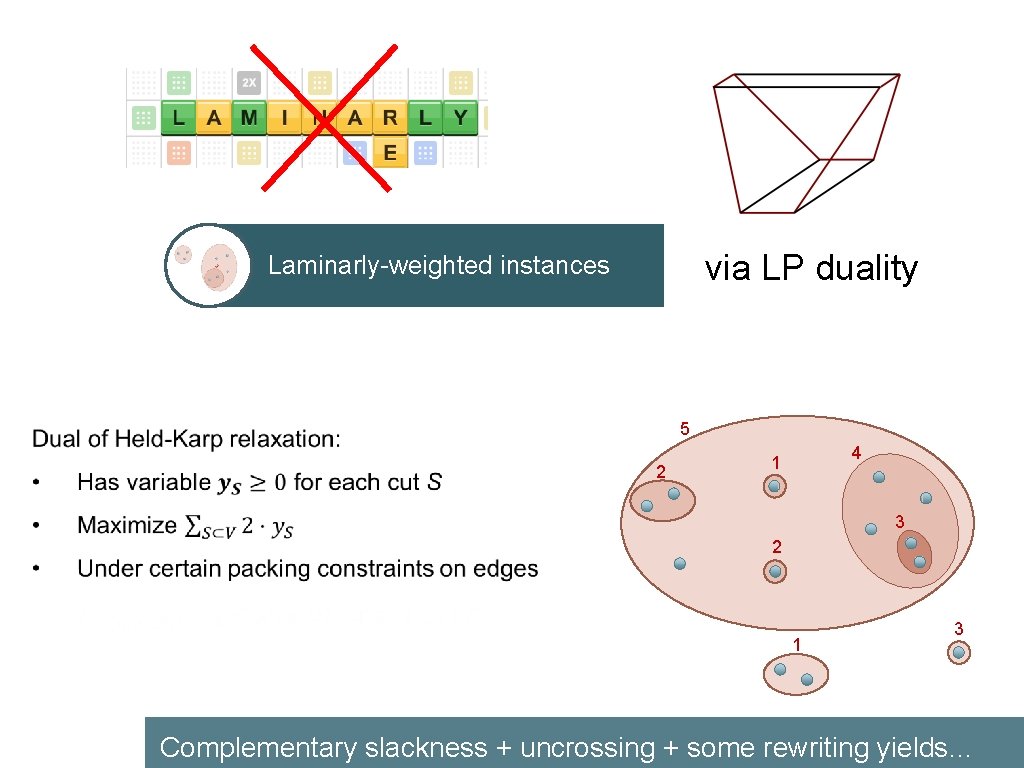
via LP duality Laminarly-weighted instances 5 2 4 1 3 2 1 3 Complementary slackness + uncrossing + some rewriting yields…
weight=1+3+2+5 Laminarly-weighted • weight=2+5+1 No two sets intersect non-trivially
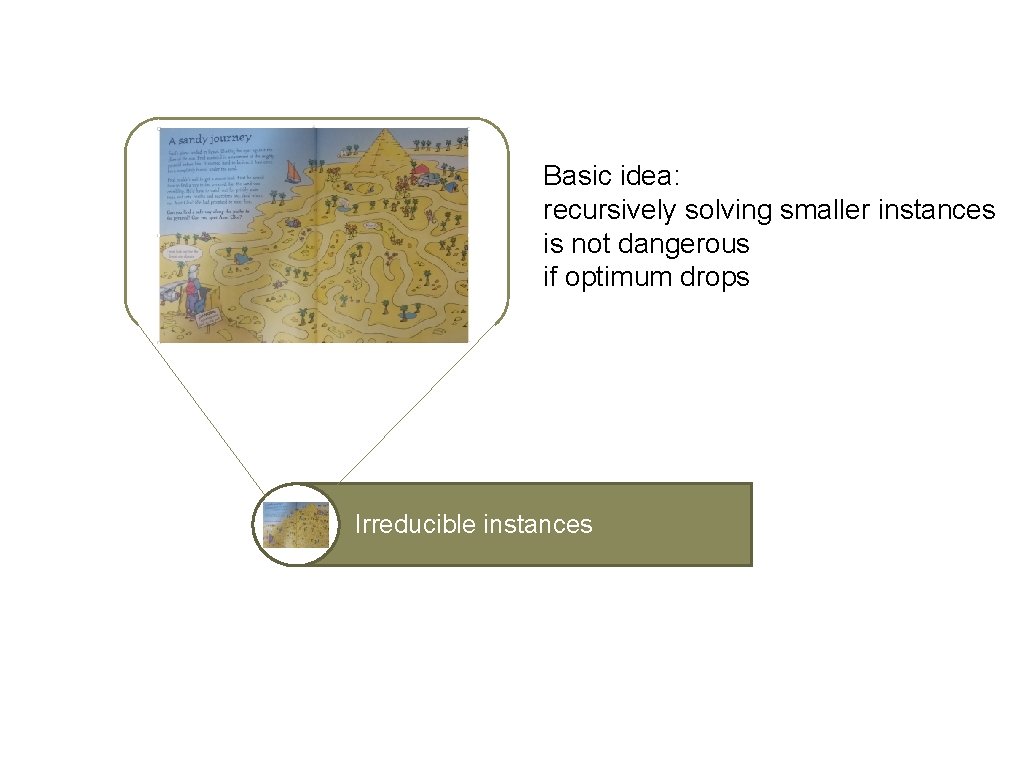
Basic idea: recursively solving smaller instances is not dangerous if optimum drops Irreducible instances
Let’s take a detour
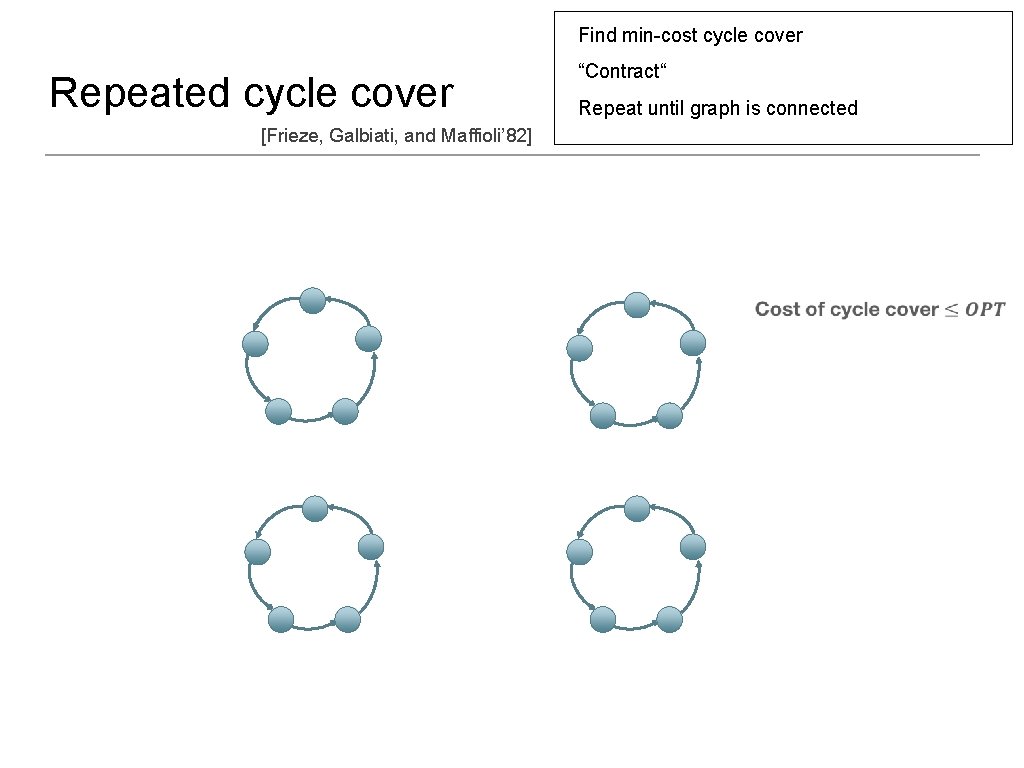
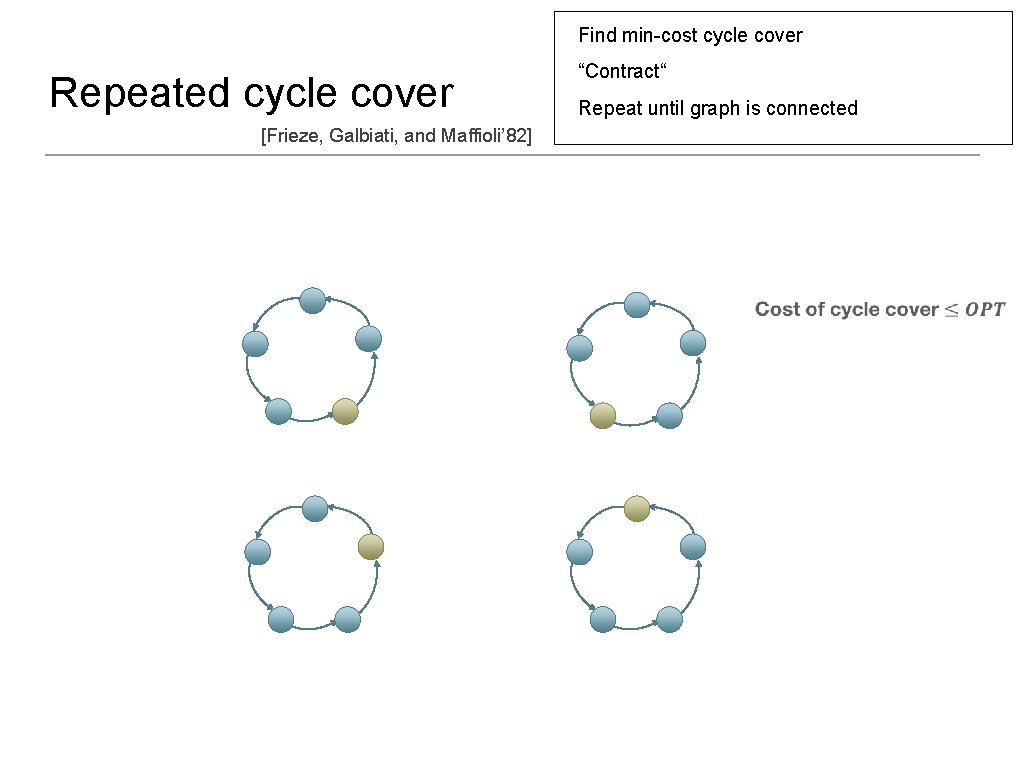
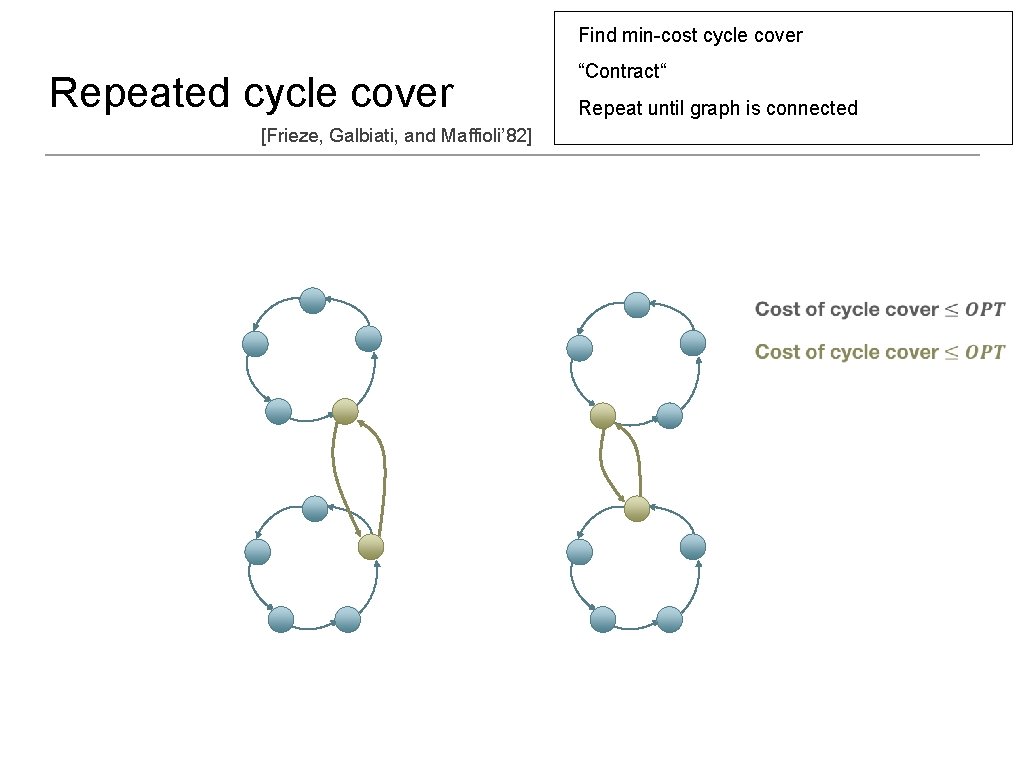
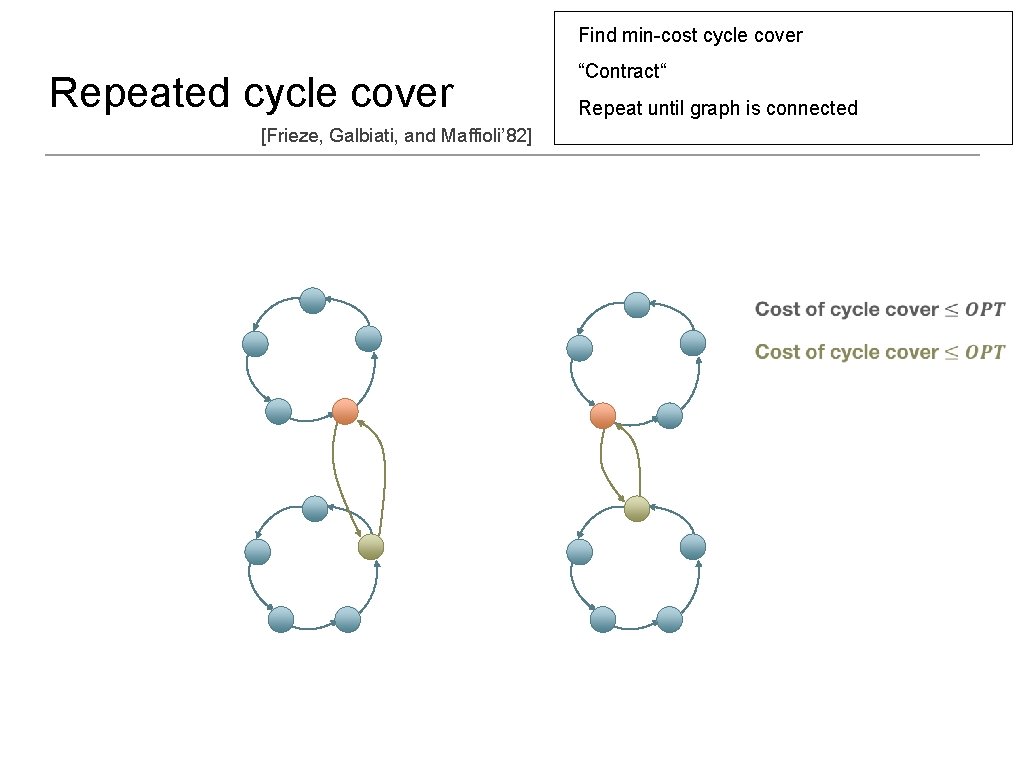
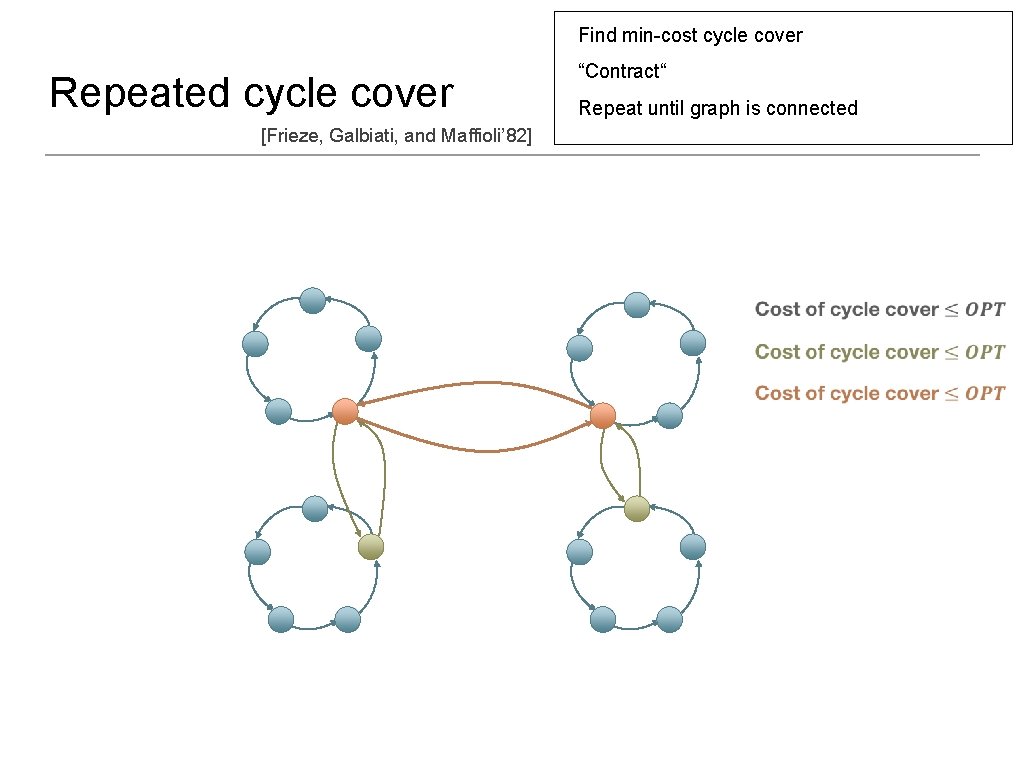
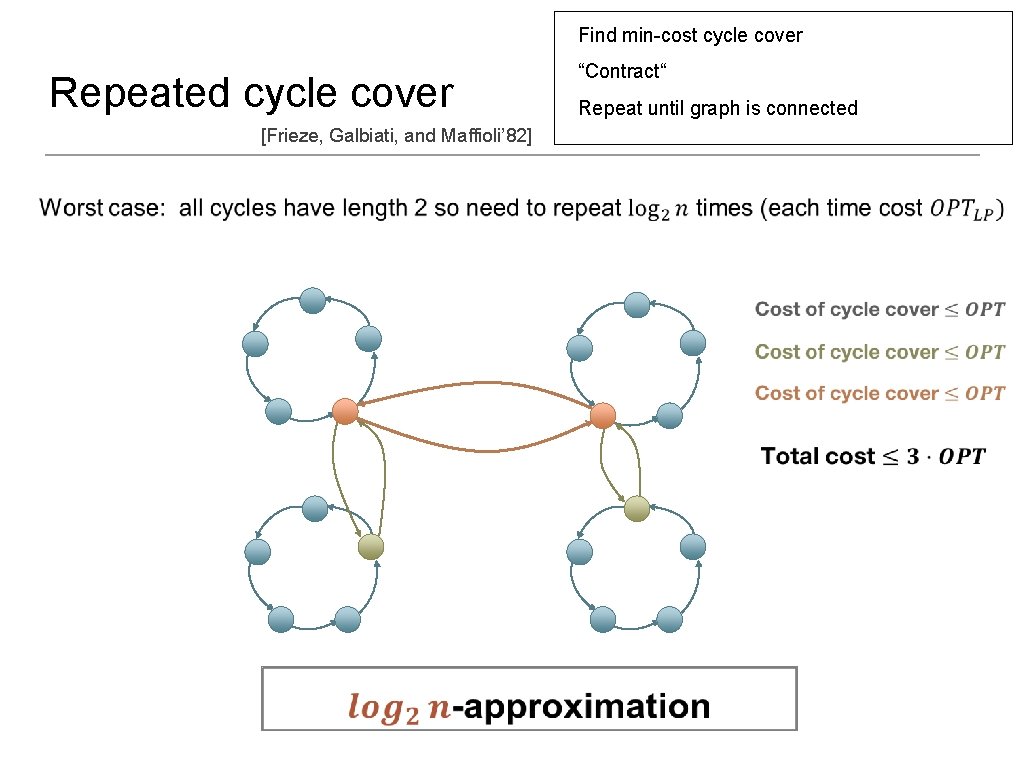
Find min-cost cycle cover Repeated cycle cover [Frieze, Galbiati, and Maffioli’ 82] “Contract“ Repeat until graph is connected
Find min-cost cycle cover Repeated cycle cover “Contract“ Repeat until graph is connected [Frieze, Galbiati, and Maffioli’ 82]
Find min-cost cycle cover Repeated cycle cover “Contract“ Repeat until graph is connected [Frieze, Galbiati, and Maffioli’ 82]
Find min-cost cycle cover Repeated cycle cover “Contract“ Repeat until graph is connected [Frieze, Galbiati, and Maffioli’ 82]
Find min-cost cycle cover Repeated cycle cover “Contract“ Repeat until graph is connected [Frieze, Galbiati, and Maffioli’ 82]
Find min-cost cycle cover Repeated cycle cover “Contract“ Repeat until graph is connected [Frieze, Galbiati, and Maffioli’ 82]
Find min-cost cycle cover “Contract“ Repeated cycle cover Repeat until graph is connected [Frieze, Galbiati, and Maffioli’ 82]
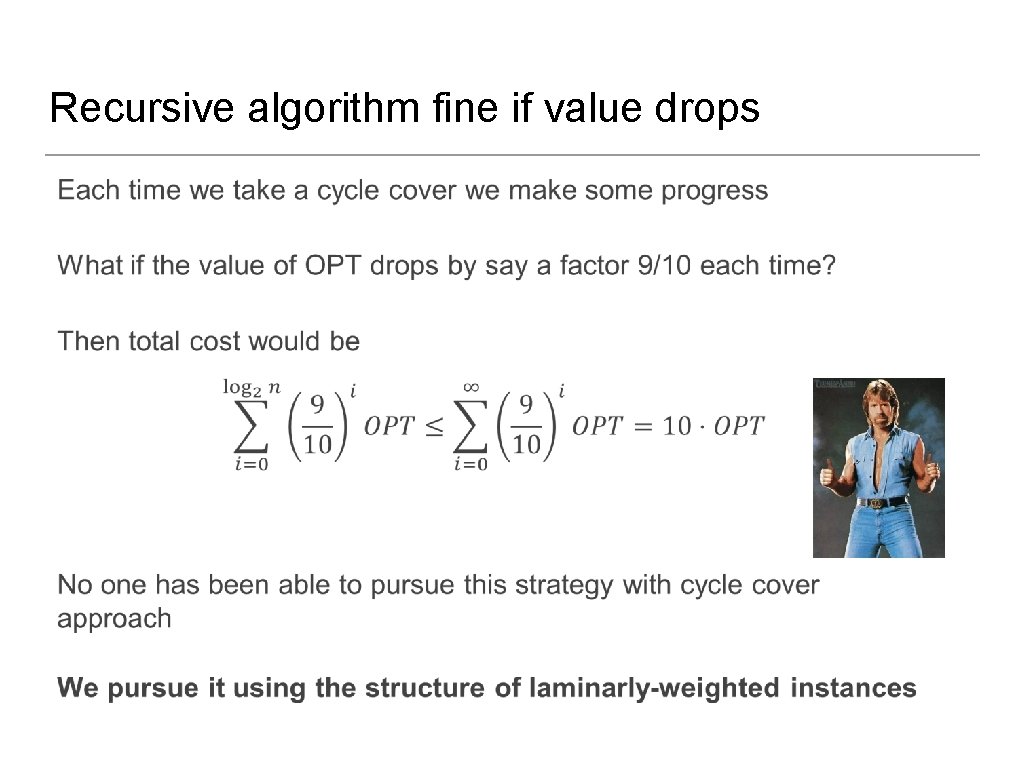
Recursive algorithm fine if value drops •
Le retour
weight=1+3+2+5 Laminarly-weighted weight=2+5+1
Key idea: recursive approach via contracting laminar sets
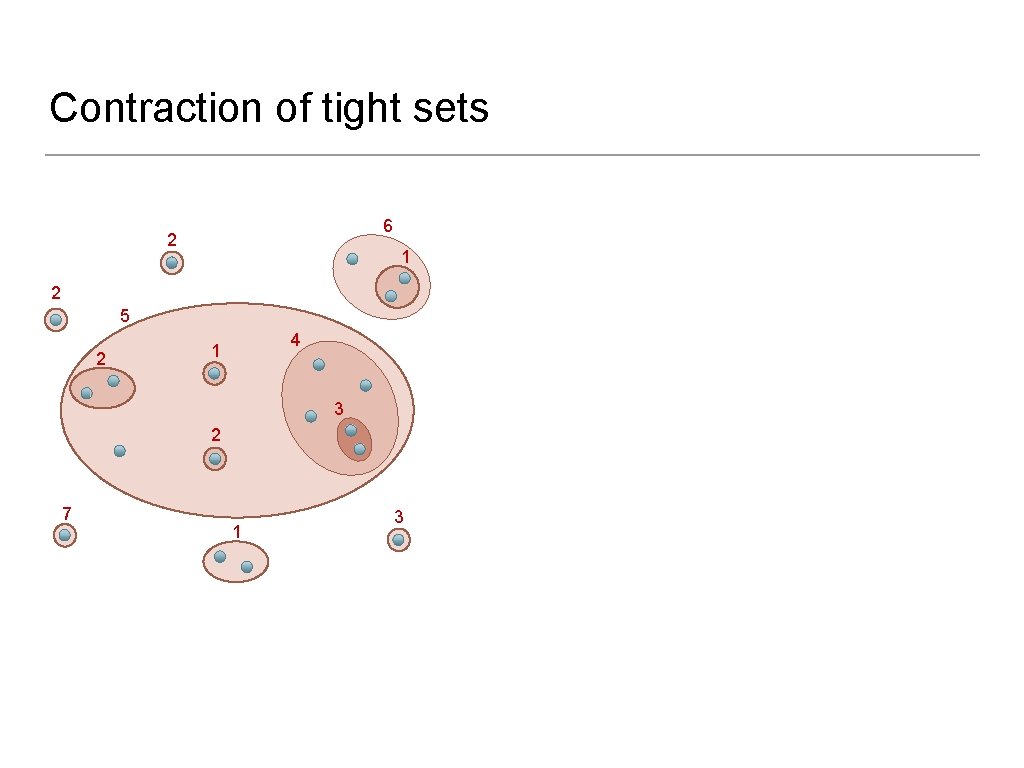
Contraction of tight sets 6 2 1 2 5 2 4 1 3 2 7 1 3
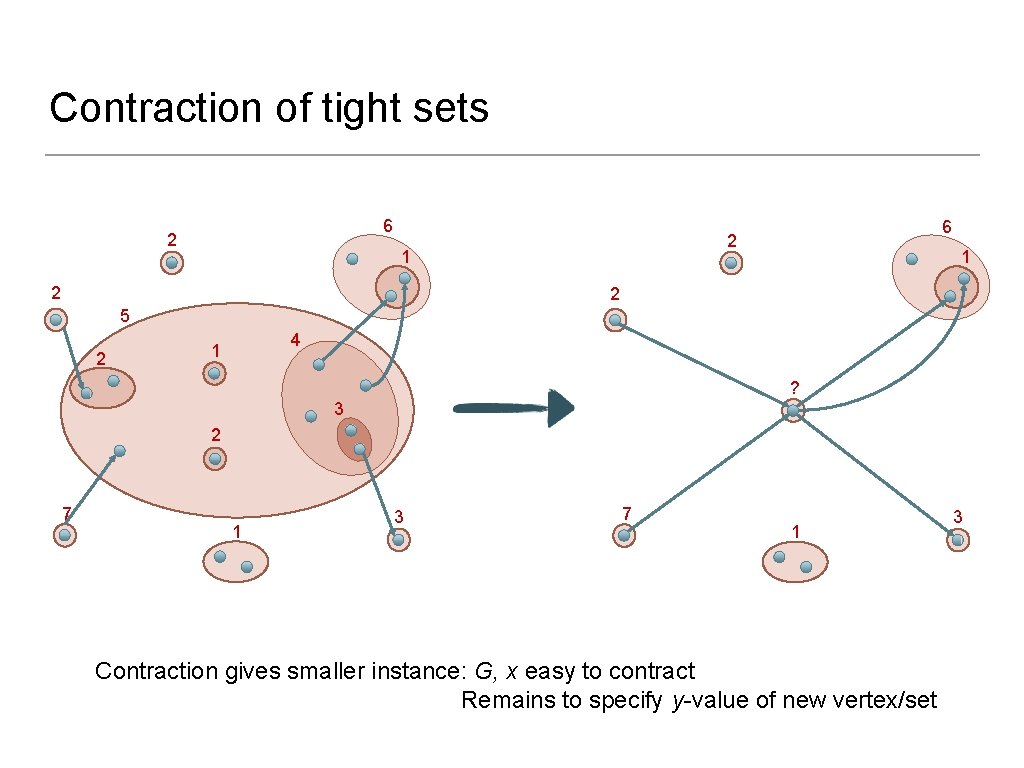
Contraction of tight sets 6 2 1 2 5 2 4 1 ? 3 2 7 1 3 7 1 Contraction gives smaller instance: G, x easy to contract Remains to specify y-value of new vertex/set 3
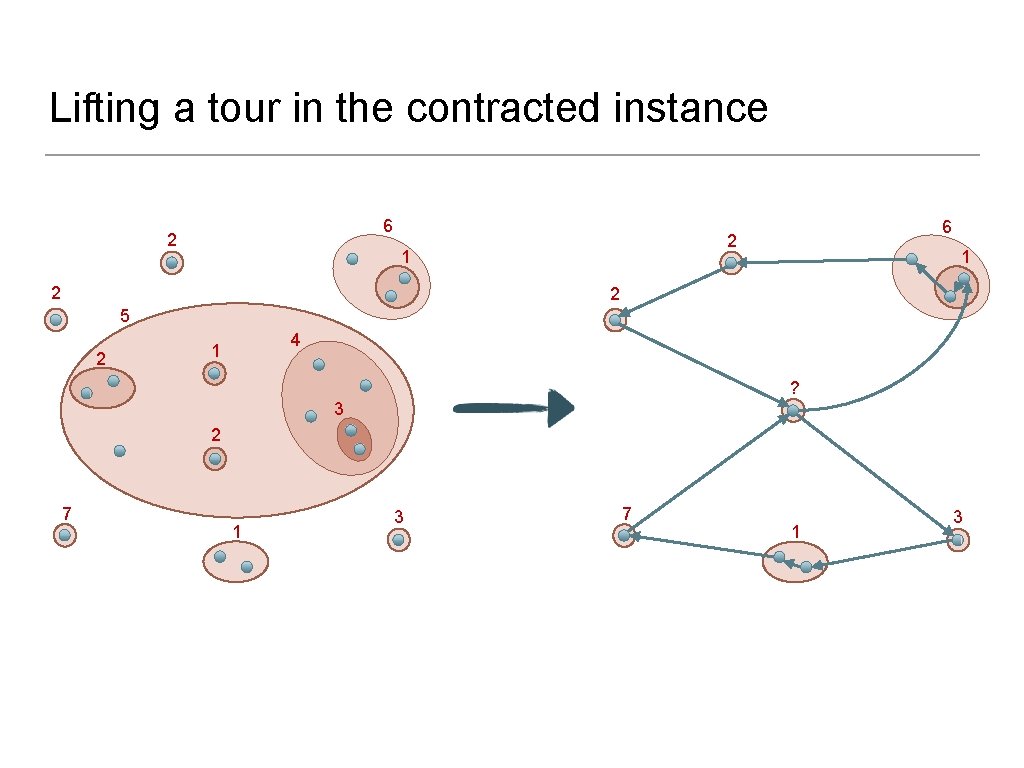
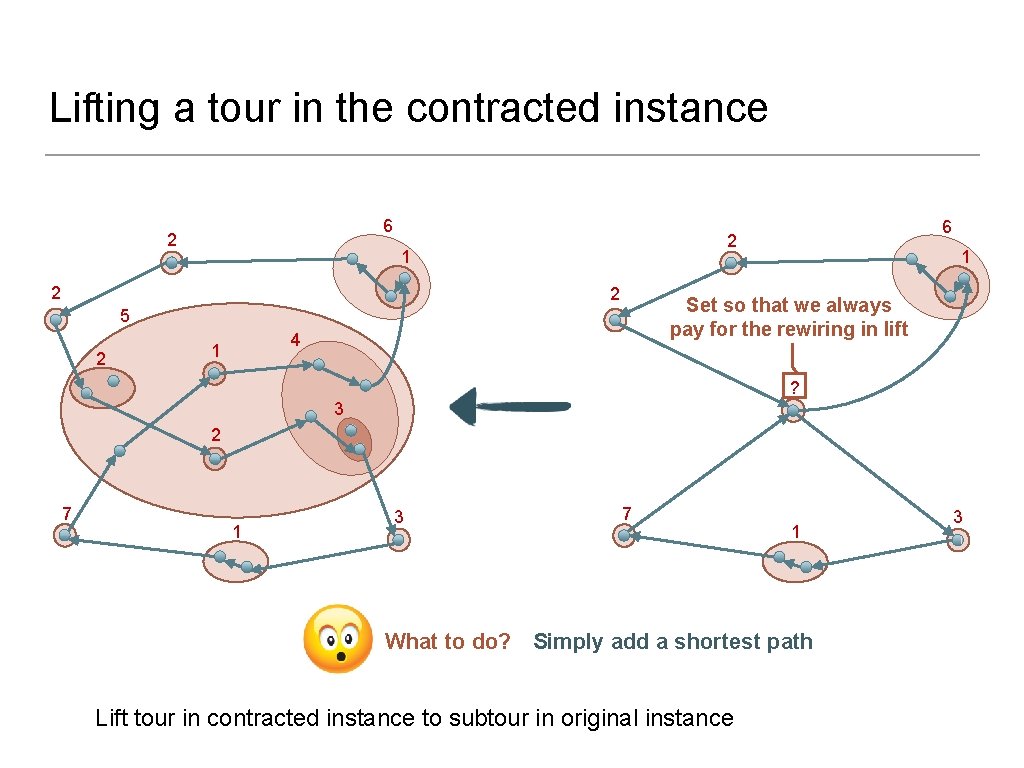
Lifting a tour in the contracted instance 6 2 1 2 5 2 4 1 ? 3 2 7 1 3
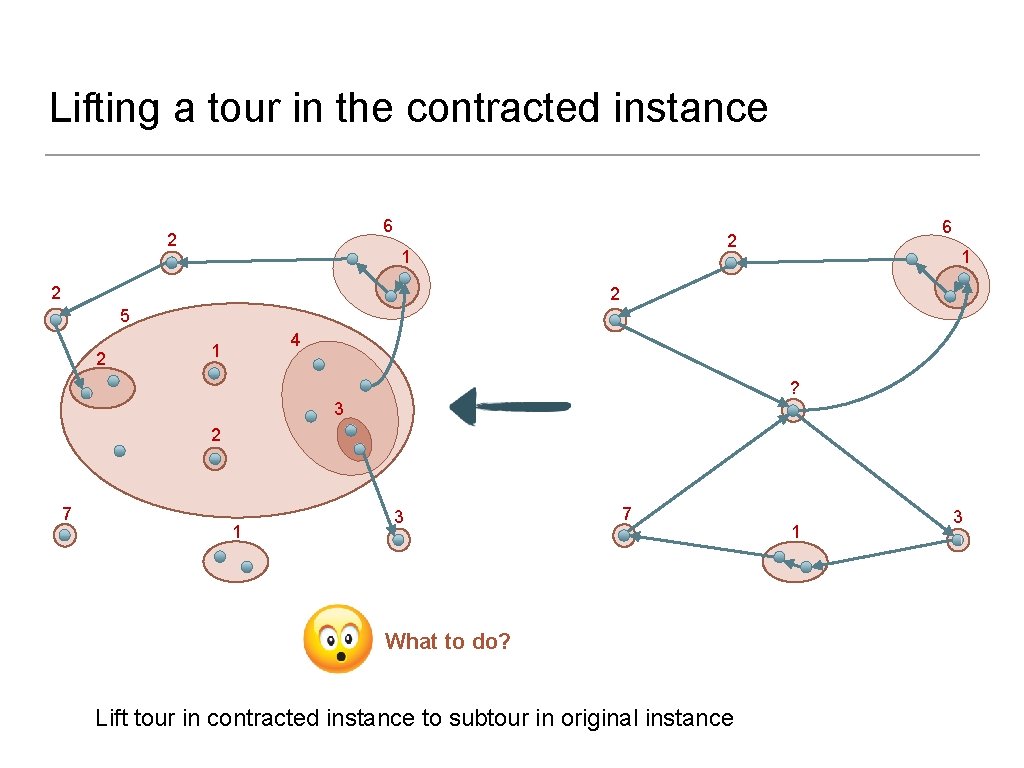
Lifting a tour in the contracted instance 6 2 1 2 5 2 4 1 ? 3 2 7 1 3 7 What to do? Lift tour in contracted instance to subtour in original instance 1 3
Lifting a tour in the contracted instance 6 2 1 2 2 2 1 Set so that we always pay for the rewiring in lift 5 4 1 6 2 ? 3 2 7 1 3 7 1 What to do? Simply add a shortest path Lift tour in contracted instance to subtour in original instance 3
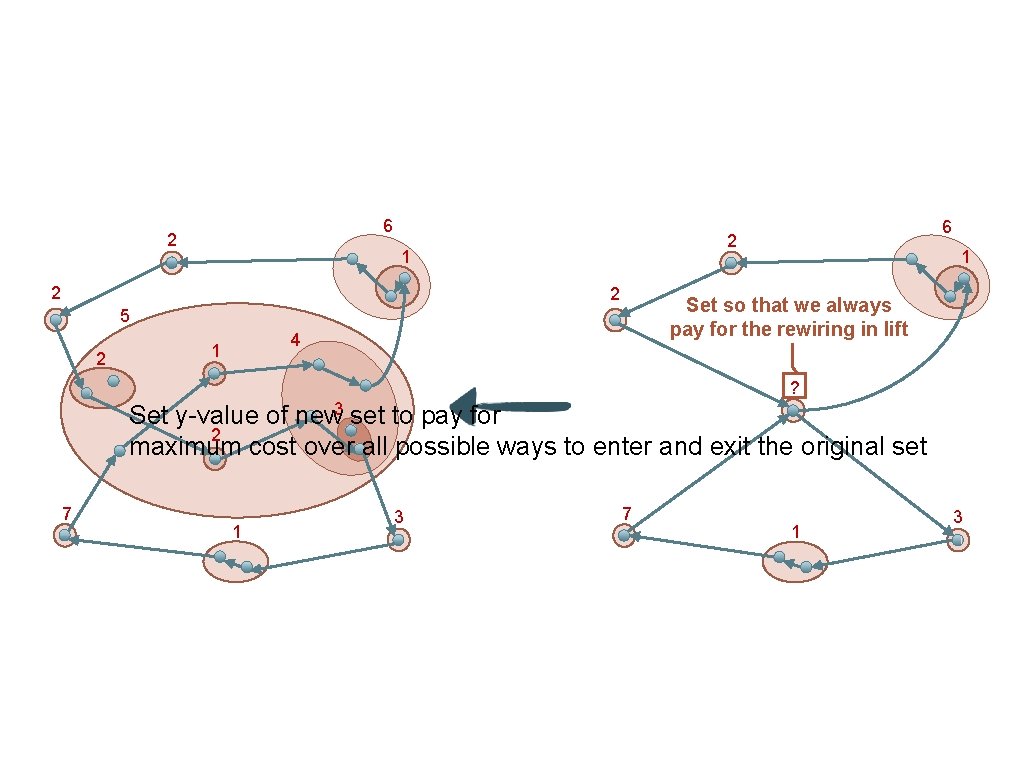
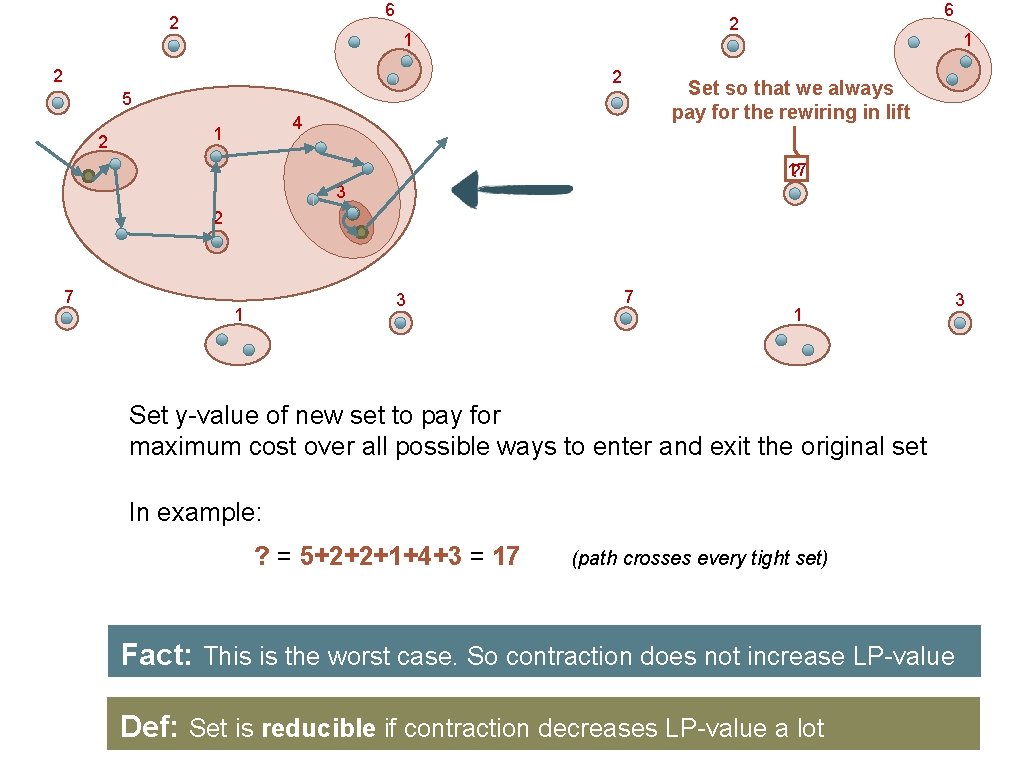
6 2 1 2 2 2 1 Set so that we always pay for the rewiring in lift 5 4 1 6 2 ? 3 Set y-value of new set to pay for 2 maximum cost over all possible ways to enter and exit the original set 7 1 3
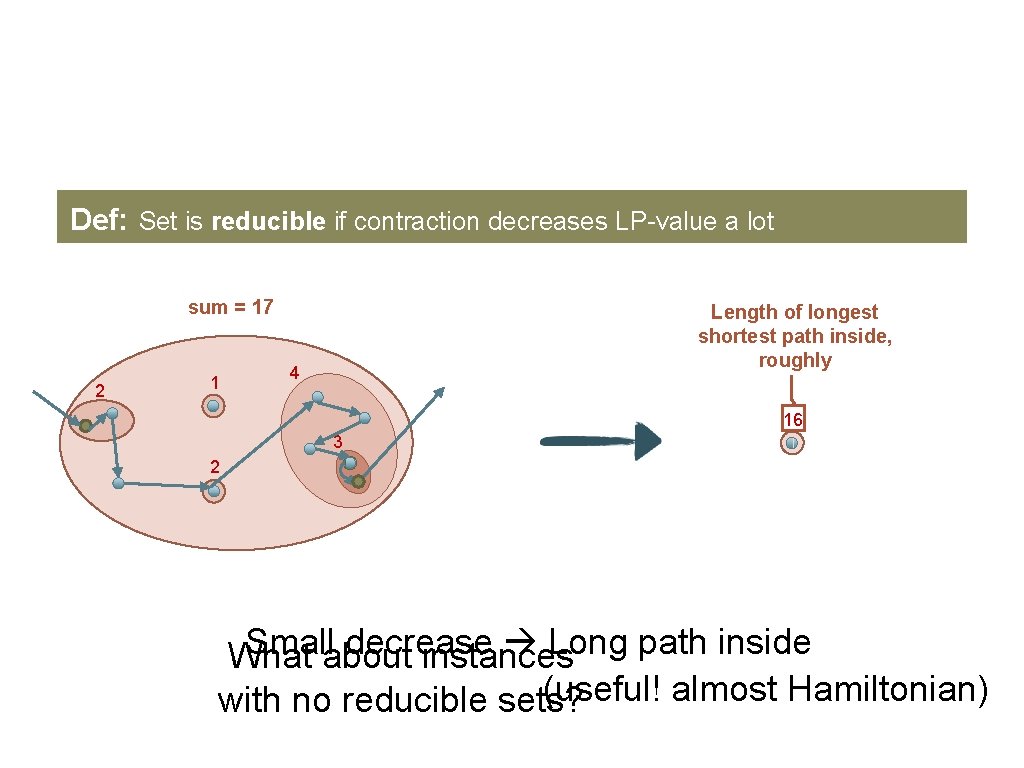
6 2 2 1 2 2 2 1 Set so that we always pay for the rewiring in lift 5 4 1 6 17 ? 3 2 7 3 1 7 1 3 Set y-value of new set to pay for maximum cost over all possible ways to enter and exit the original set In example: ? = 5+2+2+1+4+3 = 17 (path crosses every tight set) Fact: This is the worst case. So contraction does not increase LP-value Def: Set is reducible if contraction decreases LP-value a lot
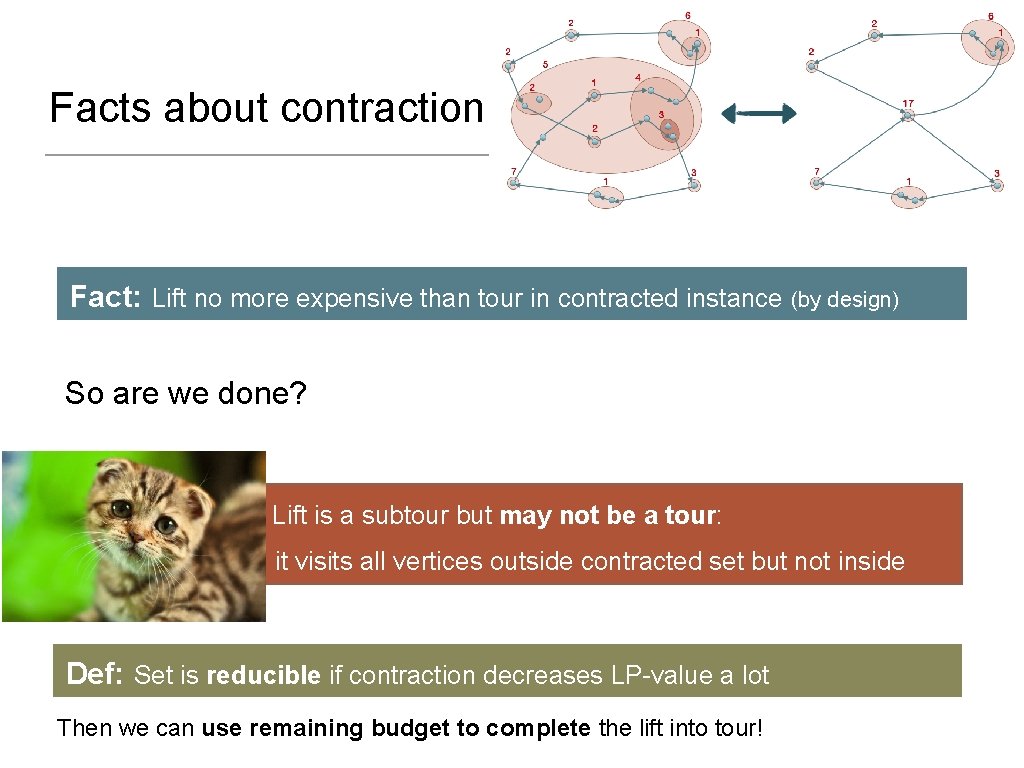
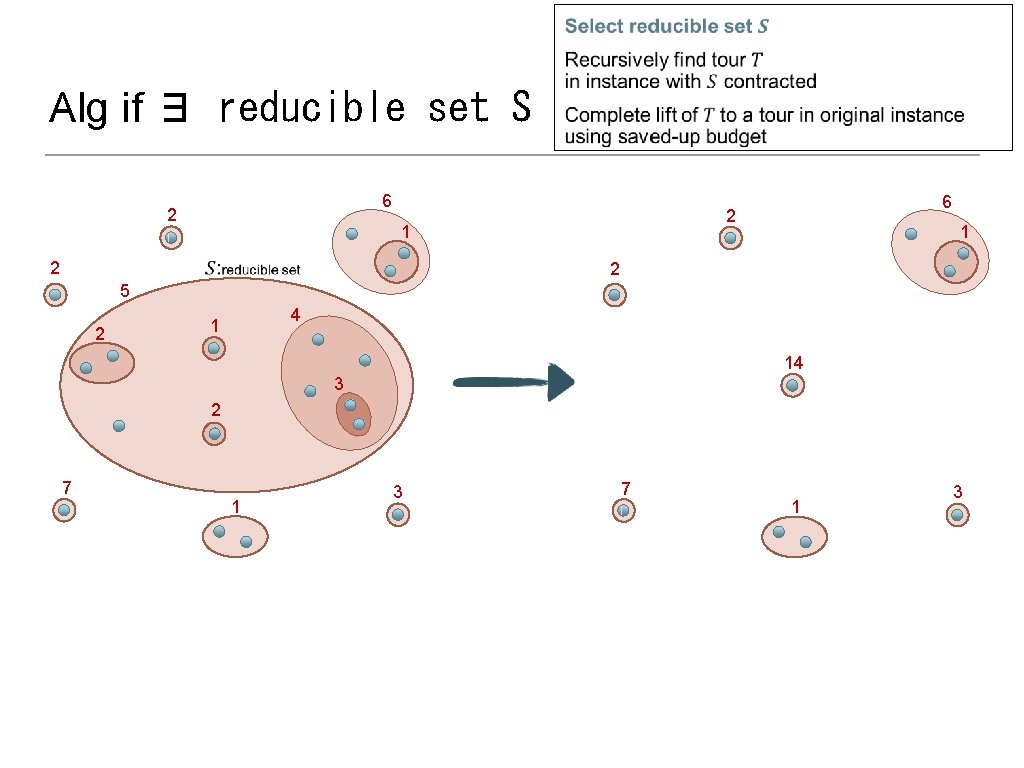
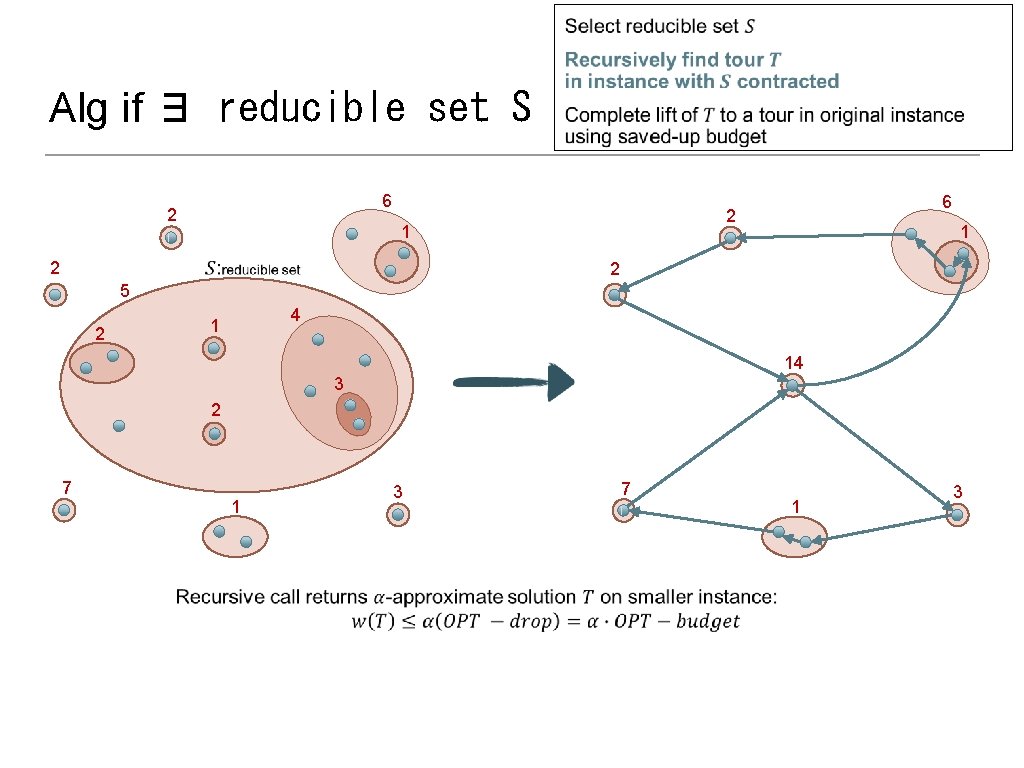
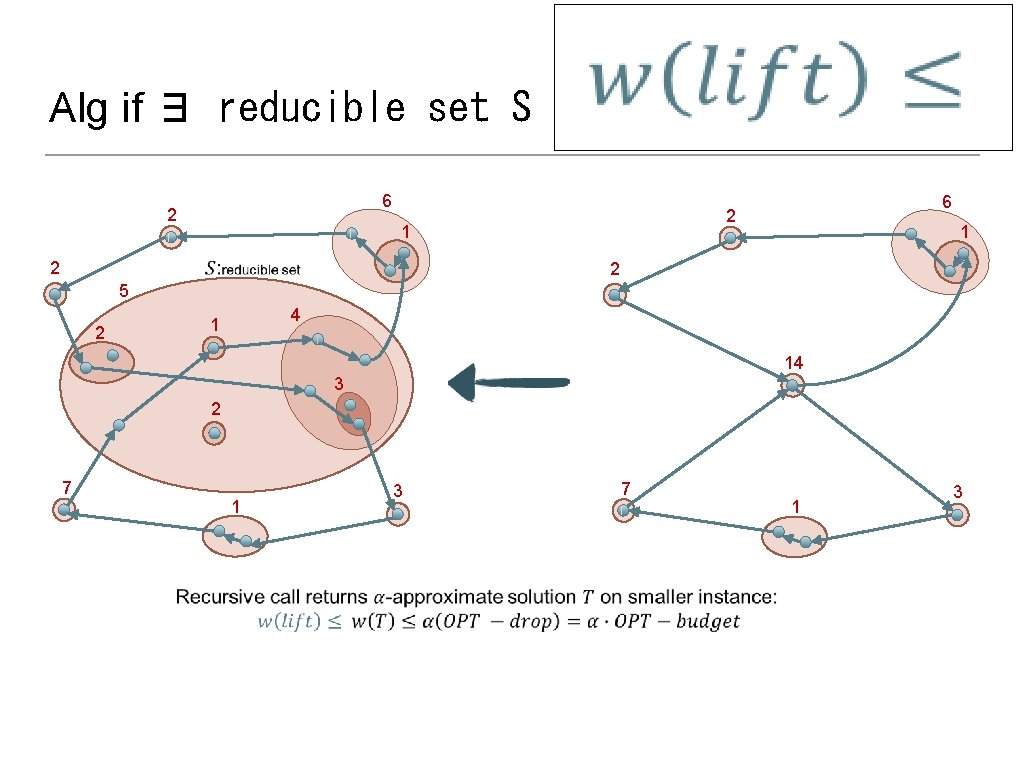
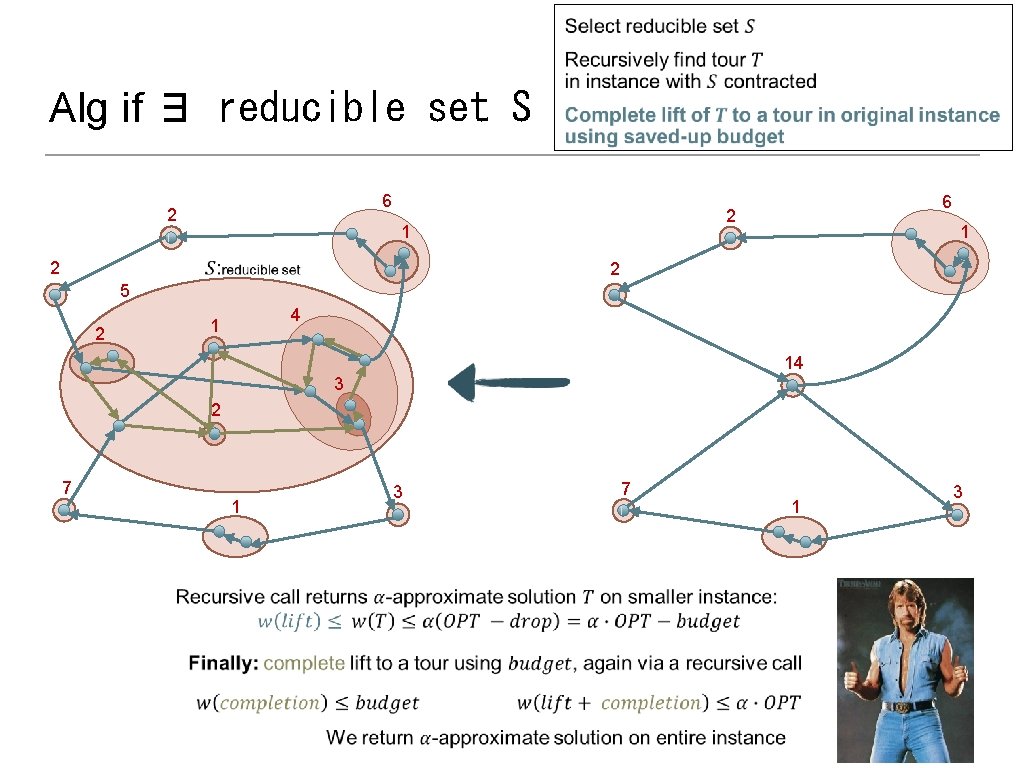
Facts about contraction Fact: Lift no more expensive than tour in contracted instance (by design) So are we done? Negative fact: Lift is a subtour but may not be a tour: it visits all vertices outside contracted set but not inside Def: Set is reducible if contraction decreases LP-value a lot Then we can use remaining budget to complete the lift into tour!
Implementing recursive strategy
Alg if ∃ reducible set S 6 2 5 2 2 1 2 6 1 2 4 1 14 3 2 7 1 3
Alg if ∃ reducible set S 6 2 5 2 2 1 2 6 1 2 4 1 14 3 2 7 1 7 3 1 3
Alg if ∃ reducible set S 6 2 5 2 2 1 2 6 1 2 4 1 14 3 2 7 7 3 1 1 3
Alg if ∃ reducible set S 6 2 5 2 2 1 2 6 1 2 4 1 14 3 2 7 7 3 1 3
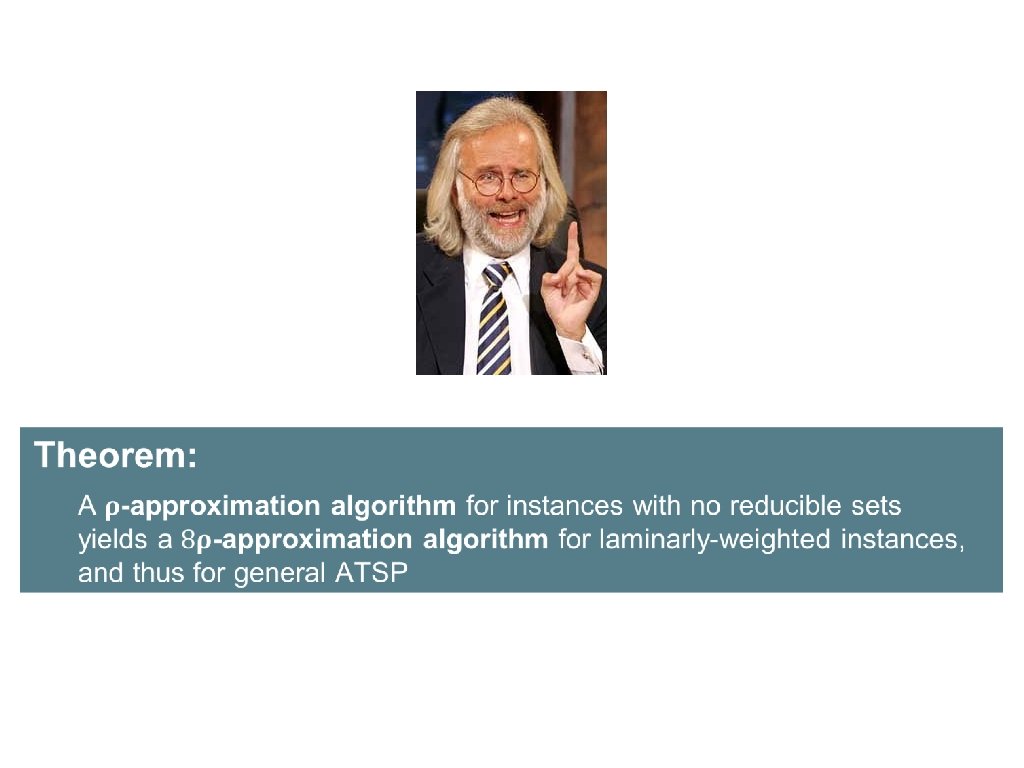
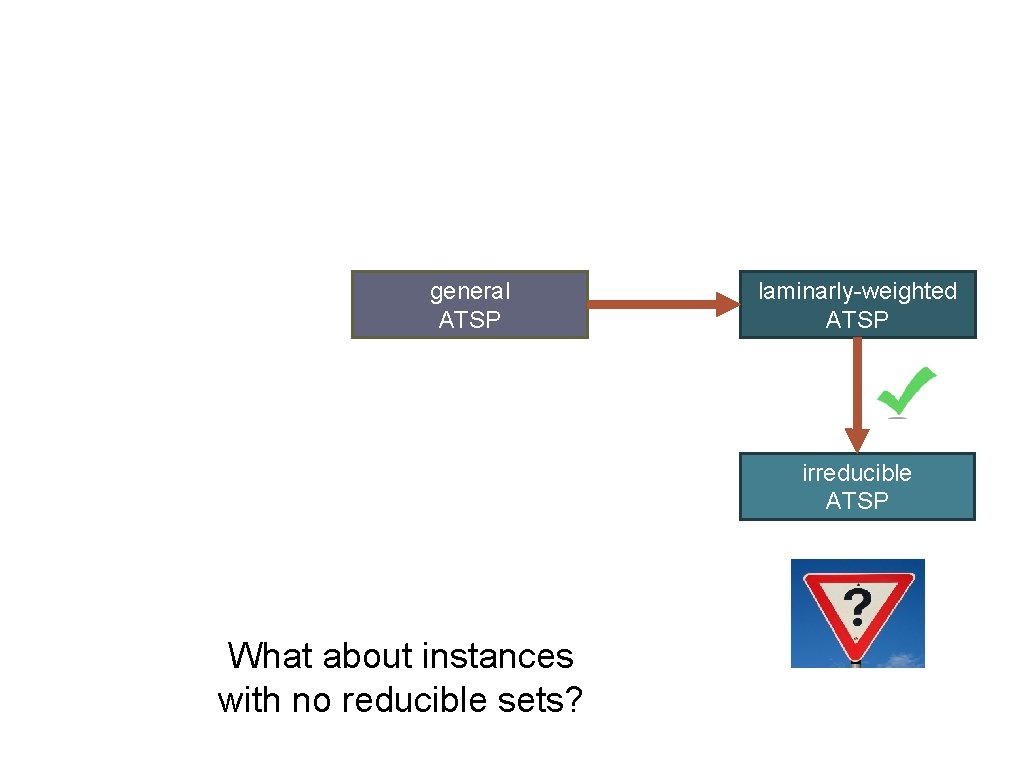
general ATSP laminarly-weighted ATSP irreducible ATSP What about instances with no reducible sets?
Def: Set is reducible if contraction decreases LP-value a lot sum = 17 2 1 Length of longest shortest path inside, roughly 4 16 3 2 Small decrease Long path inside What about instances (useful! almost Hamiltonian) with no reducible sets?
The rest of the story 10 -page version of paper with main ideas Recorded talks Talk to me at the poster session!
Summary and open problems…
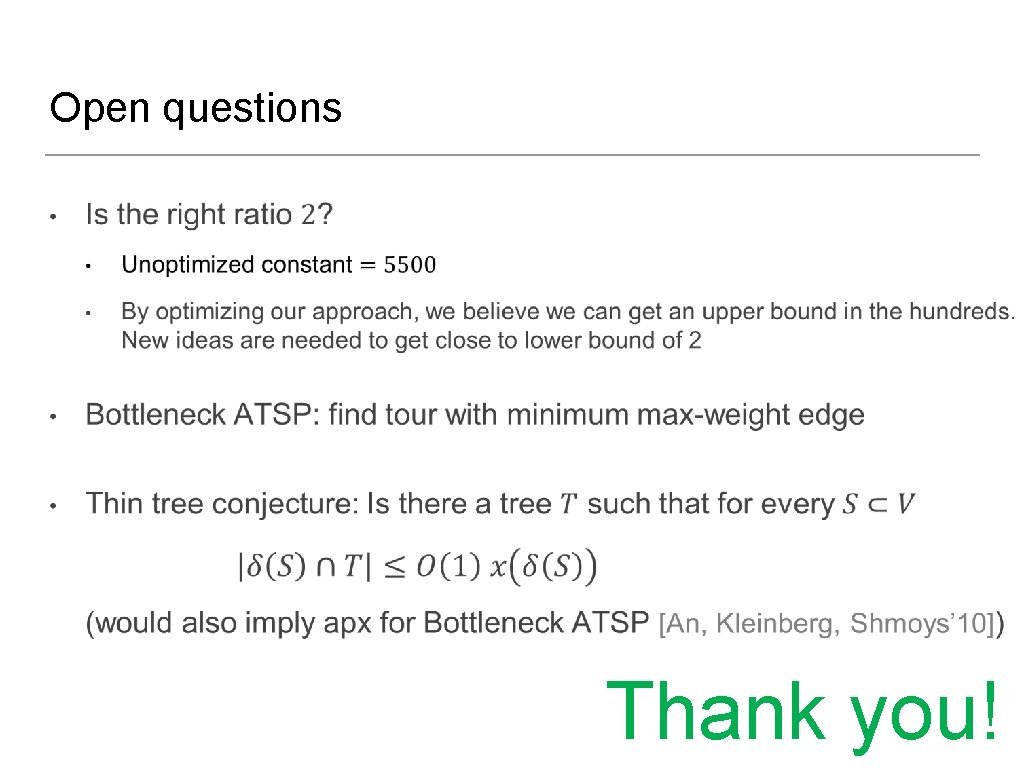
Open questions • Thank you!