
A concise title example A template for poster
- Slides: 1
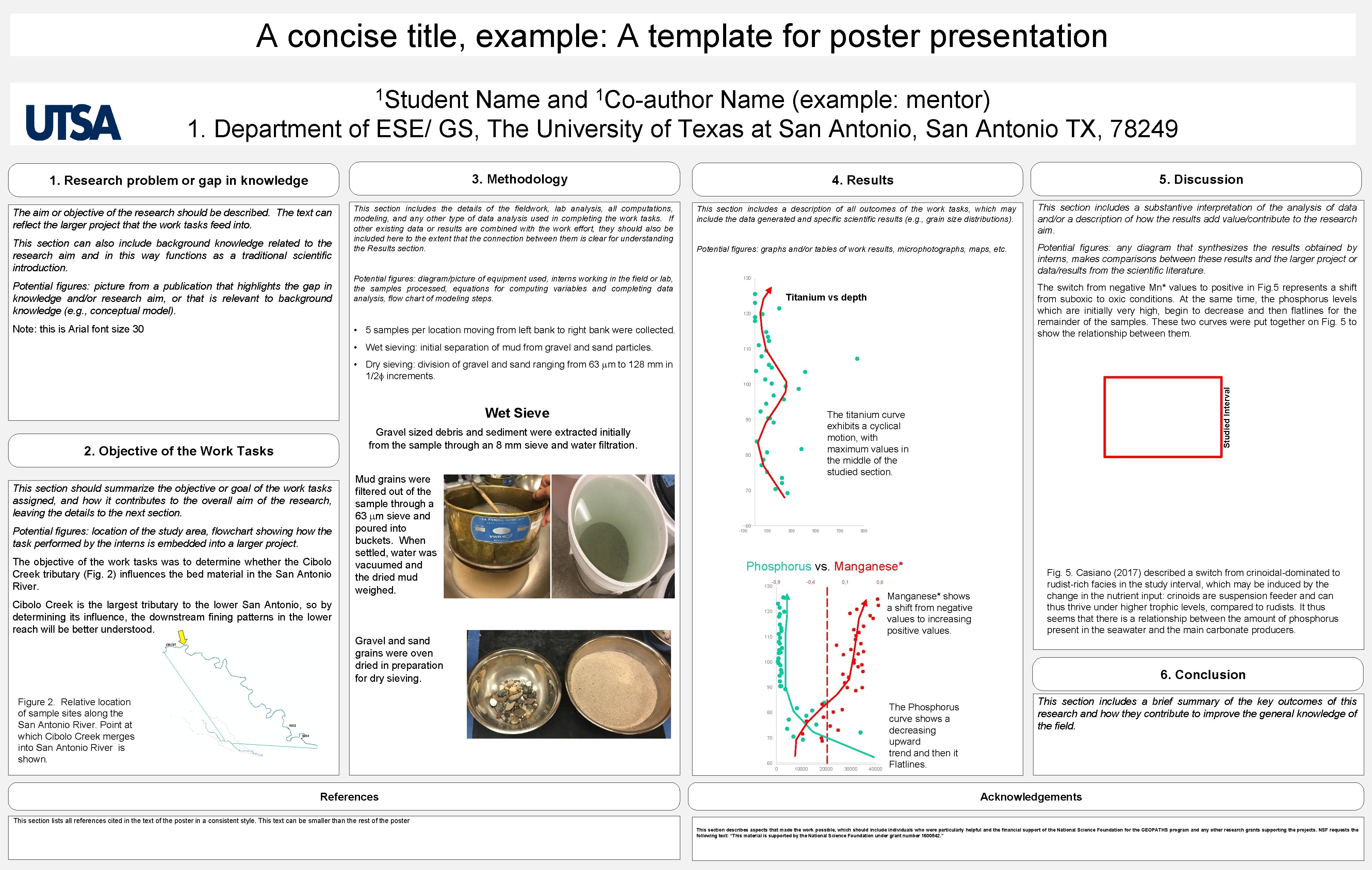
A concise title, example: A template for poster presentation 1 Student 1 Co-author Name and Name (example: mentor) 1. Department of ESE/ GS, The University of Texas at San Antonio, San Antonio TX, 78249 3. Methodology 1. Research problem or gap in knowledge The aim or objective of the research should be described. The text can reflect the larger project that the work tasks feed into. This section can also include background knowledge related to the research aim and in this way functions as a traditional scientific introduction. Potential figures: picture from a publication that highlights the gap in knowledge and/or research aim, or that is relevant to background knowledge (e. g. , conceptual model). Note: this is Arial font size 30 This section includes the details of the fieldwork, lab analysis, all computations, modeling, and any other type of data analysis used in completing the work tasks. If other existing data or results are combined with the work effort, they should also be included here to the extent that the connection between them is clear for understanding the Results section. Potential figures: diagram/picture of equipment used, interns working in the field or lab, the samples processed, equations for computing variables and completing data analysis, flow chart of modeling steps. This section includes a description of all outcomes of the work tasks, which may include the data generated and specific scientific results (e. g. , grain size distributions). This section includes a substantive interpretation of the analysis of data and/or a description of how the results add value/contribute to the research aim. Potential figures: graphs and/or tables of work results, microphotographs, maps, etc. Potential figures: any diagram that synthesizes the results obtained by interns, makes comparisons between these results and the larger project or data/results from the scientific literature. 130 The switch from negative Mn* values to positive in Fig. 5 represents a shift from suboxic to oxic conditions. At the same time, the phosphorus levels which are initially very high, begin to decrease and then flatlines for the remainder of the samples. These two curves were put together on Fig. 5 to show the relationship between them. Titanium vs depth 120 • 5 samples per location moving from left bank to right bank were collected. • Wet sieving: initial separation of mud from gravel and sand particles. 5. Discussion 4. Results 110 • Dry sieving: division of gravel and sand ranging from 63 m to 128 mm in 1/2 increments. Wet Sieve The titanium curve exhibits a cyclical motion, with maximum values in the middle of the studied section. 90 Gravel sized debris and sediment were extracted initially from the sample through an 8 mm sieve and water filtration. 2. Objective of the Work Tasks 80 This section should summarize the objective or goal of the work tasks assigned, and how it contributes to the overall aim of the research, leaving the details to the next section. Potential figures: location of the study area, flowchart showing how the task performed by the interns is embedded into a larger project. The objective of the work tasks was to determine whether the Cibolo Creek tributary (Fig. 2) influences the bed material in the San Antonio River. Mud grains were filtered out of the sample through a 63 m sieve and poured into buckets. When settled, water was vacuumed and the dried mud weighed. Cibolo Creek is the largest tributary to the lower San Antonio, so by determining its influence, the downstream fining patterns in the lower reach will be better understood. 70 60 -100 300 500 700 900 Phosphorus vs. Manganese* -0, 9 130 -0, 4 0, 1 0, 6 Manganese* shows a shift from negative values to increasing positive values. 120 Gravel and sand grains were oven dried in preparation for dry sieving. Studied Interval 100 110 Fig. 5. Casiano (2017) described a switch from crinoidal-dominated to rudist-rich facies in the study interval, which may be induced by the change in the nutrient input: crinoids are suspension feeder and can thus thrive under higher trophic levels, compared to rudists. It thus seems that there is a relationship between the amount of phosphorus present in the seawater and the main carbonate producers. 100 6. Conclusion 90 Figure 2. Relative location of sample sites along the San Antonio River. Point at which Cibolo Creek merges into San Antonio River is shown. 80 70 60 0 References 10000 20000 30000 40000 The Phosphorus curve shows a decreasing upward trend and then it Flatlines. This section includes a brief summary of the key outcomes of this research and how they contribute to improve the general knowledge of the field. Acknowledgements This section lists all references cited in the text of the poster in a consistent style. This text can be smaller than the rest of the poster This section describes aspects that made the work possible, which should include individuals who were particularly helpful and the financial support of the National Science Foundation for the GEOPATHS program and any other research grants supporting the projects. NSF requests the following text: “This material is supported by the National Science Foundation under grant number 1600542. ”