
A conceptual tool for successful participation Subject Participation
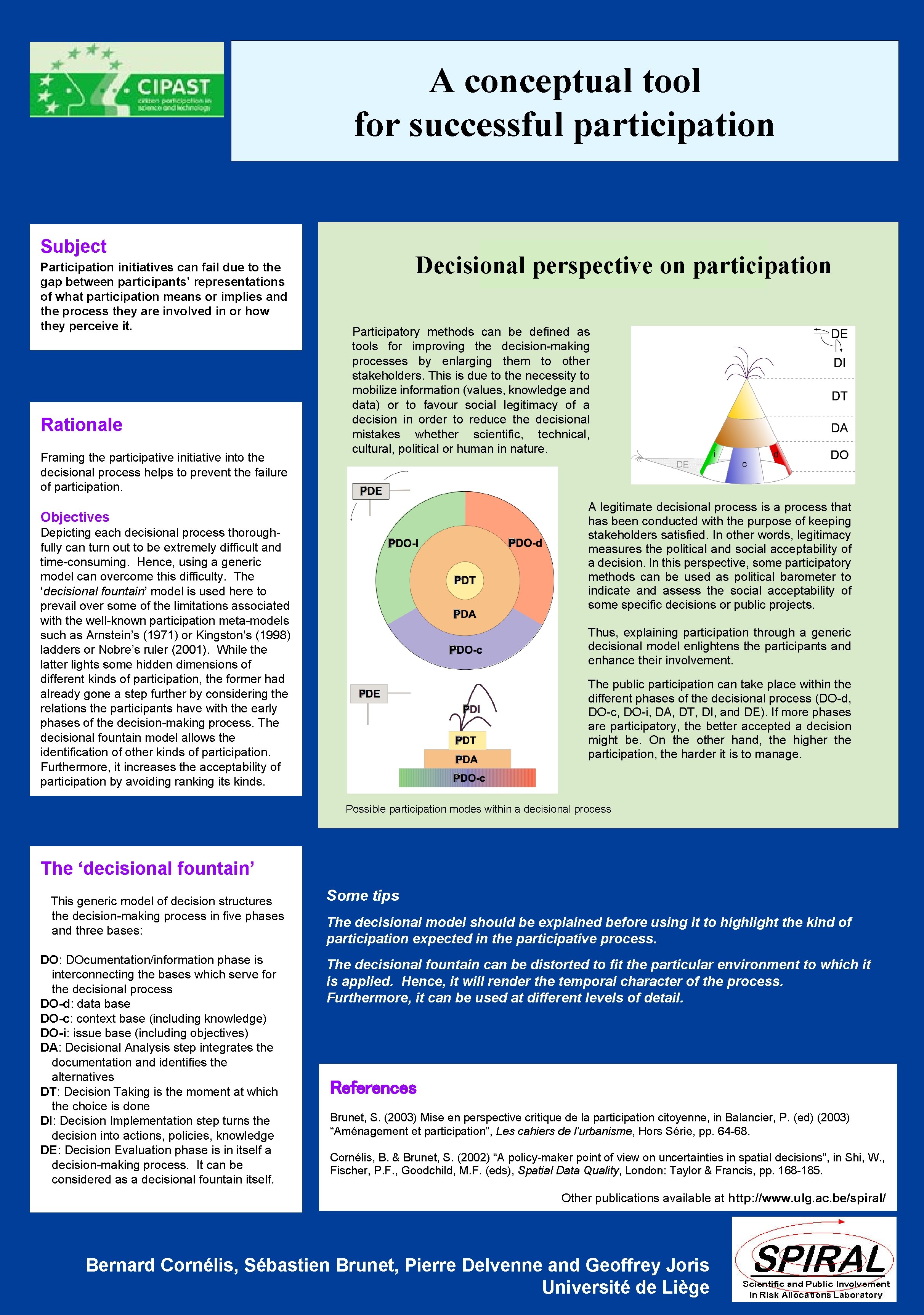
A conceptual tool for successful participation Subject Participation initiatives can fail due to the gap between participants’ representations of what participation means or implies and the process they are involved in or how they perceive it. Rationale Framing the participative initiative into the decisional process helps to prevent the failure of participation. Decisional perspective on participation Participatory methods can be defined as tools for improving the decision-making processes by enlarging them to other stakeholders. This is due to the necessity to mobilize information (values, knowledge and data) or to favour social legitimacy of a decision in order to reduce the decisional mistakes. Budget whether scientific, technical, cultural, political or human in nature. A legitimate decisional process is a process that has been conducted with the purpose of keeping stakeholders satisfied. In other words, legitimacy measures the political and social acceptability of a decision. In this perspective, some participatory methods can be used as political barometer to indicate and assess the social acceptability of some specific decisions or public projects. Objectives Depicting each decisional process thoroughfully can turn out to be extremely difficult and time-consuming. Hence, using a generic model can overcome this difficulty. The ‘decisional fountain’ model is used here to prevail over some of the limitations associated with the well-known participation meta-models such as Arnstein’s (1971) or Kingston’s (1998) ladders or Nobre’s ruler (2001). While the latter lights some hidden dimensions of different kinds of participation, the former had already gone a step further by considering the relations the participants have with the early phases of the decision-making process. The decisional fountain model allows the identification of other kinds of participation. Furthermore, it increases the acceptability of participation by avoiding ranking its kinds. Thus, explaining participation through a generic decisional model enlightens the participants and enhance their involvement. The public participation can take place within the different phases of the decisional process (DO-d, DO-c, DO-i, DA, DT, DI, and DE). If more phases are participatory, the better accepted a decision might be. On the other hand, the higher the participation, the harder it is to manage. Possible participation modes within a decisional process The ‘decisional fountain’ This generic model of decision structures the decision-making process in five phases and three bases: DOcumentation/information phase is interconnecting the bases which serve for the decisional process DO-d: data base DO-c: context base (including knowledge) DO-i: issue base (including objectives) DA: Decisional Analysis step integrates the documentation and identifies the alternatives DT: Decision Taking is the moment at which the choice is done DI: Decision Implementation step turns the decision into actions, policies, knowledge DE: Decision Evaluation phase is in itself a decision-making process. It can be considered as a decisional fountain itself. Some tips The decisional model should be explained before using it to highlight the kind of participation expected in the participative process. The decisional fountain can be distorted to fit the particular environment to which it is applied. Hence, it will render the temporal character of the process. Furthermore, it can be used at different levels of detail. References Brunet, S. (2003) Mise en perspective critique de la participation citoyenne, in Balancier, P. (ed) (2003) “Aménagement et participation”, Les cahiers de l’urbanisme, Hors Série, pp. 64 -68. Cornélis, B. & Brunet, S. (2002) “A policy-maker point of view on uncertainties in spatial decisions”, in Shi, W. , Fischer, P. F. , Goodchild, M. F. (eds), Spatial Data Quality, London: Taylor & Francis, pp. 168 -185. Other publications available at http: //www. ulg. ac. be/spiral/ Bernard Cornélis, Sébastien Brunet, Pierre Delvenne and Geoffrey Joris Université de Liège
- Slides: 1