
A Conceptual Framework for the Design of Organizational
- Slides: 19
A Conceptual Framework for the Design of Organizational Control Mechanisms William G. Ouchi, 1979 Management Science. 25 (9): 833 -847 Group 1: Meredith, Barclay, Woo-Je, and Kumar
Organizational Control Meanings and Interpretations Control equivalent to power Control as a problem in information flows Ouchi’s View What are the mechanisms through which an organization can be managed so that it moves towards its objectives? How can the design of these mechanisms be improved and what are the limits?
Example: Parts Supply Division Problem: Purchasing department buys 100, 000 different items/year from 3, 000 different manufacturers Accomplishes the work with 22 employees, of whom 3 are at the managerial level Warehousing stores the product, fills the orders and ships the product using 1, 400 employees, of whom 150 are managers
Analysis of Parts Supply Division Three Mechanisms involved: Market Purchasing division Bureaucratic Warehouse division Informal Social Concept of The Clan
Market Mechanisms Purchasing Agent Simply puts each part out for competitive bids and permits the competitive price to define the fair price Managers of Purchasing Agents Only needs to check decisions against simple criterion of cost minimization rather than observing all the steps
Market as a Pure Model Efficient Mechanism Prices convey relevant information for decision maker Arbitrary rules such as those found in warehousing unnecessary Provides a mechanism for solving problem of goal incongruity Rewards employees in direct proportion to their level of contribution But the fact that purchasing takes place in a corporate framework suggests market defects exist
Purchasing: Mixture of Market and Bureaucratic Mechanisms Work of purchasing agent is controlled through process of bureaucratic surveillance (manager) rather than price mechanisms Director of Purchasing does not determine market price Instead, agrees upon an employment contract at some price and resorts to hierarchical order giving and performance evaluation.
Bureaucratic Mechanisms (Warehousing) Fundamental mechanism of control involves close personal surveillance and direction of subordinates by superiors Task completion governed by RULES: an arbitrary standard against which a comparison is yet to be made Rules vs. Price Rules are only partial bundles of information Price is a complete bundle of information
Why does Warehouse Bureaucratic Mechanisms? Impossible to set prices for each task in warehouse No corresponding inexpensive way to determine performance Will have to establish performance standards and systems of hierarchical superiors The Bureaucratic Mechanism!
Original Dilemma Purchasing participates in a market mechanism which is more efficient Warehousing uses a bureaucratic mechanism because market is not frictionless Both Bureaucratic and Market mechanisms are directed towards the same objectives Which is more efficient depends on the particulars of the transactions
Clan Mechanisms Informal social structures that are properties of a unique organization Examples of others industries: Doctors Certified with respect to technical skills but also integrity and purity of values Once the Manager knows that the Foremen are trying to achieve the “right” objectives he can eliminate many costly forms of auditing and surveillance methods Only recently has the Clan mechanism been considered the subject of analysis central to the problem of organization
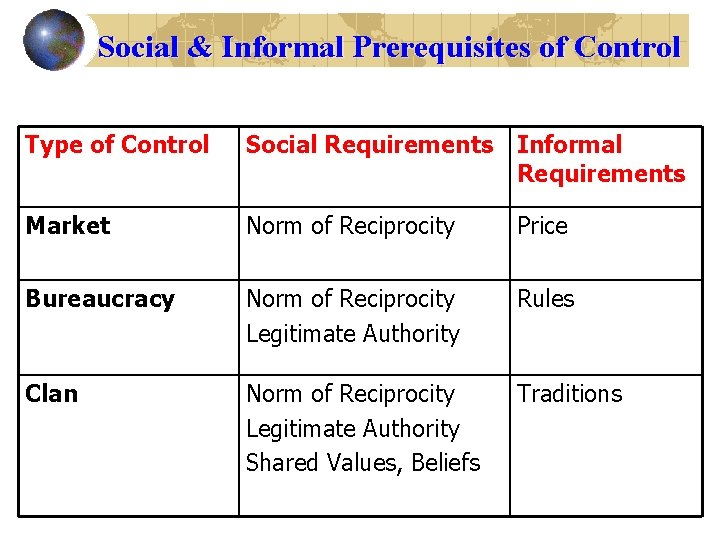
Social & Informal Prerequisites of Control Type of Control Social Requirements Informal Requirements Market Norm of Reciprocity Price Bureaucracy Norm of Reciprocity Legitimate Authority Rules Clan Norm of Reciprocity Legitimate Authority Shared Values, Beliefs Traditions
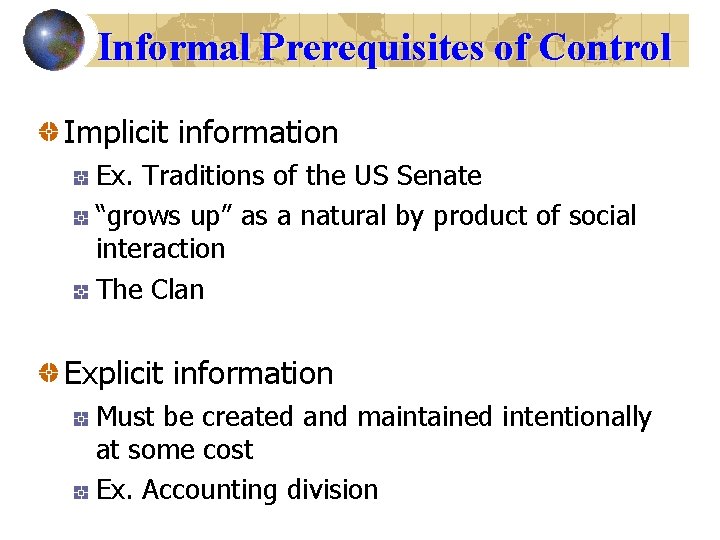
Informal Prerequisites of Control Implicit information Ex. Traditions of the US Senate “grows up” as a natural by product of social interaction The Clan Explicit information Must be created and maintained intentionally at some cost Ex. Accounting division
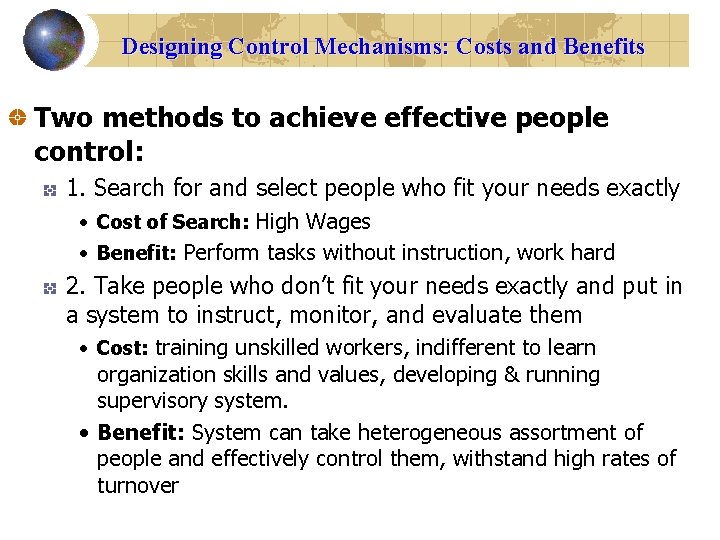
Designing Control Mechanisms: Costs and Benefits Two methods to achieve effective people control: 1. Search for and select people who fit your needs exactly • Cost of Search: High Wages • Benefit: Perform tasks without instruction, work hard 2. Take people who don’t fit your needs exactly and put in a system to instruct, monitor, and evaluate them • Cost: training unskilled workers, indifferent to learn organization skills and values, developing & running supervisory system. • Benefit: System can take heterogeneous assortment of people and effectively control them, withstand high rates of turnover
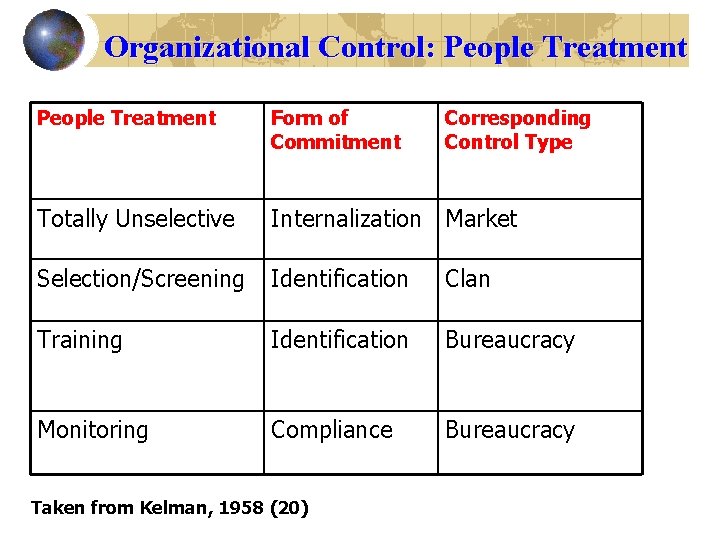
Organizational Control: People Treatment Form of Commitment Totally Unselective Internalization Market Selection/Screening Identification Clan Training Identification Bureaucracy Monitoring Compliance Bureaucracy Taken from Kelman, 1958 (20) Corresponding Control Type
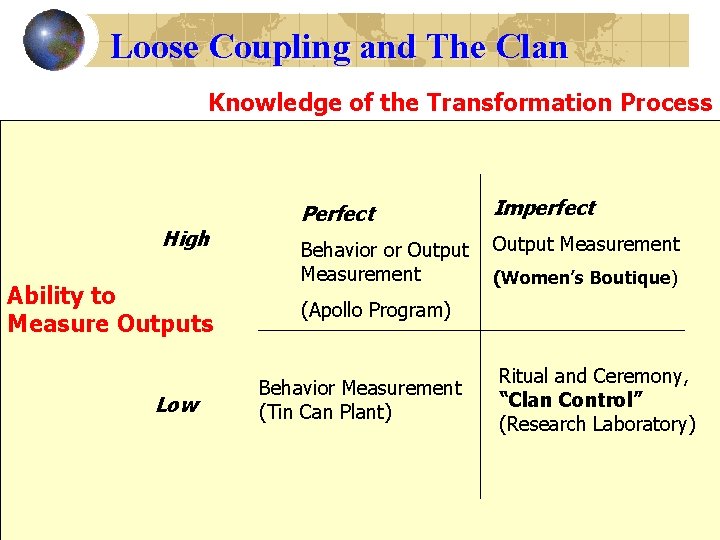
Loose Coupling and The Clan Knowledge of the Transformation Process High Ability to Measure Outputs Low Perfect Imperfect Behavior or Output Measurement (Women’s Boutique) (Apollo Program) Behavior Measurement (Tin Can Plant) Ritual and Ceremony, “Clan Control” (Research Laboratory)
Loose Coupling Fashionable Views Most hierarchies fail to transmit control from top to bottom Most organizations do not have a single or an integrated set of goals or objectives Subunits within are only loosely joined to each other Under conditions of ambiguity or loose coupling, measurement with precision is not possible. A control system based on this will lead to organizational decline. Under these circumstance clan control is preferable
Closing Observations Organizations vary in the degree to which they are coupled Control mechanisms of Market and/or Bureaucratic can be designed for relatively stable manufacturing industries Organizations in public sector, services, and technologies may be better served by clan forms of control The problem of organization design is to discover that balance of socialization and measurement which most effectively permits a particular organization to achieve cooperation among its members.
Conclusions Design of organizational control mechanisms must focus on the problems achieving coordination and cooperation among individuals Problem is to understand how, as society changes, do the control methods of organizations change with it.