
A Computational Model of ChemotaxisBased Cell Aggregation David
A Computational Model of Chemotaxis-Based Cell Aggregation David Breen Manolya Eyiyurekli Department of Computer Science Peter Lelkes School of Biomedical Engineering, Science and Health Systems Drexel University 1/30/2022 1
Chemotaxis • The characteristic movement or orientation of an organism or cell along a chemical concentration gradient, either toward or away from the chemical stimulus. 1/30/2022 2
Motivation • Explore and characterize, via simulation, the biological properties and processes that affect chemotaxis-based cell aggregation • Provide important knowledge for tissue engineering – Cell-cell aggregation reflects “fundamental” biological processes occurring during tissue assembly in vivo – Modeling cell aggregates and their assembly/differentiation into functional tissues has implications for the mechanistic understanding of “in vitro embryology” – Once processes are understood, we can direct them to control and optimize cell aggregation for tissue engineering 1/30/2022 3
Approach to Simulation “Simulation is not reality. It simply provides us with the consequences of our assumptions. ” • Alan Barr, California Institute of Technology “Everything should be made as simple as possible, but no simpler. ” • Albert Einstein 1/30/2022 4
Technical Goals • Define an accurate computational model that consists of the “essential” components of chemotaxis-based cell aggregation • Determine appropriate simplifications and approximations • Develop efficient and effective algorithms within a robust, extensible simulation environment • Utilize model/environment to computationally investigate cell aggregation behavior 1/30/2022 5
Cell Model • Atomic unit represented by a disk in the plane • Diffuses chemoattractant chemical into a 2 D environment • Detects overall chemical gradient in environment • Moves in direction of the gradient • Attaches to other cells on contact • Divides • Ages and eventually dies if unattached 1/30/2022 6

Cell Computational Cycle 1/30/2022 7
Algorithmic Optimizations/Features • • Cells live on a hexagonal grid Environment has toroidal topology Cells may attach to each other at six distinct sites Chemical diffusion approximated by a 1/r concentration field • Assume chemical interaction stops beyond a certain distance • Chemical concentration stored in the grid for visualization 1/30/2022 8
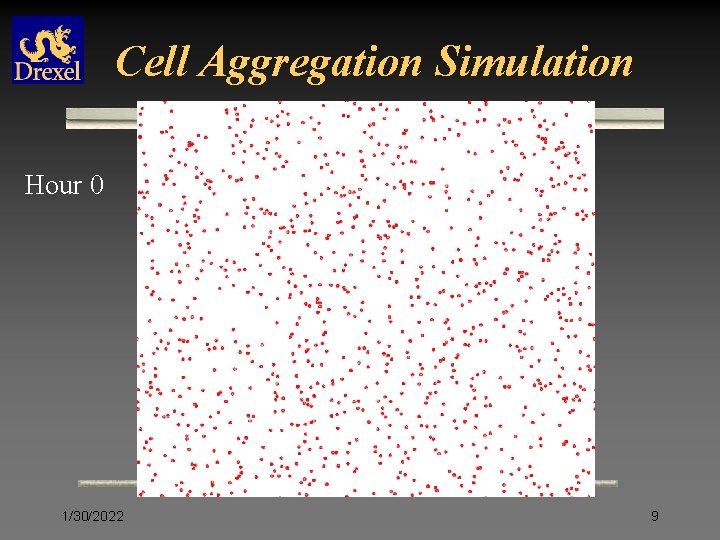
Cell Aggregation Simulation Hour 0 1/30/2022 9
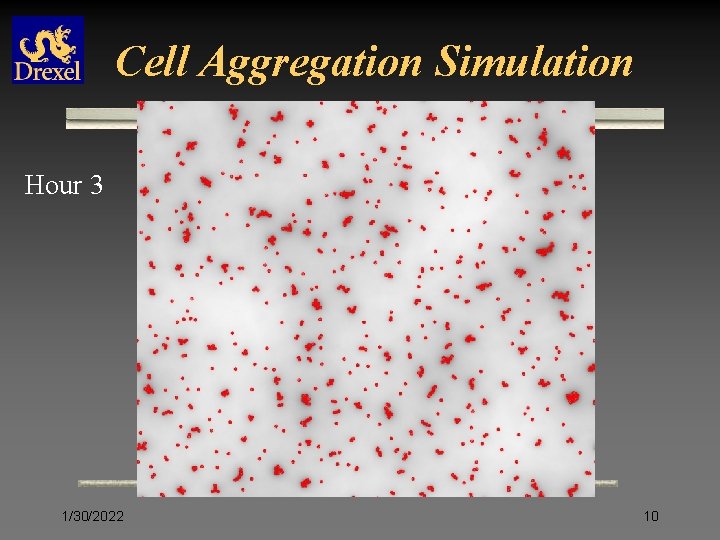
Cell Aggregation Simulation Hour 3 1/30/2022 10
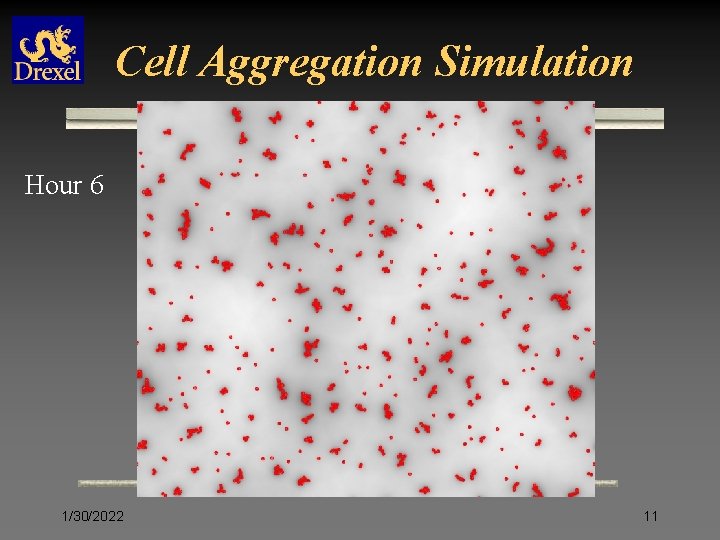
Cell Aggregation Simulation Hour 6 1/30/2022 11
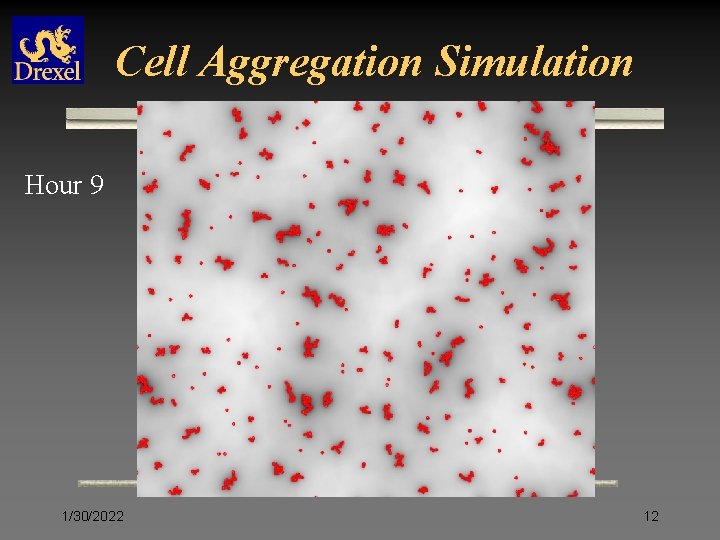
Cell Aggregation Simulation Hour 9 1/30/2022 12

Cell Aggregation Simulation Hour 12 1/30/2022 13
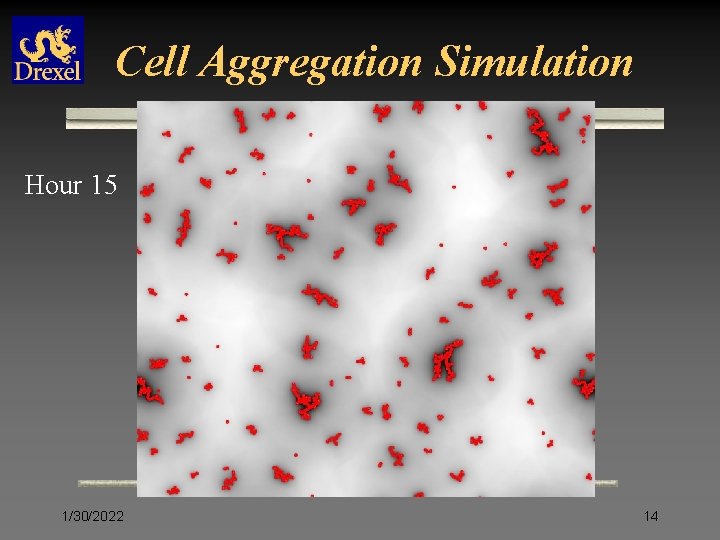
Cell Aggregation Simulation Hour 15 1/30/2022 14
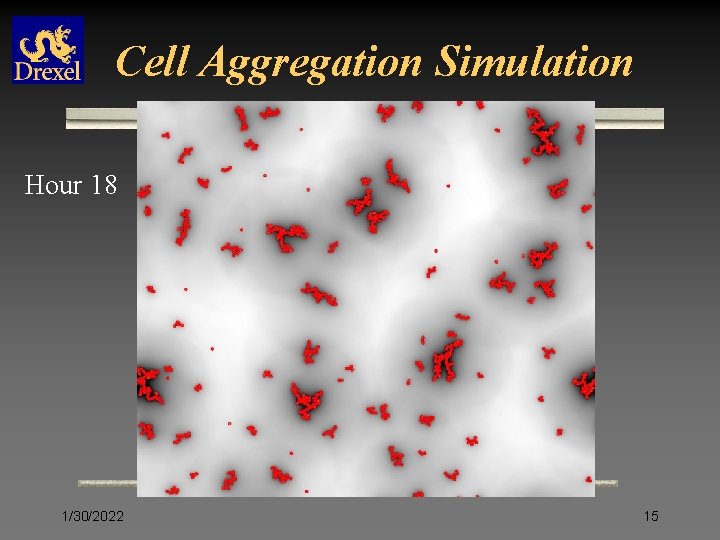
Cell Aggregation Simulation Hour 18 1/30/2022 15
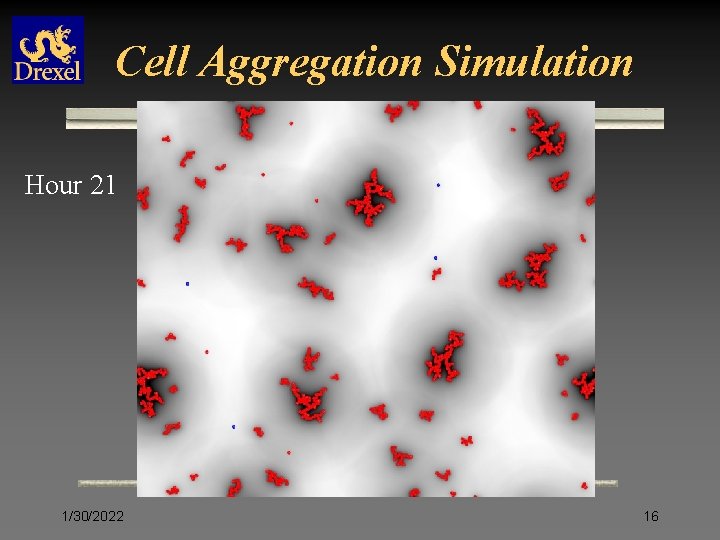
Cell Aggregation Simulation Hour 21 1/30/2022 16
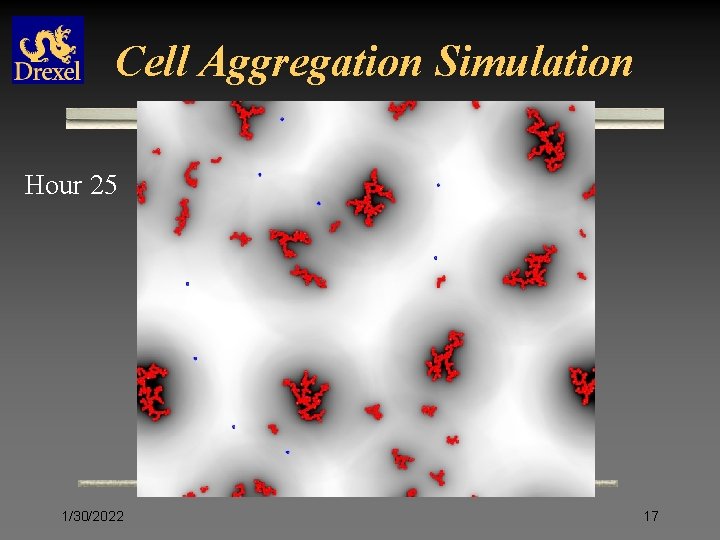
Cell Aggregation Simulation Hour 25 1/30/2022 17
Parametric Studies • Perform simulation over a range of parameter values and gather statistics – Proliferation & apoptosis rates – Chemoattractant diffusion rate – Upregulation factors – Cell velocity – Attachment/detachment probabilities 1/30/2022 19
Model Fine-Tuning and Verification • Perform a “ 24 -hour” simulation • Simulation initial conditions taken from experimental data – Number of cells, aggregate distribution • Compare simulation final results with experimental data • Currently fine-tuning model parameters to recreate experimental data 1/30/2022 20
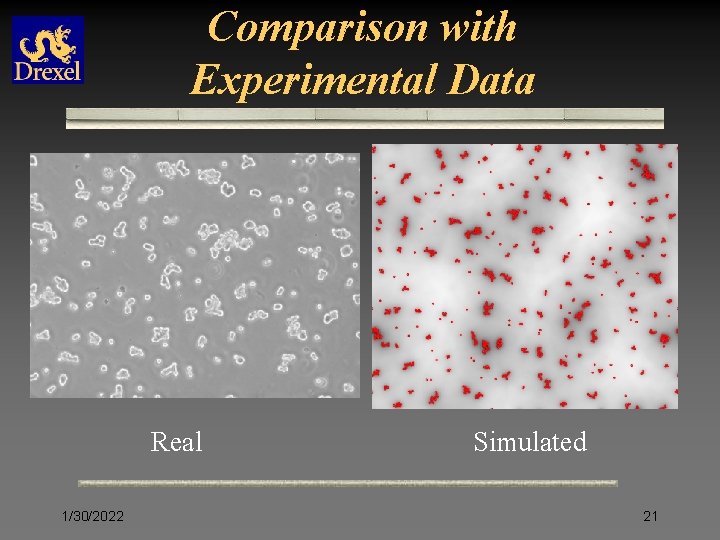
Comparison with Experimental Data Real 1/30/2022 Simulated 21
Aggregation Data Earth Mover’s Distance used to measure similarity. 1/30/2022 22
Future Work • Complete parameter fine-tuning and model verification • Conduct thorough parametric study of model – Perform numerous simulations – Determine correlation between cell properties and aggregation behavior • Extend to 3 D • Add hydrodynamic forces to simulate bioreactor experiments • Augment model to simulate cancer development 1/30/2022 23
- Slides: 22