
A compound Is a substance consisting of two
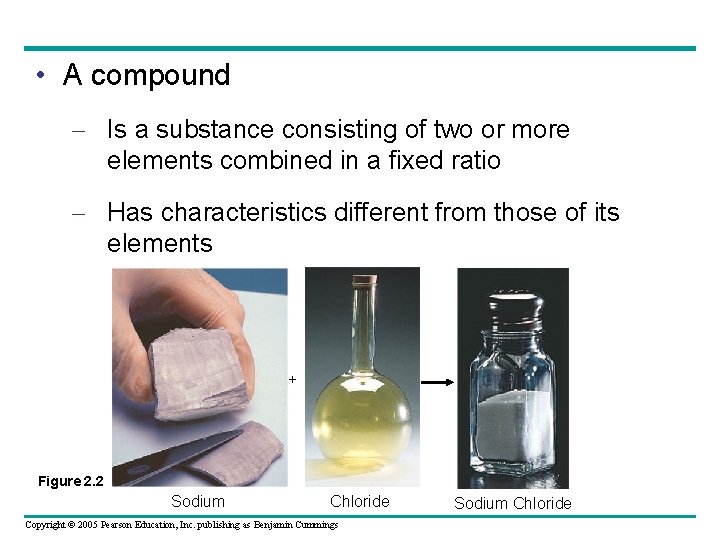
• A compound – Is a substance consisting of two or more elements combined in a fixed ratio – Has characteristics different from those of its elements + Figure 2. 2 Sodium Chloride Copyright © 2005 Pearson Education, Inc. publishing as Benjamin Cummings Sodium Chloride
Essential Elements of Life • Essential elements – Include carbon, hydrogen, oxygen, and nitrogen – Make up 96% of living matter Copyright © 2005 Pearson Education, Inc. publishing as Benjamin Cummings
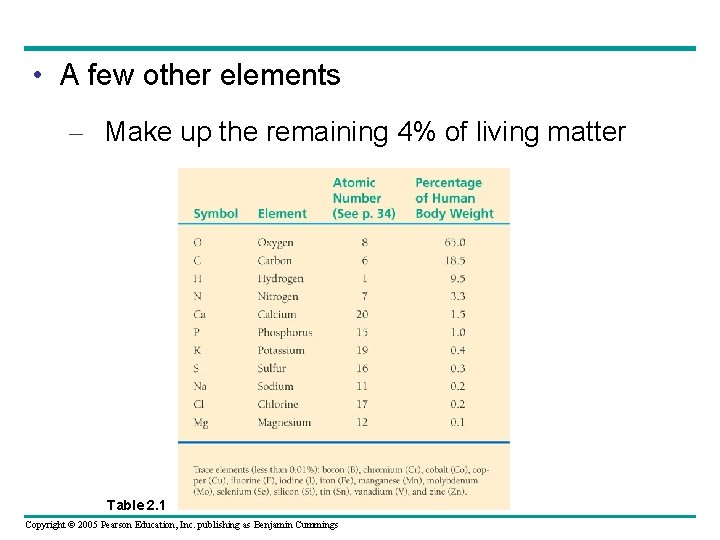
• A few other elements – Make up the remaining 4% of living matter Table 2. 1 Copyright © 2005 Pearson Education, Inc. publishing as Benjamin Cummings
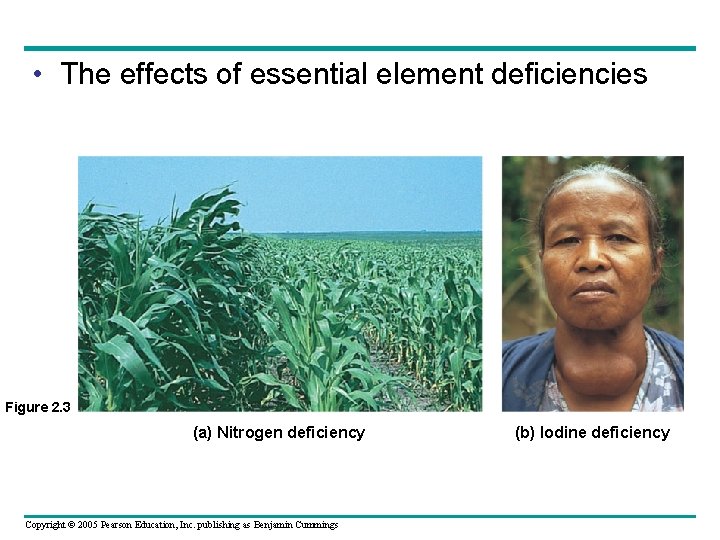
• The effects of essential element deficiencies Figure 2. 3 (a) Nitrogen deficiency Copyright © 2005 Pearson Education, Inc. publishing as Benjamin Cummings (b) Iodine deficiency
Subatomic Particles • Atoms of each element – Are composed of even smaller parts called subatomic particles Copyright © 2005 Pearson Education, Inc. publishing as Benjamin Cummings
• Relevant subatomic particles include – Neutrons, which have no electrical charge – Protons, which are positively charged – Electrons, which are negatively charged Copyright © 2005 Pearson Education, Inc. publishing as Benjamin Cummings
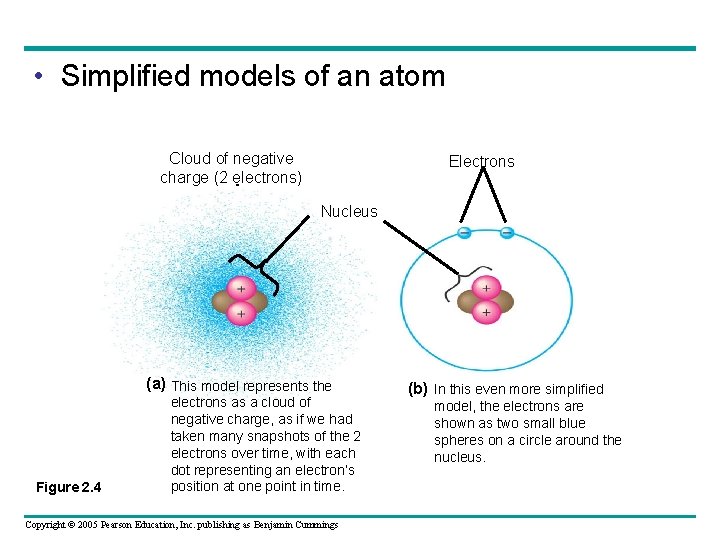
• Simplified models of an atom Cloud of negative charge (2 electrons) Electrons Nucleus (a) This model represents the Figure 2. 4 electrons as a cloud of negative charge, as if we had taken many snapshots of the 2 electrons over time, with each dot representing an electron‘s position at one point in time. Copyright © 2005 Pearson Education, Inc. publishing as Benjamin Cummings (b) In this even more simplified model, the electrons are shown as two small blue spheres on a circle around the nucleus.
• The atomic number of an element – Is the number of protons – Is unique to each element • The mass number of an element – Is the sum of protons plus neutrons in the nucleus of an atom – Is an approximation of the atomic mass of an atom Copyright © 2005 Pearson Education, Inc. publishing as Benjamin Cummings
Isotopes • Atoms of a given element – May occur in different forms • Isotopes of a given element – Differ in the number of neutrons in the atomic nucleus – Have the same number of protons • Radioactive isotopes – Spontaneously give off particles and energy Copyright © 2005 Pearson Education, Inc. publishing as Benjamin Cummings
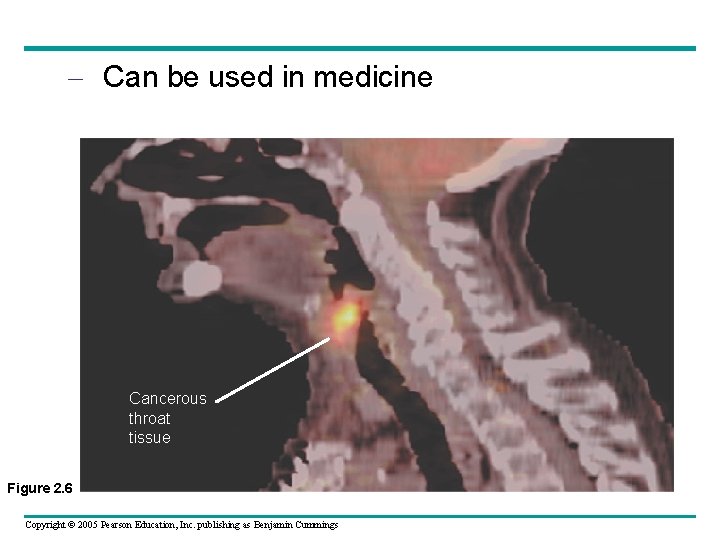
– Can be used in medicine Cancerous throat tissue Figure 2. 6 Copyright © 2005 Pearson Education, Inc. publishing as Benjamin Cummings
The Energy Levels of Electrons • An atom’s electrons – Vary in the amount of energy they possess • Energy – Is defined as the capacity to cause change • Potential energy – Is the energy that matter possesses because of its location or structure • The electrons of an atom – Differ in the amounts of potential energy they possess Copyright © 2005 Pearson Education, Inc. publishing as Benjamin Cummings
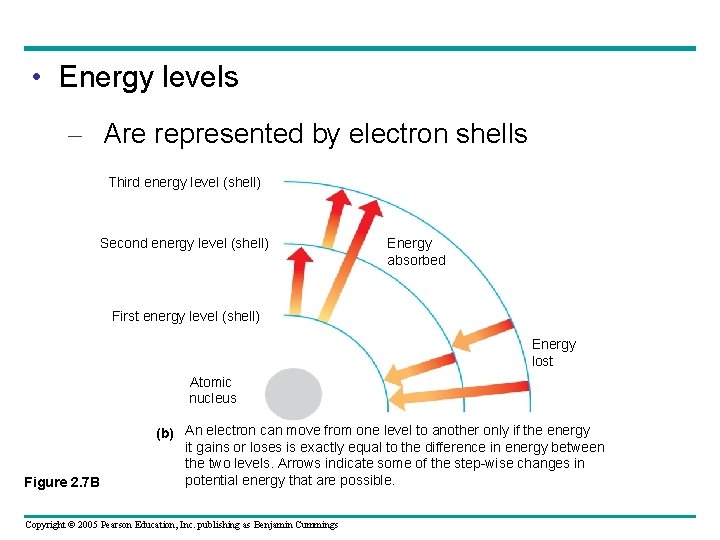
• Energy levels – Are represented by electron shells Third energy level (shell) Second energy level (shell) Energy absorbed First energy level (shell) Energy lost Atomic nucleus Figure 2. 7 B (b) An electron can move from one level to another only if the energy it gains or loses is exactly equal to the difference in energy between the two levels. Arrows indicate some of the step-wise changes in potential energy that are possible. Copyright © 2005 Pearson Education, Inc. publishing as Benjamin Cummings
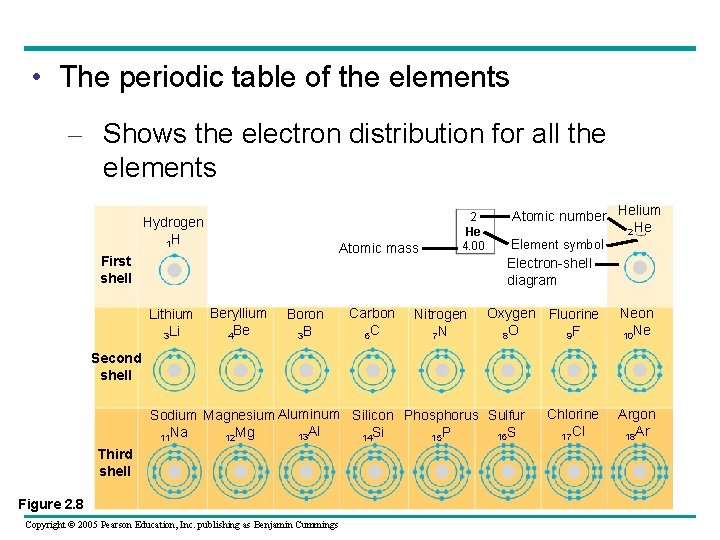
• The periodic table of the elements – Shows the electron distribution for all the elements Hydrogen 1 H Atomic mass First shell Lithium 3 Li Beryllium 4 Be Boron 3 B Carbon 6 C 2 He 4. 00 Nitrogen 7 N Atomic number Helium 2 He Element symbol Electron-shell diagram Oxygen Fluorine 8 O 9 F Neon 10 Ne Second shell Sodium Magnesium Aluminum Silicon Phosphorus Sulfur 13 Al 16 S 11 Na 12 Mg 14 Si 15 P Third shell Figure 2. 8 Copyright © 2005 Pearson Education, Inc. publishing as Benjamin Cummings Chlorine 17 Cl Argon 18 Ar
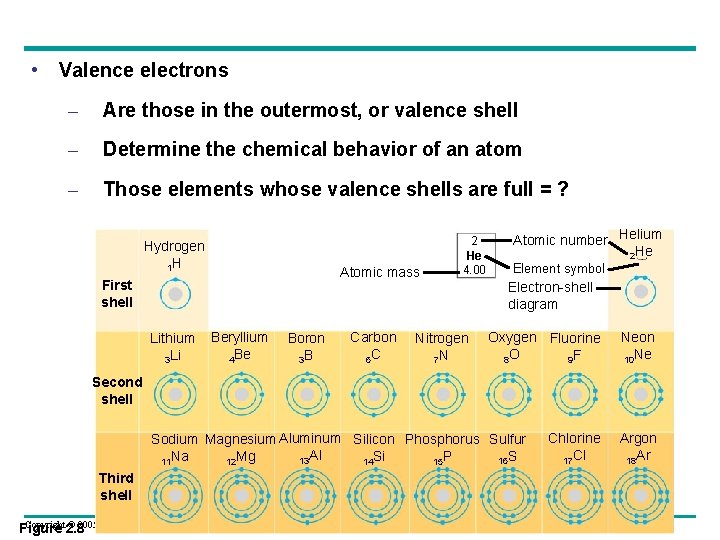
• Valence electrons – Are those in the outermost, or valence shell – Determine the chemical behavior of an atom – Those elements whose valence shells are full = ? Hydrogen 1 H Atomic mass First shell Lithium 3 Li Beryllium 4 Be Boron 3 B Carbon 6 C 2 He 4. 00 Nitrogen 7 N Atomic number Helium 2 He Element symbol Electron-shell diagram Oxygen Fluorine 8 O 9 F Neon 10 Ne Second shell Sodium Magnesium Aluminum Silicon Phosphorus Sulfur 13 Al 16 S 11 Na 12 Mg 14 Si 15 P Third shell Copyright © 2005 Pearson Education, Inc. publishing as Benjamin Cummings Figure 2. 8 Chlorine 17 Cl Argon 18 Ar
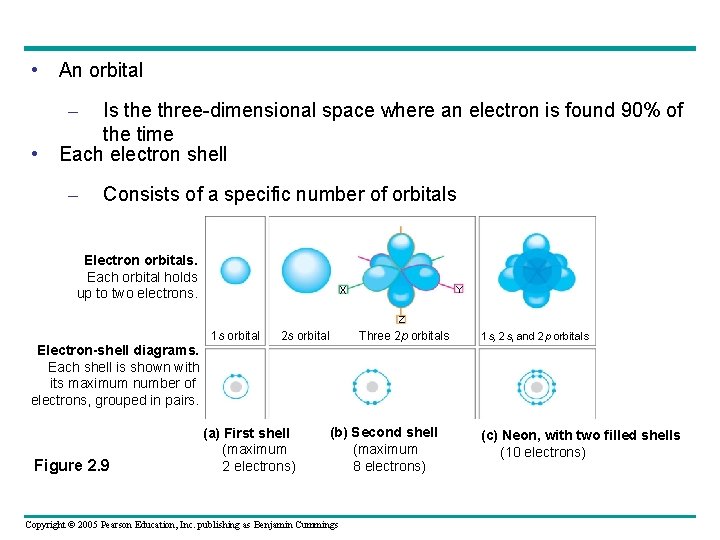
• An orbital – • Is the three-dimensional space where an electron is found 90% of the time Each electron shell – Consists of a specific number of orbitals Electron orbitals. Each orbital holds up to two electrons. x Y Z Electron-shell diagrams. Each shell is shown with its maximum number of electrons, grouped in pairs. Figure 2. 9 1 s orbital 2 s orbital (a) First shell (maximum 2 electrons) Three 2 p orbitals (b) Second shell (maximum 8 electrons) Copyright © 2005 Pearson Education, Inc. publishing as Benjamin Cummings 1 s, 2 s, and 2 p orbitals (c) Neon, with two filled shells (10 electrons)
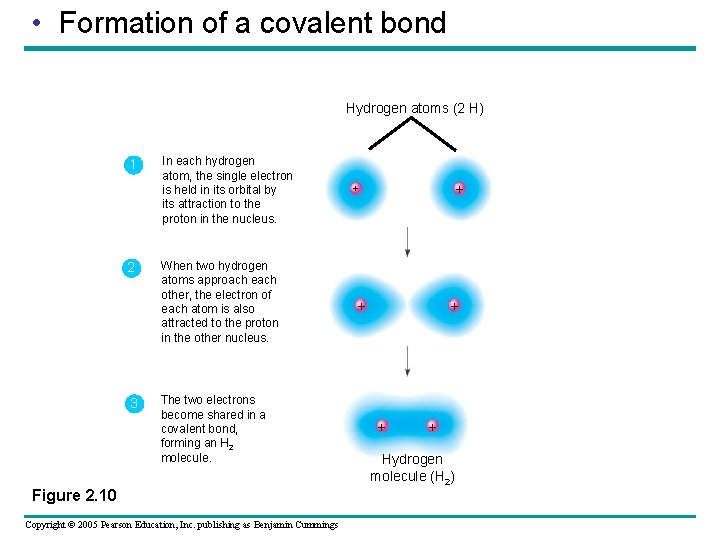
• Formation of a covalent bond Hydrogen atoms (2 H) 1 2 3 In each hydrogen atom, the single electron is held in its orbital by its attraction to the proton in the nucleus. When two hydrogen atoms approach each other, the electron of each atom is also attracted to the proton in the other nucleus. The two electrons become shared in a covalent bond, forming an H 2 molecule. Figure 2. 10 Copyright © 2005 Pearson Education, Inc. publishing as Benjamin Cummings + + + Hydrogen molecule (H 2)
• A molecule – Consists of two or more atoms held together by covalent bonds • A single bond – Is the sharing of one pair of valence electrons • A double bond – Is the sharing of two pairs of valence electrons Copyright © 2005 Pearson Education, Inc. publishing as Benjamin Cummings
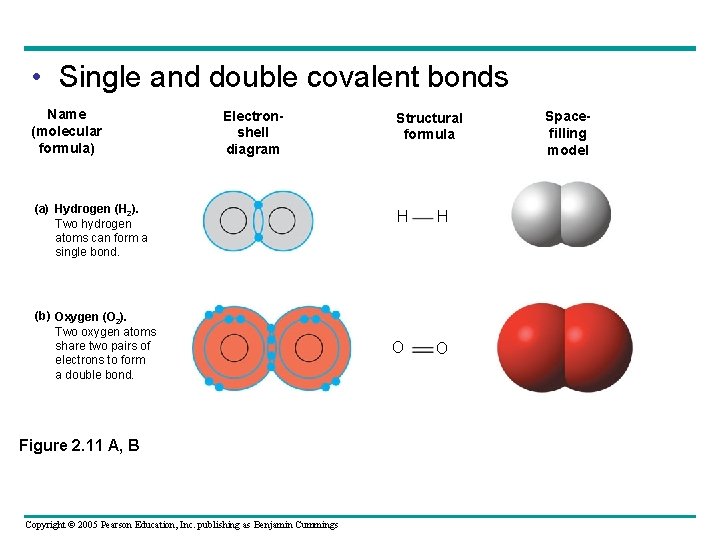
• Single and double covalent bonds Name (molecular formula) Electronshell diagram (a) Hydrogen (H 2). Two hydrogen atoms can form a single bond. (b) Oxygen (O 2). Two oxygen atoms share two pairs of electrons to form a double bond. Figure 2. 11 A, B Copyright © 2005 Pearson Education, Inc. publishing as Benjamin Cummings Structural formula H H O O Spacefilling model
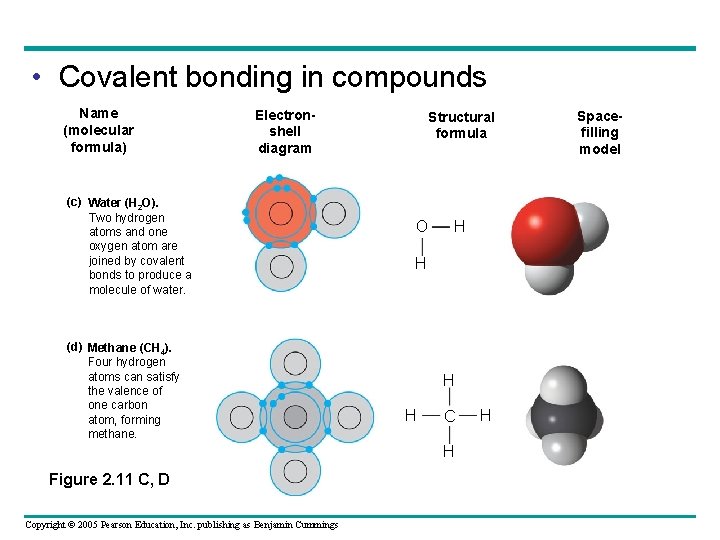
• Covalent bonding in compounds Name (molecular formula) Electronshell diagram (c) Water (H 2 O). Two hydrogen atoms and one oxygen atom are joined by covalent bonds to produce a molecule of water. (d) Methane (CH 4). Four hydrogen atoms can satisfy the valence of one carbon atom, forming methane. Structural formula O H H C H Figure 2. 11 C, D Copyright © 2005 Pearson Education, Inc. publishing as Benjamin Cummings H Spacefilling model
• Electronegativity – Is the attraction of a particular kind of atom for the electrons in a covalent bond • The more electronegative an atom – The more strongly it pulls shared electrons toward itself Copyright © 2005 Pearson Education, Inc. publishing as Benjamin Cummings
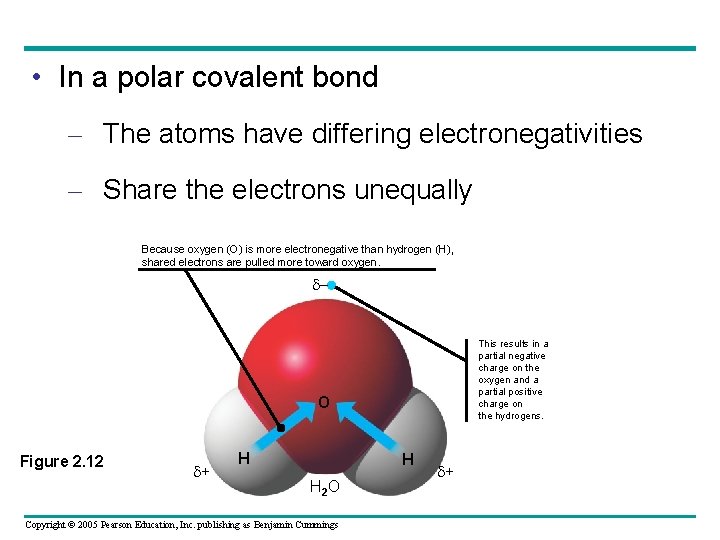
• In a polar covalent bond – The atoms have differing electronegativities – Share the electrons unequally Because oxygen (O) is more electronegative than hydrogen (H), shared electrons are pulled more toward oxygen. – This results in a partial negative charge on the oxygen and a partial positive charge on the hydrogens. O Figure 2. 12 + H H H 2 O Copyright © 2005 Pearson Education, Inc. publishing as Benjamin Cummings +
Ionic Bonds • In some cases, atoms strip electrons away from their bonding partners • Electron transfer between two atoms creates ions • Ions – Are atoms with more or fewer electrons than usual – Are charged atoms Copyright © 2005 Pearson Education, Inc. publishing as Benjamin Cummings
• An anion – Is negatively charged ions • A cation – Is positively charged Copyright © 2005 Pearson Education, Inc. publishing as Benjamin Cummings
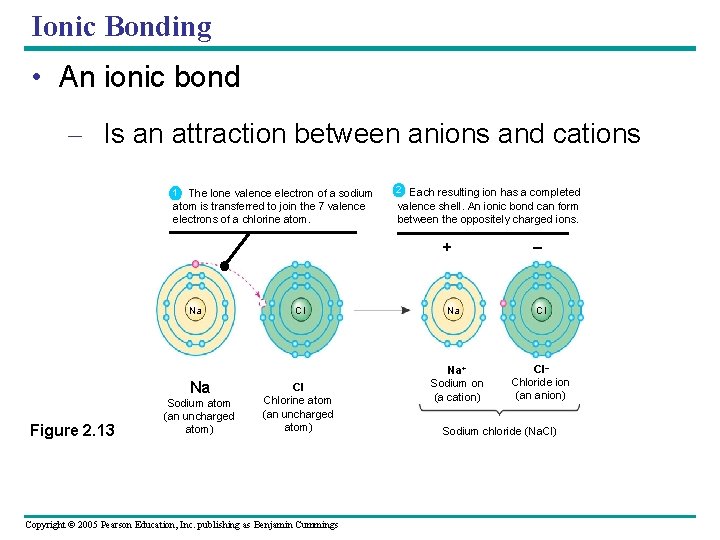
Ionic Bonding • An ionic bond – Is an attraction between anions and cations The lone valence electron of a sodium atom is transferred to join the 7 valence electrons of a chlorine atom. 1 2 Each resulting ion has a completed valence shell. An ionic bond can form between the oppositely charged ions. + Na Na Figure 2. 13 Sodium atom (an uncharged atom) Cl Cl Chlorine atom (an uncharged atom) Copyright © 2005 Pearson Education, Inc. publishing as Benjamin Cummings Na Na+ Sodium on (a cation) – Cl Cl– Chloride ion (an anion) Sodium chloride (Na. Cl)
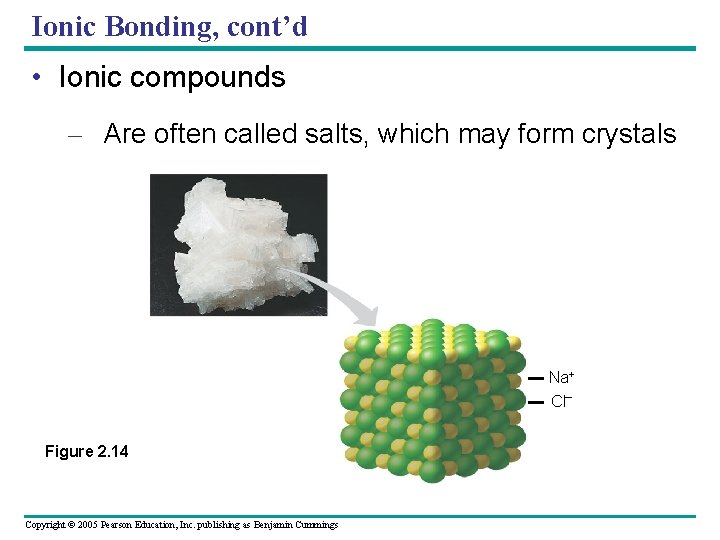
Ionic Bonding, cont’d • Ionic compounds – Are often called salts, which may form crystals Na+ Cl– Figure 2. 14 Copyright © 2005 Pearson Education, Inc. publishing as Benjamin Cummings
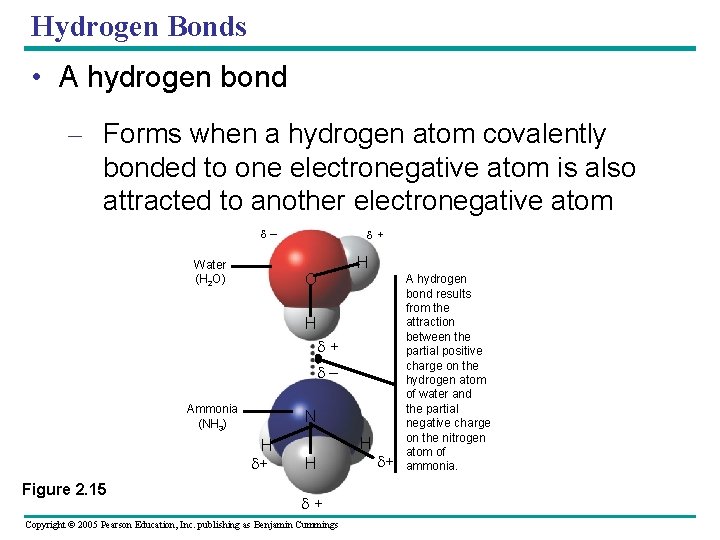
Hydrogen Bonds • A hydrogen bond – Forms when a hydrogen atom covalently bonded to one electronegative atom is also attracted to another electronegative atom – Water (H 2 O) + H O H + – Ammonia (NH 3) N H + Figure 2. 15 H H + Copyright © 2005 Pearson Education, Inc. publishing as Benjamin Cummings + A hydrogen bond results from the attraction between the partial positive charge on the hydrogen atom of water and the partial negative charge on the nitrogen atom of ammonia.
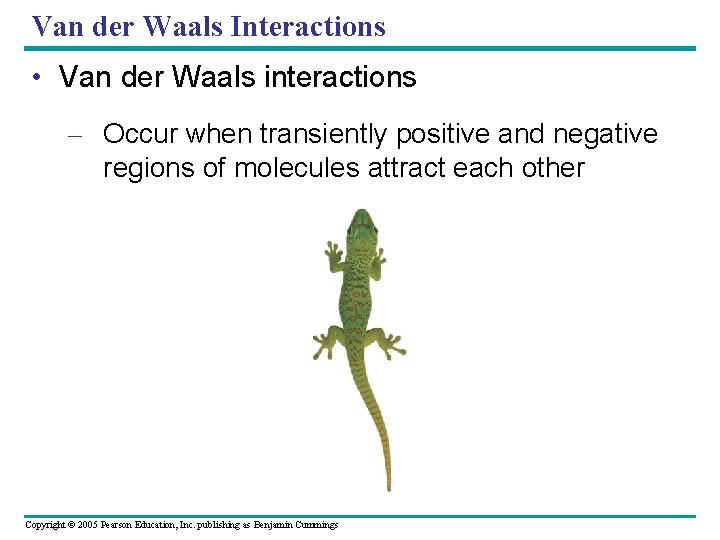
Van der Waals Interactions • Van der Waals interactions – Occur when transiently positive and negative regions of molecules attract each other Copyright © 2005 Pearson Education, Inc. publishing as Benjamin Cummings
Molecular Shape and Function • The precise shape of a molecule – Is usually very important to its function in the living cell – Is determined by the positions of its atoms’ valence orbitals Copyright © 2005 Pearson Education, Inc. publishing as Benjamin Cummings
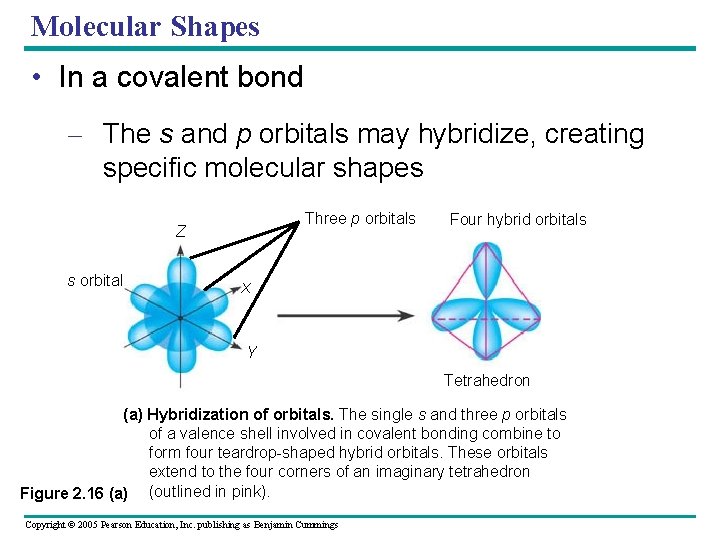
Molecular Shapes • In a covalent bond – The s and p orbitals may hybridize, creating specific molecular shapes Three p orbitals Z s orbital Four hybrid orbitals X Y Tetrahedron (a) Hybridization of orbitals. The single s and three p orbitals of a valence shell involved in covalent bonding combine to form four teardrop-shaped hybrid orbitals. These orbitals extend to the four corners of an imaginary tetrahedron Figure 2. 16 (a) (outlined in pink). Copyright © 2005 Pearson Education, Inc. publishing as Benjamin Cummings
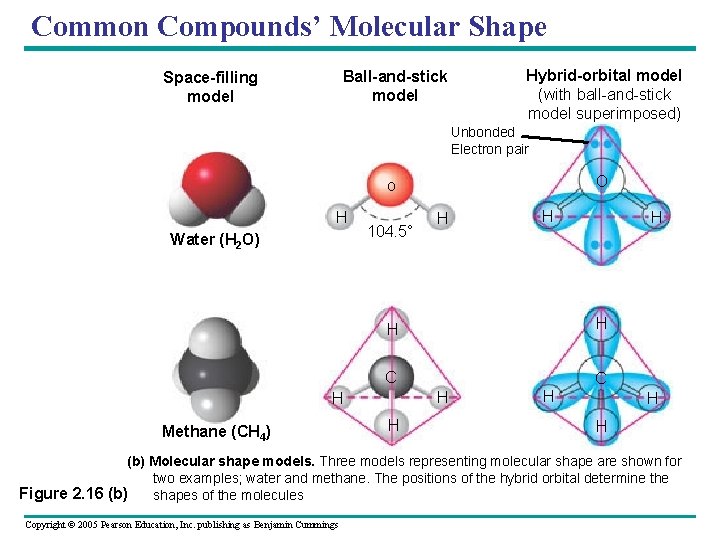
Common Compounds’ Molecular Shape Ball-and-stick model Space-filling model Hybrid-orbital model (with ball-and-stick model superimposed) Unbonded Electron pair O O H Water (H 2 O) 104. 5° H H C C H H Methane (CH 4) H H H (b) Molecular shape models. Three models representing molecular shape are shown for two examples; water and methane. The positions of the hybrid orbital determine the Figure 2. 16 (b) shapes of the molecules Copyright © 2005 Pearson Education, Inc. publishing as Benjamin Cummings
• A Chemical reaction – Is the making and breaking of chemical bonds – Leads to changes in the composition of matter Copyright © 2005 Pearson Education, Inc. publishing as Benjamin Cummings
• A Chemical reaction – Is the making and breaking of chemical bonds – Leads to changes in the composition of matter Copyright © 2005 Pearson Education, Inc. publishing as Benjamin Cummings
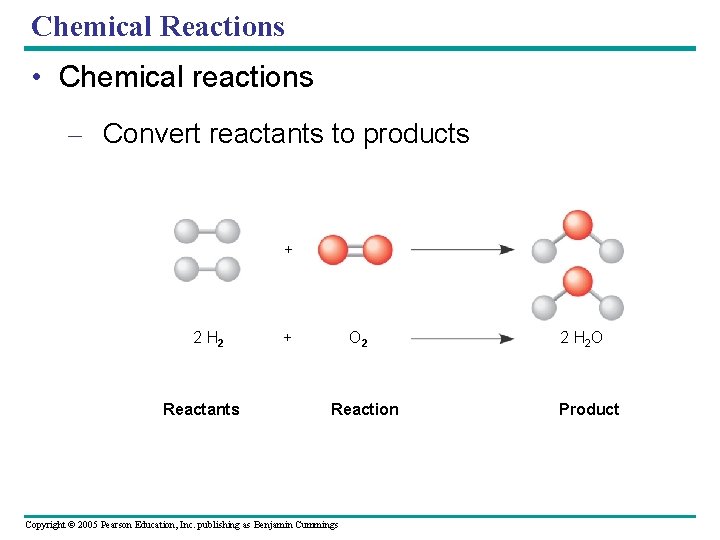
Chemical Reactions • Chemical reactions – Convert reactants to products + 2 H 2 Reactants + O 2 Reaction Copyright © 2005 Pearson Education, Inc. publishing as Benjamin Cummings 2 H 2 O Product
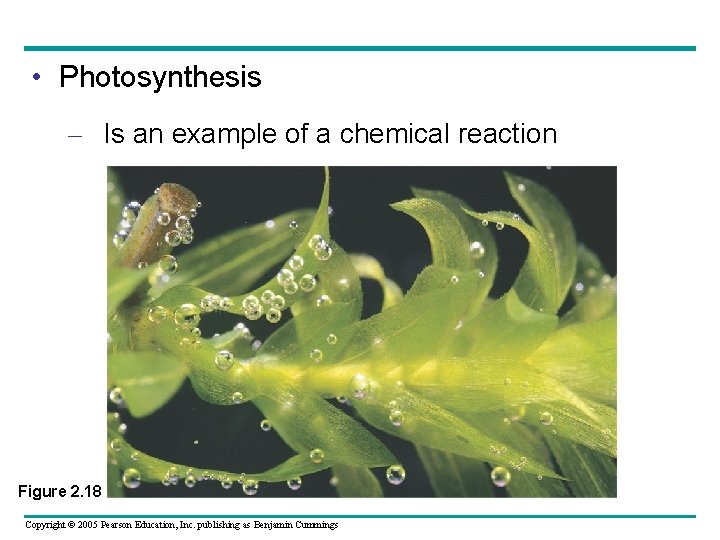
• Photosynthesis – Is an example of a chemical reaction Figure 2. 18 Copyright © 2005 Pearson Education, Inc. publishing as Benjamin Cummings
Equilibrium • Chemical equilibrium – Is reached when the forward and reverse reaction rates are equal Copyright © 2005 Pearson Education, Inc. publishing as Benjamin Cummings
- Slides: 35