
A Complexity Measure THOMAS J Mc CABE Presented
A Complexity Measure THOMAS J. Mc. CABE Presented by Sarochapol Rattanasopinswat
INTRODUCTION l How to modularize a software system so the resulting modules are both testable and maintainable? ¡ Currently is to limit programs by physical size Not adequate l 50 line program consisting of 25 consecutive “IFTHEN” constructs. l
A COMPLEXITY MEASURE l Measure and control the number of paths through a program. Definition 1 The cyclomatic number V(G) of a graph G with n vertices, e edges, and p connected components is V(G) = e – n + 2 p
A COMPLEXITY MEASURE l THEOREM 1: In a strongly connected graph G, the cyclomatic number is equal to the maximum number of linearly independent circuits
A COMPLEXITY MEASURE l Given a program we will associate with it a directed graph that has unique entry and exit nodes. Each node in the graph corresponds to a block of code in the program where the flow is sequential and the arcs correspond to branches taken in the program. l Known as “program control graph. ”

A COMPLEXITY MEASURE
A COMPLEXITY MEASURE l From the graph, the maximum number of linearly independent circuits in G is 9 -6+2. l One could choose the following 5 indepentdent circuits in G: B 1: (abefa), (beb), (abea), (acfa), (adcfa).
A COMPLEXITY MEASURE l Several properties of cyclomatic complexity: ¡ v(G) ≥ 1. ¡ v(G) is the maximum number of linearly independent paths in G; it is the size of a basis set. ¡ Inserting or deleting functional statements to G does not affect v(G). ¡ G has only one path if and only if v(G) = 1.

A COMPLEXITY MEASURE ¡ Inserting a new edge in G increases v(G) by unity. ¡ v(G) depends only on the decision structure of G.
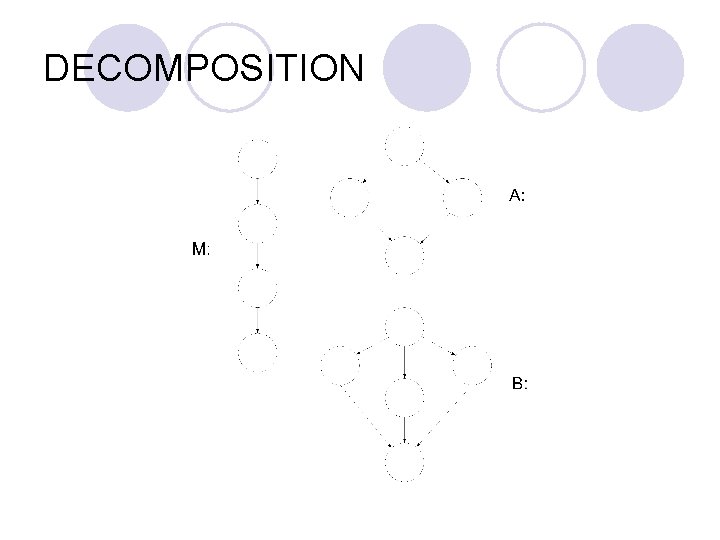
DECOMPOSITION lv = e – n + 2 p l P is the number of connected components. l All control graphs will have only one connected component.
DECOMPOSITION

DECOMPOSITION l Now, since p = 3, we calculate complexity as v(M∪A∪B) = e – n + 2 p = 13 -13+2 x 3 =6 l Notice that v(M∪A∪B) = v(M) + v(A) + v(B) = 6.
SIMPLIFICATION l 2 ways ¡ Allows the complexity calculations to be done in terms of program syntactic constructs. ¡ Calculate from the graph from.
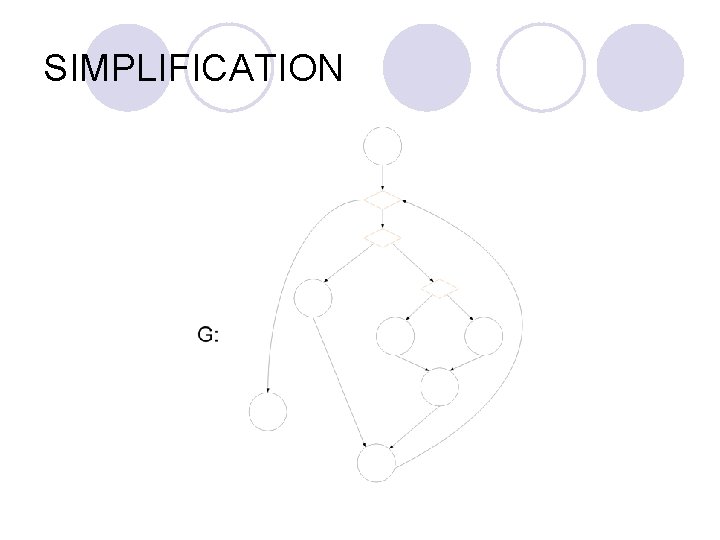
SIMPLIFICATION l First way, the cyclomatic complexity of a structured program equals the number of predicates plus one
SIMPLIFICATION
SIMPLIFICATION l From the graph, v(G) = ¶ + 1 =3+1 =4
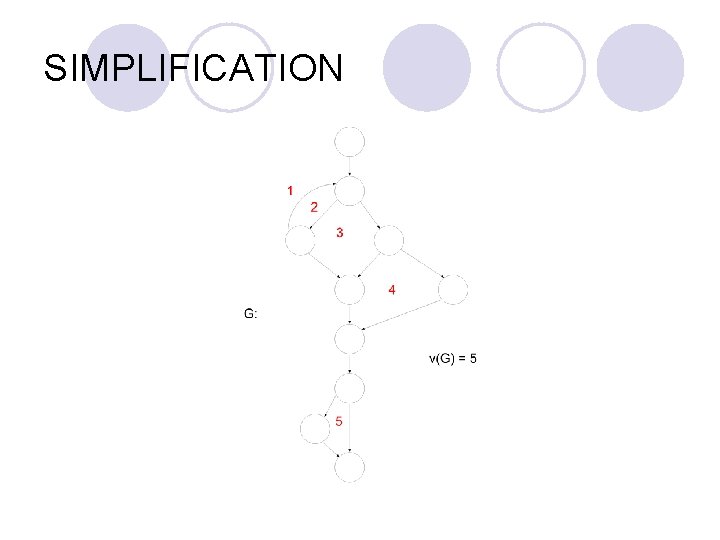
SIMPLIFICATION l The second way is by using Euler’s formula: ¡ If G is a connected plane graph with n vertices, e edges, and r regions, then n–e+r=2 ¡ So the number of regions is equal to the cyclomatic complexity.
SIMPLIFICATION
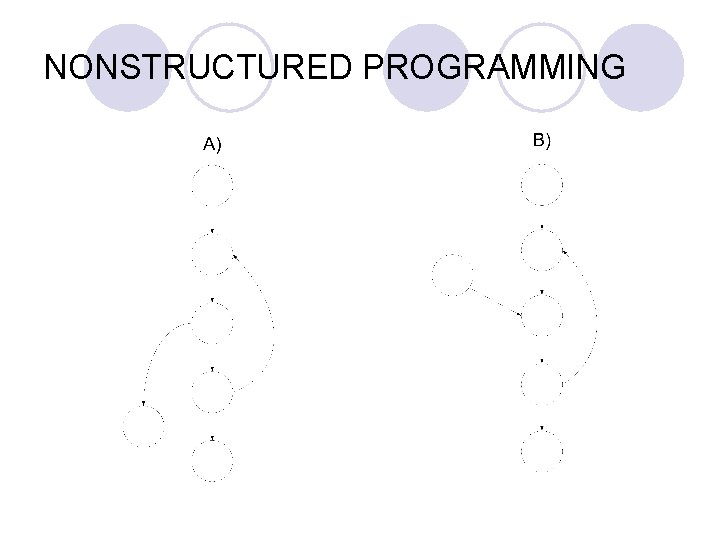
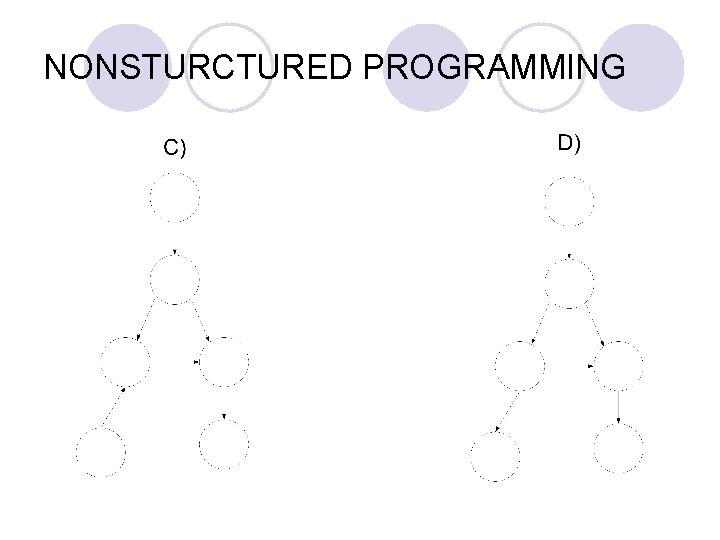
NONSTRUCTURED PROGRAMMING l There are four control structures to generate all nonstructured programs.
NONSTRUCTURED PROGRAMMING
NONSTURCTURED PROGRAMMING
NONSTRUCTURED PROGRAMMING l Result 1: A necessary and sufficient condition that a program is nonstructured is that it contains as a subgraph either a), b), or c. ( l Result 2: A nonstructured program cannot be just a little nonstructured. That is any nonstructured program must contain at least 2 of the graphs a) – d. (
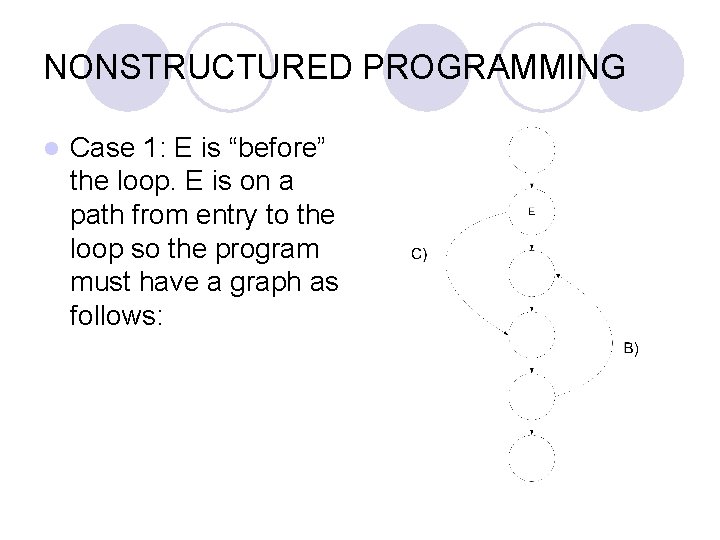
NONSTRUCTURED PROGRAMMING l Case 1: E is “before” the loop. E is on a path from entry to the loop so the program must have a graph as follows:
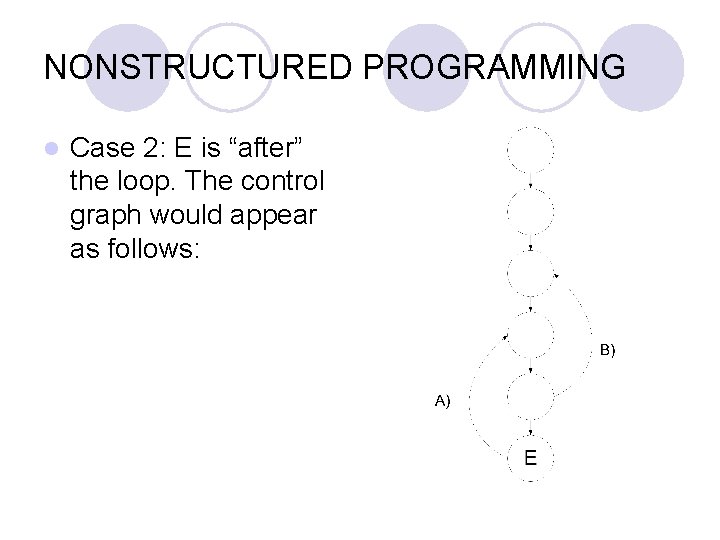
NONSTRUCTURED PROGRAMMING l Case 2: E is “after” the loop. The control graph would appear as follows:
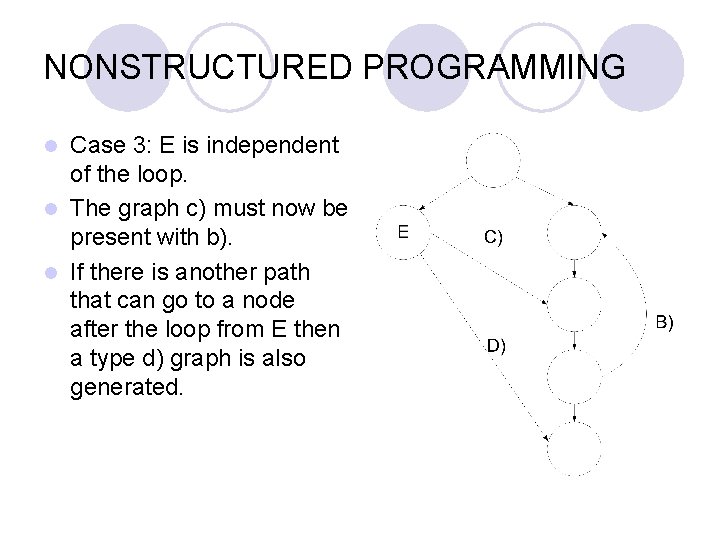
NONSTRUCTURED PROGRAMMING Case 3: E is independent of the loop. l The graph c) must now be present with b). l If there is another path that can go to a node after the loop from E then a type d) graph is also generated. l
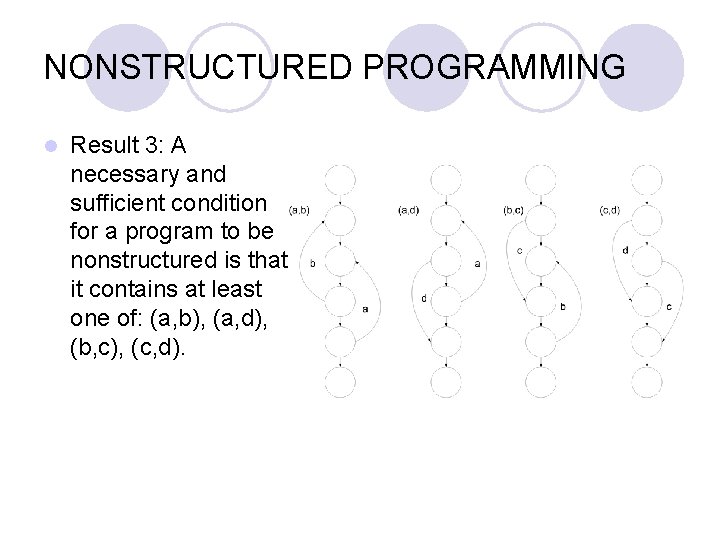
NONSTRUCTURED PROGRAMMING l Result 3: A necessary and sufficient condition for a program to be nonstructured is that it contains at least one of: (a, b), (a, d), (b, c), (c, d).
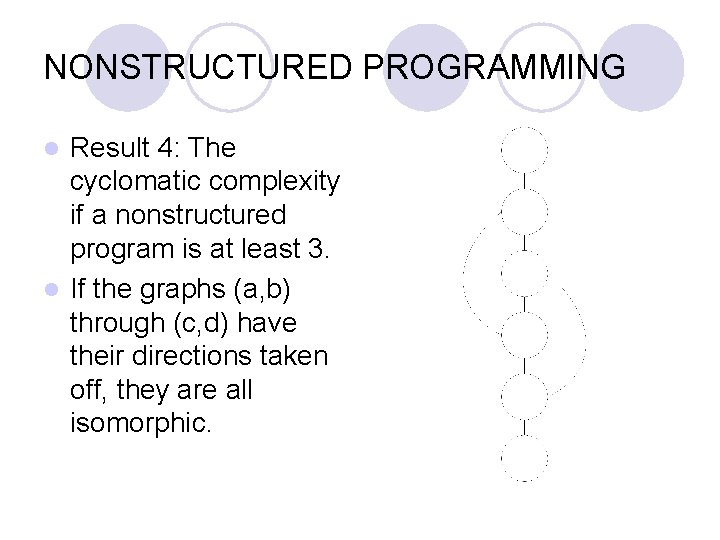
NONSTRUCTURED PROGRAMMING Result 4: The cyclomatic complexity if a nonstructured program is at least 3. l If the graphs (a, b) through (c, d) have their directions taken off, they are all isomorphic. l
NONSTRUCTURED PROGRAMMING Result 5: A structured program can be written by not branching out of loops or into decisions - a) and c) provide a basis. l Result 6: A structured program can be written by not branching into loops or out of decisions – b) and d) provide a basis. l Result 7: A structured program is reducible( process of removing subgraphs (subroutines) with unique entry and exit nodes) to a program of unit complexity. l
NONSTRUCTURED PROGRAMMING ¡ Let m be the number of proper subgraphs with unique entry and exit nodes. The following definition of essential complexity ev is used to reflect the lack of structure. ev = v – m l Result 8: The essential complexity of a structured program is one.
A TESTING METHODOLOGY l Let a program p has been written, its complexity v has been calculated, and the number of paths tested is ac (actual complexity). If ac is less than v then one of the following conditions must be true: ¡ ¡ ¡ There is more testing to be done (more paths to be tested); The program flow graph can be reduced in complexity by v-ac (v-ac decisions can be taken out); and Portions of the program can be reduced to in line code (complexity has increased to conserve space).
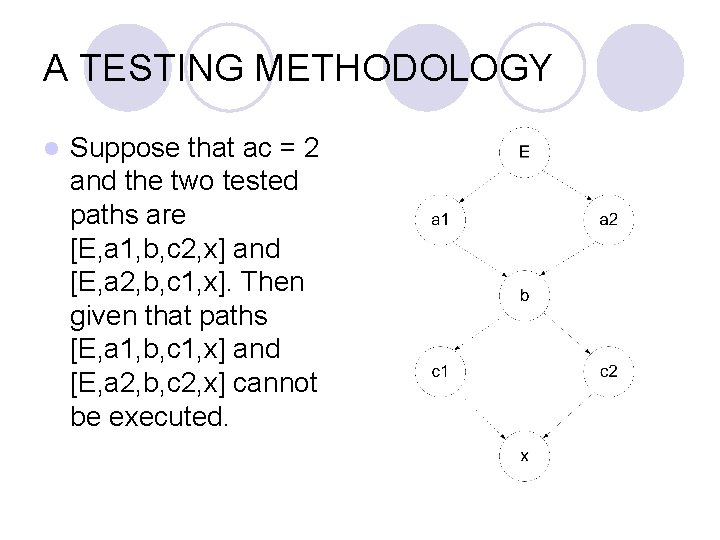
A TESTING METHODOLOGY l Suppose that ac = 2 and the two tested paths are [E, a 1, b, c 2, x] and [E, a 2, b, c 1, x]. Then given that paths [E, a 1, b, c 1, x] and [E, a 2, b, c 2, x] cannot be executed.
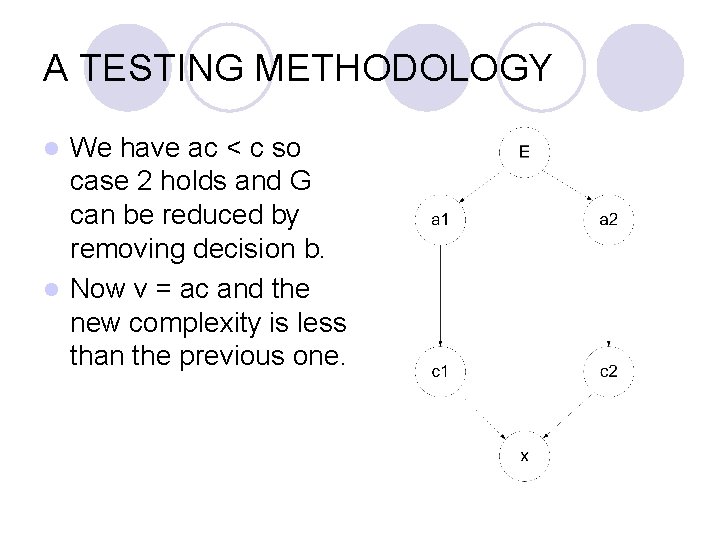
A TESTING METHODOLOGY We have ac < c so case 2 holds and G can be reduced by removing decision b. l Now v = ac and the new complexity is less than the previous one. l
A TESTING METHODOLOGY l It should be noted that v is only the minimal number of independent paths that should be tested. l It should be noted that this procedure will by no means guarantee or prove the software- all it can do is surface more bugs and improve the quality of the software
- Slides: 33