
A Comparison of topographic effect by Newtons integral
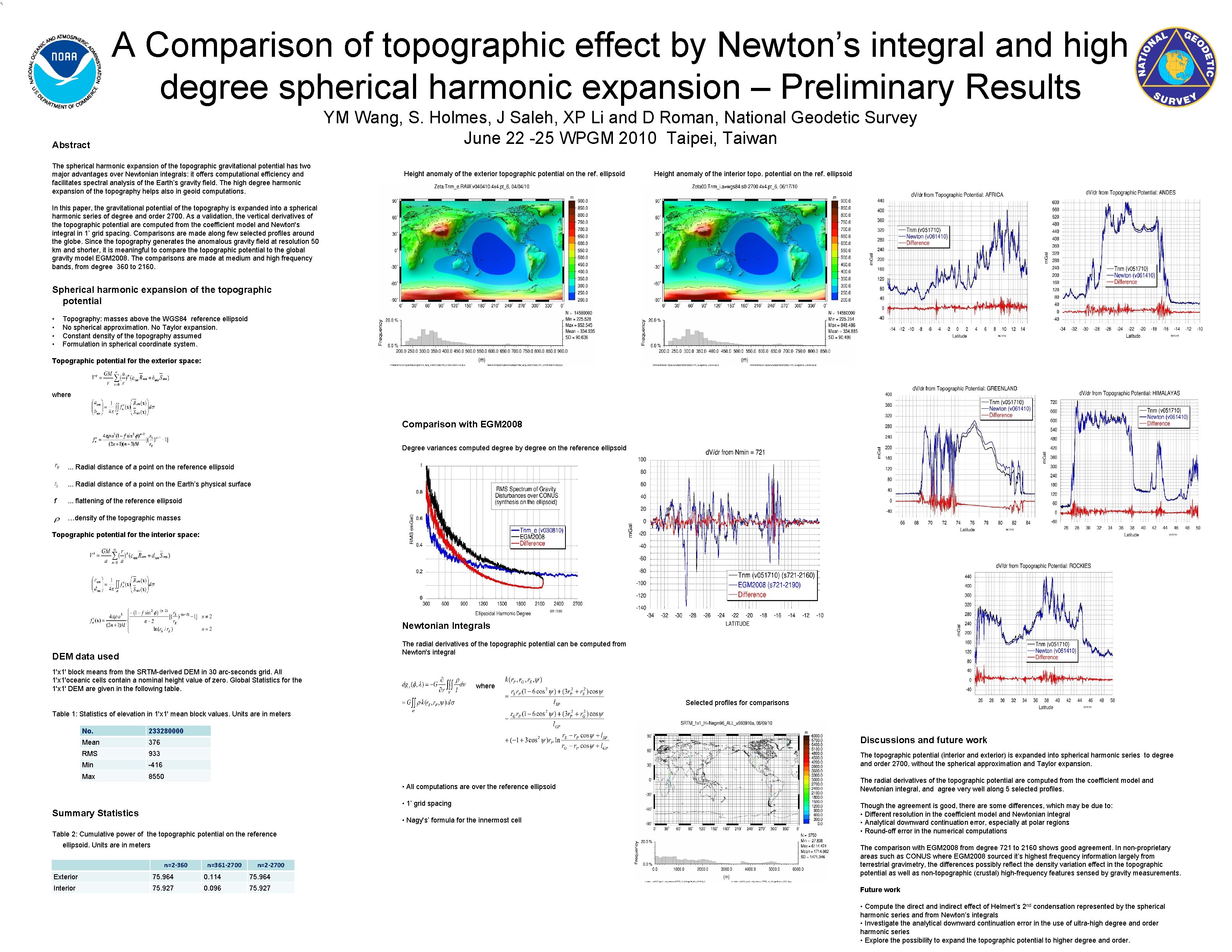
A Comparison of topographic effect by Newton’s integral and high degree spherical harmonic expansion – Preliminary Results YM Wang, S. Holmes, J Saleh, XP Li and D Roman, National Geodetic Survey June 22 -25 WPGM 2010 Taipei, Taiwan Abstract The spherical harmonic expansion of the topographic gravitational potential has two major advantages over Newtonian integrals: it offers computational efficiency and facilitates spectral analysis of the Earth’s gravity field. The high degree harmonic expansion of the topography helps also in geoid computations. Height anomaly of the exterior topographic potential on the ref. ellipsoid Height anomaly of the interior topo. potential on the ref. ellipsoid In this paper, the gravitational potential of the topography is expanded into a spherical harmonic series of degree and order 2700. As a validation, the vertical derivatives of the topographic potential are computed from the coefficient model and Newton's integral in 1’ grid spacing. Comparisons are made along few selected profiles around the globe. Since the topography generates the anomalous gravity field at resolution 50 km and shorter, it is meaningful to compare the topographic potential to the global gravity model EGM 2008. The comparisons are made at medium and high frequency bands, from degree 360 to 2160. Spherical harmonic expansion of the topographic potential • • Topography: masses above the WGS 84 reference ellipsoid No spherical approximation. No Taylor expansion. Constant density of the topography assumed Formulation in spherical coordinate system. Topographic potential for the exterior space: where Comparison with EGM 2008 Degree variances computed degree by degree on the reference ellipsoid. . . Radial distance of a point on the Earth’s physical surface f . . . flattening of the reference ellipsoid …density of the topographic masses Topographic potential for the interior space: Newtonian Integrals The radial derivatives of the topographic potential can be computed from Newton's integral DEM data used 1'x 1' block means from the SRTM-derived DEM in 30 arc-seconds grid. All 1'x 1'oceanic cells contain a nominal height value of zero. Global Statistics for the 1'x 1' DEM are given in the following table. where Selected profiles for comparisons Table 1: Statistics of elevation in 1'x 1' mean block values. Units are in meters No. 233280000 Mean 376 RMS 933 Min -416 Max 8550 Discussions and future work The topographic potential (interior and exterior) is expanded into spherical harmonic series to degree and order 2700, without the spherical approximation and Taylor expansion. • All computations are over the reference ellipsoid • 1’ grid spacing Summary Statistics • Nagy's’ formula for the innermost cell Table 2: Cumulative power of the topographic potential on the reference ellipsoid. Units are in meters n=2 -360 n=361 -2700 n=2 -2700 Exterior 75. 964 0. 114 75. 964 Interior 75. 927 0. 096 75. 927 The radial derivatives of the topographic potential are computed from the coefficient model and Newtonian integral, and agree very well along 5 selected profiles. Though the agreement is good, there are some differences, which may be due to: • Different resolution in the coefficient model and Newtonian integral • Analytical downward continuation error, especially at polar regions • Round-off error in the numerical computations The comparison with EGM 2008 from degree 721 to 2160 shows good agreement. In non-proprietary areas such as CONUS where EGM 2008 sourced it’s highest frequency information largely from terrestrial gravimetry, the differences possibly reflect the density variation effect in the topographic potential as well as non-topographic (crustal) high-frequency features sensed by gravity measurements. Future work • Compute the direct and indirect effect of Helmert’s 2 nd condensation represented by the spherical harmonic series and from Newton’s integrals • Investigate the analytical downward continuation error in the use of ultra-high degree and order harmonic series • Explore the possibility to expand the topographic potential to higher degree and order.
- Slides: 1