
A Comparison of RoboticAssisted Thoracic Lung Surgery with
A Comparison of Robotic-Assisted Thoracic Lung Surgery with Open Lung Surgery and Video-Assisted Thorascopic Lung Surgery Alex Werner, Michael J Szwerc, MD, Kyle Langston, PA
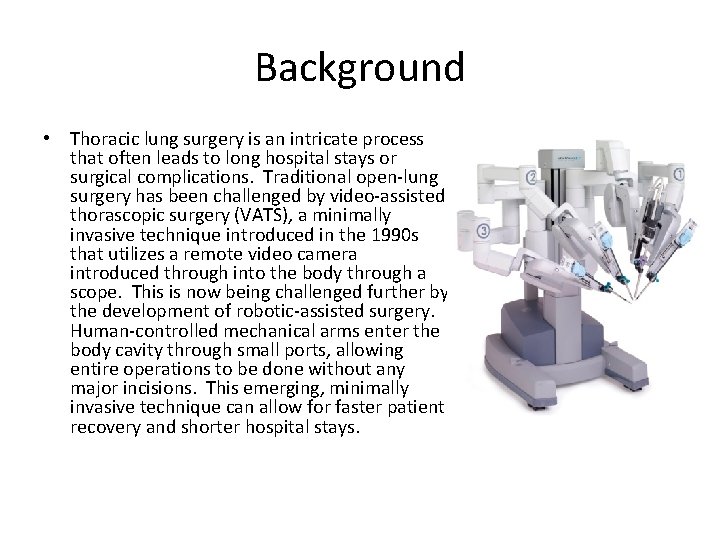
Background • Thoracic lung surgery is an intricate process that often leads to long hospital stays or surgical complications. Traditional open-lung surgery has been challenged by video-assisted thorascopic surgery (VATS), a minimally invasive technique introduced in the 1990 s that utilizes a remote video camera introduced through into the body through a scope. This is now being challenged further by the development of robotic-assisted surgery. Human-controlled mechanical arms enter the body cavity through small ports, allowing entire operations to be done without any major incisions. This emerging, minimally invasive technique can allow for faster patient recovery and shorter hospital stays.
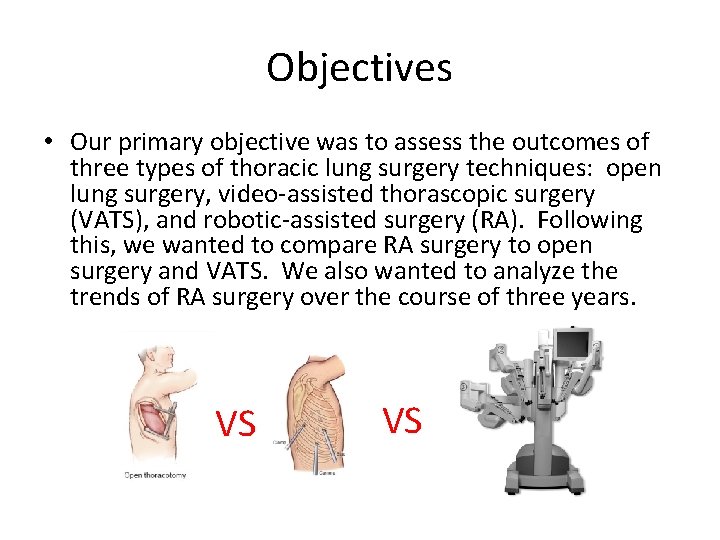
Objectives • Our primary objective was to assess the outcomes of three types of thoracic lung surgery techniques: open lung surgery, video-assisted thorascopic surgery (VATS), and robotic-assisted surgery (RA). Following this, we wanted to compare RA surgery to open surgery and VATS. We also wanted to analyze the trends of RA surgery over the course of three years. VS VS
Methods • We looked over 525 consecutive patients partaking in lobectomies and segmentectomies between June 2008 and July 2013. We thoroughly researched analyzed the following outcomes: length of stay in days after surgery, mortality rate within 30 days of surgery, readmission rate within 30 days of discharge, and conversion rate to open surgery. Within roboticassisted surgery, we also analyzed the percentage of patients going home within one and two days of the operation and readmission rates over time between June 2011 and July 2013.
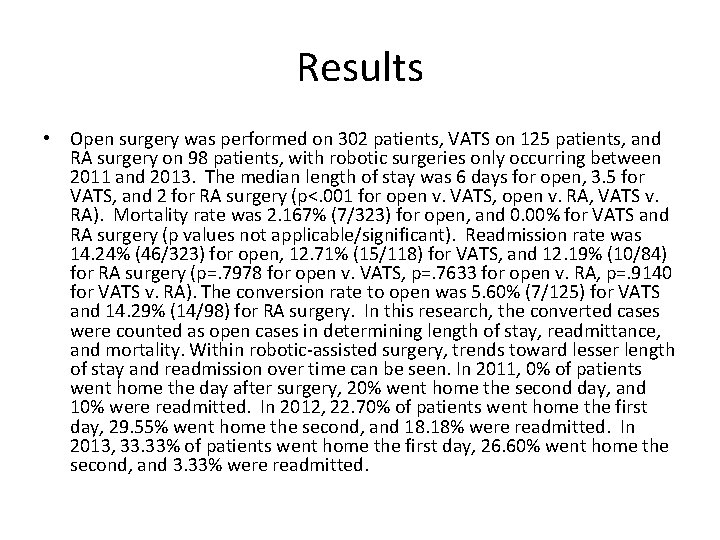
Results • Open surgery was performed on 302 patients, VATS on 125 patients, and RA surgery on 98 patients, with robotic surgeries only occurring between 2011 and 2013. The median length of stay was 6 days for open, 3. 5 for VATS, and 2 for RA surgery (p<. 001 for open v. VATS, open v. RA, VATS v. RA). Mortality rate was 2. 167% (7/323) for open, and 0. 00% for VATS and RA surgery (p values not applicable/significant). Readmission rate was 14. 24% (46/323) for open, 12. 71% (15/118) for VATS, and 12. 19% (10/84) for RA surgery (p=. 7978 for open v. VATS, p=. 7633 for open v. RA, p=. 9140 for VATS v. RA). The conversion rate to open was 5. 60% (7/125) for VATS and 14. 29% (14/98) for RA surgery. In this research, the converted cases were counted as open cases in determining length of stay, readmittance, and mortality. Within robotic-assisted surgery, trends toward lesser length of stay and readmission over time can be seen. In 2011, 0% of patients went home the day after surgery, 20% went home the second day, and 10% were readmitted. In 2012, 22. 70% of patients went home the first day, 29. 55% went home the second, and 18. 18% were readmitted. In 2013, 33. 33% of patients went home the first day, 26. 60% went home the second, and 3. 33% were readmitted.
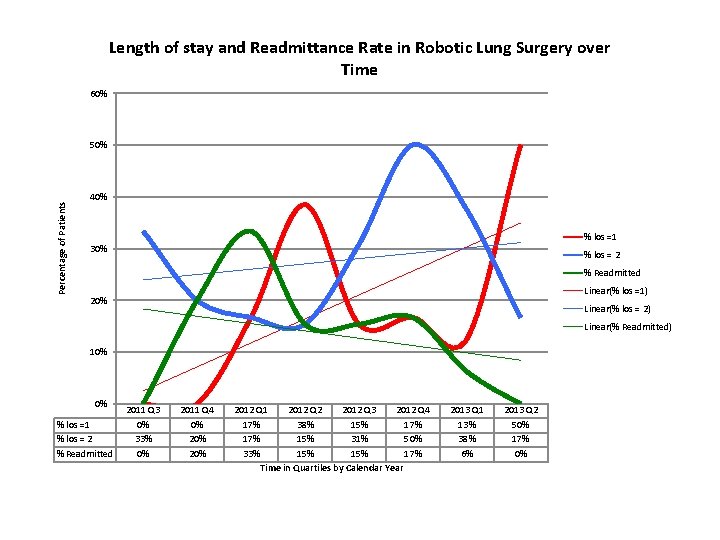
Length of stay and Readmittance Rate in Robotic Lung Surgery over Time 60% Percentage of Patients 50% 40% % los =1 30% % los = 2 % Readmitted Linear(% los =1) 20% Linear(% los = 2) Linear(% Readmitted) 10% 0% % los =1 % los = 2 % Readmitted 2011 Q 3 0% 33% 0% 2011 Q 4 0% 20% 2012 Q 1 2012 Q 2 2012 Q 3 2012 Q 4 17% 38% 15% 17% 15% 31% 50% 33% 15% 17% Time in Quartiles by Calendar Year 2013 Q 1 13% 38% 6% 2013 Q 2 50% 17% 0%
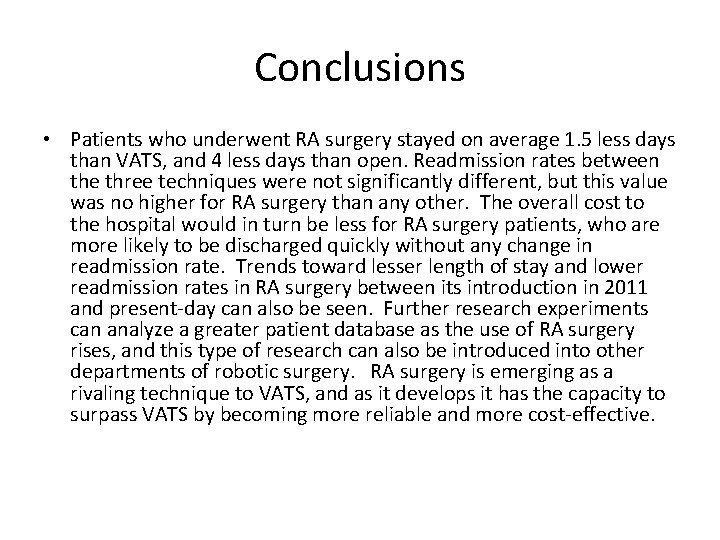
Conclusions • Patients who underwent RA surgery stayed on average 1. 5 less days than VATS, and 4 less days than open. Readmission rates between the three techniques were not significantly different, but this value was no higher for RA surgery than any other. The overall cost to the hospital would in turn be less for RA surgery patients, who are more likely to be discharged quickly without any change in readmission rate. Trends toward lesser length of stay and lower readmission rates in RA surgery between its introduction in 2011 and present-day can also be seen. Further research experiments can analyze a greater patient database as the use of RA surgery rises, and this type of research can also be introduced into other departments of robotic surgery. RA surgery is emerging as a rivaling technique to VATS, and as it develops it has the capacity to surpass VATS by becoming more reliable and more cost-effective.
Works Cited • The Da Vinci Surgical System. Digital image. The Expert Institute Group, LLC, 1 Apr. 2013. Web. 22 July 2013. • Dr. Szwerc, Michael F. Personal interview. • Robot Diagram. Digital image. Unity Point Health. St. Luke's Hospital, 2013. Web. 23 July 2013. <http: //www. stlukescr. org/how-does-itwork. aspx>.
- Slides: 8