
A Comparison of RELY and ROCKET AF Trial






- Slides: 26
A Comparison of RE-LY and ROCKET AF Trial Designs and Outcomes C. Michael Gibson, M. S. , MD.
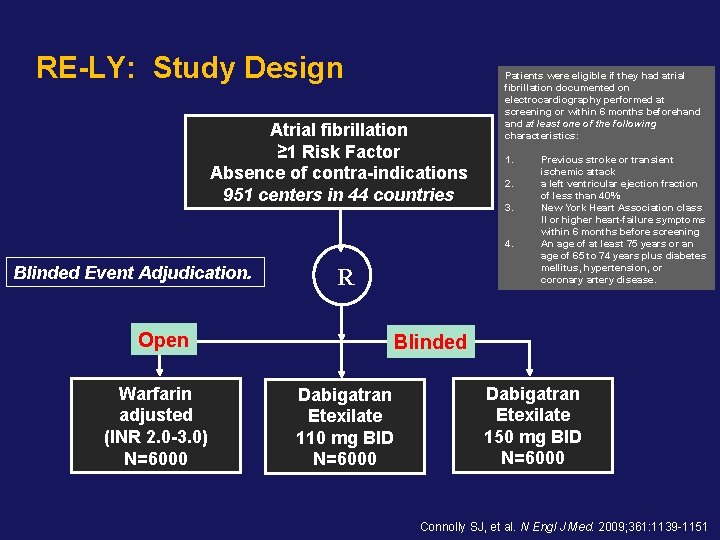
RE-LY: Study Design Atrial fibrillation ≥ 1 Risk Factor Absence of contra-indications 951 centers in 44 countries Patients were eligible if they had atrial fibrillation documented on electrocardiography performed at screening or within 6 months beforehand at least one of the following characteristics: 1. 2. 3. 4. Blinded Event Adjudication. R Open Warfarin adjusted (INR 2. 0 -3. 0) N=6000 Previous stroke or transient ischemic attack a left ventricular ejection fraction of less than 40% New York Heart Association class II or higher heart-failure symptoms within 6 months before screening An age of at least 75 years or an age of 65 to 74 years plus diabetes mellitus, hypertension, or coronary artery disease. Blinded Dabigatran Etexilate 110 mg BID N=6000 Dabigatran Etexilate 150 mg BID N=6000 Connolly SJ, et al. N Engl J Med. 2009; 361: 1139 -1151
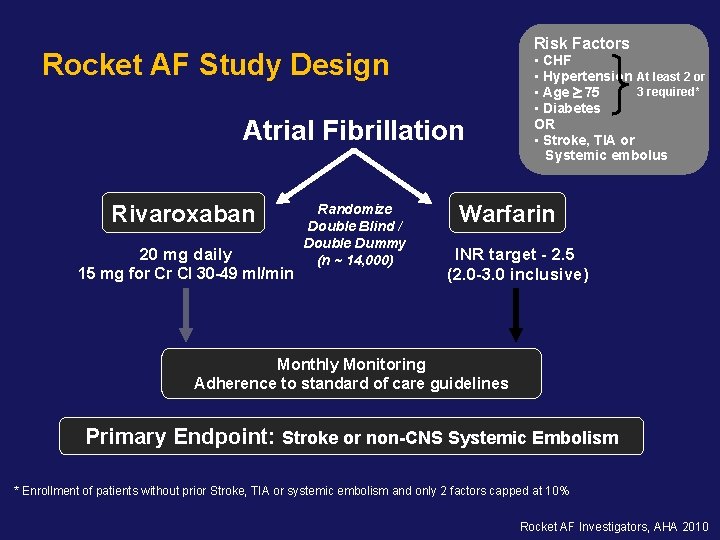
Risk Factors Rocket AF Study Design Atrial Fibrillation Rivaroxaban 20 mg daily 15 mg for Cr Cl 30 -49 ml/min Randomize Double Blind / Double Dummy (n ~ 14, 000) • CHF • Hypertension At least 2 or 3 required* • Age 75 • Diabetes OR • Stroke, TIA or Systemic embolus Warfarin INR target - 2. 5 (2. 0 -3. 0 inclusive) Monthly Monitoring Adherence to standard of care guidelines Primary Endpoint: Stroke or non-CNS Systemic Embolism * Enrollment of patients without prior Stroke, TIA or systemic embolism and only 2 factors capped at 10% Rocket AF Investigators, AHA 2010
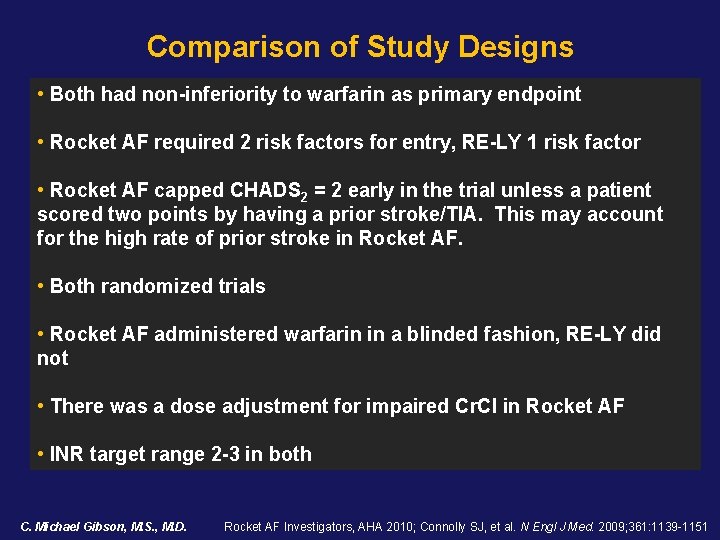
Comparison of Study Designs • Both had non-inferiority to warfarin as primary endpoint • Rocket AF required 2 risk factors for entry, RE-LY 1 risk factor • Rocket AF capped CHADS 2 = 2 early in the trial unless a patient scored two points by having a prior stroke/TIA. This may account for the high rate of prior stroke in Rocket AF. • Both randomized trials • Rocket AF administered warfarin in a blinded fashion, RE-LY did not • There was a dose adjustment for impaired Cr. Cl in Rocket AF • INR target range 2 -3 in both C. Michael Gibson, M. S. , M. D. Rocket AF Investigators, AHA 2010; Connolly SJ, et al. N Engl J Med. 2009; 361: 1139 -1151
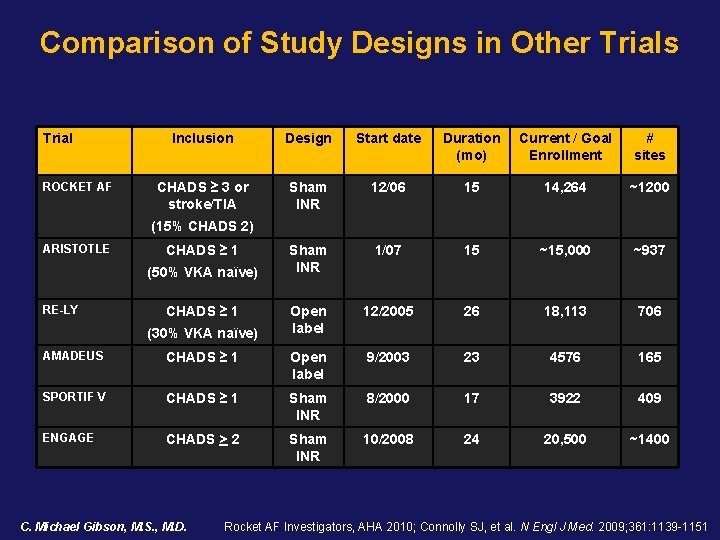
Comparison of Study Designs in Other Trials Trial ROCKET AF Inclusion Design Start date Duration (mo) Current / Goal Enrollment # sites CHADS ≥ 3 or stroke/TIA Sham INR 12/06 15 14, 264 ~1200 Sham INR 1/07 15 ~15, 000 ~937 Open label 12/2005 26 18, 113 706 (15% CHADS 2) ARISTOTLE CHADS ≥ 1 (50% VKA naïve) RE-LY CHADS ≥ 1 (30% VKA naïve) AMADEUS CHADS ≥ 1 Open label 9/2003 23 4576 165 SPORTIF V CHADS ≥ 1 Sham INR 8/2000 17 3922 409 ENGAGE CHADS > 2 Sham INR 10/2008 24 20, 500 ~1400 C. Michael Gibson, M. S. , M. D. Rocket AF Investigators, AHA 2010; Connolly SJ, et al. N Engl J Med. 2009; 361: 1139 -1151
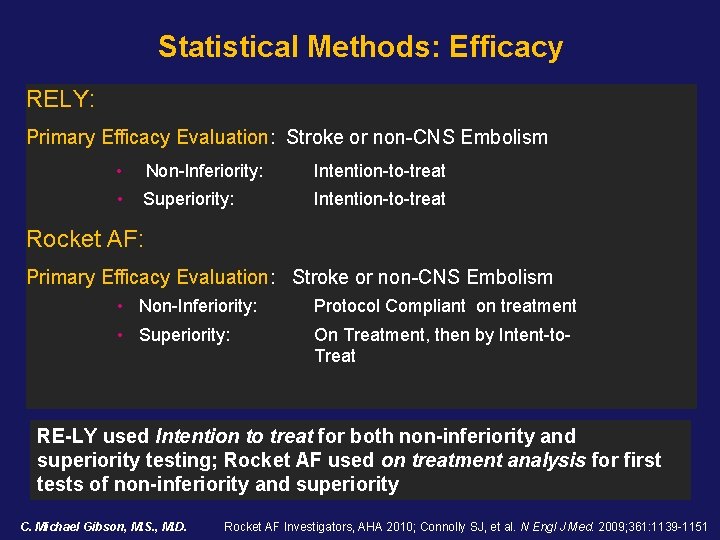
Statistical Methods: Efficacy RELY: Primary Efficacy Evaluation: Stroke or non-CNS Embolism • Non-Inferiority: Intention-to-treat • Superiority: Intention-to-treat Rocket AF: Primary Efficacy Evaluation: Stroke or non-CNS Embolism • Non-Inferiority: Protocol Compliant on treatment • Superiority: On Treatment, then by Intent-to. Treat RE-LY used Intention to treat for both non-inferiority and superiority testing; Rocket AF used on treatment analysis for first tests of non-inferiority and superiority C. Michael Gibson, M. S. , M. D. Rocket AF Investigators, AHA 2010; Connolly SJ, et al. N Engl J Med. 2009; 361: 1139 -1151
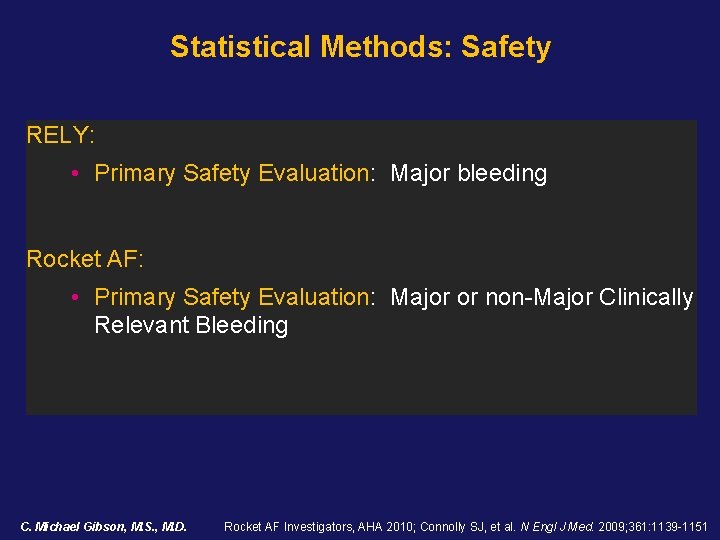
Statistical Methods: Safety RELY: • Primary Safety Evaluation: Major bleeding Rocket AF: • Primary Safety Evaluation: Major or non-Major Clinically Relevant Bleeding C. Michael Gibson, M. S. , M. D. Rocket AF Investigators, AHA 2010; Connolly SJ, et al. N Engl J Med. 2009; 361: 1139 -1151
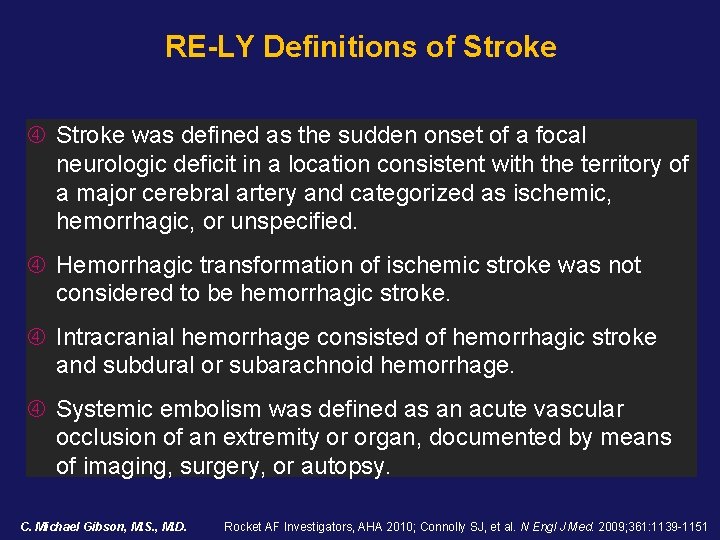
RE-LY Definitions of Stroke was defined as the sudden onset of a focal neurologic deficit in a location consistent with the territory of a major cerebral artery and categorized as ischemic, hemorrhagic, or unspecified. Hemorrhagic transformation of ischemic stroke was not considered to be hemorrhagic stroke. Intracranial hemorrhage consisted of hemorrhagic stroke and subdural or subarachnoid hemorrhage. Systemic embolism was defined as an acute vascular occlusion of an extremity or organ, documented by means of imaging, surgery, or autopsy. C. Michael Gibson, M. S. , M. D. Rocket AF Investigators, AHA 2010; Connolly SJ, et al. N Engl J Med. 2009; 361: 1139 -1151
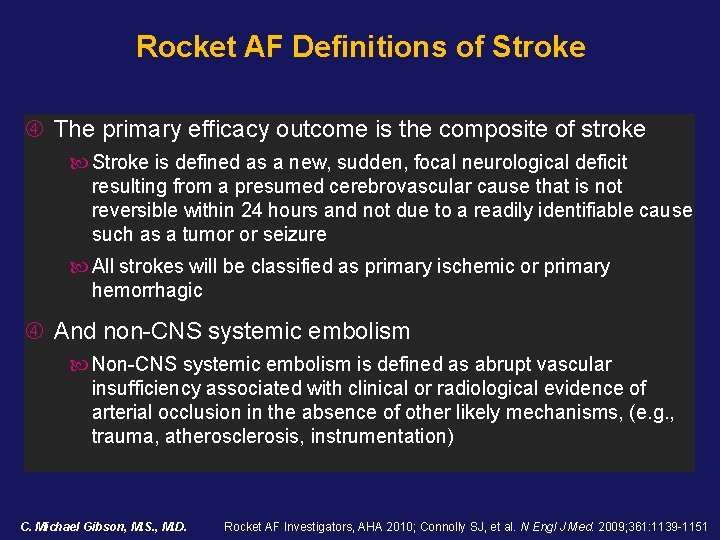
Rocket AF Definitions of Stroke The primary efficacy outcome is the composite of stroke Stroke is defined as a new, sudden, focal neurological deficit resulting from a presumed cerebrovascular cause that is not reversible within 24 hours and not due to a readily identifiable cause such as a tumor or seizure All strokes will be classified as primary ischemic or primary hemorrhagic And non-CNS systemic embolism Non-CNS systemic embolism is defined as abrupt vascular insufficiency associated with clinical or radiological evidence of arterial occlusion in the absence of other likely mechanisms, (e. g. , trauma, atherosclerosis, instrumentation) C. Michael Gibson, M. S. , M. D. Rocket AF Investigators, AHA 2010; Connolly SJ, et al. N Engl J Med. 2009; 361: 1139 -1151
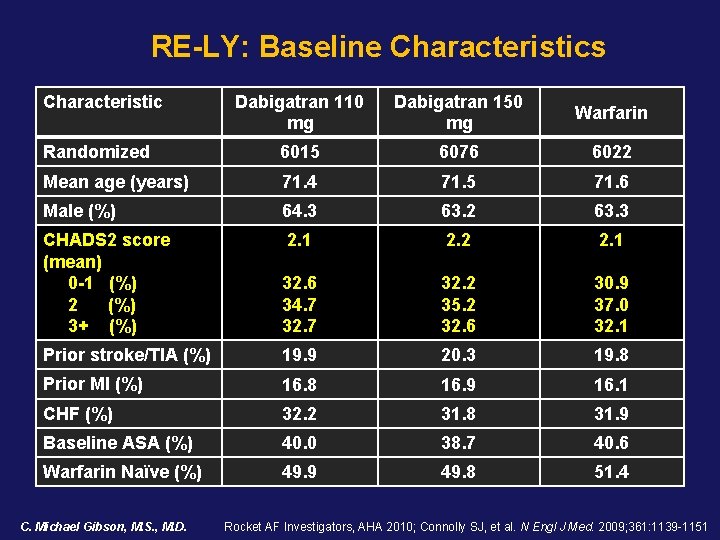
RE-LY: Baseline Characteristics Characteristic Dabigatran 110 mg Dabigatran 150 mg Warfarin Randomized 6015 6076 6022 Mean age (years) 71. 4 71. 5 71. 6 Male (%) 64. 3 63. 2 63. 3 CHADS 2 score (mean) 0 -1 (%) 2 (%) 3+ (%) 2. 1 2. 2 2. 1 32. 6 34. 7 32. 2 35. 2 32. 6 30. 9 37. 0 32. 1 Prior stroke/TIA (%) 19. 9 20. 3 19. 8 Prior MI (%) 16. 8 16. 9 16. 1 CHF (%) 32. 2 31. 8 31. 9 Baseline ASA (%) 40. 0 38. 7 40. 6 Warfarin Naïve (%) 49. 9 49. 8 51. 4 C. Michael Gibson, M. S. , M. D. Rocket AF Investigators, AHA 2010; Connolly SJ, et al. N Engl J Med. 2009; 361: 1139 -1151
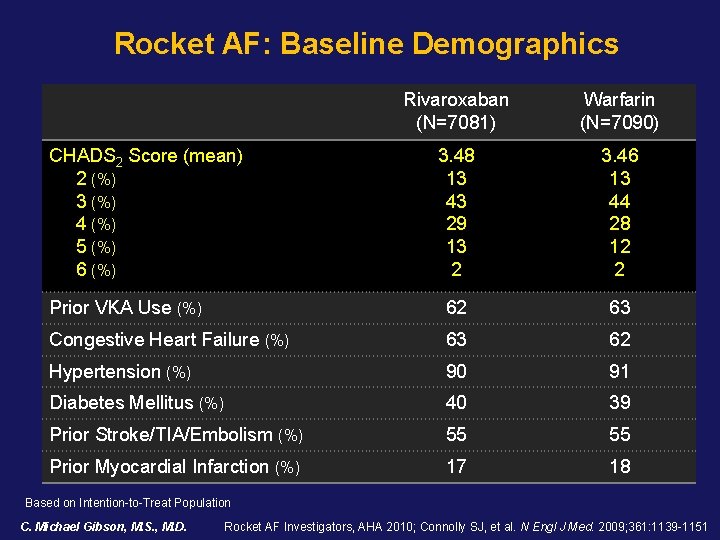
Rocket AF: Baseline Demographics Rivaroxaban (N=7081) Warfarin (N=7090) 3. 48 13 43 29 13 2 3. 46 13 44 28 12 2 Prior VKA Use (%) 62 63 Congestive Heart Failure (%) 63 62 Hypertension (%) 90 91 Diabetes Mellitus (%) 40 39 Prior Stroke/TIA/Embolism (%) 55 55 Prior Myocardial Infarction (%) 17 18 CHADS 2 Score (mean) 2 (%) 3 (%) 4 (%) 5 (%) 6 (%) Based on Intention-to-Treat Population C. Michael Gibson, M. S. , M. D. Rocket AF Investigators, AHA 2010; Connolly SJ, et al. N Engl J Med. 2009; 361: 1139 -1151
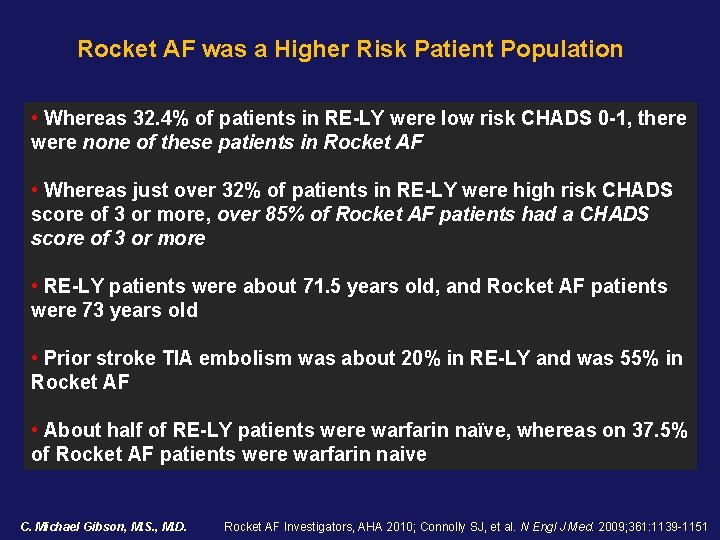
Rocket AF was a Higher Risk Patient Population • Whereas 32. 4% of patients in RE-LY were low risk CHADS 0 -1, there were none of these patients in Rocket AF • Whereas just over 32% of patients in RE-LY were high risk CHADS score of 3 or more, over 85% of Rocket AF patients had a CHADS score of 3 or more • RE-LY patients were about 71. 5 years old, and Rocket AF patients were 73 years old • Prior stroke TIA embolism was about 20% in RE-LY and was 55% in Rocket AF • About half of RE-LY patients were warfarin naïve, whereas on 37. 5% of Rocket AF patients were warfarin naive C. Michael Gibson, M. S. , M. D. Rocket AF Investigators, AHA 2010; Connolly SJ, et al. N Engl J Med. 2009; 361: 1139 -1151
Impact of Enrolling Higher CHADs Score Patients Higher CHADs scores are associated with: 1. Higher rates of major bleeding 2. Lower TTRs C. Michael Gibson, M. S. , M. D. Personal communication RE-LY Investigators. Connolly SJ, et al. N Engl J Med. 2009; 361: 1139 -1151
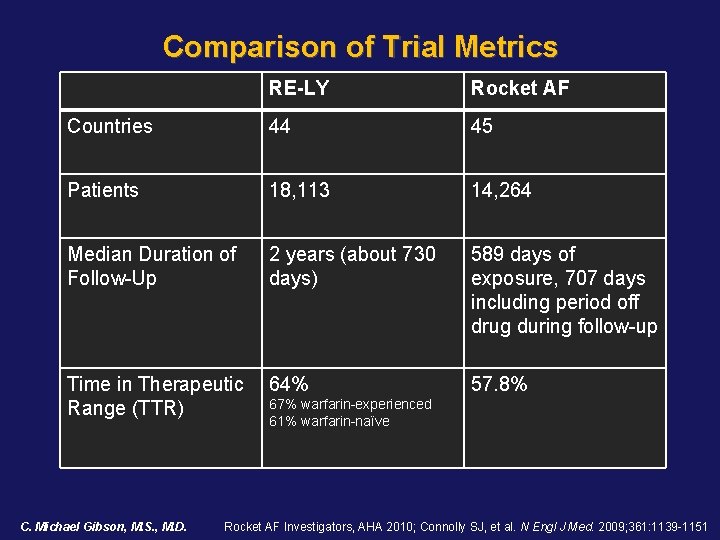
Comparison of Trial Metrics RE-LY Rocket AF Countries 44 45 Patients 18, 113 14, 264 Median Duration of Follow-Up 2 years (about 730 days) 589 days of exposure, 707 days including period off drug during follow-up Time in Therapeutic Range (TTR) 64% 57. 8% C. Michael Gibson, M. S. , M. D. 67% warfarin-experienced 61% warfarin-naïve Rocket AF Investigators, AHA 2010; Connolly SJ, et al. N Engl J Med. 2009; 361: 1139 -1151
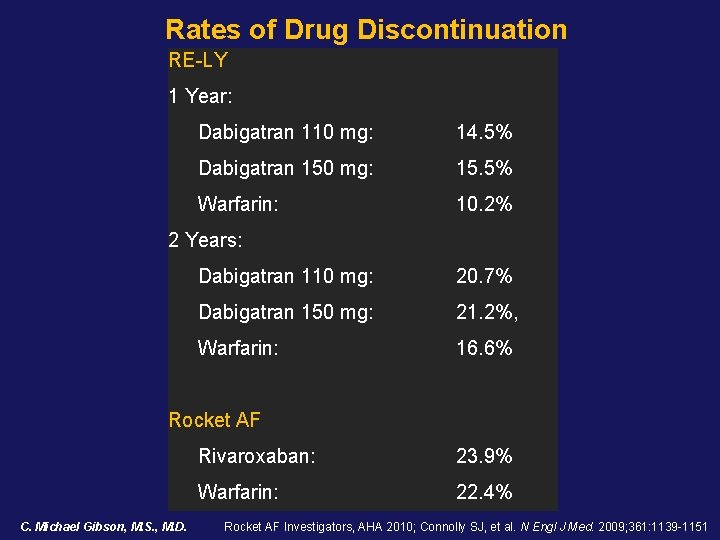
Rates of Drug Discontinuation RE-LY 1 Year: Dabigatran 110 mg: 14. 5% Dabigatran 150 mg: 15. 5% Warfarin: 10. 2% 2 Years: Dabigatran 110 mg: 20. 7% Dabigatran 150 mg: 21. 2%, Warfarin: 16. 6% Rocket AF C. Michael Gibson, M. S. , M. D. Rivaroxaban: 23. 9% Warfarin: 22. 4% Rocket AF Investigators, AHA 2010; Connolly SJ, et al. N Engl J Med. 2009; 361: 1139 -1151
Primary Endpoint of Stroke or Systemic Embolism: Non-inferiority Analysis Non Inferiorirty p vs warfarin RE-LY Dabigatran 110 mg Dabigatran 150 mg Warfarin Rocket AF Rivaroxaban 20 mg Warfarin 1. 53% per year 1. 11% per year 1. 69% per year ITT Analysis p<0. 001 Per Protocol Analysis 2. 12% per year 2. 42% per year p<0. 001 No ITT analysis is available for non-inferiority in Rocket AF. An on treatment or per-protocol analysis is generally performed in the assessment of non-inferiority. If numerous patients come off of study drug, this biases the trial towards a non-inferior result in an ITT analysis. This is the basis for performing a per-protocol analysis in a non-inferiority assessment. C. Michael Gibson, M. S. , M. D. Rocket AF Investigators, AHA 2010; Connolly SJ, et al. N Engl J Med. 2009; 361: 1139 -1151
Primary Endpoint of Stroke or Systemic Embolism: Superiority Analysis Superiority p vs warfarin ITT Analysis RE-LY Dabigatran 110 mg Dabigatran 150 mg Warfarin 1. 53% per year 1. 11% per year 1. 69% per year p=0. 34 p<0. 001 Rocket AF Rivaroxaban 20 mg Warfarin 2. 12% per year 2. 42% per year p=0. 117* *In an on treatment analysis in Rocket AF Stoke or SE rates were 1. 70% / yr for rivaroxaban and 2. 15% / yr for warfarin, p=0. 015. No on treatment analysis is available from RE-LY. C. Michael Gibson, M. S. , M. D. Rocket AF Investigators, AHA 2010; Connolly SJ, et al. N Engl J Med. 2009; 361: 1139 -1151
Hemorrhagic Stroke RELY Dabigatran 110 mg Dabigatran 150 mg 0. 12% / yr 0. 10% / yr Warfarin 0. 38% / yr HR ITT P-value 0. 31 0. 26 <0. 001 0. 59 0. 012* Rocket AF Rivaroxaban 20 mg 0. 26% / yr Warfarin 0. 44% / yr *In an on treatment analysis in Rocket AF Hemorrhagic Stoke rates were 0. 26% / yr for rivaroxaban and 0. 44% / yr for warfarin, p=0. 024. No on treatment analysis is available from RE-LY. C. Michael Gibson, M. S. , M. D. Rocket AF Investigators, AHA 2010; Connolly SJ, et al. N Engl J Med. 2009; 361: 1139 -1151
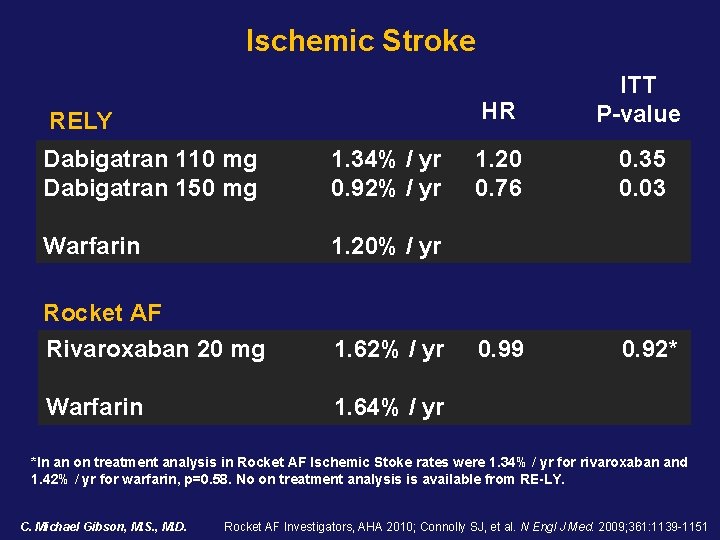
Ischemic Stroke RELY Dabigatran 110 mg Dabigatran 150 mg 1. 34% / yr 0. 92% / yr Warfarin 1. 20% / yr HR ITT P-value 1. 20 0. 76 0. 35 0. 03 0. 99 0. 92* Rocket AF Rivaroxaban 20 mg 1. 62% / yr Warfarin 1. 64% / yr *In an on treatment analysis in Rocket AF Ischemic Stoke rates were 1. 34% / yr for rivaroxaban and 1. 42% / yr for warfarin, p=0. 58. No on treatment analysis is available from RE-LY. C. Michael Gibson, M. S. , M. D. Rocket AF Investigators, AHA 2010; Connolly SJ, et al. N Engl J Med. 2009; 361: 1139 -1151
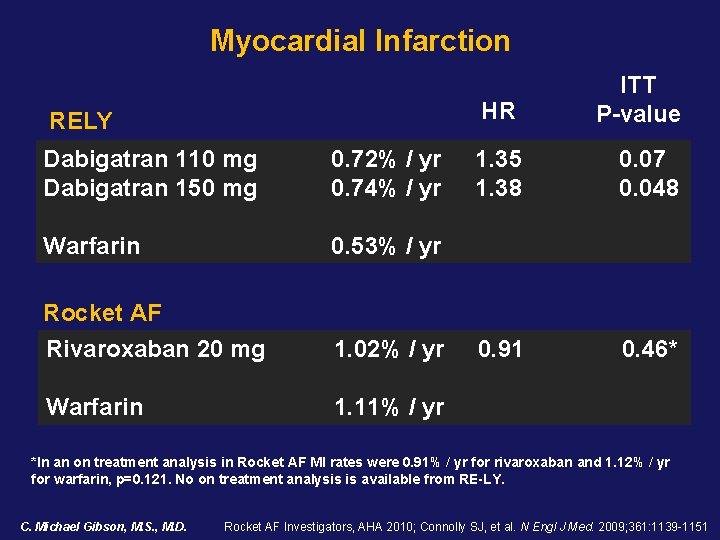
Myocardial Infarction RELY Dabigatran 110 mg Dabigatran 150 mg 0. 72% / yr 0. 74% / yr Warfarin 0. 53% / yr HR ITT P-value 1. 35 1. 38 0. 07 0. 048 0. 91 0. 46* Rocket AF Rivaroxaban 20 mg 1. 02% / yr Warfarin 1. 11% / yr *In an on treatment analysis in Rocket AF MI rates were 0. 91% / yr for rivaroxaban and 1. 12% / yr for warfarin, p=0. 121. No on treatment analysis is available from RE-LY. C. Michael Gibson, M. S. , M. D. Rocket AF Investigators, AHA 2010; Connolly SJ, et al. N Engl J Med. 2009; 361: 1139 -1151
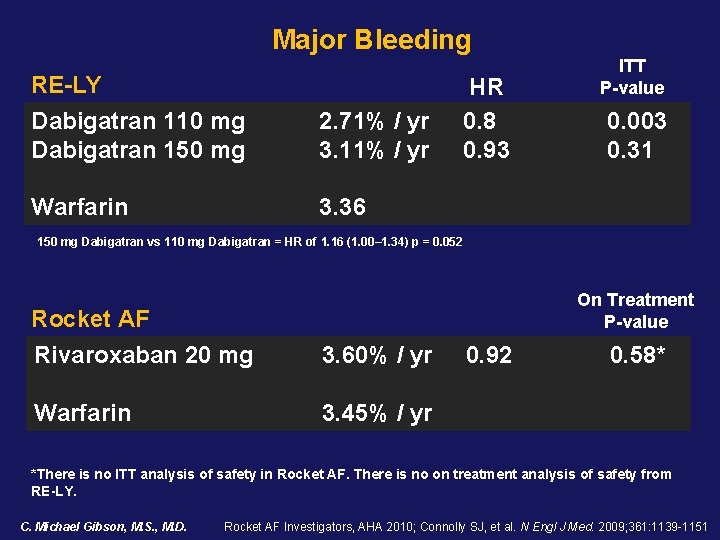
Major Bleeding RE-LY Dabigatran 110 mg Dabigatran 150 mg 2. 71% / yr 3. 11% / yr Warfarin 3. 36 HR 0. 8 0. 93 ITT P-value 0. 003 0. 31 150 mg Dabigatran vs 110 mg Dabigatran = HR of 1. 16 (1. 00– 1. 34) p = 0. 052 On Treatment P-value Rocket AF Rivaroxaban 20 mg 3. 60% / yr Warfarin 3. 45% / yr 0. 92 0. 58* *There is no ITT analysis of safety in Rocket AF. There is no on treatment analysis of safety from RE-LY. C. Michael Gibson, M. S. , M. D. Rocket AF Investigators, AHA 2010; Connolly SJ, et al. N Engl J Med. 2009; 361: 1139 -1151
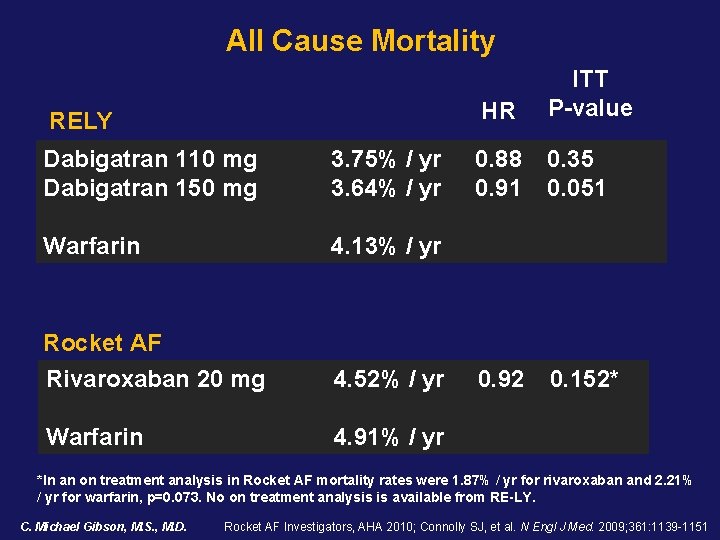
All Cause Mortality RELY Dabigatran 110 mg Dabigatran 150 mg 3. 75% / yr 3. 64% / yr Warfarin 4. 13% / yr HR ITT P-value 0. 88 0. 91 0. 35 0. 051 0. 92 0. 152* Rocket AF Rivaroxaban 20 mg 4. 52% / yr Warfarin 4. 91% / yr *In an on treatment analysis in Rocket AF mortality rates were 1. 87% / yr for rivaroxaban and 2. 21% / yr for warfarin, p=0. 073. No on treatment analysis is available from RE-LY. C. Michael Gibson, M. S. , M. D. Rocket AF Investigators, AHA 2010; Connolly SJ, et al. N Engl J Med. 2009; 361: 1139 -1151
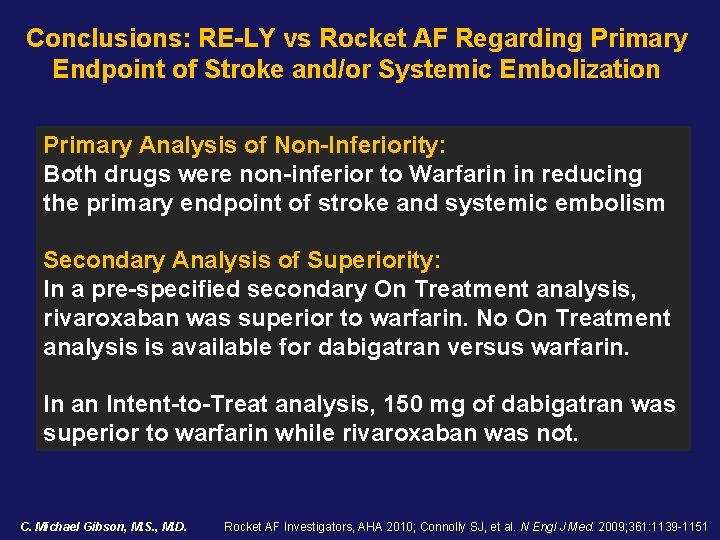
Conclusions: RE-LY vs Rocket AF Regarding Primary Endpoint of Stroke and/or Systemic Embolization Primary Analysis of Non-Inferiority: Both drugs were non-inferior to Warfarin in reducing the primary endpoint of stroke and systemic embolism Secondary Analysis of Superiority: In a pre-specified secondary On Treatment analysis, rivaroxaban was superior to warfarin. No On Treatment analysis is available for dabigatran versus warfarin. In an Intent-to-Treat analysis, 150 mg of dabigatran was superior to warfarin while rivaroxaban was not. C. Michael Gibson, M. S. , M. D. Rocket AF Investigators, AHA 2010; Connolly SJ, et al. N Engl J Med. 2009; 361: 1139 -1151
Conclusions: RE-LY vs Rocket AF Regarding Stroke Dabigatran 150 mg reduced the risk of hemorrhagic stroke (HR 0. 26, p<0. 001) as did rivaroxaban (HR 0. 59, p=0. 024). Both drugs were therefore safer. Dabigatran 150 mg also reduced the risk of ischemic stroke (HR=0. 76, p=0. 03) while rivaroxaban did not (p=0. 58)(dabigatran was associated with thrombotic efficacy) C. Michael Gibson, M. S. , M. D. Rocket AF Investigators, AHA 2010; Connolly SJ, et al. N Engl J Med. 2009; 361: 1139 -1151
Conclusions: RE-LY vs Rocket AF Regarding Bleeding There was no difference in major bleeding associated with 150 mg of dabigatran therapy versus warfarin. There was statistically less major bleeding associated with 110 mg of dabigatran than warfarin. While there was numerically more major bleeding with rivaroxaban, there was less fatal bleeding with rivaroxaban compared with warfarin. Extracranial bleeding was numerically less with 110 mg of dabigatran than warfarin, but both 150 mg of dabigatran and rivaroxaban had numerically more extracranial bleeds than warfarin C. Michael Gibson, M. S. , M. D. Rocket AF Investigators, AHA 2010; Connolly SJ, et al. N Engl J Med. 2009; 361: 1139 -1151
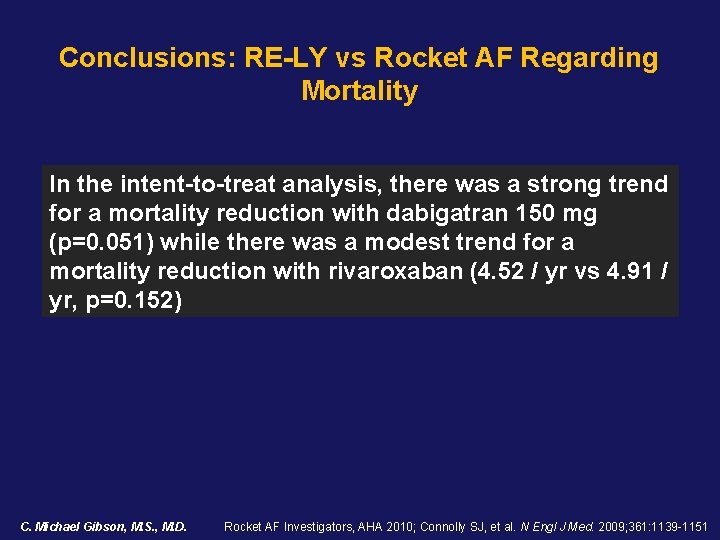
Conclusions: RE-LY vs Rocket AF Regarding Mortality In the intent-to-treat analysis, there was a strong trend for a mortality reduction with dabigatran 150 mg (p=0. 051) while there was a modest trend for a mortality reduction with rivaroxaban (4. 52 / yr vs 4. 91 / yr, p=0. 152) C. Michael Gibson, M. S. , M. D. Rocket AF Investigators, AHA 2010; Connolly SJ, et al. N Engl J Med. 2009; 361: 1139 -1151