
A Comparison of Modeling Scales in Flexible Parametric
A Comparison of Modeling Scales in Flexible Parametric Models Noori Akhtar-Danesh, Ph. D Mc. Master University Hamilton, Canada daneshn@mcmaster. ca
Outline l Background l A review of splines l Flexible parametric models l Results • Ovarian cancer • Colorectal cancer l Conclusions Stata Conference 2015, Columbus, USA 2
Background l Cox-regression and parametric survival models are quite common in the analysis of survival data l Recently, Flexible Parametric Models (FPM), have been introduced as an extension to the parametric models such as Weibull model (hazard- scale), loglogistic model (oddsscale), and lognormal model (probit-scale) Stata Conference 2015, Columbus, USA 3
Objectives & Methods l In this presentation different FPMs will be compared based on these modeling scales l Used two subsets of the U. S. National Cancer Institute's Surveillance, Epidemiology and End Results (SEER) dataset from the original 9 registries; • Ovarian cancer diagnosed 1991 - 2010 • Colorectal cancer in men 60+ diagnosed 2001 - 2010 Stata Conference 2015, Columbus, USA 4
A review of splines l The daily statistical practice usually involves assessing relationship between one outcome variable and one or more explanatory variables l We usually assume linear relationship between some function of the outcome variable and the explanatory variables l However, in many situations this assumption may not be appropriate Stata Conference 2015, Columbus, USA 5
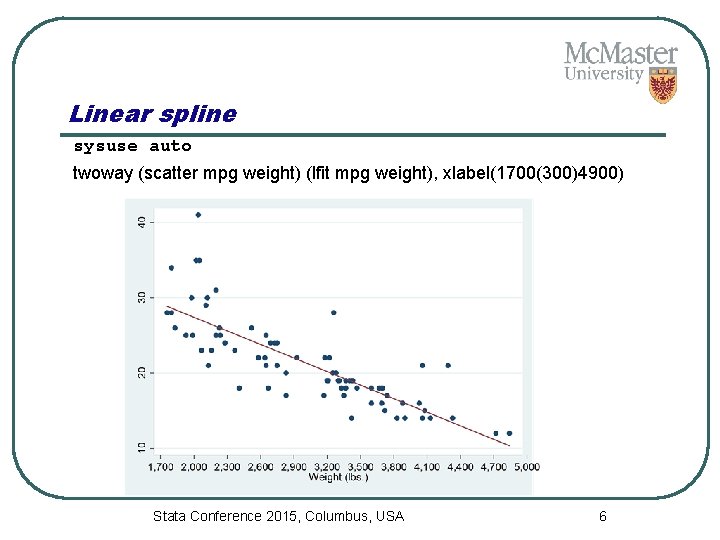
Linear spline sysuse auto twoway (scatter mpg weight) (lfit mpg weight), xlabel(1700(300)4900) Stata Conference 2015, Columbus, USA 6
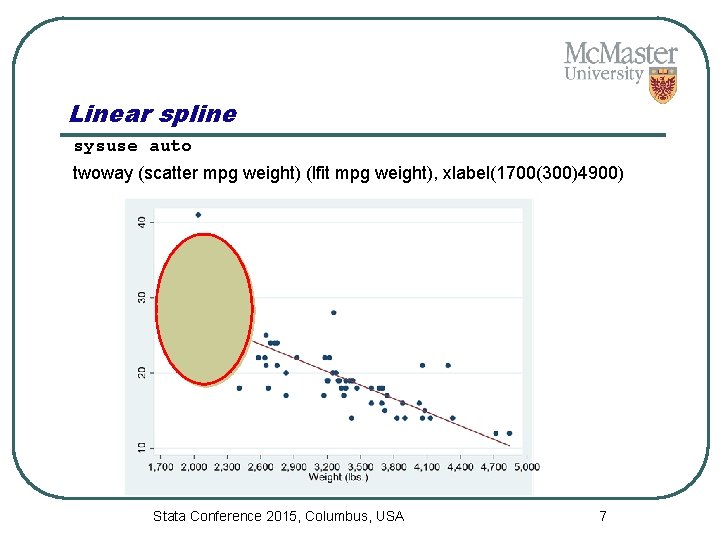
Linear spline sysuse auto twoway (scatter mpg weight) (lfit mpg weight), xlabel(1700(300)4900) Stata Conference 2015, Columbus, USA 7
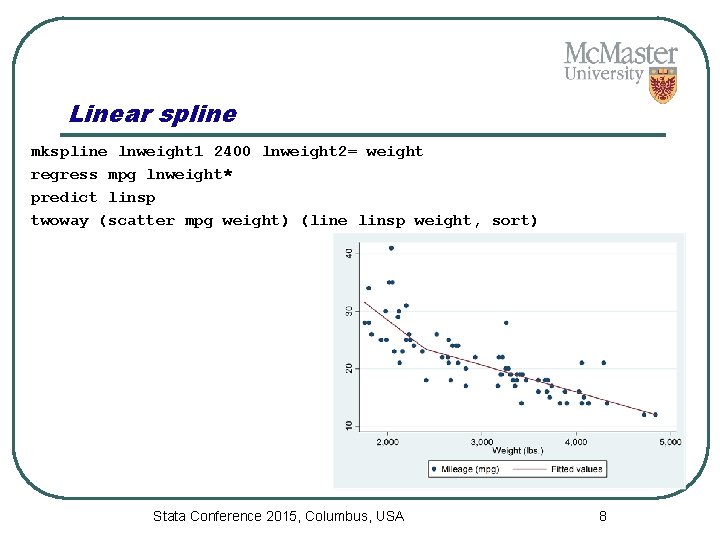
Linear spline mkspline lnweight 1 2400 lnweight 2= weight regress mpg lnweight* predict linsp twoway (scatter mpg weight) (line linsp weight, sort) Stata Conference 2015, Columbus, USA 8
Cubic Splines l Cubic splines are piecewise cubic polynomials with a separate cubic polynomial fit in each of the predefined number of intervals l The number of intervals is chosen by the user and the split points are known as knots l Continuity restrictions are imposed to join the splines at knots to fit a smooth function Stata Conference 2015, Columbus, USA 9
Restricted Cubic Splines l In RCS the spline function is forced (restricted) to be linear before the first and after the last knot (the boundary knots) l When modeling survival time, the boundary knots are usually defined as the minimum and maximum of the uncensored survival times Stata Conference 2015, Columbus, USA 10
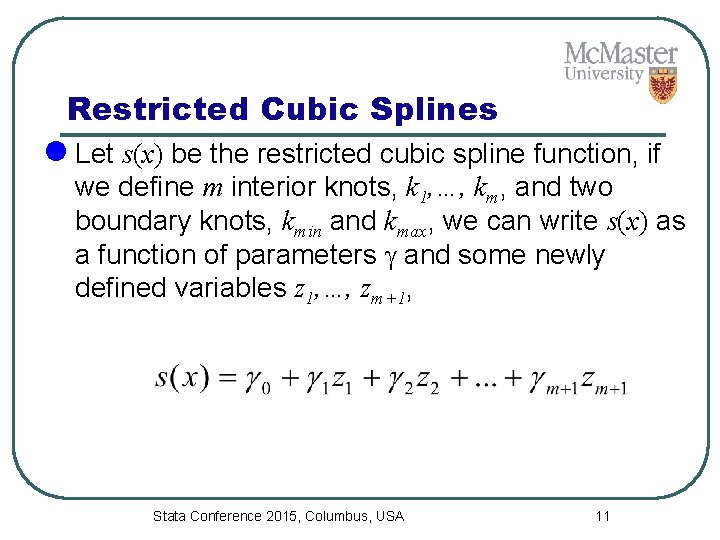
Restricted Cubic Splines l Let s(x) be the restricted cubic spline function, if we define m interior knots, k 1, …, km, and two boundary knots, kmin and kmax, we can write s(x) as a function of parameters and some newly defined variables z 1, …, zm+1, Stata Conference 2015, Columbus, USA 11
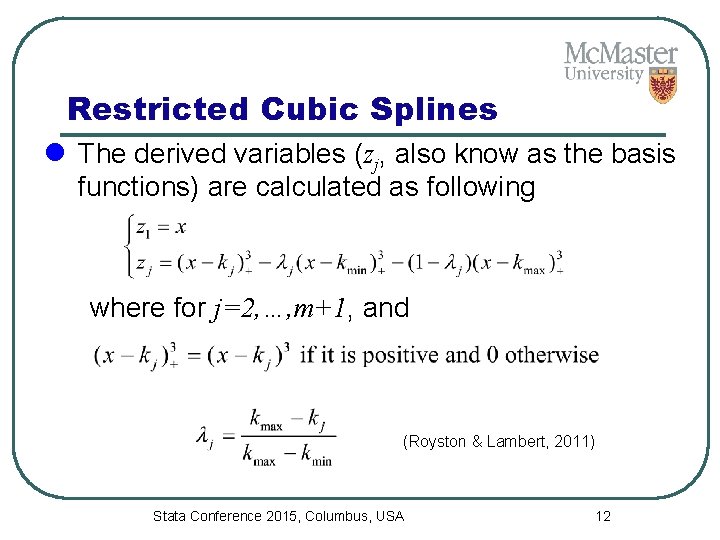
Restricted Cubic Splines l The derived variables (zj, also know as the basis functions) are calculated as following where for j=2, …, m+1, and (Royston & Lambert, 2011) Stata Conference 2015, Columbus, USA 12
Restricted Cubic Splines l These RCSs can be calculated using a number of Stata commands, including mkspline (an official Stata command), rcsgen, and splinegen (two user written commands) l The rcsgen command can orthogonalize the derived spline variables which can lead to more stable parameter estimates and quicker model convergence Stata Conference 2015, Columbus, USA 13
rcsgen; an alternative spline macro sysuse auto, clear rcsgen weight, gen(rcs) df(3) regress mpg rcs 1 -rcs 3 predictnl pred = xb(), ci(lci uci) twoway (rarea lci uci weight, sort) /// (scatter mpg weight, sort) /// (line pred weight, sort lcolor(black)), /// legend(off) Stata Conference 2015, Columbus, USA 14
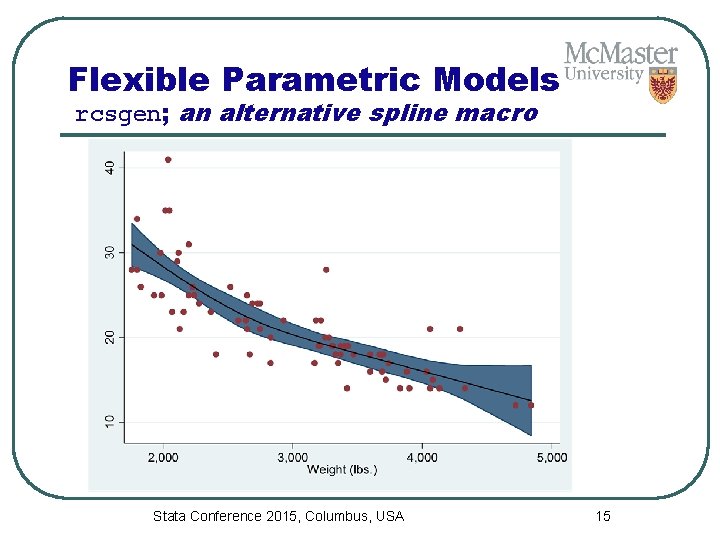
Flexible Parametric Models rcsgen; an alternative spline macro Stata Conference 2015, Columbus, USA 15
FPM: Royston-Parmer (RP) Models l RP models are a extension of the parametric models (Weibull, log-logistic, and log-normal) which offer greater flexibility with respect to shape of the survival distribution l The additional flexibility of an RP model is because, for instance for a hazard model, it represents the baseline distribution function as a restricted cubic spline function of log time instead of simply as a linear function of log time l The complexity of modeling spline functions is determined by the number and positions of the knots in the log time Stata Conference 2015, Columbus, USA 16
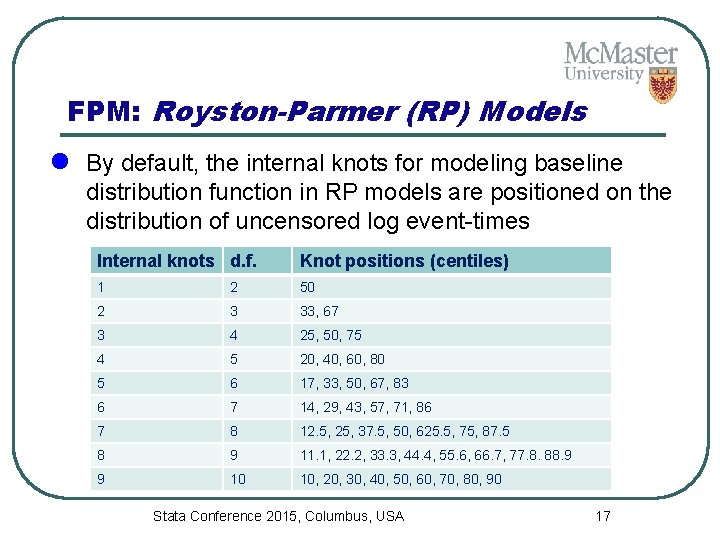
FPM: Royston-Parmer (RP) Models l By default, the internal knots for modeling baseline distribution function in RP models are positioned on the distribution of uncensored log event-times Internal knots d. f. Knot positions (centiles) 1 2 50 2 3 33, 67 3 4 25, 50, 75 4 5 20, 40, 60, 80 5 6 17, 33, 50, 67, 83 6 7 14, 29, 43, 57, 71, 86 7 8 12. 5, 25, 37. 5, 50, 625. 5, 75, 87. 5 8 9 11. 1, 22. 2, 33. 3, 44. 4, 55. 6, 66. 7, 77. 8. 88. 9 9 10 10, 20, 30, 40, 50, 60, 70, 80, 90 Stata Conference 2015, Columbus, USA 17
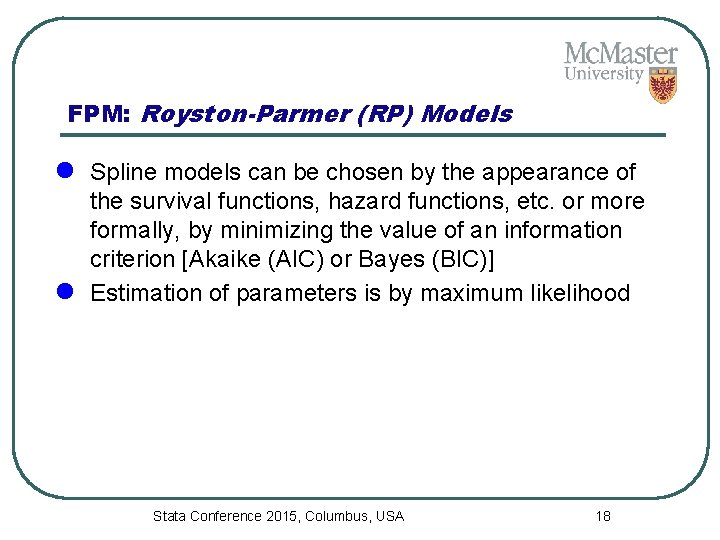
FPM: Royston-Parmer (RP) Models l Spline models can be chosen by the appearance of the survival functions, hazard functions, etc. or more formally, by minimizing the value of an information criterion [Akaike (AIC) or Bayes (BIC)] l Estimation of parameters is by maximum likelihood Stata Conference 2015, Columbus, USA 18
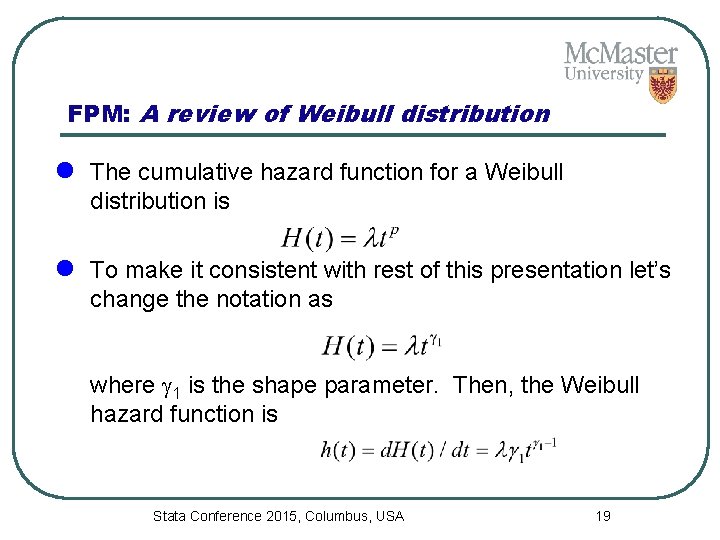
FPM: A review of Weibull distribution l The cumulative hazard function for a Weibull distribution is l To make it consistent with rest of this presentation let’s change the notation as where 1 is the shape parameter. Then, the Weibull hazard function is Stata Conference 2015, Columbus, USA 19
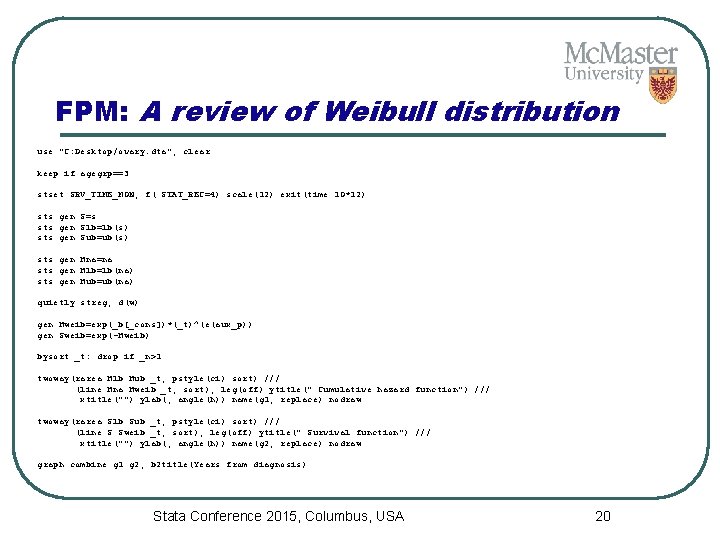
FPM: A review of Weibull distribution use "C: Desktop/ovary. dta", clear keep if agegrp==3 stset SRV_TIME_MON, f( STAT_REC=4) scale(12) exit(time 10*12) sts gen S=s sts gen Slb=lb(s) sts gen Sub=ub(s) sts gen Hna=na sts gen Hlb=lb(na) sts gen Hub=ub(na) quietly streg, d(w) gen Hweib=exp(_b[_cons])*(_t)^(e(aux_p)) gen Sweib=exp(-Hweib) bysort _t: drop if _n>1 twoway(rarea Hlb Hub _t, pstyle(ci) sort) /// (line Hna Hweib _t, sort), leg(off) ytitle(" Cumulative hazard function") /// xtitle("") ylab(, angle(h)) name(g 1, replace) nodraw twoway(rarea Slb Sub _t, pstyle(ci) sort) /// (line S Sweib _t, sort), leg(off) ytitle(" Survival function") /// xtitle("") ylab(, angle(h)) name(g 2, replace) nodraw graph combine g 1 g 2, b 2 title(Years from diagnosis) Stata Conference 2015, Columbus, USA 20
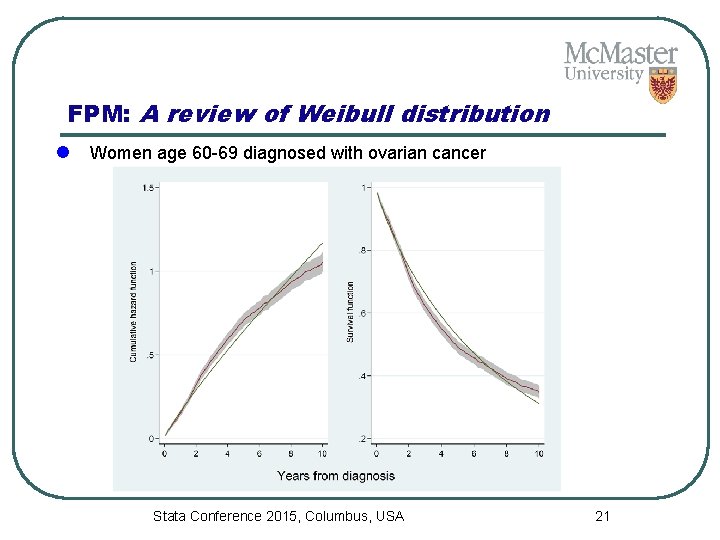
FPM: A review of Weibull distribution l Women age 60 -69 diagnosed with ovarian cancer Stata Conference 2015, Columbus, USA 21
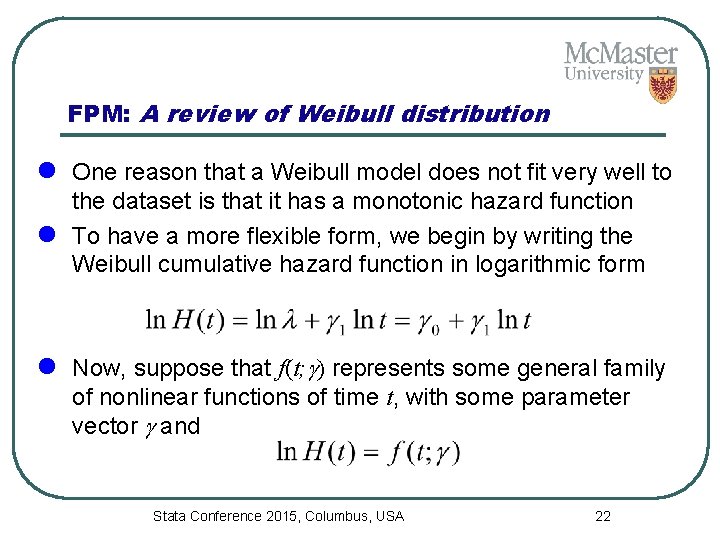
FPM: A review of Weibull distribution l One reason that a Weibull model does not fit very well to the dataset is that it has a monotonic hazard function l To have a more flexible form, we begin by writing the Weibull cumulative hazard function in logarithmic form l Now, suppose that f(t; ) represents some general family of nonlinear functions of time t, with some parameter vector and Stata Conference 2015, Columbus, USA 22
FPM: Royston-Parmer (RP) Models l Because cumulative hazard functions are monotonic in time, f(t; ) must be monotonic too l Two potentially appropriate functions are fractional polynomials (Royston & Altman 1994) and splines (de Boor 2001) Stata Conference 2015, Columbus, USA 23
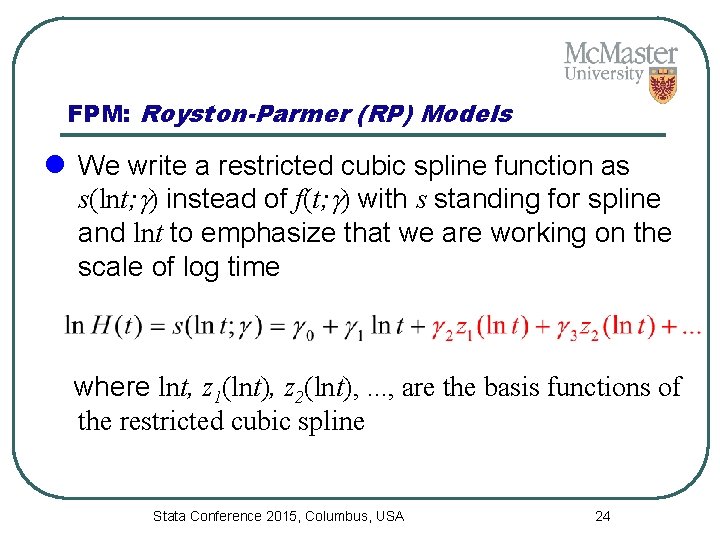
FPM: Royston-Parmer (RP) Models l We write a restricted cubic spline function as s(lnt; ) instead of f(t; ) with s standing for spline and lnt to emphasize that we are working on the scale of log time where lnt, z 1(lnt), z 2(lnt), . . . , are the basis functions of the restricted cubic spline Stata Conference 2015, Columbus, USA 24
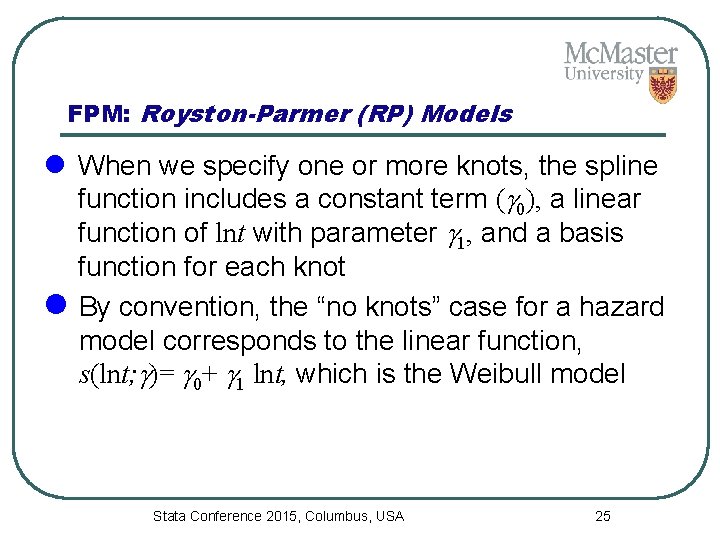
FPM: Royston-Parmer (RP) Models l When we specify one or more knots, the spline l function includes a constant term ( 0), a linear function of lnt with parameter 1, and a basis function for each knot By convention, the “no knots” case for a hazard model corresponds to the linear function, s(lnt; )= 0+ 1 lnt, which is the Weibull model Stata Conference 2015, Columbus, USA 25
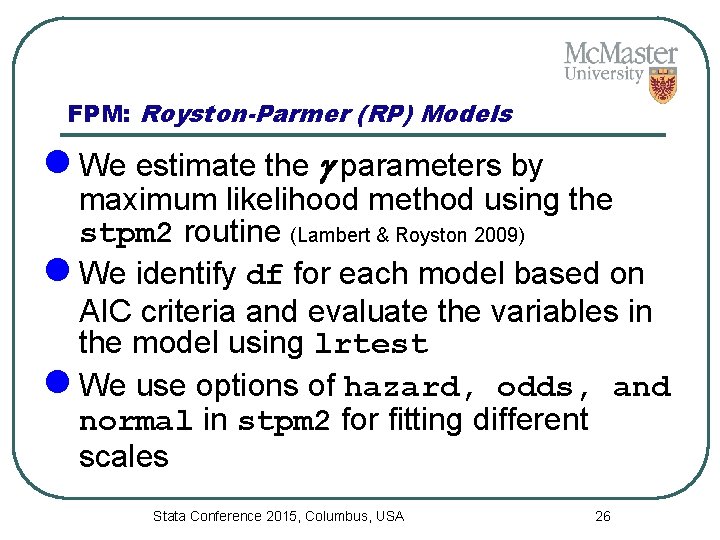
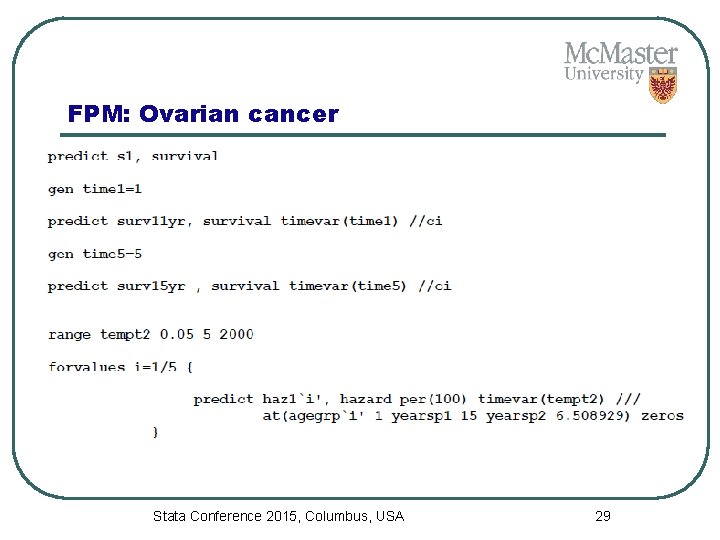
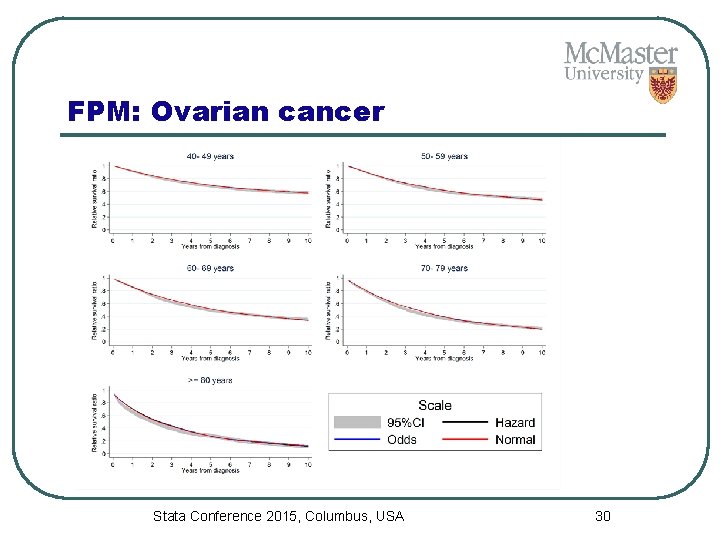
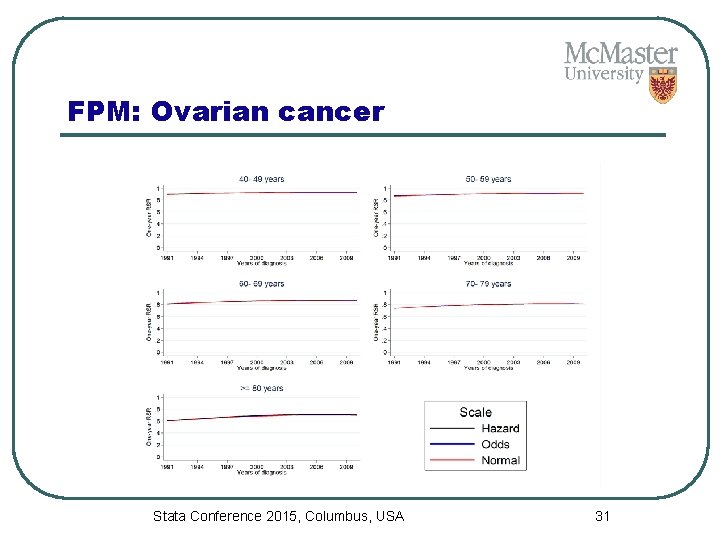
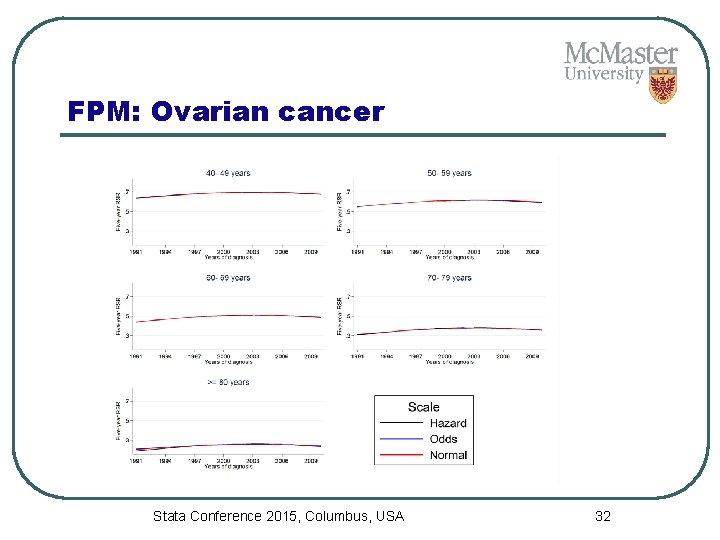
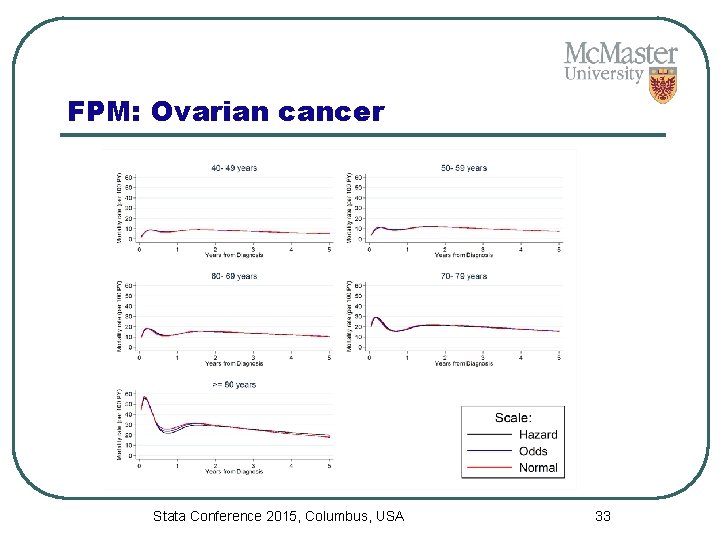
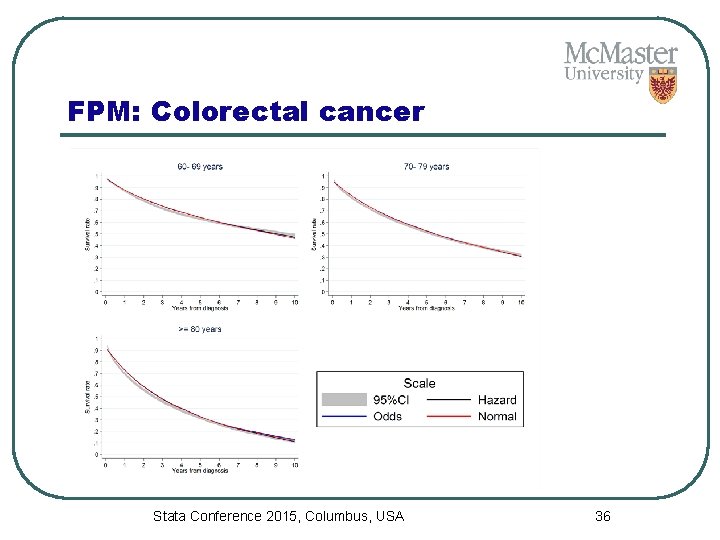
FPM: Royston-Parmer (RP) Models l We estimate the parameters by maximum likelihood method using the stpm 2 routine (Lambert & Royston 2009) l We identify df for each model based on AIC criteria and evaluate the variables in the model using lrtest l We use options of hazard, odds, and normal in stpm 2 for fitting different scales Stata Conference 2015, Columbus, USA 26
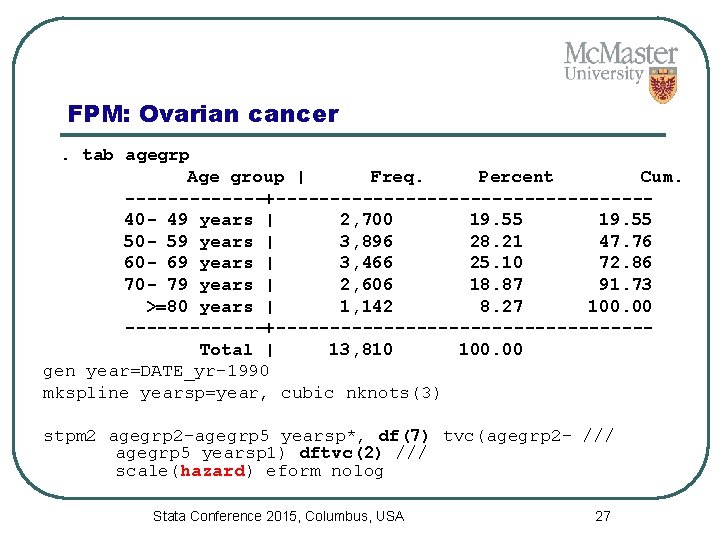
FPM: Ovarian cancer. tab agegrp Age group | Freq. Percent Cum. -------+-----------------40 - 49 years | 2, 700 19. 55 50 - 59 years | 3, 896 28. 21 47. 76 60 - 69 years | 3, 466 25. 10 72. 86 70 - 79 years | 2, 606 18. 87 91. 73 >=80 years | 1, 142 8. 27 100. 00 -------+-----------------Total | 13, 810 100. 00 gen year=DATE_yr-1990 mkspline yearsp=year, cubic nknots(3) stpm 2 agegrp 2 -agegrp 5 yearsp*, df(7) tvc(agegrp 2 - /// agegrp 5 yearsp 1) dftvc(2) /// scale(hazard) eform nolog Stata Conference 2015, Columbus, USA 27
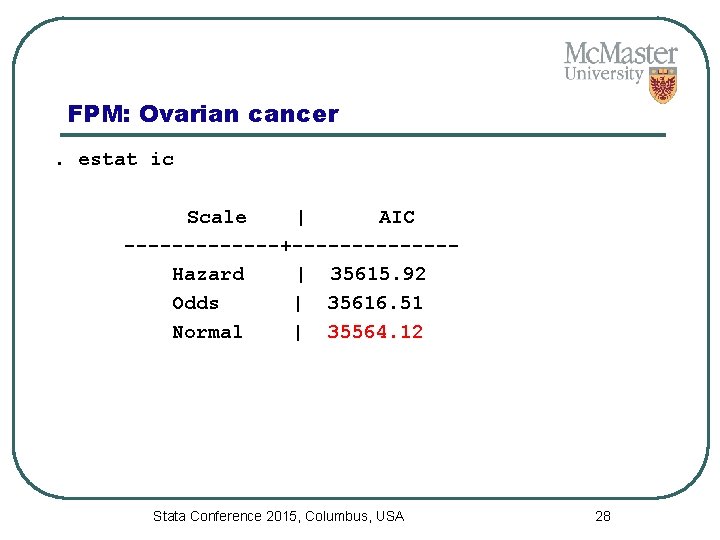
FPM: Ovarian cancer. estat ic Scale | AIC -------+-------Hazard | 35615. 92 Odds | 35616. 51 Normal | 35564. 12 Stata Conference 2015, Columbus, USA 28
FPM: Ovarian cancer Stata Conference 2015, Columbus, USA 29
FPM: Ovarian cancer Stata Conference 2015, Columbus, USA 30
FPM: Ovarian cancer Stata Conference 2015, Columbus, USA 31
FPM: Ovarian cancer Stata Conference 2015, Columbus, USA 32
FPM: Ovarian cancer Stata Conference 2015, Columbus, USA 33
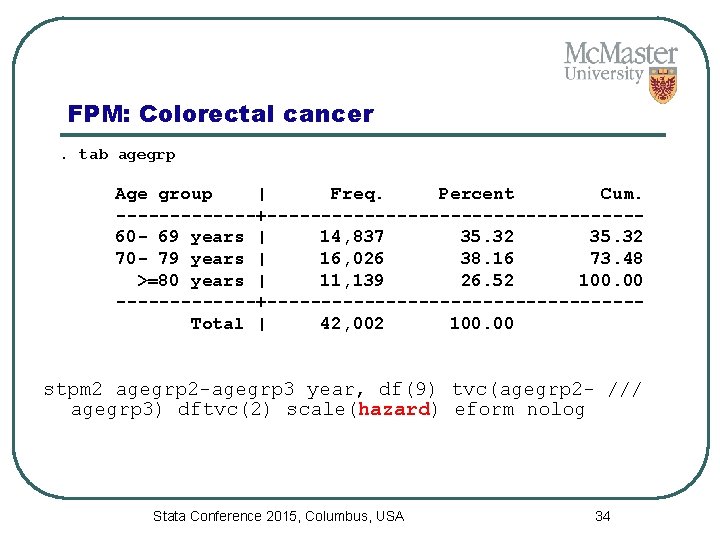
FPM: Colorectal cancer. tab agegrp Age group | Freq. Percent Cum. -------+-----------------60 - 69 years | 14, 837 35. 32 70 - 79 years | 16, 026 38. 16 73. 48 >=80 years | 11, 139 26. 52 100. 00 -------+-----------------Total | 42, 002 100. 00 stpm 2 agegrp 2 -agegrp 3 year, df(9) tvc(agegrp 2 - /// agegrp 3) dftvc(2) scale(hazard) eform nolog Stata Conference 2015, Columbus, USA 34
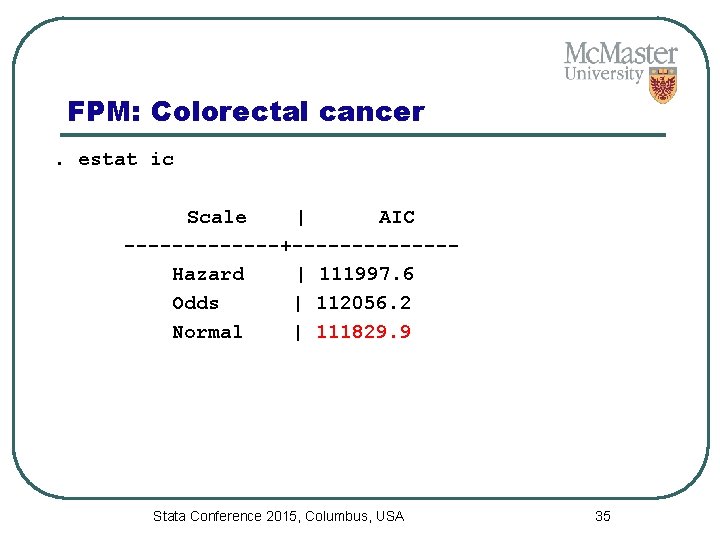
FPM: Colorectal cancer. estat ic Scale | AIC -------+-------Hazard | 111997. 6 Odds | 112056. 2 Normal | 111829. 9 Stata Conference 2015, Columbus, USA 35
FPM: Colorectal cancer Stata Conference 2015, Columbus, USA 36
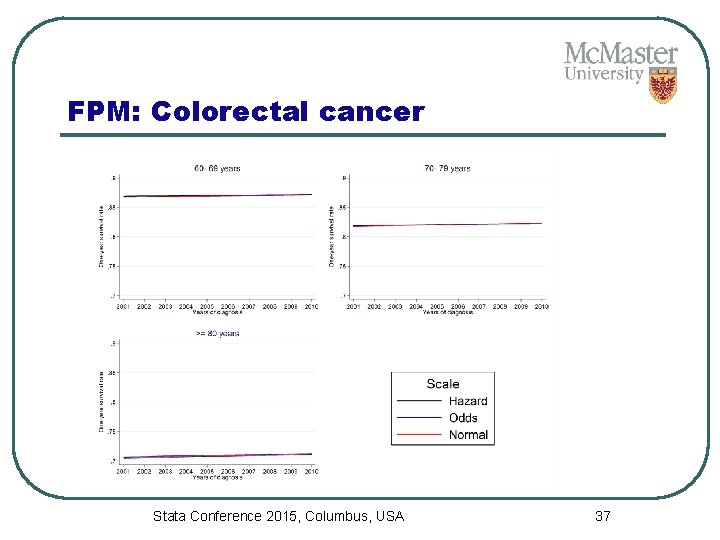
FPM: Colorectal cancer Stata Conference 2015, Columbus, USA 37
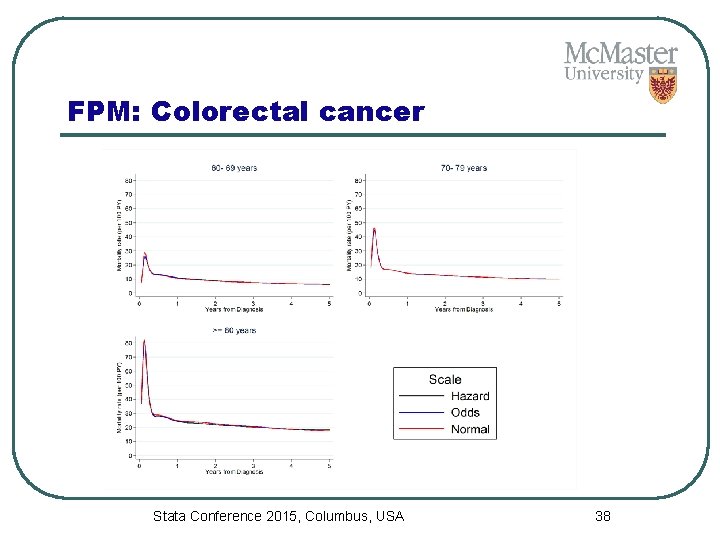
FPM: Colorectal cancer Stata Conference 2015, Columbus, USA 38
Conclusion l In general, there were no substantial differences between the estimates from the three modeling scales, although the probit-scale showed slightly better fit based on the Akaike information criterion (AIC) for both datasets Stata Conference 2015, Columbus, USA 39
References de Boor, C. 2001. A Practical Guide to Splines, Revised ed ed. New York, Springer. Durrleman, S. & Simon, R. 1989. Flexible regression models with cubic splines. Stat. Med. , 8, (5) 551 -561 available from: PM: 2657958 Lambert, P. C. & Royston, P. 2009. Further development of flexible parametric models for survival analysis. The Stata Journal, 9, 265 -290 Royston, P. & Altman, D. G. 1994. Regression using fractional polynomials of continuous covariates: Parsimonious parametric modelling (with discussion). Applied Statistics, 43, 429 -467 Royston, P. & Lambert, P. C. 2011. Flexible Parametric Survival Analysis Using Stata: Beyond the Cox Model Stata Press. Royston, P. & Parmar, M. K. 2002. Flexible parametric proportional-hazards and proportional-odds models for censored survival data, with application to prognostic modelling and estimation of treatment effects. Stat. Med. , 21, (15) 2175 -2197 available from: PM: 12210632 Stata Conference 2015, Columbus, USA 40
- Slides: 40