
A Comparison of Grain Size Measurement Methods George

- Slides: 75
A Comparison of Grain Size Measurement Methods George F. Vander Voort Consultant – Struers Inc.
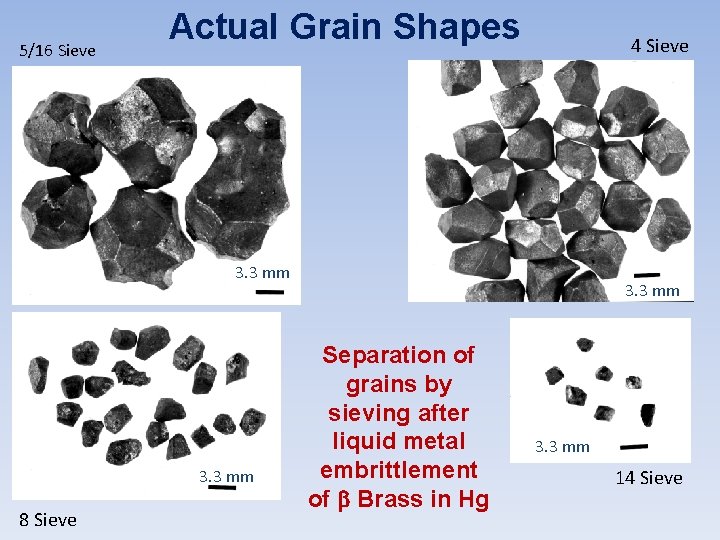
5/16 Sieve Actual Grain Shapes 4 Sieve 3. 3 mm 8 Sieve 3. 3 mm Separation of grains by sieving after liquid metal embrittlement of Brass in Hg 3. 3 mm 14 Sieve
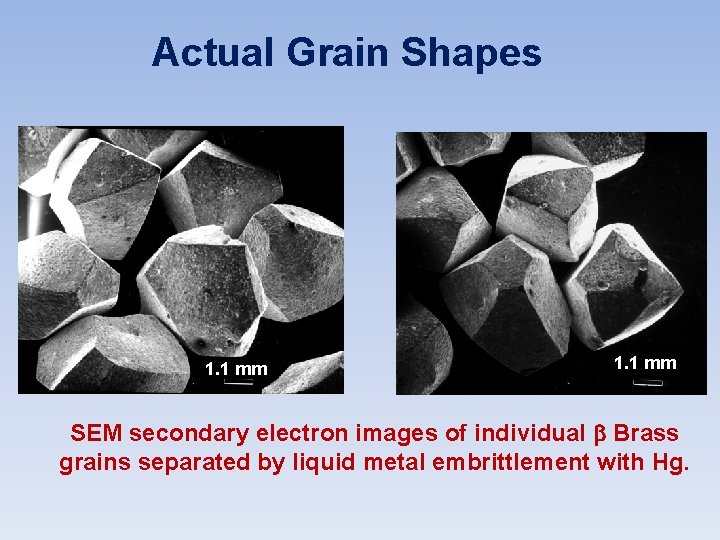
Actual Grain Shapes 1. 1 mm SEM secondary electron images of individual Brass grains separated by liquid metal embrittlement with Hg.
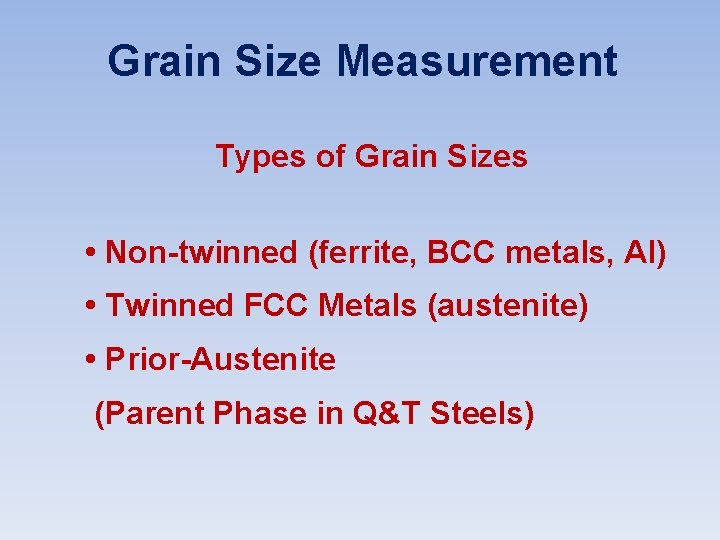
Grain Size Measurement Types of Grain Sizes • Non-twinned (ferrite, BCC metals, Al) • Twinned FCC Metals (austenite) • Prior-Austenite (Parent Phase in Q&T Steels)
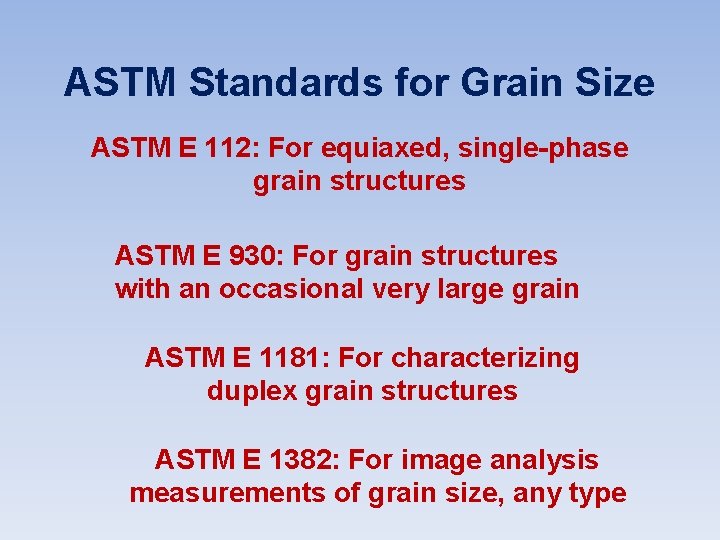
ASTM Standards for Grain Size ASTM E 112: For equiaxed, single-phase grain structures ASTM E 930: For grain structures with an occasional very large grain ASTM E 1181: For characterizing duplex grain structures ASTM E 1382: For image analysis measurements of grain size, any type
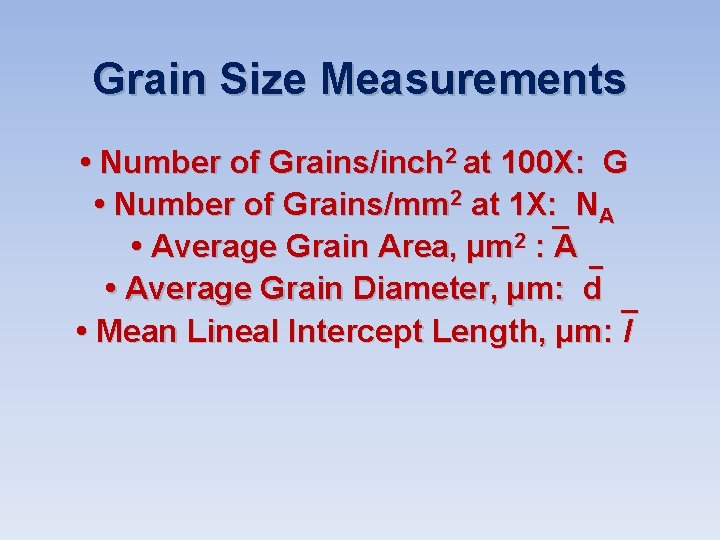
Grain Size Measurements • Number of Grains/inch 2 at 100 X: G • Number of Grains/mm 2 at 1 X: _ NA • Average Grain Area, µm 2 : A _ • Average Grain Diameter, µm: d _ • Mean Lineal Intercept Length, µm: l
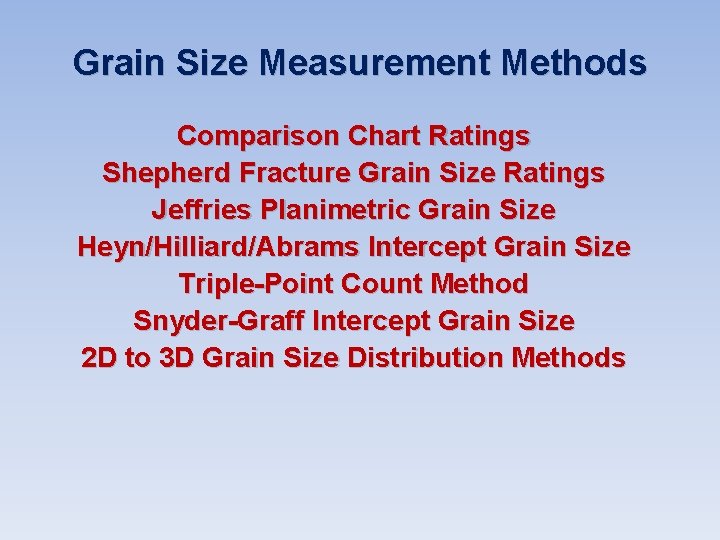
Grain Size Measurement Methods Comparison Chart Ratings Shepherd Fracture Grain Size Ratings Jeffries Planimetric Grain Size Heyn/Hilliard/Abrams Intercept Grain Size Triple-Point Count Method Snyder-Graff Intercept Grain Size 2 D to 3 D Grain Size Distribution Methods
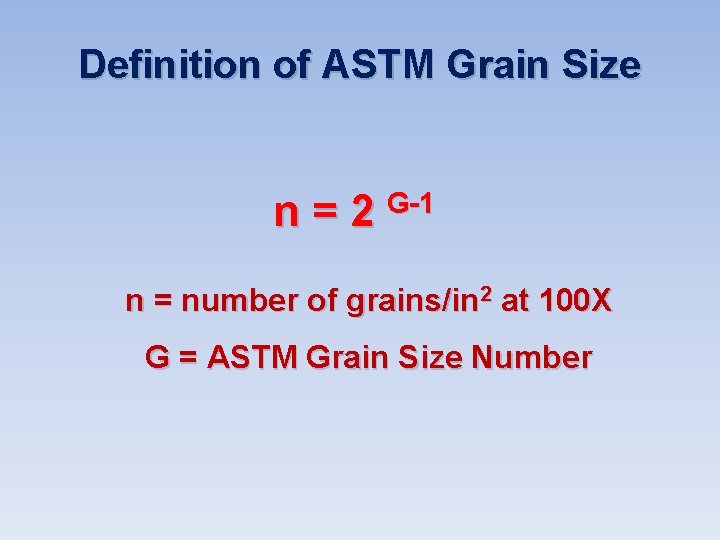
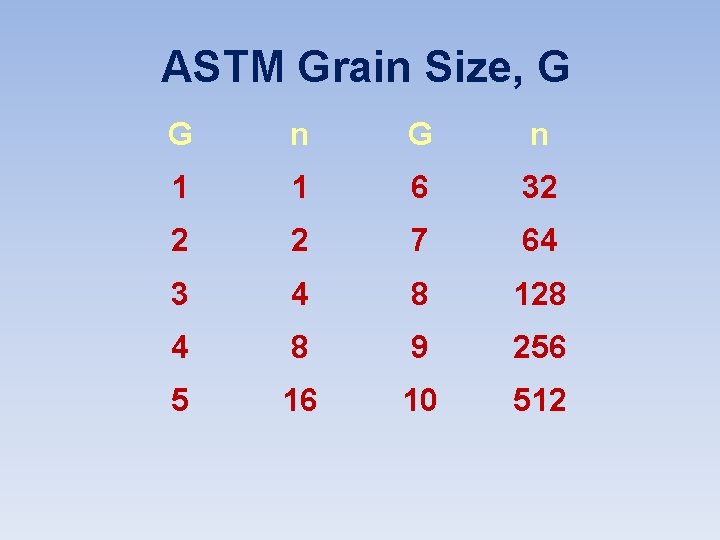
Definition of ASTM Grain Size n = 2 G-1 n = number of grains/in 2 at 100 X G = ASTM Grain Size Number
ASTM Grain Size, G G n 1 1 6 32 2 2 7 64 3 4 8 128 4 8 9 256 5 16 10 512
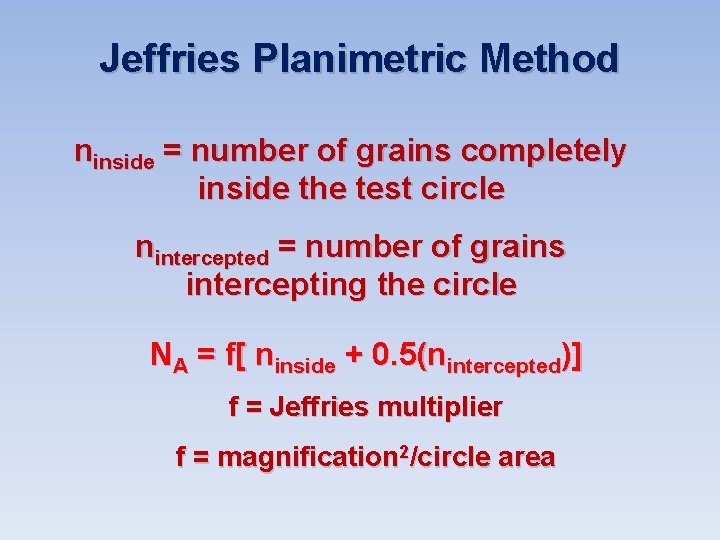
Jeffries Planimetric Method ninside = number of grains completely inside the test circle nintercepted = number of grains intercepting the circle NA = f[ ninside + 0. 5(nintercepted)] f = Jeffries multiplier f = magnification 2/circle area
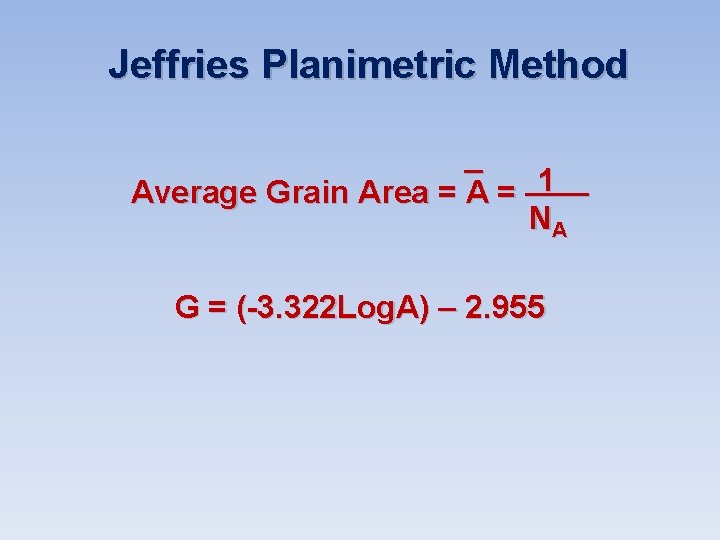
Jeffries Planimetric Method _ 1 Average Grain Area = A = —— NA G = (-3. 322 Log. A) – 2. 955
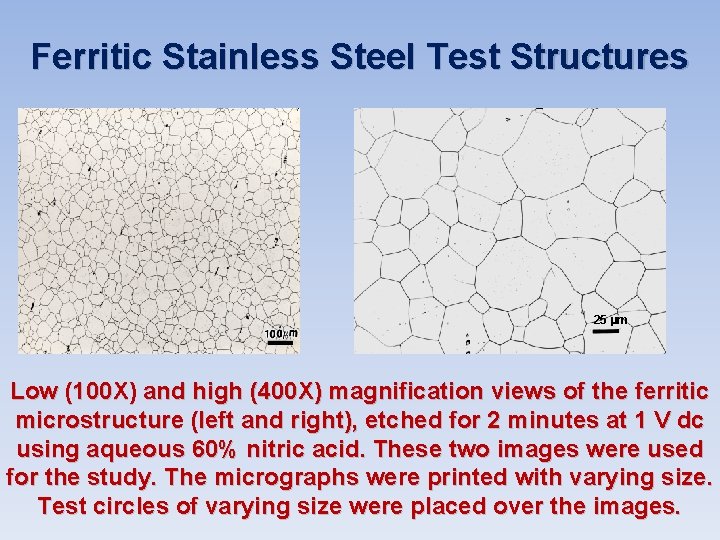
Ferritic Stainless Steel Test Structures 25 m Low (100 X) and high (400 X) magnification views of the ferritic microstructure (left and right), etched for 2 minutes at 1 V dc using aqueous 60% nitric acid. These two images were used for the study. The micrographs were printed with varying size. Test circles of varying size were placed over the images.
Influence of the Number of Measurements Per Grid Placement on the ASTM Grain Size It has long been believed that if the counts of grains within the Jeffries test circle is low, the grain size measurement will be biased. But, I have never seen a publication where this variable was evaluated. Is this true?
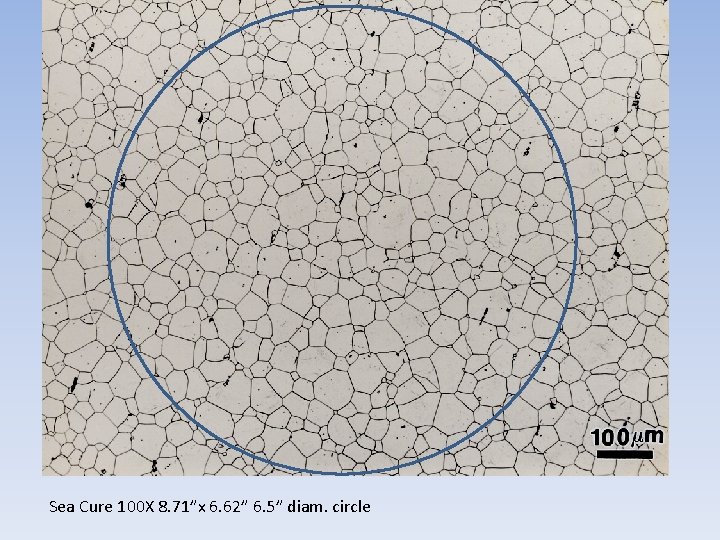
Sea Cure 100 X 8. 71”x 6. 62” 6. 5” diam. circle
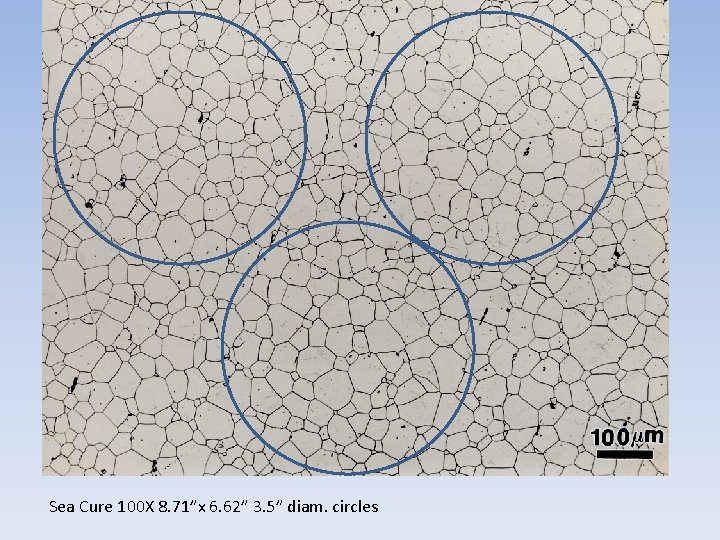
Sea Cure 100 X 8. 71”x 6. 62” 3. 5” diam. circles
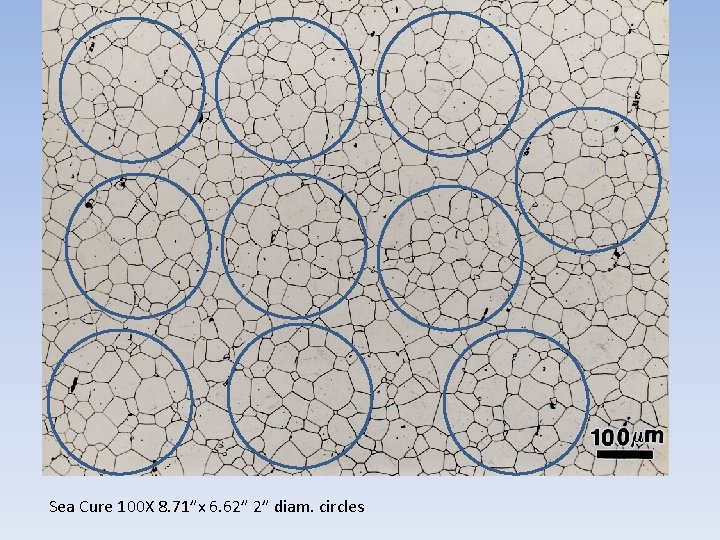
Sea Cure 100 X 8. 71”x 6. 62” 2” diam. circles
Results for 40 measurements using the E 112 planimetric method with (ninside + 0. 5 nintercepted) varying from 5 to 444. The linear trend line is almost flat.
Plot of (ninside + 0. 5 nintercepted) for values greater than 30. Note that the linear trend line is virtually flat over this range.
Effect of Test Circles of Low D on G G is erratic, but not biased to higher or lower values when the count is <10. The linear fit line has a slight upward slope. G values for counts > ~16 yielded results very close to the reference value of G = 6. 666
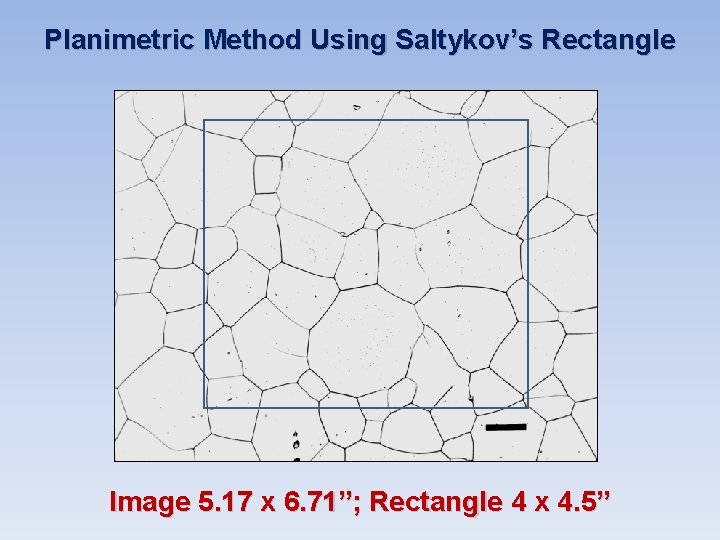
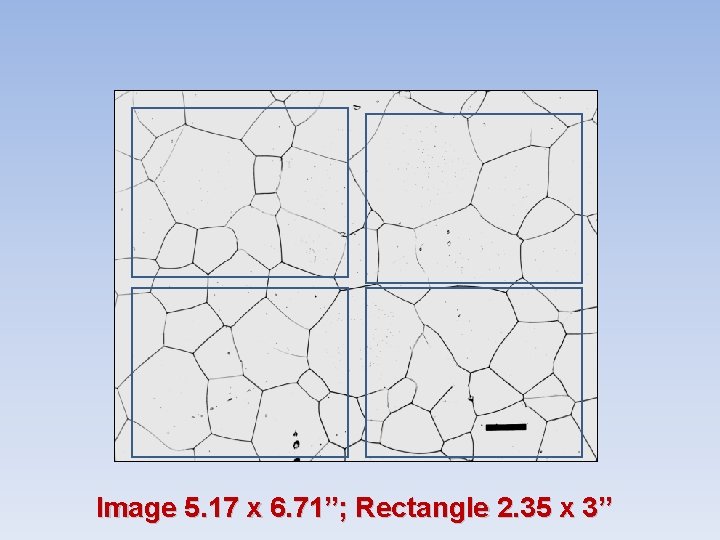
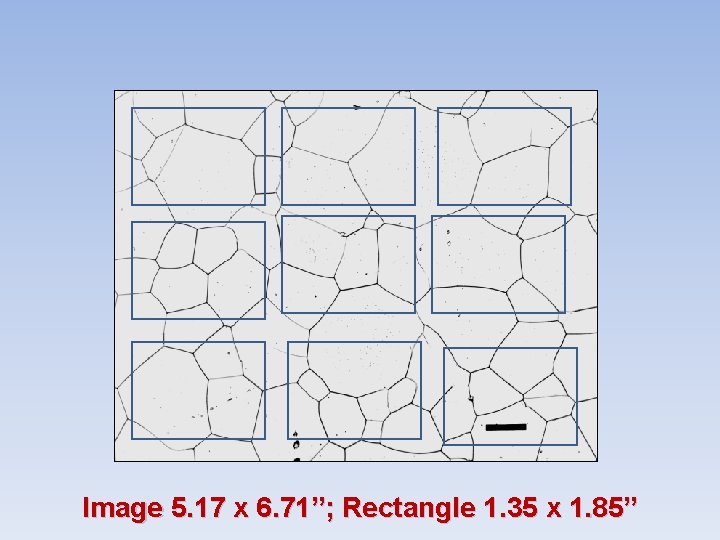
Saltykov Planimetric Method Using Rectangles To minimize bias in planimetric grain size measurements when the grains are very large and the number of grains inside the circle gets low, Sarkis A. Saltykov proposed using a rectangle for the grain counts. The grains at the 4 corners are ignore, but are assumed to contribute a total of 1 grain to the count. The number of grains completely inside the rectangle, ninside, are counted and are weighted as one each. The number of grains that intersect the edges, nintercepted, are counted, but not those at the corners, and are weighted as one-half. Then, NA is determined as: NA = f[ninside + 0. 5 nintercepted + 1] where f is defined as before, M 2/A
Planimetric Method Using Saltykov’s Rectangle Image 5. 17 x 6. 71”; Rectangle 4 x 4. 5”
Image 5. 17 x 6. 71”; Rectangle 2. 35 x 3”
Image 5. 17 x 6. 71”; Rectangle 1. 35 x 1. 85”
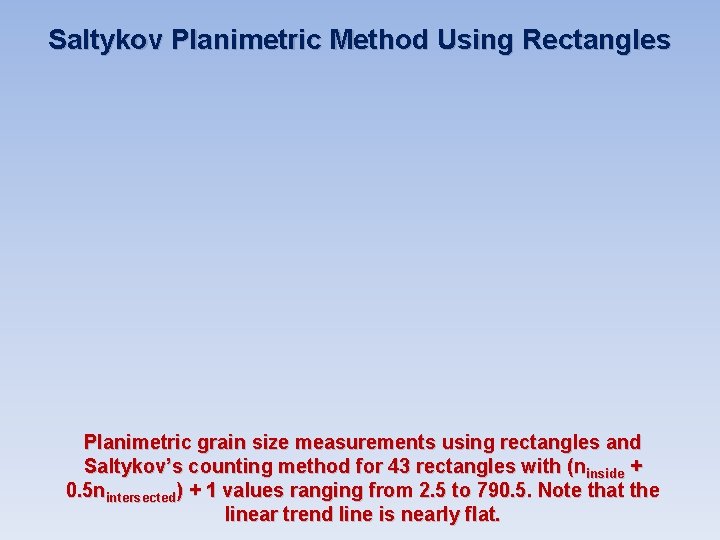
Saltykov Planimetric Method Using Rectangles Planimetric grain size measurements using rectangles and Saltykov’s counting method for 43 rectangles with (ninside + 0. 5 nintersected) + 1 values ranging from 2. 5 to 790. 5. Note that the linear trend line is nearly flat.
Saltykov Planimetric Method With Rectangles, Counts 10 Planimetric grain size measurements using rectangles and Saltykov’s counting method for 23 rectangles with (ninside + nintersected) + 1 values above 10. Note that the linear trend line is flat over this range.
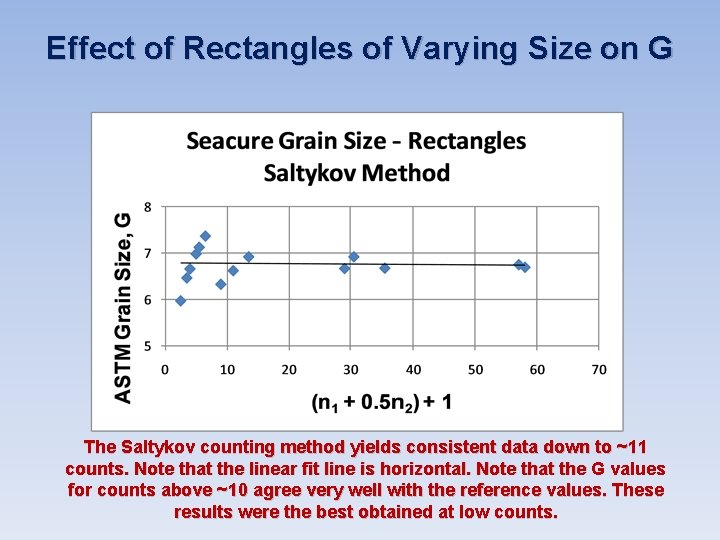
Effect of Rectangles of Varying Size on G The Saltykov counting method yields consistent data down to ~11 counts. Note that the linear fit line is horizontal. Note that the G values for counts above ~10 agree very well with the reference values. These results were the best obtained at low counts.
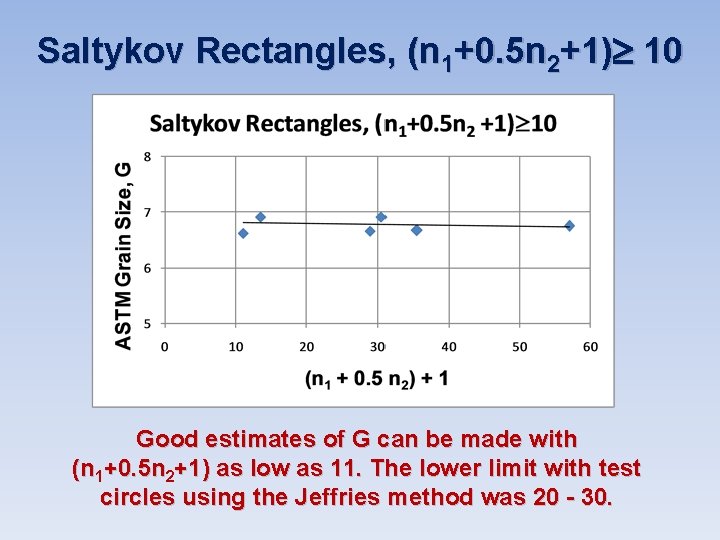
Saltykov Rectangles, (n 1+0. 5 n 2+1) 10 Good estimates of G can be made with (n 1+0. 5 n 2+1) as low as 11. The lower limit with test circles using the Jeffries method was 20 - 30.
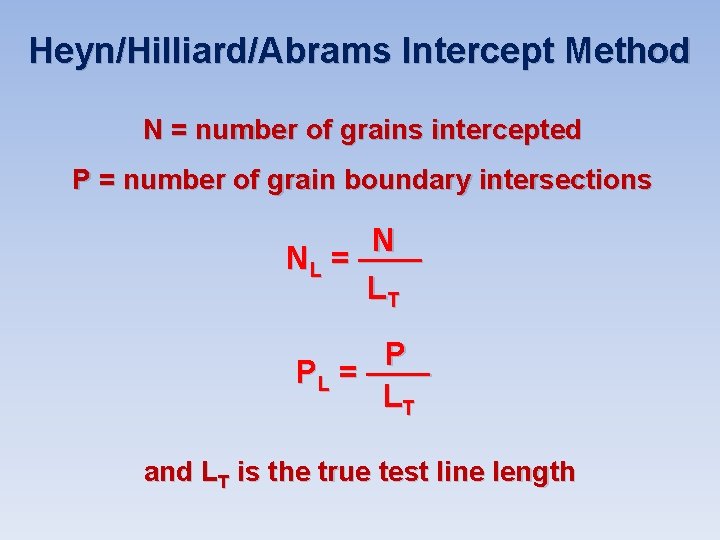
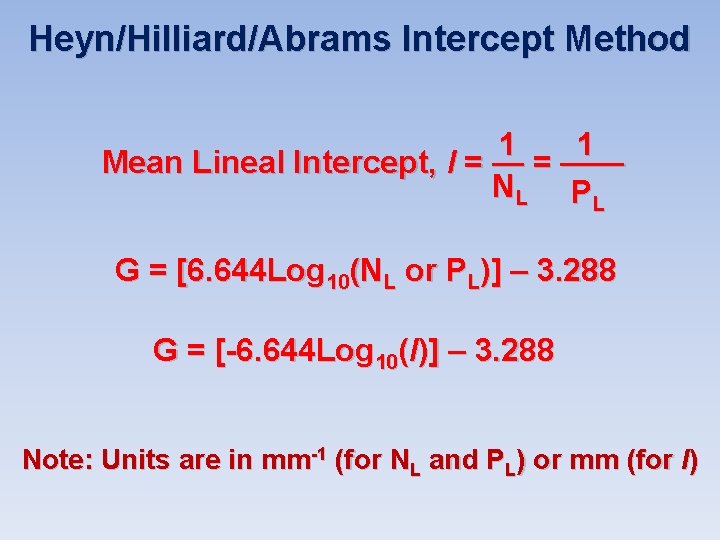
Heyn/Hilliard/Abrams Intercept Method N = number of grains intercepted P = number of grain boundary intersections N NL = —— LT P PL = —— LT and LT is the true test line length
Heyn/Hilliard/Abrams Intercept Method 1 1 Mean Lineal Intercept, l = —— NL P L G = [6. 644 Log 10(NL or PL)] – 3. 288 G = [-6. 644 Log 10(l)] – 3. 288 Note: Units are in mm-1 (for NL and PL) or mm (for l)
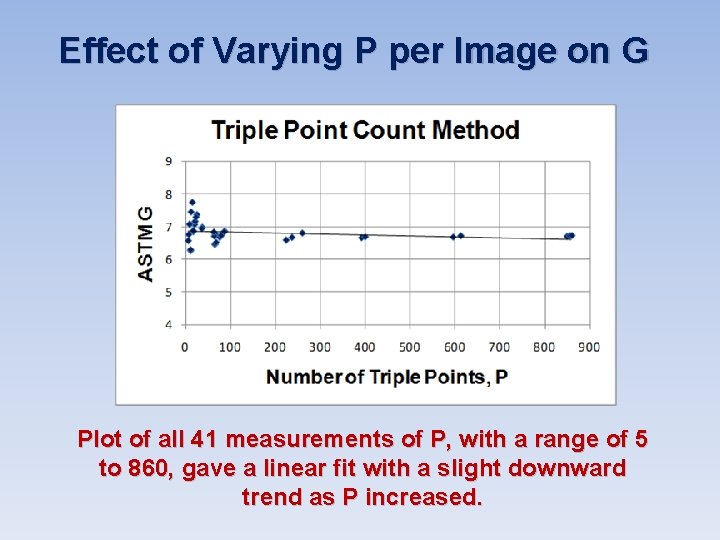
Effect of Varying the P Counts on G Results for 40 measurements using the E 112 intercept method (but with a single test circle) with Pintersections varying from 6 to 89. The linear trend line is almost flat.
G by the Intercept Method is Better When P>20 Plot of Pintersections for values above 20. Note that the linear trend line has a slight downward slope now.
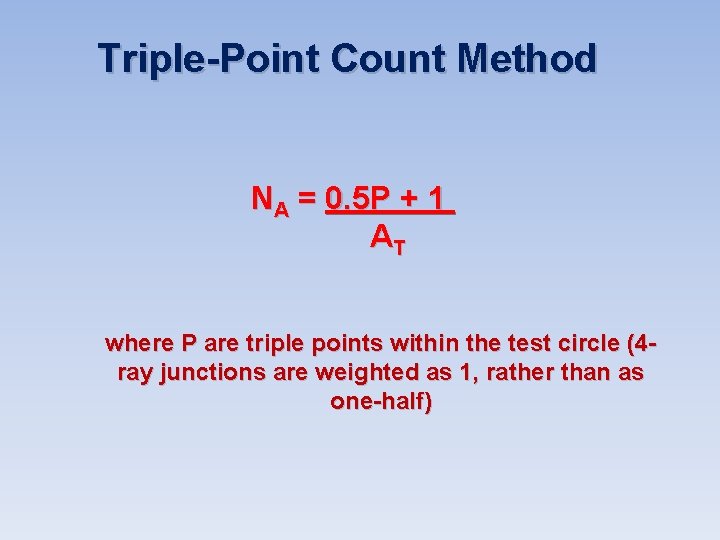
Triple-Point Count Method NA = 0. 5 P + 1 AT where P are triple points within the test circle (4 ray junctions are weighted as 1, rather than as one-half)
Effect of Varying P per Image on G Plot of all 41 measurements of P, with a range of 5 to 860, gave a linear fit with a slight downward trend as P increased.
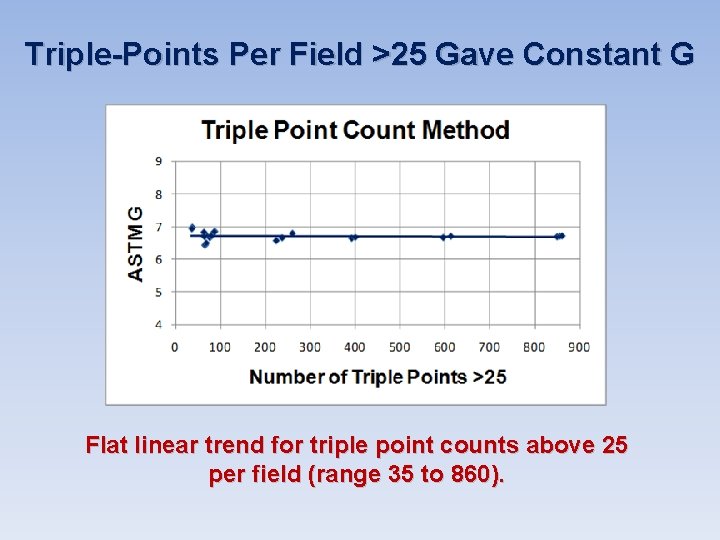
Triple-Points Per Field >25 Gave Constant G Flat linear trend for triple point counts above 25 per field (range 35 to 860).
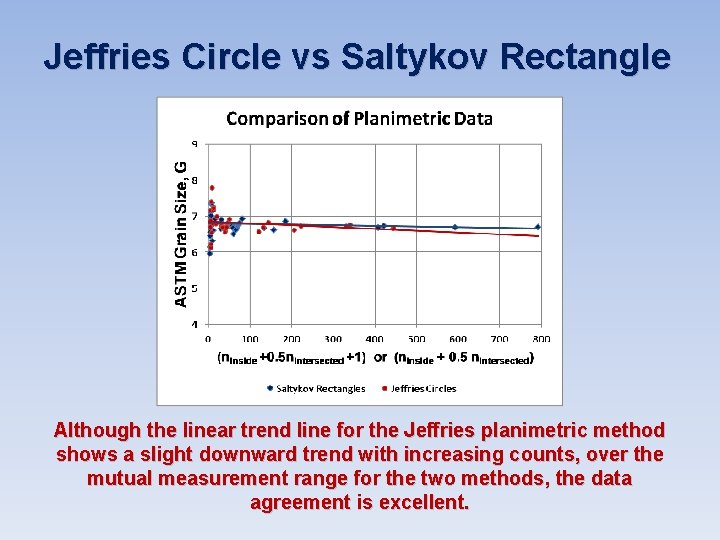
Jeffries Circle vs Saltykov Rectangle Although the linear trend line for the Jeffries planimetric method shows a slight downward trend with increasing counts, over the mutual measurement range for the two methods, the data agreement is excellent.
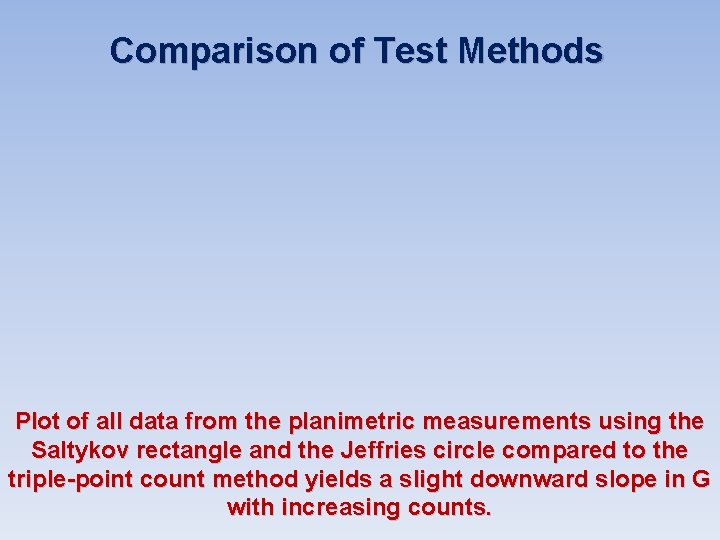
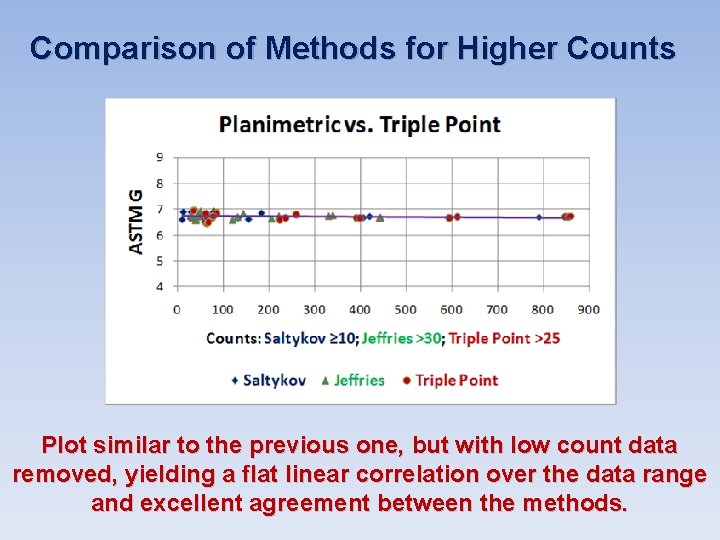
Comparison of Test Methods Plot of all data from the planimetric measurements using the Saltykov rectangle and the Jeffries circle compared to the triple-point count method yields a slight downward slope in G with increasing counts.
Comparison of Methods for Higher Counts Plot similar to the previous one, but with low count data removed, yielding a flat linear correlation over the data range and excellent agreement between the methods.
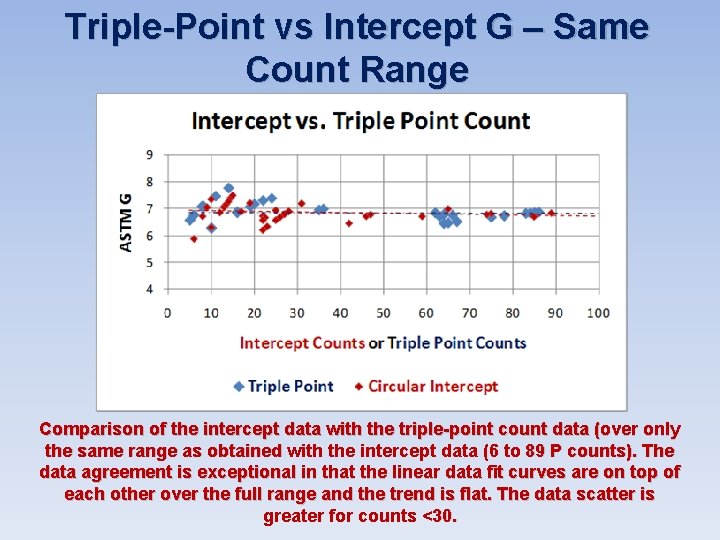
Triple-Point vs Intercept G – Same Count Range Comparison of the intercept data with the triple-point count data (over only the same range as obtained with the intercept data (6 to 89 P counts). The data agreement is exceptional in that the linear data fit curves are on top of each other over the full range and the trend is flat. The data scatter is greater for counts <30.
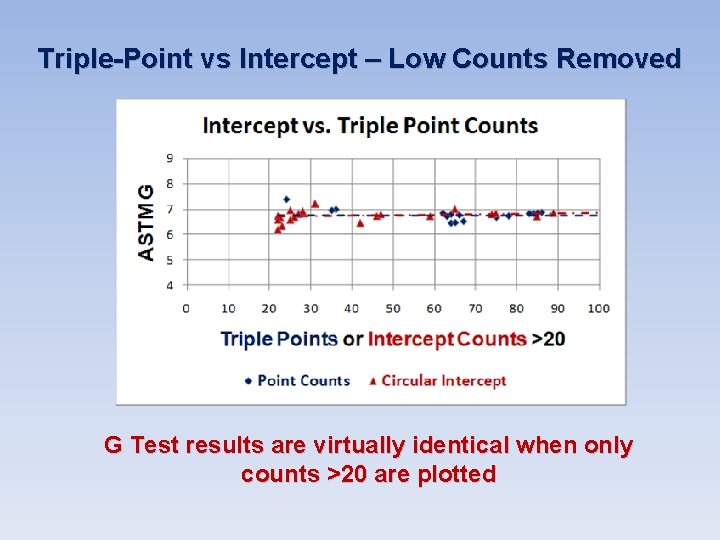
Triple-Point vs Intercept – Low Counts Removed G Test results are virtually identical when only counts >20 are plotted
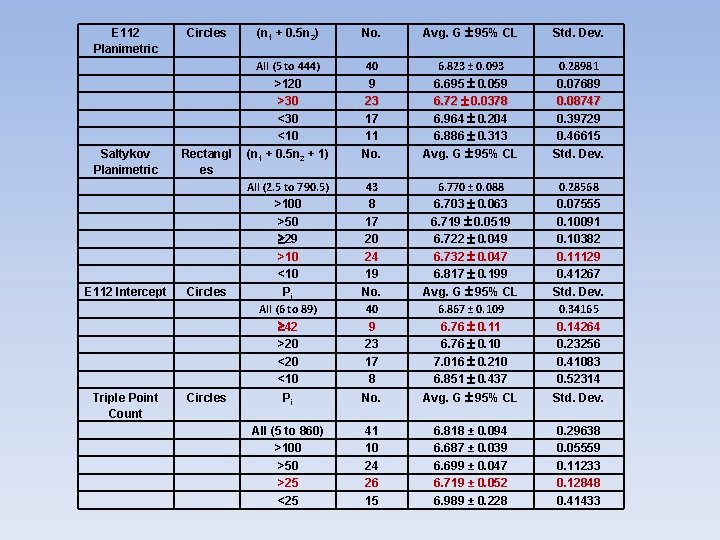
E 112 Planimetric Saltykov Planimetric Circles Rectangl es E 112 Intercept Circles Triple Point Count Circles (n 1 + 0. 5 n 2) No. Avg. G 95% CL Std. Dev. All (5 to 444) >120 >30 <10 (n 1 + 0. 5 n 2 + 1) 40 9 23 17 11 6. 823 ± 0. 093 6. 695 0. 059 6. 72 0. 0378 6. 964 0. 204 6. 886 0. 313 Avg. G 95% CL 0. 28981 0. 07689 0. 08747 0. 39729 0. 46615 Std. Dev. 0. 28568 0. 07555 0. 10091 0. 10382 0. 11129 0. 41267 Std. Dev. 0. 34165 0. 14264 0. 23256 0. 41083 0. 52314 No. All (2. 5 to 790. 5) >100 >50 29 >10 <10 Pi All (6 to 89) 42 >20 <10 43 8 17 20 24 19 No. 40 9 23 17 8 6. 770 ± 0. 088 6. 703 0. 063 6. 719 0. 0519 6. 722 0. 049 6. 732 0. 047 6. 817 0. 199 Avg. G 95% CL 6. 867 ± 0. 109 6. 76 0. 11 6. 76 0. 10 7. 016 0. 210 6. 851 0. 437 Pi No. Avg. G 95% CL Std. Dev. All (5 to 860) >100 >50 >25 <25 41 10 24 26 15 6. 818 ± 0. 094 6. 687 ± 0. 039 6. 699 ± 0. 047 6. 719 ± 0. 052 6. 989 ± 0. 228 0. 29638 0. 05559 0. 11233 0. 12848 0. 41433
Conclusions · Low counts did not produced an obvious bias in the grain size, G. It did produce data scatter. The best grain size measurements were made with the Saltykov rectangle planimetric method yielding constant G with as little is 10 counts per field. The Triple-Point count method (rarely used and in no grain size test method), gave excellent G values when the count was >25 per field. ·The Jeffries planimetric method gave excellent results when the count was >30 per field. · The intercept method showed a slight variation in G with the count per field and results were best when the count was >40 per field. Experiments at higher counts/field should be done. The intercept method gave slightly poorer results than the other methods. · The agreement in G for the 4 methods was superb (fortunately for us!)
Measurement of Grain Size for Grains Containing Annealing Twins and When Two Phases or Constituents Are Present
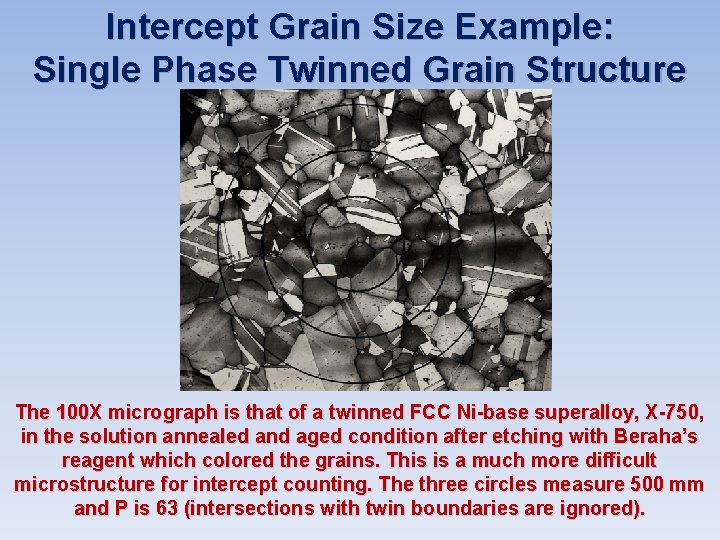
Intercept Grain Size Example: Single Phase Twinned Grain Structure The 100 X micrograph is that of a twinned FCC Ni-base superalloy, X-750, in the solution annealed and aged condition after etching with Beraha’s reagent which colored the grains. This is a much more difficult microstructure for intercept counting. The three circles measure 500 mm and P is 63 (intersections with twin boundaries are ignored).
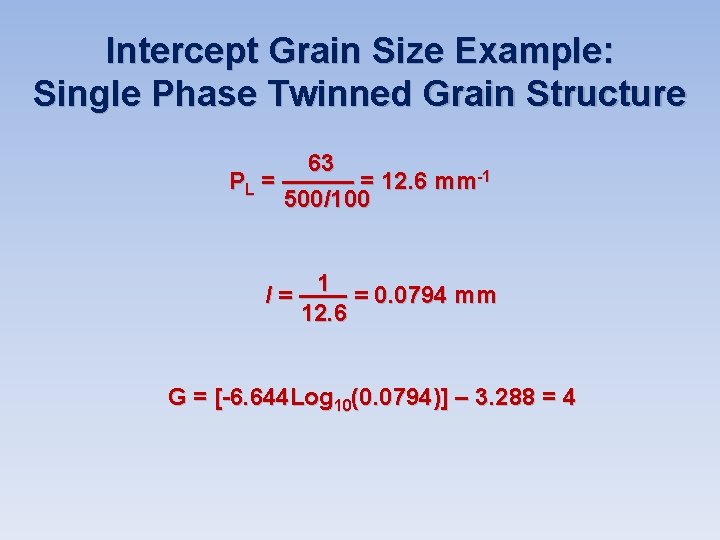
Intercept Grain Size Example: Single Phase Twinned Grain Structure 63 PL = ——— = 12. 6 mm-1 500/100 1 = 0. 0794 mm l = —— 12. 6 G = [-6. 644 Log 10(0. 0794)] – 3. 288 = 4
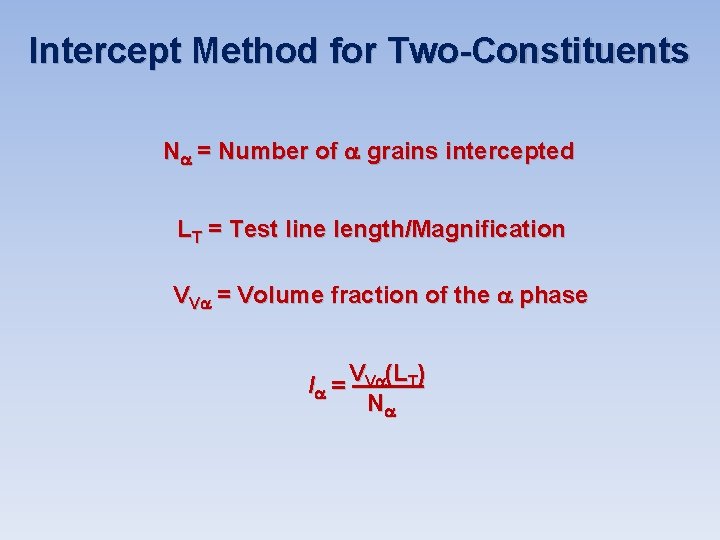
Intercept Method for Two-Constituents N = Number of grains intercepted LT = Test line length/Magnification VV = Volume fraction of the phase V (LT) l = V ——— N
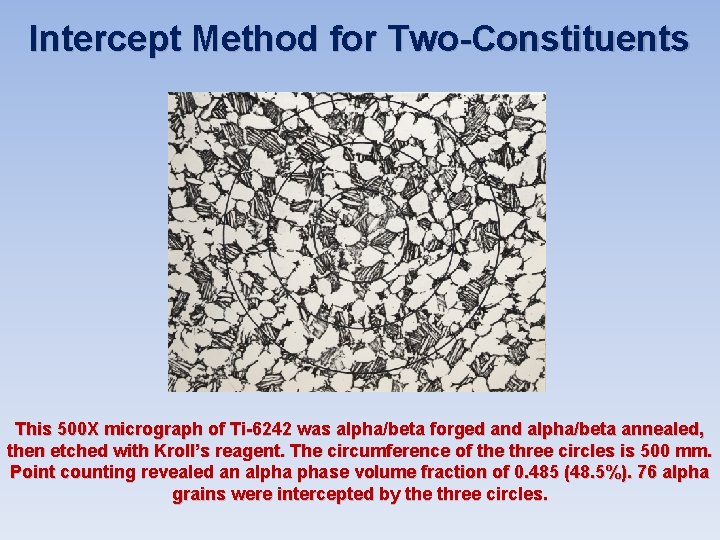
Intercept Method for Two-Constituents This 500 X micrograph of Ti-6242 was alpha/beta forged and alpha/beta annealed, then etched with Kroll’s reagent. The circumference of the three circles is 500 mm. Point counting revealed an alpha phase volume fraction of 0. 485 (48. 5%). 76 alpha grains were intercepted by the three circles.
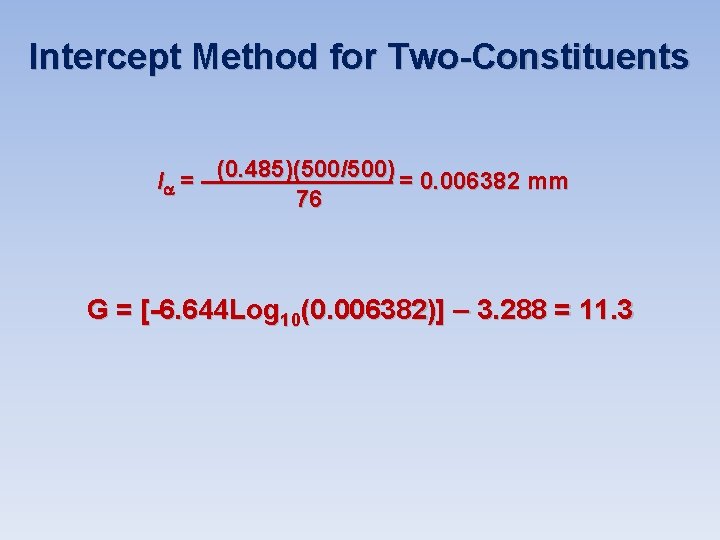
Intercept Method for Two-Constituents (0. 485)(500/500) = 0. 006382 mm l = ———— 76 G = [-6. 644 Log 10(0. 006382)] – 3. 288 = 11. 3
Normal Grain Size Distribution Example
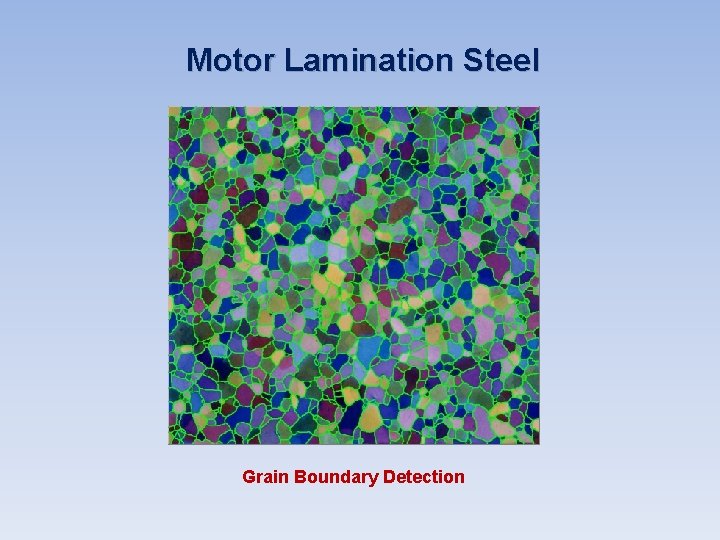
Motor Lamination Steel Klemm’s I 100 X
Motor Lamination Steel Grain Boundary Detection
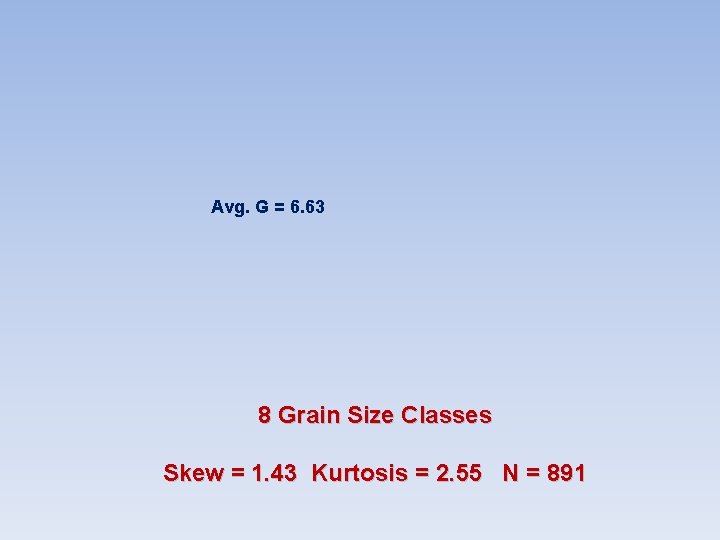
Avg. G = 6. 63 8 Grain Size Classes Skew = 1. 43 Kurtosis = 2. 55 N = 891
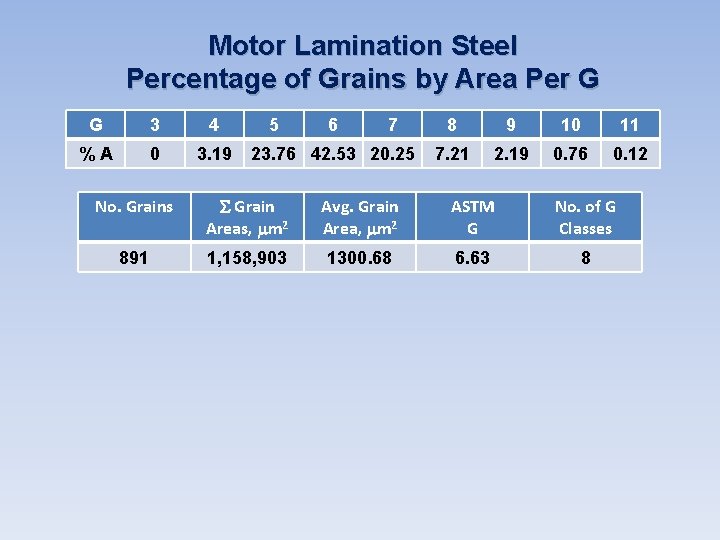
Motor Lamination Steel Percentage of Grains by Area Per G G 3 4 %A 0 3. 19 5 6 7 23. 76 42. 53 20. 25 8 9 10 11 7. 21 2. 19 0. 76 0. 12 No. Grains Grain Areas, m 2 Avg. Grain Area, m 2 ASTM G No. of G Classes 891 1, 158, 903 1300. 68 6. 63 8
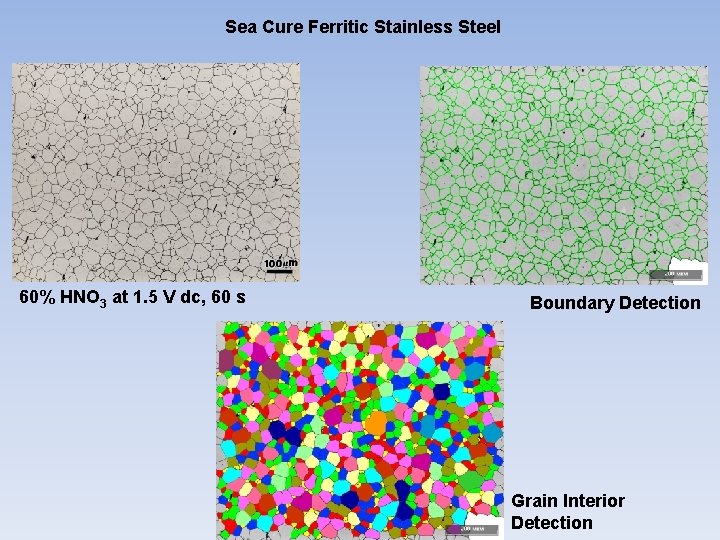
Sea Cure Ferritic Stainless Steel 60% HNO 3 at 1. 5 V dc, 60 s Boundary Detection Grain Interior Detection
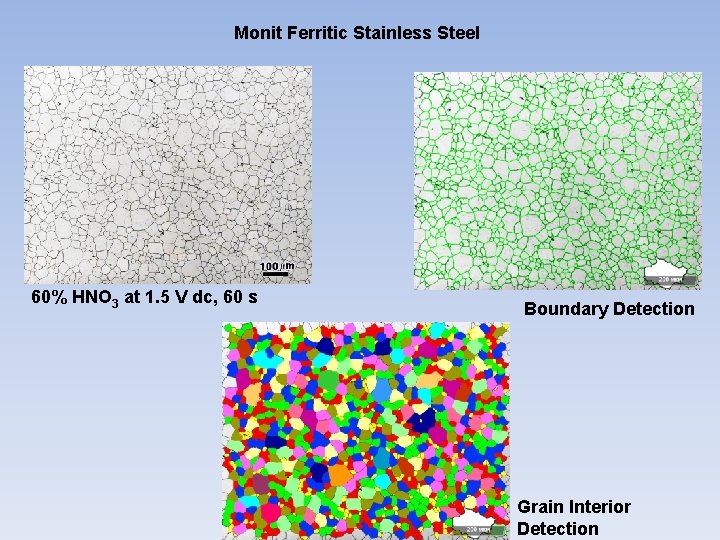
Monit Ferritic Stainless Steel 60% HNO 3 at 1. 5 V dc, 60 s Boundary Detection Grain Interior Detection
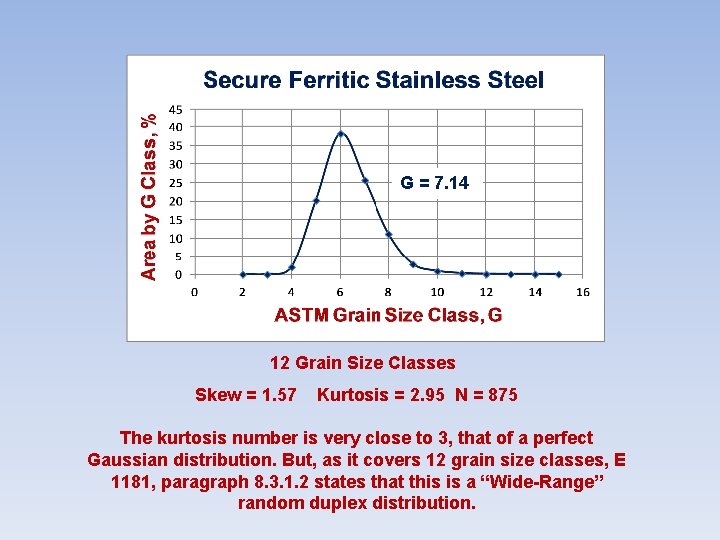
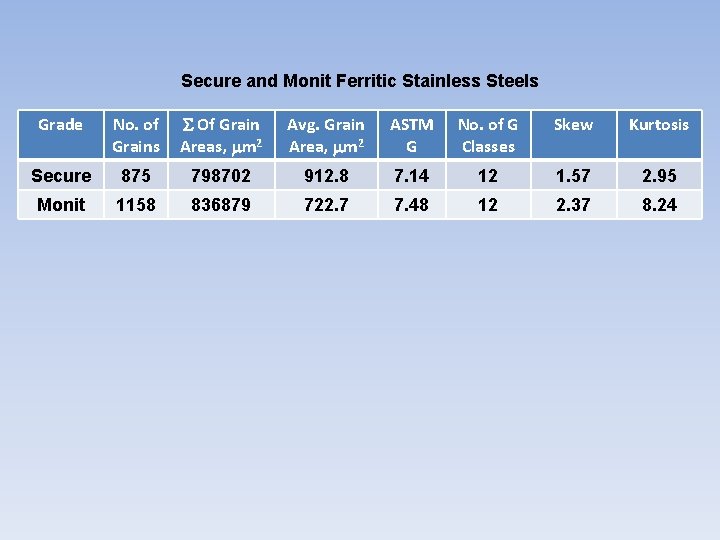
G = 7. 14 12 Grain Size Classes Skew = 1. 57 Kurtosis = 2. 95 N = 875 The kurtosis number is very close to 3, that of a perfect Gaussian distribution. But, as it covers 12 grain size classes, E 1181, paragraph 8. 3. 1. 2 states that this is a “Wide-Range” random duplex distribution.
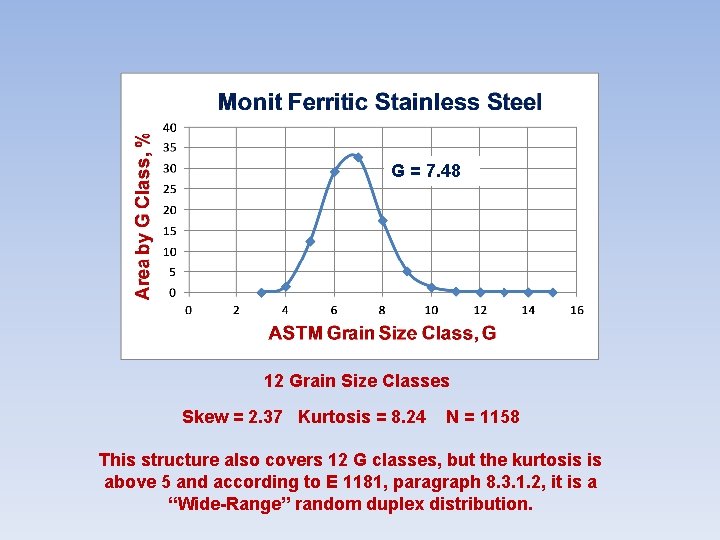
G = 7. 48 12 Grain Size Classes Skew = 2. 37 Kurtosis = 8. 24 N = 1158 This structure also covers 12 G classes, but the kurtosis is above 5 and according to E 1181, paragraph 8. 3. 1. 2, it is a “Wide-Range” random duplex distribution.
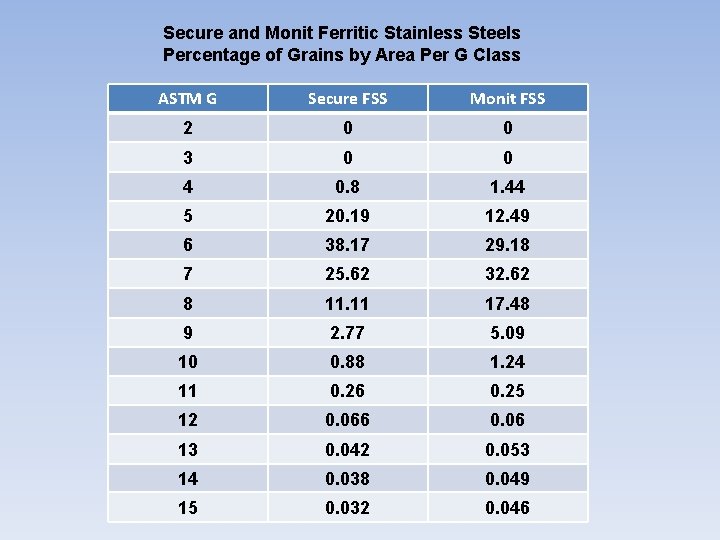
Secure and Monit Ferritic Stainless Steels Percentage of Grains by Area Per G Class ASTM G Secure FSS Monit FSS 2 0 0 3 0 0 4 0. 8 1. 44 5 20. 19 12. 49 6 38. 17 29. 18 7 25. 62 32. 62 8 11. 11 17. 48 9 2. 77 5. 09 10 0. 88 1. 24 11 0. 26 0. 25 12 0. 066 0. 06 13 0. 042 0. 053 14 0. 038 0. 049 15 0. 032 0. 046
Secure and Monit Ferritic Stainless Steels Grade No. of Grains Of Grain Areas, m 2 Avg. Grain Area, m 2 ASTM G No. of G Classes Skew Kurtosis Secure 875 798702 912. 8 7. 14 12 1. 57 2. 95 Monit 1158 836879 722. 7 7. 48 12 2. 37 8. 24
Bi-Modal Grain Size Distribution Examples
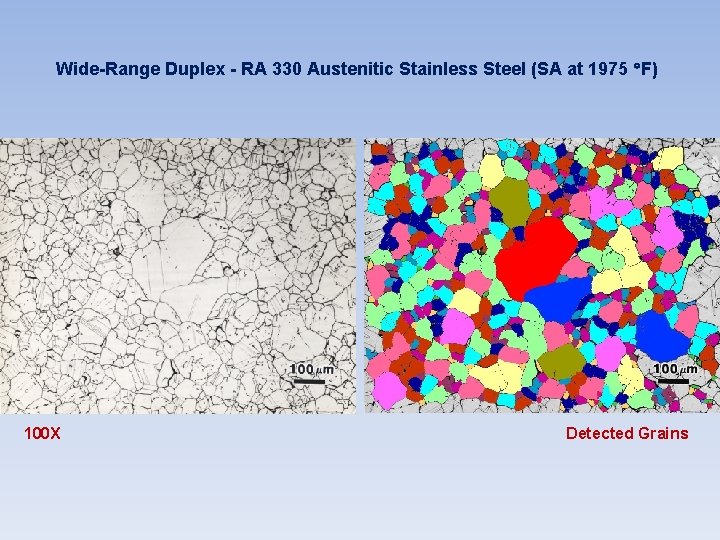
Wide-Range Duplex - RA 330 Austenitic Stainless Steel (SA at 1975 F) 100 X Detected Grains
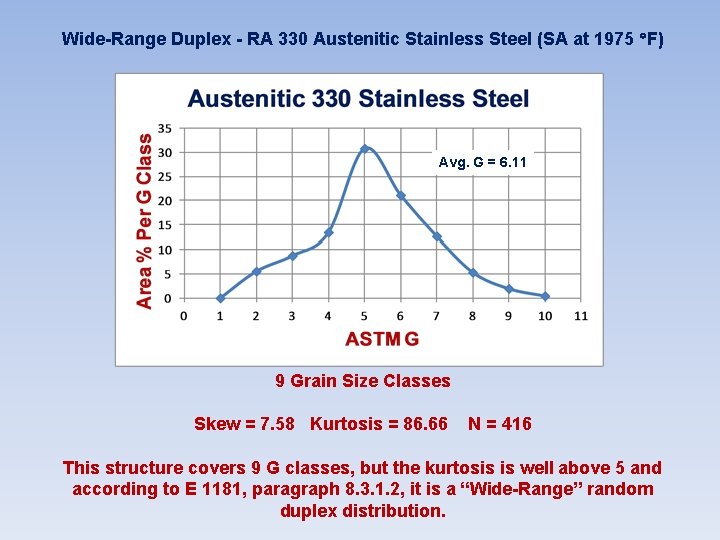
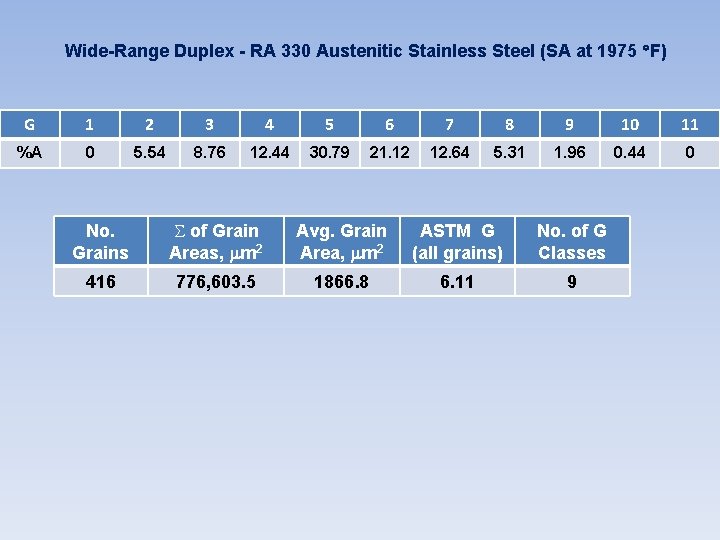
Wide-Range Duplex - RA 330 Austenitic Stainless Steel (SA at 1975 F) Avg. G = 6. 11 9 Grain Size Classes Skew = 7. 58 Kurtosis = 86. 66 N = 416 This structure covers 9 G classes, but the kurtosis is well above 5 and according to E 1181, paragraph 8. 3. 1. 2, it is a “Wide-Range” random duplex distribution.
Wide-Range Duplex - RA 330 Austenitic Stainless Steel (SA at 1975 F) G 1 2 3 4 5 6 7 8 9 10 11 %A 0 5. 54 8. 76 12. 44 30. 79 21. 12 12. 64 5. 31 1. 96 0. 44 0 No. Grains S of Grain Areas, m 2 Avg. Grain Area, m 2 ASTM G (all grains) No. of G Classes 416 776, 603. 5 1866. 8 6. 11 9
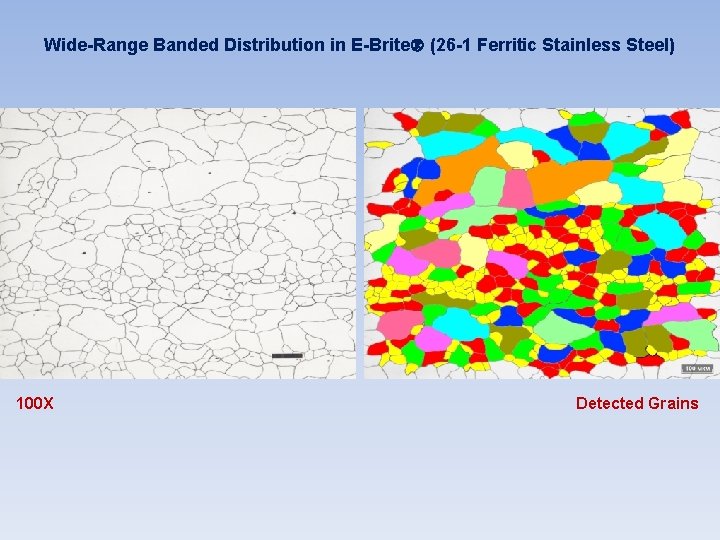
Wide-Range Banded Distribution in E-Brite (26 -1 Ferritic Stainless Steel) 100 X Detected Grains
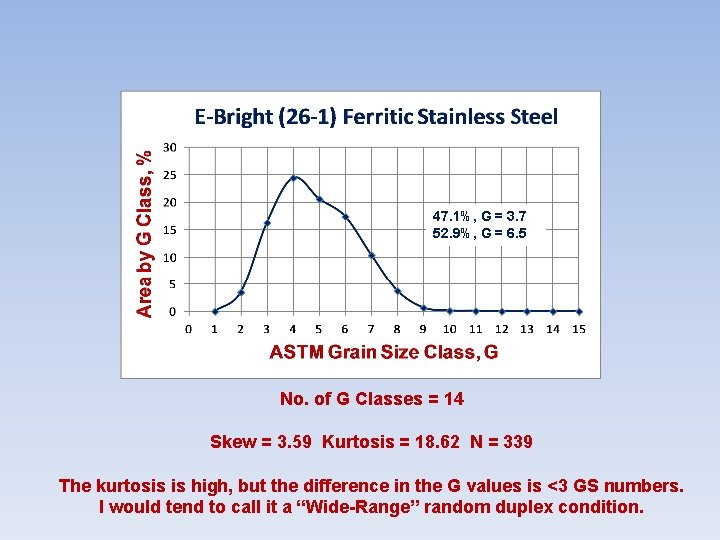
47. 1%, G = 3. 7 52. 9%, G = 6. 5 No. of G Classes = 14 Skew = 3. 59 Kurtosis = 18. 62 N = 339 The kurtosis is high, but the difference in the G values is <3 GS numbers. I would tend to call it a “Wide-Range” random duplex condition.
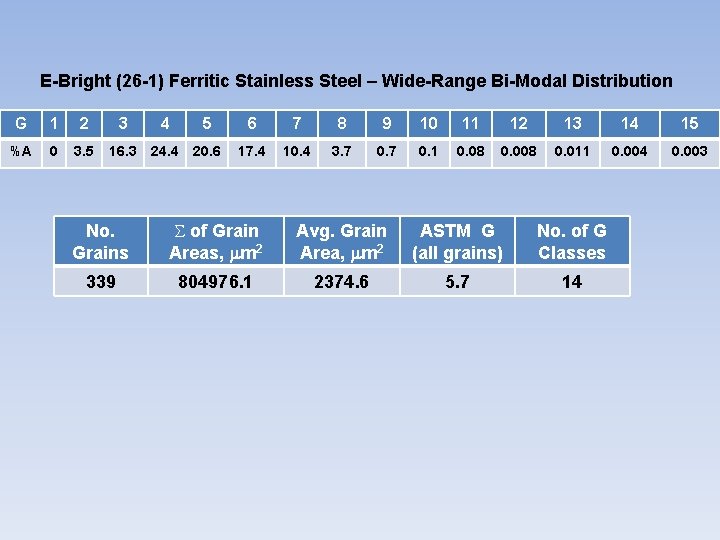
E-Bright (26 -1) Ferritic Stainless Steel – Wide-Range Bi-Modal Distribution G 1 2 3 4 5 6 7 8 9 10 11 12 13 14 15 %A 0 3. 5 16. 3 24. 4 20. 6 17. 4 10. 4 3. 7 0. 1 0. 08 0. 011 0. 004 0. 003 No. Grains S of Grain Areas, m 2 Avg. Grain Area, m 2 ASTM G (all grains) No. of G Classes 339 804976. 1 2374. 6 5. 7 14
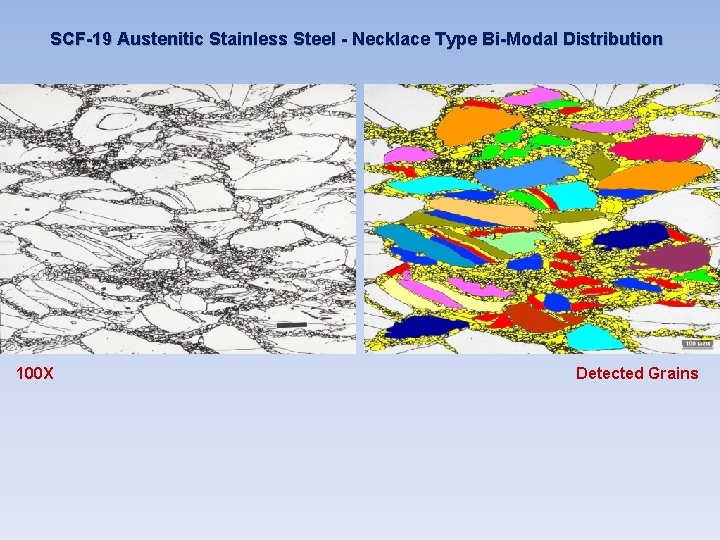
SCF-19 Austenitic Stainless Steel - Necklace Type Bi-Modal Distribution 100 X Detected Grains
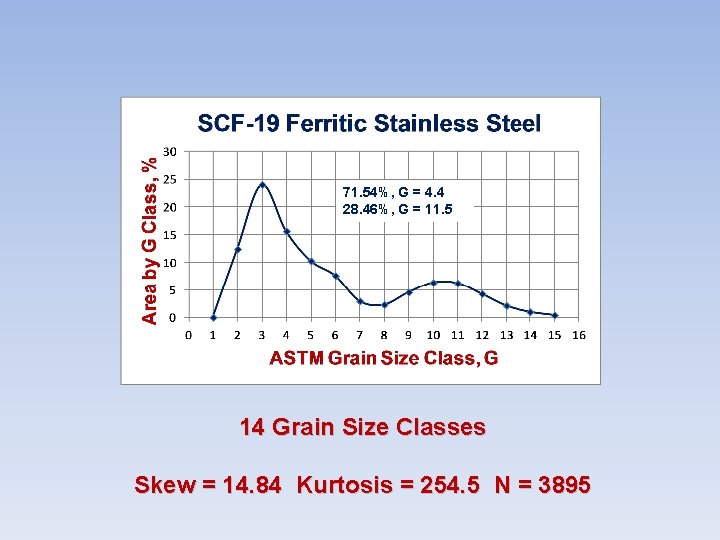
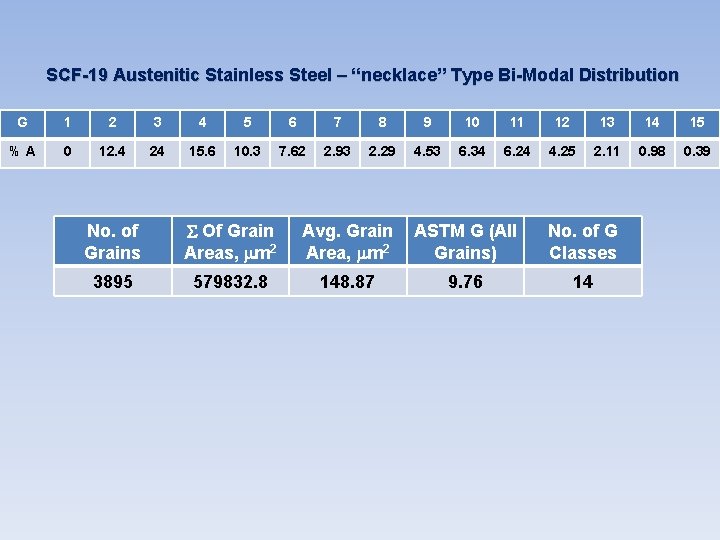
71. 54%, G = 4. 4 28. 46%, G = 11. 5 14 Grain Size Classes Skew = 14. 84 Kurtosis = 254. 5 N = 3895
SCF-19 Austenitic Stainless Steel – “necklace” Type Bi-Modal Distribution G 1 2 3 4 5 6 7 8 9 10 11 12 13 14 15 %A 0 12. 4 24 15. 6 10. 3 7. 62 2. 93 2. 29 4. 53 6. 34 6. 24 4. 25 2. 11 0. 98 0. 39 No. of Grains Of Grain Areas, m 2 Avg. Grain Area, m 2 ASTM G (All Grains) No. of G Classes 3895 579832. 8 148. 87 9. 76 14
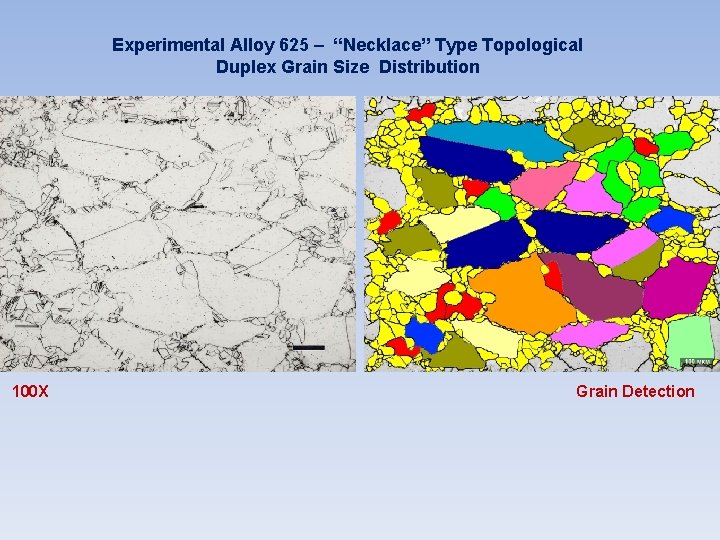
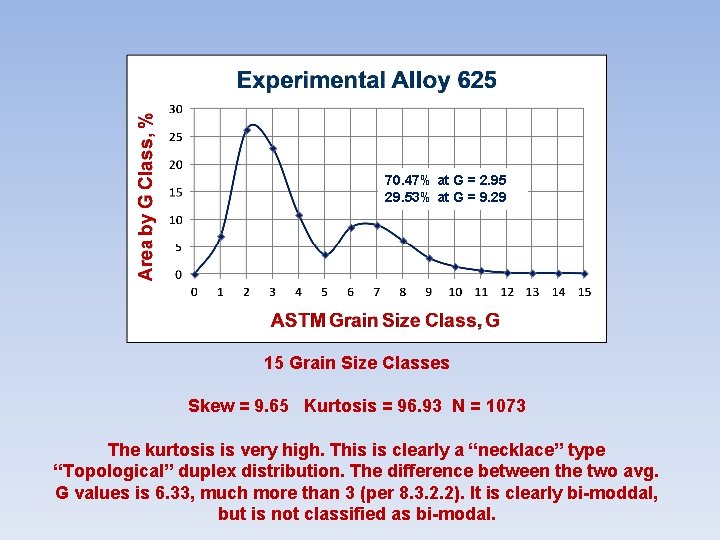
Experimental Alloy 625 – “Necklace” Type Topological Duplex Grain Size Distribution 100 X Grain Detection
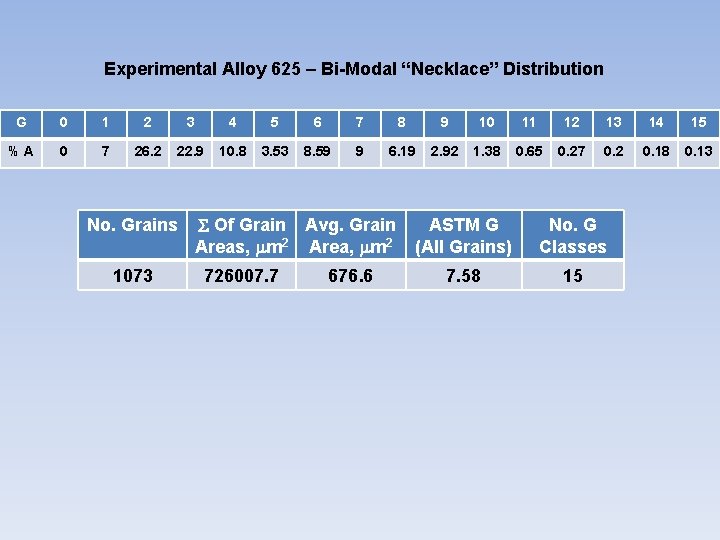
70. 47% at G = 2. 95 29. 53% at G = 9. 29 15 Grain Size Classes Skew = 9. 65 Kurtosis = 96. 93 N = 1073 The kurtosis is very high. This is clearly a “necklace” type “Topological” duplex distribution. The difference between the two avg. G values is 6. 33, much more than 3 (per 8. 3. 2. 2). It is clearly bi-moddal, but is not classified as bi-modal.
Experimental Alloy 625 – Bi-Modal “Necklace” Distribution G 0 1 2 3 4 5 6 7 8 9 10 11 12 13 14 15 %A 0 7 26. 2 22. 9 10. 8 3. 53 8. 59 9 6. 19 2. 92 1. 38 0. 65 0. 27 0. 2 0. 18 0. 13 No. Grains 1073 Of Grain Avg. Grain Areas, m 2 Area, m 2 726007. 7 676. 6 ASTM G (All Grains) No. G Classes 7. 58 15
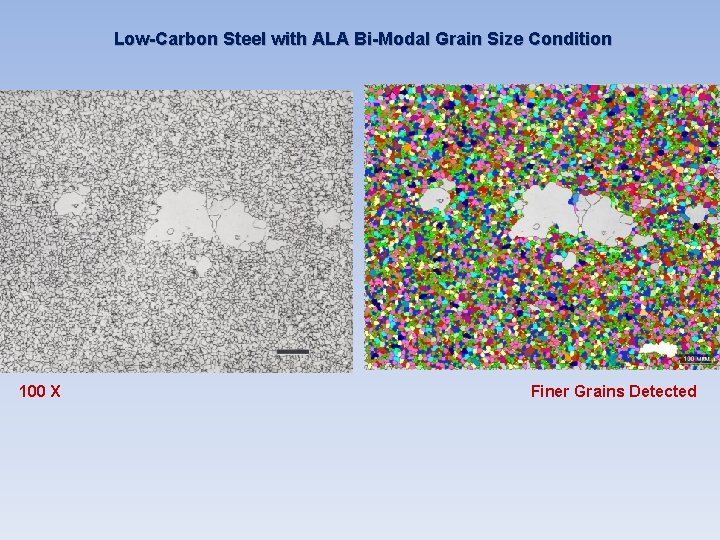
Low-Carbon Steel with ALA Bi-Modal Grain Size Condition 100 X Finer Grains Detected
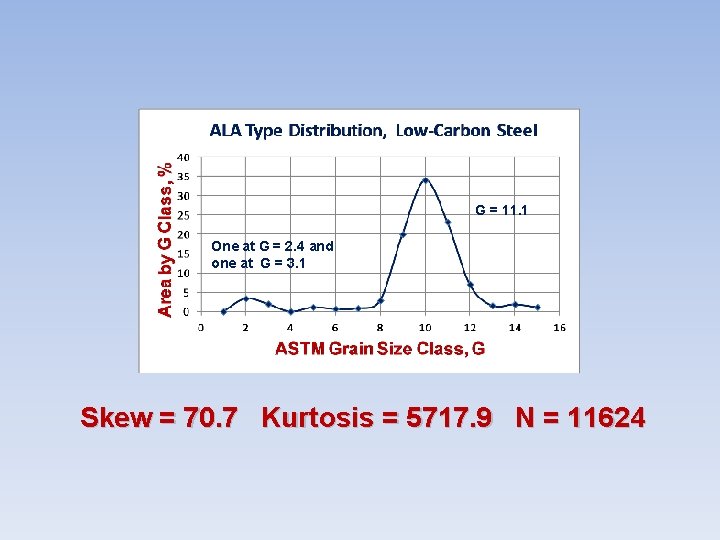
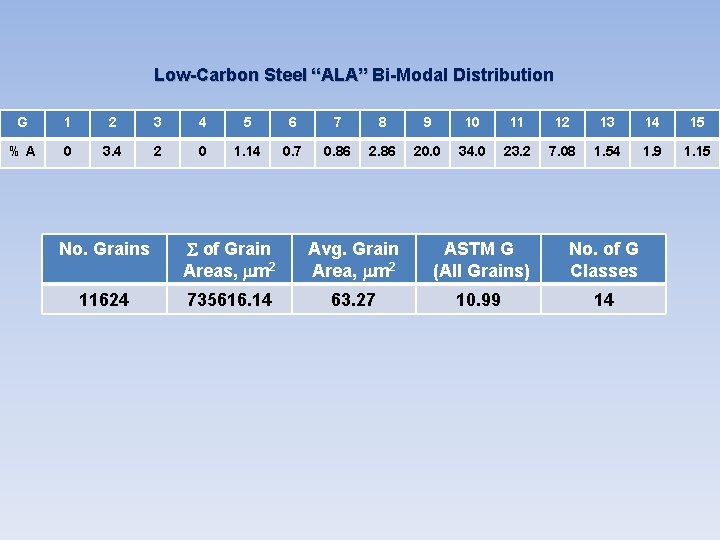
G = 11. 1 One at G = 2. 4 and one at G = 3. 1 Skew = 70. 7 Kurtosis = 5717. 9 N = 11624
Low-Carbon Steel “ALA” Bi-Modal Distribution G 1 2 3 4 5 6 7 8 9 10 11 12 13 14 15 %A 0 3. 4 2 0 1. 14 0. 7 0. 86 20. 0 34. 0 23. 2 7. 08 1. 54 1. 9 1. 15 No. Grains of Grain Areas, m 2 Avg. Grain Area, m 2 ASTM G (All Grains) No. of G Classes 11624 735616. 14 63. 27 10. 99 14
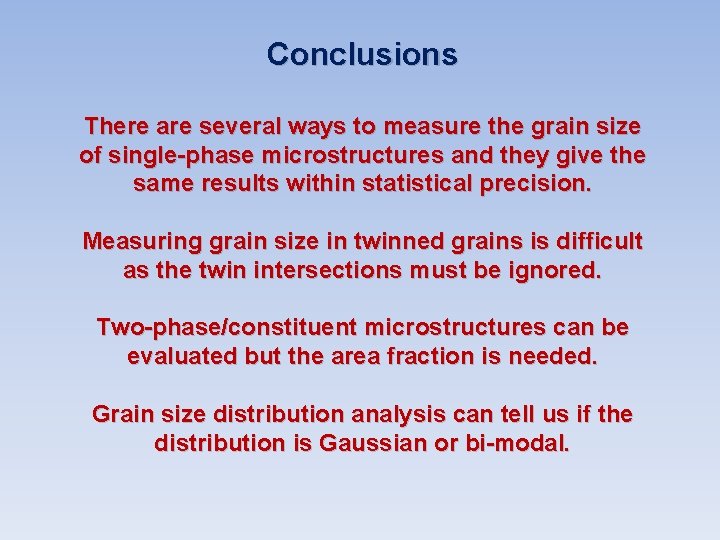
Conclusions There are several ways to measure the grain size of single-phase microstructures and they give the same results within statistical precision. Measuring grain size in twinned grains is difficult as the twin intersections must be ignored. Two-phase/constituent microstructures can be evaluated but the area fraction is needed. Grain size distribution analysis can tell us if the distribution is Gaussian or bi-modal.