
A Comparison of Flipped Programming Classroom Models Results
- Slides: 1
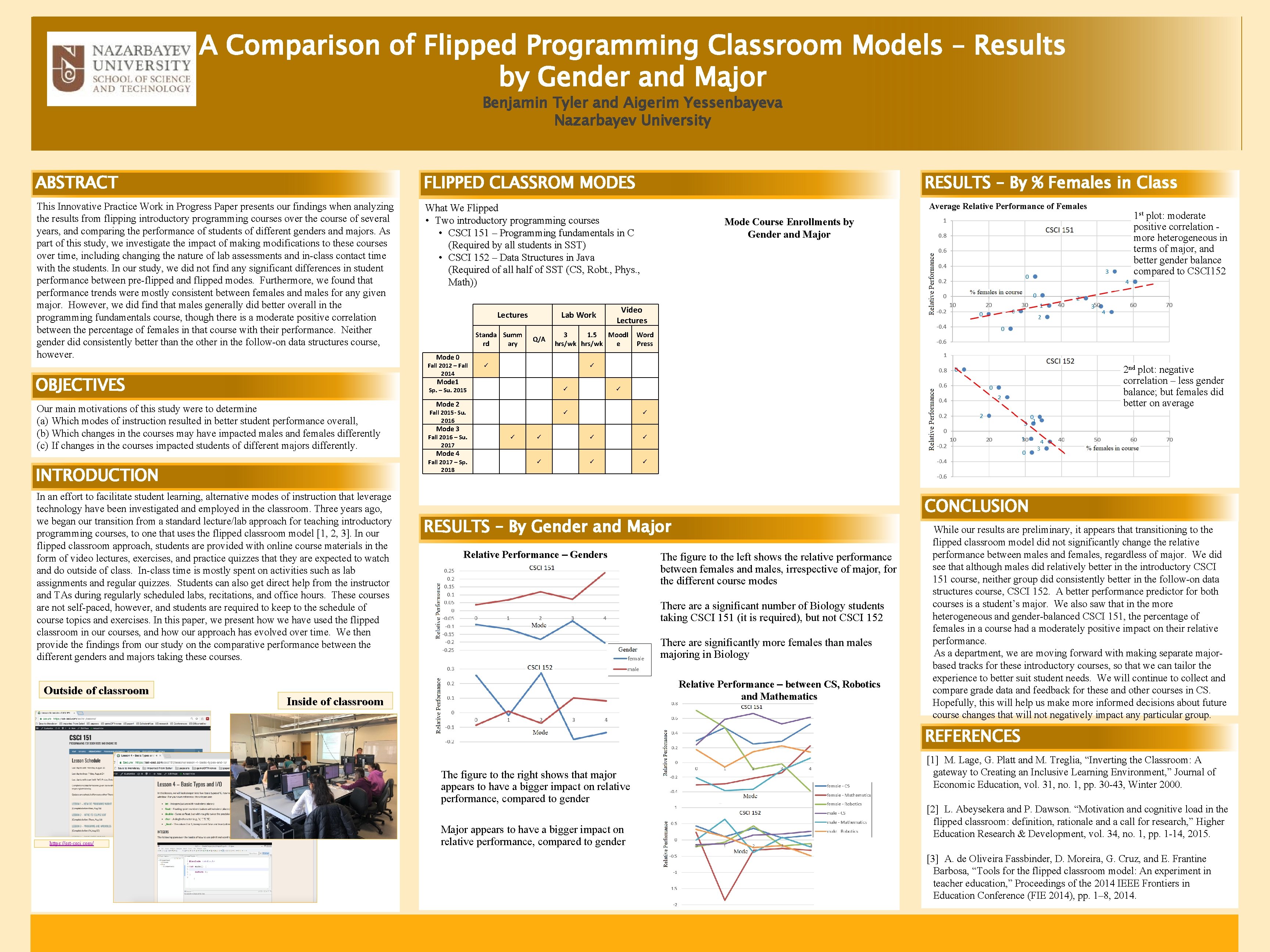
A Comparison of Flipped Programming Classroom Models – Results by Gender and Major Benjamin Tyler and Aigerim Yessenbayeva Nazarbayev University ABSTRACT FLIPPED CLASSROM MODES This Innovative Practice Work in Progress Paper presents our findings when analyzing the results from flipping introductory programming courses over the course of several years, and comparing the performance of students of different genders and majors. As part of this study, we investigate the impact of making modifications to these courses over time, including changing the nature of lab assessments and in-class contact time with the students. In our study, we did not find any significant differences in student performance between pre-flipped and flipped modes. Furthermore, we found that performance trends were mostly consistent between females and males for any given major. However, we did find that males generally did better overall in the programming fundamentals course, though there is a moderate positive correlation between the percentage of females in that course with their performance. Neither gender did consistently better than the other in the follow-on data structures course, however. What We Flipped • Two introductory programming courses • CSCI 151 – Programming fundamentals in C (Required by all students in SST) • CSCI 152 – Data Structures in Java (Required of all half of SST (CS, Robt. , Phys. , Math)) Standa Summ rd ary Lab Work Q/A ✓ 2 nd plot: negative correlation – less gender balance; but females did better on average ✓ Mode 2 Fall 2015 - Su. 2016 ✓ ✓ Mode 3 Fall 2016 – Su. 2017 ✓ ✓ ✓ ✓ Mode 4 Fall 2017 – Sp. 2018 In an effort to facilitate student learning, alternative modes of instruction that leverage technology have been investigated and employed in the classroom. Three years ago, we began our transition from a standard lecture/lab approach for teaching introductory programming courses, to one that uses the flipped classroom model [1, 2, 3]. In our flipped classroom approach, students are provided with online course materials in the form of video lectures, exercises, and practice quizzes that they are expected to watch and do outside of class. In-class time is mostly spent on activities such as lab assignments and regular quizzes. Students can also get direct help from the instructor and TAs during regularly scheduled labs, recitations, and office hours. These courses are not self-paced, however, and students are required to keep to the schedule of course topics and exercises. In this paper, we present how we have used the flipped classroom in our courses, and how our approach has evolved over time. We then provide the findings from our study on the comparative performance between the different genders and majors taking these courses. Word Press ✓ Sp. – Su. 2015 INTRODUCTION Mode Course Enrollments by Gender and Major 1 st plot: moderate positive correlation more heterogeneous in terms of major, and better gender balance compared to CSCI 152 Video Lectures 3 1. 5 Moodl hrs/wk e ✓ Mode 1 Our main motivations of this study were to determine (a) Which modes of instruction resulted in better student performance overall, (b) Which changes in the courses may have impacted males and females differently (c) If changes in the courses impacted students of different majors differently. Average Relative Performance of Females Mode 0 Fall 2012 – Fall 2014 OBJECTIVES Outside of classroom Lectures RESULTS – By % Females in Class CONCLUSION RESULTS – By Gender and Major Relative Performance – Genders The figure to the left shows the relative performance between females and males, irrespective of major, for the different course modes There a significant number of Biology students taking CSCI 151 (it is required), but not CSCI 152 There are significantly more females than males majoring in Biology Relative Performance – between CS, Robotics and Mathematics Inside of classroom While our results are preliminary, it appears that transitioning to the flipped classroom model did not significantly change the relative performance between males and females, regardless of major. We did see that although males did relatively better in the introductory CSCI 151 course, neither group did consistently better in the follow-on data structures course, CSCI 152. A better performance predictor for both courses is a student’s major. We also saw that in the more heterogeneous and gender-balanced CSCI 151, the percentage of females in a course had a moderately positive impact on their relative performance. As a department, we are moving forward with making separate majorbased tracks for these introductory courses, so that we can tailor the experience to better suit student needs. We will continue to collect and compare grade data and feedback for these and other courses in CS. Hopefully, this will help us make more informed decisions about future course changes that will not negatively impact any particular group. REFERENCES The figure to the right shows that major appears to have a bigger impact on relative performance, compared to gender https: //sst-csci. com/ Major appears to have a bigger impact on relative performance, compared to gender [1] M. Lage, G. Platt and M. Treglia, “Inverting the Classroom: A gateway to Creating an Inclusive Learning Environment, ” Journal of Economic Education, vol. 31, no. 1, pp. 30 -43, Winter 2000. [2] L. Abeysekera and P. Dawson. “Motivation and cognitive load in the flipped classroom: definition, rationale and a call for research, ” Higher Education Research & Development, vol. 34, no. 1, pp. 1 -14, 2015. [3] A. de Oliveira Fassbinder, D. Moreira, G. Cruz, and E. Frantine Barbosa, “Tools for the flipped classroom model: An experiment in teacher education, ” Proceedings of the 2014 IEEE Frontiers in Education Conference (FIE 2014), pp. 1– 8, 2014.