
A COMPARISON OF EXPLICIT AND IMPLICIT CONSUMER IDENTIFICATION
- Slides: 12
A COMPARISON OF EXPLICIT AND IMPLICIT CONSUMER IDENTIFICATION WITH COMMERCIAL AND PLACE BRANDS Sonia Capelli Charlotte Lécuyer University of Lyon - France 6 th Consumer Brand Relationship Conference – May 21 st 2019
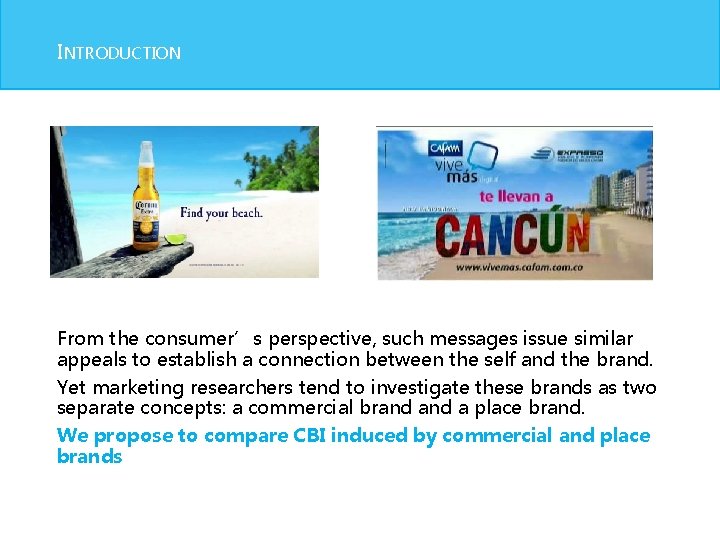
INTRODUCTION From the consumer’s perspective, such messages issue similar appeals to establish a connection between the self and the brand. Yet marketing researchers tend to investigate these brands as two separate concepts: a commercial brand a place brand. We propose to compare CBI induced by commercial and place brands
THEORETICAL BACKGROUND Q CONSUMER-BRAND IDENTIFICATION Social Identity theory (Tajfel & Turner, 1985) 2 Identification ways: § Brand as partner : Consumers use brands to define who they are (Albert et al. , 2013; Lam et al. , 2010) § Consuming brand to be part of a group who indentifies with the same brand (Lam et al. , 2010) Q CONDITIONS FOR BRANDS TO ACHIEVEC BI § Emotional attachment to the brand (Malar et al. , 2011) § Enhancing favorable consequences of the bond (Batra et al. 2012) § Enhancing cognitive perception of the overlap (Bergami and Bagozzi, 2000; Stokburger-Sauer et al. , 2012)
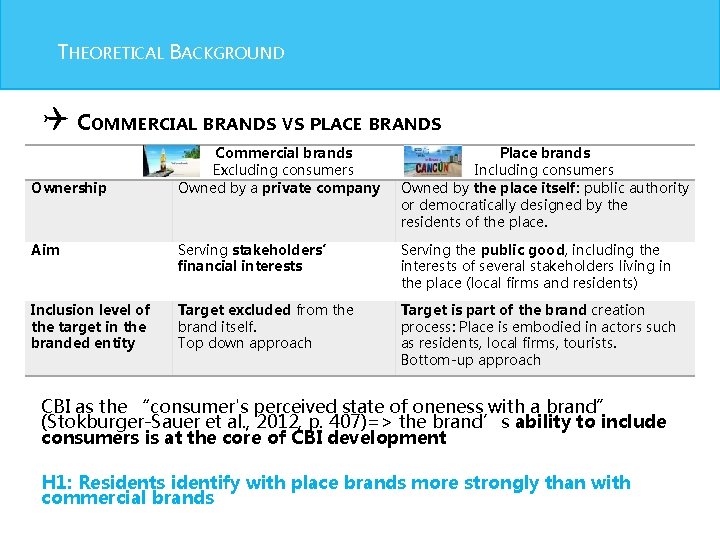
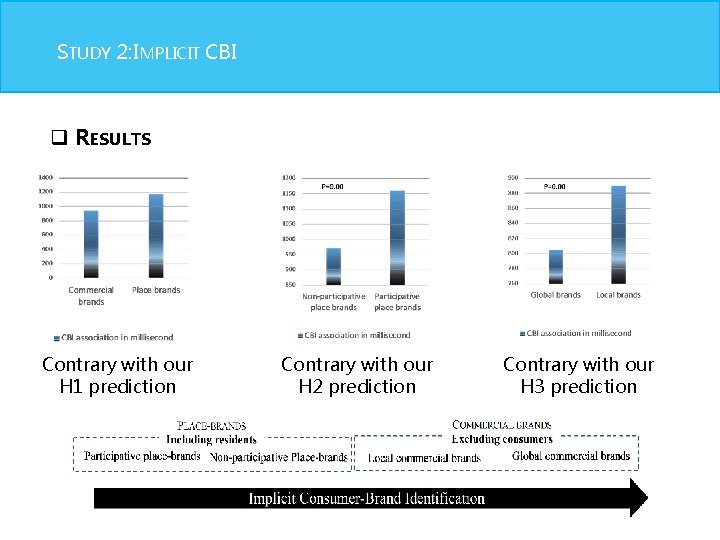
THEORETICAL BACKGROUND Q COMMERCIAL BRANDS VS PLACE BRANDS Commercial brands Excluding consumers Owned by a private company Place brands Including consumers Owned by the place itself: public authority or democratically designed by the residents of the place. Aim Serving stakeholders’ financial interests Serving the public good, including the interests of several stakeholders living in the place (local firms and residents) Inclusion level of the target in the branded entity Target excluded from the brand itself. Top down approach Target is part of the brand creation process: Place is embodied in actors such as residents, local firms, tourists. Bottom-up approach Ownership CBI as the “consumer's perceived state of oneness with a brand” (Stokburger-Sauer et al. , 2012, p. 407)=> the brand’s ability to include consumers is at the core of CBI development H 1: Residents identify with place brands more strongly than with commercial brands
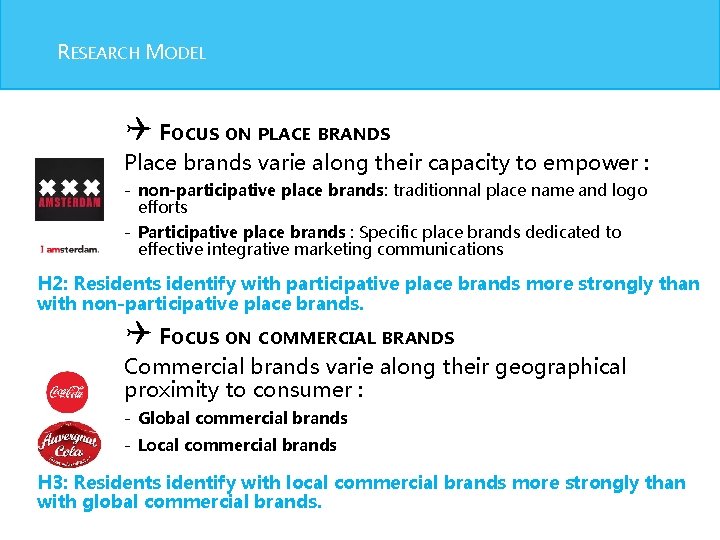
RESEARCH MODEL Q FOCUS ON PLACE BRANDS Place brands varie along their capacity to empower : - non-participative place brands: traditionnal place name and logo efforts - Participative place brands : Specific place brands dedicated to effective integrative marketing communications H 2: Residents identify with participative place brands more strongly than with non-participative place brands. Q FOCUS ON COMMERCIAL BRANDS Commercial brands varie along their geographical proximity to consumer : - Global commercial brands - Local commercial brands H 3: Residents identify with local commercial brands more strongly than with global commercial brands.
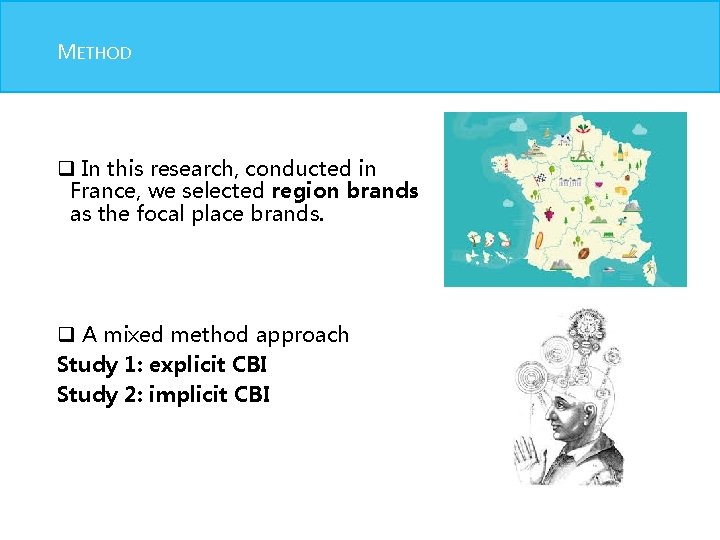
METHOD q In this research, conducted in France, we selected region brands as the focal place brands. q A mixed method approach Study 1: explicit CBI Study 2: implicit CBI
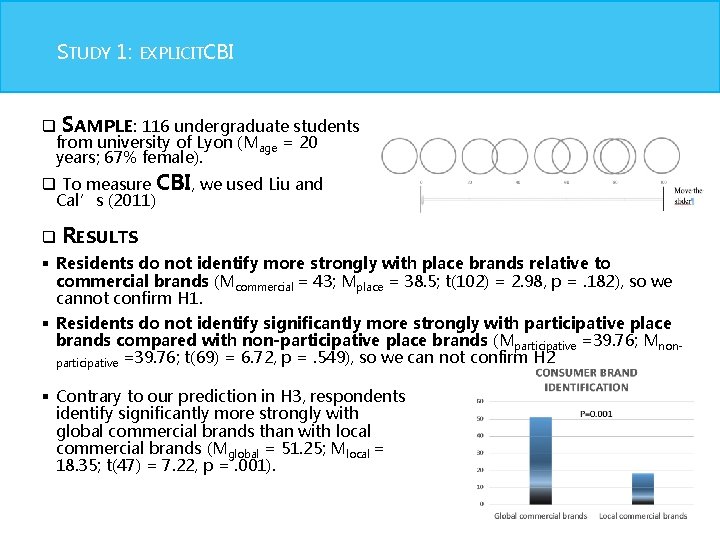
STUDY 1: EXPLICITCBI q SAMPLE: 116 undergraduate students from university of Lyon (Mage = 20 years; 67% female). q To measure CBI, we used Liu and Cal’s (2011) q RESULTS § Residents do not identify more strongly with place brands relative to commercial brands (Mcommercial = 43; Mplace = 38. 5; t(102) = 2. 98, p =. 182), so we cannot confirm H 1. § Residents do not identify significantly more strongly with participative place brands compared with non-participative place brands (Mparticipative =39. 76; Mnonparticipative =39. 76; t(69) = 6. 72, p =. 549), so we can not confirm H 2 § Contrary to our prediction in H 3, respondents identify significantly more strongly with global commercial brands than with local commercial brands (Mglobal = 51. 25; Mlocal = 18. 35; t(47) = 7. 22, p =. 001).
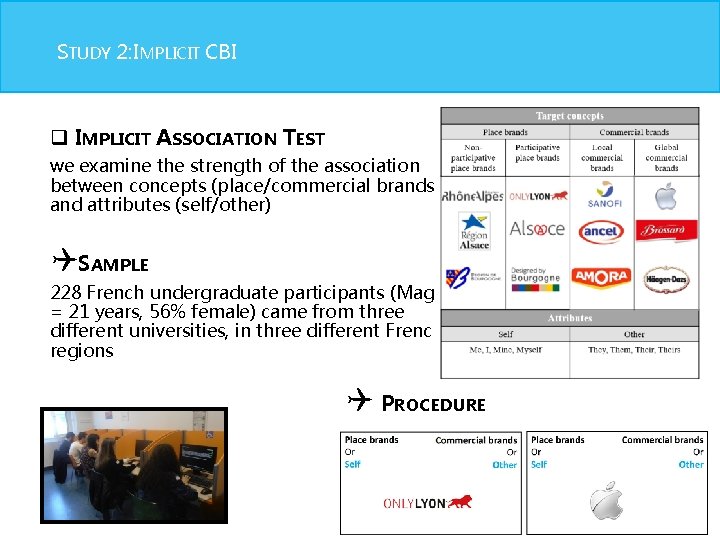
STUDY 2: IMPLICIT CBI q IMPLICIT ASSOCIATION TEST we examine the strength of the association between concepts (place/commercial brands) and attributes (self/other) QSAMPLE 228 French undergraduate participants (Mage = 21 years, 56% female) came from three different universities, in three different French regions Q PROCEDURE
STUDY 2: IMPLICIT CBI q RESULTS Contrary with our H 1 prediction Contrary with our H 2 prediction Contrary with our H 3 prediction
ACADEMIC CONTRIBUTIONS q Most studies measure CBI explicitly. We propose an original measure, based on an IAT, to access implicit CBI. We confirm a dissociation between explicit and implicit results: selfreported identification with a region might be masked, potentially by factors such as resident role playing. q We discern that geographical proximity might not be the best way to enhance CBI. Value-based identification developed by strong global commercial brands encourages more consumer identification. q. If most place branding studies advocate the use of branding strategies to support place attractiveness; our results indicate that parallel approaches for CBI are not obvious.
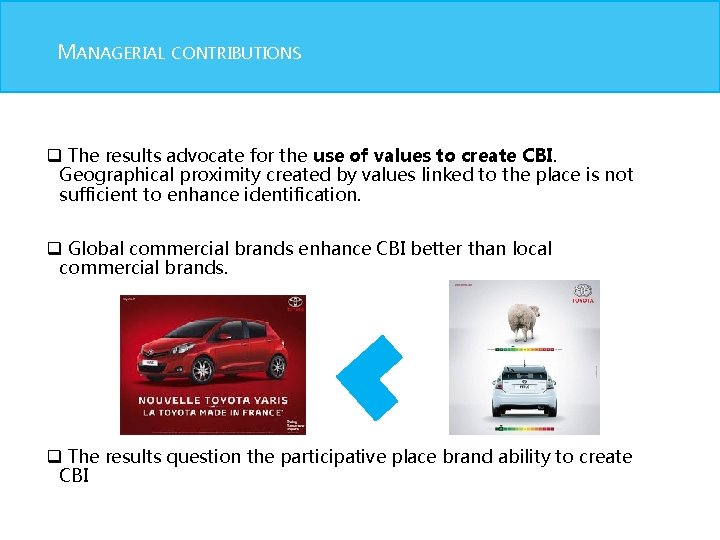
MANAGERIAL CONTRIBUTIONS q The results advocate for the use of values to create CBI. Geographical proximity created by values linked to the place is not sufficient to enhance identification. q Global commercial brands enhance CBI better than local commercial brands. q The results question the participative place brand ability to create CBI
A COMPARISON OF EXPLICIT AND IMPLICIT CONSUMER IDENTIFICATION WITH COMMERCIAL AND PLACE BRANDS Sonia Capelli Charlotte Lécuyer University of Lyon - France 6 th Consumer Brand Relationship Conference – May 21 st 2019