
A Comparison of EquationBased and AIMD Congestion Control

A Comparison of Equation-Based and AIMD Congestion Control Sally Floyd, Mark Handley, Jitendra Padhye ACIRI (Unpublished)
Outline • Introduction • AIMD • TCP vs. AIMD • TFRC vs. AIMD • Related Work • Conclusions
Introduction • TCP halves sending rate upon congestion – MM likes smooth rate • TFRC uses equation to make more smooth – 5 RTT’s to reduce by half – Increase. 28 packets per RTT – Still “TCP-friendly” • TCP better modeled, understood than • equation-based There are other AIMD protocols besides TCP – Find one that is more smooth than TCP – Make sure “TCP-friendly”
Additive Increase Multiplicative Decrease • AIMD(a, b), with window size W – Increase parameter a, Decrease parameter b • Each RTT increase window to W+a • Upon loss event decrease to (1 -b)W • TCP uses AIMD(1, ½) – Increase by 1 every RTT – Decrease by ½ upon loss • Smoother should have b < ½ • TCP-friendly should then have a < 1
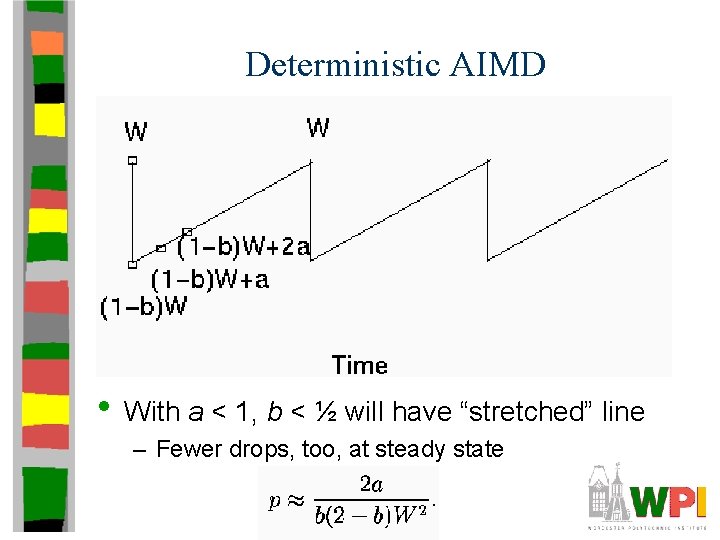
Deterministic AIMD • With a < 1, b < ½ will have “stretched” line – Fewer drops, too, at steady state
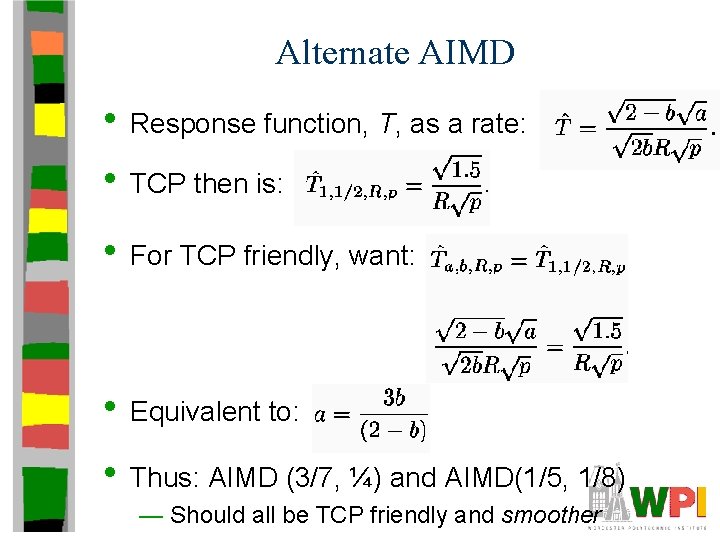
Alternate AIMD • Response function, T, as a rate: • TCP then is: • For TCP friendly, want: • Equivalent to: • Thus: AIMD (3/7, ¼) and AIMD(1/5, 1/8) — Should all be TCP friendly and smoother
Outline • Introduction • AIMD • TCP vs. AIMD • TFRC vs. AIMD • Related Work • Conclusions
Evaluation of TCP vs. AIMD • Run simulations in NS – Topology noted, but probably “dumbbell” • SACK TCP vs. SACK TCP(1/5, 1/8) • Normalize so 1 is fair share
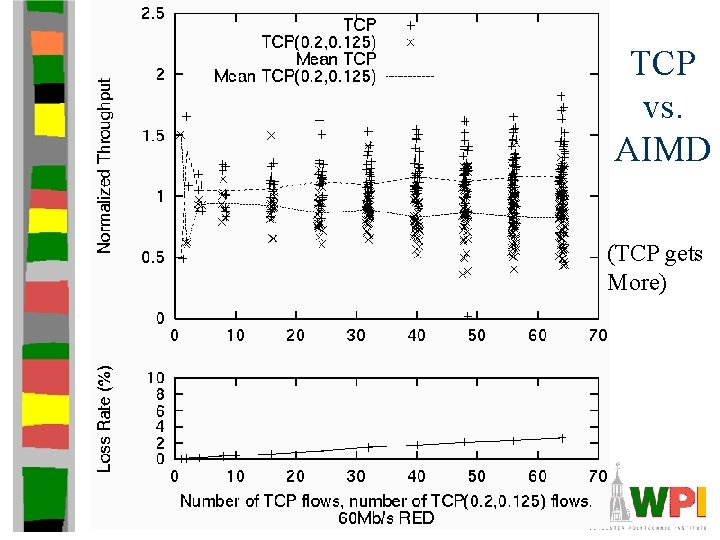
TCP vs. AIMD (TCP gets More)
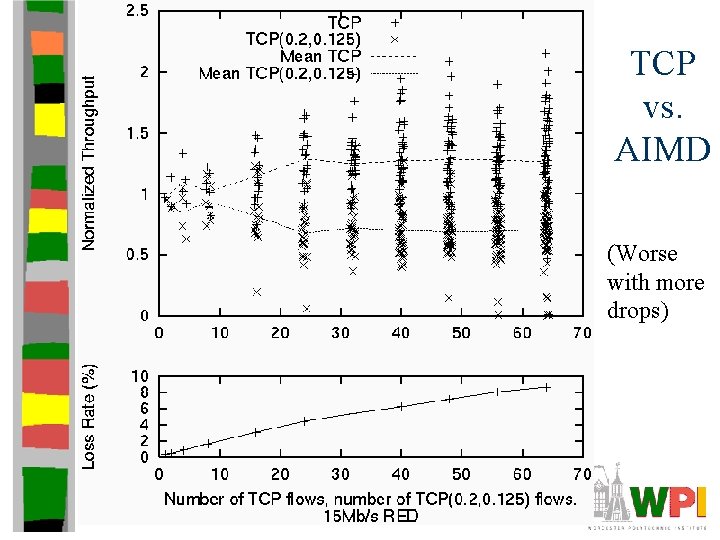
TCP vs. AIMD (Worse with more drops)
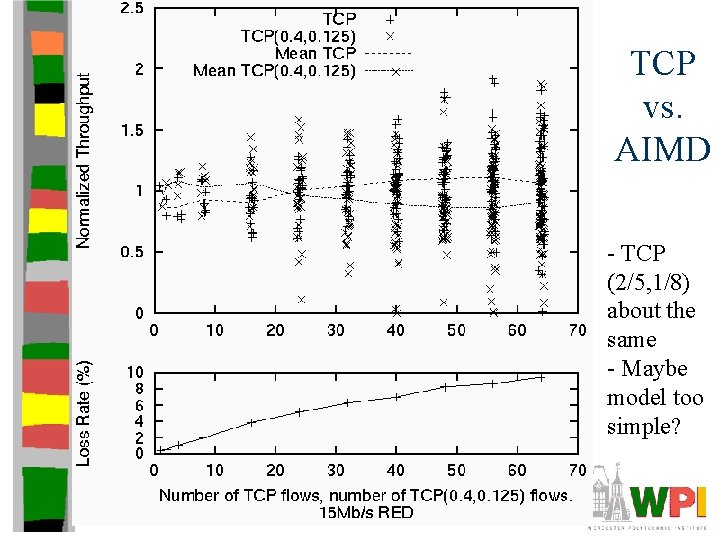
TCP vs. AIMD - TCP (2/5, 1/8) about the same - Maybe model too simple?
Outline • Introduction • AIMD • TCP vs. AIMD • TFRC vs. AIMD • Related Work • Conclusions
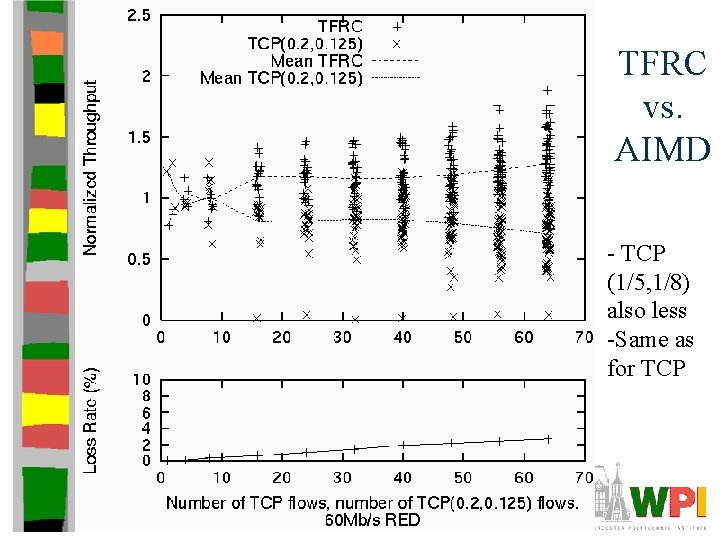
TFRC vs. AIMD - TCP (1/5, 1/8) also less -Same as for TCP
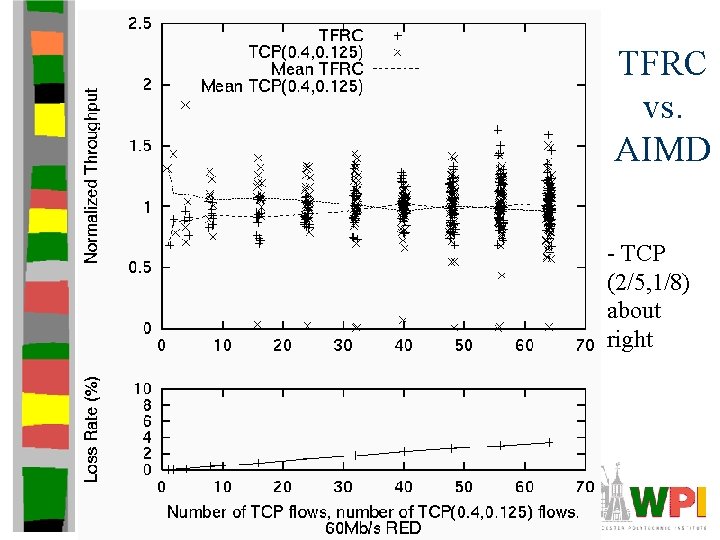
TFRC vs. AIMD - TCP (2/5, 1/8) about right
Transient Response • Can determine reaction at congestion • TCP(a, b) takes log 1 -b 0. 5 RTTs to ½ rate – b=1/8, then 5 RTTs to ½ rate – b=1/4, then 3 RTTs to ½ rate • TFRC takes 5 RTTs to ½ rate – Thus, like TCP(a, 1/8) • One way of comparing responsiveness – RTTs to ½ rate • Aggressiveness based on a – Largest increase in rate during 1 RTT • Smoothness based on b – Largest decrease in rate during 1 RTT
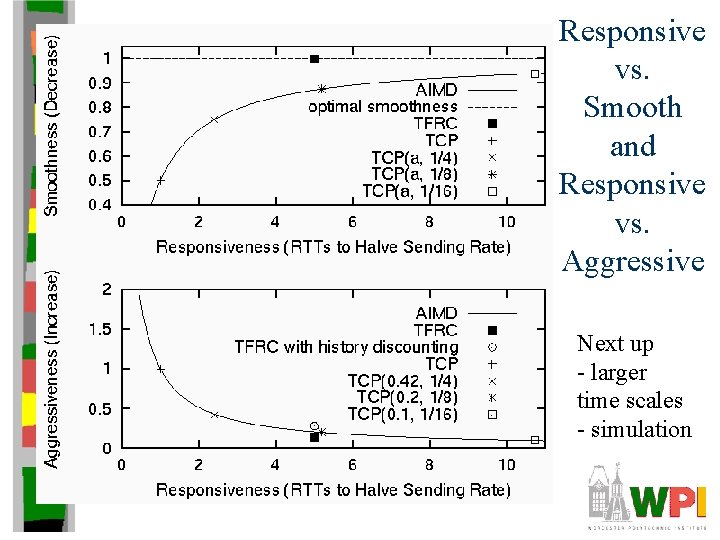
Responsive vs. Smooth and Responsive vs. Aggressive Next up - larger time scales - simulation
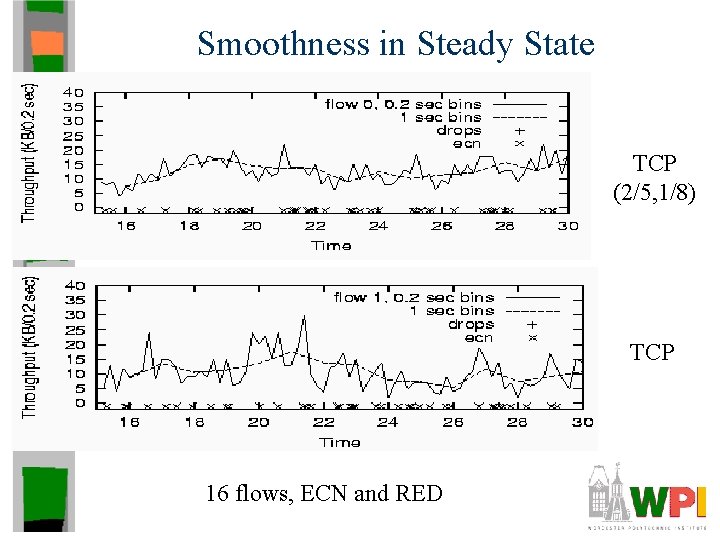
Smoothness in Steady State TCP (2/5, 1/8) TCP 16 flows, ECN and RED
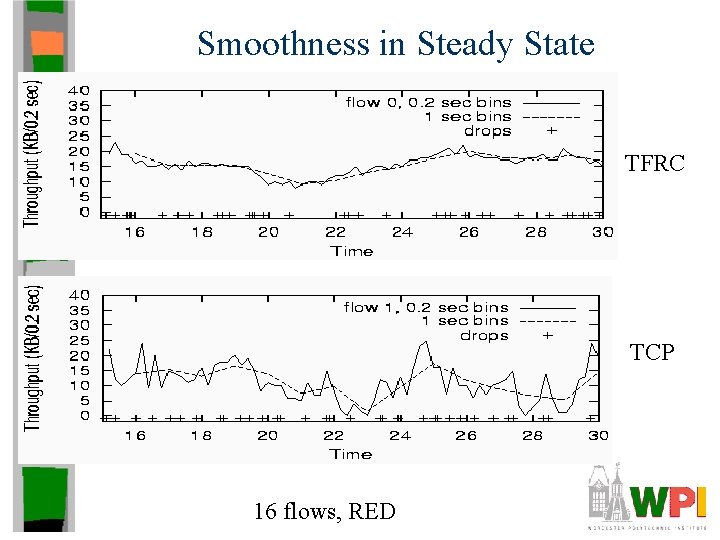
Smoothness in Steady State TFRC TCP 16 flows, RED
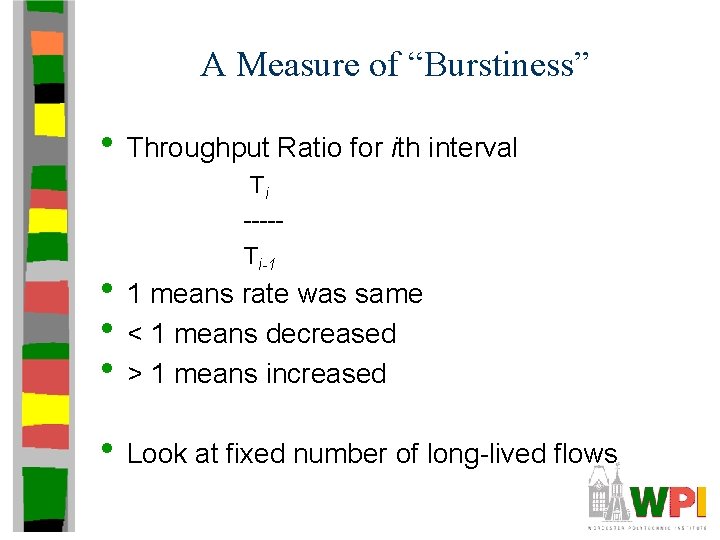
A Measure of “Burstiness” • Throughput Ratio for ith interval Ti ----Ti-1 • 1 means rate was same • < 1 means decreased • > 1 means increased • Look at fixed number of long-lived flows
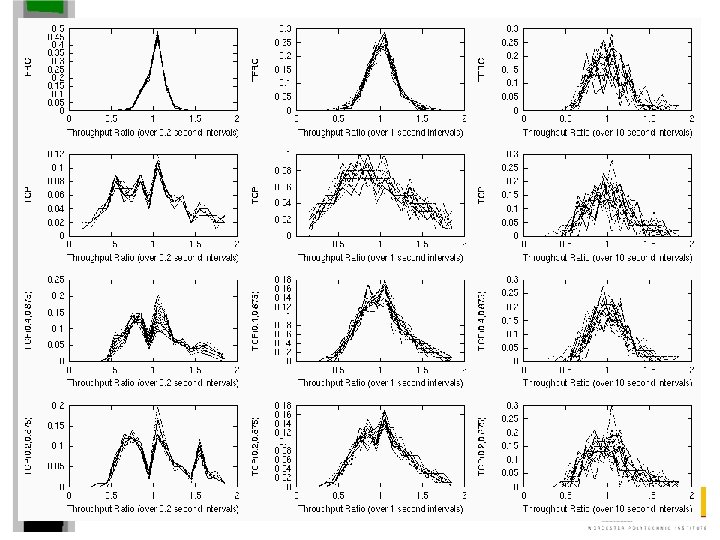
Burstiness
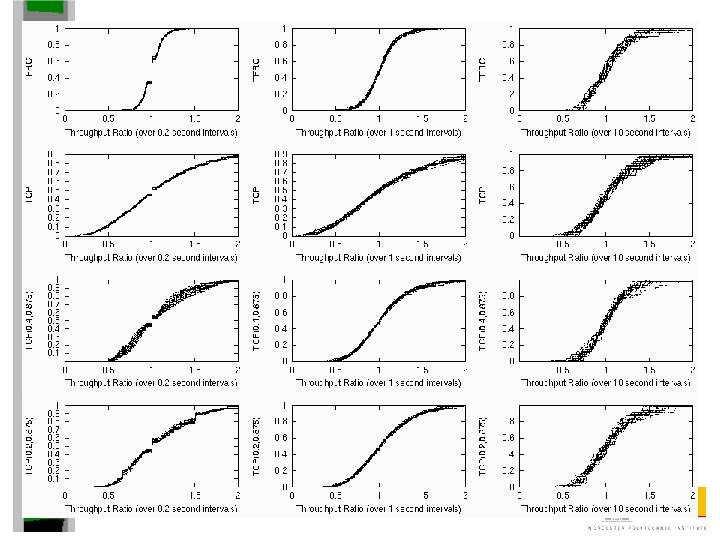
Cumulative Distribution
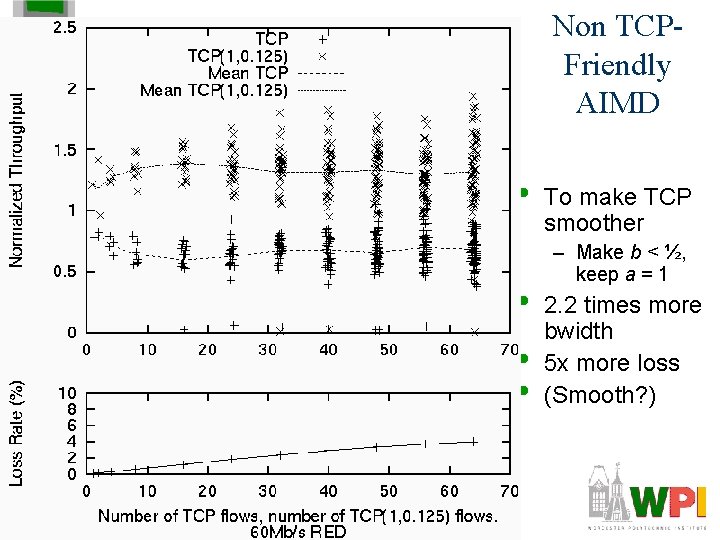
Non TCPFriendly AIMD • • To make TCP smoother – Make b < ½, keep a = 1 2. 2 times more bwidth 5 x more loss (Smooth? )
Conclusion • Family of AIMD (a, b) • Comparison of those like TCP – (1/5, 1/8) - theoretical – (2/5, 1/8) – actual – Smoother over some time intervals • Comparison with TFRC – TFRC smoother than all
Future Work • “Burstiness” in the face of – Bursty traffic (here, all steady state) – Higher drop rates (here, only 4%) • Adaptive AIMD (Hari Kannan) – At steady state, decrease a and b – Upon bursy congestion, increase a and b + Maintain TCP friendly – When bursty, like TCP – When steady, smooth and no drops
Evaluation of Science? • Category of Paper • Science Evaluation (1 -10)? • Space devoted to Experiments?
- Slides: 25