
A Comparison of EqualArea Map Projections for Regional

- Slides: 32
A Comparison of Equal-Area Map Projections for Regional and Global Raster Data E. Lynn Usery and Jeong-Chang Seong 29 th International Geographical Congress
Outline • • • Objectives Hypotheses Approach Theoretical Results Empirical Results with Land Cover Conclusions 29 th International Geographical Congress
Objectives • Determine effects of various map projections on regional and global raster data • Assess problem mathematically • Test empirically • Long-term goal -- develop specialized projection, if necessary, to optimize projection of raster data 29 th International Geographical Congress
Hypotheses • Projection of raster data will produce variable results dependent on three factors: – Projection type and specific projection – Raster resolution – Latitude 29 th International Geographical Congress
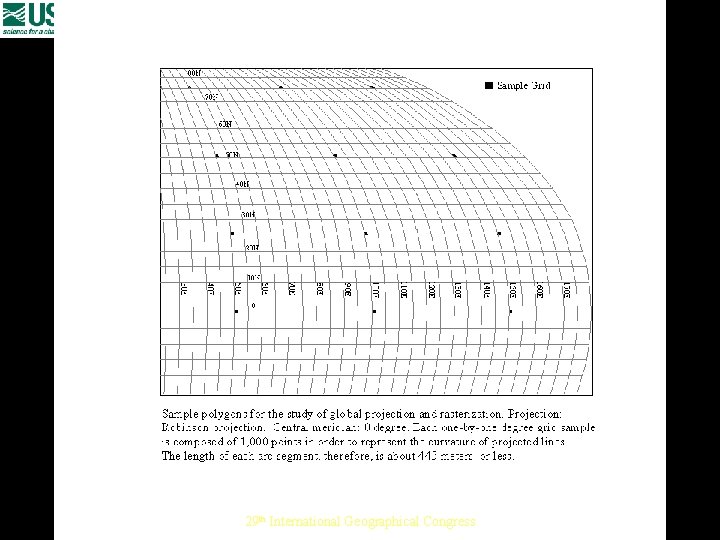
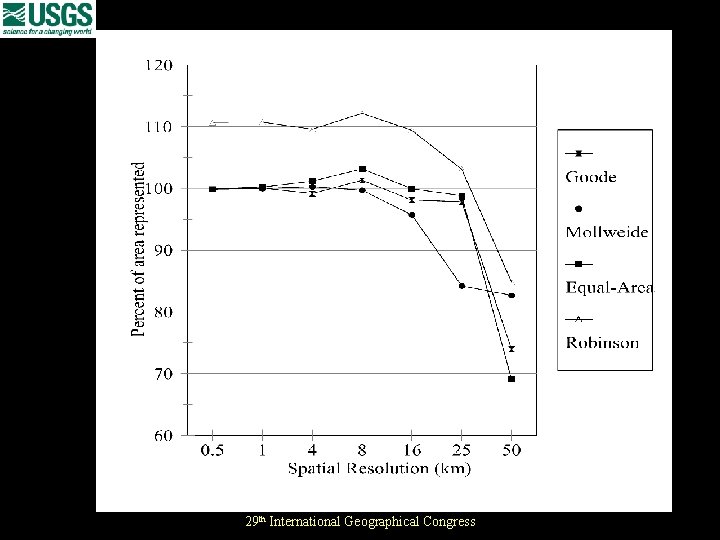
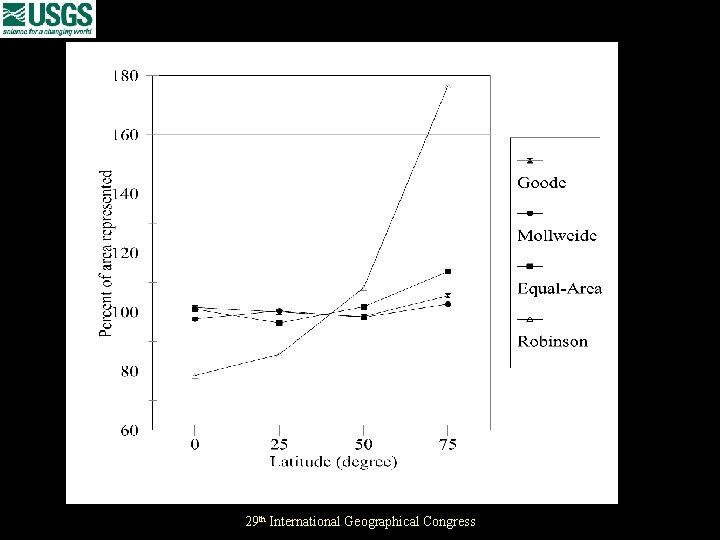
Approach • Theoretical – Use vector representation of 1 x 1 degree squares at various latitudes to determine actual areas – Convert squares to raster and transform using exact projection equations (rigorous transformation) to various projections – Tabulate resulting areas of cells and compare to the vector “truth” 29 th International Geographical Congress
Projections Used • Equal Area – Goode Homolosine (Goode) – Equal Area Cylindrical (Eq-Cyl) – Mollweide (Mw) • Pseudocylindircal -- compromise – Robinson (Rob) 29 th International Geographical Congress
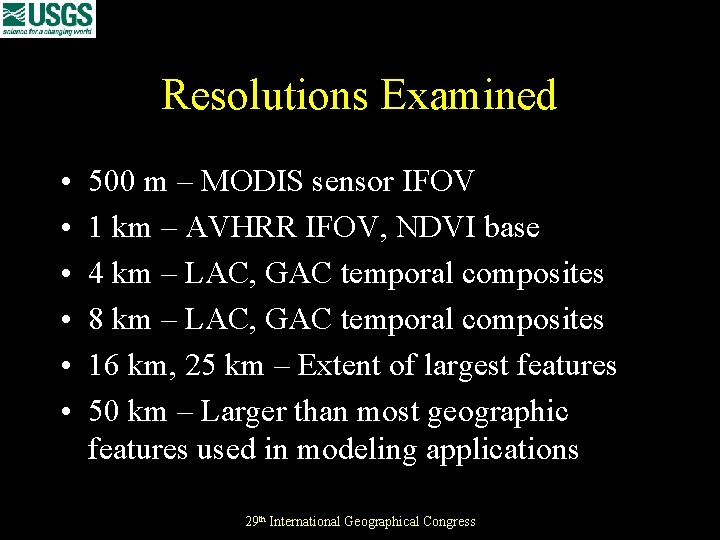
Resolutions Examined • • • 500 m – MODIS sensor IFOV 1 km – AVHRR IFOV, NDVI base 4 km – LAC, GAC temporal composites 8 km – LAC, GAC temporal composites 16 km, 25 km – Extent of largest features 50 km – Larger than most geographic features used in modeling applications 29 th International Geographical Congress
29 th International Geographical Congress
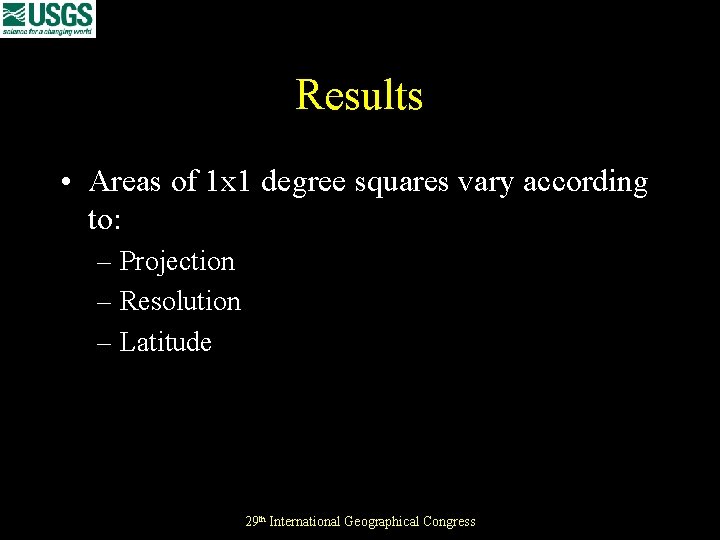
Results • Areas of 1 x 1 degree squares vary according to: – Projection – Resolution – Latitude 29 th International Geographical Congress
29 th International Geographical Congress
29 th International Geographical Congress
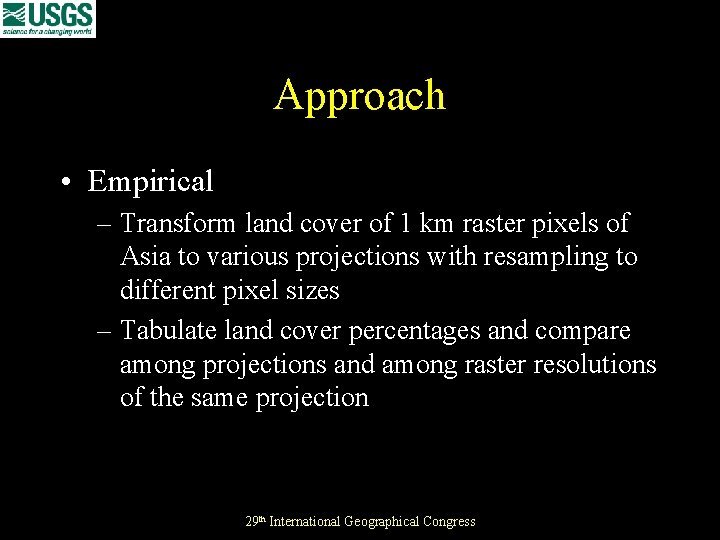
Approach • Empirical – Transform land cover of 1 km raster pixels of Asia to various projections with resampling to different pixel sizes – Tabulate land cover percentages and compare among projections and among raster resolutions of the same projection 29 th International Geographical Congress
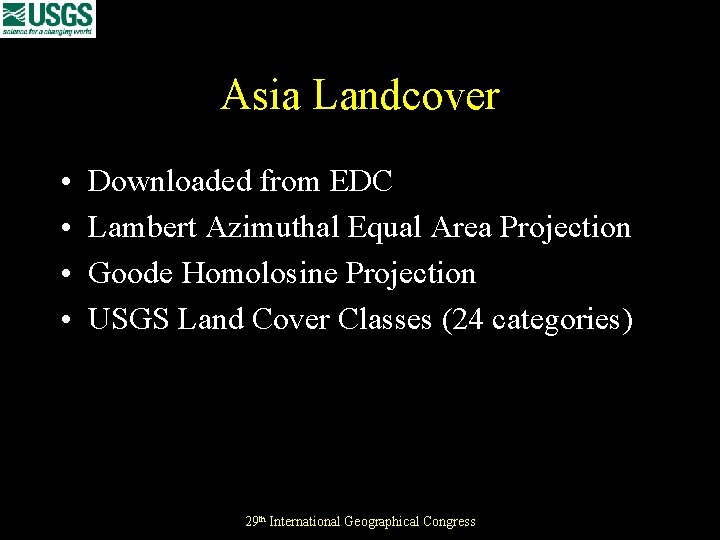
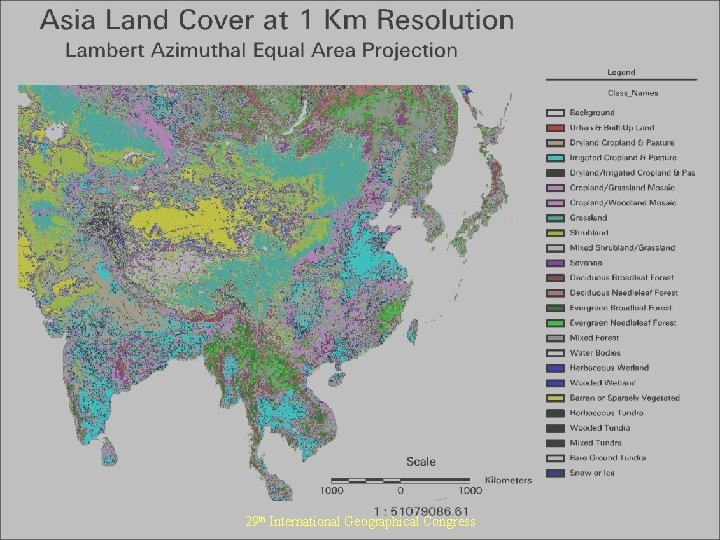
Asia Landcover • • Downloaded from EDC Lambert Azimuthal Equal Area Projection Goode Homolosine Projection USGS Land Cover Classes (24 categories) 29 th International Geographical Congress
29 th International Geographical Congress
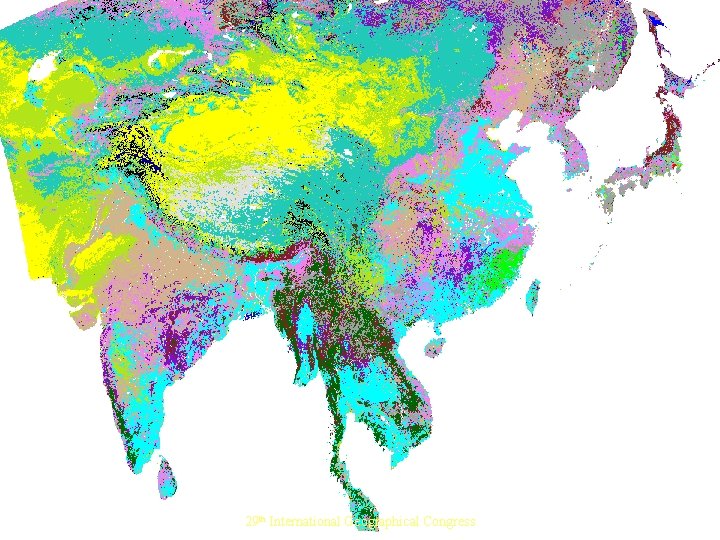
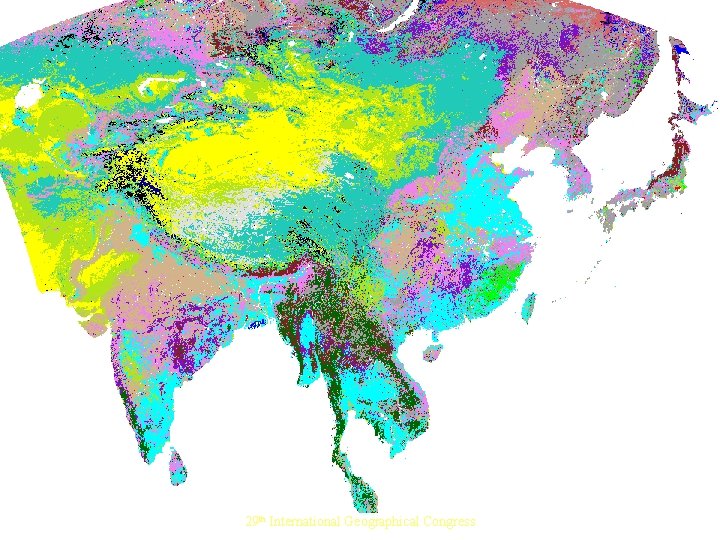
Asia Land Cover in Lambert Azimuthal Equal Area Projection (8 km Pixels) 29 th International Geographical Congress
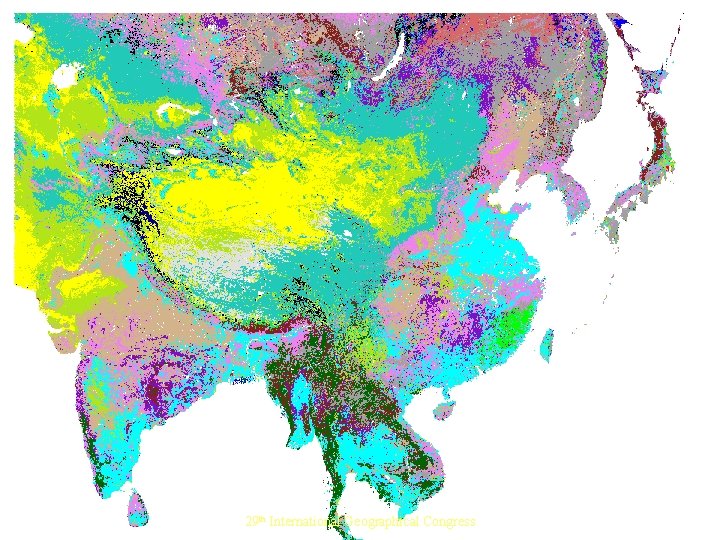
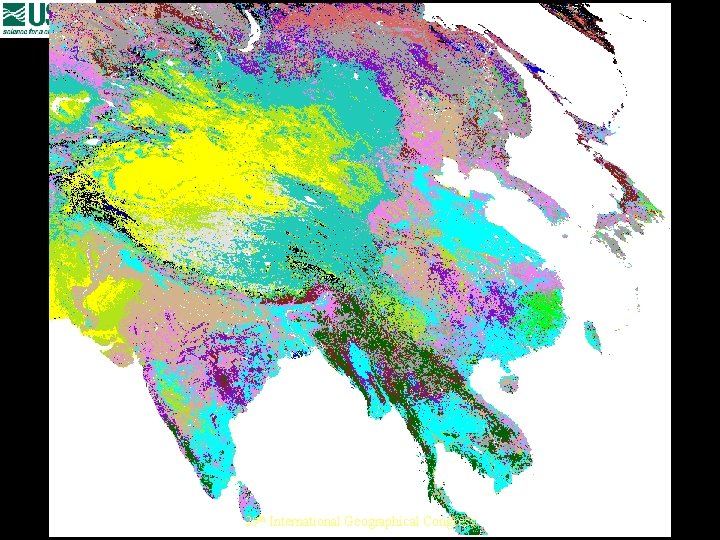
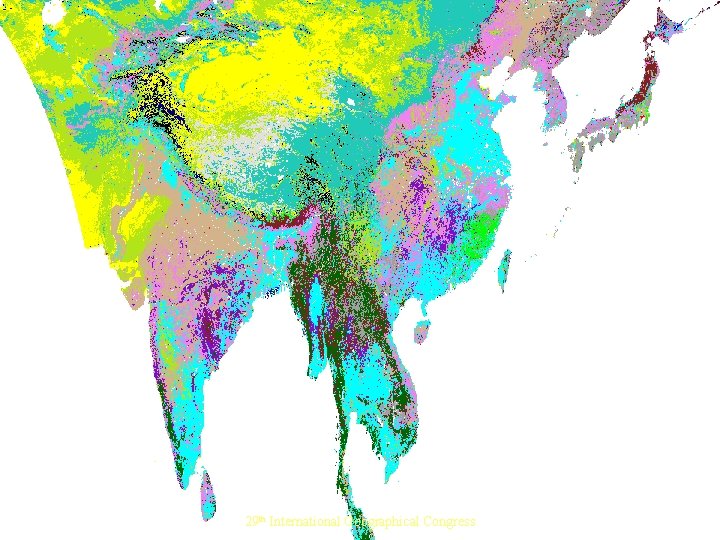
Asia Land Cover in Goode Projection (8 km Pixels) 29 th International Geographical Congress
Asia Land Cover in Equal Area Cylindrical Projection (8 km Pixels) 29 th International Geographical Congress
Asia Land Cover in Mollweide Projection (8 km Pixels) 29 th International Geographical Congress
Asia Land Cover in Robinson Projection (8 km Pixels) 29 th International Geographical Congress
29 th International Geographical Congress
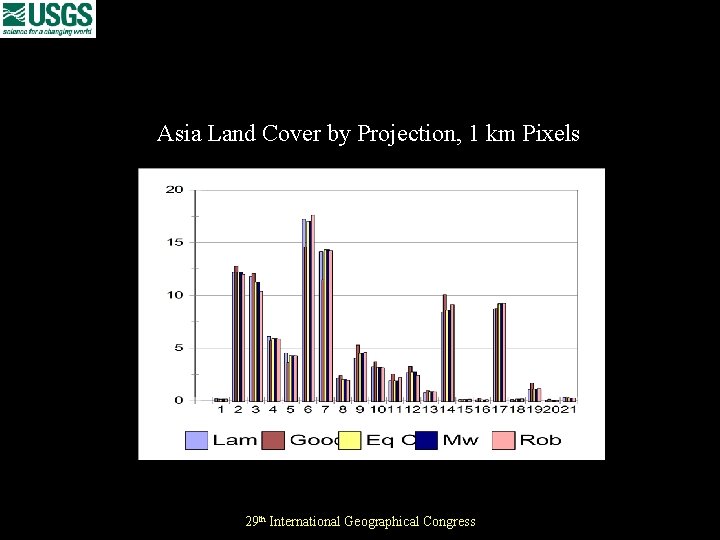
Asia Land Cover by Projection, 1 km Pixels 29 th International Geographical Congress
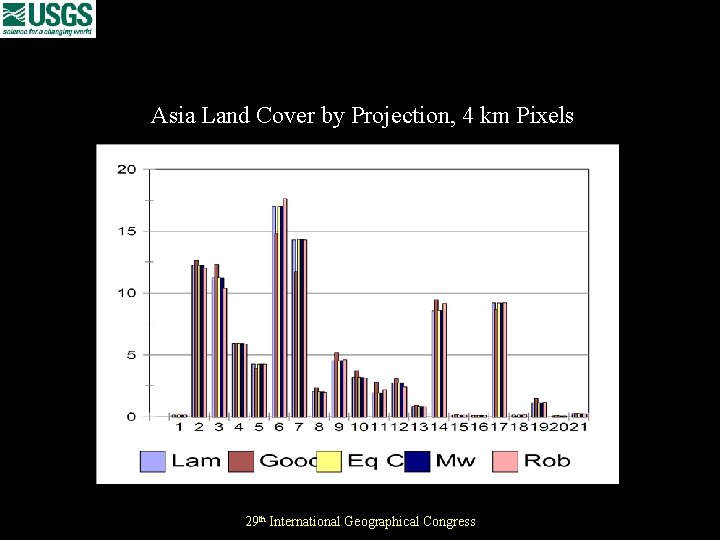
Asia Land Cover by Projection, 4 km Pixels 29 th International Geographical Congress
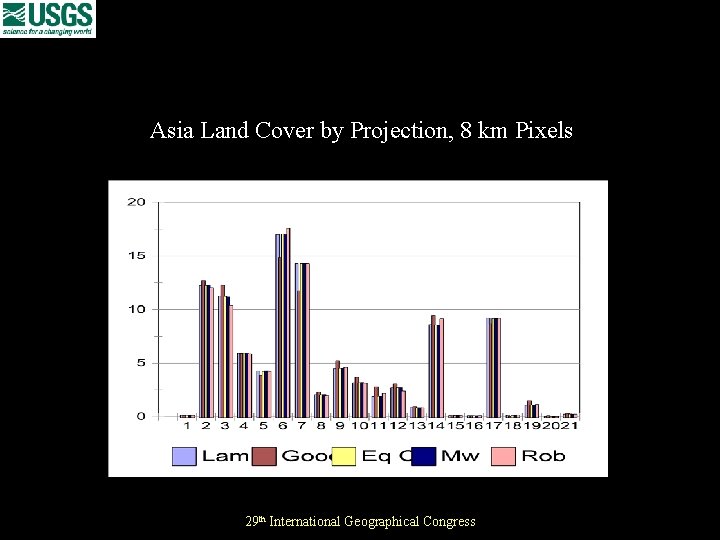
Asia Land Cover by Projection, 8 km Pixels 29 th International Geographical Congress
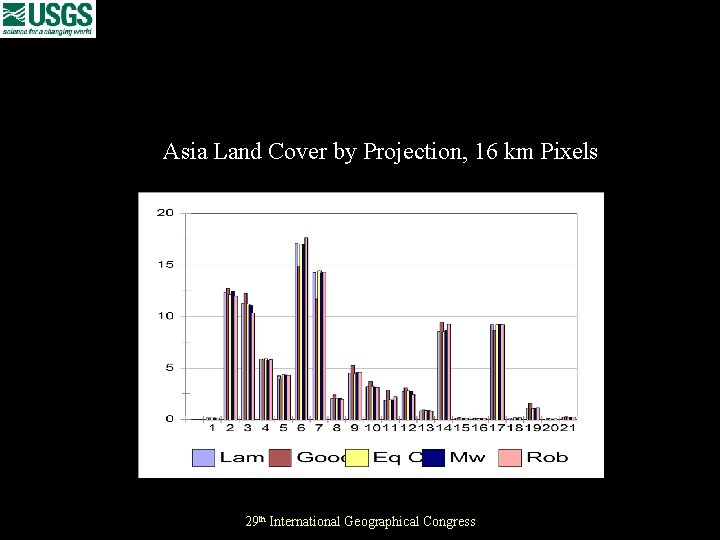
Asia Land Cover by Projection, 16 km Pixels 29 th International Geographical Congress
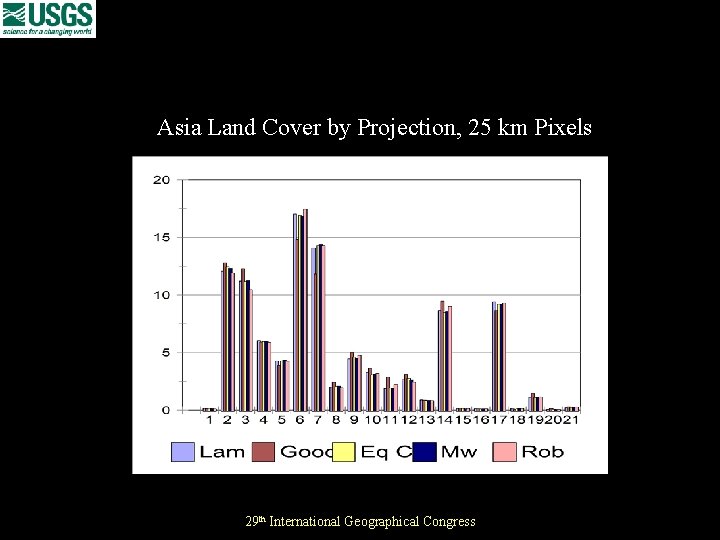
Asia Land Cover by Projection, 25 km Pixels 29 th International Geographical Congress
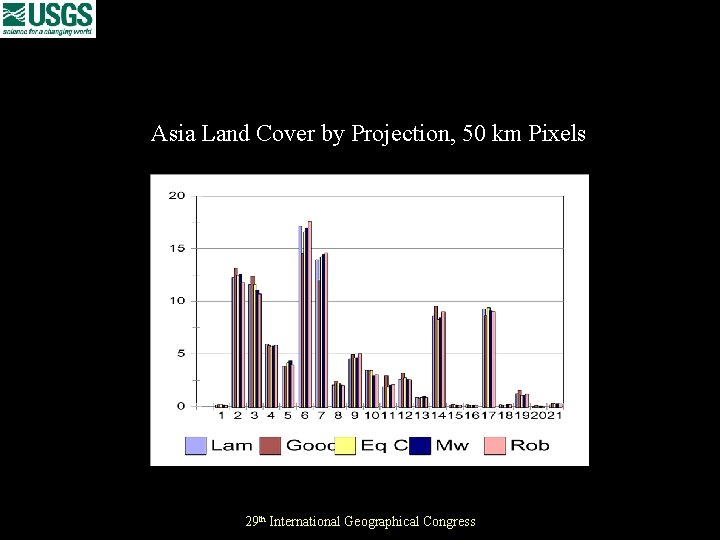
Asia Land Cover by Projection, 50 km Pixels 29 th International Geographical Congress
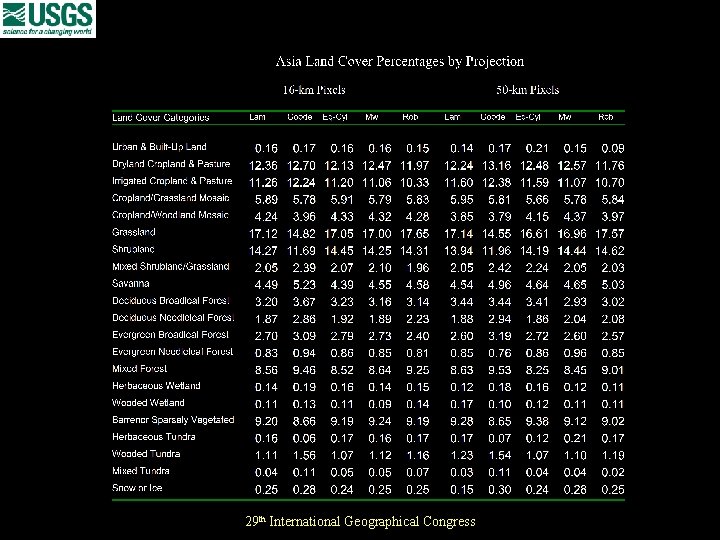
Asia Land Cover by Projection • Verifies theoretical analysis • Robinson overestimates except at 50 km • 16 km – Lam, Mw, Eq-Cyl retain almost identical % • Mw same at 50 km • Goode doesn’t maintain between 16 and 50 km 29 th International Geographical Congress
Asia Land Cover by Projection • Latitudinal results verified by examining specific land covers which occur at unique latitudes • Deciduous needleleaf forests occur in high latitudes – Order of areas lowest to highest – Mw, Eq-Cyl, Robinson – Goode anomaly because different source 29 th International Geographical Congress
Summary • Empirical results at 1, 4, 8, 16, 25, and 50 km verify theoretical results shown in the graphics. • Visually which is most pleasing? 29 th International Geographical Congress
Conclusions • Regional and global raster data yield varying areas when projected in different equal area projections. • Variance is by projection, resolution, latitude • 1 km or less, any equal area is okay • 1 to 8 km, Mw shows best accuracy • 16 to 25 km, Eq-Cyl and Goode better • 50 km, Mw best • Overall, Mw a good alternative 29 th International Geographical Congress
Current Work • Global datasets – Land Cover (1 km) – Elevation (30 arc-sec and 5 min) – Vegetation (1 degree) – Precipitation (30 min) – Temperature (30 min) • Projections – – – Equal Area Cylindrical Eckert IV Hammer Mollweide Quartic Authalic Sinusoidal – Robinson – Van der Grinten 29 th International Geographical Congress
Future Work • Correct problems with raster projection – DSS for use with current software based on empirical base developed – Develop dynamic projection for raster data – Implement error correction procedures – Prefect resampling from one projection to another 29 th International Geographical Congress