
A COMPARISON IN THREE ACTS Or A Literary
![STAGE DIRECTIONS Her [Blanche’s] expression is one of shocked disbelief. Her appearance is incongruous](https://slidetodoc.com/presentation_image/3b8e8075af31cef167bd208b62cc4e53/image-6.jpg "STAGE DIRECTIONS Her [Blanche’s] expression is one of shocked disbelief. Her appearance is incongruous")

- Slides: 50
A COMPARISON IN THREE ACTS Or, A Literary Magic Trick
“I WANT MAGIC!” v Every magic trick has three parts 1) The Pledge – Setting your foundation 2) The Turn – A new direction 3) The Prestige – Tying it together v The key to a strong essay is structure
THE PROMPT With detailed reference to the opening scenes of Othello and A Streetcar Named Desire, compare and contrast the ways in which the playwrights present Othello and Blanche as outsiders in their societies.
Act I THE PLEDGE
GROUNDWORK v Leave your thesis for later v First, let’s figure out what evidence we have, and let our arguments develop from there (always start from the text) v What methods shape the way we think of Blanche and Othello as outsiders?
STAGE DIRECTIONS Her [Blanche’s] expression is one of shocked disbelief. Her appearance is incongruous to this setting. She is daintily dressed in a white suit with a fluffy bodice, necklace and earrings of pearl, white gloves and hat, looking as if she were arriving at a summer tea or cocktail party in the garden district.
METHODS? 1) Visual contrast: “her appearance is incongruous to this setting” 2) Color: white suit, hat, and gloves 3) Simile: “looking as if she were arriving to a summer tea”
BLANCHE AND STELLA Oh, I'm not going to be hypocritical, I'm going to be honestly critical about it! Never, never in my worst dreams could I picture--Only Poe! Only Mr. Edgar Allan Poe!--could do it justice! Out there I suppose is the ghoul-haunted woodland of Weir!
METHODS? 1) Literary Allusion: Blanche alludes to Poe to describe her surroundings, which has two effects a) Contrasts her language with that of others b) Shows her fear and sense of displacement in New Orleans
NOW TO OTHELLO v Othello is not present in the first scene v His real name is not mentioned ONCE v Other characters talk about him, creating an image of him in our minds – the same image that Brabantio has
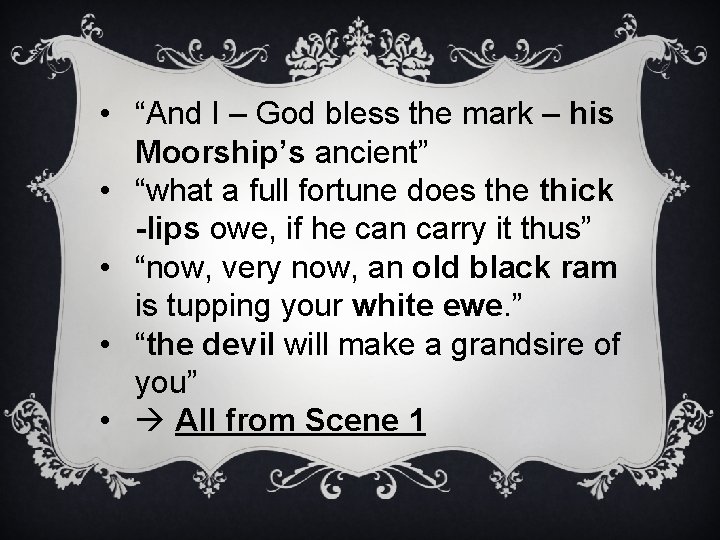
• “And I – God bless the mark – his Moorship’s ancient” • “what a full fortune does the thick -lips owe, if he can carry it thus” • “now, very now, an old black ram is tupping your white ewe. ” • “the devil will make a grandsire of you” • All from Scene 1
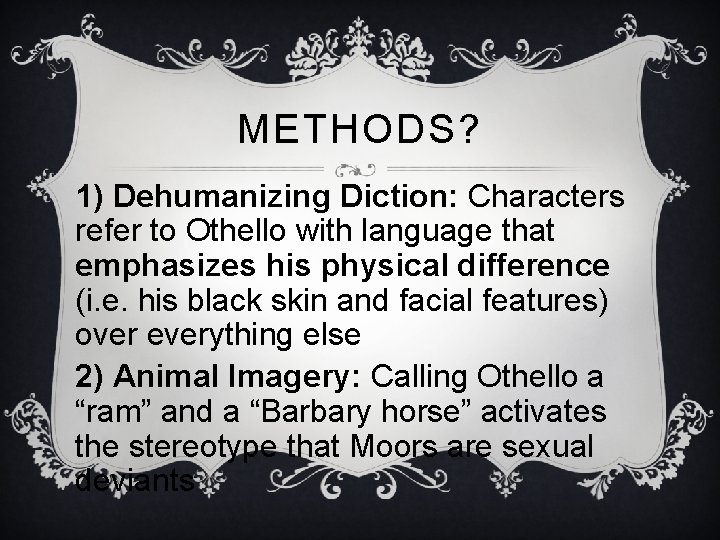
METHODS? 1) Dehumanizing Diction: Characters refer to Othello with language that emphasizes his physical difference (i. e. his black skin and facial features) over everything else 2) Animal Imagery: Calling Othello a “ram” and a “Barbary horse” activates the stereotype that Moors are sexual deviants
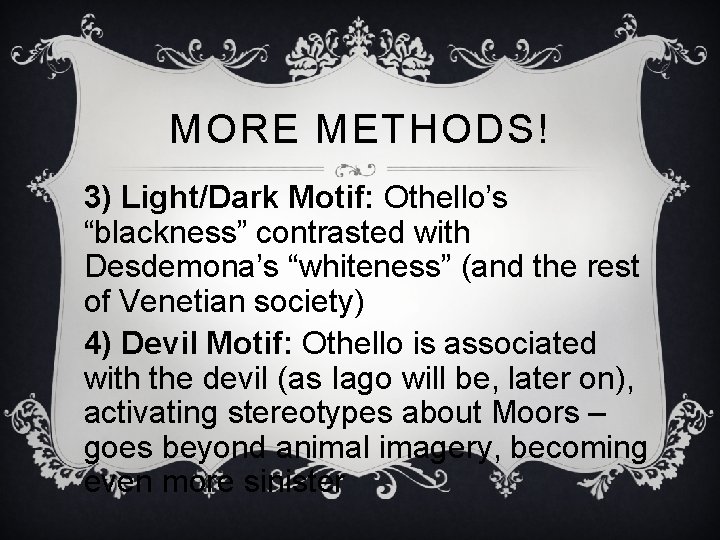
MORE METHODS! 3) Light/Dark Motif: Othello’s “blackness” contrasted with Desdemona’s “whiteness” (and the rest of Venetian society) 4) Devil Motif: Othello is associated with the devil (as Iago will be, later on), activating stereotypes about Moors – goes beyond animal imagery, becoming even more sinister
FIRST COMPARISON v I now have 4 methods for each character, all of which show Othello and Blanche are seen as outsiders (i. e. more than enough) v But how do I choose which to include in the first (1 -2 paragraphs) section of my essay? (NOT intro – body paragraphs)
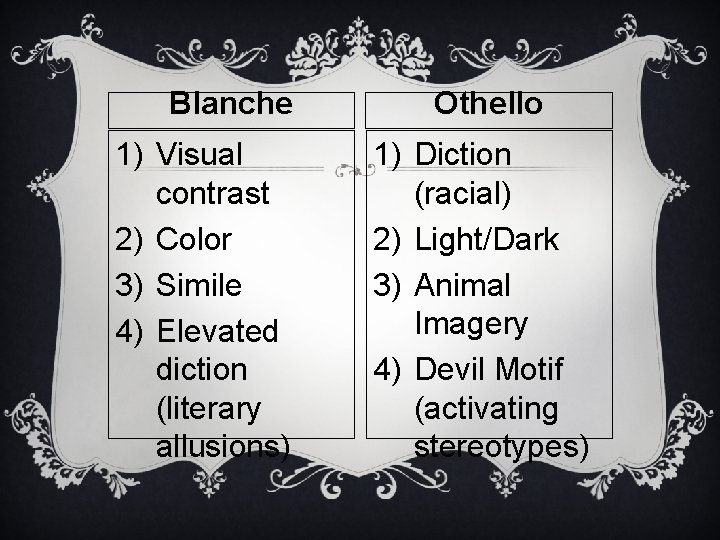
Blanche 1) Visual contrast 2) Color 3) Simile 4) Elevated diction (literary allusions) Othello 1) Diction (racial) 2) Light/Dark 3) Animal Imagery 4) Devil Motif (activating stereotypes)
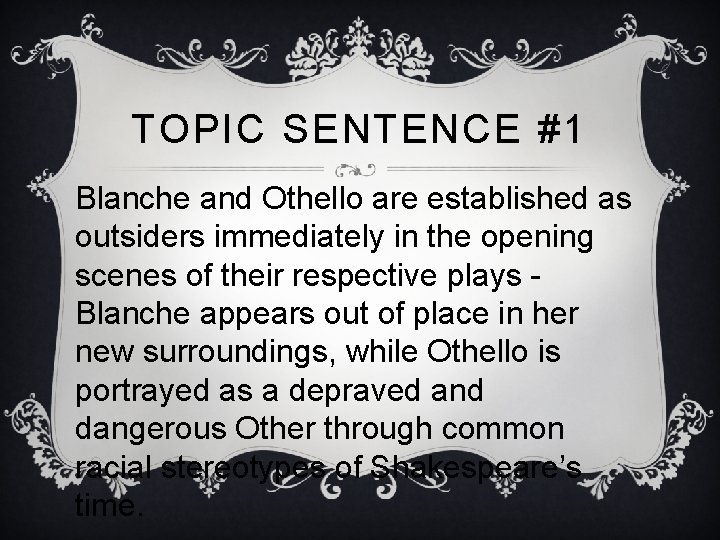
TOPIC SENTENCE #1 Blanche and Othello are established as outsiders immediately in the opening scenes of their respective plays Blanche appears out of place in her new surroundings, while Othello is portrayed as a depraved and dangerous Other through common racial stereotypes of Shakespeare’s time.
DEVELOPMENT v This may be one long paragraph, or I may decide to split it when I start talking about Blanche v If the latter, the 2 nd paragraph must have more comparative language to link it to the analysis of Othello’s opening scene
Act II THE TURN
WHAT NEXT? v This is where many essays floundered v You’ve got 1 or 2 paragraphs on the opening scenes, but your essay lacks a direction (a new argument – a ‘turn’) v They’re both outsiders – SO WHAT?
ASK A NEW QUESTION v What is the fate of an outsider? Are all outsiders doomed to be looked down on or oppressed by society? v Let’s answer this question using new evidence from both plays
OTHELLO AS OUTSIDER v “My services which I have done the signory, / Shall outtongue his complaints” (Scene 2) v “If virtue no delighted beauty lack, your son-in-law is far more fair than black” (Scene 3)
THE DUKE’S APPROVAL v Othello is confident that his “services” will outweigh the complaints of a Senator, and after the Trial Scene, he’s right! v He has the Duke’s stamp of approval, but why? Could it be because he’s needed to fight the Turks? Society needs him! (this will be important for comparison)
STILL AN “OTHER” v “Far more fair than black” – see how the Duke still holds stereotypes? v Othello’s blackness is still associated with preconceptions about Moors v But his “virtue” (or, I argue, his usefulness to the State) drives the Duke to make allowances for Othello
METHODS? 1) Form of Address: “Valiant Othello” contrasts with “the Moor” 2) Light/Dark Motif: “Far more fair than black” – the effect is to elevate Othello in society’s eyes, without abandoning the stereotypes connecting to “blackness”
…AND BLANCHE? v Even though Blanche is far from her original home, she is still going to stay with her sister v Isn’t home supposed to be “where the heart is? ” Why can’t Blanche find acceptance with family?
NOT A SANCTUARY STELLA: It’s best not to talk about it until she’s calmed down. STANLEY: So that’s the deal, huh? Sister Blanche cannot be annoyed with business details right now!
KINDNESS OF FAMILY? v Blanche has arrived after an “ordeal, ” but Stanley, the head of the household, is only concerned that he (through Stella) has been cheated v Blanche is only valued in terms of how Stanley can profit from her – when he finds she is penniless, she becomes worthless
METHODS? 1) Legal Language: ‘business details, ’ ‘acquaintances, ’ and above all Stanley’s love of the Napoleonic code 2) Types of Value: ‘get these appraised, ’ examining the furs, peering at the love letters from Blanche’s dead husband
OUTCOME v Family ties are replaced by business v “Value” is measured in dollars, and Blanche’s importance to Stanley is measured by her value v Unlike Othello, Blanche is of no “practical use” to her society
CRUCIAL DIFFERENCE Othello is a Moor, feared and reviled, yet he gains some measure of acceptance from Venetian society. Blanche, in contrast, is treated more and more as an outcast by the very people she hoped would shelter her.
STAY CONNECTED v The central comparison here is between Othello and Blanche’s relationships with their respective societies v Those relationships change over time, and we can describe the key difference in the way they change (Othello is more accepted, while Blanche is cast out)
TOPIC SENTENCE #2 The label of “outsider” is not absolute in Othello, as we see Othello overcome the social stigmas attached to Moors and gain a certain measure of acceptance.
FOCUS OF A PARAGRAPH v This paragraph shows change over time, not yet comparison v That means the next paragraph MUST link directly to this paragraph v Use phrases like “in contrast, ” “unlike Othello, ” etc. – ways to LINK the two paragraphs of this middle section
TOPIC SENTENCE #3 Unlike Othello, Blanche is unable to change her status as an outsider, offering a tragic example of how many outsiders are helpless to overcome the alienation forced on them by society.
LINKED PARAGRAPHS v These two paragraphs show that the plight of the outsider is not static – the lines can be blurred, the situation can change v They are centered around a crucial difference between “Othello-asoutcast” and “Blanche-as-outcast”
Act III THE PRESTIGE
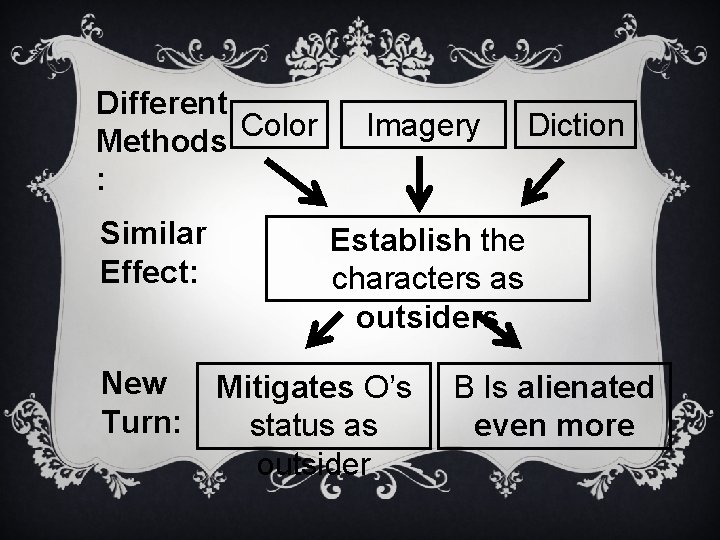
OUR STRATEGY SO FAR 1) Compare different methods that have a similar effect (1 -2 Body Paragraphs) 2) Show the evolution of the status of the two outsiders over time, anchoring with a central/key difference (2 Body Paragraphs)
Different Color Methods : Similar Effect: New Turn: Imagery Diction Establish the characters as outsiders Mitigates O’s status as outsider B Is alienated even more
WHAT NEXT? v Extract an idea about what it means to be labeled an outsider that arises from examining both plays v Othello gains acceptance in spite of his differences, but Blanche fails to do so – what does that suggest about the relationship between society and individuals who don’t conform to the same norms?
CONCLUSION Whether in Elizabethan England or postwar America, society values individuals only in terms of their utility; that is, what they can contribute. Othello is a man of war, whose skills are necessary to maintain Venice’s superiority. But for Blanche, a poor woman with skills that are no longer marketable in an industrialized society, she has nothing to bargain with for safety or acceptance.
The End (OF THAT ESSAY, ANYWAY…)
IN REVIEW v I showed how different methods all had the same effect – specifically, casting Othello and Blanche as outsiders v Next I raised a crucial difference for Blanche and Othello as “outsiders” – both try to overcome their alienation, but only the general is partially successful
IN REVIEW v Finally, in the conclusion, I extract an argument about the relationship between society and the individual – that it is fundamentally a transactional relationship – by comparing Othello’s partial success with Blanche’s failure
ESSAY SKELETON 1) Different Methods Same Effect 2) Reveal a Crucial Difference (still analyzing methods, remember), comparing the development of the characters over time 3) Compare the end results of the two cases, extracting a concluding argument
BEING PREPARED v Worried that you can’t think up strong concluding arguments in only one hour? v YOU DON’T HAVE TO!!! v These arguments should be prepared already, before you ever step into the exam hall – all you have to do is arrange the arguments in the right sequence
FOR PRACTICE v Alienation v The individual’s struggle for power v Gender roles v Illusion and Reality v Truth and Falsehood v Society exerting control over individuals
And Now… TRY IT ON YOUR OWN!
“I swear it is better to be much abused, than to know but a little. ” With detailed reference to Othello and A Streetcar Named Desire, comment on the importance of truth for Blanche and Othello.
WHERE TO START? v Methods, methods! v Where does Blanche talk most plainly about her relationship to truth? v When does Othello appear obsessed with knowing the “truth, ” and when does he say that he would prefer not to know?
LAST WARNING v Don’t feel you have to ignore evidence to force similarity where it doesn’t quite exist v Instead, articulate a clearer distinction – say why a certain difference exists, and what you can learn from it about the central concern (in this case, the nature of truth)