
A Common Computational Framework for Semiringbased Argumentation Systems
A Common Computational Framework for Semiring-based Argumentation Systems S. Bistarelli 1, 2, F. Santini 1, 2 1 Dipartimento 2 Istituto di Matematica e Informatica, Perugia di Informatica e Telematica CNR, Pisa
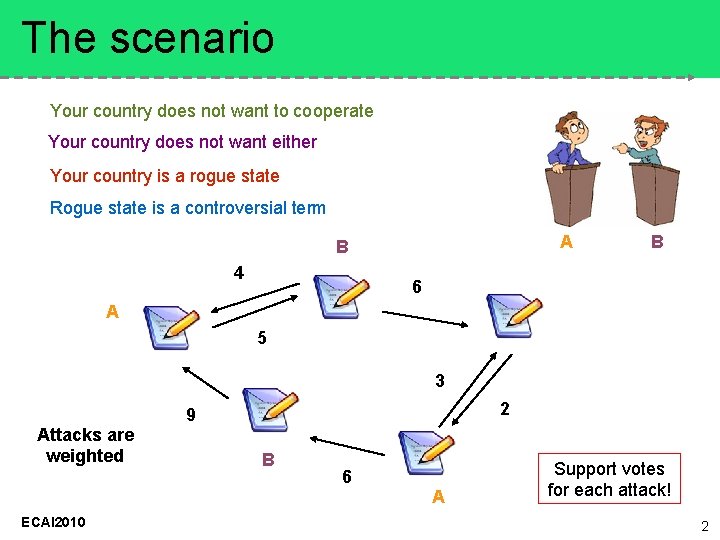
The scenario Your country does not want to cooperate Your country does not want either Your country is a rogue state Rogue state is a controversial term A B 4 B 6 A 5 3 Attacks are weighted ECAI 2010 2 9 B 6 A Support votes for each attack! 2
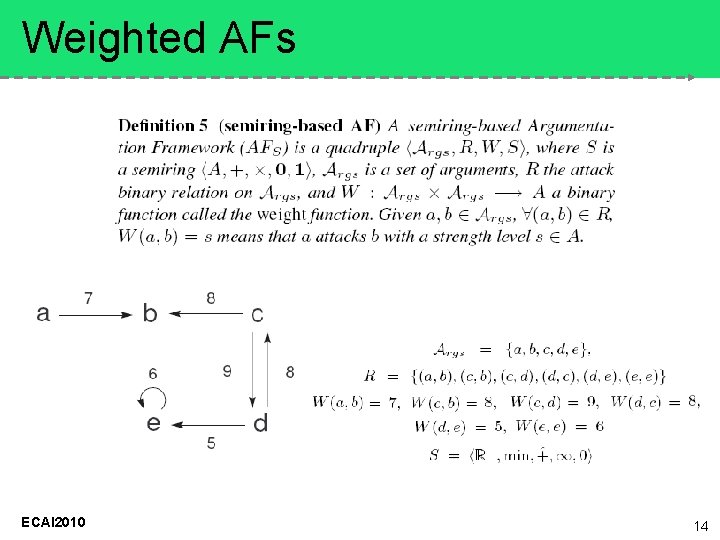
Abstract A way to parametrically represent “weighted” Argumentation Frameworks (AFs) In literature, attacks are associated with preferences (or not) Weighted [Dunne et al 09] Fuzzy [Schroeder, Schweimeier 02] Probabilistic [Haenni 09] Classical (not weighted relationships) [Dung 95] Costs can be parametrically represented with semirings The Argumentation problem is mapped to a Soft Constraint Satisfaction Problem A common computational and quantitative framework ECAI 2010 3
Weighted AF: A forecast example Two individuals P and Q exchanging arguments A and B about the weather forecast: P: Today will be dry in London since BBC forecasts sunshine Q: Today will be wet in London since CNN forecasts rain ECAI 2010
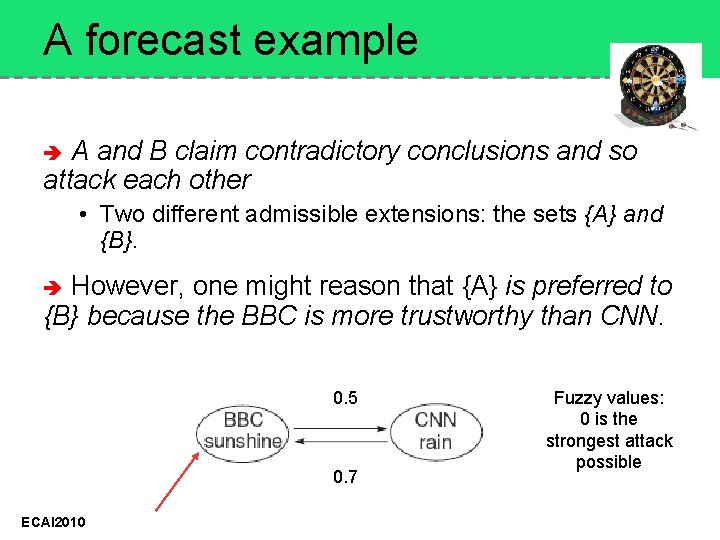
A forecast example A and B claim contradictory conclusions and so attack each other • Two different admissible extensions: the sets {A} and {B}. However, one might reason that {A} is preferred to {B} because the BBC is more trustworthy than CNN. 0. 5 0. 7 ECAI 2010 Fuzzy values: 0 is the strongest attack possible
Background Argumentation and Soft Constraint Satisfaction problems ECAI 2010
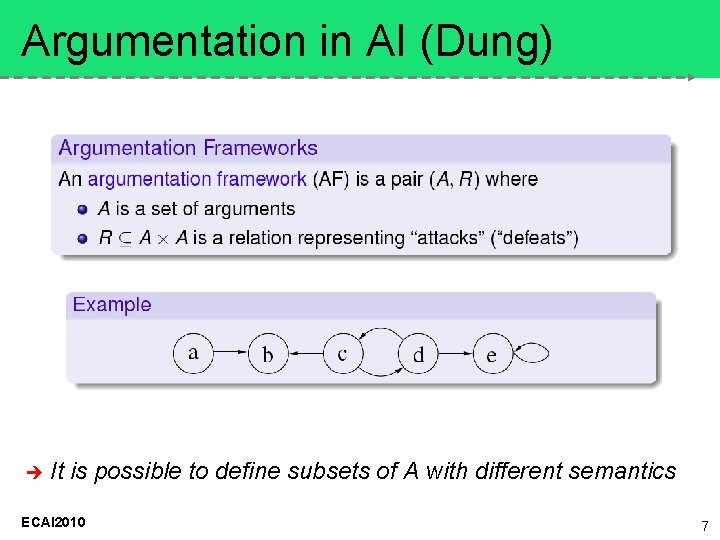
Argumentation in AI (Dung) It is possible to define subsets of A with different semantics ECAI 2010 7
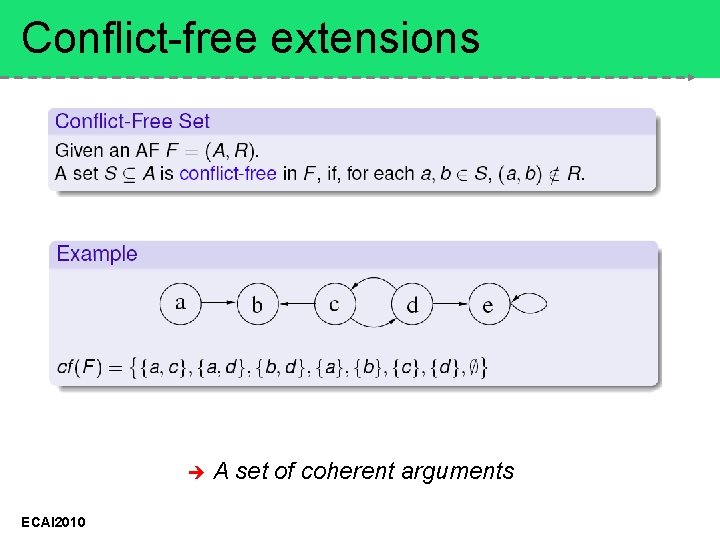
Conflict-free extensions ECAI 2010 A set of coherent arguments
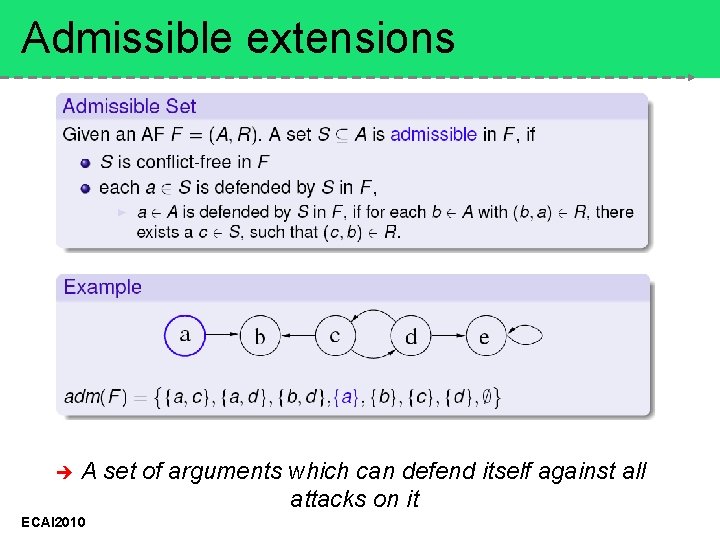
Admissible extensions A set of arguments which can defend itself against all attacks on it ECAI 2010
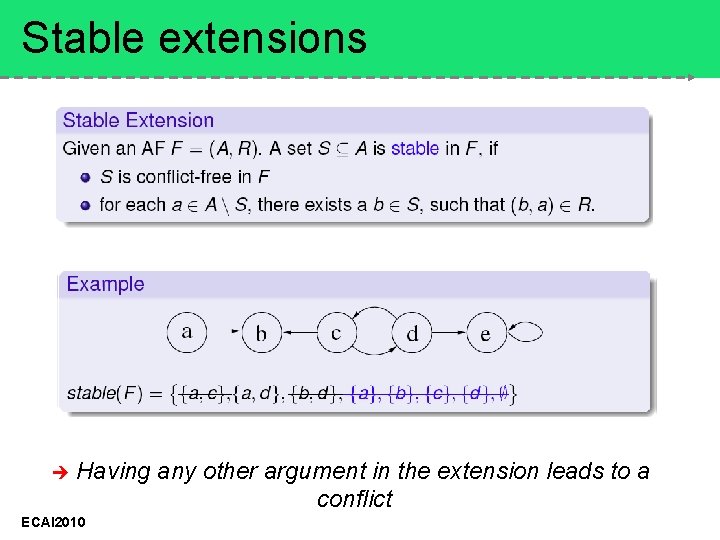
Stable extensions Having any other argument in the extension leads to a conflict ECAI 2010
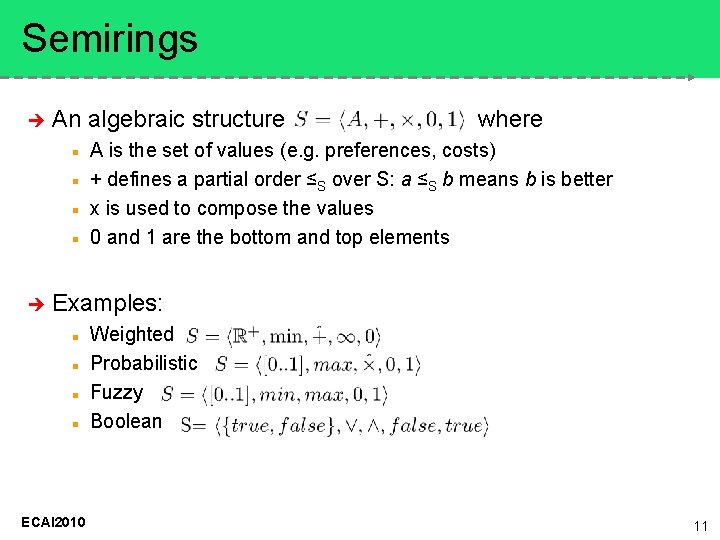
Semirings An algebraic structure where A is the set of values (e. g. preferences, costs) + defines a partial order ≤S over S: a ≤S b means b is better x is used to compose the values 0 and 1 are the bottom and top elements Examples: Weighted Probabilistic Fuzzy Boolean ECAI 2010 11
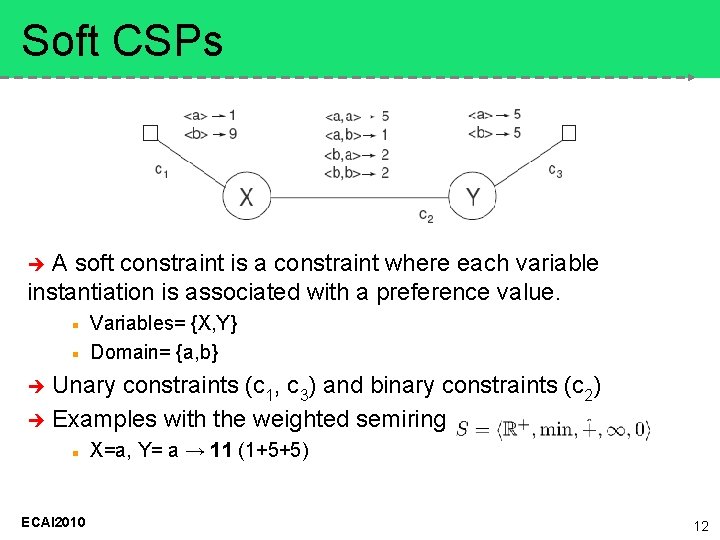
Soft CSPs A soft constraint is a constraint where each variable instantiation is associated with a preference value. Variables= {X, Y} Domain= {a, b} Unary constraints (c 1, c 3) and binary constraints (c 2) Examples with the weighted semiring X=a, Y= a → 11 (1+5+5) ECAI 2010 12
What's new (Part 1) Defining our weighted extension ECAI 2010
Weighted AFs ECAI 2010 14
Weighted attacks for sets 3 12 7 19 22 ECAI 2010 15
α-conflict free α-stable 3 4 6 Tolerating a certain amount of conflict in a set ECAI 2010 2 1 means no attack, 0 means “not consistent” 8 -conflict free 16
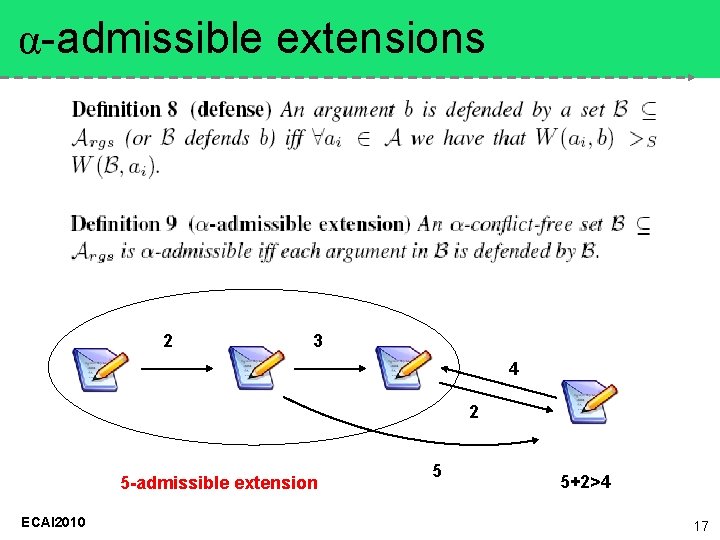
α-admissible extensions 2 3 4 2 5 -admissible extension ECAI 2010 5 5+2>4 17
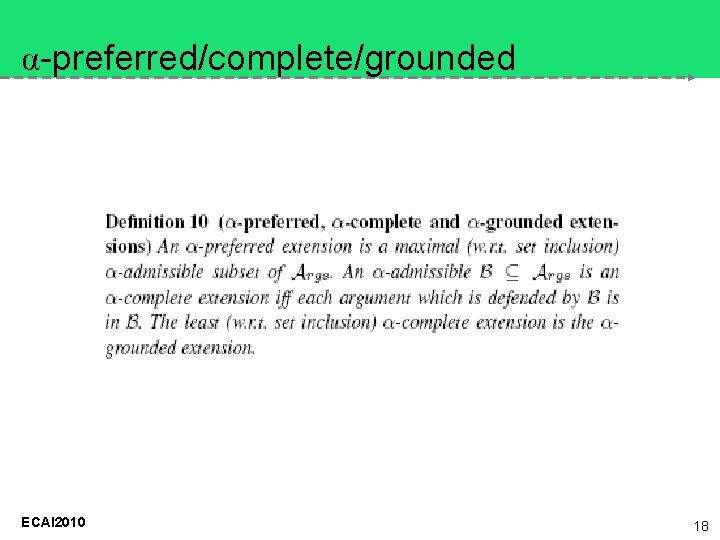
α-preferred/complete/grounded ECAI 2010 18
What's new (Part 2) A mapping from weighted argumentation frameworks To Soft Constraint Satisfaction Problems ECAI 2010
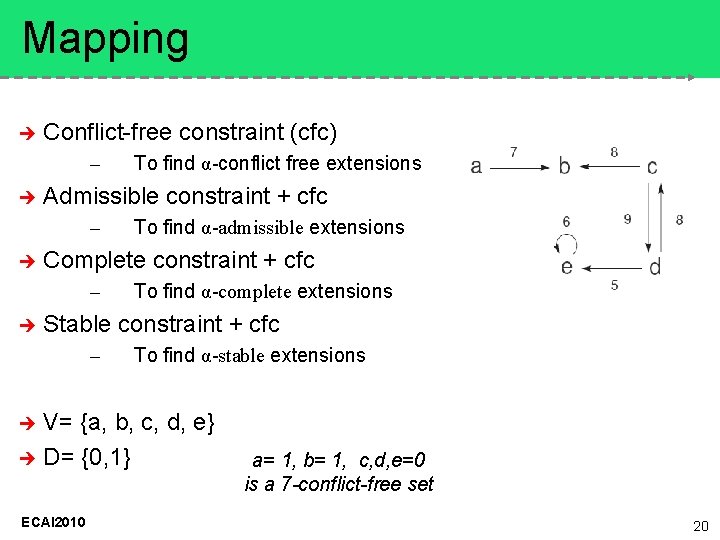
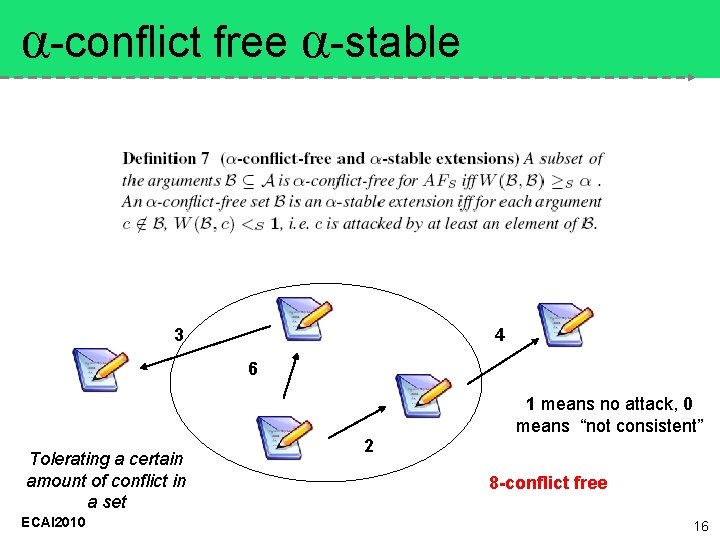
Mapping Conflict-free constraint (cfc) – Admissible constraint + cfc – To find α-admissible extensions Complete constraint + cfc – To find α-conflict free extensions To find α-complete extensions Stable constraint + cfc – To find α-stable extensions V= {a, b, c, d, e} D= {0, 1} ECAI 2010 a= 1, b= 1, c, d, e=0 is a 7 -conflict-free set 20
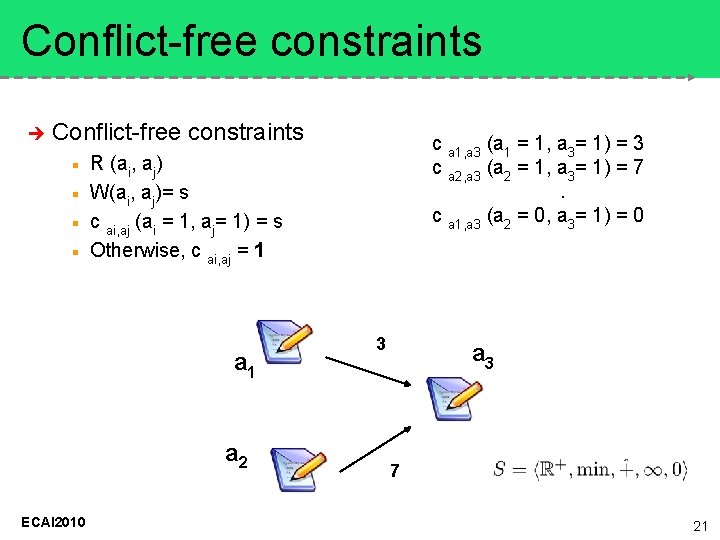
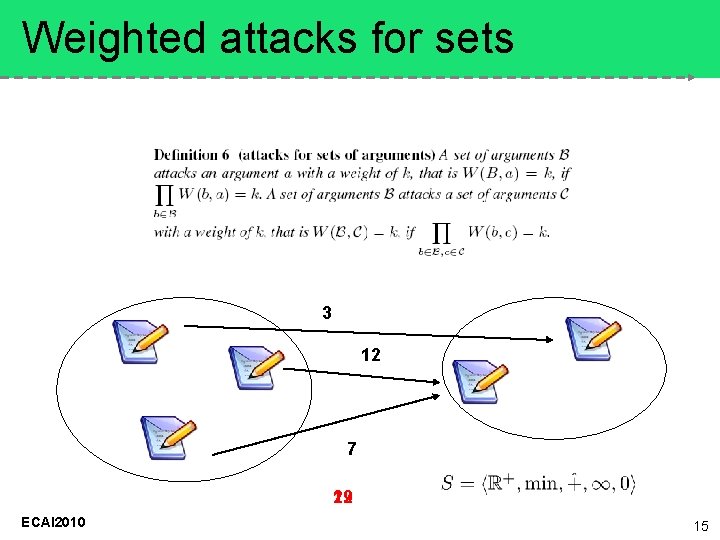
Conflict-free constraints c a 1, a 3 (a 1 = 1, a 3= 1) = 3 c a 2, a 3 (a 2 = 1, a 3= 1) = 7. c a 1, a 3 (a 2 = 0, a 3= 1) = 0 R (ai, aj) W(ai, aj)= s c ai, aj (ai = 1, aj= 1) = s Otherwise, c ai, aj = 1 a 2 ECAI 2010 3 a 3 7 21
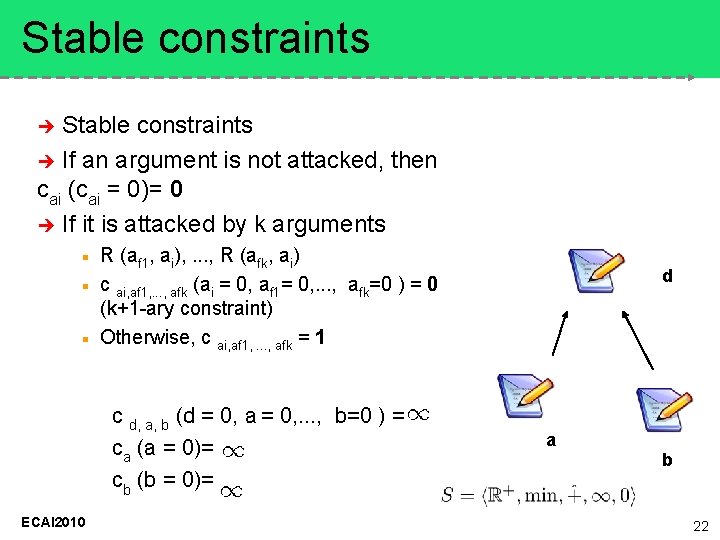
Stable constraints If an argument is not attacked, then cai (cai = 0)= 0 If it is attacked by k arguments R (af 1, ai), . . . , R (afk, ai) c ai, af 1, . . . , afk (ai = 0, af 1= 0, . . . , afk=0 ) = 0 (k+1 -ary constraint) Otherwise, c ai, af 1, . . . , afk = 1 c d, a, b (d = 0, a = 0, . . . , b=0 ) = ca (a = 0)= cb (b = 0)= ECAI 2010 d a b 22
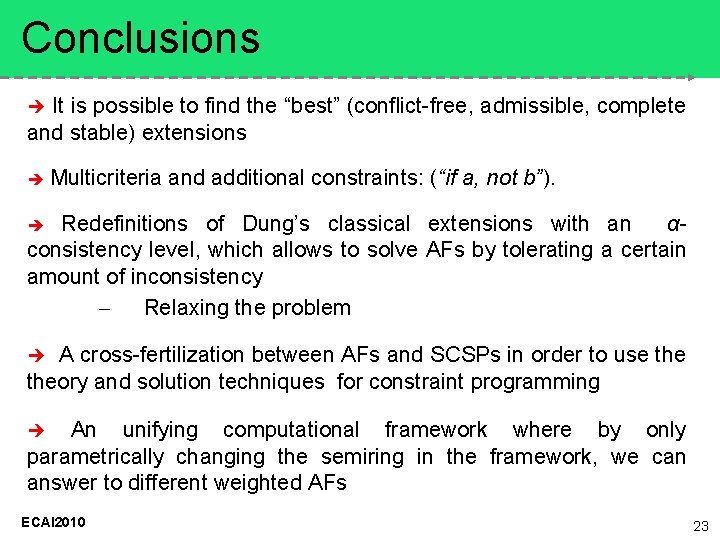
Conclusions It is possible to find the “best” (conflict-free, admissible, complete and stable) extensions Multicriteria and additional constraints: (“if a, not b”). Redefinitions of Dung’s classical extensions with an αconsistency level, which allows to solve AFs by tolerating a certain amount of inconsistency – Relaxing the problem A cross-fertilization between AFs and SCSPs in order to use theory and solution techniques for constraint programming An unifying computational framework where by only parametrically changing the semiring in the framework, we can answer to different weighted AFs ECAI 2010 23
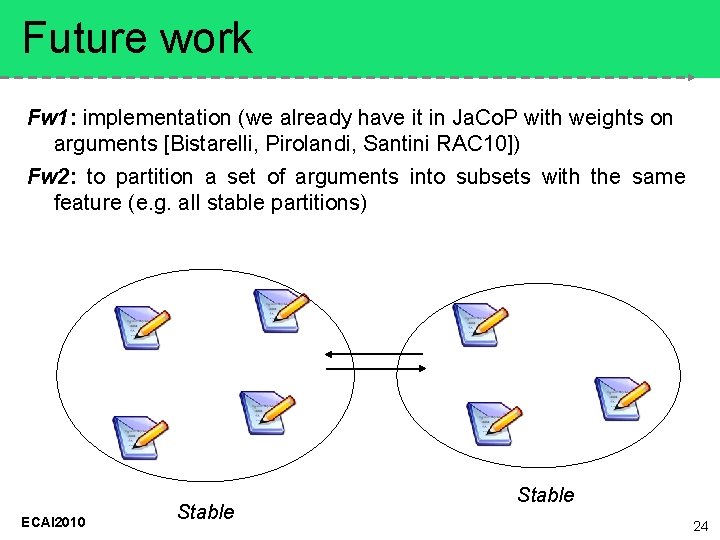
Future work Fw 1: implementation (we already have it in Ja. Co. P with weights on arguments [Bistarelli, Pirolandi, Santini RAC 10]) Fw 2: to partition a set of arguments into subsets with the same feature (e. g. all stable partitions) ECAI 2010 Stable 24
Thank you for your time! Contacts: francesco. santini@dmi. unipg. it ECAI 2010 25
- Slides: 25