
A comment from the perspective of structured problem
A comment from the perspective of structured problem solving Keiko Hino Utsunomiya University, Japan khino@cc. utsunomiya-u. ac. jp
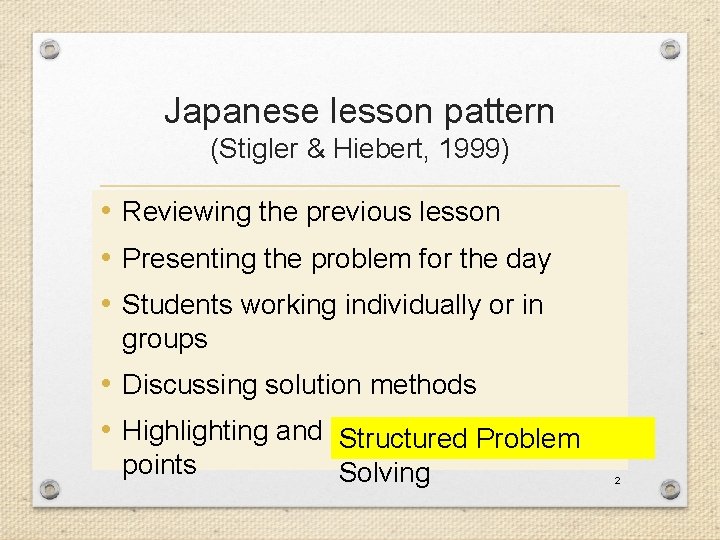
Japanese lesson pattern (Stigler & Hiebert, 1999) • Reviewing the previous lesson • Presenting the problem for the day • Students working individually or in groups • Discussing solution methods • Highlighting and summarizing the major Structured Problem points Solving 2
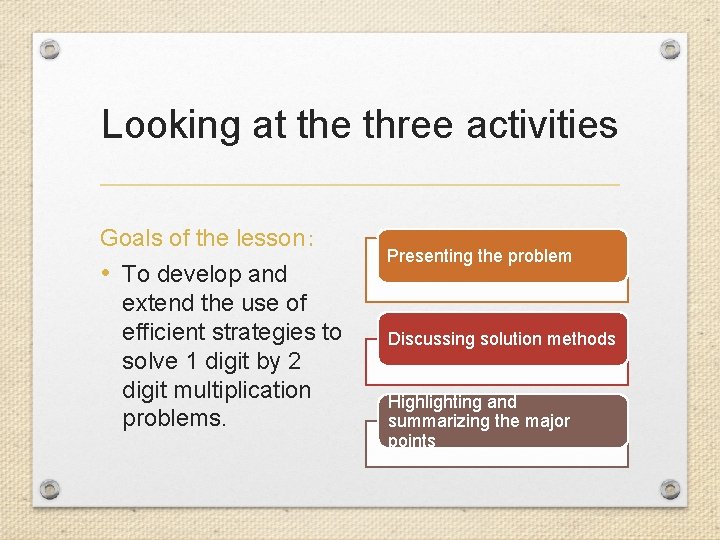
Looking at the three activities Goals of the lesson: • To develop and extend the use of efficient strategies to solve 1 digit by 2 digit multiplication problems. Presenting the problem Discussing solution methods Highlighting and summarizing the major points
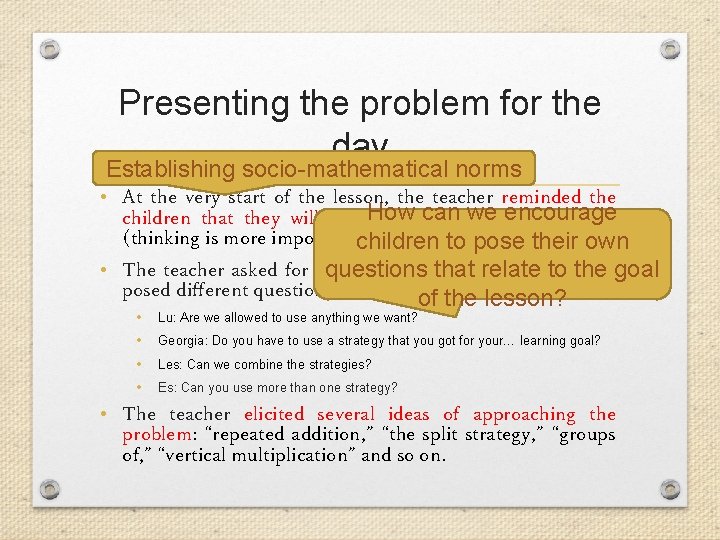
Presenting the problem for the day Establishing socio-mathematical norms • At the very start of the lesson, the teacher reminded the How can about we encourage children that they will not be talking the answer (thinking is more important children than just getting their answer). to pose own • The teacher asked for thinking question, the children questions that and relate to the goal posed different questions. • • of the lesson? Lu: Are we allowed to use anything we want? Georgia: Do you have to use a strategy that you got for your… learning goal? Les: Can we combine the strategies? Es: Can you use more than one strategy? • The teacher elicited several ideas of approaching the problem: “repeated addition, ” “the split strategy, ” “groups of, ” “vertical multiplication” and so on.

Discussing solution methods • The teacher elicited multiple solution methods, and the class shared/discussed features of each method. • Purposeful naming; Comparing and contrasting different methods; Encourage to take notes (green pencil); Putting name to the solution method; and so on. • Ari’s “complicated strategy” was an unexpected one. Nevertheless, the teacher and the class were trying to understand his reasoning. • Goal of the lesson is to develop and extend the use of efficient strategies. “Did discussion move forward to the goal? ” This question is often addressed as the object of post-lesson discussion.
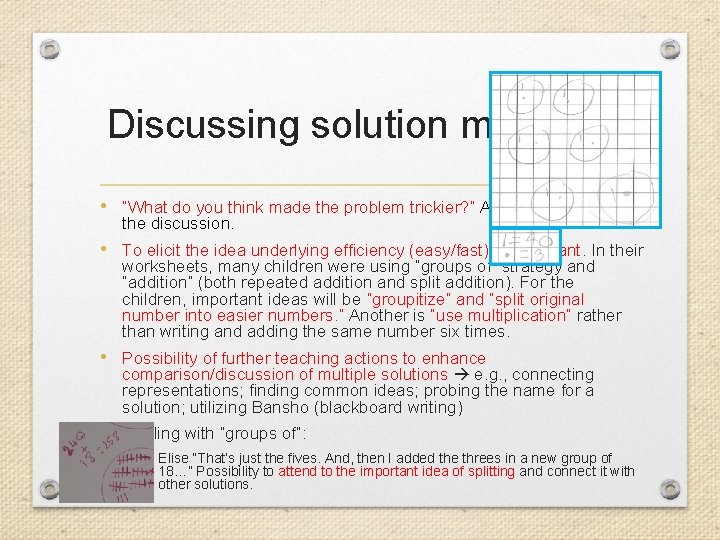
Discussing solution methods • “What do you think made the problem trickier? ” A good way to begin the discussion. • To elicit the idea underlying efficiency (easy/fast) is important. In their worksheets, many children were using “groups of” strategy and “addition” (both repeated addition and split addition). For the children, important ideas will be “groupitize” and “split original number into easier numbers. ” Another is “use multiplication” rather than writing and adding the same number six times. • Possibility of further teaching actions to enhance comparison/discussion of multiple solutions e. g. , connecting representations; finding common ideas; probing the name for a solution; utilizing Bansho (blackboard writing) • Dealing with “groups of”: • Elise “That’s just the fives. And, then I added the threes in a new group of 18…” Possibility to attend to the important idea of splitting and connect it with other solutions.
Highlighting and summarizing the major points • The children wrote “handy hint” for someone to solve this problem. Four opportunity. children presented their hints. Nice What do you want to do in the next lesson? • They also could solve similar problem by themselves to reflect What questions do you have now? on the solutions. Not just listening to solutions by others but also doing by themselves fosters learning. It is also important to make connection to the next lesson. • Opportunity for critical reflection of the lesson by the children’s writing of “handy hints”: • The number of children who wrote about the idea of splitting was small. • Several children wrote that “groups of” strategy is not efficient so should not be used.
Summary • As I showed in the slides, I observed important teaching actions to elicit children’s thinking, making connections as well as reflections. The teacher is calm and carefully listens and gives feedback to the variety of children’s voices. I was also impressed by the children from different grade levels who work together and learn from each other. • Since this is “composite class, ” setting up a common lesson-goal as well as organizing the whole-class discussion toward the goal is not easy. One attempt would be to connect and emphasize the ideas underlying efficiency to enhance each child’s internalization. • I wonder what the differences are between the inquiry approach emphasized in Australia and the structured problem solving approach to teach mathematics in Japan.
Thank you
- Slides: 9