
A Collaborative University of Technology and Further Education
A Collaborative University of Technology and Further Education and Training Curriculum Development Project Bennett Alexander OECD Visit Friday 31 January 2014
Curriculum Imperatives • Pillars of a University of Technology in South Africa • [Roy du Pre (2010) Kagisano No. 7] • University of Technology vs Technikon • New South African HEQF • The South African ICT Economy • Quality Assurance
Pillars of Uo. Ts in SA • Excellence in teaching and learning • Applied research • Developing leadership in technology • Technology transfer and innovation • Partnerships with industry (education for the world of work) and internationalization (for benchmarking good and best practice)
Uo. T vs Technikon • Technikon was mainly about technical skills transfer • Uo. T is about developing Attitude, Knowledge, Skills, and Skilfulness • WIL, SIE and IE programmes • Personal and Professional Development initiatives • Open learning opportunities
New South African HEQF • Focus – Professional Qualifications – Foundational knowledge, Practical or Applied skills, Reflexivity, and Professionalism • NQF Standards – NQF Level 5+ • Articulation – The Inverted Pyramid • Benchmarking – – – Academic Industry ACM Curriculum
South African ICT Economy • Responsiveness to industry needs • Inverted pyramid and FET access • Promotion of R&D • Vocational Imperatives – Organising Framework for Occupations (OFO)
Quality Assurance • Promoting Access � Promoting Throughput � Improving Pass Rates � Placement Opportunities � Entrepreneurship � Technological Opportunities Innovation
My Paper Concept Model • – – – � Process Model – – – • Learning Outcomes Assessment Approaches ***Action Research Organisational Model – – – • Uo. T – FET Collaboration Model New HEQF implemented… Notion of “graduateness” interrogated wrt SA ICT economy Departmental Organogram Strategic Collaborations Socio-political-economic modelling wrt FETs Teaching Methodology – New generation of cyber-enabled students – Fundamentals vs Application – ***Etc
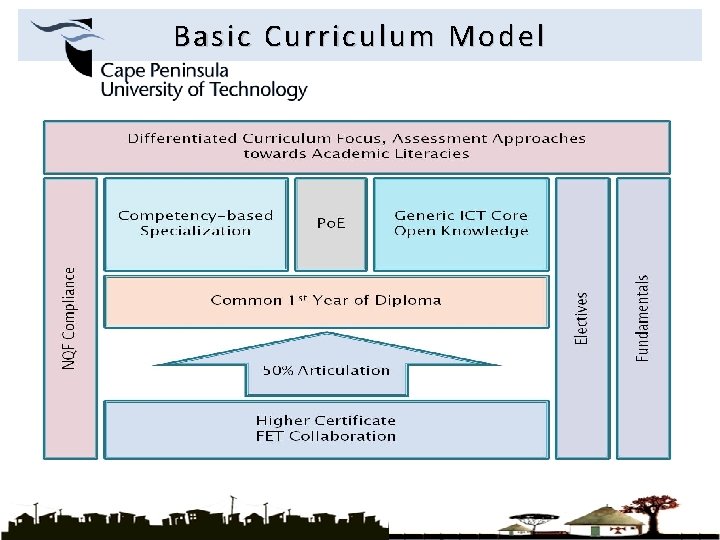
Basic Curriculum Model
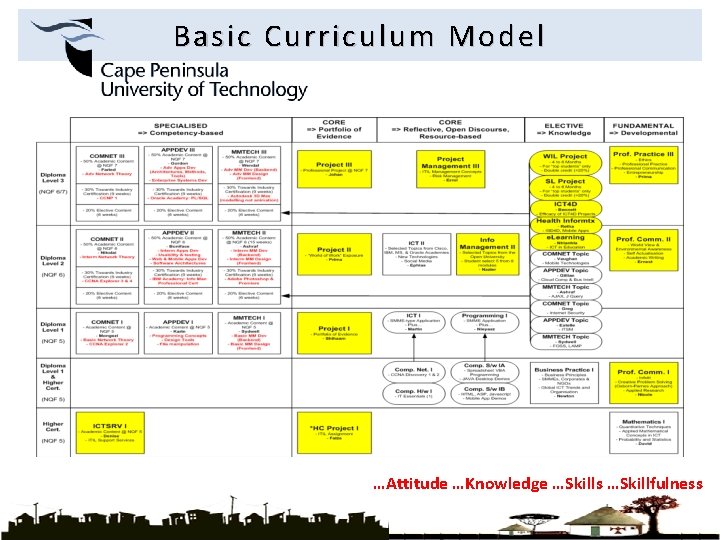
Basic Curriculum Model …Attitude …Knowledge …Skills …Skillfulness
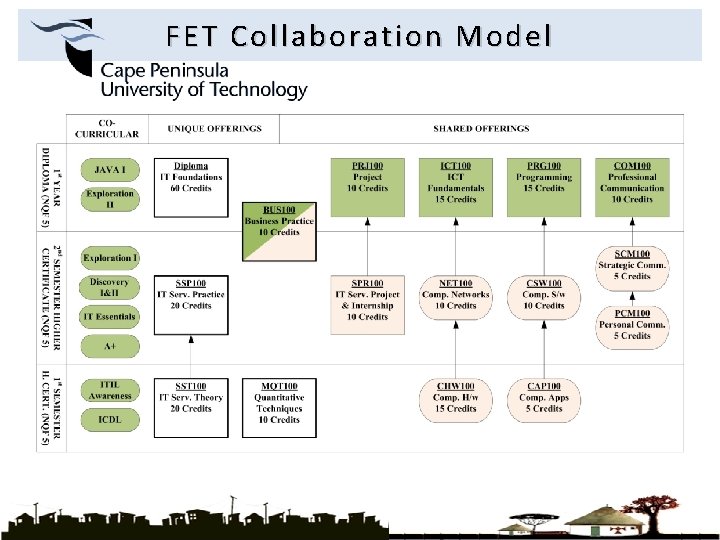
FET Collaboration Model
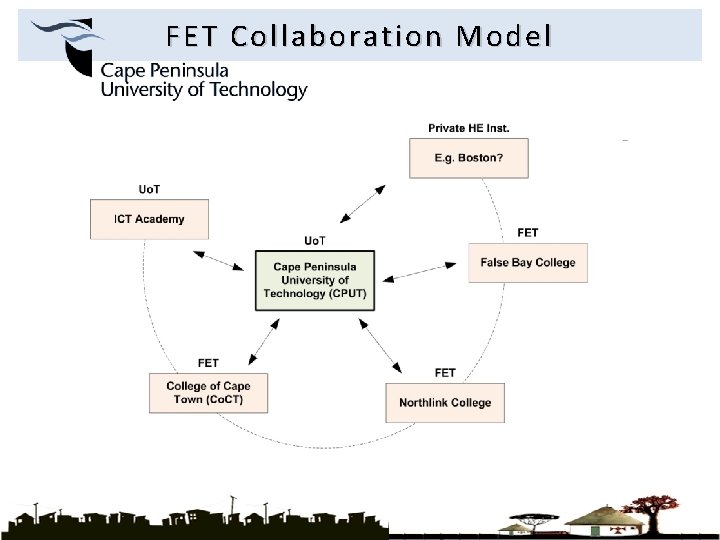
FET Collaboration Model
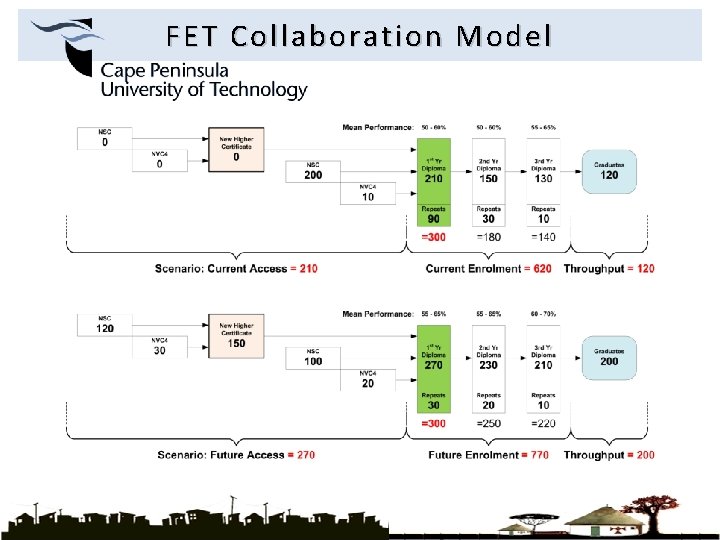
FET Collaboration Model
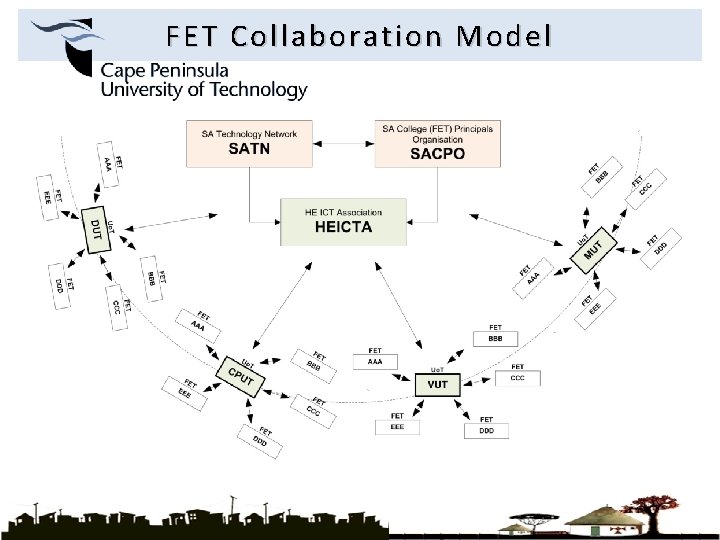
FET Collaboration Model
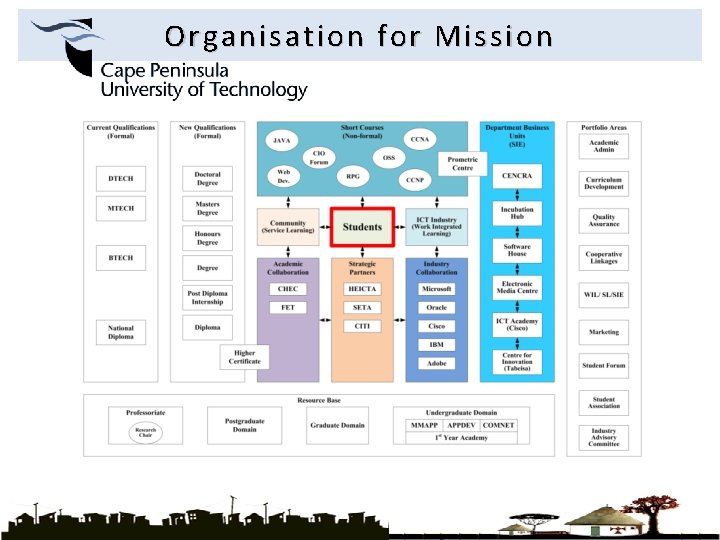
Organisation for Mission
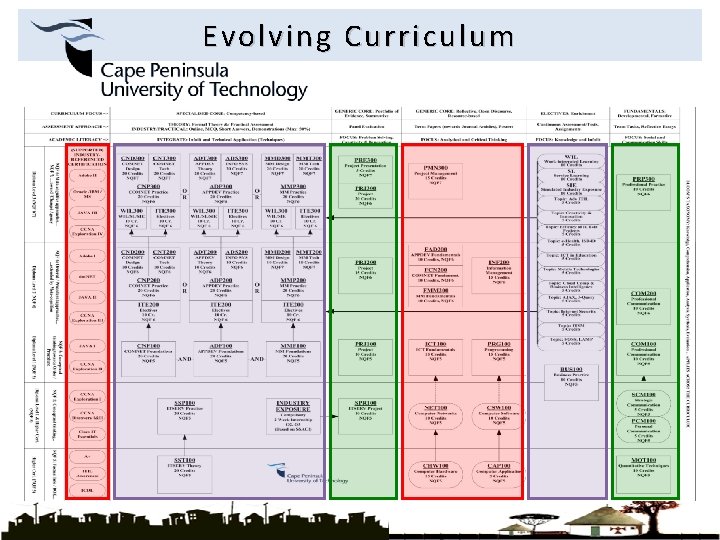
Evolving Curriculum
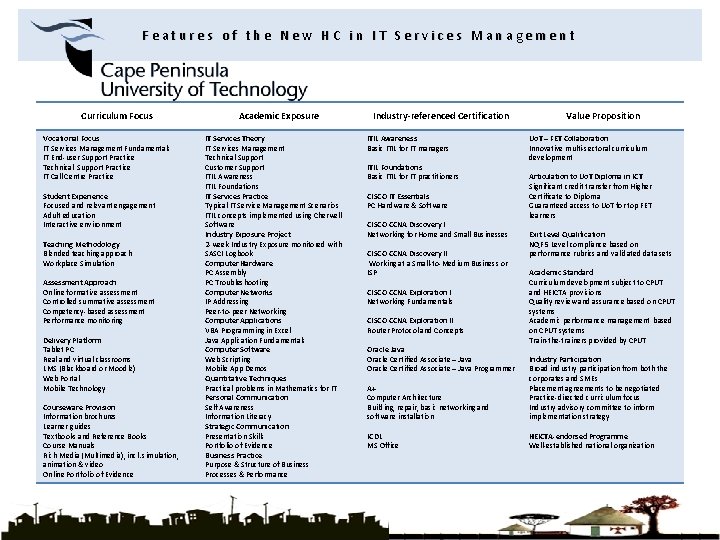
Features of the New HC in IT Services Management Curriculum Focus Vocational Focus IT Services Management Fundamentals IT End-user Support Practice Technical Support Practice IT Call Centre Practice Student Experience Focused and relevant engagement Adult education Interactive environment Teaching Methodology Blended teaching approach Workplace Simulation Assessment Approach Online formative assessment Controlled summative assessment Competency-based assessment Performance monitoring Delivery Platform Tablet PC Real and virtual classrooms LMS (Blackboard or Moodle) Web Portal Mobile Technology Courseware Provision Information brochures Learner guides Textbooks and Reference Books Course Manuals Rich Media (Multimedia), incl. simulation, animation & video Online Portfolio of Evidence Academic Exposure IT Services Theory IT Services Management Technical Support Customer Support ITIL Awareness ITIL Foundations IT Services Practice Typical IT Service Management Scenarios ITIL concepts implemented using Cherwell Software Industry Exposure Project 2 -week Industry Exposure monitored with SASCI Logbook Computer Hardware PC Assembly PC Troubleshooting Computer Networks IP Addressing Peer-to-peer Networking Computer Applications VBA Programming in Excel Java Application Fundamentals Computer Software Web Scripting Mobile App Demos Quantitative Techniques Practical problems in Mathematics for IT Personal Communication Self Awareness Information Literacy Strategic Communication Presentation Skills Portfolio of Evidence Business Practice Purpose & Structure of Business Processes & Performance Industry-referenced Certification ITIL Awareness Basic ITIL for IT managers ITIL Foundations Basic ITIL for IT practitioners CISCO IT Essentials PC Hardware & Software CISCO CCNA Discovery I Networking for Home and Small Businesses CISCO CCNA Discovery II Working at a Small-to-Medium Business or ISP CISCO CCNA Exploration I Networking Fundamentals CISCO CCNA Exploration II Router Protocol and Concepts Oracle Java Oracle Certified Associate – Java Programmer Value Proposition Uo. T – FET Collaboration Innovative multi-sectoral curriculum development Articulation to Uo. T Diploma in ICT Significant credit transfer from Higher Certificate to Diploma Guaranteed access to Uo. T for top FET learners Exit Level Qualification NQF 5 Level compliance based on performance rubrics and validated data sets Academic Standard Curriculum development subject to CPUT and HEICTA provisions Quality review and assurance based on CPUT systems Academic performance management based on CPUT systems Train-the-trainers provided by CPUT A+ Computer Architecture Building, repair, basic networking and software installation Industry Participation Broad industry participation from both the corporates and SMEs Placement agreements to be negotiated Practice-directed curriculum focus Industry advisory committee to inform implementation strategy ICDL MS Office HEICTA-endorsed Programme Well-established national organization
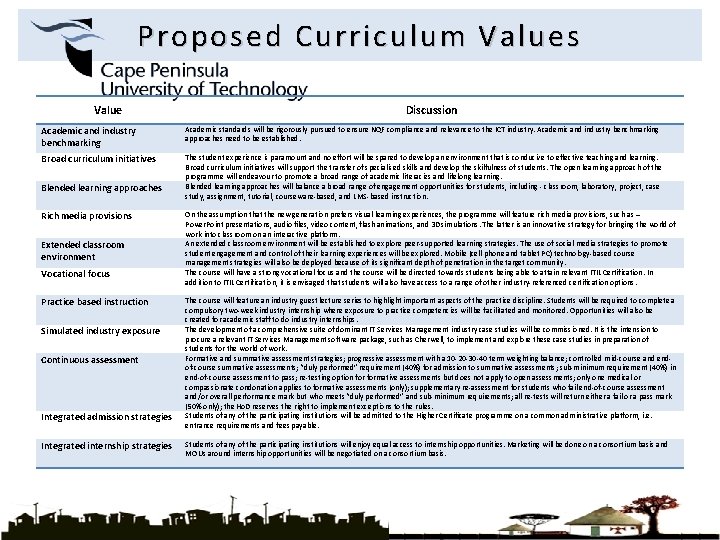
Proposed Curriculum Values Value Discussion Academic and industry benchmarking Academic standards will be rigorously pursued to ensure NQF compliance and relevance to the ICT industry. Academic and industry benchmarking approaches need to be established. Broad curriculum initiatives The student experience is paramount and no effort will be spared to develop an environment that is conducive to effective teaching and learning. Broad curriculum initiatives will support the transfer of specialised skills and develop the skilfulness of students. The open learning approach of the programme will endeavour to promote a broad range of academic literacies and lifelong learning. Blended learning approaches will balance a broad range of engagement opportunities for students, including - classroom, laboratory, project, case study, assignment, tutorial, courseware-based, and LMS-based instruction. Blended learning approaches Rich media provisions Extended classroom environment Vocational focus Practice based instruction Simulated industry exposure Continuous assessment Integrated admission strategies Integrated internship strategies On the assumption that the new generation prefers visual learning experiences, the programme will feature rich media provisions, such as – Power. Point presentations, audio files, video content, flash animations, and 3 D simulations. The latter is an innovative strategy for bringing the world of work into classroom on an interactive platform. An extended classroom environment will be established to explore peer-supported learning strategies. The use of social media strategies to promote student engagement and control of their learning experiences will be explored. Mobile (cell phone and tablet PC) technology-based course management strategies will also be deployed because of its significant depth of penetration in the target community. The course will have a strong vocational focus and the course will be directed towards students being able to attain relevant ITIL Certification. In addition to ITIL Certification, it is envisaged that students will also have access to a range of other industry-referenced certification options. The course will feature an industry guest lecture series to highlight important aspects of the practice discipline. Students will be required to complete a compulsory two-week industry internship where exposure to practice competencies will be facilitated and monitored. Opportunities will also be created for academic staff to do industry internships. The development of a comprehensive suite of dominant IT Services Management industry case studies will be commissioned. It is the intension to procure a relevant IT Services Management software package, such as Cherwell, to implement and explore these case studies in preparation of students for the world of work. Formative and summative assessment strategies; progressive assessment with a 10 -20 -30 -40 term weighting balance; controlled mid-course and endof-course summative assessments; “duly performed” requirement (40%) for admission to summative assessments; sub-minimum requirement (40%) in end-of-course assessment to pass; re-testing option formative assessments but does not apply to open assessments; only one medical or compassionate condonation applies to formative assessments (only); supplementary re-assessment for students who fail end-of-course assessment and/or overall performance mark but who meets “duly performed” and sub-minimum requirements; all re-tests will return either a fail or a pass mark (50% only); the Ho. D reserves the right to implement exceptions to the rules. Students of any of the participating institutions will be admitted to the Higher Certificate programme on a common administrative platform, i. e. entrance requirements and fees payable. Students of any of the participating institutions will enjoy equal access to internship opportunities. Marketing will be done on a consortium basis and MOUs around internship opportunities will be negotiated on a consortium basis.
Thanks!
- Slides: 19