
A Cognitive Hierarchy Model of OneShot Games Teck
- Slides: 43
A Cognitive Hierarchy Model of One-Shot Games Teck H. Ho Haas School of Business University of California, Berkeley Joint work with Colin Camerer, Caltech Juin-Kuan Chong, NUS CH Model Teck-Hua Ho 1
Motivation q. Nash equilibrium and its refinements: Dominant theories in economics for predicting behaviors in games. q. Subjects do not play Nash in many one-shot games. q. Behaviors do not converge to Nash with repeated interactions in some games. q. Multiplicity problem (e. g. , coordination games). q. Modeling heterogeneity really matters in games. April 15, 2004 CH Model Teck-Hua Ho 2
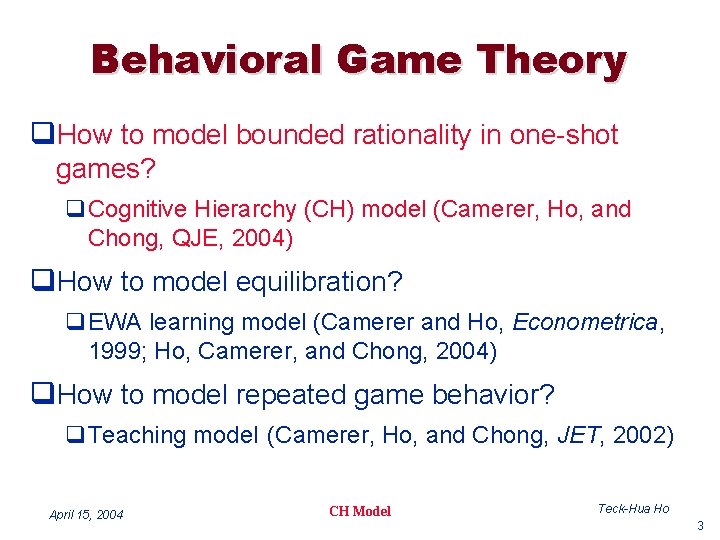
Behavioral Game Theory q. How to model bounded rationality in one-shot games? q. Cognitive Hierarchy (CH) model (Camerer, Ho, and Chong, QJE, 2004) q. How to model equilibration? q. EWA learning model (Camerer and Ho, Econometrica, 1999; Ho, Camerer, and Chong, 2004) q. How to model repeated game behavior? q. Teaching model (Camerer, Ho, and Chong, JET, 2002) April 15, 2004 CH Model Teck-Hua Ho 3
First-Shot Games q. The FCC license auctions, elections, military campaigns, legal disputes q. Many marketing models and simple game experiments q. Initial conditions for learning April 15, 2004 CH Model Teck-Hua Ho 4
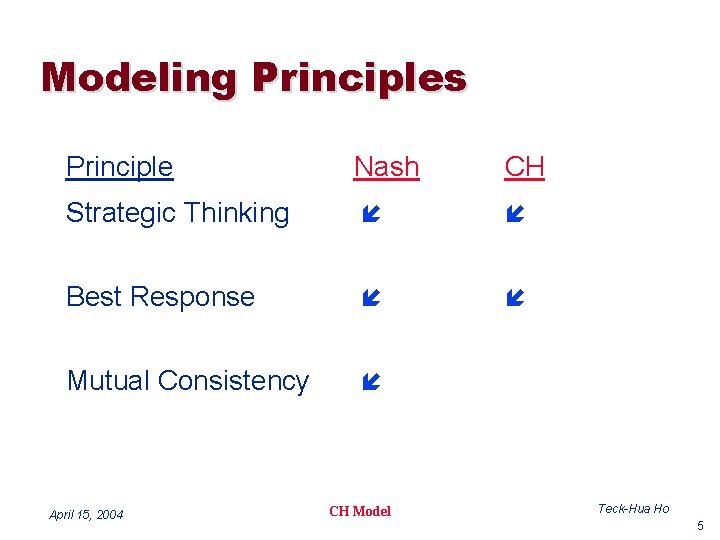
Modeling Principles Principle Nash CH Strategic Thinking Best Response Mutual Consistency April 15, 2004 CH Model Teck-Hua Ho 5
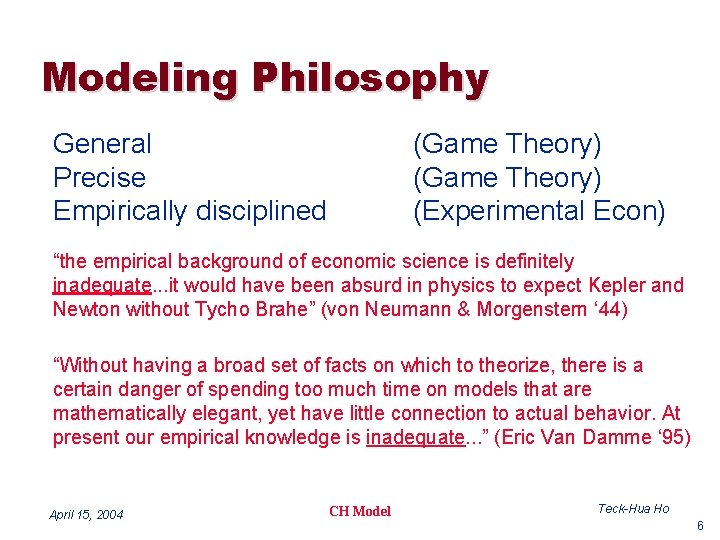
Modeling Philosophy General Precise Empirically disciplined (Game Theory) (Experimental Econ) “the empirical background of economic science is definitely inadequate. . . it would have been absurd in physics to expect Kepler and Newton without Tycho Brahe” (von Neumann & Morgenstern ‘ 44) “Without having a broad set of facts on which to theorize, there is a certain danger of spending too much time on models that are mathematically elegant, yet have little connection to actual behavior. At present our empirical knowledge is inadequate. . . ” (Eric Van Damme ‘ 95) April 15, 2004 CH Model Teck-Hua Ho 6
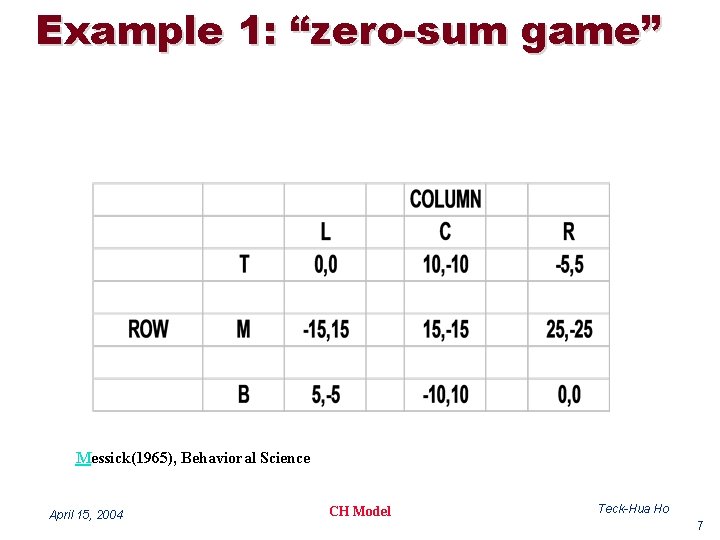
Example 1: “zero-sum game” Messick(1965), Behavioral Science April 15, 2004 CH Model Teck-Hua Ho 7
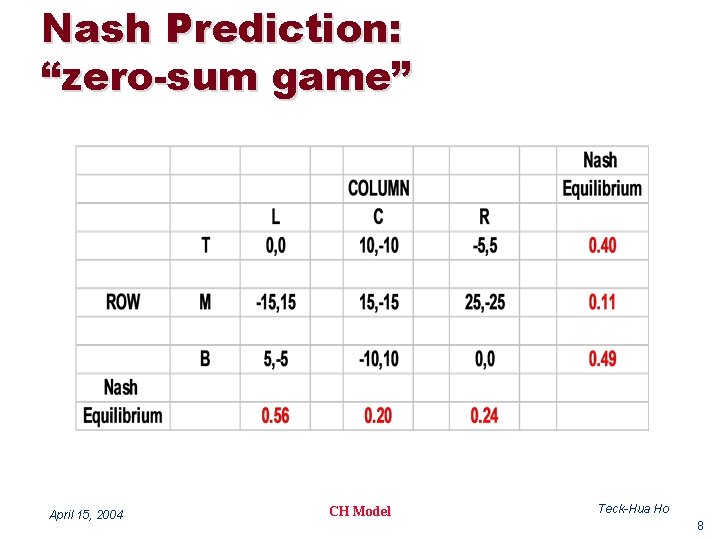
Nash Prediction: “zero-sum game” April 15, 2004 CH Model Teck-Hua Ho 8
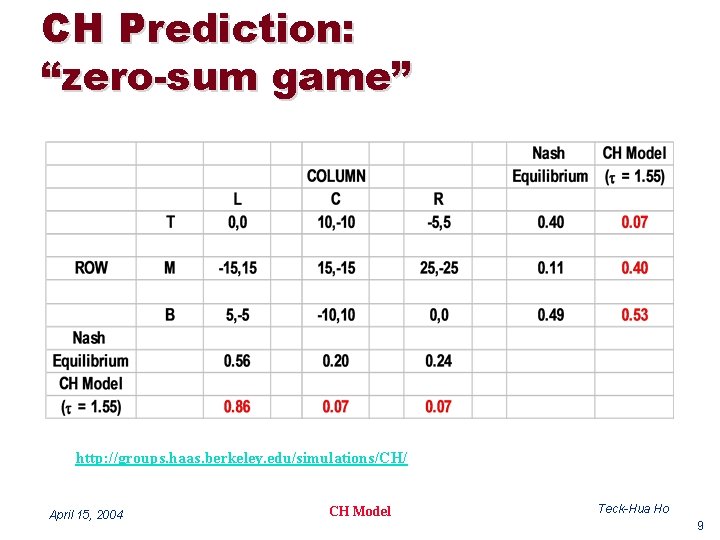
CH Prediction: “zero-sum game” http: //groups. haas. berkeley. edu/simulations/CH/ April 15, 2004 CH Model Teck-Hua Ho 9
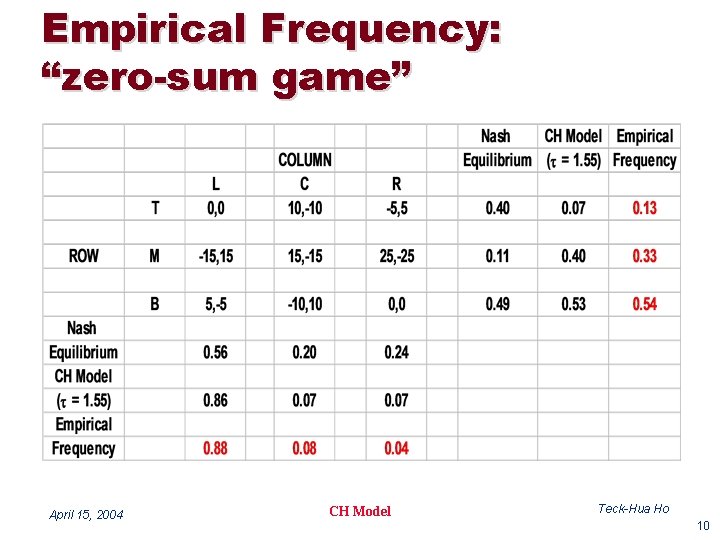
Empirical Frequency: “zero-sum game” April 15, 2004 CH Model Teck-Hua Ho 10
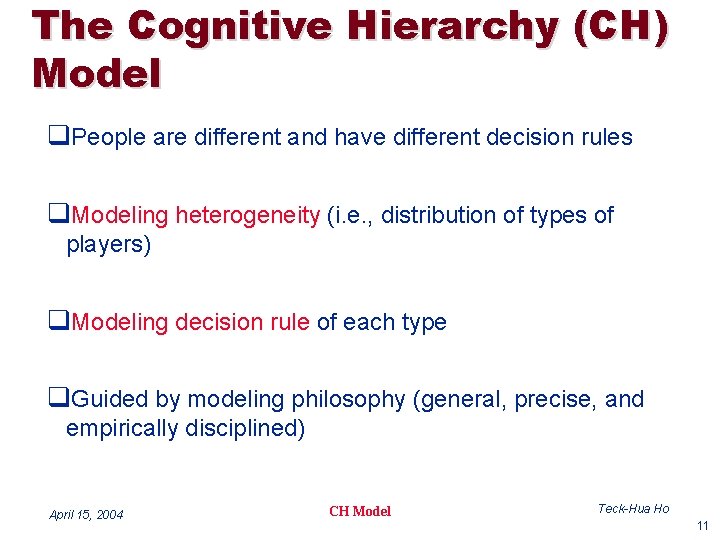
The Cognitive Hierarchy (CH) Model q. People are different and have different decision rules q. Modeling heterogeneity (i. e. , distribution of types of players) q. Modeling decision rule of each type q. Guided by modeling philosophy (general, precise, and empirically disciplined) April 15, 2004 CH Model Teck-Hua Ho 11
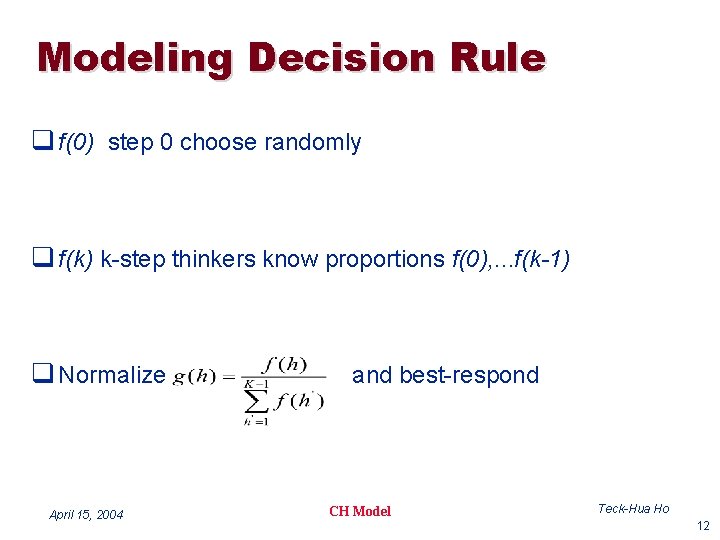
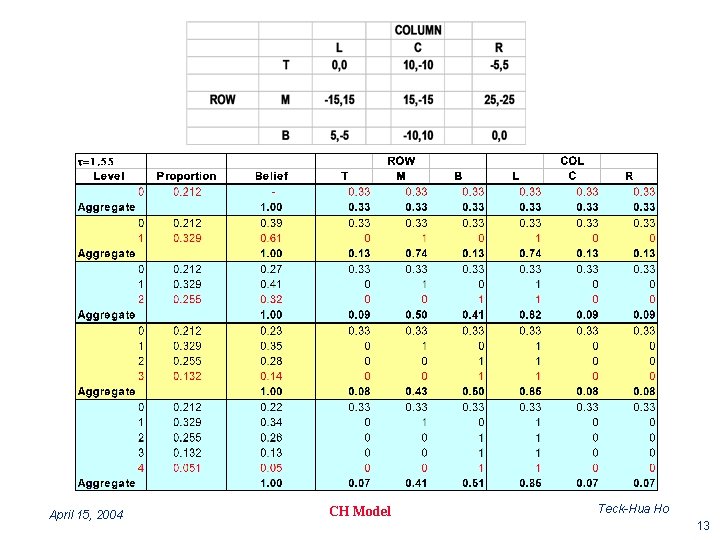
Modeling Decision Rule q f(0) step 0 choose randomly q f(k) k-step thinkers know proportions f(0), . . . f(k-1) q Normalize April 15, 2004 and best-respond CH Model Teck-Hua Ho 12
April 15, 2004 CH Model Teck-Hua Ho 13
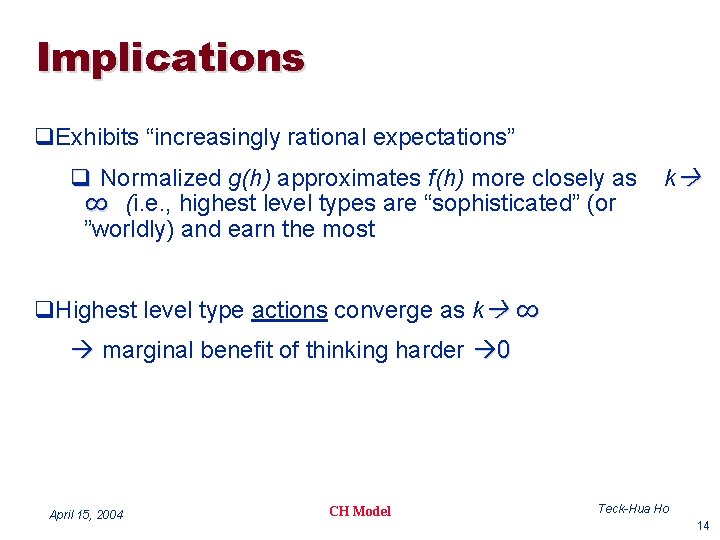
Implications q. Exhibits “increasingly rational expectations” q Normalized g(h) approximates f(h) more closely as ∞ (i. e. , highest level types are “sophisticated” (or ”worldly) and earn the most k q. Highest level type actions converge as k ∞ marginal benefit of thinking harder 0 April 15, 2004 CH Model Teck-Hua Ho 14
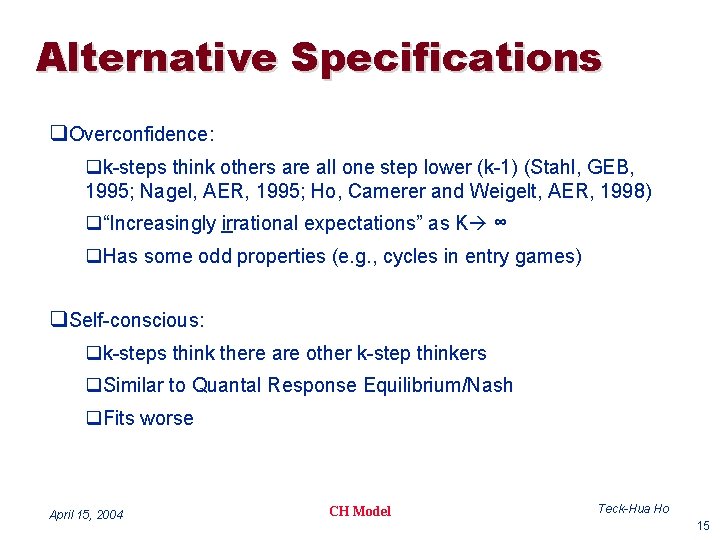
Alternative Specifications q. Overconfidence: qk-steps think others are all one step lower (k-1) (Stahl, GEB, 1995; Nagel, AER, 1995; Ho, Camerer and Weigelt, AER, 1998) q“Increasingly irrational expectations” as K ∞ q. Has some odd properties (e. g. , cycles in entry games) q. Self-conscious: qk-steps think there are other k-step thinkers q. Similar to Quantal Response Equilibrium/Nash q. Fits worse April 15, 2004 CH Model Teck-Hua Ho 15
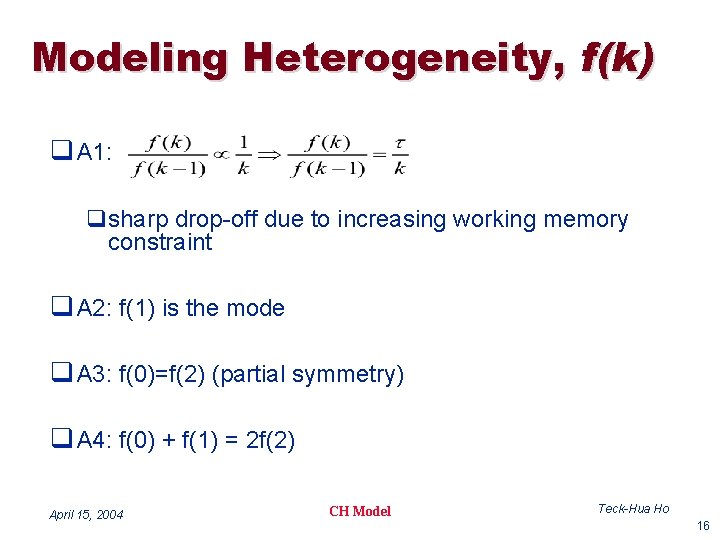
Modeling Heterogeneity, f(k) q A 1: qsharp drop-off due to increasing working memory constraint q A 2: f(1) is the mode q A 3: f(0)=f(2) (partial symmetry) q A 4: f(0) + f(1) = 2 f(2) April 15, 2004 CH Model Teck-Hua Ho 16
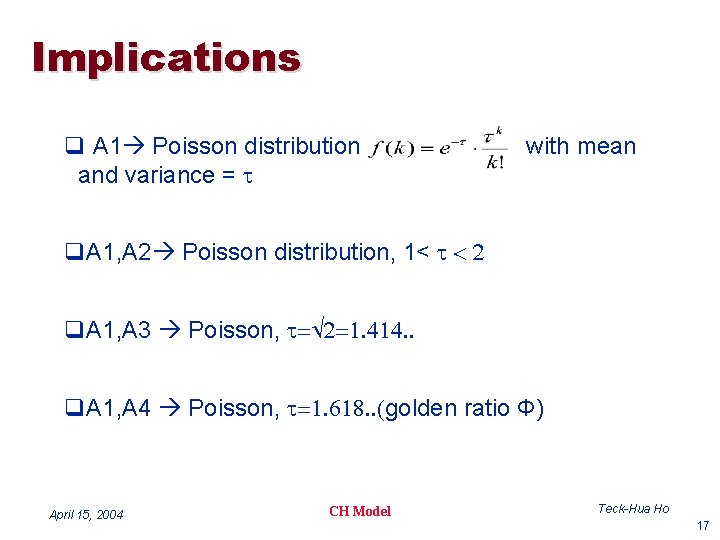
Implications q A 1 Poisson distribution and variance = t with mean q. A 1, A 2 Poisson distribution, 1< t < 2 q. A 1, A 3 Poisson, t= 2=1. 414. . q. A 1, A 4 Poisson, t=1. 618. . (golden ratio Φ) April 15, 2004 CH Model Teck-Hua Ho 17
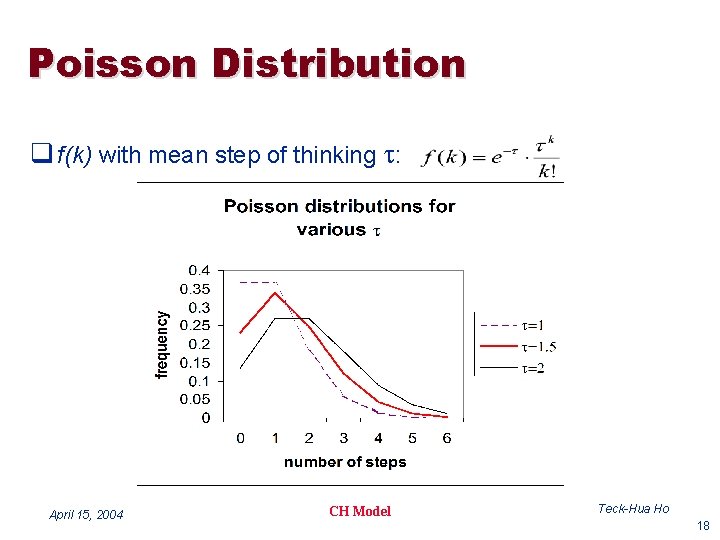
Poisson Distribution q f(k) with mean step of thinking t: April 15, 2004 CH Model Teck-Hua Ho 18
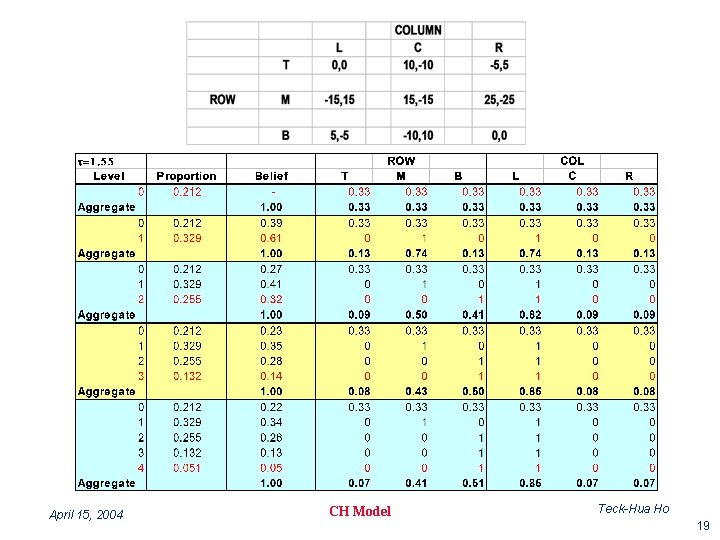
April 15, 2004 CH Model Teck-Hua Ho 19
Historical Roots q “Fictitious play” as an algorithm for computing Nash equilibrium (Brown, 1951; Robinson, 1951) q In our terminology, the fictitious play model is equivalent to one in which f(k) = 1/N for N steps of thinking and N ∞ q Instead of a single player iterating repeatedly until a fixed point is reached and taking the player’s earlier tentative decisions as pseudo-data, we posit a population of players in which a fraction f(k) stop after k-steps of thinking April 15, 2004 CH Model Teck-Hua Ho 20
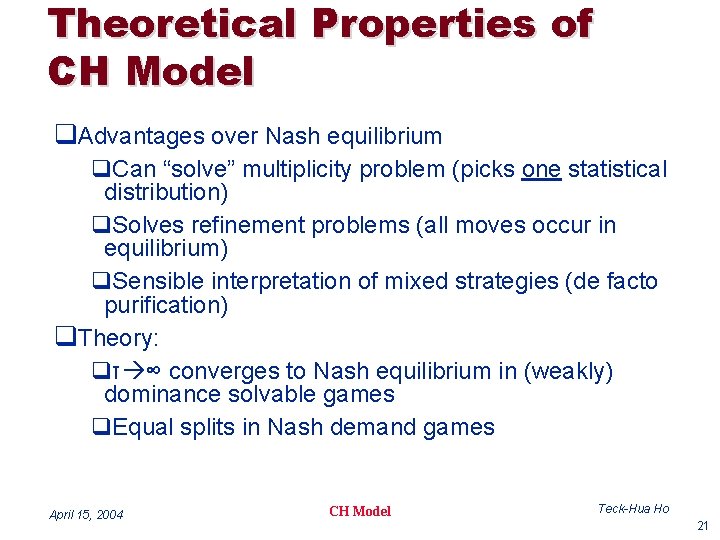
Theoretical Properties of CH Model q. Advantages over Nash equilibrium q. Can “solve” multiplicity problem (picks one statistical distribution) q. Solves refinement problems (all moves occur in equilibrium) q. Sensible interpretation of mixed strategies (de facto purification) q. Theory: qτ ∞ converges to Nash equilibrium in (weakly) dominance solvable games q. Equal splits in Nash demand games April 15, 2004 CH Model Teck-Hua Ho 21
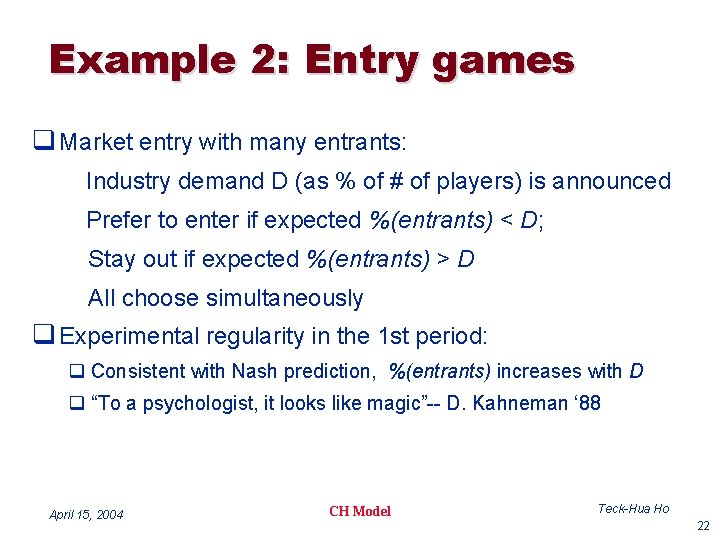
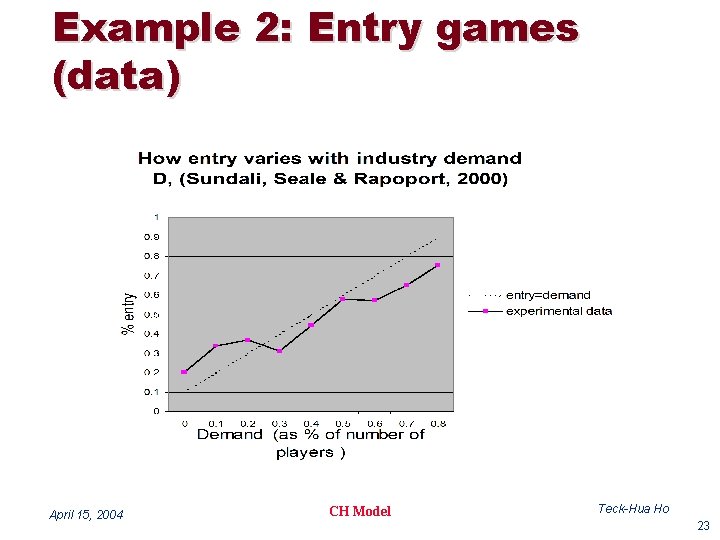
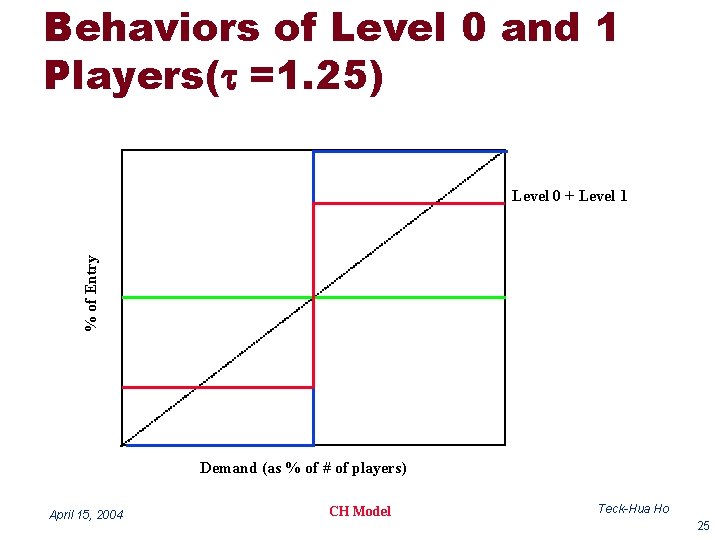
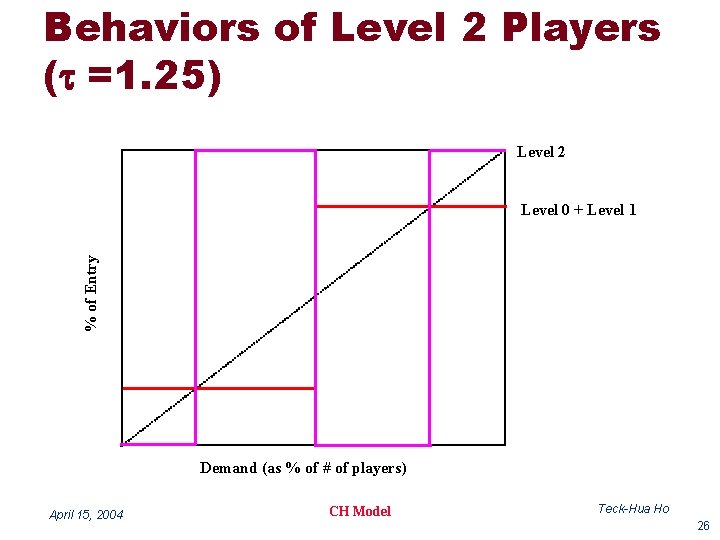
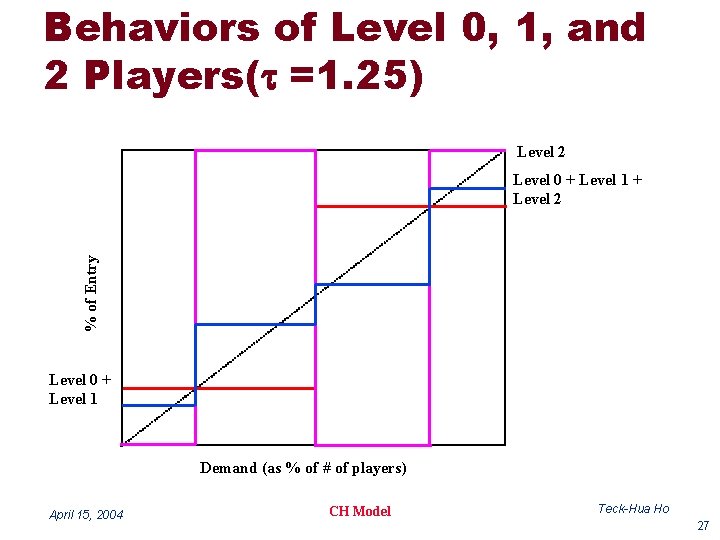
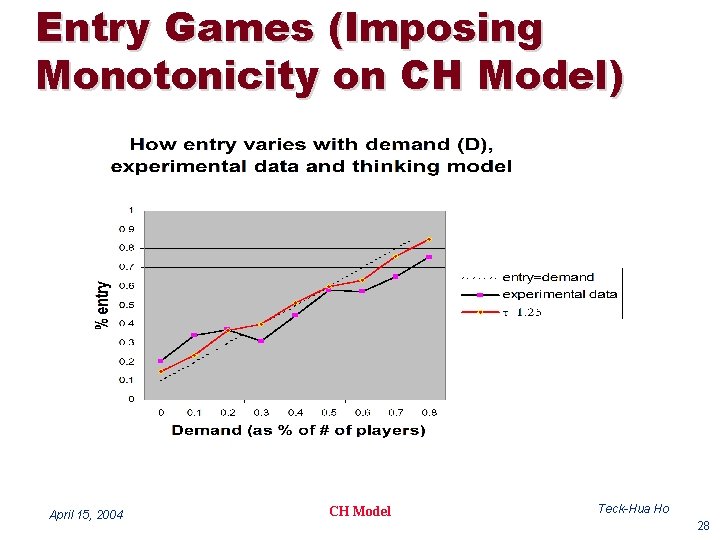
Example 2: Entry games q Market entry with many entrants: Industry demand D (as % of # of players) is announced Prefer to enter if expected %(entrants) < D; Stay out if expected %(entrants) > D All choose simultaneously q Experimental regularity in the 1 st period: q Consistent with Nash prediction, %(entrants) increases with D q “To a psychologist, it looks like magic”-- D. Kahneman ‘ 88 April 15, 2004 CH Model Teck-Hua Ho 22
Example 2: Entry games (data) April 15, 2004 CH Model Teck-Hua Ho 23
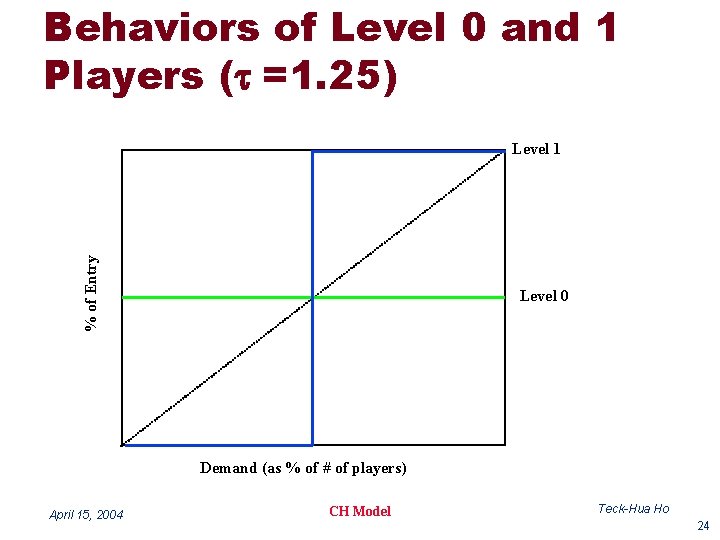
Behaviors of Level 0 and 1 Players (t =1. 25) % of Entry Level 1 Level 0 Demand (as % of # of players) April 15, 2004 CH Model Teck-Hua Ho 24
Behaviors of Level 0 and 1 Players(t =1. 25) % of Entry Level 0 + Level 1 Demand (as % of # of players) April 15, 2004 CH Model Teck-Hua Ho 25
Behaviors of Level 2 Players (t =1. 25) Level 2 % of Entry Level 0 + Level 1 Demand (as % of # of players) April 15, 2004 CH Model Teck-Hua Ho 26
Behaviors of Level 0, 1, and 2 Players(t =1. 25) Level 2 % of Entry Level 0 + Level 1 + Level 2 Level 0 + Level 1 Demand (as % of # of players) April 15, 2004 CH Model Teck-Hua Ho 27
Entry Games (Imposing Monotonicity on CH Model) April 15, 2004 CH Model Teck-Hua Ho 28
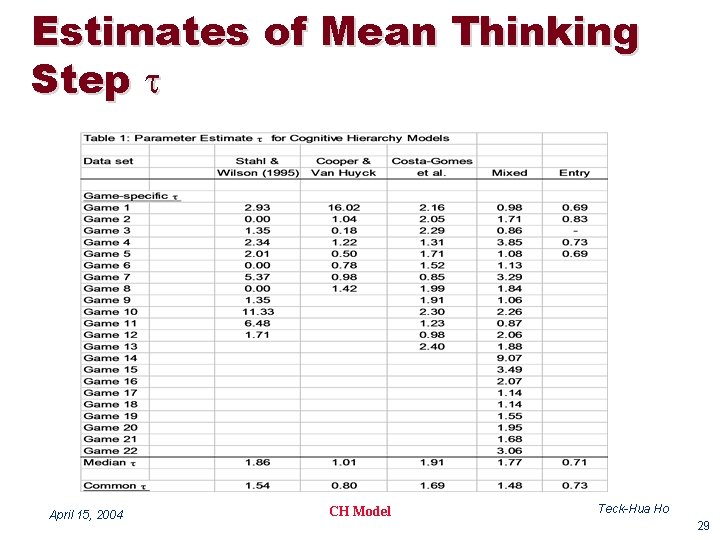
Estimates of Mean Thinking Step t April 15, 2004 CH Model Teck-Hua Ho 29
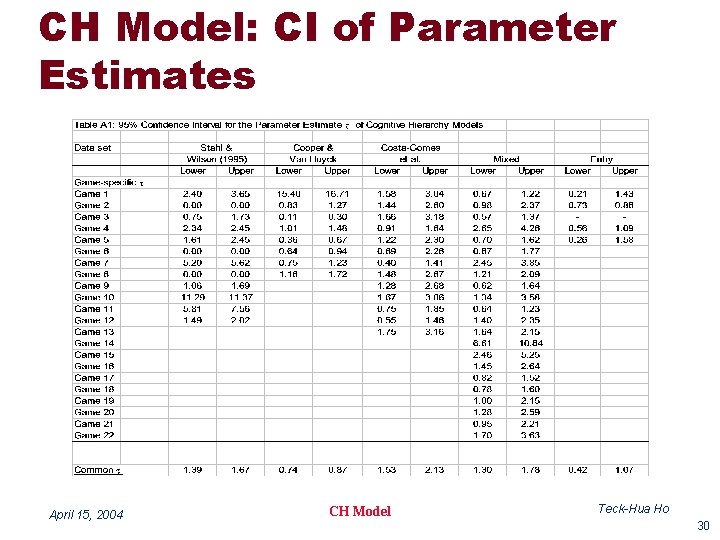
CH Model: CI of Parameter Estimates April 15, 2004 CH Model Teck-Hua Ho 30
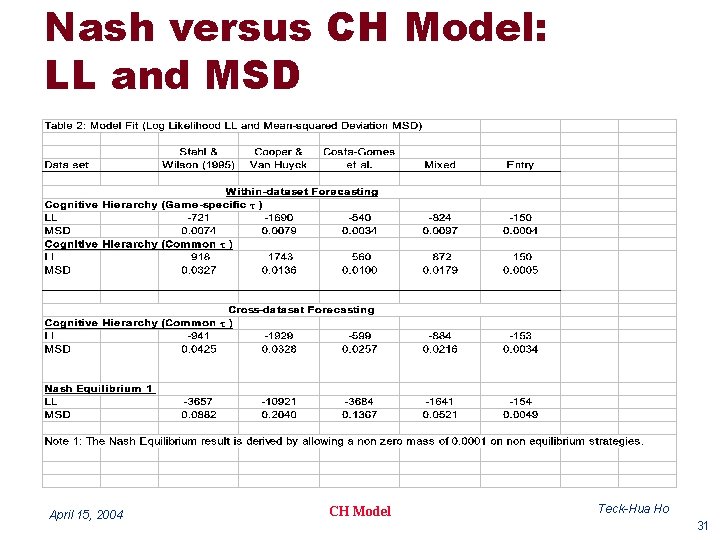
Nash versus CH Model: LL and MSD April 15, 2004 CH Model Teck-Hua Ho 31
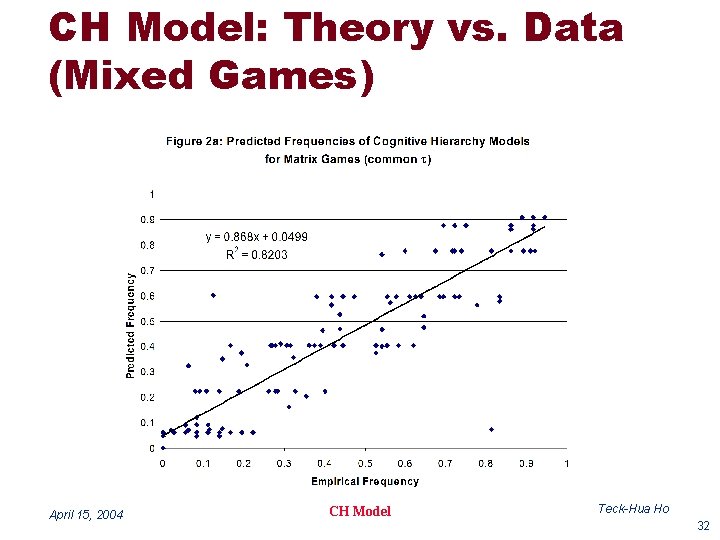
CH Model: Theory vs. Data (Mixed Games) April 15, 2004 CH Model Teck-Hua Ho 32
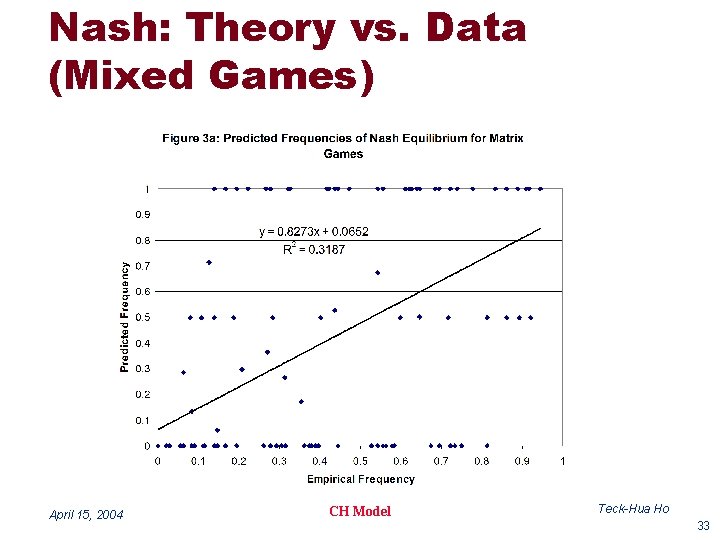
Nash: Theory vs. Data (Mixed Games) April 15, 2004 CH Model Teck-Hua Ho 33
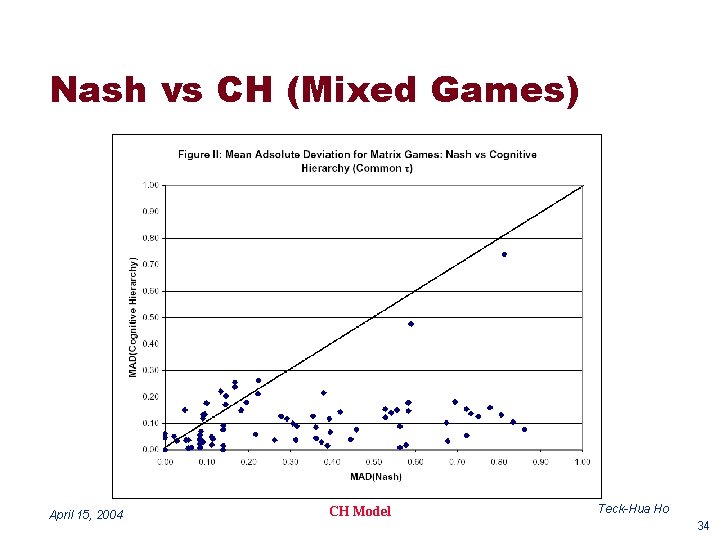
Nash vs CH (Mixed Games) April 15, 2004 CH Model Teck-Hua Ho 34
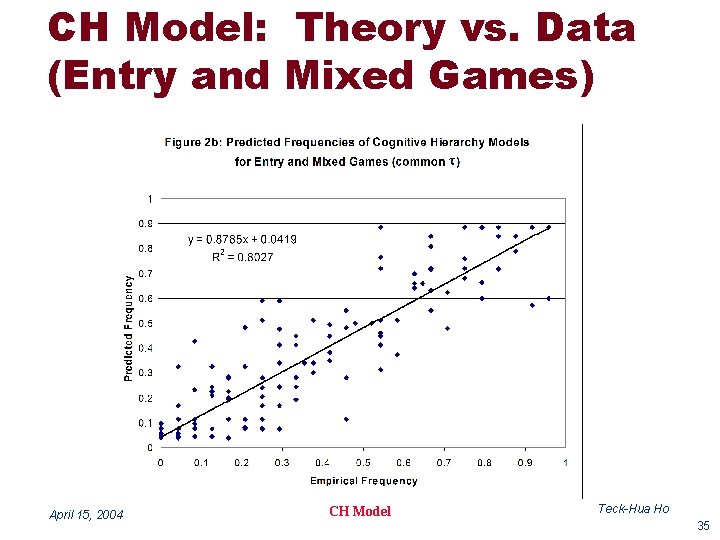
CH Model: Theory vs. Data (Entry and Mixed Games) April 15, 2004 CH Model Teck-Hua Ho 35
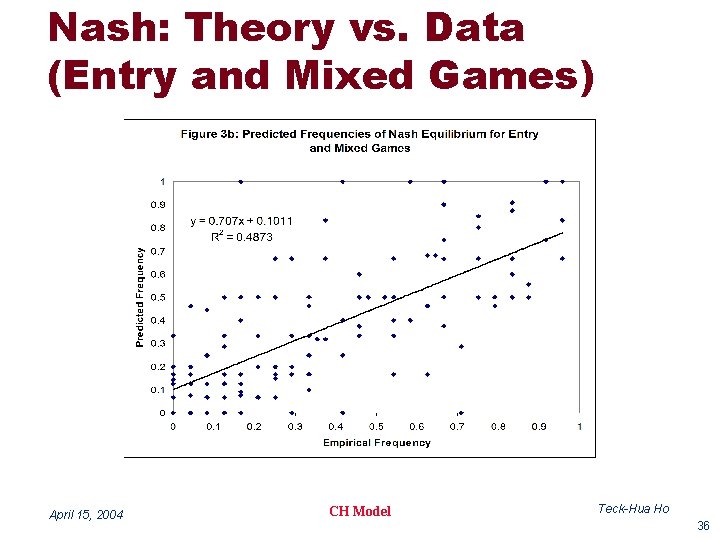
Nash: Theory vs. Data (Entry and Mixed Games) April 15, 2004 CH Model Teck-Hua Ho 36
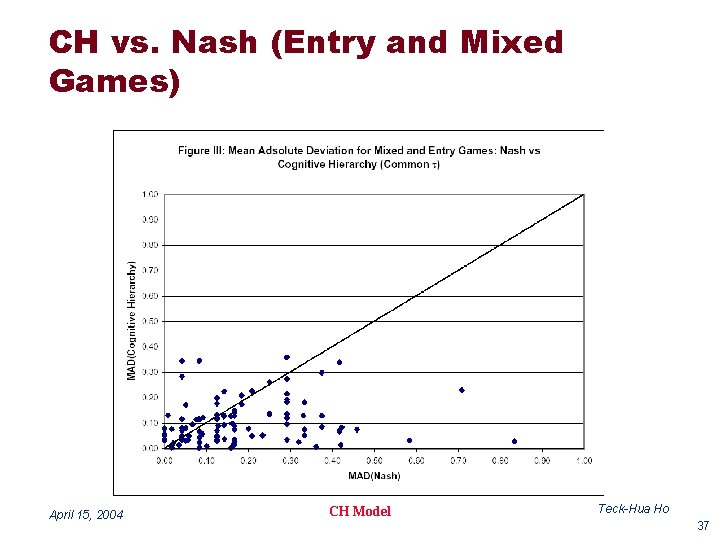
CH vs. Nash (Entry and Mixed Games) April 15, 2004 CH Model Teck-Hua Ho 37
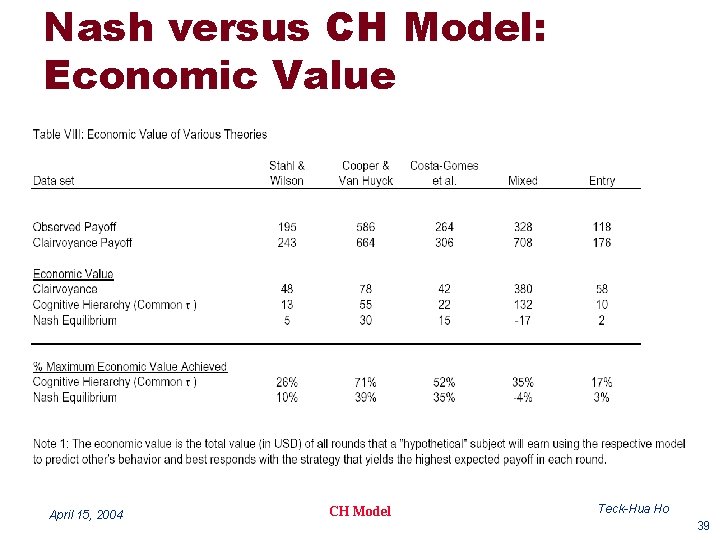
Economic Value q Evaluate models based on their value-added rather than statistical fit (Camerer and Ho, 2000) q Treat models like consultants q If players were to hire Mr. Nash and Ms. CH as consultants and listen to their advice (i. e. , use the model to forecast what others will do and best-respond), would they have made a higher payoff? q A measure of disequilibrium April 15, 2004 CH Model Teck-Hua Ho 38
Nash versus CH Model: Economic Value April 15, 2004 CH Model Teck-Hua Ho 39
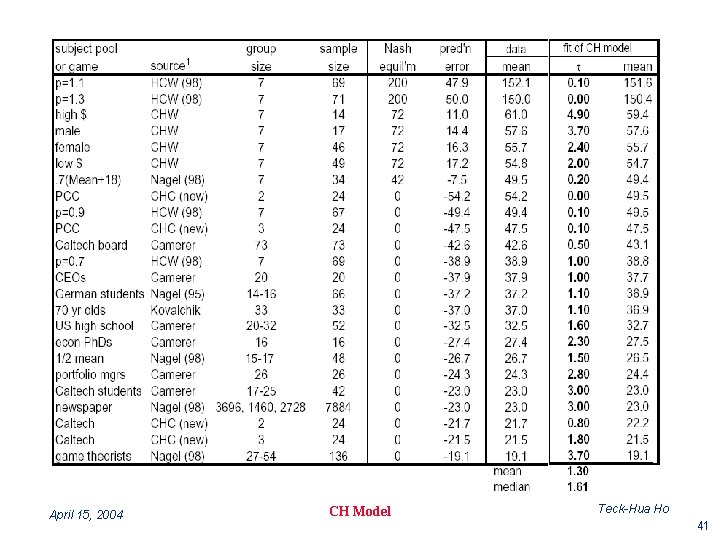
Example 3: P-Beauty Contest q n players q Every player simultaneously chooses a number from 0 to 100 q Compute the group average q Define Target Number to be 0. 7 times the group average q The winner is the player whose number is the closet to the Target Number q The prize to the winner is US$10 CH Model Teck-Hua Ho 40
April 15, 2004 CH Model Teck-Hua Ho 41
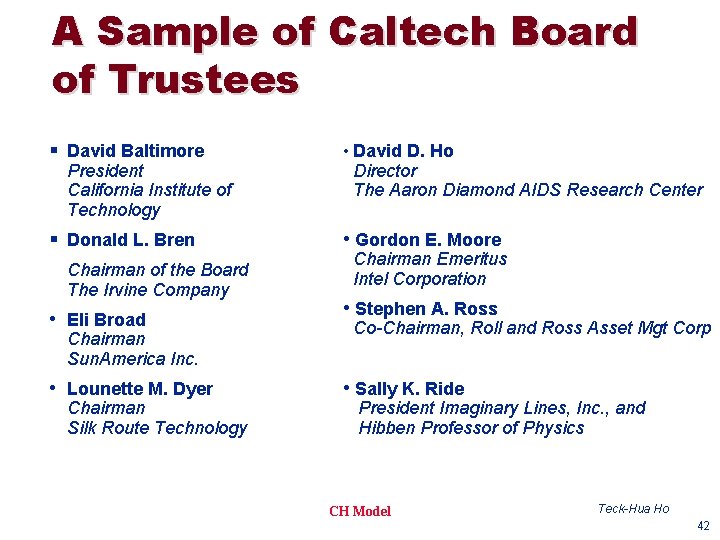
A Sample of Caltech Board of Trustees § David Baltimore • David D. Ho § Donald L. Bren • Gordon E. Moore President California Institute of Technology Chairman of the Board The Irvine Company • Eli Broad Chairman Sun. America Inc. • Lounette M. Dyer Chairman Silk Route Technology Director The Aaron Diamond AIDS Research Center Chairman Emeritus Intel Corporation • Stephen A. Ross Co-Chairman, Roll and Ross Asset Mgt Corp • Sally K. Ride President Imaginary Lines, Inc. , and Hibben Professor of Physics CH Model Teck-Hua Ho 42
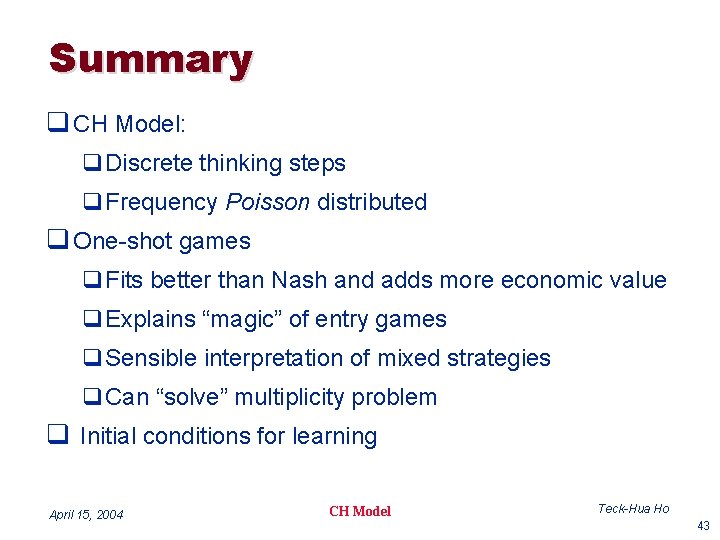
Summary q CH Model: q. Discrete thinking steps q. Frequency Poisson distributed q One-shot games q. Fits better than Nash and adds more economic value q. Explains “magic” of entry games q. Sensible interpretation of mixed strategies q. Can “solve” multiplicity problem q Initial conditions for learning April 15, 2004 CH Model Teck-Hua Ho 43