
A Cognitive Approach to Learning Order of Operations


- Slides: 39
A Cognitive Approach to Learning Order of Operations: Lessons from Language Processing Richard Ries College of Redwoods Ying Lin Santa Rosa Junior College
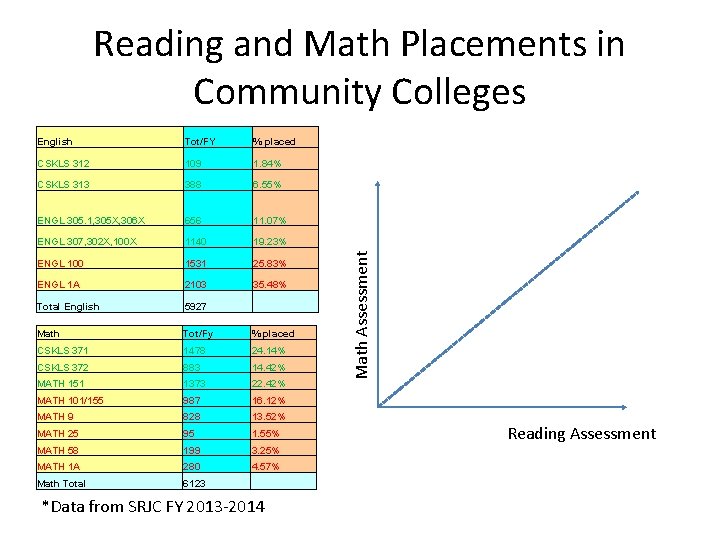
English Tot/FY % placed CSKLS 312 109 1. 84% CSKLS 313 388 6. 55% ENGL 305. 1, 305 X, 306 X 656 11. 07% ENGL 307, 302 X, 100 X 1140 19. 23% ENGL 100 1531 25. 83% ENGL 1 A 2103 35. 48% Total English 5927 Math Tot/Fy % placed CSKLS 371 1478 24. 14% CSKLS 372 883 14. 42% MATH 151 1373 22. 42% MATH 101/155 987 16. 12% MATH 9 828 13. 52% MATH 25 95 1. 55% MATH 58 199 3. 25% MATH 1 A 280 4. 57% Math Total 6123 *Data from SRJC FY 2013 -2014 Math Assessment Reading and Math Placements in Community Colleges Reading Assessment
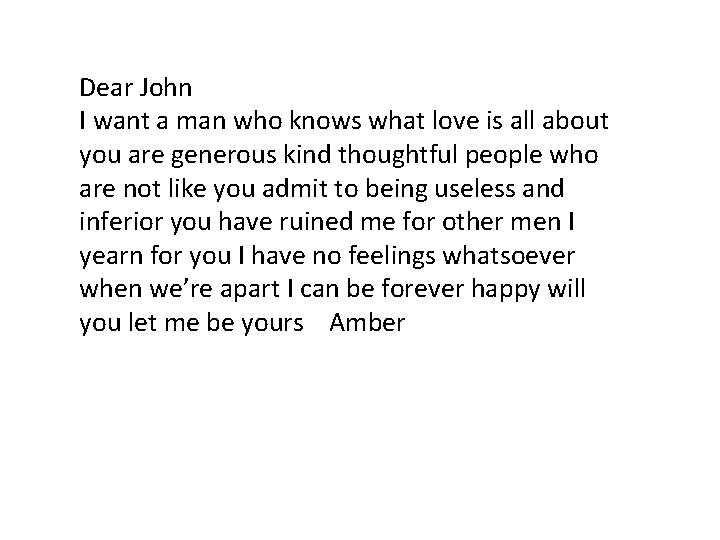
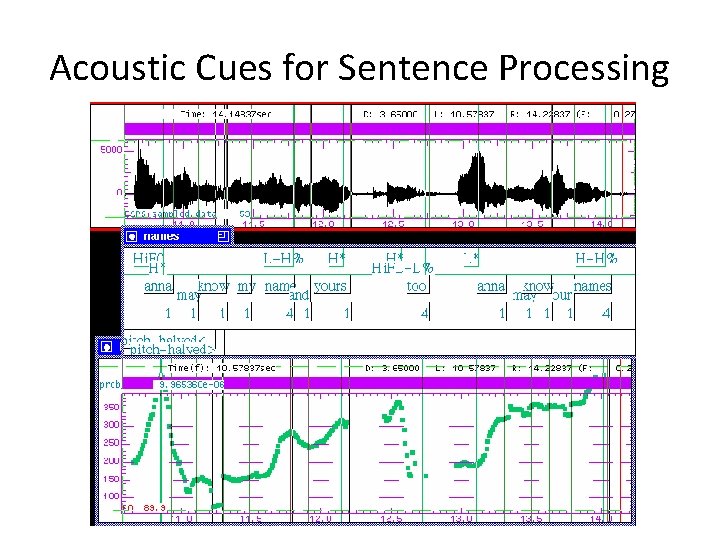
Dear John I want a man who knows what love is all about you are generous kind thoughtful people who are not like you admit to being useless and inferior you have ruined me for other men I yearn for you I have no feelings whatsoever when we’re apart I can be forever happy will you let me be yours Amber
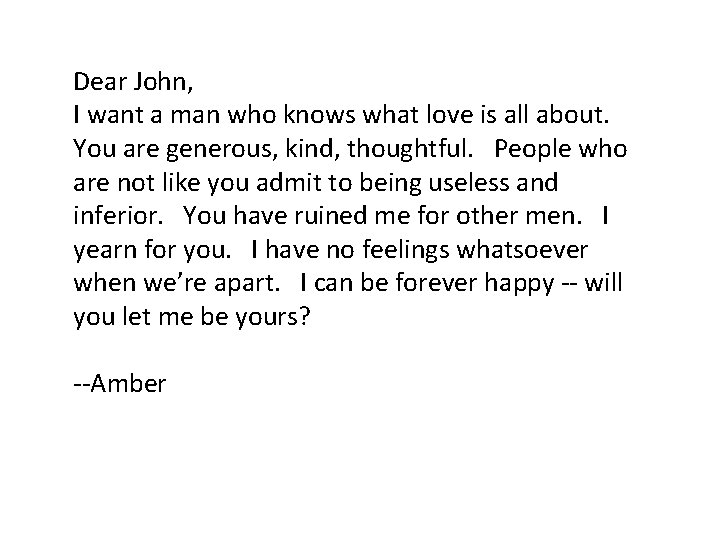
Dear John, I want a man who knows what love is all about. You are generous, kind, thoughtful. People who are not like you admit to being useless and inferior. You have ruined me for other men. I yearn for you. I have no feelings whatsoever when we’re apart. I can be forever happy -- will you let me be yours? --Amber
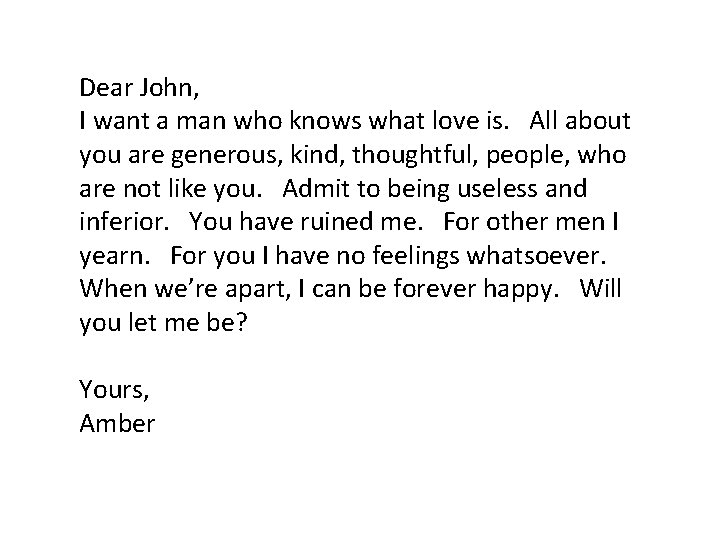
Dear John, I want a man who knows what love is. All about you are generous, kind, thoughtful, people, who are not like you. Admit to being useless and inferior. You have ruined me. For other men I yearn. For you I have no feelings whatsoever. When we’re apart, I can be forever happy. Will you let me be? Yours, Amber
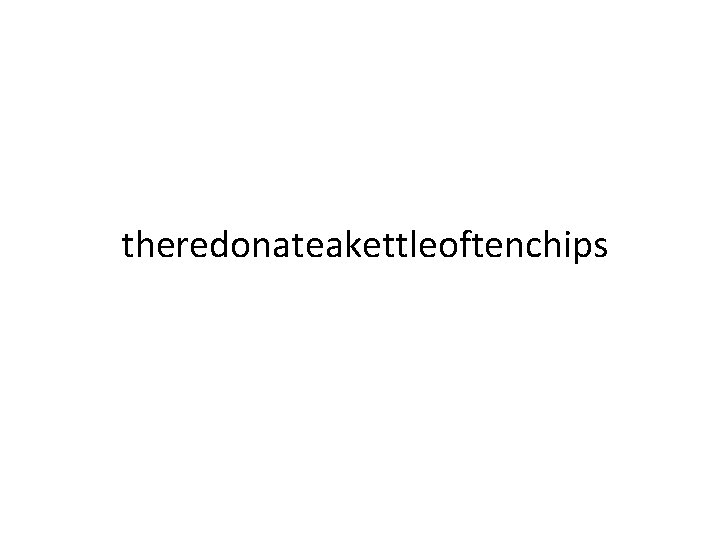
theredonateakettleoftenchips
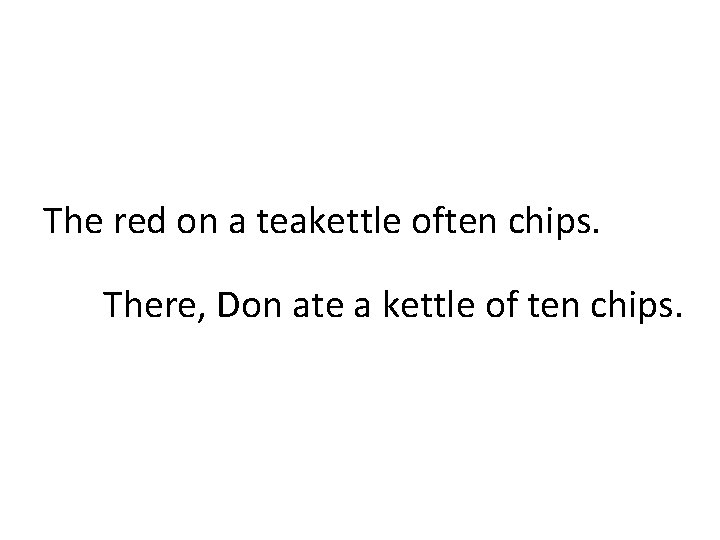
The red on a teakettle often chips. There, Don ate a kettle of ten chips.
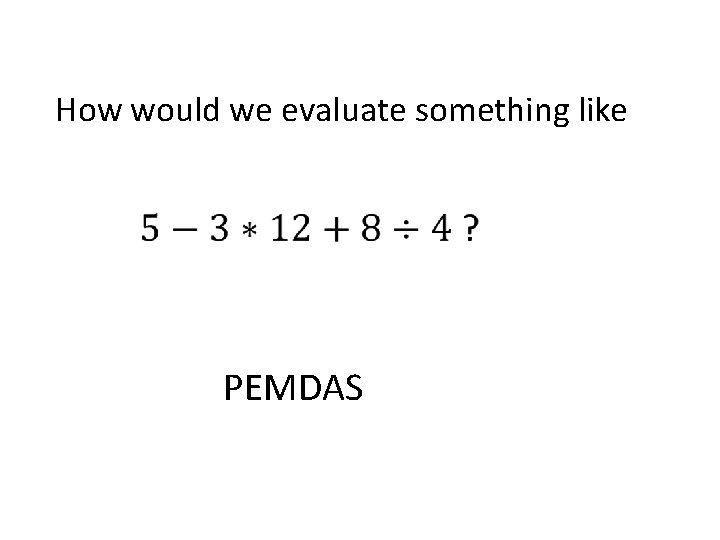
How would we evaluate something like PEMDAS
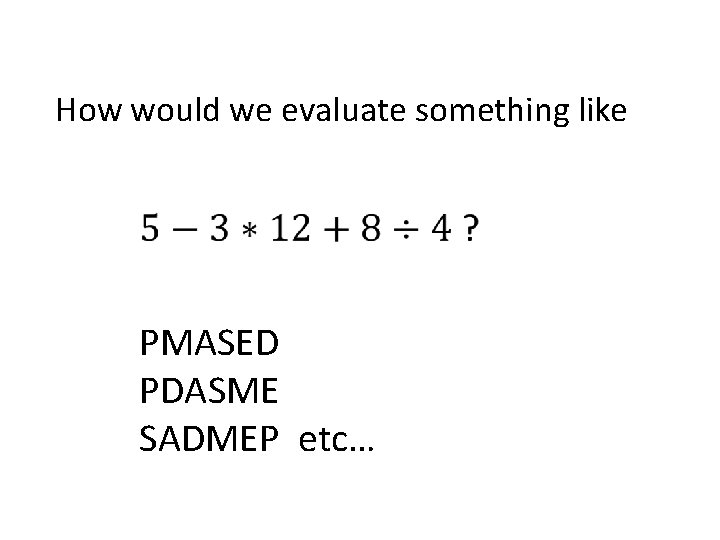
How would we evaluate something like PMASED PDASME SADMEP etc…
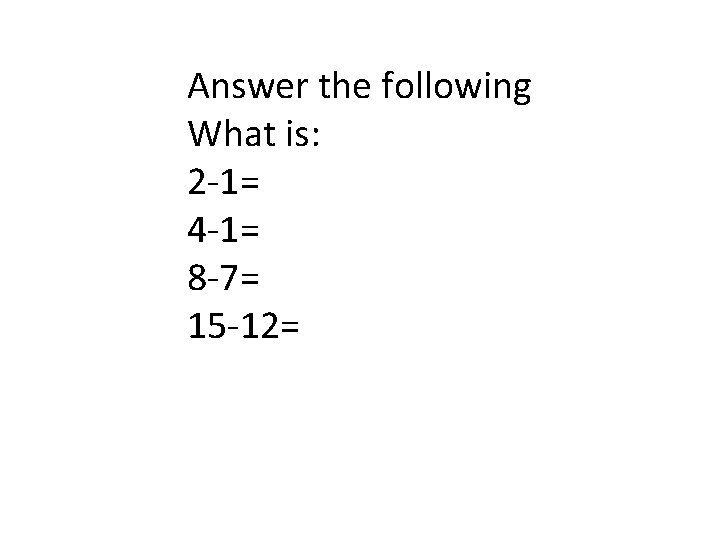
Answer the following What is: 2 -1= 4 -1= 8 -7= 15 -12=
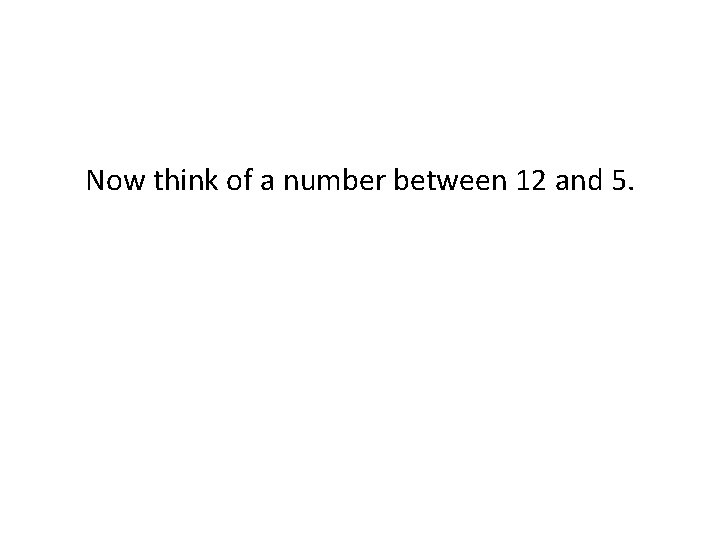
Now think of a number between 12 and 5.
Was it 7?
Subtraction mode? (also known as “priming” in cognitive psychology)
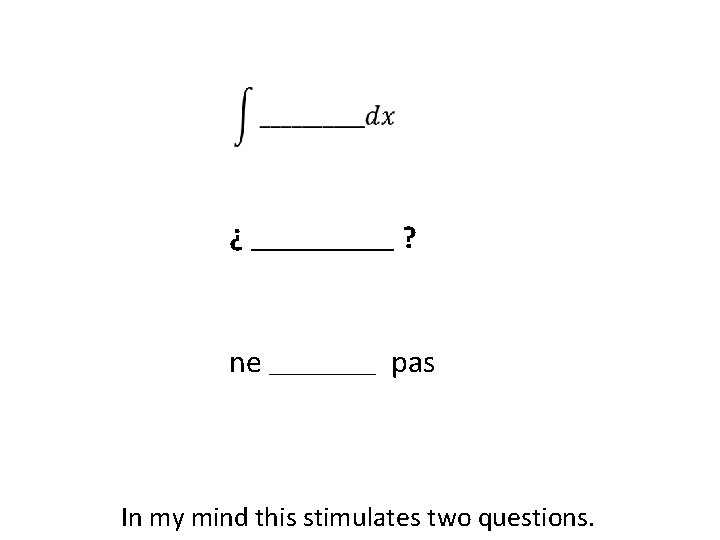
¿ ________ ? ne ______ pas In my mind this stimulates two questions.
Q 1. What are the psychological/cultural/linguistic factors creating these predispositions? Q 2. What are the frequencies at which various dispositions govern the interpretive order of operations?
Methodology and Subjects • Short quizzes containing the test items (6 each) were administered by instructors • 8 Instructors from 3 colleges (Norco, Fullerton, SRJC) participated • Includes nearly 1000 students • Levels include Arithmetic, Pre-algebra, and Elementary Algebra
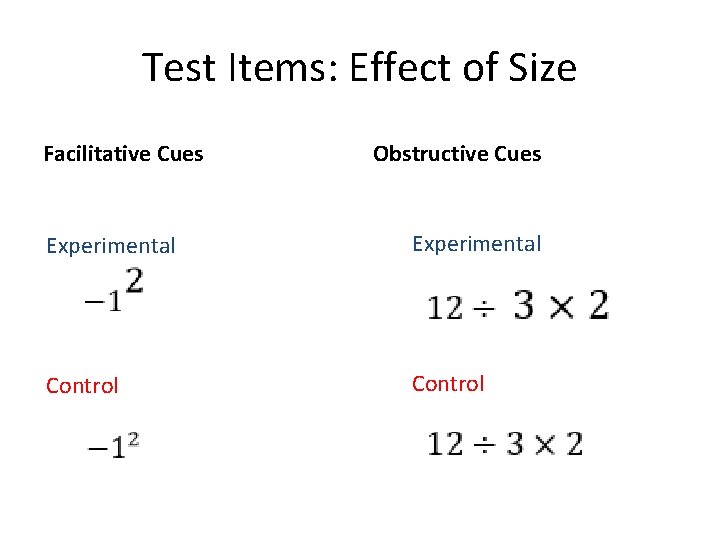
Test Items: Effect of Size Facilitative Cues Obstructive Cues Experimental Control
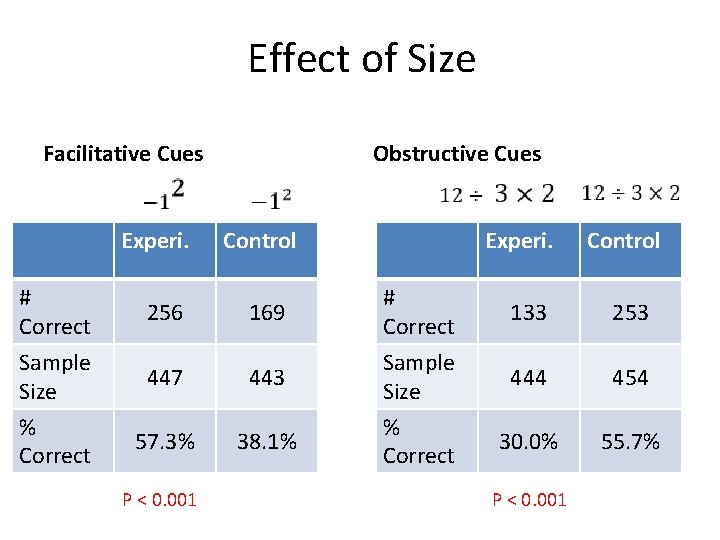
Effect of Size Facilitative Cues Experi. # Correct Sample Size % Correct Obstructive Cues Control 256 169 447 443 57. 3% P < 0. 001 38. 1% Experi. # Correct Sample Size % Correct Control 133 253 444 454 30. 0% 55. 7% P < 0. 001
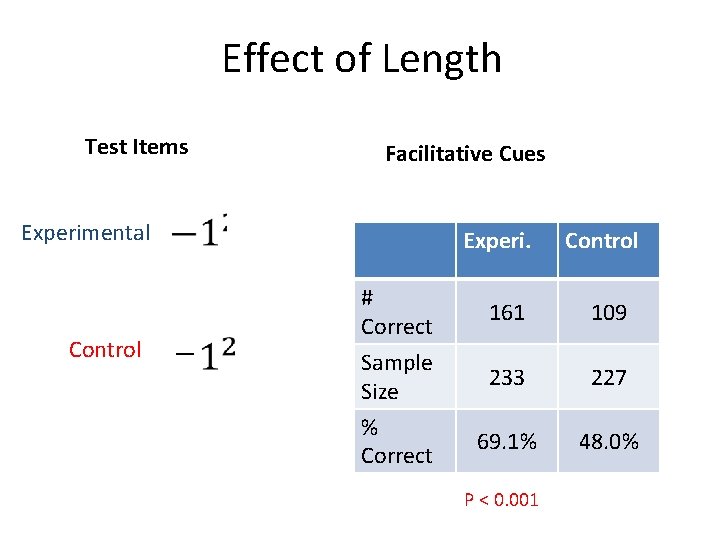
Effect of Length Test Items Experimental Control Facilitative Cues Experi. – # Correct Sample Size % Correct Control 161 109 233 227 69. 1% 48. 0% P < 0. 001
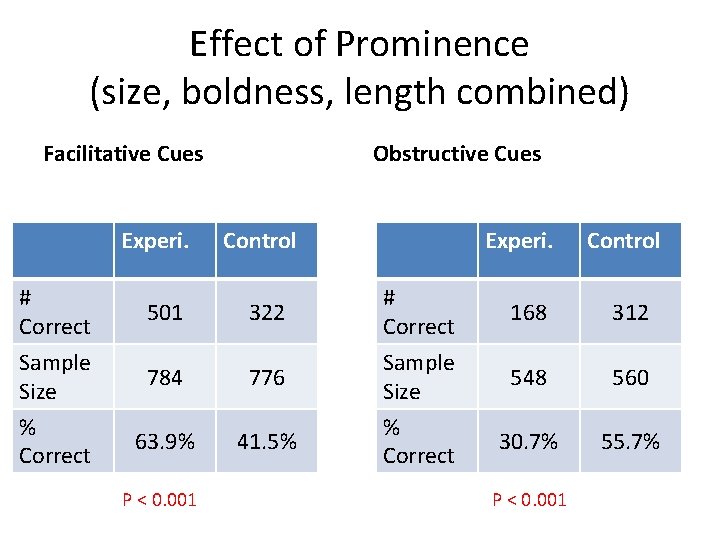
Effect of Prominence (size, boldness, length combined) Facilitative Cues Experi. # Correct Sample Size % Correct Obstructive Cues Control 501 322 784 776 63. 9% P < 0. 001 41. 5% Experi. # Correct Sample Size % Correct Control 168 312 548 560 30. 7% 55. 7% P < 0. 001
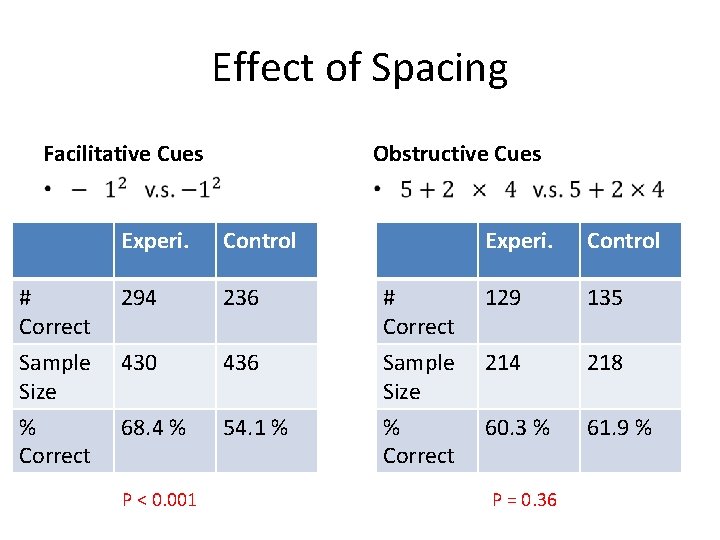
Effect of Spacing Facilitative Cues Obstructive Cues • • Experi. Control # Correct Sample Size 294 236 430 436 % Correct 68. 4 % 54. 1 % P < 0. 001 Experi. Control # Correct Sample Size 129 135 214 218 % Correct 60. 3 % 61. 9 % P = 0. 36
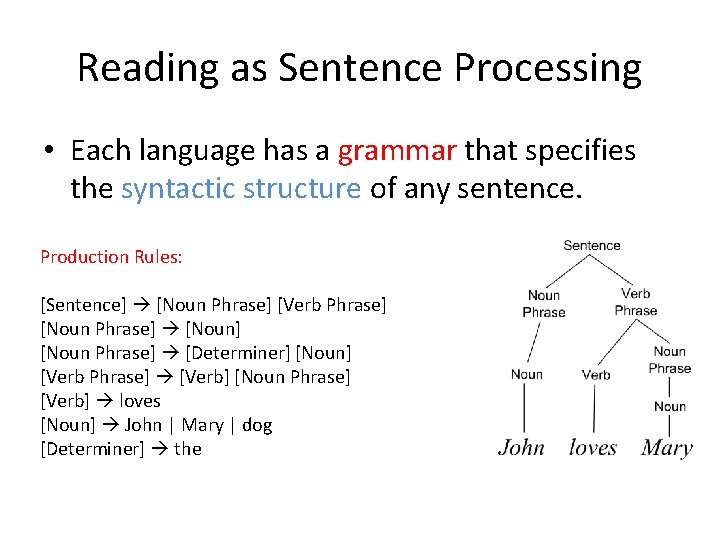
Reading as Sentence Processing • Each language has a grammar that specifies the syntactic structure of any sentence. Production Rules: [Sentence] [Noun Phrase] [Verb Phrase] [Noun Phrase] [Noun] [Noun Phrase] [Determiner] [Noun] [Verb Phrase] [Verb] [Noun Phrase] [Verb] loves [Noun] John | Mary | dog [Determiner] the
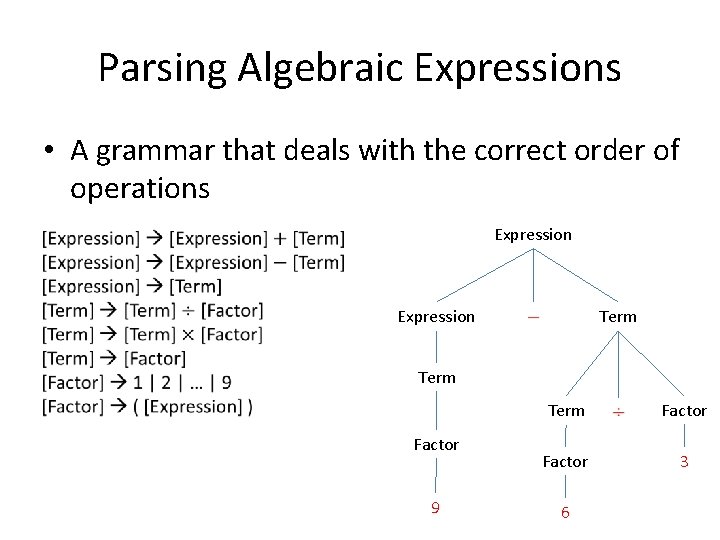
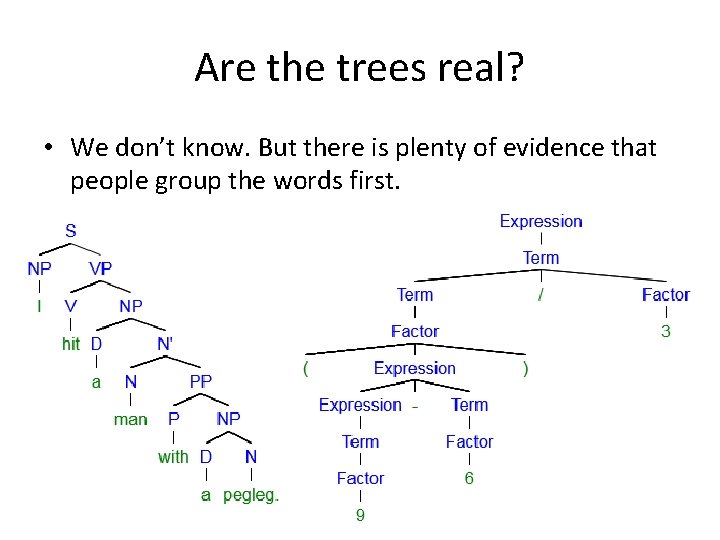
Parsing Algebraic Expressions • A grammar that deals with the correct order of operations Expression Term Factor 9 Factor 6 Factor 3
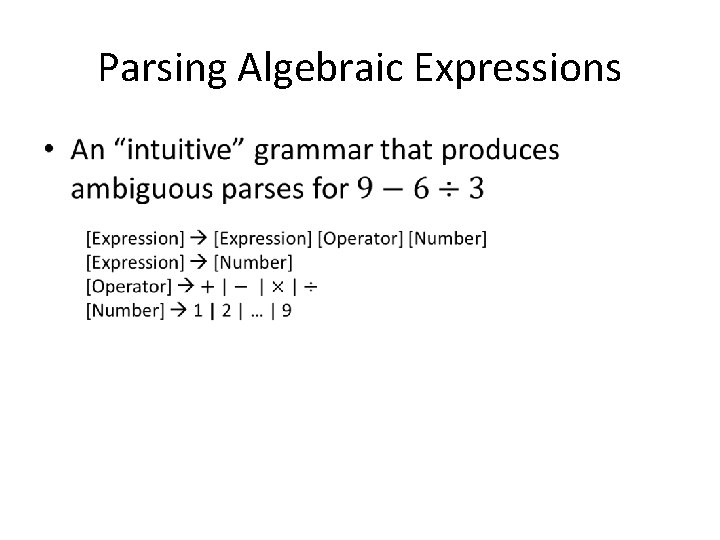
Parsing Algebraic Expressions •
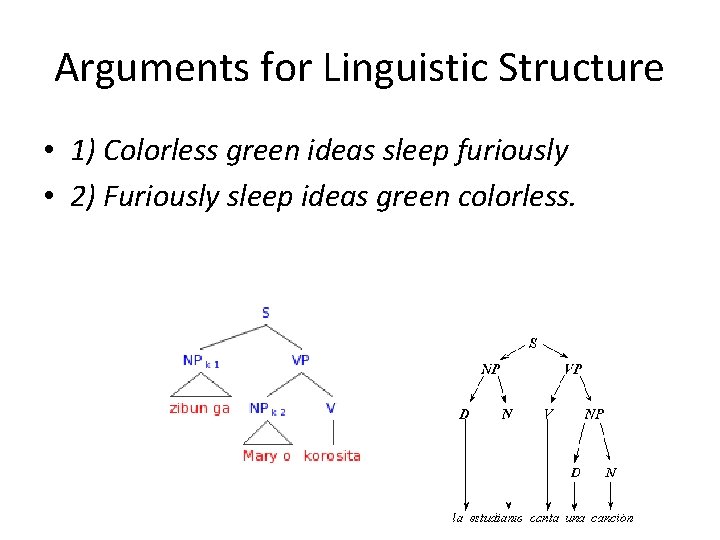
Are the trees real? • We don’t know. But there is plenty of evidence that people group the words first.
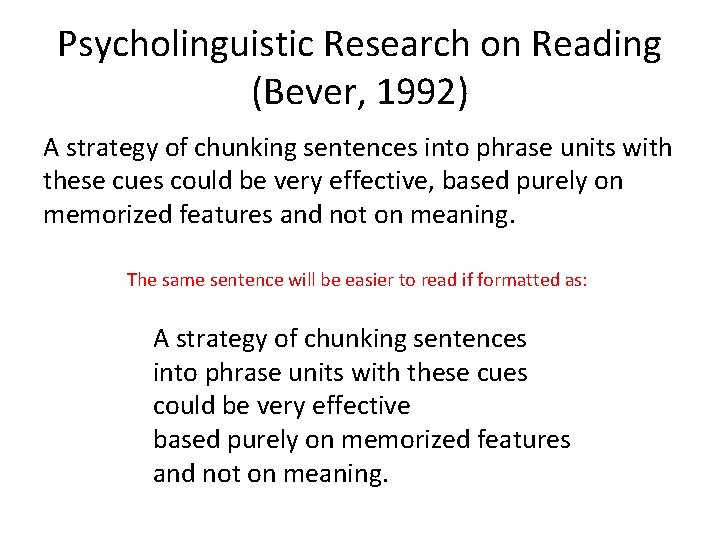
Psycholinguistic Research on Reading (Bever, 1992) A strategy of chunking sentences into phrase units with these cues could be very effective, based purely on memorized features and not on meaning. The same sentence will be easier to read if formatted as: A strategy of chunking sentences into phrase units with these cues could be very effective based purely on memorized features and not on meaning.
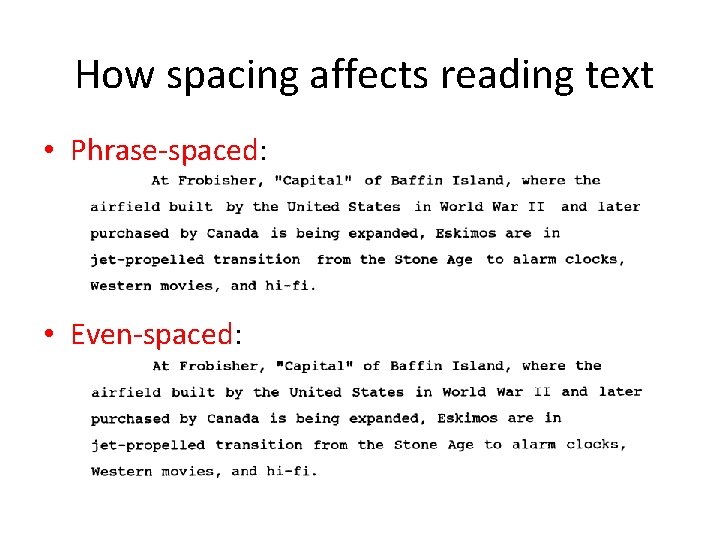
How spacing affects reading text • Phrase-spaced: • Even-spaced:
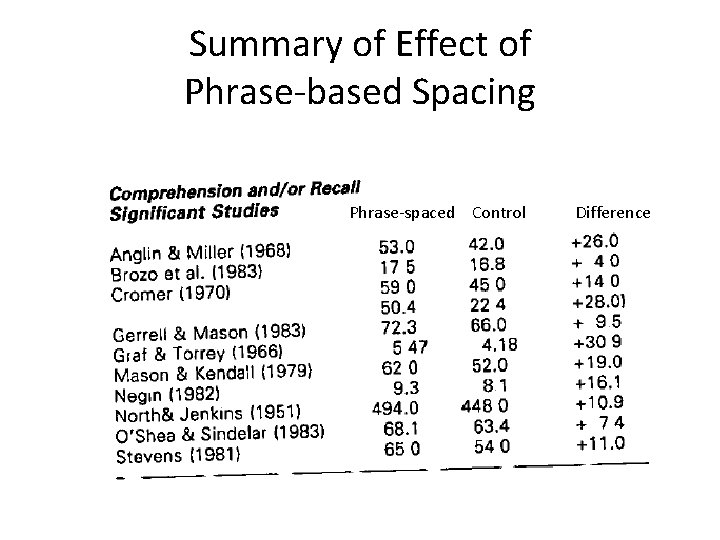
Main findings regarding Effect of Spacing • Cromer (1970): people with good vocabulary and reading disabilities benefit from extra spacing that shows the correct grouping of words. • Bever (1991, 1992): Formatting the text with spacing cues improves the comprehension of average readers, but no effect on advanced readers.
Summary of Effect of Phrase-based Spacing Phrase-spaced Control Difference
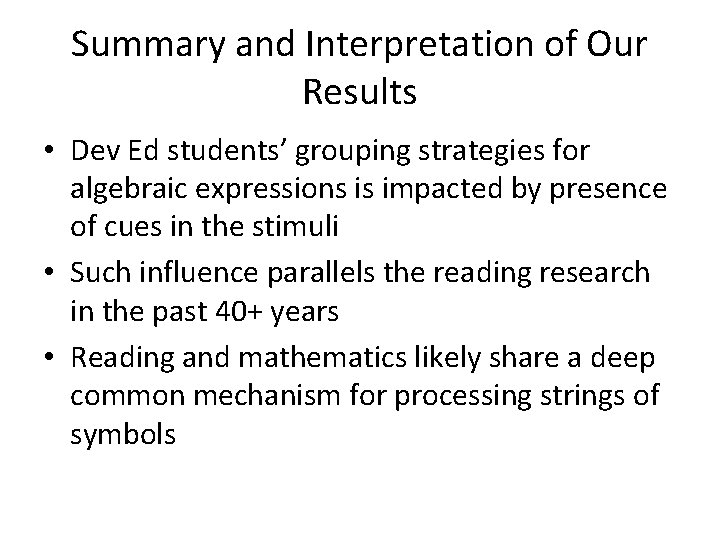
Summary and Interpretation of Our Results • Dev Ed students’ grouping strategies for algebraic expressions is impacted by presence of cues in the stimuli • Such influence parallels the reading research in the past 40+ years • Reading and mathematics likely share a deep common mechanism for processing strings of symbols
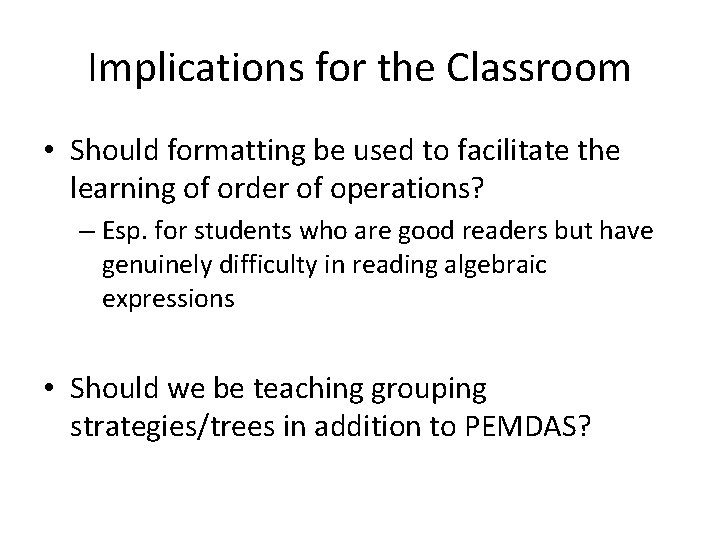
Implications for the Classroom • Should formatting be used to facilitate the learning of order of operations? – Esp. for students who are good readers but have genuinely difficulty in reading algebraic expressions • Should we be teaching grouping strategies/trees in addition to PEMDAS?
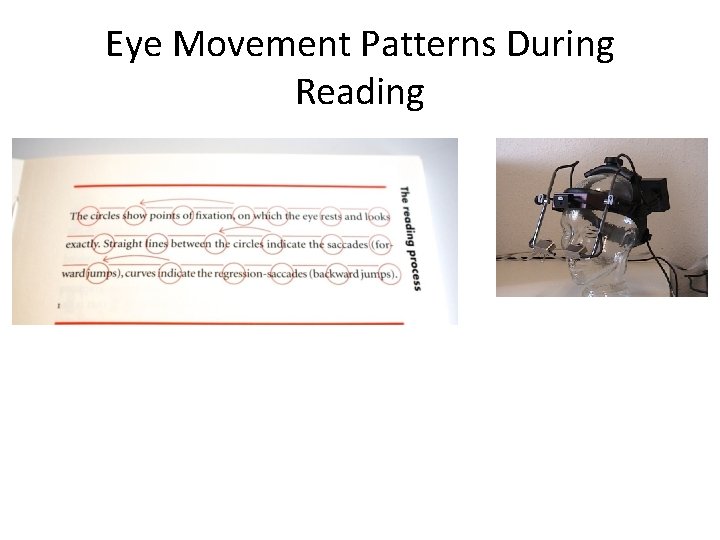
Future Explorations • New task / design – Measuring speed as well as accuracy. – Within-subject design to minimize the effect of test items • Automatic formatting of teaching materials • Using eye-tracking to identify the rapid eye movements during reading algebraic expressions
Eye Movement Patterns During Reading
References • Bever, T. G. , Jandreau, S. , Burwell, R. , Kaplan, R. , & Zaenan, A. (1991). Spacing printed text to isolate major phrases improves readability. Visible Language, 25, 74– 87. • Cromer, W. (1970). The Difference Model: A New Explanation of Some Reading Difficulties. Journal of Educational Psychology, 61 • Jandreau, S. , & Bever, T. G. (1992). Phrase-spaced formats improve comprehension in average readers. Journal of Applied Psychology, 77, 143– 146. • Mac. Gregor, M. & Price, E (1999). An Exploration of Aspects of Language Proficiency and Algebra Learning. Journal for Research in Mathematics Education, 30. 4. • Shattuck-Hufnagel, S. , & Turk, A. E. (1996). A prosody tutorial for investigators of auditory sentence processing. Journal of Psycholinguistic Research, 25(2),
Acknowledge • Assistance with data collection: – Norco College: Debbie Smith, Joseph De. Guzman, Steven Park, Andy Robles – Fullerton College: Mareike Claasen – SRJC: Carlos Valencia, Amy Flores
Richard. S. Ries@gmail. com Or ylin@santarosa. edu
Arguments for Linguistic Structure • 1) Colorless green ideas sleep furiously • 2) Furiously sleep ideas green colorless.
Acoustic Cues for Sentence Processing