
A cloudbased architecture for supporting medical imaging analysis
A cloud-based architecture for supporting medical imaging analysis through INDIGO-Data. Cloud Ignacio Blanquer, Germán Moltó, Miguel Caballer (UPV) Luis Martí-Bonmatí, Angel Alberich, (HUPLF)
Contents • Euro. Bio. Imaging, BIMCV and INDIGO-Data. Cloud. • The Use Case • • • Objectives. Life-cycle. Requirements. Design. Implementation proposal. • Conclusions. EGI Conference - Amsterdam 08/04/2016 2
Euro. Bio. Imaging www. eurobioimaging. eu • Euro. Bio. Imaging is a Distributed imaging infrastructure for microscopy, molecular and medical imaging • 24 countries and more than 100 institutions participating in the preparatory phase. • Structured in the form of a network of nodes. • Euro. Bio. Imaging opened a call on late 2013 for nodes with 71 proposals received from 221 institutions • In 8/12/2015, a subset of 28 nodes were ratified by the national delegates and the Euro. Bio. Imaging board, as the initial core of nodes (http: //www. eurobioimaging. eu/contentnews/euro-bioimaging-appoints-its-hub-and-nominates-first-generation-nodes) • BIM-CV (a node led by the CEIB and with the participation of UPV) was ratified as an official Node. • The role of the UPV in BIM-CV is to address the computing requirement issues within BIM-CV. EGI Conference - Amsterdam 08/04/2016 3
INDIGO-Data. Cloud (https: //www. indigo-datacloud. eu/) • H 2020 Project aiming at developing an Open Source Cloud Platform for computing and data tailored to Science. • Already presented in the Conference by Giacinto Donvito in session https: //indico. egi. eu/indico /event/2875/session/11/ contribution/77 EGI Conference - Amsterdam 08/04/2016 4
Main use Case: Population Imaging • BIMCV hosts a population database from a regional area of 5 Million people • About 5. 3 Million of clinical cases per year from 210 different image modalities. • BIMCV will provide access to external projects to its databank through Euro. Bio. Imaging • BIMCV will provide processing tools and pipelines and will allow the use of any third party tool. • BIMCV can only provide computing resources to small-scale projects (less than 100 cores and 100 TBs) • BIMCV is interested on acting as broker for accessing computing resources, but not directly providing massive capacity. EGI Conference - Amsterdam 08/04/2016 5
The Use case Lifecycle • BIMCV will receive applications for projects • Projects describe data, software and computing requirements. • E. g. A brain atlas for a given population segment and diagnostic. • If positive evaluated, the matching imaging studies will be made available to the researchers in a shared space • Projects will be provided with the means to create a virtual infrastructure where the requested data will be available and a set of computing nodes to process them • If requested, access to resources will be negotiated, despite that it could be executed using on-premise or public infrastructures. • Additionally the researchers will have access to recipes to configure and customize Virtual Appliances • Researchers deploy the VAs on BIMCV’s infrastructure, own one or third parties’ one. EGI Conference - Amsterdam 08/04/2016 6
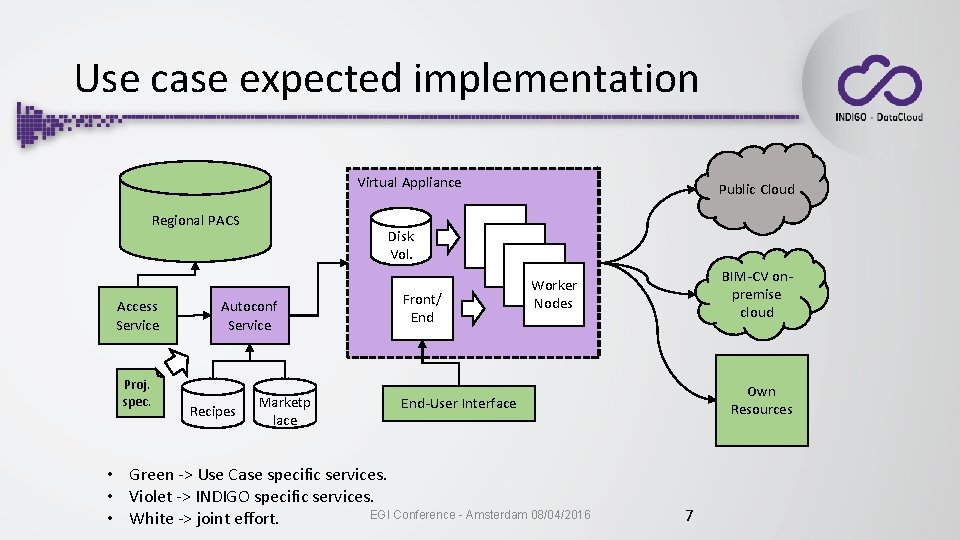
Use case expected implementation Virtual Appliance Regional PACS Access Service Proj. spec. Disk Vol. Autoconf Service Recipes Public Cloud Marketp lace Front/ End BIM-CV onpremise cloud Worker Nodes Own Resources End-User Interface • Green -> Use Case specific services. • Violet -> INDIGO specific services. EGI Conference - Amsterdam 08/04/2016 • White -> joint effort. 7
More precise example • Development of an automatic analysis of Bone density • Data request, few hundreds of abdominal CT images (~100 GB) with patient metadata (age, sex, weight, height, up to three ICD-10 coded diagnosis). Osteoporotic patients and controls. • Step 1: (Admin privileges) Fetch and anonymise data (dcm 2 nii from MICRON), converting it into nifty (http: //nifti. nimh. nih. gov/nifti-1), and copy it into a volume. The volume ID is provided to the subproject IT contact. • Step 2: (subproject IT privileges) Define the execution environment (expert guided). It will comprise XNAT + batch queue (condor) + tools on the nodes (Caffe, own image quality analysis, octave), visualization with dcm 4 chee. • We can leverage GPUs if available. • Step 3: (subproject IT privileges) Deploy the environment with the volume mounted (Read only), and additional (Read & Write) volumes for results. • Step 4: (end-user privileges) Access the portal (XNAT) run pipelines and produce results. No need, in this use case, of additional user management. • Aim 1: Refine the deep-learning segmentation system for the population selected. • Aim 2: Validate the Bone density analysis written in Octave and python. Reports are written in Jasper. • During the process direct Access to the resources will be needed to refine, correct, update and fine-tune the system. EGI Conference -with Amsterdam 08/04/2016 • Currently, this is done on a local infrastructre manual intervention. 8
Use case requirements • Storage • • • Persistent (but medium-term) data storage volumes with standard POSIX file access. ACL in the access to data volumes. Online access to data. Management of users and groups. Long-term availability of results. • Computing • Execution of data-driven and computing-intensive workflows. • Resources adaptation to workload. • Provenance and repeatability of experiments. • Autoconfiguration • Availability of customised software. • Deployment of own software. • Terminal access to the resources. EGI Conference - Amsterdam 08/04/2016 9
INDIGO Components • IM • Deployment and configuration of complex application architectures on multiple back-ends • http: //www. grycap. upv. es/im • Ansible galaxy • A public repository of Ansible configuration recipes. • https: //galaxy. ansible. com/ • CLUES • Elastic management of batch queues • http: //www. grycap. upv. es/clues • One. Dock • Support for Docker containers in Open. Nebula as lightweigth VMs • http: //github. com/indigo-dc/onedock • One. Data • Global data storage solution for distributed infrastructures • http: //oneadata. org EGI Conference - Amsterdam 08/04/2016 11
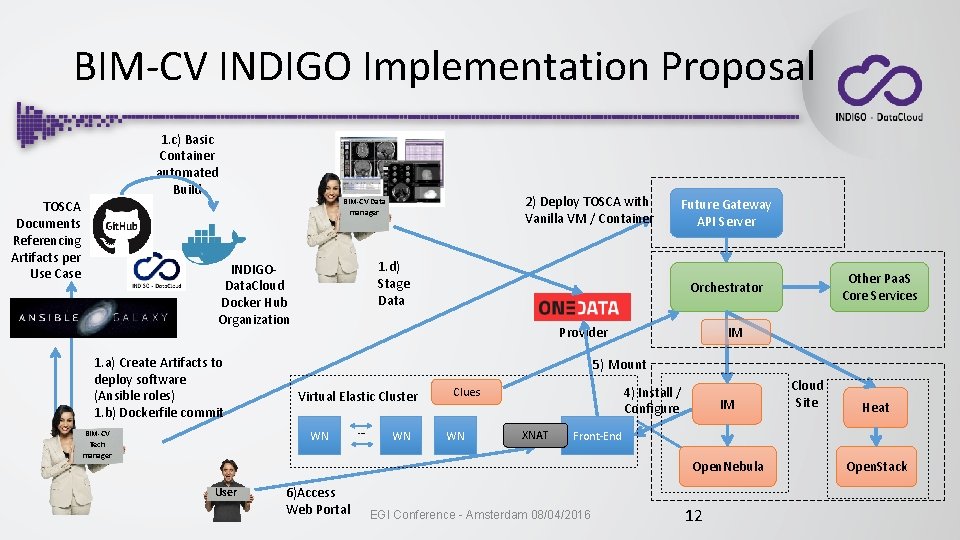
BIM-CV INDIGO Implementation Proposal 1. c) Basic Container automated Build TOSCA Documents Referencing Artifacts per Use Case IM 5) Mount Virtual Elastic Cluster … WN 4) Install / Configure Clues WN XNAT IM 6)Access Web Portal Cloud Site Heat Front-End Open. Nebula User Other Paa. S Core Services Orchestrator Provider WN BIM-CV Tech manager Future Gateway API Server 1. d) Stage Data INDIGOData. Cloud Docker Hub Organization 1. a) Create Artifacts to deploy software (Ansible roles) 1. b) Dockerfile commit 2) Deploy TOSCA with Vanilla VM / Container BIM-CV Data manager EGI Conference - Amsterdam 08/04/2016 12 Open. Stack
Conclusions • BIM-CV aims at providing access to population imaging medical data and an environment for its processing • Versatility, efficiency, no vendor lock-in are the main design criteria. • Efficient data access is needed, although differing from other use cases on the use of a dedicated sub-repository. • INDIGO Datacloud model will help on encapsulating different software requirements from multiple sub-projects, as well as preserving sub-repositories. EGI Conference - Amsterdam 08/04/2016 13
- Slides: 12