
A Closer Look At Vocational Rehabilitation College Training
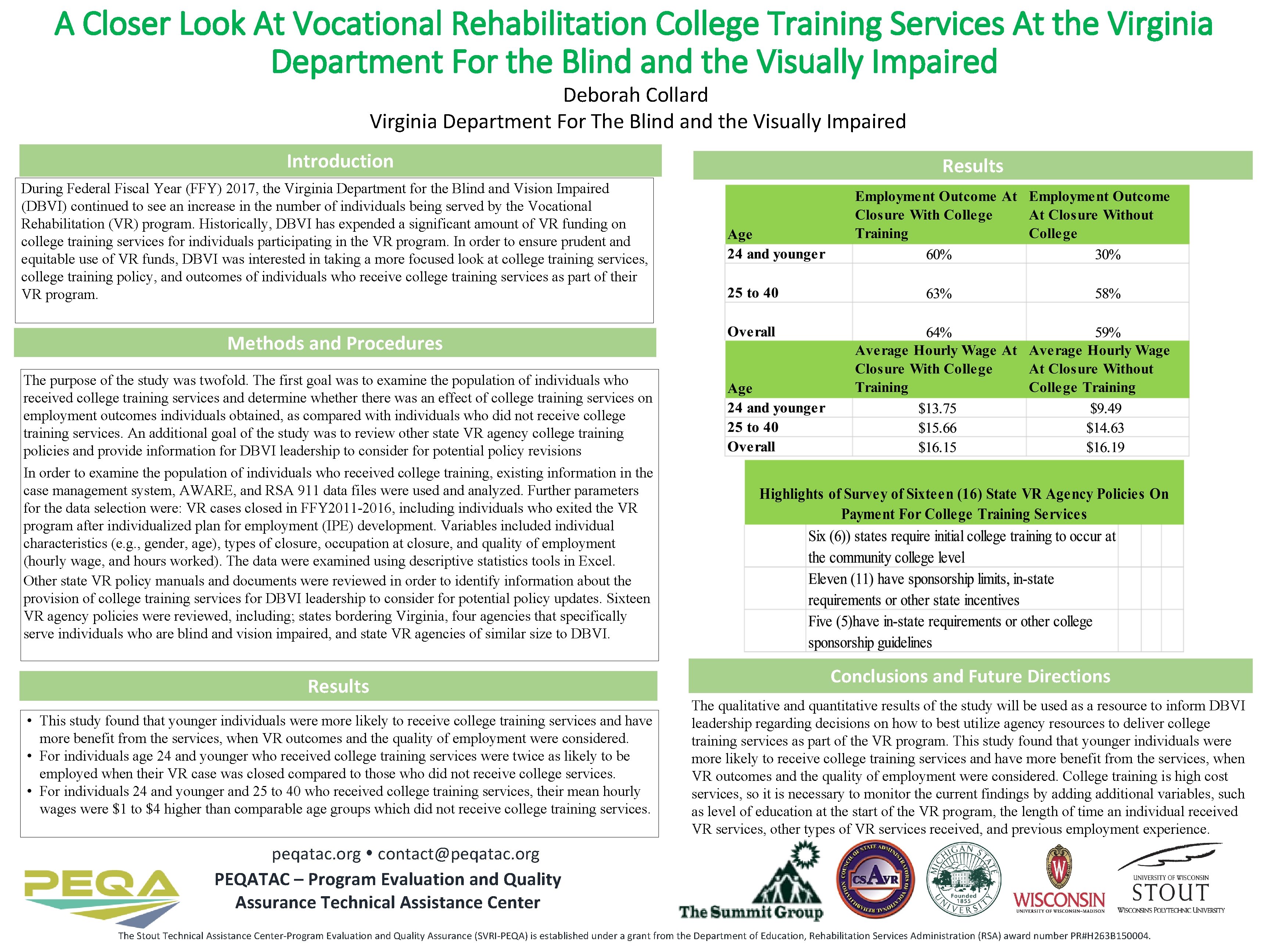
A Closer Look At Vocational Rehabilitation College Training Services At the Virginia Department For the Blind and the Visually Impaired Deborah Collard Virginia Department For The Blind and the Visually Impaired Introduction Results During Federal Fiscal Year (FFY) 2017, the Virginia Department for the Blind and Vision Impaired (DBVI) continued to see an increase in the number of individuals being served by the Vocational Rehabilitation (VR) program. Historically, DBVI has expended a significant amount of VR funding on college training services for individuals participating in the VR program. In order to ensure prudent and equitable use of VR funds, DBVI was interested in taking a more focused look at college training services, college training policy, and outcomes of individuals who receive college training services as part of their VR program. Methods and Procedures The purpose of the study was twofold. The first goal was to examine the population of individuals who received college training services and determine whethere was an effect of college training services on employment outcomes individuals obtained, as compared with individuals who did not receive college training services. An additional goal of the study was to review other state VR agency college training policies and provide information for DBVI leadership to consider for potential policy revisions In order to examine the population of individuals who received college training, existing information in the case management system, AWARE, and RSA 911 data files were used analyzed. Further parameters for the data selection were: VR cases closed in FFY 2011 -2016, including individuals who exited the VR program after individualized plan for employment (IPE) development. Variables included individual characteristics (e. g. , gender, age), types of closure, occupation at closure, and quality of employment (hourly wage, and hours worked). The data were examined using descriptive statistics tools in Excel. Other state VR policy manuals and documents were reviewed in order to identify information about the provision of college training services for DBVI leadership to consider for potential policy updates. Sixteen VR agency policies were reviewed, including; states bordering Virginia, four agencies that specifically serve individuals who are blind and vision impaired, and state VR agencies of similar size to DBVI. Results • This study found that younger individuals were more likely to receive college training services and have more benefit from the services, when VR outcomes and the quality of employment were considered. • For individuals age 24 and younger who received college training services were twice as likely to be employed when their VR case was closed compared to those who did not receive college services. • For individuals 24 and younger and 25 to 40 who received college training services, their mean hourly wages were $1 to $4 higher than comparable age groups which did not receive college training services. Conclusions and Future Directions The qualitative and quantitative results of the study will be used as a resource to inform DBVI leadership regarding decisions on how to best utilize agency resources to deliver college training services as part of the VR program. This study found that younger individuals were more likely to receive college training services and have more benefit from the services, when VR outcomes and the quality of employment were considered. College training is high cost services, so it is necessary to monitor the current findings by adding additional variables, such as level of education at the start of the VR program, the length of time an individual received VR services, other types of VR services received, and previous employment experience. peqatac. org contact@peqatac. org PEQATAC – Program Evaluation and Quality Assurance Technical Assistance Center The Stout Technical Assistance Center-Program Evaluation and Quality Assurance (SVRI-PEQA) is established under a grant from the Department of Education, Rehabilitation Services Administration (RSA) award number PR#H 263 B 150004.
- Slides: 1