
A CLOSER LOOK AT VISIBLE LIGHT ASTRONOMY CH
A CLOSER LOOK AT VISIBLE LIGHT ASTRONOMY – CH. 20
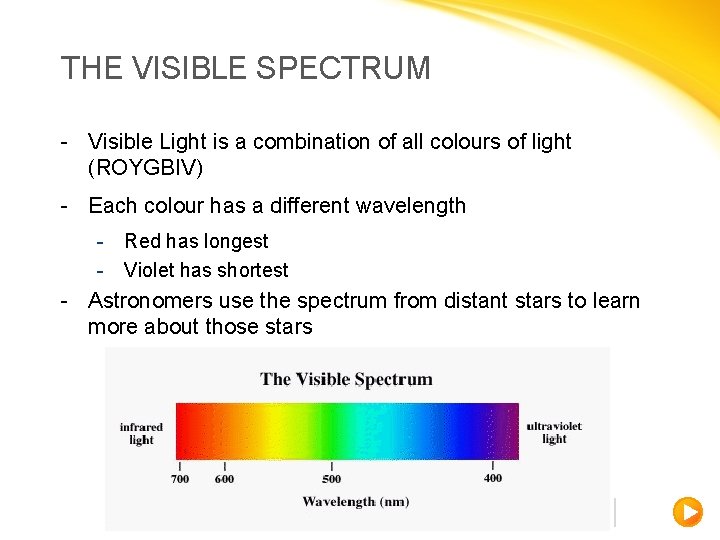
THE VISIBLE SPECTRUM - Visible Light is a combination of all colours of light (ROYGBIV) - Each colour has a different wavelength - Red has longest - Violet has shortest - Astronomers use the spectrum from distant stars to learn more about those stars
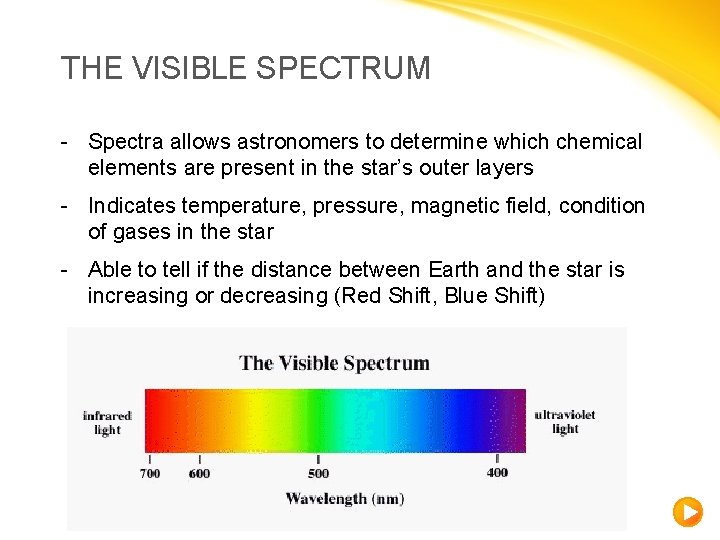
THE VISIBLE SPECTRUM - Spectra allows astronomers to determine which chemical elements are present in the star’s outer layers - Indicates temperature, pressure, magnetic field, condition of gases in the star - Able to tell if the distance between Earth and the star is increasing or decreasing (Red Shift, Blue Shift)

SPECTROSCOPES - A tool used to separate starlight into its colours - Combination of a PRISM and a tiny viewing TELESCOPE - The prism can separate the light into its different colours - There are several kinds of visible spectra

CONTINUOUS SPECTRUM - Unbroken band of colours - Shows that its source is sending out light of all visible wavelengths - Can come from 3 different materials: - A glowing solid (ex: light bulb) - A glowing liquid (ex: molten iron) - A hot compressed gas deep inside a star
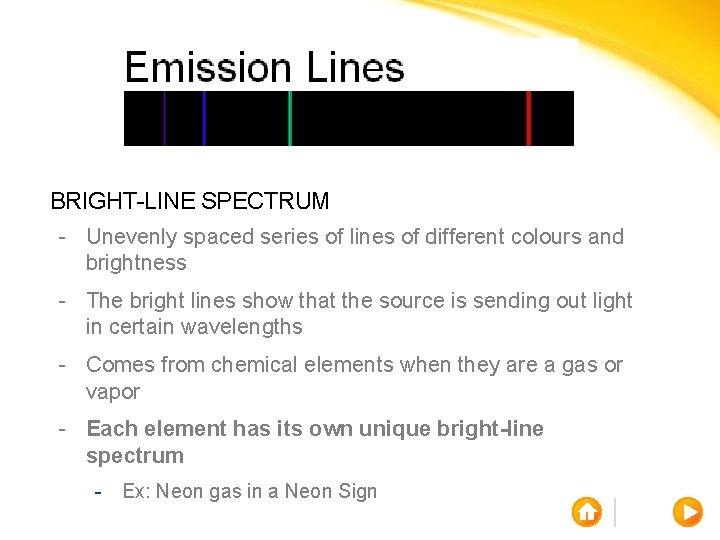
BRIGHT-LINE SPECTRUM - Unevenly spaced series of lines of different colours and brightness - The bright lines show that the source is sending out light in certain wavelengths - Comes from chemical elements when they are a gas or vapor - Each element has its own unique bright-line spectrum - Ex: Neon gas in a Neon Sign

DARK-LINE SPECTRUM - Continuous spectrum with dark lines where light is absorbed - The dark lines are in exactly the same place as the bright lines from the bright-line spectrum - Forms when the light from a continuous spectrum passes through a cooler gas
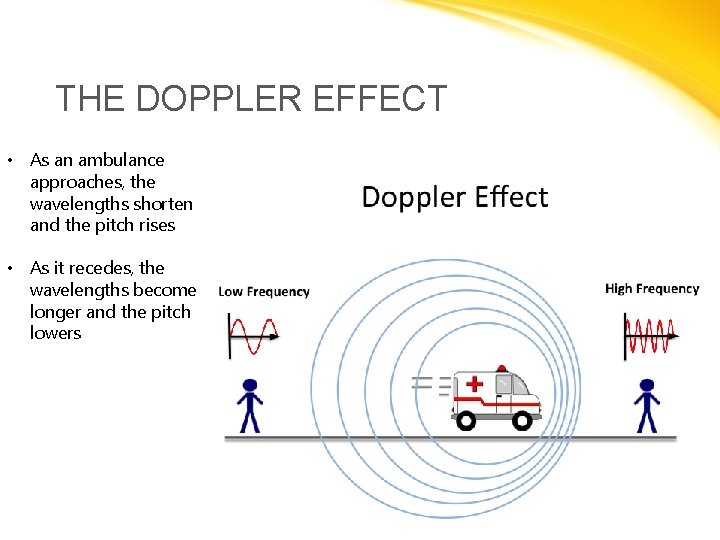
THE DOPPLER EFFECT • As an ambulance approaches, the wavelengths shorten and the pitch rises • As it recedes, the wavelengths become longer and the pitch lowers
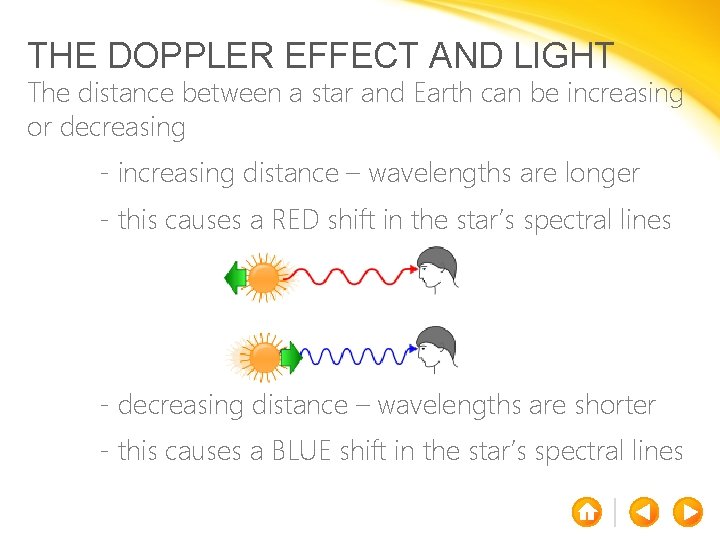
THE DOPPLER EFFECT AND LIGHT The distance between a star and Earth can be increasing or decreasing - increasing distance – wavelengths are longer - this causes a RED shift in the star’s spectral lines - decreasing distance – wavelengths are shorter - this causes a BLUE shift in the star’s spectral lines
- Slides: 9