
A Civilization of Writing Mesopotamia What is a










- Slides: 19
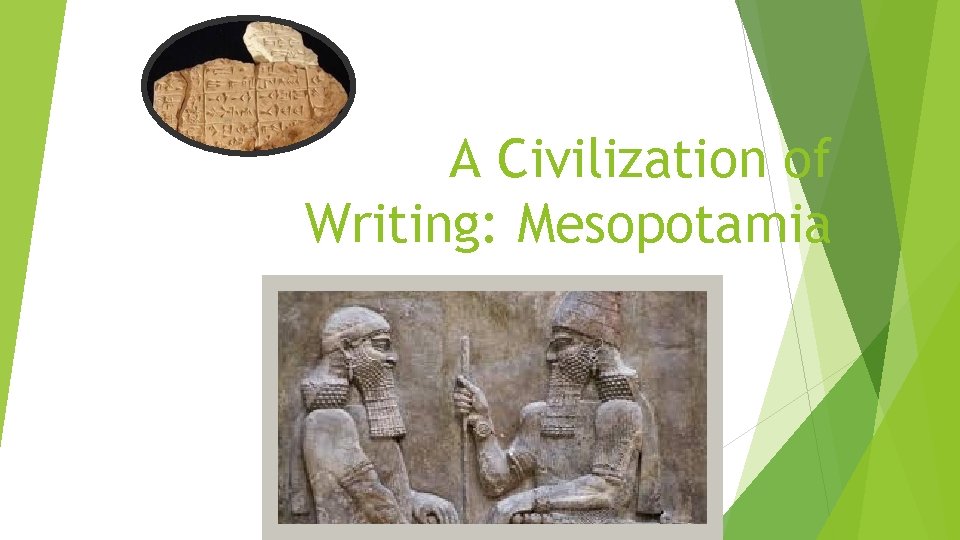
A Civilization of Writing: Mesopotamia
What is a Civilization? In general, a civilization refers to organized societies that have social, religious, artistic, scientific, etc. elements in common.
When?
Early Civilizations Mesopotamian Civilization (around 3500 BCE) • Valley of the Tigris and Euphrates Why Here? Located in the Fertile Crescent (Remember? ). • Located between two rivers (constant source of water). • Spring rains and melting snow flooded the floor of the valley each year (leaving behind sediments) making it rich and fertile. • Numerous marshes, which attracted game and provided fish. •
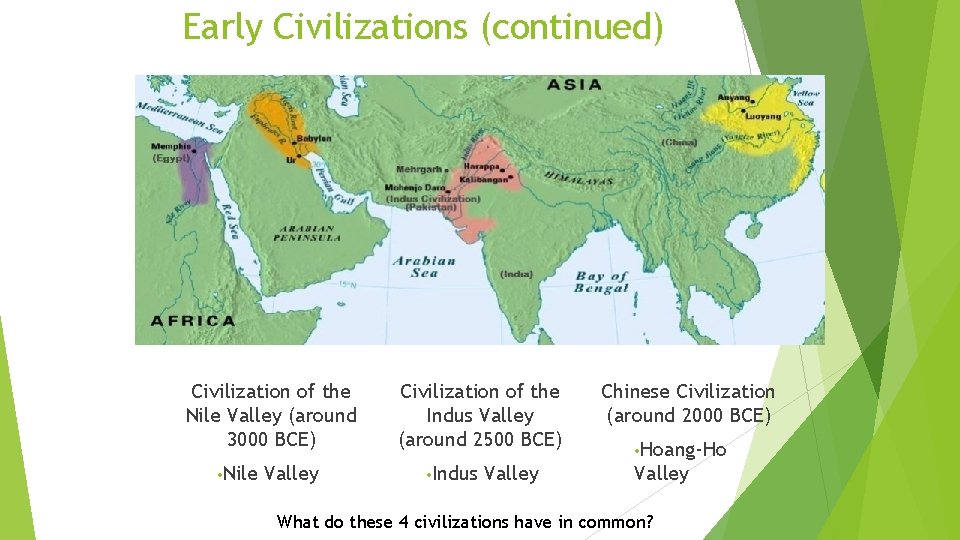
Early Civilizations (continued) * ALL emerged in large valleys crossed by major rivers* Civilization of the Nile Valley (around 3000 BCE) • Nile Valley Civilization of the Indus Valley (around 2500 BCE) • Indus Valley Chinese Civilization (around 2000 BCE) • Hoang-Ho Valley What do these 4 civilizations have in common?
Mesopotamia: From Nomads to Farmers Follow along with the handout and answers the questions Answers 8. Slaves 9. Scribe 10. Judgements 1. Land between two rivers 2. Hold water to prevent flood 3. To know when the floods will come 4. Keep track of trades choses the farmers 5. Clay tablets Repairs the temples 6. Cuneiform 11. burdens 7. Ziggurat 12. time trade with other cities
Mesopotamia: The Land Between the Rivers Complete Worksheet 3 Page 35 in the text #2 -3
Irrigation System Regular flood inundated the land leaving behind sediments and fertile land. Mesopotamians learned to tame the flood and use the water. Farmers learned to dig tanks in the ground to store some of the flood water for later use… They also built dikes to create storage reservoirs for the water… Constructed many irrigation canals across the flat flood plain to carry water to the fields…
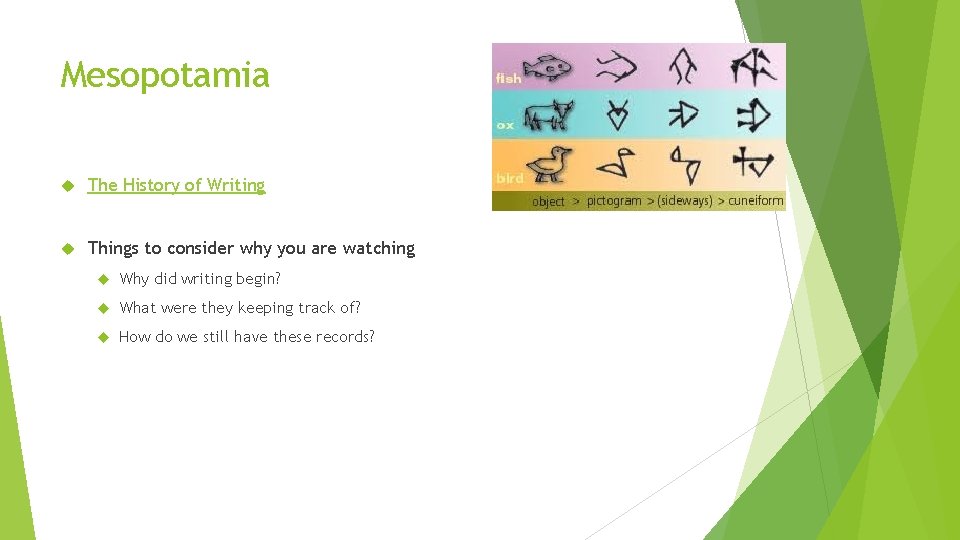
Mesopotamia The History of Writing Things to consider why you are watching Why did writing begin? What were they keeping track of? How do we still have these records?
The Need for Records To keep records of the foods and goods kept in their stores and warehouses… Record transactions because Kings wanted to issue orders and keep accounts of their wars… The transfer of property and the regulation of society demanded some form of keeping records…
The Development of Writing Thousands of written records have been found by archaeologists in Mesopotamia (most were written on clay tablets)… Stone was used if the record was meant to be more permanent… Scholars have learned how to translate most of them : )
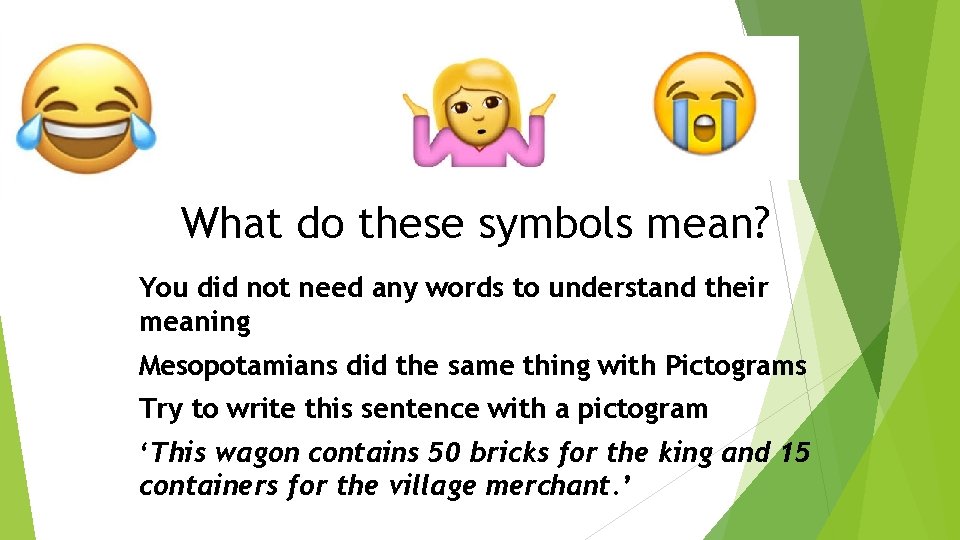
What do these symbols mean? You did not need any words to understand their meaning Mesopotamians did the same thing with Pictograms Try to write this sentence with a pictogram ‘This wagon contains 50 bricks for the king and 15 containers for the village merchant. ’
The Development of Writing About 3000 BCE “pictograph signs” were used to record stores… Each sign was a simple picture of the object (about 1200 signs were used to record objects or actions)… A sharpened reed was used to scratch these signs onto a slab of wet clay (later the slab would be baked hard to be kept as a permanent record)… What do you think the pictographs in the picture above represent?
The Development of Writing (continued) After about 2500 BCE a wedge-shaped stylus was used to press the signs into the clay (which was faster)… This type of writing is called “cuneiform”… The pictographs were changed into groups of impressions made by the stylus in the clay…
The Development of Writing (continued) By about 2000 BCE, the number of signs that the scribes had to learn had been reduced to about 600… Early records were written in vertical columns starting at the top right of the clay tablet (but scribes later found it easier to make the stylus marks in horizontal rows starting from the left side)…
The Development of Writing (continued) Finally, scribes found that a sign could denote a sound… Each sign represented a syllable (two or more signs could be combined to make a word) = phonetic symbols… This system was not as simple as our alphabet but it allowed information to be recorded more easily!
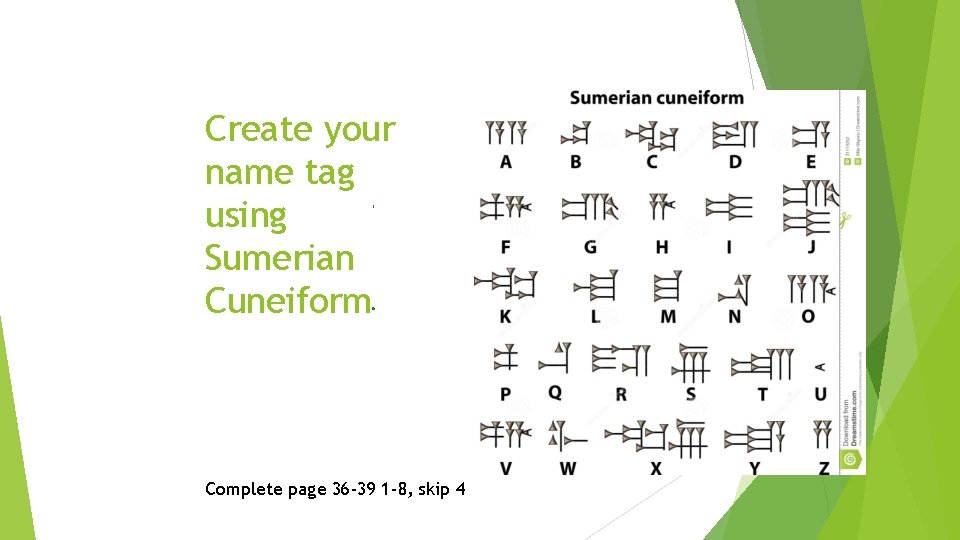
Create your name tag using Sumerian Cuneiform Complete page 36 -39 1 -8, skip 4
Today Hand in Cuneiform Name Tag Take up page 36 -39 1 -8, skip 4 Watch Mesopotamia- National Geographic