
A Christmas Carol Stave Four Tuesday Learning purposes





- Slides: 16
A Christmas Carol Stave Four Tuesday
Learning purposes • To read and understand Stave 4 • To analyse the presentation of key characters in the novella • To explore how Victorian London is presented in the novella and consider Dickens’ intentions. Recap from last week’s lesson: • How have the Cratchit family been presented? • In what ways have children been presented in the novella? Why has Dickens presented children in these ways? Future learning: Ø We are going to develop our analytical writing skills by analysing key extracts in A Christmas Carol. Ø We are developing a sound knowledge of the plot, characters and themes in the novella. Ø Extract assessment before half term.
Ignorance and Want recap Explore how Dickens presents Ignorance and Want in the extract. Dickens presents Ignorance and Want as….
Words of the day KEY THEMES/IDEAS WITHIN THE TEXT: • Social injustice – lack of fairness in society • Social responsibility – acting for the benefit of all individuals within a society • Social commentary - implementing or promoting change by informing the general populace about a given problem and appealing to people's sense of justice.
Key Terms… • A Christmas Carol highlights social injustice because… • Dickens introduces the idea of social responsibility when… • A Christmas Carol is Dickens’ social commentary on a number of issues that blighted Victorian society, including…
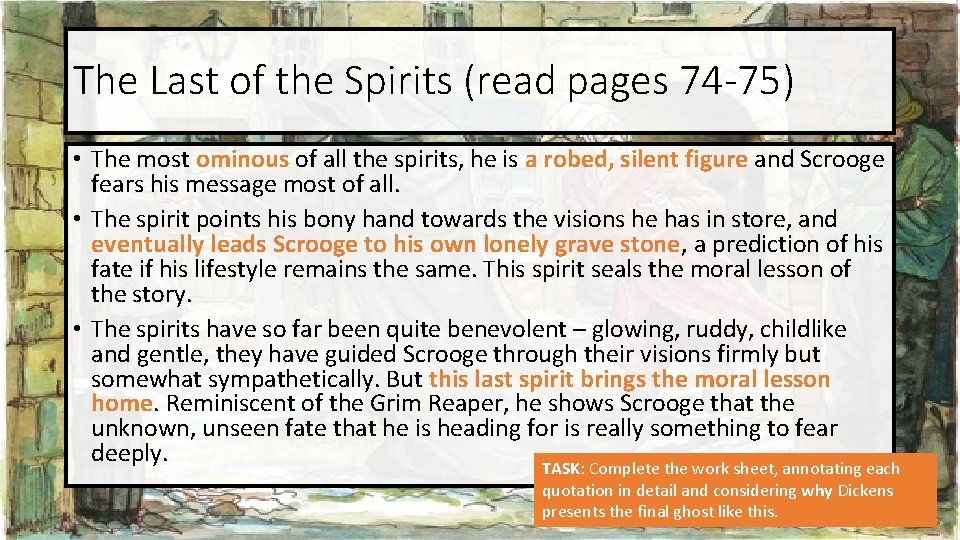
The Last of the Spirits (read pages 74 -75) • The most ominous of all the spirits, he is a robed, silent figure and Scrooge fears his message most of all. • The spirit points his bony hand towards the visions he has in store, and eventually leads Scrooge to his own lonely grave stone, a prediction of his fate if his lifestyle remains the same. This spirit seals the moral lesson of the story. • The spirits have so far been quite benevolent – glowing, ruddy, childlike and gentle, they have guided Scrooge through their visions firmly but somewhat sympathetically. But this last spirit brings the moral lesson home. Reminiscent of the Grim Reaper, he shows Scrooge that the unknown, unseen fate that he is heading for is really something to fear deeply. TASK: Complete the work sheet, annotating each quotation in detail and considering why Dickens presents the final ghost like this.
Read pages 75 (They scarcely seemed to enter the city) -77 (the solution of these riddles easy) How does Dickens show that the business men are not concerned about the death of this man? What type of image would the 19 th century reader get of London from this part of the novella? TASK: Annotate extract 1 on your sheet.
Read pages 77 (Quiet and dark) – 81 (Merciful heaven, what is this) How does Dickens present Old Joe, Mrs Dilber and ‘the woman’? What type of image would the 19 th century reader get of London from this part of the novella? TASK: Annotate extract 2 on your sheet.
How does Dickens present the setting of London in Stave 4 of A Christmas Carol? Use the structure below to write a paragraph analysing the presentation of London in both extracts. A Christmas Carol is Dickens’ social commentary on a number of issues that blighted Victorian society, including poverty and the divide between the rich and poor. This is evident in Stave 4 when State how London is presented analyse a quotation closely Dickens………………. . …………………. . …. …. . This is later contrasted only a few paragraphs later when State how London is presented analyse a quotation closely Dickens…………………………. …. …. deliberately presents these juxtaposing depictions of London in such close proximity to illustrate to the Victorian readers…
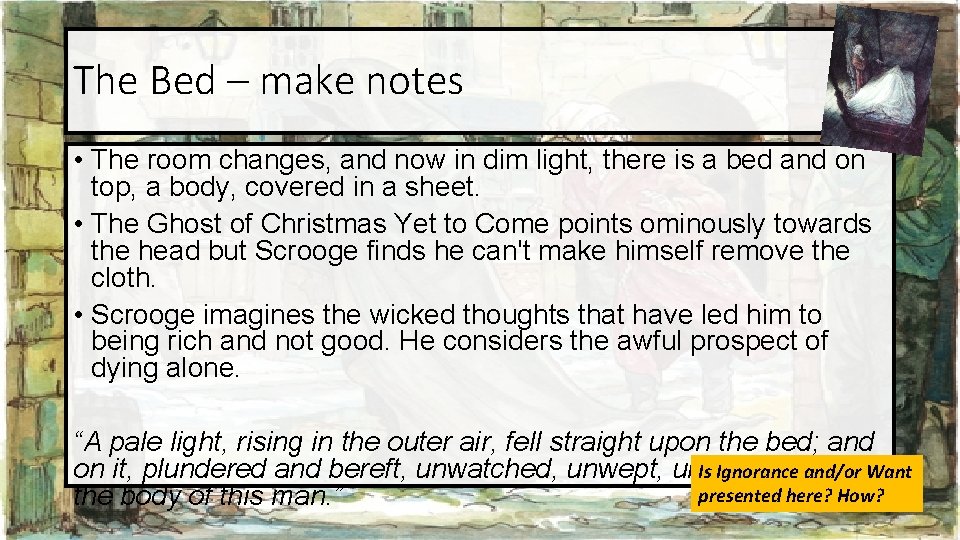
The Bed – make notes • The room changes, and now in dim light, there is a bed and on top, a body, covered in a sheet. • The Ghost of Christmas Yet to Come points ominously towards the head but Scrooge finds he can't make himself remove the cloth. • Scrooge imagines the wicked thoughts that have led him to being rich and not good. He considers the awful prospect of dying alone. “A pale light, rising in the outer air, fell straight upon the bed; and on it, plundered and bereft, unwatched, unwept, uncared for, was. Want Is Ignorance and/or presented here? How? the body of this man. ”
The Husband Wife – make notes • Scrooge begs to see one person who is sorry for this dead man. They visit the home of a young family; he tells his wife that the man they are indebted to is dead. • Even the omnipotent ghost is unable to find a single scene that shows any sadness for the loss of this man. In fact, the world seems to be better off for him being gone. • Scrooge seems to have a sense that the fate he is witnessing is his own. Through the story of this dead man, Scrooge finally realises how his own lifestyle has set him up for a fate worse than death. “We may sleep tonight with light hearts Caroline!” Is Ignorance and/or Want presented here? How?
The Cratchit Family How were the Cratchit family presented earlier in the novella? Stave 3 Stave 4 TASK: Find quotations in Stave 3 to show the Cratchits were presented.
Read pages 84 -86 Why does the Spirit show Scrooge this depiction of the Cratchit family? What is this supposed to teach Scrooge? TASK: Complete the Cratchit family table that you started earlier, adding quotations from Stave 4.
Read pages 86 -88 As we are reading, consider why Dickens includes this setting (authorial intentions) and how he is attempting to present Scrooge.
How is Scrooge presented? Write this quotation into your exercise books and annotate it, considering the language and structural devices used to present Scrooge. “I will honour Christmas in my heart, and try to keep it all the year. I will live in the Past, the Present, and the Future. The Spirits of all Three shall strive within me. I will not shut out the lessons that they teach. Oh, tell me I may sponge away the writing on this stone!”
Plenary Re-read page 88. TASK: Identify at least 3 quotations that show Scrooge’s willingness to repent (feel or express sincere regret or remorse about one's wrongdoing or sin). • Do you believe Scrooge will change? Why? • How might Scrooge amend his ways?