
A changing climate leads to changes in extreme

- Slides: 15
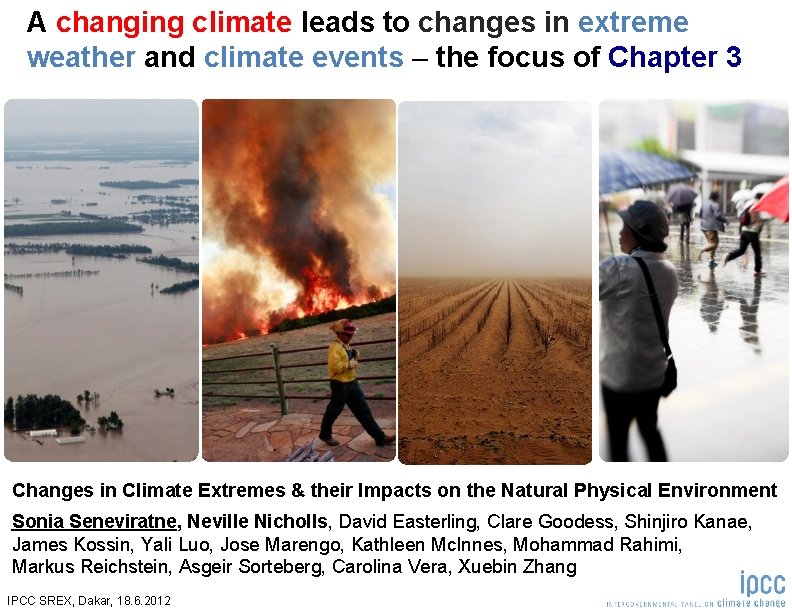
A changing climate leads to changes in extreme weather and climate events – the focus of Chapter 3 Changes in Climate Extremes & their Impacts on the Natural Physical Environment Sonia Seneviratne, Neville Nicholls, David Easterling, Clare Goodess, Shinjiro Kanae, James Kossin, Yali Luo, Jose Marengo, Kathleen Mc. Innes, Mohammad Rahimi, Markus Reichstein, Asgeir Sorteberg, Carolina Vera, Xuebin Zhang IPCC SREX, Dakar, 18. 6. 2012 S. I. Seneviratne, ETH Zurich
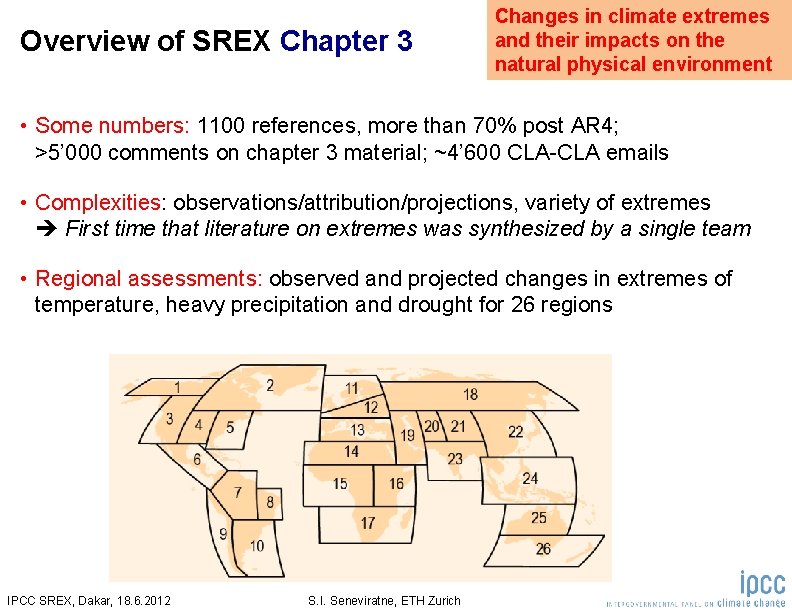
Overview of SREX Chapter 3 Changes in climate extremes and their impacts on the natural physical environment • Some numbers: 1100 references, more than 70% post AR 4; >5’ 000 comments on chapter 3 material; ~4’ 600 CLA-CLA emails • Complexities: observations/attribution/projections, variety of extremes First time that literature on extremes was synthesized by a single team • Regional assessments: observed and projected changes in extremes of temperature, heavy precipitation and drought for 26 regions IPCC SREX, Dakar, 18. 6. 2012 S. I. Seneviratne, ETH Zurich
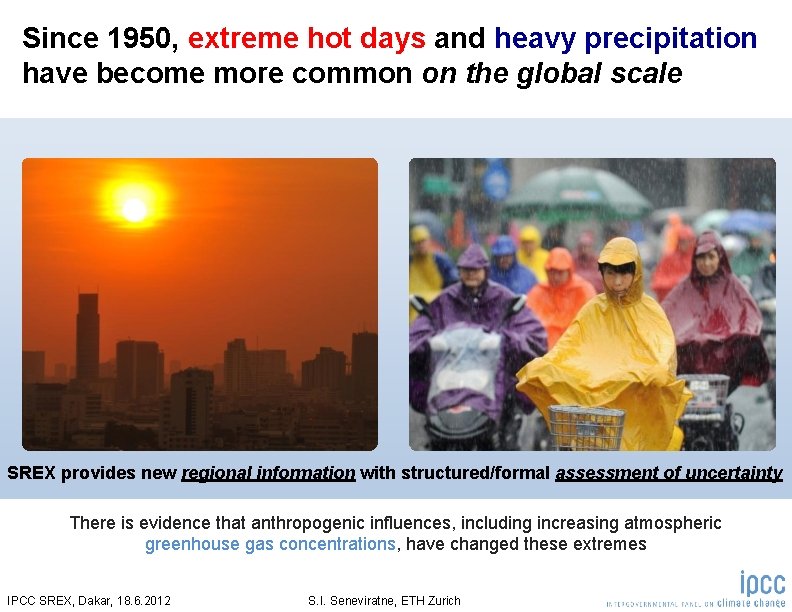
Since 1950, extreme hot days and heavy precipitation have become more common on the global scale SREX provides new regional information with structured/formal assessment of uncertainty There is evidence that anthropogenic influences, including increasing atmospheric greenhouse gas concentrations, have changed these extremes IPCC SREX, Dakar, 18. 6. 2012 S. I. Seneviratne, ETH Zurich
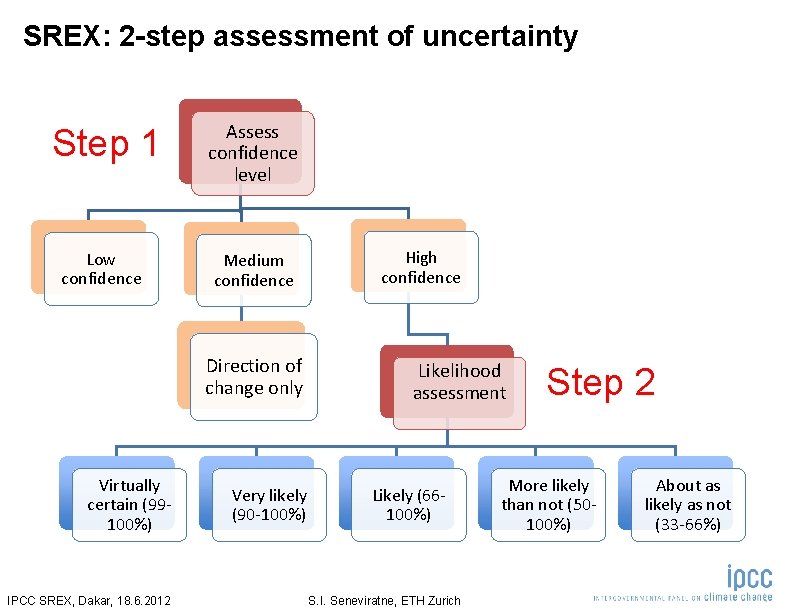
SREX: 2 -step assessment of uncertainty Step 1 Assess confidence level Low confidence Medium confidence Direction of change only Virtually certain (99100%) IPCC SREX, Dakar, 18. 6. 2012 Very likely (90 -100%) High confidence Likelihood assessment Likely (66100%) S. I. Seneviratne, ETH Zurich Step 2 More likely than not (50100%) About as likely as not (33 -66%)
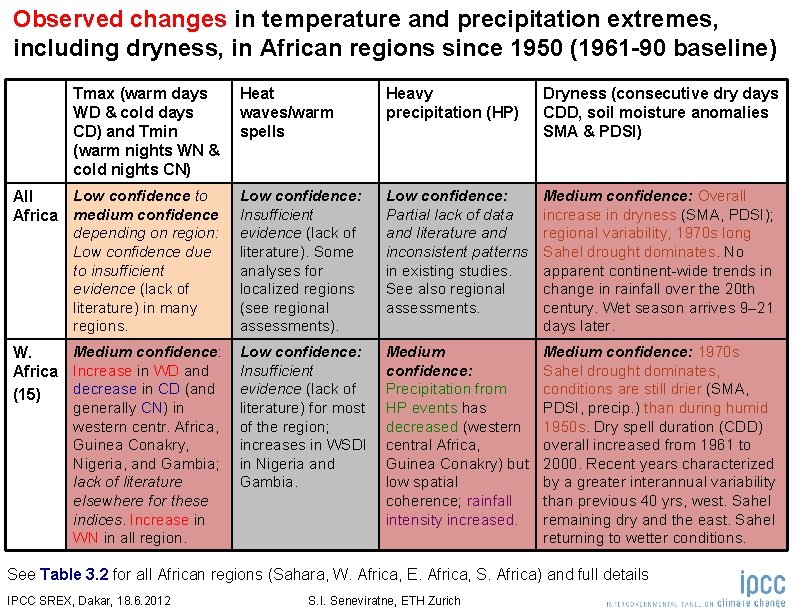
Observed changes in temperature and precipitation extremes, including dryness, in African regions since 1950 (1961 -90 baseline) Tmax (warm days WD & cold days CD) and Tmin (warm nights WN & cold nights CN) Heat waves/warm spells Heavy precipitation (HP) Dryness (consecutive dry days CDD, soil moisture anomalies SMA & PDSI) Low confidence to All Africa medium confidence depending on region: Low confidence due to insufficient evidence (lack of literature) in many regions. Low confidence: Insufficient evidence (lack of literature). Some analyses for localized regions (see regional assessments). Low confidence: Partial lack of data and literature and inconsistent patterns in existing studies. See also regional assessments. Medium confidence: Overall increase in dryness (SMA, PDSI); regional variability, 1970 s long Sahel drought dominates. No apparent continent-wide trends in change in rainfall over the 20 th century. Wet season arrives 9– 21 days later. Medium confidence: W. Africa Increase in WD and decrease in CD (and (15) generally CN) in western centr. Africa, Guinea Conakry, Nigeria, and Gambia; lack of literature elsewhere for these indices. Increase in WN in all region. Low confidence: Insufficient evidence (lack of literature) for most of the region; increases in WSDI in Nigeria and Gambia. Medium confidence: Precipitation from HP events has decreased (western central Africa, Guinea Conakry) but low spatial coherence; rainfall intensity increased. Medium confidence: 1970 s Sahel drought dominates, conditions are still drier (SMA, PDSI, precip. ) than during humid 1950 s. Dry spell duration (CDD) overall increased from 1961 to 2000. Recent years characterized by a greater interannual variability than previous 40 yrs, west. Sahel remaining dry and the east. Sahel returning to wetter conditions. See Table 3. 2 for all African regions (Sahara, W. Africa, E. Africa, S. Africa) and full details IPCC SREX, Dakar, 18. 6. 2012 S. I. Seneviratne, ETH Zurich
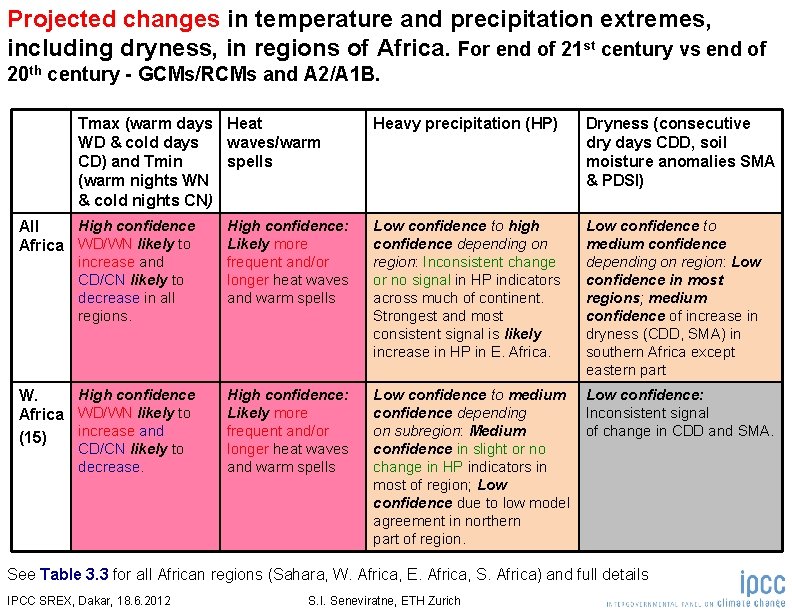
Projected changes in temperature and precipitation extremes, including dryness, in regions of Africa. For end of 21 st century vs end of 20 th century - GCMs/RCMs and A 2/A 1 B. Tmax (warm days Heat WD & cold days waves/warm CD) and Tmin spells (warm nights WN & cold nights CN) Heavy precipitation (HP) Dryness (consecutive dry days CDD, soil moisture anomalies SMA & PDSI) High confidence All Africa WD/WN likely to High confidence: Likely more frequent and/or longer heat waves and warm spells Low confidence to high confidence depending on region: Inconsistent change or no signal in HP indicators across much of continent. Strongest and most consistent signal is likely increase in HP in E. Africa. Low confidence to medium confidence depending on region: Low confidence in most regions; medium confidence of increase in dryness (CDD, SMA) in southern Africa except eastern part High confidence W. Africa WD/WN likely to increase and (15) High confidence: Likely more frequent and/or longer heat waves and warm spells Low confidence to medium confidence depending on subregion: Medium confidence in slight or no change in HP indicators in most of region; Low confidence due to low model agreement in northern part of region. Low confidence: Inconsistent signal of change in CDD and SMA. increase and CD/CN likely to decrease in all regions. CD/CN likely to decrease. See Table 3. 3 for all African regions (Sahara, W. Africa, E. Africa, S. Africa) and full details IPCC SREX, Dakar, 18. 6. 2012 S. I. Seneviratne, ETH Zurich
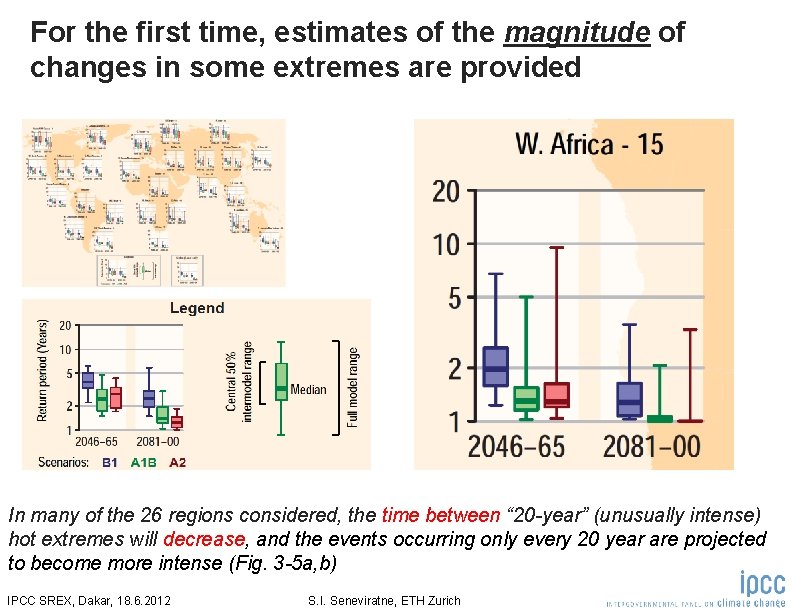
For the first time, estimates of the magnitude of changes in some extremes are provided In many of the 26 regions considered, the time between “ 20 -year” (unusually intense) hot extremes will decrease, and the events occurring only every 20 year are projected to become more intense (Fig. 3 -5 a, b) IPCC SREX, Dakar, 18. 6. 2012 S. I. Seneviratne, ETH Zurich
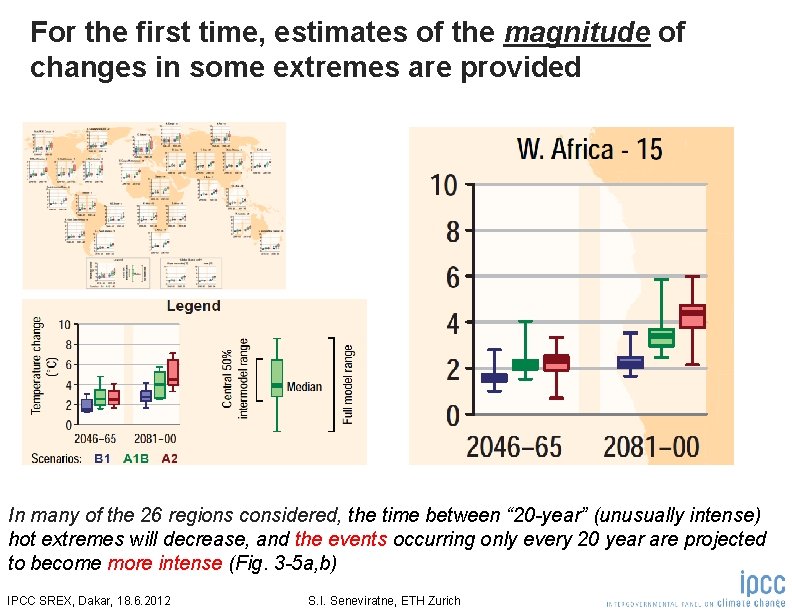
For the first time, estimates of the magnitude of changes in some extremes are provided In many of the 26 regions considered, the time between “ 20 -year” (unusually intense) hot extremes will decrease, and the events occurring only every 20 year are projected to become more intense (Fig. 3 -5 a, b) IPCC SREX, Dakar, 18. 6. 2012 S. I. Seneviratne, ETH Zurich
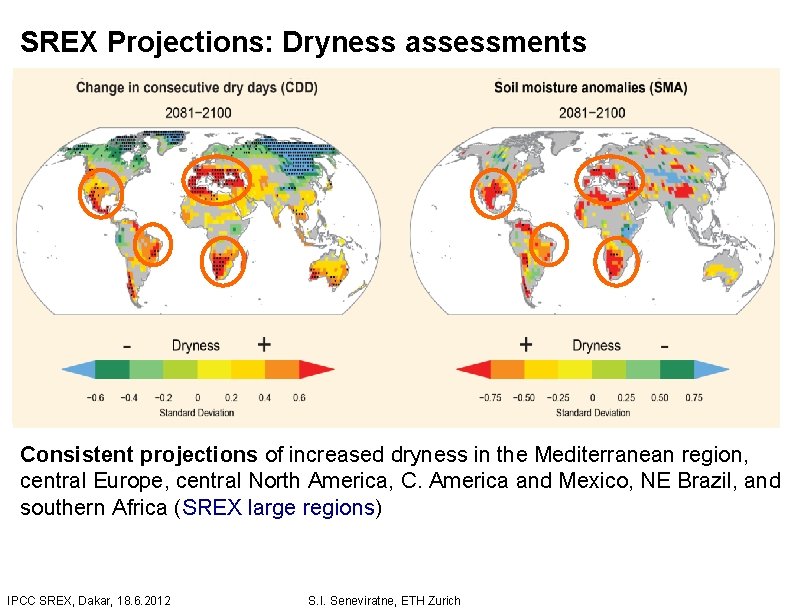
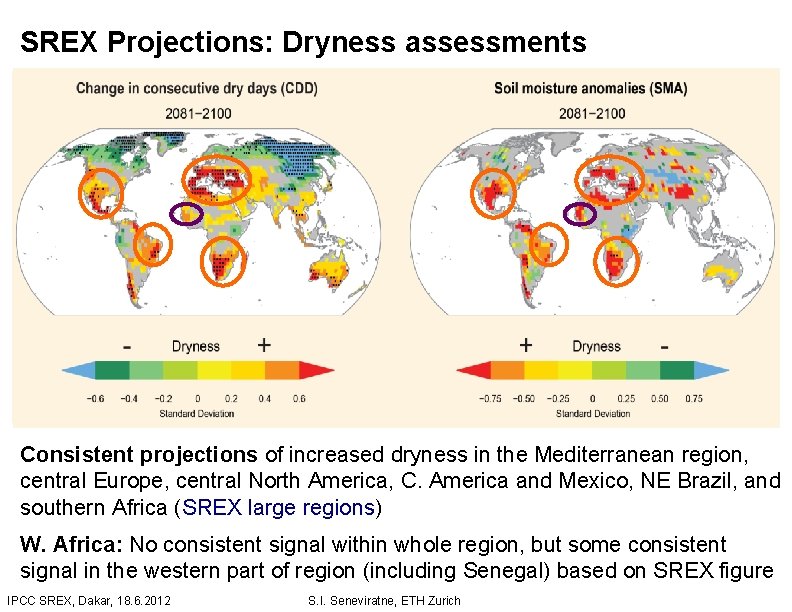
SREX Projections: Dryness assessments Consistent projections of increased dryness in the Mediterranean region, central Europe, central North America, C. America and Mexico, NE Brazil, and southern Africa (SREX large regions) W. Africa: No consistent signal within whole region, but some consistent signal in the western part of region (including Senegal) based on SREX figure IPCC SREX, Dakar, 18. 6. 2012 S. I. Seneviratne, ETH Zurich
SREX Projections: Dryness assessments Consistent projections of increased dryness in the Mediterranean region, central Europe, central North America, C. America and Mexico, NE Brazil, and southern Africa (SREX large regions) W. Africa: No consistent signal within whole region, but some consistent signal in the western part of region (including Senegal) based on SREX figure IPCC SREX, Dakar, 18. 6. 2012 S. I. Seneviratne, ETH Zurich
Also assessed changes in phenomena related to weather & climate extremes, and impacts on physical environment: Monsoons • Low confidence in observed trends and their attribution due to insufficient evidence • Low confidence in projected changes due to insufficient agreement between climate models Extreme sea level and coastal impacts • Likely increase in extreme coastal high water worldwide related to increases in mean sea level in the late 20 th century • Likely anthropogenic influence on observed changes via mean sea level contributions • Very likely that mean sea level rise will contribute to upward trends in extreme coastal high water levels • High confidence that locations currently experiencing coastal erosion and inundation will continue to do so due to increasing sea level, in the absence of changes in other contributing factors See Table 3. 1 IPCC SREX, Dakar, 18. 6. 2012 S. I. Seneviratne, ETH Zurich
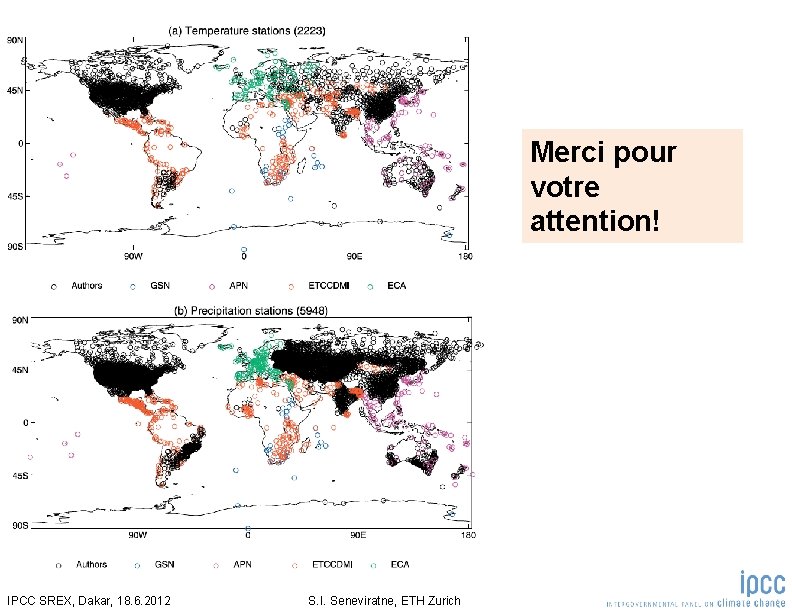
Summary for West Africa • Temperature extremes: Observed increase in hot extremes and decrease in cold extremes (medium confidence); likely projected continuation of these trends; projected increase of hot extremes of the order of 4° for A 2 scenario • Heavy precipitation: Not very clear signal either for observations nor for projections; some observed increased in precipitation intensity • Droughts: In observed trends, 1970 s Sahel drought still dominate the overall signal; projected sign of change unclear in most of West Africa (projections smaller scale would require refinement of regions) • Sea level rise: of importance for coastal regions • Data quality: Lack of suitable observational datasets & studies for most extremes in Africa (e. g. no studies for Senegal assessed) Improved information on regional level also requires regional input (e. g. data for model validation!) IPCC SREX, Dakar, 18. 6. 2012 S. I. Seneviratne, ETH Zurich
Merci pour votre attention! IPCC SREX, Dakar, 18. 6. 2012 S. I. Seneviratne, ETH Zurich
14 IPCC SREX, Dakar, 18. 6. 2012 S. I. Seneviratne, ETH Zurich
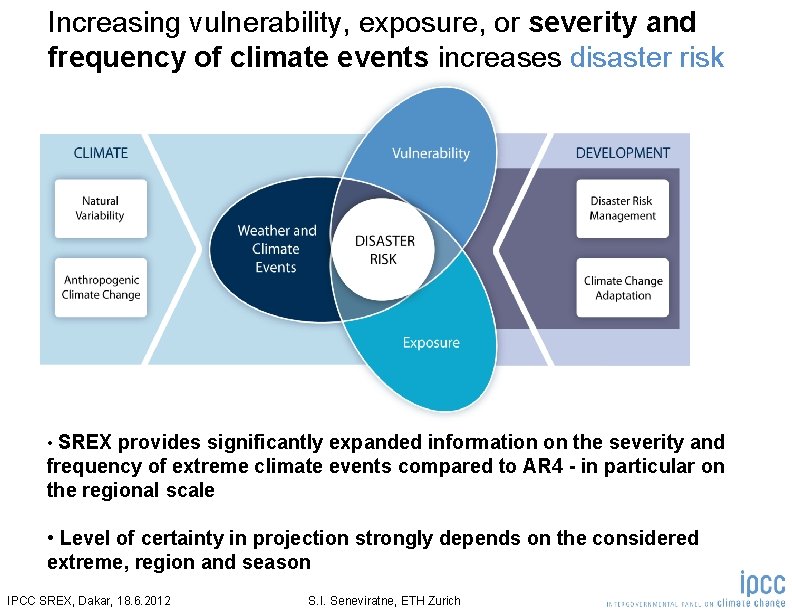
Increasing vulnerability, exposure, or severity and frequency of climate events increases disaster risk • SREX provides significantly expanded information on the severity and frequency of extreme climate events compared to AR 4 - in particular on the regional scale • Level of certainty in projection strongly depends on the considered extreme, region and season IPCC SREX, Dakar, 18. 6. 2012 S. I. Seneviratne, ETH Zurich