
A Challenge Who are We to Judge MORAL
- Slides: 49
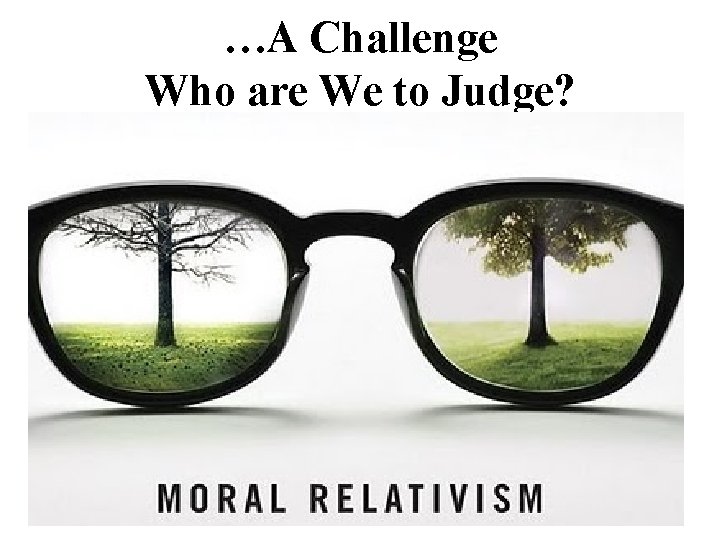
…A Challenge Who are We to Judge?
MORAL RELATIVISM: the concept that morality is relative. Objectivism says that all people are under the same moral principles. Moral principles are objective. Relativism says that societies decide what is moral. Who are we to judge?
• Moral Relativism does not say that in morality anything goes. • It does not mean there are no moral rules. • Moral rules are relative. • It states that what’s moral for a society could be immoral for another. • So there is no way to say that one society is moral and the other immoral. • Morality is relative to the particular society.
Who Are We to Judge? • The Callatians, an Indian people, ate their dead people, while ancient Greeks cremated theirs. They viewed each other’s practice as immoral. So moral relativism concludes that morality is a matter of what peoples take it to be.
But, is morality relative? It seems that people’s beliefs differ, not moral principles. Callatians believed their dead would continue living if ingested. Greeks believed flesh could be corrupted and so cremated the dead. Often, peoples’ differences are not moral but cultural. Aabortion? Everyone agrees that murder is wrong. We disagree over whether a fetus is a person.
Implications of Relativism
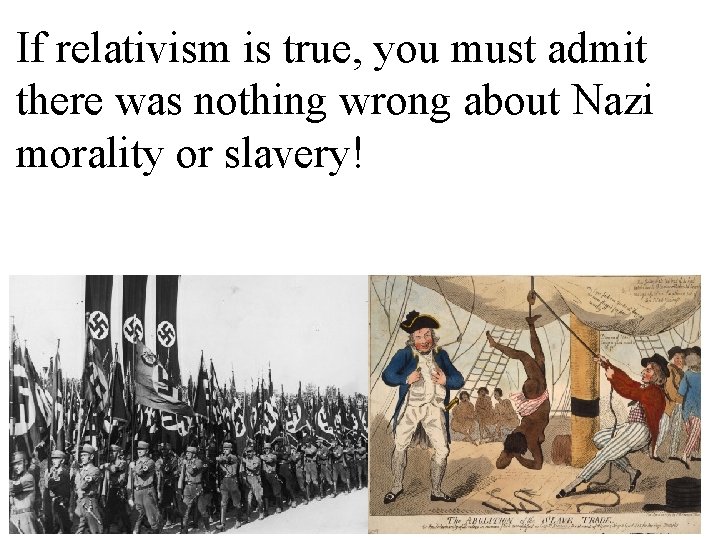
If relativism is true, you must admit there was nothing wrong about Nazi morality or slavery!
Think About it… Those who fought against segregation and slavery were moral reformers. If you are a moral relativist, you cannot praise moral reformers. In fact, you should condemn them.
Those who try to better the moral principles of a society try to change the moral rules of that society! Moral progress implies moving toward an ideal, objective, moral standard. But this is what relativism denies! There is no objective morality.
Also, relativism says that the social group you belong to determines morality, right? But ask yourself: to which social group do I belong? Answer: you belong to many groups.
Finally, some might say relativism is valid because we should have tolerance and respect other people’s practices and beliefs. But, if we apply this principle universally, then tolerance is ruled out by relativism because you are not a relativist but an objectivist.
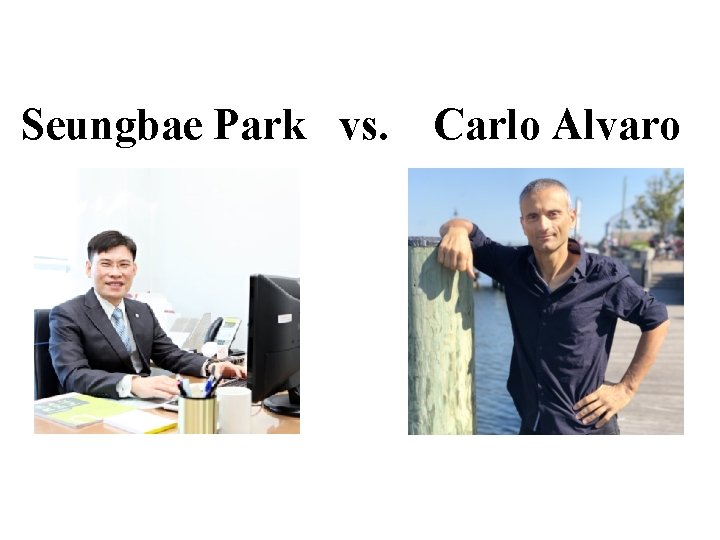
Seungbae Park vs. Carlo Alvaro
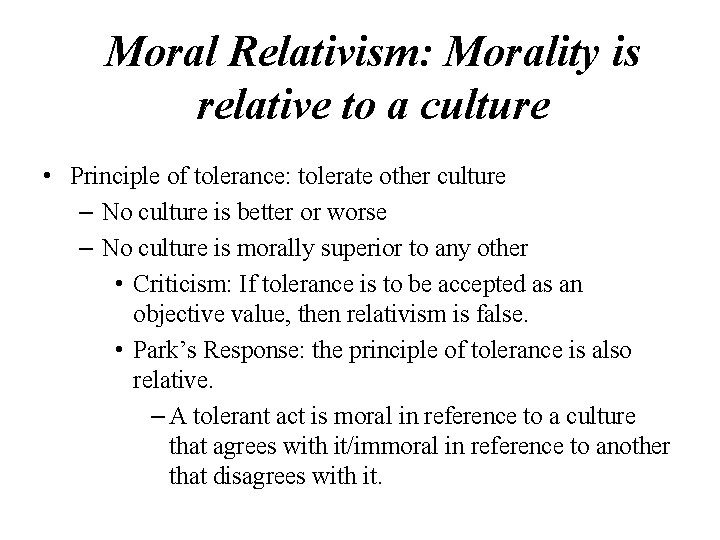
Moral Relativism: Morality is relative to a culture • Principle of tolerance: tolerate other culture – No culture is better or worse – No culture is morally superior to any other • Criticism: If tolerance is to be accepted as an objective value, then relativism is false. • Park’s Response: the principle of tolerance is also relative. – A tolerant act is moral in reference to a culture that agrees with it/immoral in reference to another that disagrees with it.
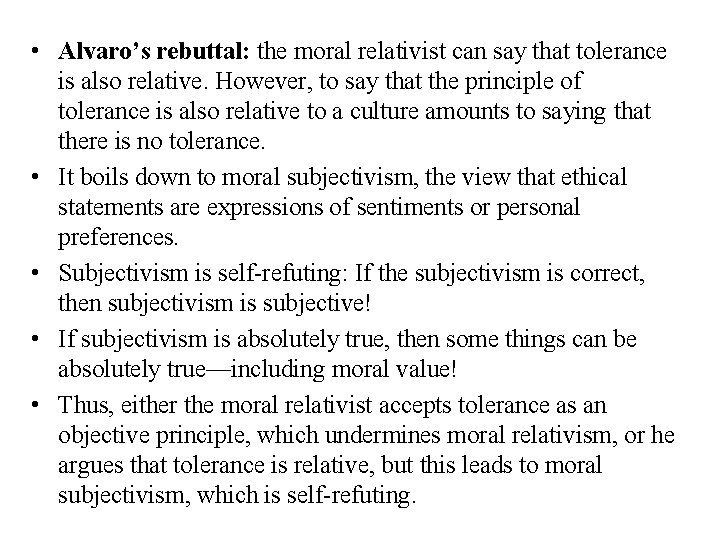
• Alvaro’s rebuttal: the moral relativist can say that tolerance is also relative. However, to say that the principle of tolerance is also relative to a culture amounts to saying that there is no tolerance. • It boils down to moral subjectivism, the view that ethical statements are expressions of sentiments or personal preferences. • Subjectivism is self-refuting: If the subjectivism is correct, then subjectivism is subjective! • If subjectivism is absolutely true, then some things can be absolutely true—including moral value! • Thus, either the moral relativist accepts tolerance as an objective principle, which undermines moral relativism, or he argues that tolerance is relative, but this leads to moral subjectivism, which is self-refuting.
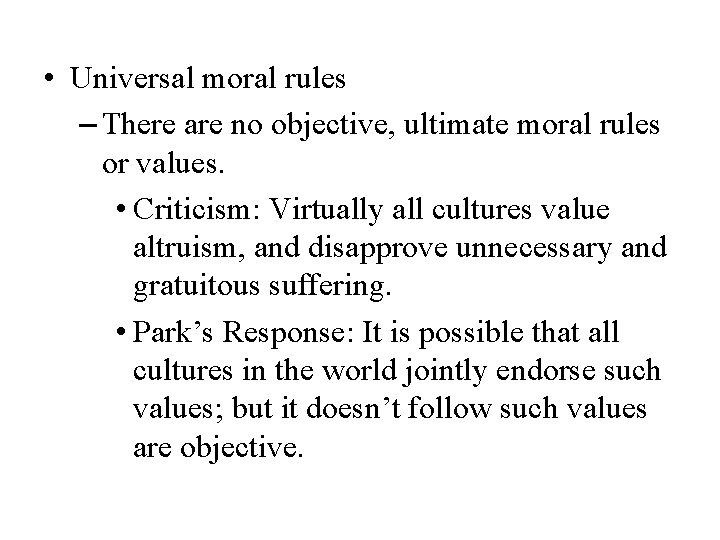
• Universal moral rules – There are no objective, ultimate moral rules or values. • Criticism: Virtually all cultures value altruism, and disapprove unnecessary and gratuitous suffering. • Park’s Response: It is possible that all cultures in the world jointly endorse such values; but it doesn’t follow such values are objective.
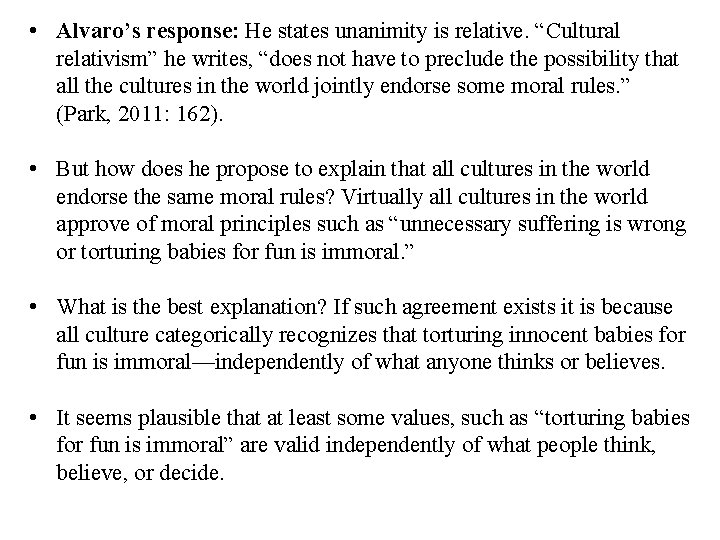
• Alvaro’s response: He states unanimity is relative. “Cultural relativism” he writes, “does not have to preclude the possibility that all the cultures in the world jointly endorse some moral rules. ” (Park, 2011: 162). • But how does he propose to explain that all cultures in the world endorse the same moral rules? Virtually all cultures in the world approve of moral principles such as “unnecessary suffering is wrong or torturing babies for fun is immoral. ” • What is the best explanation? If such agreement exists it is because all culture categorically recognizes that torturing innocent babies for fun is immoral—independently of what anyone thinks or believes. • It seems plausible that at least some values, such as “torturing babies for fun is immoral” are valid independently of what people think, believe, or decide.
• Hitler was right? – Accordingly, no one is ultimately right or wrong, but relatively so. Thus, Hitler was right. • Criticism: how can we plausibly believe that Hitler was right? • Park’s Response: Hitler was right depending on the moral framework from which we evaluate his actions.
• Alvaro’s Response: During the Nazi era in Germany, as a result of Darwin’s evolutionary theory, the notion of “social Darwinism” and “survival of the fittest” was applied to human beings. • The eugenics movement started by Francis Galton (1822 -1911), was readily taken up and distorted into racial superiority and racial hygiene by the Nazis. • If there were no objective moral values, moral statements could not be true. Then, arguing logically about morality would be impossible. Consider this argument: 1. Murder is the unlawful and malicious act of killing a human being. 2. Unlawful and malicious acts of killing a human being are morally wrong. 3. It follows that murder is morally wrong. 4. Hitler committed murder. 5. Therefore, Hitler is morally wrong. This is a deductively valid and sound moral argument. Consequently, if relativism is true, then moral argumentation is not a possibility; but logical moral argumentation is possible, as the example above illustrates.
• Social reformers & Moral Progress – Are social reformers right in their efforts to change the status quo? • Criticism: relativism implies anti slavery, anti racism reformers were wrong. This is absurd. – Is moral progress possible? • Criticism: moral progress is possible. Moral progress implies moving toward an ideal standard of morality. Therefore, relativism is false. • Park’s Response: Moral reformers are right and wrong depending on the moral frame of reference from which we evaluate them. • Moral progress is relative. We say that equality is better than slavery because we judge from our present frame of reference.
• Alvaro’s response: What exactly are “the past culture” and “the present culture”? Are they not the same culture? And when does the old culture end and the new culture begin? • It is more plausible to say that it is the same culture developing morally. • Park cannot explain the pervasive trend toward liberalization of values over human history. The best explanation is humanity is becoming increasingly liberal because liberalism is the objectively correct moral stance.
• An act can be right and wrong at the same time? • Criticism: nothing can be and not be at the same time! • Park’s Response: morality is like motion. A body is both at rest and in motion depending on which frame of reference we measure its state.
• Alvaro’s Rebuttal: We have good reasons to trust our moral experience. We might be in the matrix, but in the absence of a good argument, we have good evidence that we aren’t in the matrix. • We have compelling reasons to condemn such a culture. On the other hand, the serial killers’ culture does not have any rational reason to justify their position. • If I judge other cultures to be good, I can judge them to be bad. • we have experiential and ra-tional resources to show that the moral framework that values equality is superior to a moral framework that value slavery. • Moral value is not like motion. Motion may be relative depending on how we measure it, but an objective fact of the world.
• The concept of culture is vague? –According to relativism, morality is relative to a culture. • Criticism: What is a culture? How many people is a culture? You belong to many overlapping cultures. Relativism is false. • Park’s Response: Any number of people is sufficient.
• Alvaro’s Rebuttal: Can any number of people make a culture? Can to people make a culture? One? • This leads back to moral subjectivism (since no two people in the same culture agree on anything). • Park’s argument only shows that people have different opinions—not that moral values differ or do not exist.
• Which culture is right? : Suppose, for example, that Mary is an American citizen and Christian, and that she had an abortion. The American law condones it, but Christianity prohibits it… • A cultural relativist would again ask us to reflect upon the relativity of motion. Suppose that a car is in motion with respect to the ground. In such a situation, the driver is both in motion and at rest… • The driver is in motion with respect to the ground but is at rest with respect to the passenger. The same is true of morality… • Mary’s abortion is moral in relation to the American culture but is immoral in relation to the Christian culture. (Park 2011: 165)
• Suppose that in addition to being a Christian, Mary is a naturalized US citizen native of Moldova, a feminist, an anarchist, and a single mother who lives in New York City. Assuming that she is interested in her future as an American, which aspect of her being an American is her guiding force? • Considering that the majority religion in the US is Christianity (70. 6% according to Pew Research Center, 2019), wouldn’t Mary’s interest in her future as an American involve being a good Christian?
CONCLUSION • If the arguments presented are sound, I have shown that Park’s defense of moral relativism fail; and the standard objections against cultural relativism are true. • Moral relativism is incoherent. Thus, it’s no wonder most moral philosophers do not regard moral relativism as a viable doctrine in ethics.
The Scottish Philosopher David Hume (1711 -1776): 28
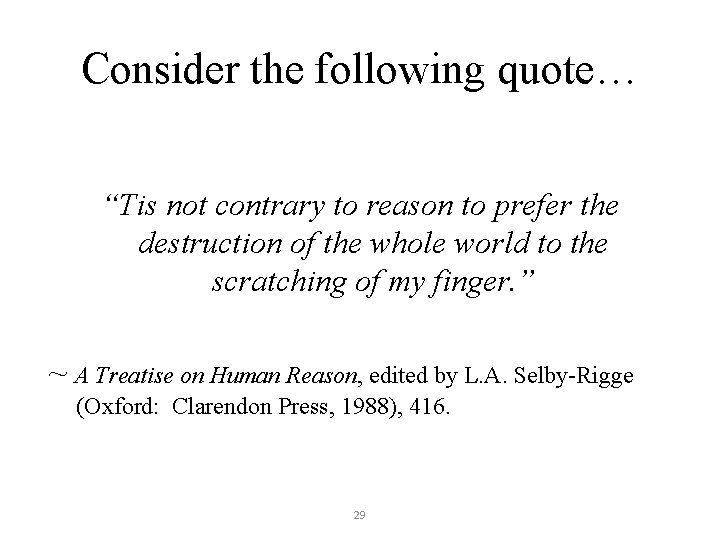
Consider the following quote… “Tis not contrary to reason to prefer the destruction of the whole world to the scratching of my finger. ” ~ A Treatise on Human Reason, edited by L. A. Selby-Rigge (Oxford: Clarendon Press, 1988), 416. 29
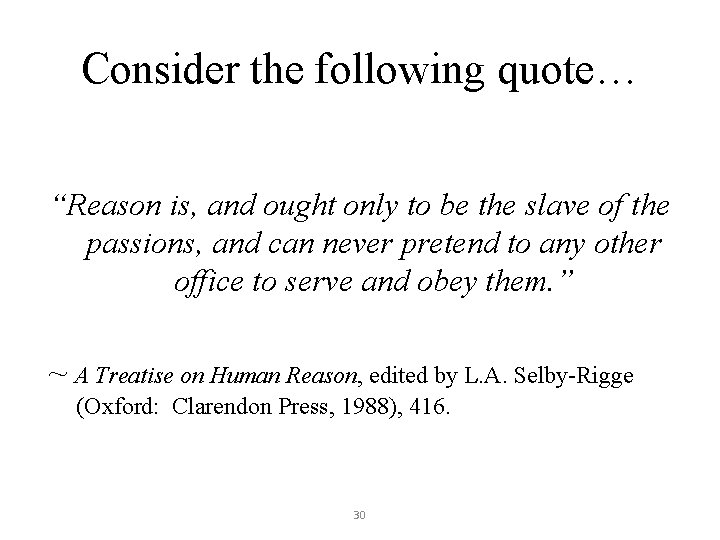
Consider the following quote… “Reason is, and ought only to be the slave of the passions, and can never pretend to any other office to serve and obey them. ” ~ A Treatise on Human Reason, edited by L. A. Selby-Rigge (Oxford: Clarendon Press, 1988), 416. 30
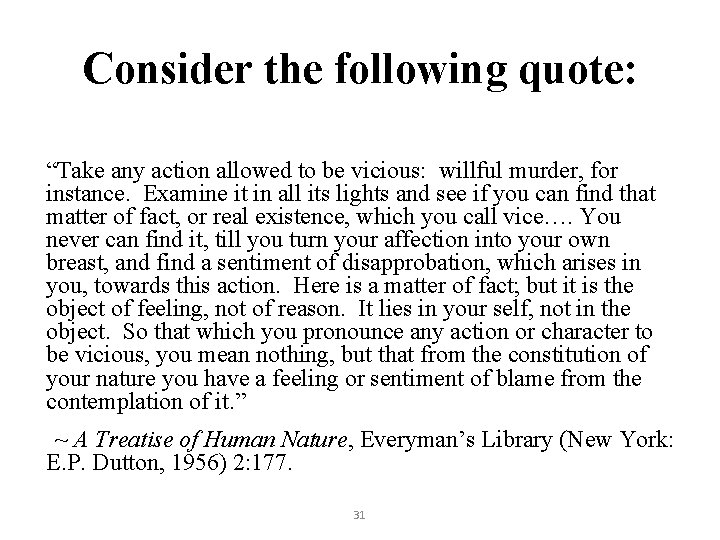
Consider the following quote: “Take any action allowed to be vicious: willful murder, for instance. Examine it in all its lights and see if you can find that matter of fact, or real existence, which you call vice…. You never can find it, till you turn your affection into your own breast, and find a sentiment of disapprobation, which arises in you, towards this action. Here is a matter of fact; but it is the object of feeling, not of reason. It lies in your self, not in the object. So that which you pronounce any action or character to be vicious, you mean nothing, but that from the constitution of your nature you have a feeling or sentiment of blame from the contemplation of it. ” ~ A Treatise of Human Nature, Everyman’s Library (New York: E. P. Dutton, 1956) 2: 177. 31
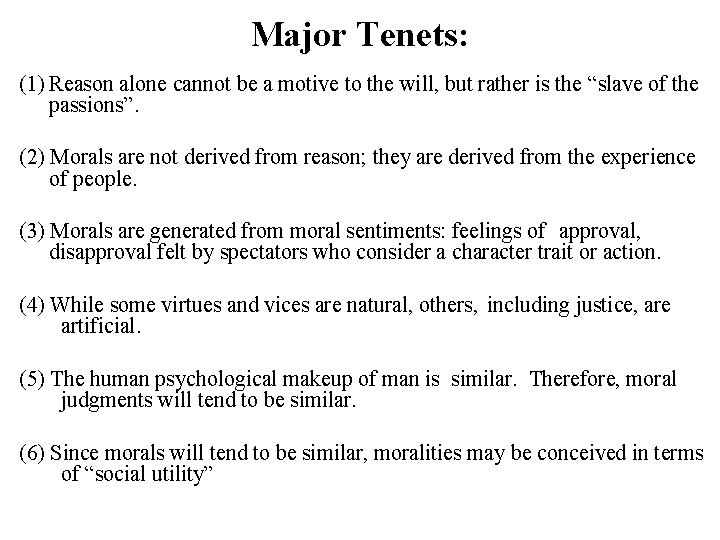
Major Tenets: (1) Reason alone cannot be a motive to the will, but rather is the “slave of the passions”. (2) Morals are not derived from reason; they are derived from the experience of people. (3) Morals are generated from moral sentiments: feelings of approval, disapproval felt by spectators who consider a character trait or action. (4) While some virtues and vices are natural, others, including justice, are artificial. (5) The human psychological makeup of man is similar. Therefore, moral judgments will tend to be similar. (6) Since morals will tend to be similar, moralities may be conceived in terms of “social utility”
Sentimentalism vs. Moral Rationalism • Hume’s ethical theory is moral sentimentalism: we never can make moral judgments based on reason alone. • Reason deals with facts and draws conclusions from them, but reason cannot reveal to us which option we ought to choose; rather, our sentiments can: . . . morality is determined by sentiment. It defines virtue to be whatever mental action or quality gives to a spectator the pleasing sentiment of approbation; and vice the contrary. (Enquiry, Appendix 1, ¶ 10) • Hume’s sentimentalism for Hume we know moral truths via our sentiments—our feelings of approval and disapproval, in a direct way without reason.
Sympathy, altruism, and egoism • According to Hume, our sympathy-based sentiments can motivate us to perform non-selfish acts, such benefiting others. • Hume comes to the conclusion that most of the behaviors we approve of increase public utility. • Besides self-interest, Hume argues that we can be moved by our natural sentiment of sympathy for others, which can provide a person with non-selfish concerns.
Natural and Artificial Virtues: • Artificial virtues are dependent upon social structures: justice; fidelity to promises, chastity, modesty, duties to sovereign states. • Natural virtues originate in nature and are more universal: compassion, generosity, gratitude, friendship, fidelity, charity, benevolence, clemency, equity, prudence.
Moral Nihilism (From Psychology to Linguistics)
• Nihilism: (nihil = ‘nothing’). There aren’t any objective moral facts or subjective. • There exist 2 forms of nihilism: – Error theory – Expressivism.
Expressivism: there are no moral facts or values; our moral judgments cannot be true or false. Moral language and normal language: • (1) Ice is cold. • (2) Your socks are dirty. • (3) NYC is lovely in the fall. • (4) Lying is wrong. • (5) Pulling the cat’s tail is mischievous. • (1) – (3) Describe, (4) – (5) don’t.
• What is being described by moral language? Is there such a property as ‘wrongness’ or mischievousness? • No such entities exist, so my sentence is neither true nor false but nonsensical. • “Pizza is ‘Yummy!’ true or false? ”
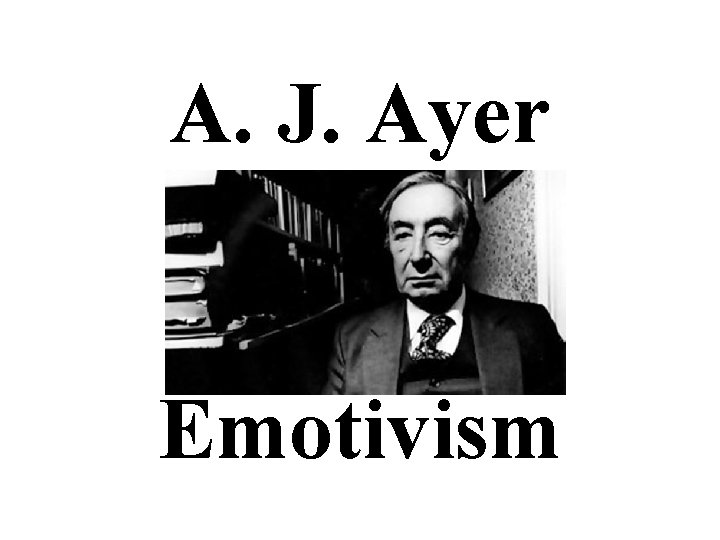
A. J. Ayer Emotivism
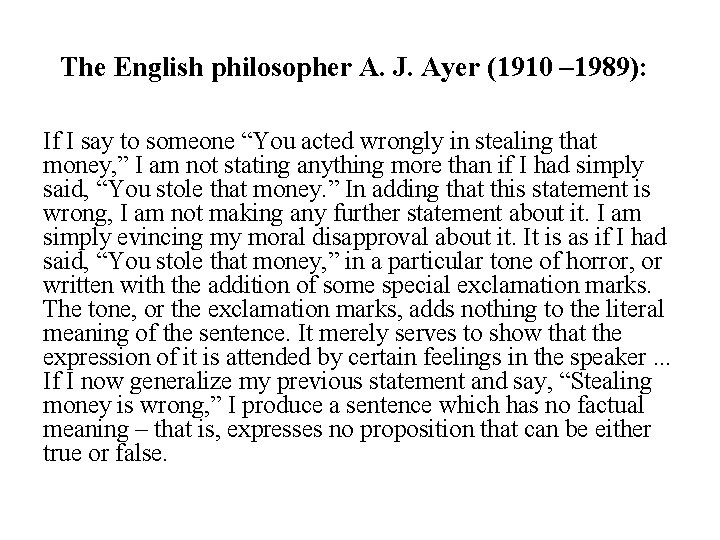
The English philosopher A. J. Ayer (1910 – 1989): If I say to someone “You acted wrongly in stealing that money, ” I am not stating anything more than if I had simply said, “You stole that money. ” In adding that this statement is wrong, I am not making any further statement about it. I am simply evincing my moral disapproval about it. It is as if I had said, “You stole that money, ” in a particular tone of horror, or written with the addition of some special exclamation marks. The tone, or the exclamation marks, adds nothing to the literal meaning of the sentence. It merely serves to show that the expression of it is attended by certain feelings in the speaker. . . If I now generalize my previous statement and say, “Stealing money is wrong, ” I produce a sentence which has no factual meaning – that is, expresses no proposition that can be either true or false.
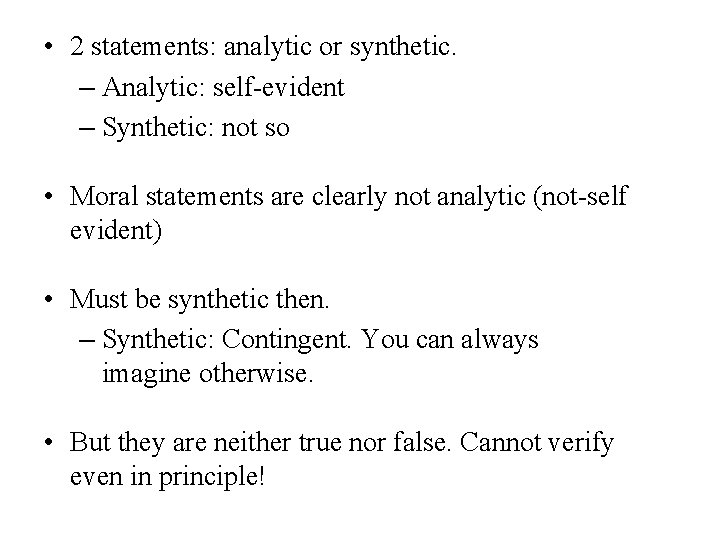
• 2 statements: analytic or synthetic. – Analytic: self-evident – Synthetic: not so • Moral statements are clearly not analytic (not-self evident) • Must be synthetic then. – Synthetic: Contingent. You can always imagine otherwise. • But they are neither true nor false. Cannot verify even in principle!
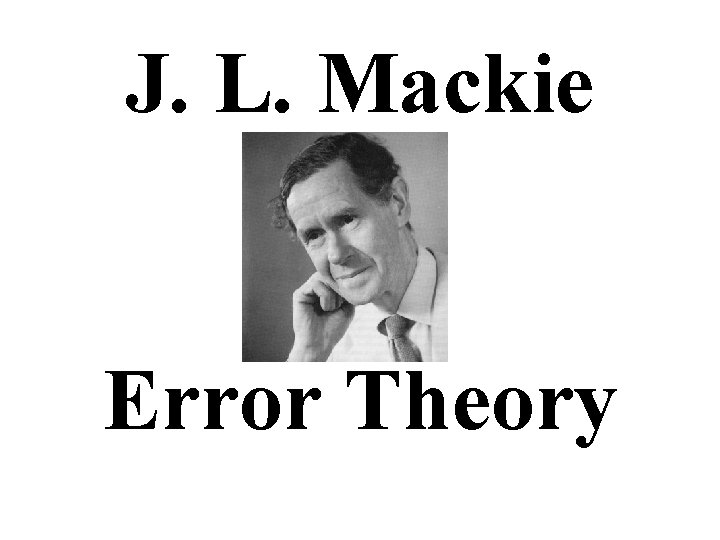
J. L. Mackie Error Theory
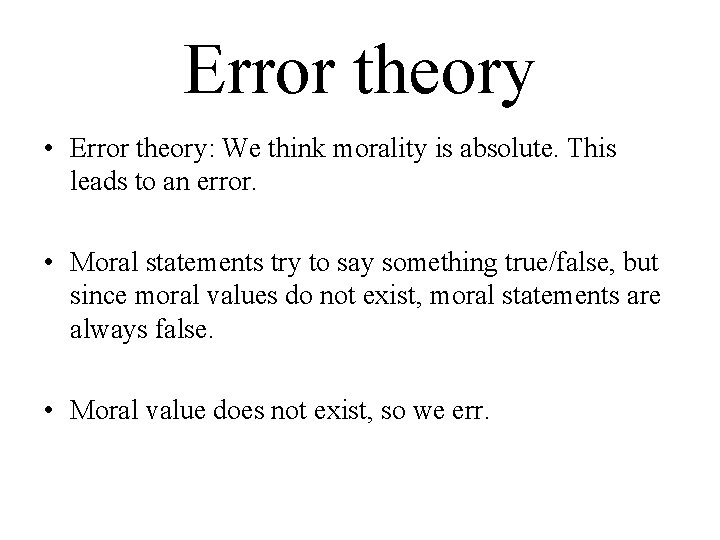
Error theory • Error theory: We think morality is absolute. This leads to an error. • Moral statements try to say something true/false, but since moral values do not exist, moral statements are always false. • Moral value does not exist, so we err.
Why value does not exist? • 2 arguments: Relativism + Queerness • Relativism: Morality is relative to culture: Monogamy is right at X wrong at Y. It seems all agree to promote happiness, universalizability, etc. • But such principles differ in different circumstances. • The fact is that people judge things right or wrong or good or bad because those things arouse certain responses in them—not vice versa.
Queerness: Epistemological and metaphysical • Epistemological: How do we know value? Value should be action guiding – If we were aware of values, it would be through special faculty of moral perception, different from our faculties. – We have no such faculty. – Therefore, even if values existed we would not be able to know them. • Moral problems are not solved by sitting down and thinking. Otherwise there would be no moral disagreement.
• Metaphysical: They must be very weird properties. – If there were values, they would be of a very strange sort, different from anything else in the universe. – We never found any of these. – Therefore, they don’t exist or even if they do, they are so different they practically don’t add to morality.
• Plato/forms. What are they? – They must have an embedded notion of right/wrong action – How do they connect to nature? – What’s the relation between wrong and act?
The End