
A Catalytic Theory of Perception Action Patricia A
- Slides: 15
A Catalytic Theory of Perception & Action Patricia A. Carpenter, Carnegie Mellon Perspectives on Mind-Body Sensory Substitution Fractal Catalysis -- (Davia, 2006) Questions & Related Approaches
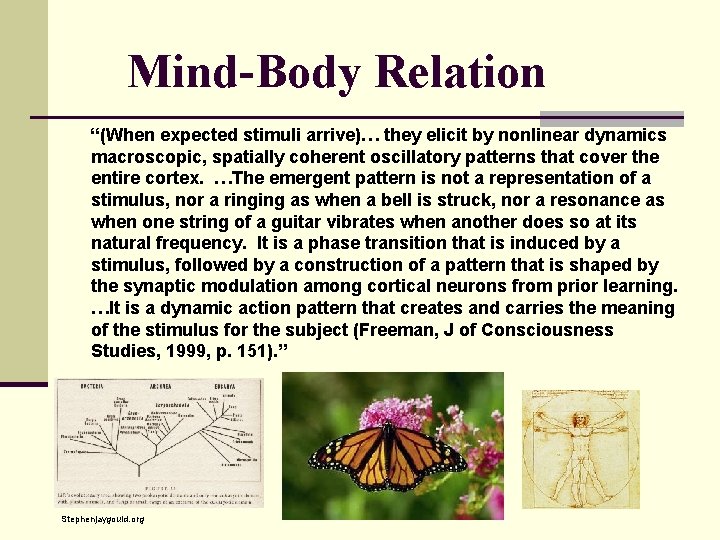
Mind-Body Relation “(When expected stimuli arrive)… they elicit by nonlinear dynamics macroscopic, spatially coherent oscillatory patterns that cover the entire cortex. …The emergent pattern is not a representation of a stimulus, nor a ringing as when a bell is struck, nor a resonance as when one string of a guitar vibrates when another does so at its natural frequency. It is a phase transition that is induced by a stimulus, followed by a construction of a pattern that is shaped by the synaptic modulation among cortical neurons from prior learning. …It is a dynamic action pattern that creates and carries the meaning of the stimulus for the subject (Freeman, J of Consciousness Studies, 1999, p. 151). ” Stephenjaygould. org
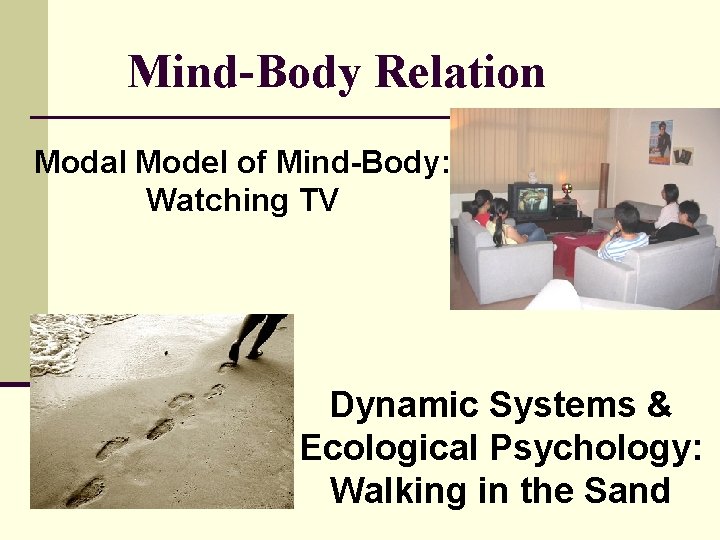
Mind-Body Relation Modal Model of Mind-Body: Watching TV Dynamic Systems & Ecological Psychology: Walking in the Sand
Perspectives n Outside: dynamic events n Inside: phenomena constitute the experience of the organism n Living systems are cognitive systems and living is the process of cognition (Maturana & Varela, 1980, 1987; also Bateson, 1972) n Fractal Catalysis: the wave-like behavioral and metabolic processes of an organism, including those of the body and brain, are the way an entity mediates (catalyzes) its environment (Davia, 2006) n Organism’s experience is the process of catalysis n Scale-invariant: applies to enzyme, cell, organ & organism
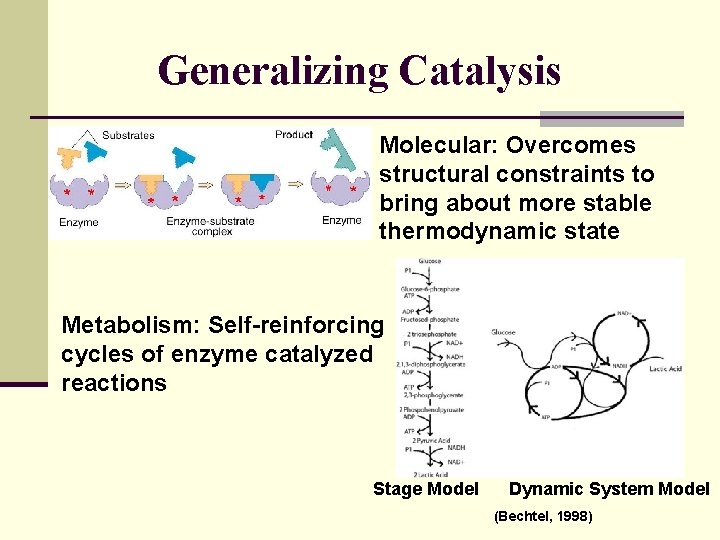
Generalizing Catalysis Molecular: Overcomes structural constraints to bring about more stable thermodynamic state Metabolism: Self-reinforcing cycles of enzyme catalyzed reactions Stage Model Dynamic System Model (Bechtel, 1998)
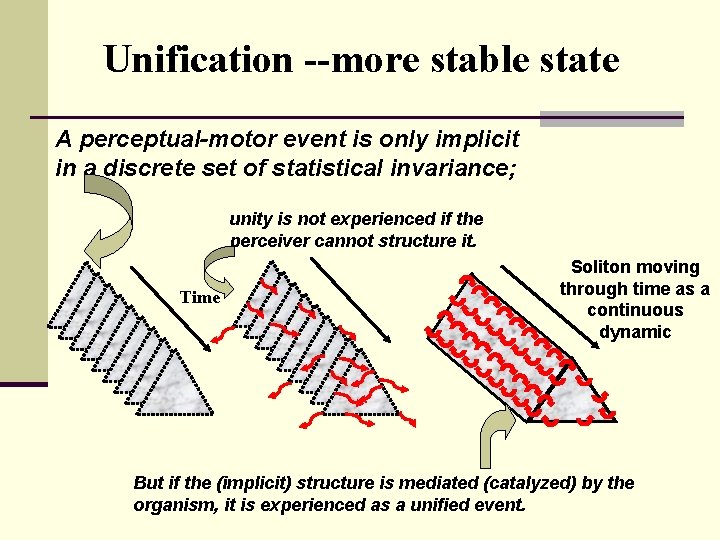
Unification --more stable state A perceptual-motor event is only implicit in a discrete set of statistical invariance; unity is not experienced if the perceiver cannot structure it. Time Soliton moving through time as a continuous dynamic But if the (implicit) structure is mediated (catalyzed) by the organism, it is experienced as a unified event.
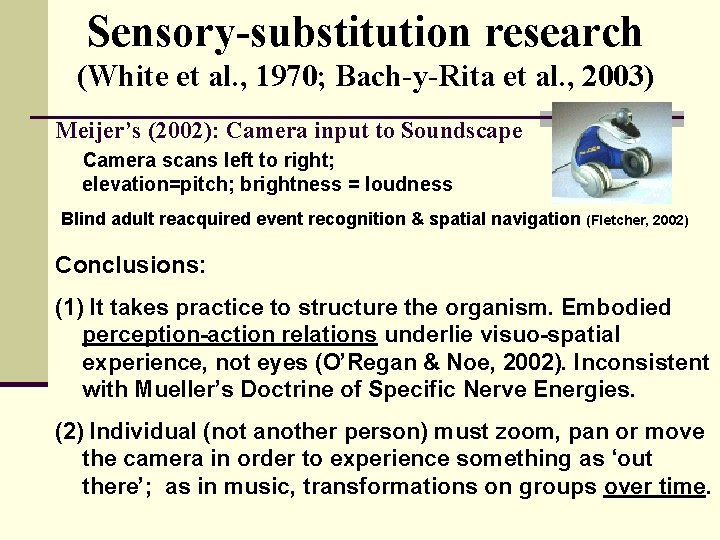
Sensory-substitution research (White et al. , 1970; Bach-y-Rita et al. , 2003) Meijer’s (2002): Camera input to Soundscape Camera scans left to right; elevation=pitch; brightness = loudness Blind adult reacquired event recognition & spatial navigation (Fletcher, 2002) Conclusions: (1) It takes practice to structure the organism. Embodied perception-action relations underlie visuo-spatial experience, not eyes (O’Regan & Noe, 2002). Inconsistent with Mueller’s Doctrine of Specific Nerve Energies. (2) Individual (not another person) must zoom, pan or move the camera in order to experience something as ‘out there’; as in music, transformations on groups over time.
Related Phenomena • With practice, our experience of environment is transparent to the tool of exploration (e. g. , Carello & Turvey, 2000) • Kinetic Depth Effect -- necessary & sufficient condition for experience of discontinuity is subsets of points share different velocity vectors (Shaw, Mc. Intyre & Mace, 1974) • O’Regan & Noe’s (2001) list of ‘perceptual-motor contingencies’ • Scale invariance • in EEG parameters (Freeman, 1999) • 1/f noise in response times (Gilden, Thornton & Mallon, 1995); spectral analysis of speech (Anderson & Kello, 2006)
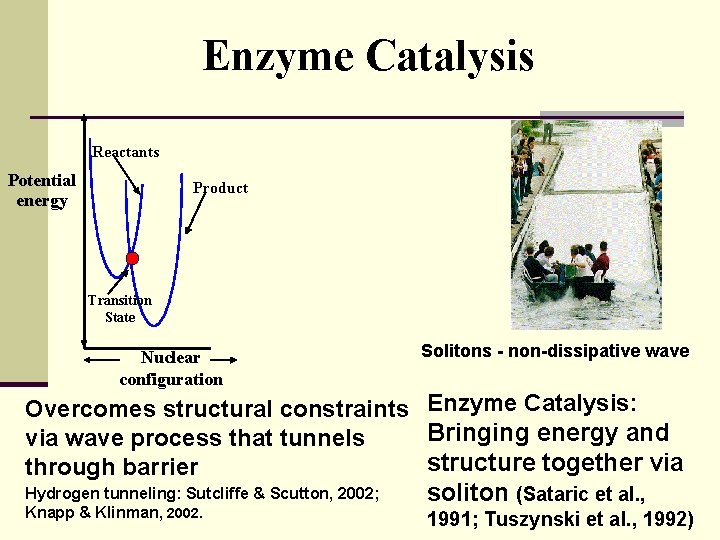
Enzyme Catalysis Reactants Potential energy Product Transition State Nuclear configuration Solitons - non-dissipative wave Overcomes structural constraints Enzyme Catalysis: Bringing energy and via wave process that tunnels structure together via through barrier Hydrogen tunneling: Sutcliffe & Scutton, 2002; soliton (Sataric et al. , Knapp & Klinman, 2002. 1991; Tuszynski et al. , 1992)
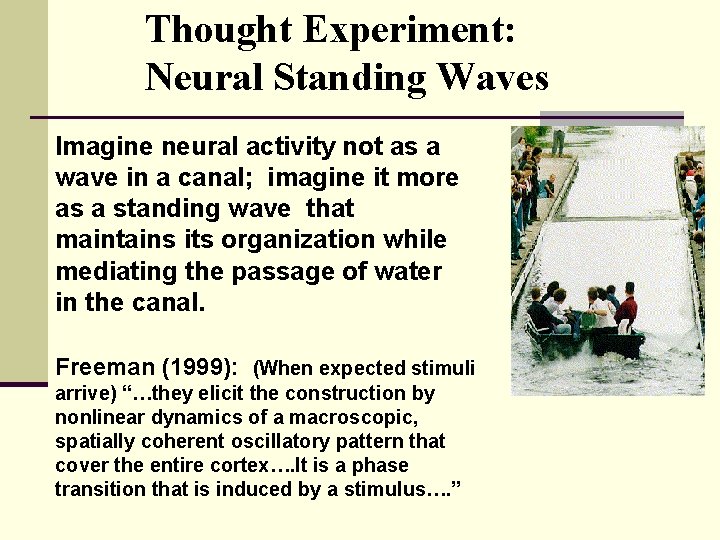
Thought Experiment: Neural Standing Waves Imagine neural activity not as a wave in a canal; imagine it more as a standing wave that maintains its organization while mediating the passage of water in the canal. Freeman (1999): (When expected stimuli arrive) “…they elicit the construction by nonlinear dynamics of a macroscopic, spatially coherent oscillatory pattern that cover the entire cortex…. It is a phase transition that is induced by a stimulus…. ”
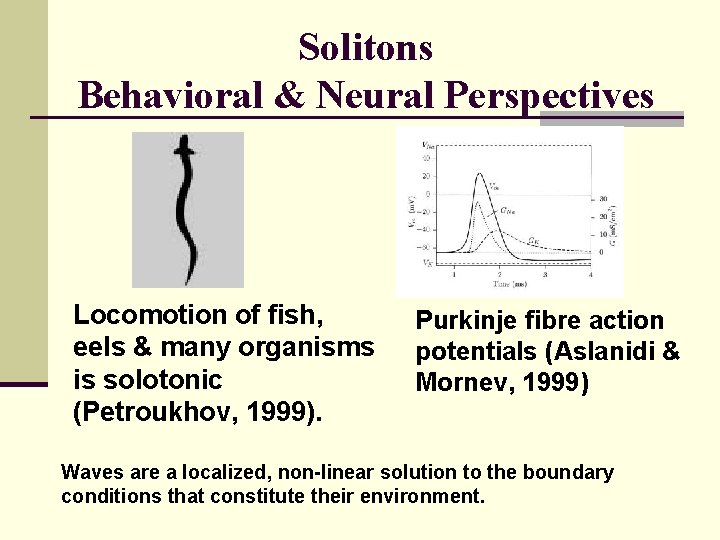
Solitons Behavioral & Neural Perspectives Locomotion of fish, eels & many organisms is solotonic (Petroukhov, 1999). Purkinje fibre action potentials (Aslanidi & Mornev, 1999) Waves are a localized, non-linear solution to the boundary conditions that constitute their environment.
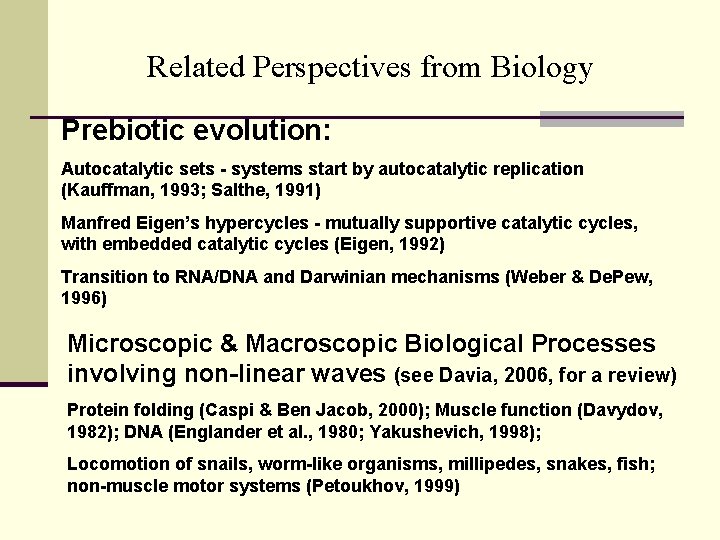
Related Perspectives from Biology Prebiotic evolution: Autocatalytic sets - systems start by autocatalytic replication (Kauffman, 1993; Salthe, 1991) Manfred Eigen’s hypercycles - mutually supportive catalytic cycles, with embedded catalytic cycles (Eigen, 1992) Transition to RNA/DNA and Darwinian mechanisms (Weber & De. Pew, 1996) Microscopic & Macroscopic Biological Processes involving non-linear waves (see Davia, 2006, for a review) Protein folding (Caspi & Ben Jacob, 2000); Muscle function (Davydov, 1982); DNA (Englander et al. , 1980; Yakushevich, 1998); Locomotion of snails, worm-like organisms, millipedes, snakes, fish; non-muscle motor systems (Petoukhov, 1999)
Questions Why think of this as experience and not as representation? It is a subtle shift and an alternative to the assumption of an independent environment. Importantly, theory suggests that there is no code. What about memory? As suggested by connectionists, it is embodied in an organism’s history. If a single cell or simple organism has experience, what is it? Look to the environment it is mediating; research by J. Le. Doux on the similarity of fear conditioning throughout the phyla (fruit fly, marine snail, fish, lizard, pigeon, cat, macaque, human etc) suggests similarity in the experiences of these organisms to environments that are threatening to them and to stimuli conditioned to such threats. What novel phenomena come from this perspective?
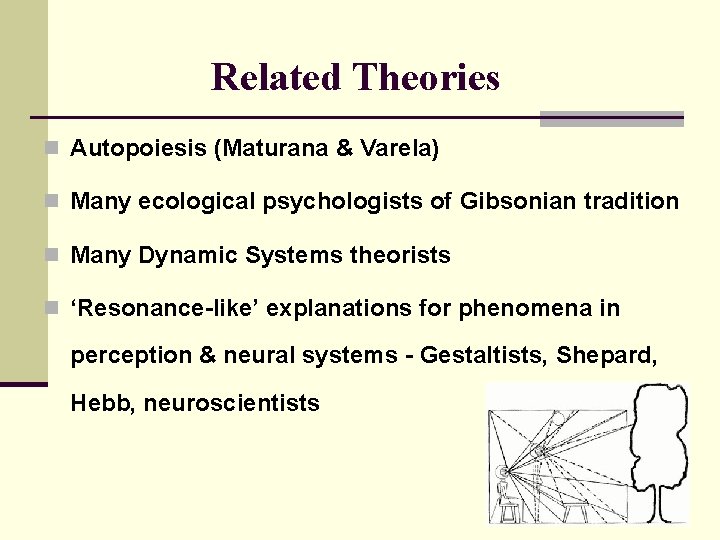
Related Theories n Autopoiesis (Maturana & Varela) n Many ecological psychologists of Gibsonian tradition n Many Dynamic Systems theorists n ‘Resonance-like’ explanations for phenomena in perception & neural systems - Gestaltists, Shepard, Hebb, neuroscientists
Experience Revisited ‘Experience’ is not a representation of an independent world, nor a correlate of such a representation, but may be better understood as catalysis Life may be a process that brings consciousness into the classical world Fractal Catalytic Theory suggests that life is not a process in the environment, but that it is a process of the environment.