
A case study The use of the Pupillometer

- Slides: 29
A case study The use of the Pupillometer in predicting increased ICP in the Adult Neurosciences ICU Lauren Walker, RN, BSN, CCRN
Case Background �On 4/7/11 a 19 year-old-male with no significant PMH presented to an OSH after the onset of a severe HA. • At the OSH, the pt became unresponsive, was intubated and sent to CT • He was then transferred to GUH for a large right intracerebral hematoma
Admission Exam �Neuro: no sedation, no eye opening, R pupil 6 mm and nonreactive, L pupil 3 mm and sluggish by manual exam, not following commands, MAE non-purposely. �Resp: Intubated, unlabored, clear lung sounds bilaterally, O 2 Sats stable. �CV: HR regular, VSS, afebrile, 2+ pulses bilaterally, CRT less than 3 seconds.
Admission Pupil Exam �MD: Right Eye: 6 mm and Fixed Left Eye: 3 mm Fixed �RN Right Eye: 8 mm and Fixed Left Eye: 3 mm Sluggish Why is this admission exam so different when taken at the same time?
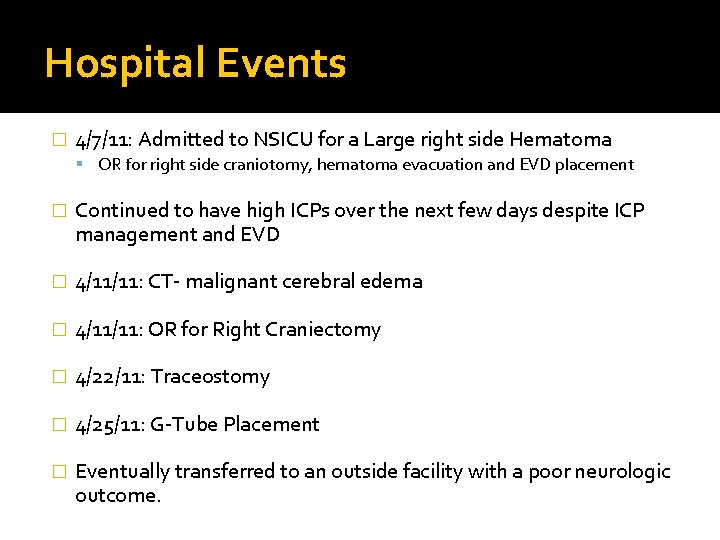
Hospital Events � 4/7/11: Admitted to NSICU for a Large right side Hematoma OR for right side craniotomy, hematoma evacuation and EVD placement � Continued to have high ICPs over the next few days despite ICP management and EVD � 4/11/11: CT- malignant cerebral edema � 4/11/11: OR for Right Craniectomy � 4/22/11: Traceostomy � 4/25/11: G-Tube Placement � Eventually transferred to an outside facility with a poor neurologic outcome.
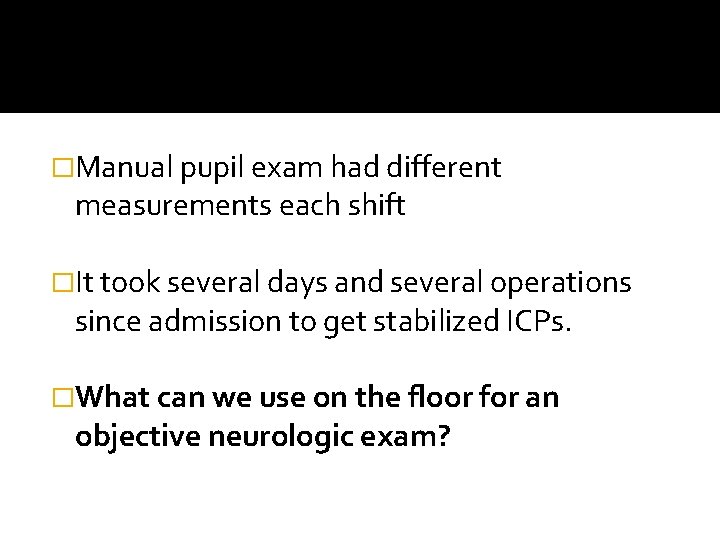
�Manual pupil exam had different measurements each shift �It took several days and several operations since admission to get stabilized ICPs. �What can we use on the floor for an objective neurologic exam?
The Pupillometer!!!
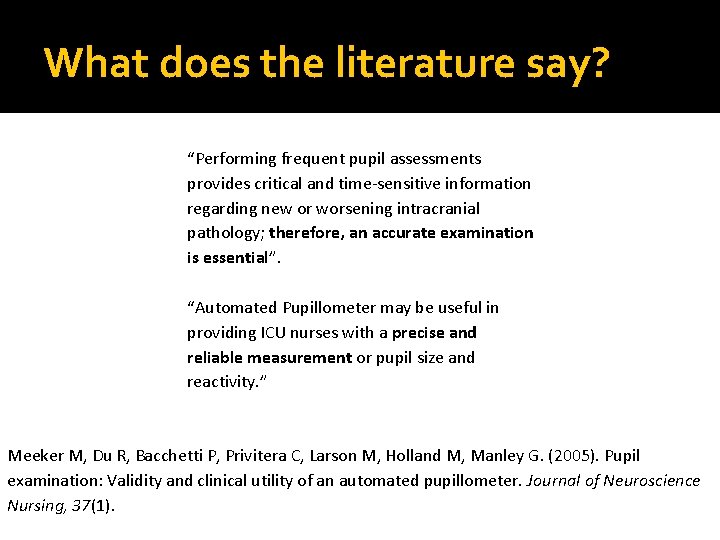
What does the literature say? “Performing frequent pupil assessments provides critical and time-sensitive information regarding new or worsening intracranial pathology; therefore, an accurate examination is essential”. “Automated Pupillometer may be useful in providing ICU nurses with a precise and reliable measurement or pupil size and reactivity. ” Meeker M, Du R, Bacchetti P, Privitera C, Larson M, Holland M, Manley G. (2005). Pupil examination: Validity and clinical utility of an automated pupillometer. Journal of Neuroscience Nursing, 37(1).
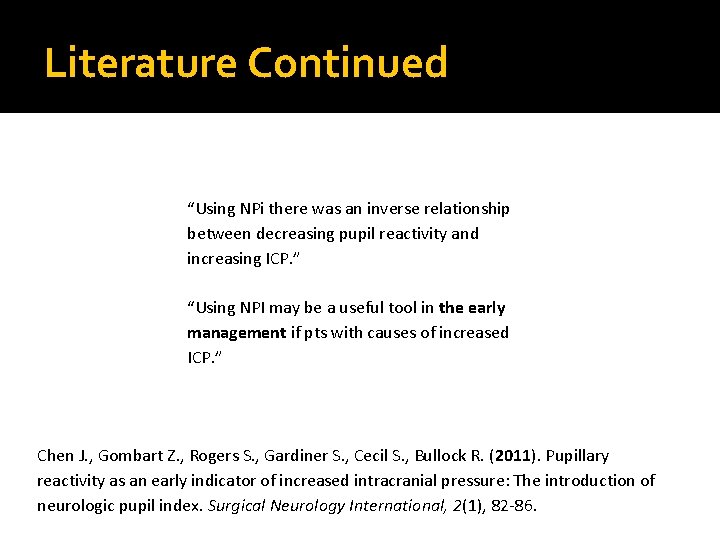
Literature Continued “Using NPi there was an inverse relationship between decreasing pupil reactivity and increasing ICP. ” “Using NPI may be a useful tool in the early management if pts with causes of increased ICP. ” Chen J. , Gombart Z. , Rogers S. , Gardiner S. , Cecil S. , Bullock R. (2011). Pupillary reactivity as an early indicator of increased intracranial pressure: The introduction of neurologic pupil index. Surgical Neurology International, 2(1), 82 -86.
Third Article “The development of a portable, automated, infrared Pupillometer has recently transformed pupillary parameter measuring from a subjective and highly variable methodology to an accurate and reproducible one”. “Meticulous standardization of the technique can minimize the observed variations”. Fountas, K. , Kapsalaki, E. , Machinis, T. , & Boev, A. (2006). Clinical implications of quantitative infrared pupillometry in neurosurgical patients. Neurocritical Care, 5
More Literature! Taylor, W. , Chen, J. , Meltzer, H. , Gennarelli, T. , Kelbch, C. , Knowlton, S. , . . . Marshall, L. (2003). Qualtitative pupillometry, a new technology: Normative data and preliminary observations in patients with acute head injury. J Neurosurg, 98, 205 -213. “The pupillometer is a reliable and safe method that provides detailed and accurate information regarding patterns of pupillary responsiveness”. “Early detection of changes in brain volume with the use of the Pupilometer may reduce the mortality rate”.
Literature vs C 63 �Does our patient’s Pupillometer readings correlate with the literature?
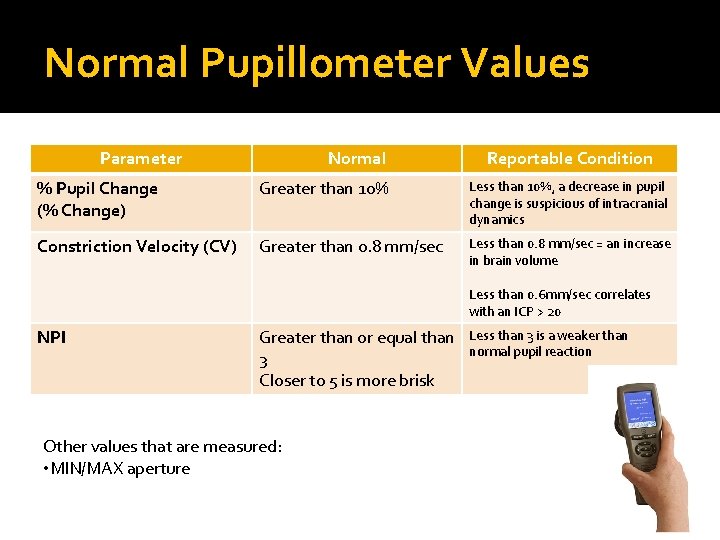
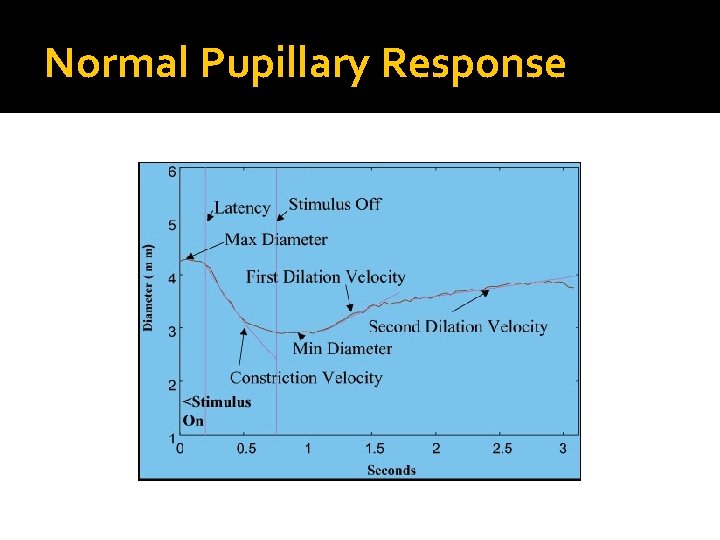
Normal Pupillometer Values Parameter Normal Reportable Condition % Pupil Change (% Change) Greater than 10% Less than 10%, a decrease in pupil change is suspicious of intracranial dynamics Constriction Velocity (CV) Greater than 0. 8 mm/sec Less than 0. 8 mm/sec = an increase in brain volume Less than 0. 6 mm/sec correlates with an ICP > 20 NPI Greater than or equal than 3 Closer to 5 is more brisk Other values that are measured: • MIN/MAX aperture Less than 3 is a weaker than normal pupil reaction
Normal Pupillary Response
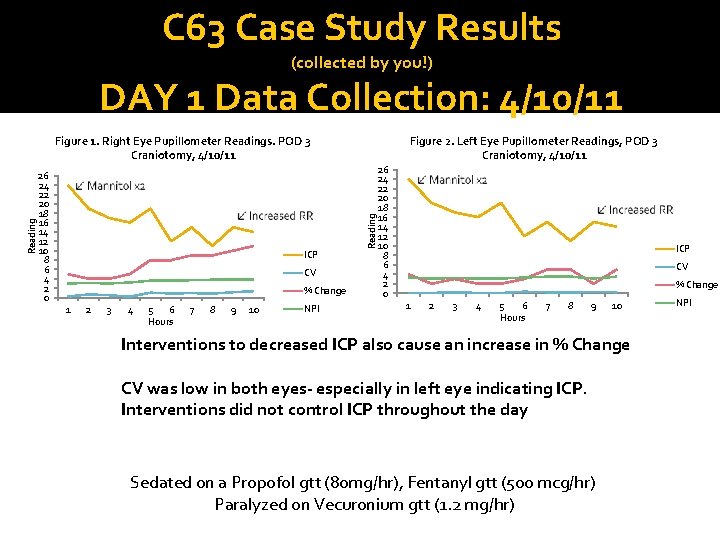
C 63 Case Study Results (collected by you!) DAY 1 Data Collection: 4/10/11 26 24 22 20 18 16 14 12 10 8 6 4 2 0 ICP CV % Change 1 2 3 4 5 6 Hours 7 8 9 10 NPI Figure 2. Left Eye Pupillometer Readings, POD 3 Craniotomy, 4/10/11 Reading Figure 1. Right Eye Pupillometer Readings. POD 3 Craniotomy, 4/10/11 26 24 22 20 18 16 14 12 10 8 6 4 2 0 ICP CV % Change 1 2 3 4 5 6 Hours 7 8 9 10 Interventions to decreased ICP also cause an increase in % Change CV was low in both eyes- especially in left eye indicating ICP. Interventions did not control ICP throughout the day Sedated on a Propofol gtt (80 mg/hr), Fentanyl gtt (500 mcg/hr) Paralyzed on Vecuronium gtt (1. 2 mg/hr) NPI
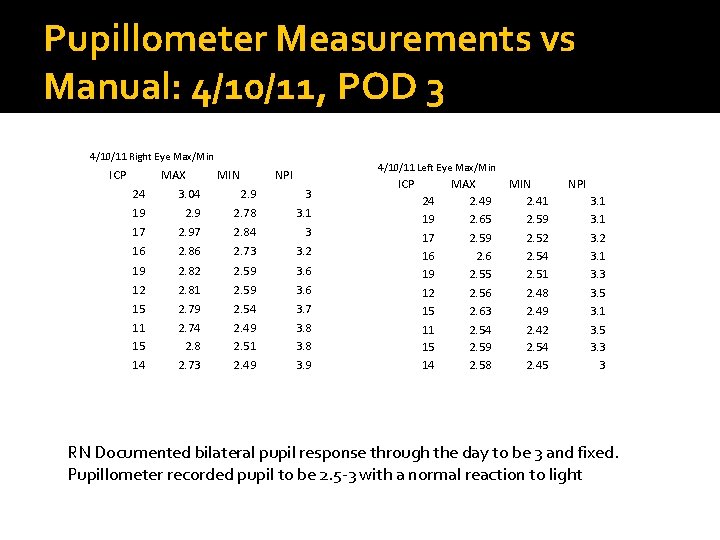
Pupillometer Measurements vs Manual: 4/10/11, POD 3 4/10/11 Right Eye Max/Min ICP 24 19 17 16 19 12 15 11 15 14 MAX 3. 04 2. 97 2. 86 2. 82 2. 81 2. 79 2. 74 2. 8 2. 73 MIN 2. 9 2. 78 2. 84 2. 73 2. 59 2. 54 2. 49 2. 51 2. 49 4/10/11 Left Eye Max/Min NPI 3 3. 1 3 3. 2 3. 6 3. 7 3. 8 3. 9 ICP 24 19 17 16 19 12 15 11 15 14 MAX 2. 49 2. 65 2. 59 2. 6 2. 55 2. 56 2. 63 2. 54 2. 59 2. 58 MIN 2. 41 2. 59 2. 52 2. 54 2. 51 2. 48 2. 49 2. 42 2. 54 2. 45 NPI 3. 1 3. 2 3. 1 3. 3 3. 5 3. 1 3. 5 3. 3 3 RN Documented bilateral pupil response through the day to be 3 and fixed. Pupillometer recorded pupil to be 2. 5 -3 with a normal reaction to light
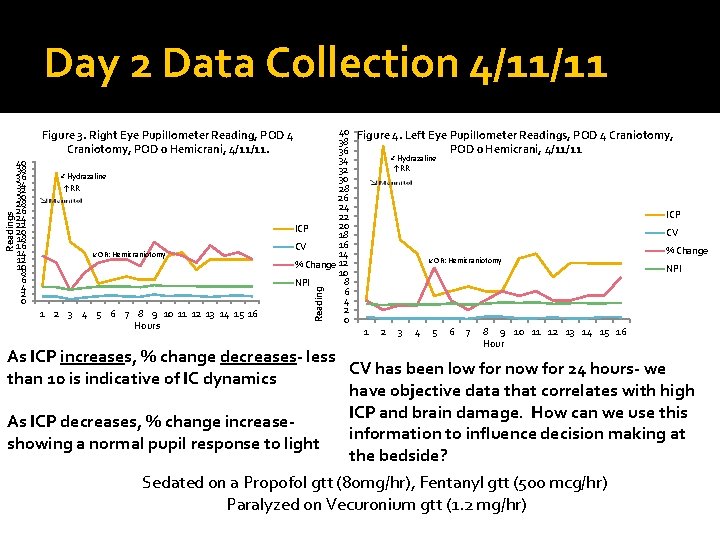
40 38 36 34 32 30 28 26 24 22 20 18 16 14 12 10 8 6 4 2 0 Figure 3. Right Eye Pupillometer Reading, POD 4 Craniotomy, POD 0 Hemicrani, 4/11/11. ↙ Hydrazaline ↑RR ↙OR: Hemicraniotomy 1 2 3 4 5 6 7 8 9 10 11 12 13 14 15 16 Hours 40 38 36 34 32 30 28 26 24 22 20 ICP 18 16 CV 14 % Change 12 10 8 NPI 6 4 2 0 Figure 4. Left Eye Pupillometer Readings, POD 4 Craniotomy, POD 0 Hemicrani, 4/11/11 ↙ Hydrazaline ↑RR ICP CV ↙OR: Hemicraniotomy % Change NPI Readings Day 2 Data Collection 4/11/11 1 2 3 4 5 6 7 8 9 10 11 12 13 14 15 16 Hour As ICP increases, % change decreases- less CV has been low for now for 24 hours- we than 10 is indicative of IC dynamics have objective data that correlates with high ICP and brain damage. How can we use this As ICP decreases, % change increaseinformation to influence decision making at showing a normal pupil response to light the bedside? Sedated on a Propofol gtt (80 mg/hr), Fentanyl gtt (500 mcg/hr) Paralyzed on Vecuronium gtt (1. 2 mg/hr)
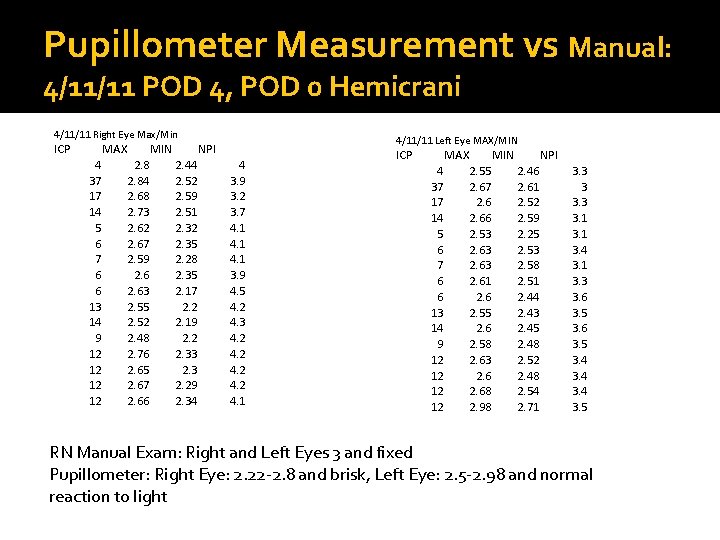
Pupillometer Measurement vs Manual: 4/11/11 POD 4, POD 0 Hemicrani 4/11/11 Right Eye Max/Min ICP 4 37 17 14 5 6 7 6 6 13 14 9 12 12 MAX 2. 84 2. 68 2. 73 2. 62 2. 67 2. 59 2. 63 2. 55 2. 52 2. 48 2. 76 2. 65 2. 67 2. 66 MIN 2. 44 2. 52 2. 59 2. 51 2. 32 2. 35 2. 28 2. 35 2. 17 2. 2 2. 19 2. 2 2. 33 2. 29 2. 34 NPI 4/11/11 Left Eye MAX/MIN 4 3. 9 3. 2 3. 7 4. 1 3. 9 4. 5 4. 2 4. 3 4. 2 4. 1 ICP MAX MIN NPI 4 2. 55 2. 46 37 2. 61 17 2. 6 2. 52 14 2. 66 2. 59 5 2. 53 2. 25 6 2. 63 2. 53 7 2. 63 2. 58 6 2. 61 2. 51 6 2. 44 13 2. 55 2. 43 14 2. 6 2. 45 9 2. 58 2. 48 12 2. 63 2. 52 12 2. 6 2. 48 12 2. 68 2. 54 12 2. 98 2. 71 3. 3 3. 1 3. 4 3. 1 3. 3 3. 6 3. 5 3. 4 3. 5 RN Manual Exam: Right and Left Eyes 3 and fixed Pupillometer: Right Eye: 2. 22 -2. 8 and brisk, Left Eye: 2. 5 -2. 98 and normal reaction to light
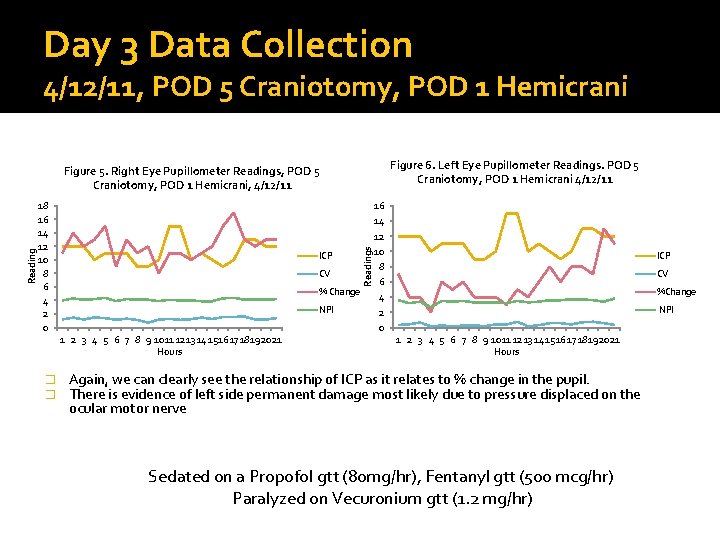
Day 3 Data Collection 4/12/11, POD 5 Craniotomy, POD 1 Hemicrani Figure 6. Left Eye Pupillometer Readings. POD 5 Craniotomy, POD 1 Hemicrani 4/12/11 18 16 14 12 10 8 6 4 2 0 16 14 12 ICP CV % Change NPI 10 ICP 8 CV 6 %Change 4 NPI 2 0 1 2 3 4 5 6 7 8 9 10 11 12 13 14 1516 17 18192021 Hours � � Readings Reading Figure 5. Right Eye Pupillometer Readings, POD 5 Craniotomy, POD 1 Hemicrani, 4/12/11 1 2 3 4 5 6 7 8 9 10 11 12 13 14 15 16 17 18 19 2021 Hours Again, we can clearly see the relationship of ICP as it relates to % change in the pupil. There is evidence of left side permanent damage most likely due to pressure displaced on the ocular motor nerve Sedated on a Propofol gtt (80 mg/hr), Fentanyl gtt (500 mcg/hr) Paralyzed on Vecuronium gtt (1. 2 mg/hr)
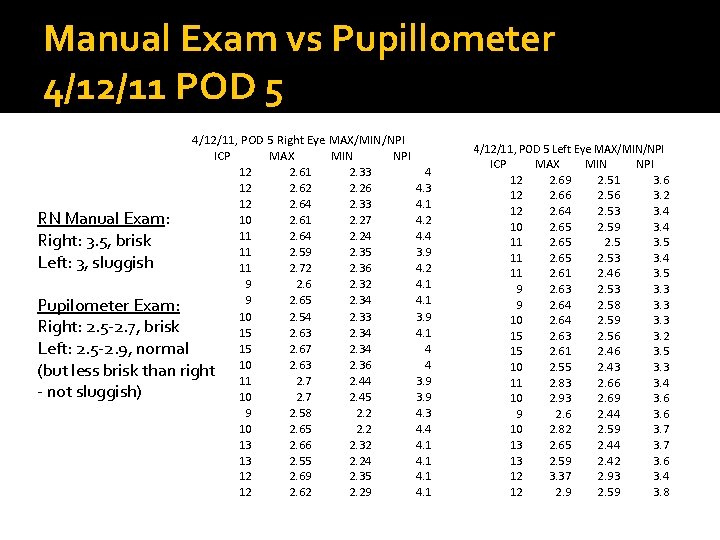
Manual Exam vs Pupillometer 4/12/11 POD 5 4/12/11, POD 5 Right Eye MAX/MIN/NPI ICP MAX MIN NPI 12 2. 61 2. 33 12 2. 62 2. 26 12 2. 64 2. 33 10 2. 61 2. 27 RN Manual Exam: 11 2. 64 2. 24 Right: 3. 5, brisk 11 2. 59 2. 35 Left: 3, sluggish 11 2. 72 2. 36 9 2. 6 2. 32 9 2. 65 2. 34 Pupilometer Exam: 10 2. 54 2. 33 Right: 2. 5 -2. 7, brisk 15 2. 63 2. 34 15 2. 67 2. 34 Left: 2. 5 -2. 9, normal 2. 63 2. 36 (but less brisk than right 10 11 2. 7 2. 44 - not sluggish) 10 2. 7 2. 45 9 2. 58 2. 2 10 2. 65 2. 2 13 2. 66 2. 32 13 2. 55 2. 24 12 2. 69 2. 35 12 2. 62 2. 29 4/12/11, POD 5 Left Eye MAX/MIN/NPI 4 4. 3 4. 1 4. 2 4. 4 3. 9 4. 2 4. 1 3. 9 4. 1 4 4 3. 9 4. 3 4. 4 4. 1 ICP 12 12 12 10 11 11 11 9 9 10 15 15 10 11 10 9 10 13 13 12 12 MAX 2. 69 2. 66 2. 64 2. 65 2. 61 2. 63 2. 64 2. 63 2. 61 2. 55 2. 83 2. 93 2. 6 2. 82 2. 65 2. 59 3. 37 2. 9 MIN 2. 51 2. 56 2. 53 2. 59 2. 53 2. 46 2. 53 2. 58 2. 59 2. 56 2. 43 2. 66 2. 69 2. 44 2. 59 2. 44 2. 42 2. 93 2. 59 NPI 3. 6 3. 2 3. 4 3. 5 3. 3 3. 2 3. 5 3. 3 3. 4 3. 6 3. 7 3. 6 3. 4 3. 8
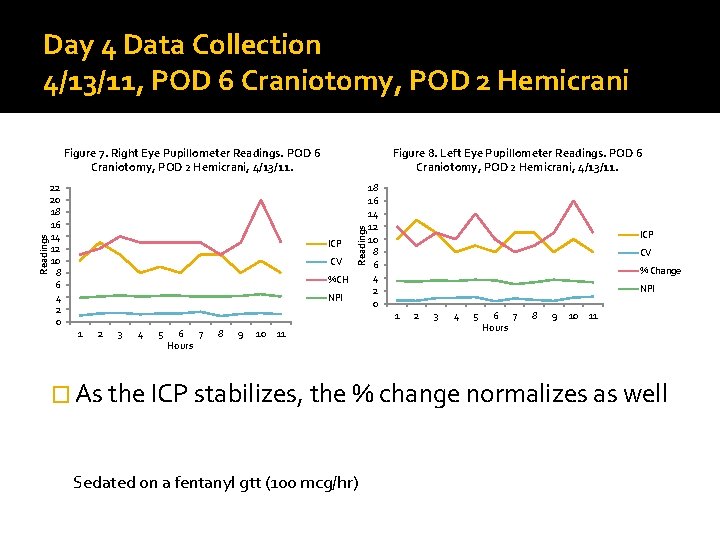
Day 4 Data Collection 4/13/11, POD 6 Craniotomy, POD 2 Hemicrani 22 20 18 16 14 12 10 8 6 4 2 0 Figure 8. Left Eye Pupillometer Readings. POD 6 Craniotomy, POD 2 Hemicrani, 4/13/11. ICP CV Readings Figure 7. Right Eye Pupillometer Readings. POD 6 Craniotomy, POD 2 Hemicrani, 4/13/11. %CH NPI 18 16 14 12 10 8 6 4 2 0 ICP CV % Change NPI 1 1 2 3 4 5 6 7 Hours 8 9 10 11 � As the ICP stabilizes, the % change normalizes as well Sedated on a fentanyl gtt (100 mcg/hr)
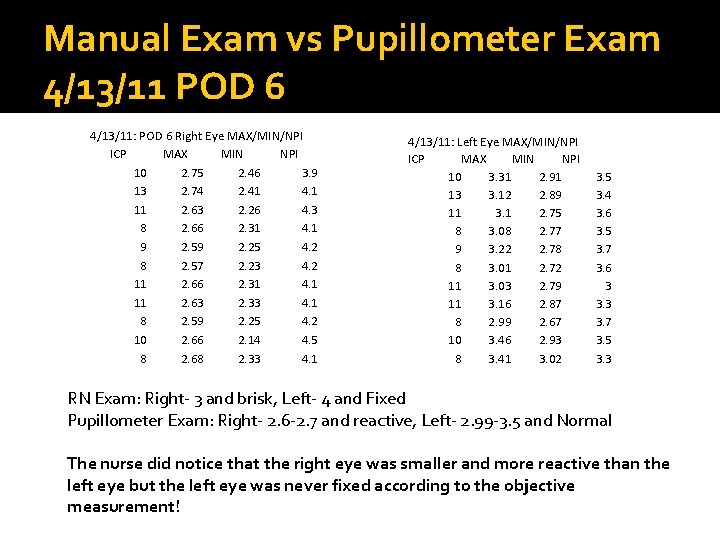
Manual Exam vs Pupillometer Exam 4/13/11 POD 6 4/13/11: POD 6 Right Eye MAX/MIN/NPI ICP MAX MIN NPI 10 2. 75 2. 46 3. 9 13 2. 74 2. 41 4. 1 11 2. 63 2. 26 4. 3 8 2. 66 2. 31 4. 1 9 2. 59 2. 25 4. 2 8 2. 57 2. 23 4. 2 11 2. 66 2. 31 4. 1 11 2. 63 2. 33 4. 1 8 2. 59 2. 25 4. 2 10 2. 66 2. 14 4. 5 8 2. 68 2. 33 4. 1 4/13/11: Left Eye MAX/MIN/NPI ICP MAX MIN NPI 10 3. 31 2. 91 13 3. 12 2. 89 11 3. 1 2. 75 8 3. 08 2. 77 9 3. 22 2. 78 8 3. 01 2. 72 11 3. 03 2. 79 11 3. 16 2. 87 8 2. 99 2. 67 10 3. 46 2. 93 8 3. 41 3. 02 3. 5 3. 4 3. 6 3. 5 3. 7 3. 6 3 3. 7 3. 5 3. 3 RN Exam: Right- 3 and brisk, Left- 4 and Fixed Pupillometer Exam: Right- 2. 6 -2. 7 and reactive, Left- 2. 99 -3. 5 and Normal The nurse did notice that the right eye was smaller and more reactive than the left eye but the left eye was never fixed according to the objective measurement!
Why use the Pupillometer? �Its Easy!! It’s portable!! It’s user friendly!! �It is a reliable, repetitive, and safe method that provides detailed and accurate information regarding pupillary response! �Non invasive
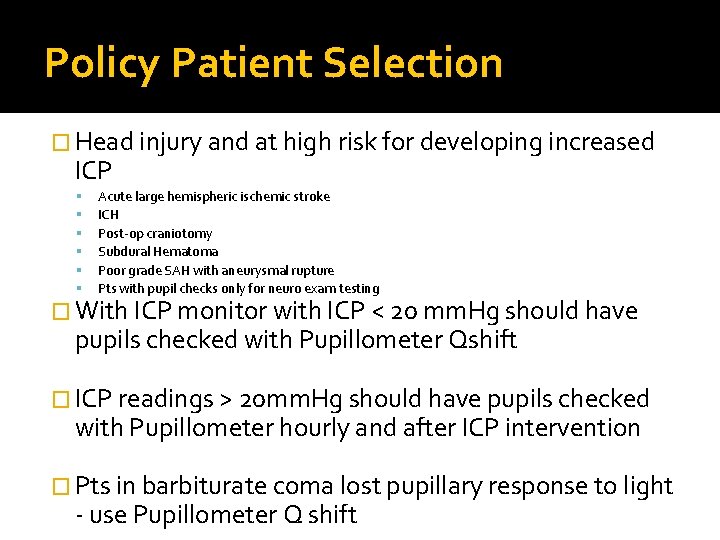
Policy Patient Selection � Head injury and at high risk for developing increased ICP Acute large hemispheric ischemic stroke ICH Post-op craniotomy Subdural Hematoma Poor grade SAH with aneurysmal rupture Pts with pupil checks only for neuro exam testing � With ICP monitor with ICP < 20 mm. Hg should have pupils checked with Pupillometer Qshift � ICP readings > 20 mm. Hg should have pupils checked with Pupillometer hourly and after ICP intervention � Pts in barbiturate coma lost pupillary response to light - use Pupillometer Q shift
For the Future… �Should be used for a routine pupil measurement instead of penlight or flashlight �These measurements can help influence the medical decisions of care! �Detect abnormalities faster and help motivate interventions. �Start using it early and use the trends!! Don’t stop taking measurements!
What does this mean to you? �In this case, what could we have done in the management of our patient? �What would you do next time when your notice an unchanging trend in low CV or any other abnormal trend in measurements?
WWYD? (what would you do? ) �It is time for your routine pupil assessment. �You notice a decline in GCS. �Your pts pupils are now asymmetric. �You notice an overall decline in your pt neuro status �Your EVD has a poor waveform, you believe it is not draining correctly or draining CSF
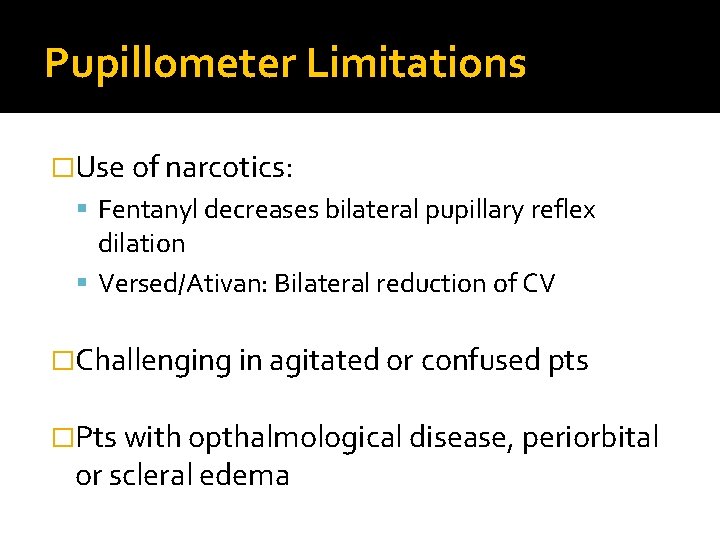
Pupillometer Limitations �Use of narcotics: Fentanyl decreases bilateral pupillary reflex dilation Versed/Ativan: Bilateral reduction of CV �Challenging in agitated or confused pts �Pts with opthalmological disease, periorbital or scleral edema
References Bader, M. K. (2011). Inside the black box: Multimodality monitoring in the neuro trauma patient. Unpublished manuscript. Chen J. , Gombart Z. , Rogers S. , Gardiner S. , Cecil S. , Bullock R. (2011). Pupillary reactivity as an early indicator of increased intracranial pressure: The introduction of neurologic pupil index. Surgical Neurology International, 2(1), 82 -86. Fountas, K. , Kapsalaki, E. , Machinis, T. , & Boev, A. (2006). Clinical implications of quantitative infrared pupillometry in neurosurgical patients. Neurocritical Care, 5. Meeker M, Du R, Bacchetti P, Privitera C, Larson M, Holland M, Manley G. (2005). Pupil examination: Validity and clinical utility of an automated pupilometer. Journal of Neuroscience Nursing, 37(1). Taylor, W. , Chen, J. , Meltzer, H. , Gennarelli, T. , Kelbch, C. , Knowlton, S. , . . . Marshall, L. (2003). Qualtitative pupillometry, a new technology: Normative data and prelimary observations in patients with acute head injury. J Neurosurg, 98, 205 -213.