
A case report on cavitating mesenteric lymph node
- Slides: 8
A case report on cavitating mesenteric lymph node syndrome Dr Matthew Kim, ST 4 Radiology Dr Hameed Rafiee, consultant radiologist Radiology Academy, Norwich, UK
Clinical History • 70 -year-old white male presented to gastroenterology clinic with loss of weight, loss of appetite and occasional diarrhoea. He had lost 4 stones (25 kg) in weight following campylobacter gastroenteritis 4 years ago, and failed to regain it. • No known history of coeliac disease. • On examination, his abdomen was soft and non-tender with no masses.
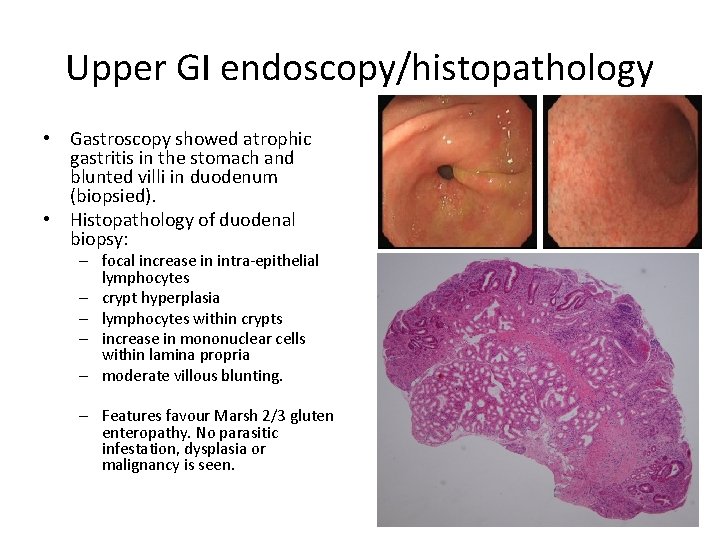
Upper GI endoscopy/histopathology • Gastroscopy showed atrophic gastritis in the stomach and blunted villi in duodenum (biopsied). • Histopathology of duodenal biopsy: – focal increase in intra-epithelial lymphocytes – crypt hyperplasia – lymphocytes within crypts – increase in mononuclear cells within lamina propria – moderate villous blunting. – Features favour Marsh 2/3 gluten enteropathy. No parasitic infestation, dysplasia or malignancy is seen.
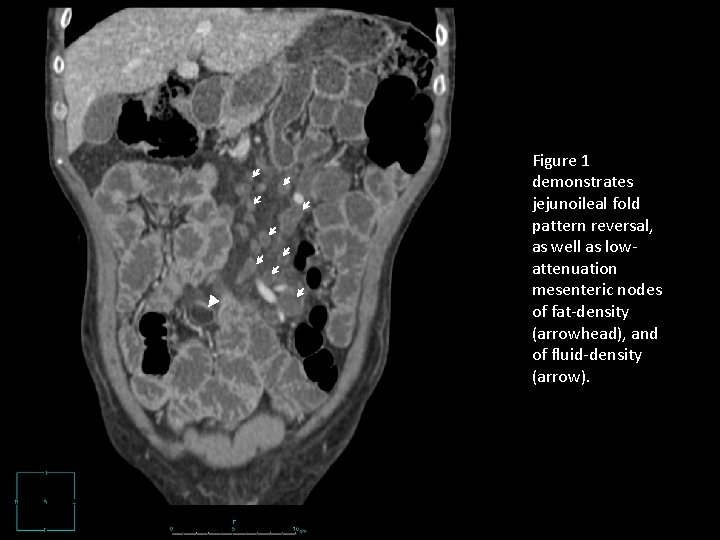
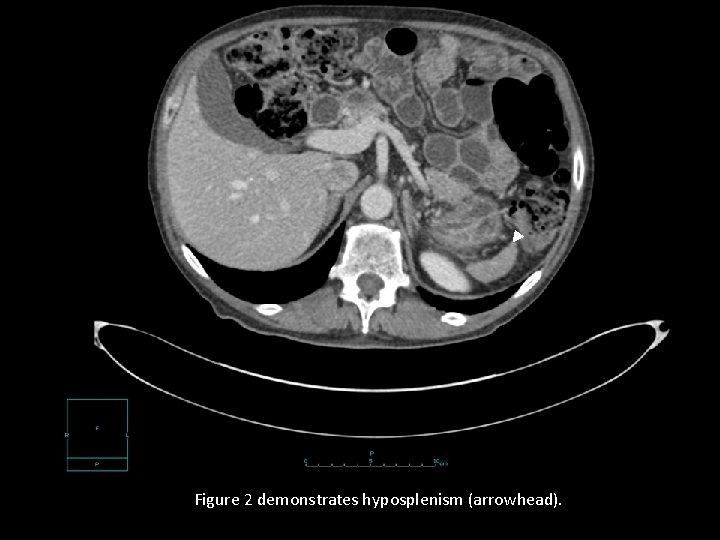
• Initial investigation also comprised of CT colonoscopy to look for colonic mass/polyps. • No colonic tumour or polyps were demonstrated, however there was low density mesenteric adenopathy so a CT neck, chest, abdomen and pelvis with contrast was recommended. • Post contrast CT NCAP showed: – Reversal of jejunoileal fold pattern with jejunisation of the ileum and loss of folds in the jejunum (figure 1) – Multiple low attenuation lymph nodes with rim enhancement in the small bowel mesentery measuring up to 37 mm in short axis (figure 1). Most contain fluid attenuation, though a few contain macroscopic fat. No fat-fluid levels were seen. – Small spleen measuring 39 mm in length (figure 2)
Figure 1 demonstrates jejunoileal fold pattern reversal, as well as lowattenuation mesenteric nodes of fat-density (arrowhead), and of fluid-density (arrow).
Figure 2 demonstrates hyposplenism (arrowhead).
Discussion • Cavitating mesenteric lymph node syndrome (CMLNS) is a poorly understood and rare complication of longstanding or refractory coeliac disease. 1 • CT features include central low attenuation mesenteric lymph nodes with thin enhancing rims, which may be cystic and/or fatty in attenuation (+/- fat-fluid levels). 2 • Splenic atrophy often accompanies CMLNS. • The pathogenesis is poorly understood. Hypotheses include excessive antigen exposure via damaged small bowel mucosa causing lymphoid cell depletion in the lymph nodes and spleen. 3 • Alternatively, changes may reflect necrosis in the mesenteric nodes triggered by localized immune-mediated complement activation and intravascular coagulation. 3 1. Green C. , Hun T. , Van Vliet C. et al. Captivating cases of cavitating mesenteric lymph node syndrome. Pathology 2016, Volume 48, S 126 2. Huppert B. , Farrell M. , Kawashima A. , et al. Diagnosis of Cavitating Mesenteric Lymph Node Syndrome in Celiac Disease Using MRI. American Journal of Roentgenology. 2004; 183: 1375 -1377. 10. 2214/ajr. 183. 5. 1831375 3. Freeman, H. Mesenteric lymph node cavitation syndrome. World J Gastroenterol 2010 June 28; 16(24): 2991 -2993 ISSN 1007 - 9327
Discussion • Low attenuation mesenteric adenopathy on CT can also be seen in mycobacterial infection, Whipple’s disease, necrotic/mucinous metastases, and some high grade necrotic lymphomas. Other differentials include mesenteric neurofibromatosis and lymphangioma. • Functional hyposplenism may be present which increases the susceptibility to infection. • Some reports of CMLNS have been associated with a mortality rate of 50% and an increased risk of lymphoma. 2 • In conclusion, cavitating mesenteric lymph node syndrome and underlying coeliac disease should be suspected when patients have cystic changes limited to the mesenteric lymph nodes, especially in the presence of splenic atrophy. 2. Huppert B. , Farrell M. , Kawashima A. , et al. Diagnosis of Cavitating Mesenteric Lymph Node Syndrome in Celiac Disease Using MRI. American Journal of Roentgenology. 2004; 183: 1375 -1377. 10. 2214/ajr. 183. 5. 1831375