
A CASE FOR DIRECT AIR CAPTURE DAC Mennat
- Slides: 1
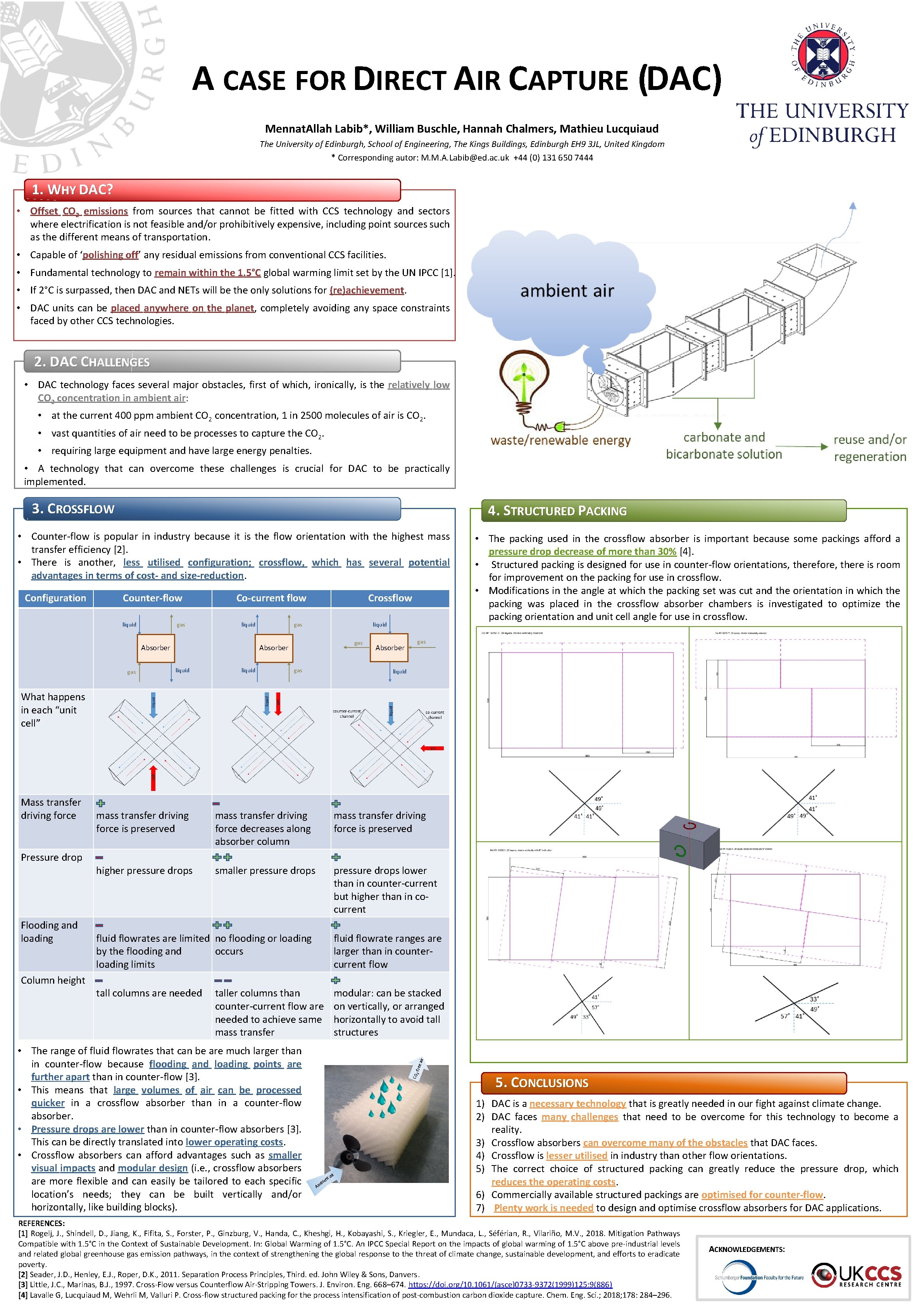
A CASE FOR DIRECT AIR CAPTURE (DAC) Mennat. Allah Labib*, William Buschle, Hannah Chalmers, Mathieu Lucquiaud The University of Edinburgh, School of Engineering, The Kings Buildings, Edinburgh EH 9 3 JL, United Kingdom * Corresponding autor: M. M. A. Labib@ed. ac. uk +44 (0) 131 650 7444 1. WHY DAC? • Offset CO 2 emissions from sources that cannot be fitted with CCS technology and sectors where electrification is not feasible and/or prohibitively expensive, including point sources such as the different means of transportation. • Capable of ‘polishing off’ any residual emissions from conventional CCS facilities. • Fundamental technology to remain within the 1. 5°C global warming limit set by the UN IPCC [1]. • If 2°C is surpassed, then DAC and NETs will be the only solutions for (re)achievement. • DAC units can be placed anywhere on the planet, completely avoiding any space constraints faced by other CCS technologies. 2. DAC CHALLENGES • DAC technology faces several major obstacles, first of which, ironically, is the relatively low CO 2 concentration in ambient air: • at the current 400 ppm ambient CO 2 concentration, 1 in 2500 molecules of air is CO 2. • vast quantities of air need to be processes to capture the CO 2. • requiring large equipment and have large energy penalties. • A technology that can overcome these challenges is crucial for DAC to be practically implemented. 3. CROSSFLOW 4. STRUCTURED PACKING • Counter-flow is popular in industry because it is the flow orientation with the highest mass transfer efficiency [2]. • There is another, less utilised configuration; crossflow, which has several potential advantages in terms of cost- and size-reduction. Configuration Counter-flow liquid gas Co-current flow liquid Absorber gas Crossflow liquid gas Absorber • The packing used in the crossflow absorber is important because some packings afford a pressure drop decrease of more than 30% [4]. • Structured packing is designed for use in counter-flow orientations, therefore, there is room for improvement on the packing for use in crossflow. • Modifications in the angle at which the packing set was cut and the orientation in which the packing was placed in the crossflow absorber chambers is investigated to optimize the packing orientation and unit cell angle for use in crossflow. gas liquid What happens in each “unit cell” mass transfer driving force decreases along absorber column + smaller pressure drops Pressure drop higher pressure drops Flooding and loading + fluid flowrates are limited no flooding or loading by the flooding and occurs loading limits fluid flowrate ranges are larger than in countercurrent flow + taller columns than modular: can be stacked counter-current flow are on vertically, or arranged needed to achieve same horizontally to avoid tall mass transfer structures • The range of fluid flowrates that can be are much larger than in counter-flow because flooding and loading points are further apart than in counter-flow [3]. • This means that large volumes of air can be processed quicker in a crossflow absorber than in a counter-flow absorber. • Pressure drops are lower than in counter-flow absorbers [3]. This can be directly translated into lower operating costs. • Crossflow absorbers can afford advantages such as smaller visual impacts and modular design (i. e. , crossflow absorbers are more flexible and can easily be tailored to each specific location’s needs; they can be built vertically and/or horizontally, like building blocks). r tall columns are needed + pressure drops lower than in counter-current but higher than in cocurrent e ai Column height mass transfer driving force is preserved 2 -fre mass transfer driving force is preserved CO Mass transfer driving force Am nt bie air 5. CONCLUSIONS 1) DAC is a necessary technology that is greatly needed in our fight against climate change. 2) DAC faces many challenges that need to be overcome for this technology to become a reality. 3) Crossflow absorbers can overcome many of the obstacles that DAC faces. 4) Crossflow is lesser utilised in industry than other flow orientations. 5) The correct choice of structured packing can greatly reduce the pressure drop, which reduces the operating costs. 6) Commercially available structured packings are optimised for counter-flow. 7) Plenty work is needed to design and optimise crossflow absorbers for DAC applications. REFERENCES: [1] Rogelj, J. , Shindell, D. , Jiang, K. , Fifita, S. , Forster, P. , Ginzburg, V. , Handa, C. , Kheshgi, H. , Kobayashi, S. , Kriegler, E. , Mundaca, L. , Séférian, R. , Vilariño, M. V. , 2018. Mitigation Pathways Compatible with 1. 5°C in the Context of Sustainable Development. In: Global Warming of 1. 5°C. An IPCC Special Report on the impacts of global warming of 1. 5°C above pre-industrial levels and related global greenhouse gas emission pathways, in the context of strengthening the global response to the threat of climate change, sustainable development, and efforts to eradicate poverty. [2] Seader, J. D. , Henley, E. J. , Roper, D. K. , 2011. Separation Process Principles, Third. ed. John Wiley & Sons, Danvers. [3] Little, J. C. , Marinas, B. J. , 1997. Cross-Flow versus Counterflow Air-Stripping Towers. J. Environ. Eng. 668– 674. https: //doi. org/10. 1061/(asce)0733 -9372(1999)125: 9(886) [4] Lavalle G, Lucquiaud M, Wehrli M, Valluri P. Cross-flow structured packing for the process intensification of post-combustion carbon dioxide capture. Chem. Eng. Sci. ; 2018; 178: 284– 296. ACKNOWLEDGEMENTS: