
A Career in Engineering Is this feasible for
A Career in Engineering Is this feasible for women? Industry or Academia? Can membership in IEEE help you in your career? Celia Desmond President World Class –Telecommunications Past President IEEE Communications Society President IEEE Canada (2000 -2001) Vice President IEEE Technical Activities 2006 IEEE Secretary 2007 and 2012 Celia Desmond World Class Telecommunications 1
Some surprising answers Is an engineering career feasible for women? Yes, but … Industry or Academia? Really a personal decision Can membership in IEEE help you in your career? A resounding yes – and some comments Celia Desmond World Class Telecommunications 2
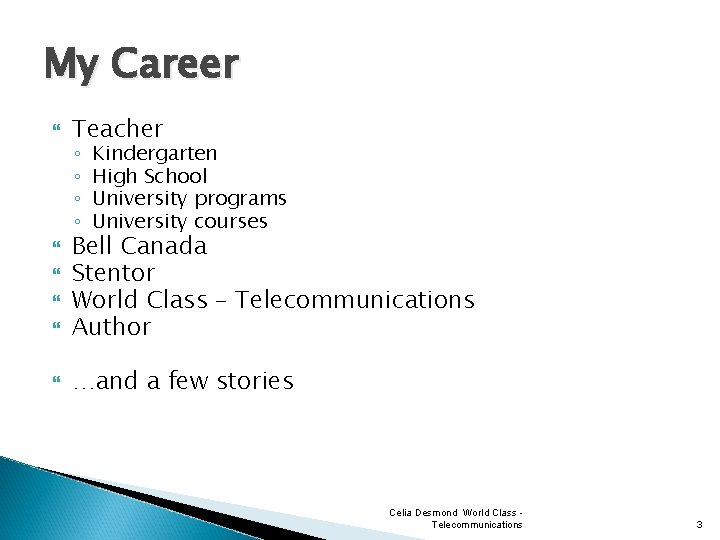
My Career Teacher ◦ ◦ Kindergarten High School University programs University courses Bell Canada Stentor World Class – Telecommunications Author …and a few stories Celia Desmond World Class Telecommunications 3
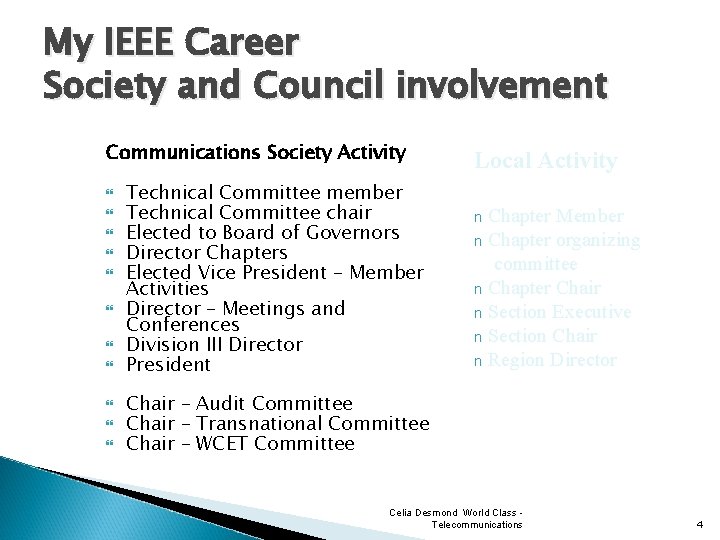
My IEEE Career Society and Council involvement Communications Society Activity Technical Committee member Technical Committee chair Elected to Board of Governors Director Chapters Elected Vice President – Member Activities Director – Meetings and Conferences Division III Director President Chair – Audit Committee Chair – Transnational Committee Chair – WCET Committee Local Activity Chapter Member n Chapter organizing committee n Chapter Chair n Section Executive n Section Chair n Region Director n Celia Desmond World Class Telecommunications 4
Other IEEE areas Local Chapters, Section n n n Chapter Member Chapter organizing committee Chapter Chair Section Executive Section Chair Region Director Board of Directors ◦ Must work up to this Committees ◦ Highly interesting, at all levels ◦ Lots of time required – so why do this? Celia Desmond World Class Telecommunications 5
IEEE Communications Society … a diverse group of international communications professionals with a common interest in advancing all communications technologies. Toward that end it sponsors publications, conferences, educational programs, local activities, and technical committees that: Foster original work in all aspects of communications. Encourage applications for voice, data, image, and video communications and the integration of computing and communications. Promote theory and development of end–to–end communications networking and systems. Advance communications infrastructure and technologies for systems including the Internet, personal communications, multimedia communications, enterprise networks, and optical communications. Celia Desmond World Class Telecommunications 6
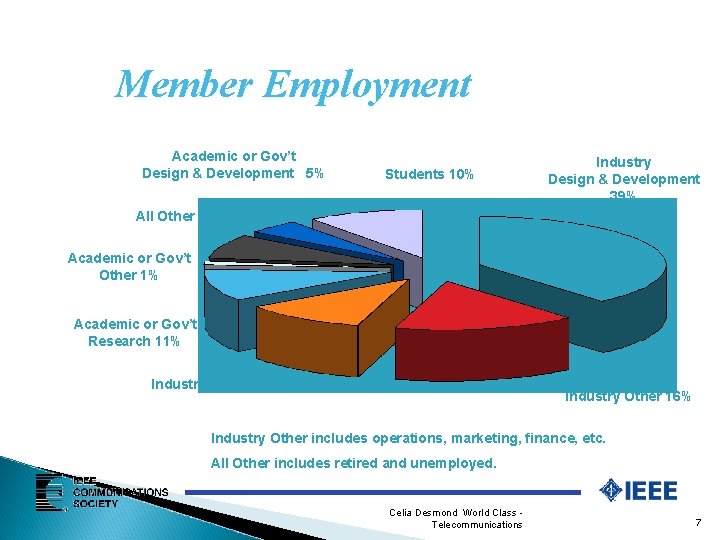
Member Employment Academic or Gov’t Design & Development 5% Students 10% Industry Design & Development 39% All Other 8% Academic or Gov’t Other 1% Academic or Gov’t Research 11% Industry Other 16% Industry Other includes operations, marketing, finance, etc. All Other includes retired and unemployed. Celia Desmond World Class Telecommunications 7
Snippets for WIE Discussion at Globecom Mary Ward-Callan IEEE Managing Director of Technical Activities Celia Desmond World Class Telecommunications 8
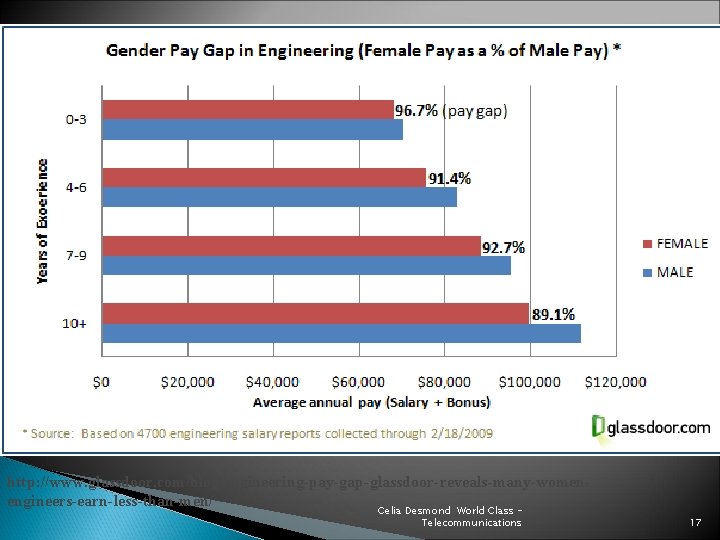
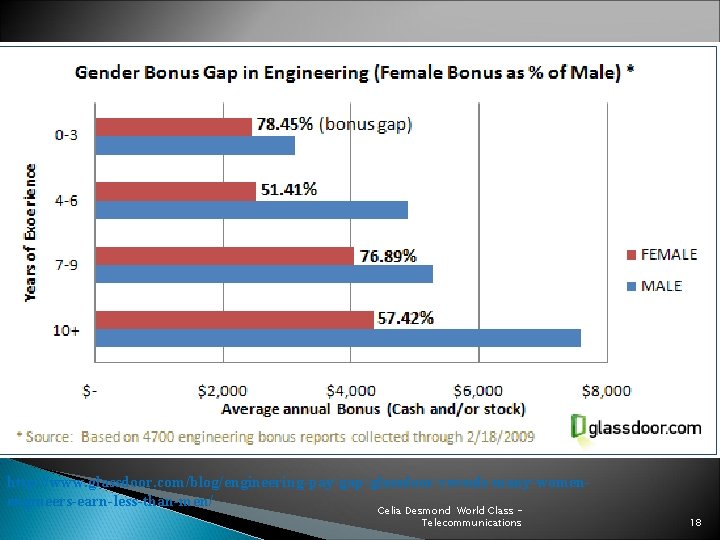
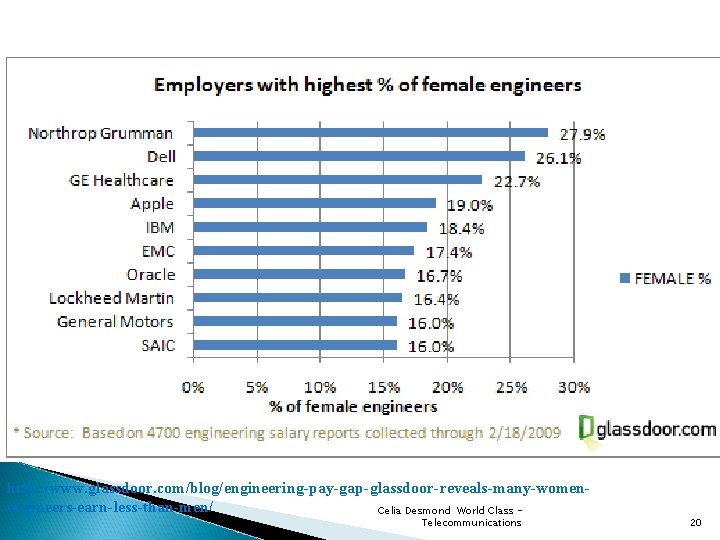
Topics General unemployment in US: gender (trend and 2 Q 2009) not separated by General employment information for women Gender gap in pay and bonuses ◦ Gender gap in cities with most female engineers ◦ Employers with the highest percentage of female engineers Why are Women leaving Engineering Women in Academics Women in the IEEE Celia Desmond World Class Telecommunications 9
Unemployment Numbers Celia Desmond World Class Telecommunications 10
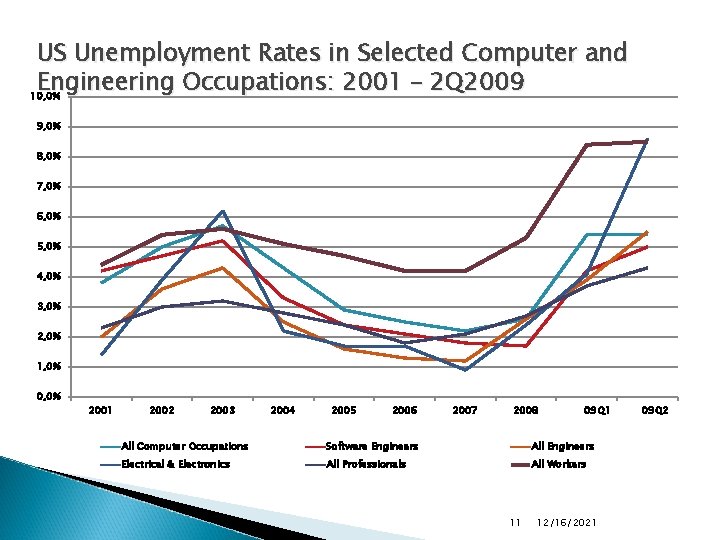
US Unemployment Rates in Selected Computer and Engineering Occupations: 2001 – 2 Q 2009 10, 0% 9, 0% 8, 0% 7, 0% 6, 0% 5, 0% 4, 0% 3, 0% 2, 0% 1, 0% 0, 0% 2001 2002 2003 2004 2005 2006 2007 2008 09 Q 1 All Computer Occupations Software Engineers All Engineers Electrical & Electronics All Professionals All Workers 11 12/16/2021 09 Q 2
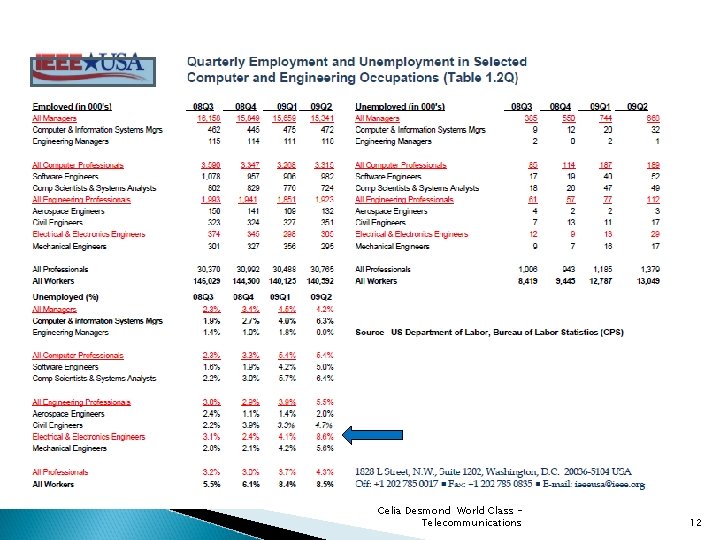
Celia Desmond World Class Telecommunications 12
Employment Numbers for Women Celia Desmond World Class Telecommunications 13
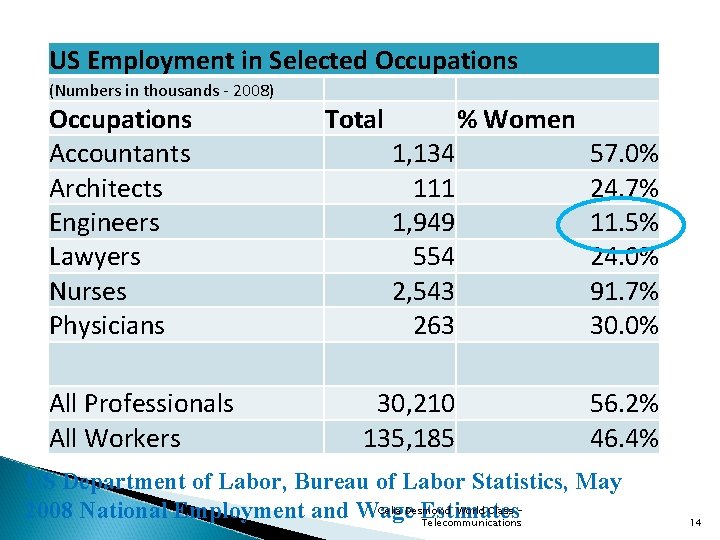
US Employment in Selected Occupations (Numbers in thousands - 2008) Occupations Accountants Architects Engineers Lawyers Nurses Physicians All Professionals All Workers Total % Women 1, 134 111 1, 949 554 2, 543 263 57. 0% 24. 7% 11. 5% 24. 0% 91. 7% 30. 0% 30, 210 135, 185 56. 2% 46. 4% US Department of Labor, Bureau of Labor Statistics, May Celia Desmond World Class 2008 National Employment and Wage Estimates Telecommunications 14
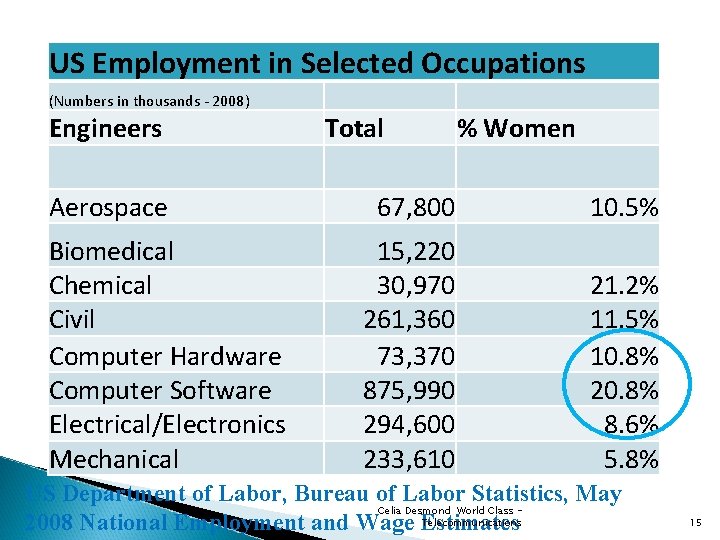
US Employment in Selected Occupations (Numbers in thousands - 2008) Engineers Aerospace Biomedical Chemical Civil Computer Hardware Computer Software Electrical/Electronics Mechanical Total % Women 67, 800 10. 5% 15, 220 30, 970 261, 360 73, 370 875, 990 294, 600 233, 610 21. 2% 11. 5% 10. 8% 20. 8% 8. 6% 5. 8% US Department of Labor, Bureau of Labor Statistics, May Celia Desmond World Class Telecommunications 2008 National Employment and Wage Estimates 15
GENDER PAY GAPS Celia Desmond World Class Telecommunications 16
http: //www. glassdoor. com/blog/engineering-pay-gap-glassdoor-reveals-many-womenengineers-earn-less-than-men/ Celia Desmond World Class Telecommunications 17
http: //www. glassdoor. com/blog/engineering-pay-gap-glassdoor-reveals-many-womenengineers-earn-less-than-men/ Celia Desmond World Class Telecommunications 18
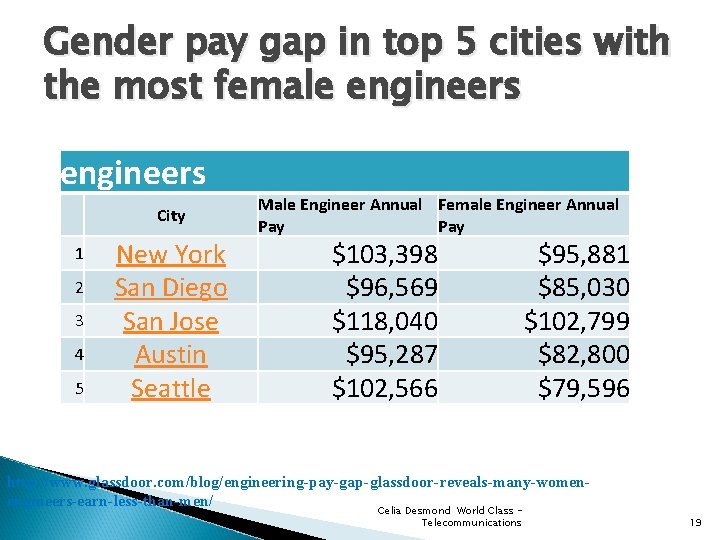
Gender pay gap in top 5 cities with the most female engineers City 1 2 3 4 5 New York San Diego San Jose Austin Seattle Male Engineer Annual Female Engineer Annual Pay $103, 398 $96, 569 $118, 040 $95, 287 $102, 566 $95, 881 $85, 030 $102, 799 $82, 800 $79, 596 http: //www. glassdoor. com/blog/engineering-pay-gap-glassdoor-reveals-many-womenengineers-earn-less-than-men/ Celia Desmond World Class Telecommunications 19
http: //www. glassdoor. com/blog/engineering-pay-gap-glassdoor-reveals-many-womenengineers-earn-less-than-men/ Celia Desmond World Class Telecommunications 20
WHY ARE WOMEN LEAVING ENGINEERING? Celia Desmond World Class Telecommunications 21
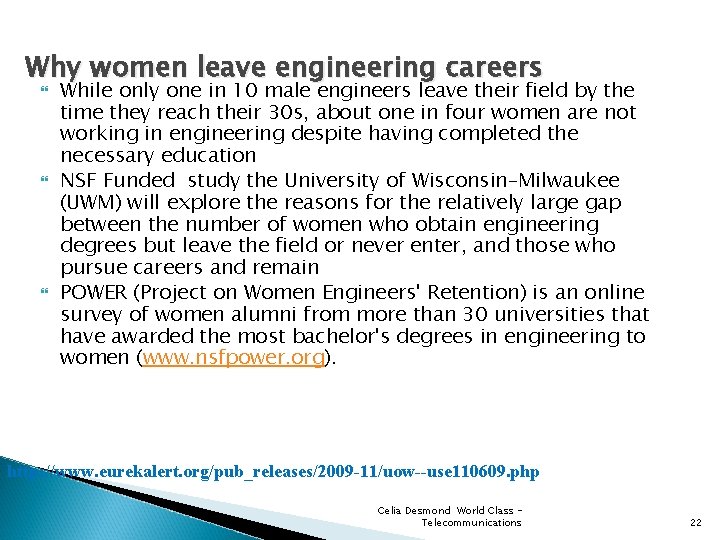
Why women leave engineering careers While only one in 10 male engineers leave their field by the time they reach their 30 s, about one in four women are not working in engineering despite having completed the necessary education NSF Funded study the University of Wisconsin–Milwaukee (UWM) will explore the reasons for the relatively large gap between the number of women who obtain engineering degrees but leave the field or never enter, and those who pursue careers and remain POWER (Project on Women Engineers' Retention) is an online survey of women alumni from more than 30 universities that have awarded the most bachelor's degrees in engineering to women (www. nsfpower. org). http: //www. eurekalert. org/pub_releases/2009 -11/uow--use 110609. php Celia Desmond World Class Telecommunications 22
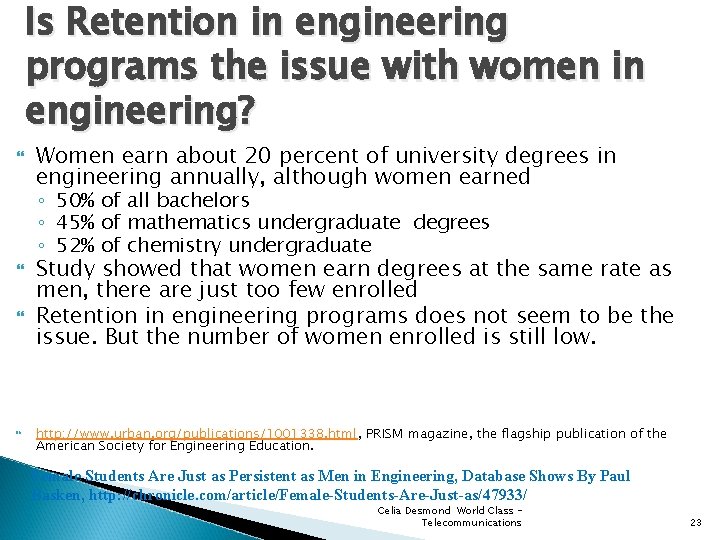
Is Retention in engineering programs the issue with women in engineering? Women earn about 20 percent of university degrees in engineering annually, although women earned ◦ 50% of all bachelors ◦ 45% of mathematics undergraduate degrees ◦ 52% of chemistry undergraduate Study showed that women earn degrees at the same rate as men, there are just too few enrolled Retention in engineering programs does not seem to be the issue. But the number of women enrolled is still low. http: //www. urban. org/publications/1001338. html, PRISM magazine, the flagship publication of the American Society for Engineering Education. Female Students Are Just as Persistent as Men in Engineering, Database Shows By Paul Basken, http: //chronicle. com/article/Female-Students-Are-Just-as/47933/ Celia Desmond World Class Telecommunications 23
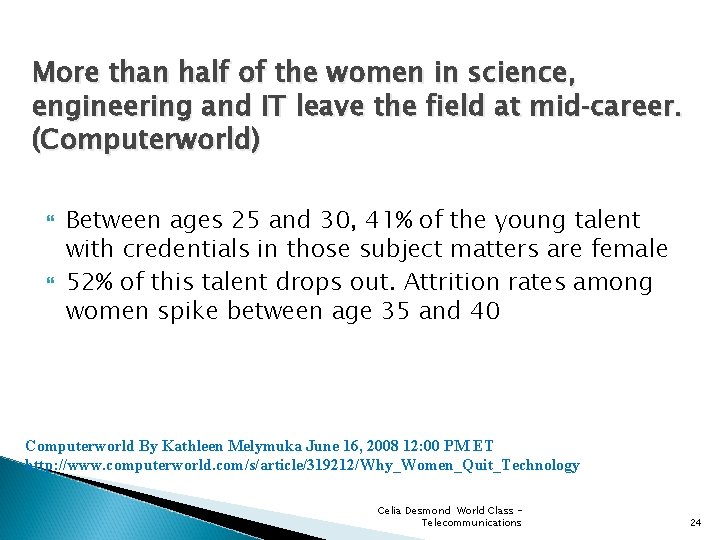
More than half of the women in science, engineering and IT leave the field at mid career. (Computerworld) Between ages 25 and 30, 41% of the young talent with credentials in those subject matters are female 52% of this talent drops out. Attrition rates among women spike between age 35 and 40 Computerworld By Kathleen Melymuka June 16, 2008 12: 00 PM ET http: //www. computerworld. com/s/article/319212/Why_Women_Quit_Technology Celia Desmond World Class Telecommunications 24
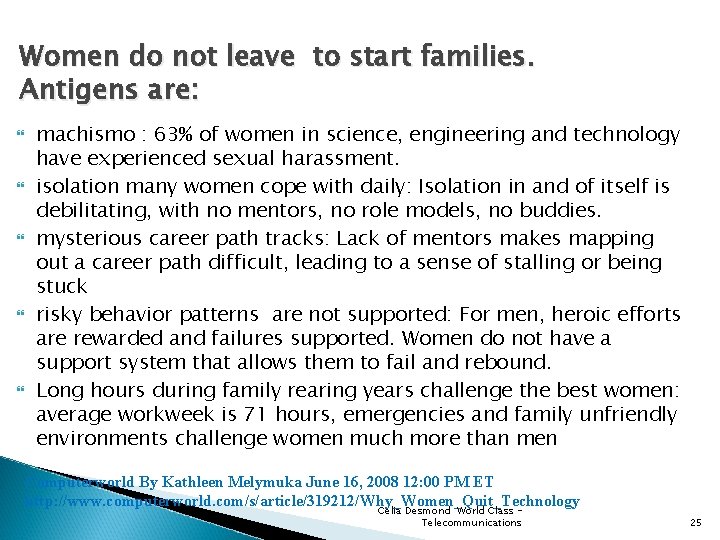
Women do not leave to start families. Antigens are: machismo : 63% of women in science, engineering and technology have experienced sexual harassment. isolation many women cope with daily: Isolation in and of itself is debilitating, with no mentors, no role models, no buddies. mysterious career path tracks: Lack of mentors makes mapping out a career path difficult, leading to a sense of stalling or being stuck risky behavior patterns are not supported: For men, heroic efforts are rewarded and failures supported. Women do not have a support system that allows them to fail and rebound. Long hours during family rearing years challenge the best women: average workweek is 71 hours, emergencies and family unfriendly environments challenge women much more than men Computerworld By Kathleen Melymuka June 16, 2008 12: 00 PM ET http: //www. computerworld. com/s/article/319212/Why_Women_Quit_Technology Celia Desmond World Class Telecommunications 25
Women in Academics Celia Desmond World Class Telecommunications 26
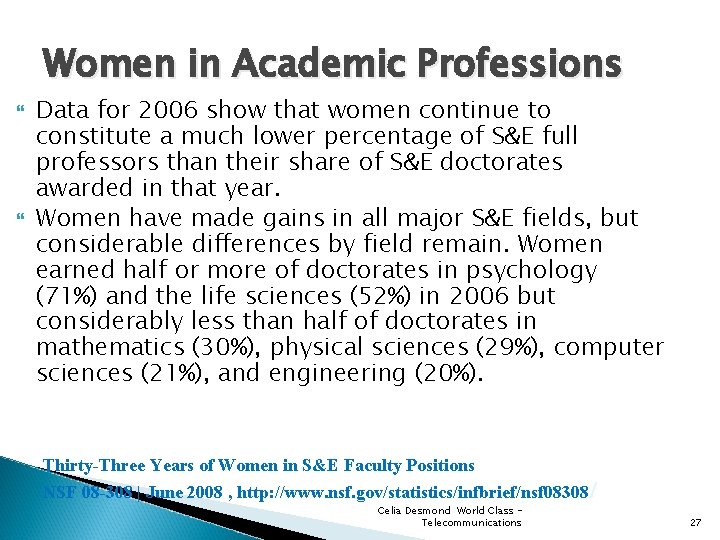
Women in Academic Professions Data for 2006 show that women continue to constitute a much lower percentage of S&E full professors than their share of S&E doctorates awarded in that year. Women have made gains in all major S&E fields, but considerable differences by field remain. Women earned half or more of doctorates in psychology (71%) and the life sciences (52%) in 2006 but considerably less than half of doctorates in mathematics (30%), physical sciences (29%), computer sciences (21%), and engineering (20%). Thirty-Three Years of Women in S&E Faculty Positions NSF 08 -308 | June 2008 , http: //www. nsf. gov/statistics/infbrief/nsf 08308/ Celia Desmond World Class Telecommunications 27
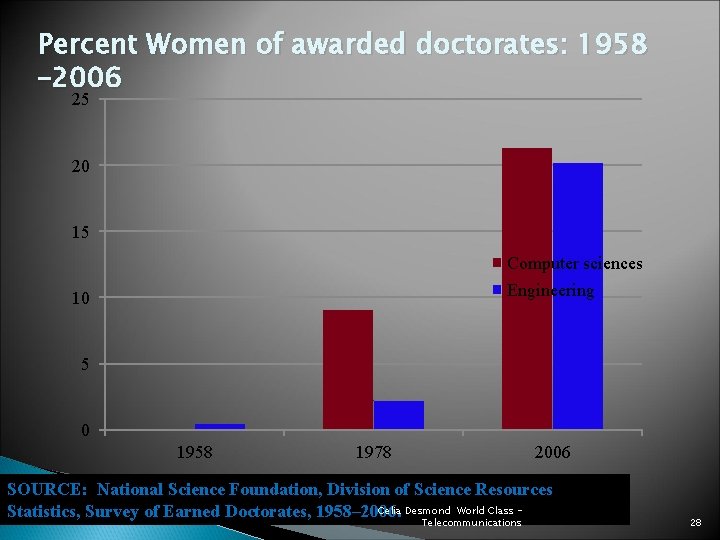
Percent Women of awarded doctorates: 1958 – 2006 25 20 15 Computer sciences Engineering 10 5 0 1958 1978 2006 SOURCE: National Science Foundation, Division of Science Resources Celia Desmond World Class Statistics, Survey of Earned Doctorates, 1958– 2006. Telecommunications 28
Women in the IEEE Celia Desmond World Class Telecommunications 29
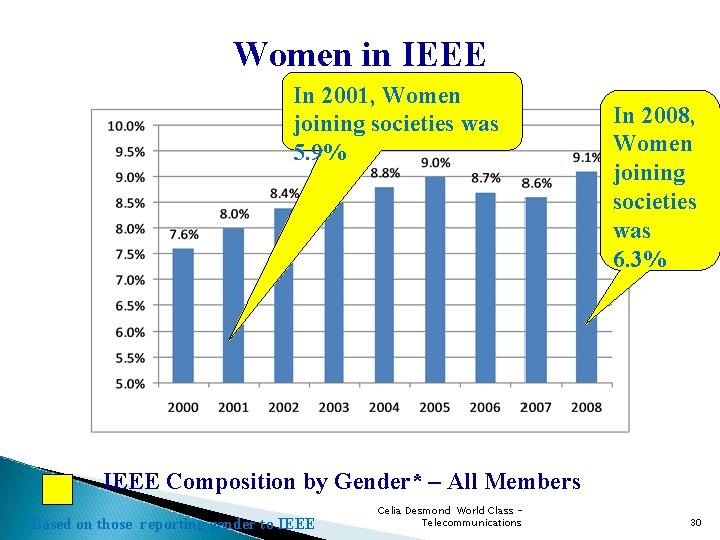
Women in IEEE In 2001, Women joining societies was 5. 9% In 2008, Women joining societies was 6. 3% IEEE Composition by Gender* – All Members * Based on those reporting gender to IEEE Celia Desmond World Class Telecommunications 30
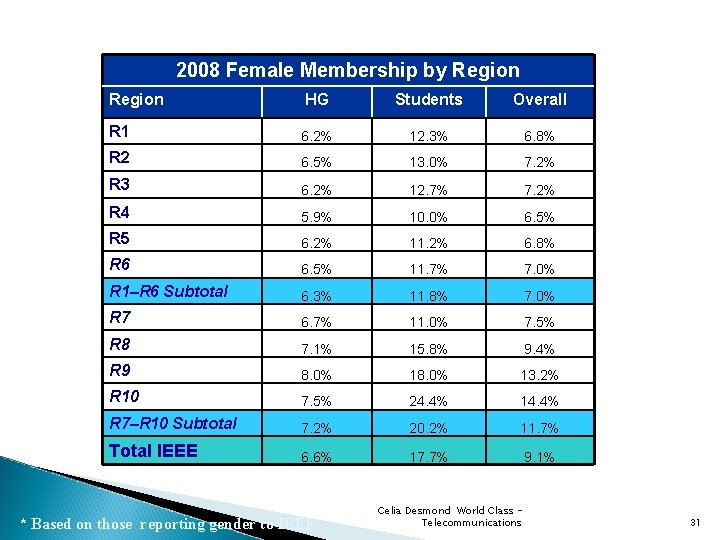
2008 Female Membership by Region HG Students Overall R 1 6. 2% 12. 3% 6. 8% R 2 6. 5% 13. 0% 7. 2% R 3 6. 2% 12. 7% 7. 2% R 4 5. 9% 10. 0% 6. 5% R 5 6. 2% 11. 2% 6. 8% R 6 6. 5% 11. 7% 7. 0% R 1–R 6 Subtotal 6. 3% 11. 8% 7. 0% R 7 6. 7% 11. 0% 7. 5% R 8 7. 1% 15. 8% 9. 4% R 9 8. 0% 13. 2% R 10 7. 5% 24. 4% 14. 4% R 7–R 10 Subtotal 7. 2% 20. 2% 11. 7% Total IEEE 6. 6% 17. 7% 9. 1% * Based on those reporting gender to IEEE Celia Desmond World Class Telecommunications 31
Gender Differences in Learning September 25, 2008 Dr. Laurel Haak Discovery Logic http: //www. wepan. org Celia Desmond World Classfrom Sponsored by a generous grant Telecommunications Alcoa Foundation © 2008 WEPAN www. wepan. org and Laurel Haak, Ph. D Sponsored by a generous grant from 32 32
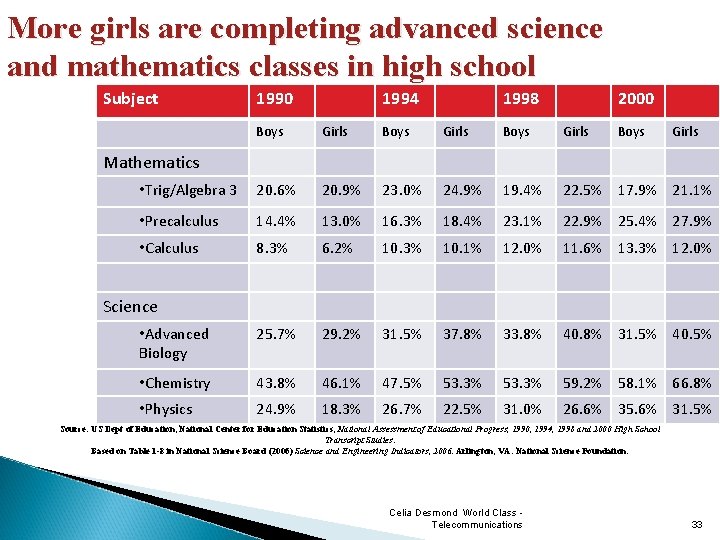
More girls are completing advanced science and mathematics classes in high school Subject 1990 1994 1998 2000 Boys Girls • Trig/Algebra 3 20. 6% 20. 9% 23. 0% 24. 9% 19. 4% 22. 5% 17. 9% 21. 1% • Precalculus 14. 4% 13. 0% 16. 3% 18. 4% 23. 1% 22. 9% 25. 4% 27. 9% • Calculus 8. 3% 6. 2% 10. 3% 10. 1% 12. 0% 11. 6% 13. 3% 12. 0% • Advanced Biology 25. 7% 29. 2% 31. 5% 37. 8% 33. 8% 40. 8% 31. 5% 40. 5% • Chemistry 43. 8% 46. 1% 47. 5% 53. 3% 59. 2% 58. 1% 66. 8% • Physics 24. 9% 18. 3% 26. 7% 22. 5% 31. 0% 26. 6% 35. 6% 31. 5% Mathematics Science Source: US Dept of Education, National Center for Education Statistics, National Assessment of Educational Progress, 1990, 1994, 1998 and 2000 High School Transcript Studies. Based on Table 1 -8 in National Science Board (2006) Science and Engineering Indicators, 2006. Arlington, VA: National Science Foundation. Celia Desmond World Class Telecommunications 33
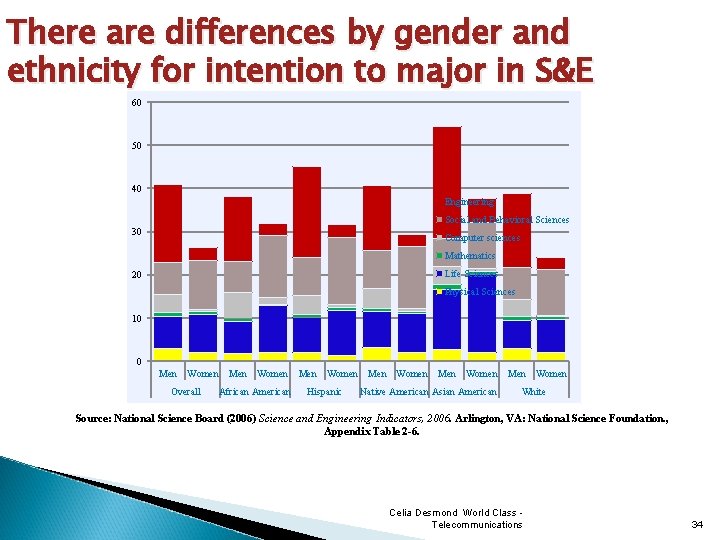
There are differences by gender and ethnicity for intention to major in S&E 60 50 40 Engineering Social and Behavioral Sciences 30 Computer sciences Mathematics Life Sciences 20 Physical Sciences 10 0 Men Women Overall Men Women African American Men Women Hispanic Men Women Native American Asian American Men Women White Source: National Science Board (2006) Science and Engineering Indicators, 2006. Arlington, VA: National Science Foundation. , Appendix Table 2 -6. Celia Desmond World Class Telecommunications 34
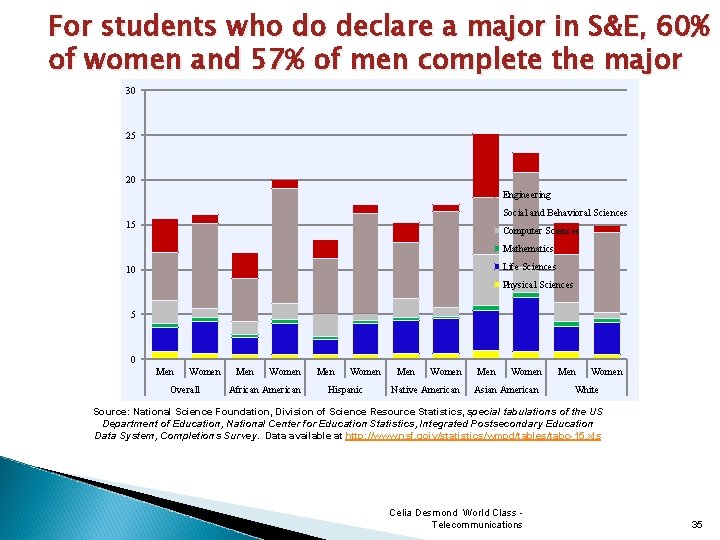
For students who do declare a major in S&E, 60% of women and 57% of men complete the major 30 25 20 Engineering Social and Behavioral Sciences 15 Computer Sciences Mathematics Life Sciences 10 Physical Sciences 5 0 Men Women Overall Men Women African American Men Women Hispanic Men Women Native American Men Women Asian American Men Women White Source: National Science Foundation, Division of Science Resource Statistics, special tabulations of the US Department of Education, National Center for Education Statistics, Integrated Postsecondary Education Data System, Completions Survey. Data available at http: //www. nsf. goiv/statistics/wmpd/tables/tabc-15. xls Celia Desmond World Class Telecommunications 35
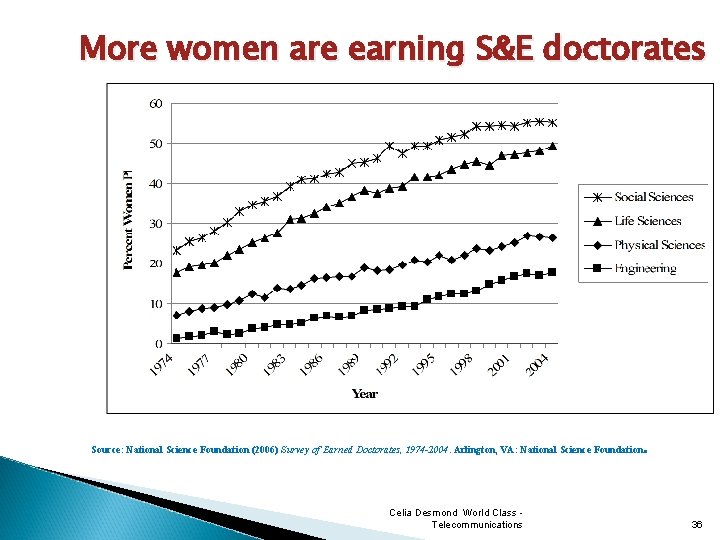
More women are earning S&E doctorates Source: National Science Foundation (2006) Survey of Earned Doctorates, 1974 -2004. Arlington, VA: National Science Foundation Celia Desmond World Class Telecommunications . 36
Pipeline Problems? For more than 30 years, women have earned more than 30% of doctorates in social and behavioral sciences and more than 20% in the life sciences. But, at top research institutions, women hold: • 15% of full professorships in social sciences • 15% of full professorships in the life sciences • <10% of full professorships in other scientific fields Minority women are virtually absent from leading S&E departments. Celia Desmond World Class Telecommunications 37
Controlled experiments and observation of real life experiences show that people, including scientists and engineers: ◦ are less likely to hire a woman than a man with identical qualifications ◦ are less likely to ascribe credit to a woman than to a man for identical accomplishments ◦ will far more often give the benefit of the doubt to a man than to a woman Celia Desmond World Class Telecommunications 38
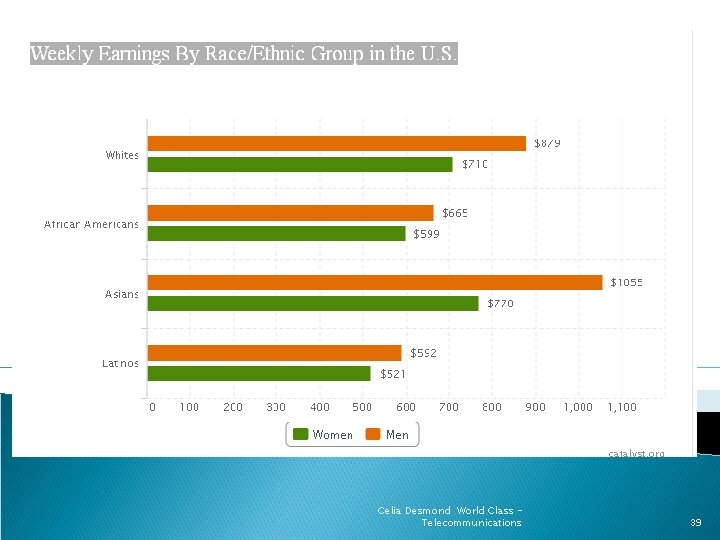
Celia Desmond World Class Telecommunications 39
Some surprising answers Is a(n engineering) career feasible for women? Yes, but … Industry or Academia? Really a personal decision Can membership in IEEE help you in your career? A resounding yes – and some comments Celia Desmond World Class Telecommunications 40
It’s up to you! No one can select the career that works for you You will spend at least half, probably 80% of your waking hours immersed in your career choice Choose carefully! Celia Desmond World Class Telecommunications 41
- Slides: 41