
A CAMERA CALIBRATION TECHNIQUE USING TARGETS OF CIRCULAR
A CAMERA CALIBRATION TECHNIQUE USING TARGETS OF CIRCULAR FEATURES Ginés García Mateos Dept. de Informática y Sistemas Universidad de Murcia - España UNIVERSIDAD DE MURCIA LÍNEA DE INVESTIGACIÓN DE PERCEPCIÓN ARTIFICIAL Y RECONOCIMIENTO DE PATRONES - GRUPO DE COMPUTACIÓN CIENTÍFICA
INTRODUCTION A CAMERA CALIBRATION TECHNIQUE USING TARGETS OF CIRCULAR FEATURES Ginés García Mateos SIARP’ 2000 LISBOA SEPT. 2000 • Camera calibration: estimation of the unknown values in a camera model. – Intrinsic parameters. – Extrinsic parameters. • Calibration target: object of known geometry, easy to detect and locate, used in calibration. 2
INTRODUCTION A CAMERA CALIBRATION TECHNIQUE USING TARGETS OF CIRCULAR FEATURES Ginés García Mateos SIARP’ 2000 LISBOA SEPT. 2000 • The whole procedure of camera calibration [Heikkilä et al. 97]: – Determinate a camera model. – Control point location in the images. – Camera model fitting. – Image correction for distortion. – Estimate the errors of the previous stages. 3
INTRODUCTION A CAMERA CALIBRATION TECHNIQUE USING TARGETS OF CIRCULAR FEATURES Ginés García Mateos SIARP’ 2000 LISBOA SEPT. 2000 • Much research has been devoted to model fitting. • Control point location: – Design physical target structure. – Design an algorithm for target detection and location. – Goals: accuracy, robustness, efficiency, simplicity. 4
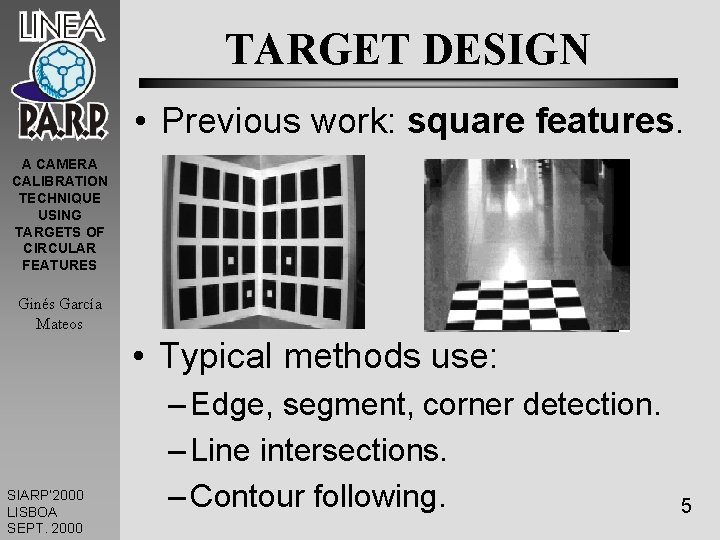
TARGET DESIGN • Previous work: square features. A CAMERA CALIBRATION TECHNIQUE USING TARGETS OF CIRCULAR FEATURES Ginés García Mateos • Typical methods use: SIARP’ 2000 LISBOA SEPT. 2000 – Edge, segment, corner detection. – Line intersections. – Contour following. 5
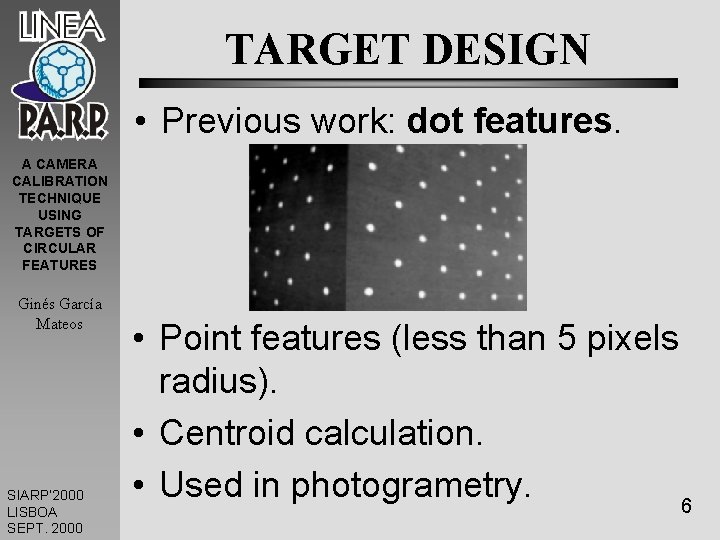
TARGET DESIGN • Previous work: dot features. A CAMERA CALIBRATION TECHNIQUE USING TARGETS OF CIRCULAR FEATURES Ginés García Mateos SIARP’ 2000 LISBOA SEPT. 2000 • Point features (less than 5 pixels radius). • Centroid calculation. • Used in photogrametry. 6
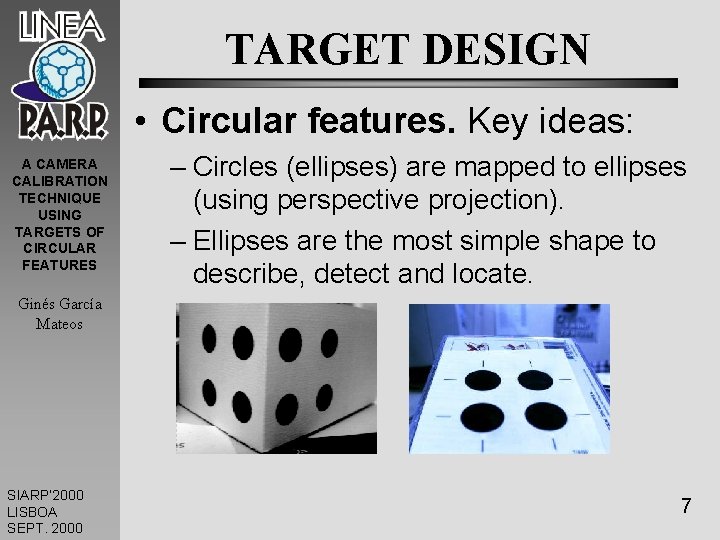
TARGET DESIGN • Circular features. Key ideas: A CAMERA CALIBRATION TECHNIQUE USING TARGETS OF CIRCULAR FEATURES – Circles (ellipses) are mapped to ellipses (using perspective projection). – Ellipses are the most simple shape to describe, detect and locate. Ginés García Mateos SIARP’ 2000 LISBOA SEPT. 2000 7
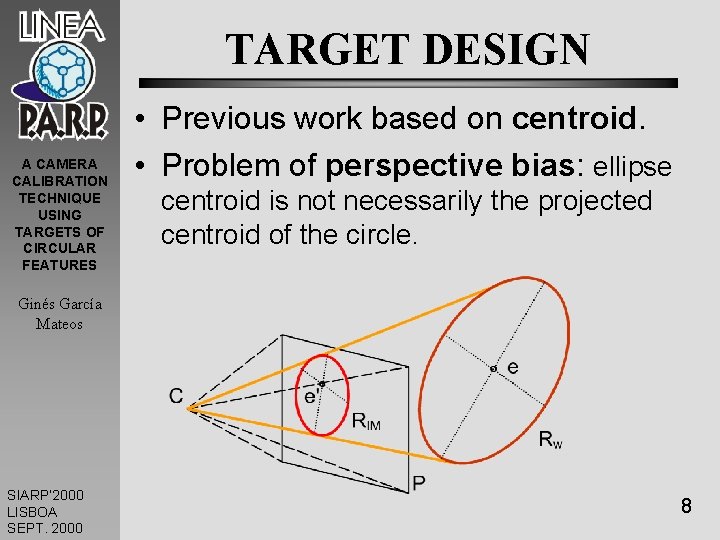
TARGET DESIGN A CAMERA CALIBRATION TECHNIQUE USING TARGETS OF CIRCULAR FEATURES • Previous work based on centroid. • Problem of perspective bias: ellipse centroid is not necessarily the projected centroid of the circle. Ginés García Mateos SIARP’ 2000 LISBOA SEPT. 2000 8
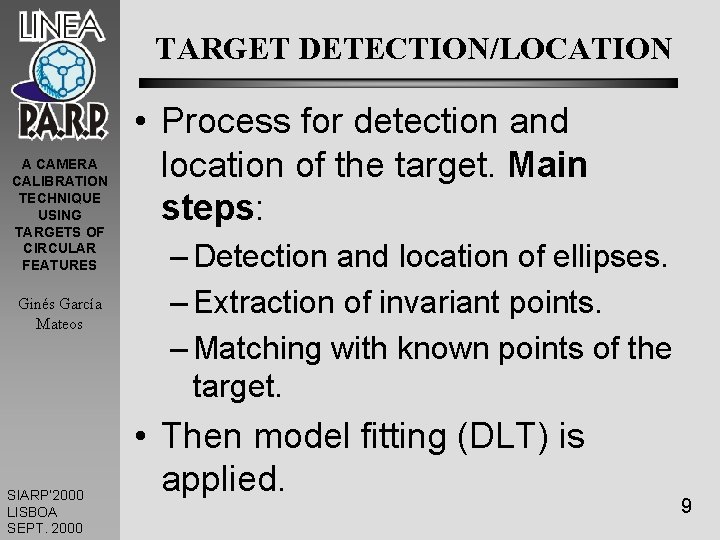
TARGET DETECTION/LOCATION A CAMERA CALIBRATION TECHNIQUE USING TARGETS OF CIRCULAR FEATURES Ginés García Mateos SIARP’ 2000 LISBOA SEPT. 2000 • Process for detection and location of the target. Main steps: – Detection and location of ellipses. – Extraction of invariant points. – Matching with known points of the target. • Then model fitting (DLT) is applied. 9

TARGET DETECTION/LOCATION • Ellipse detection and location: A CAMERA CALIBRATION TECHNIQUE USING TARGETS OF CIRCULAR FEATURES Ginés García Mateos SIARP’ 2000 LISBOA SEPT. 2000 – Image binarization. • Threshold: median value of partial histogram. – Connected component grouping. – Gaussian component description. • For each region: , and number of points. 10
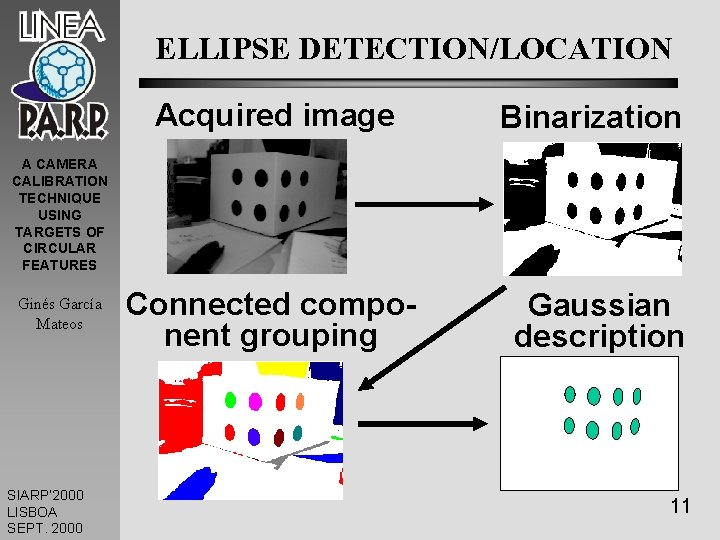
ELLIPSE DETECTION/LOCATION Acquired image Binarization Connected component grouping Gaussian description A CAMERA CALIBRATION TECHNIQUE USING TARGETS OF CIRCULAR FEATURES Ginés García Mateos SIARP’ 2000 LISBOA SEPT. 2000 11
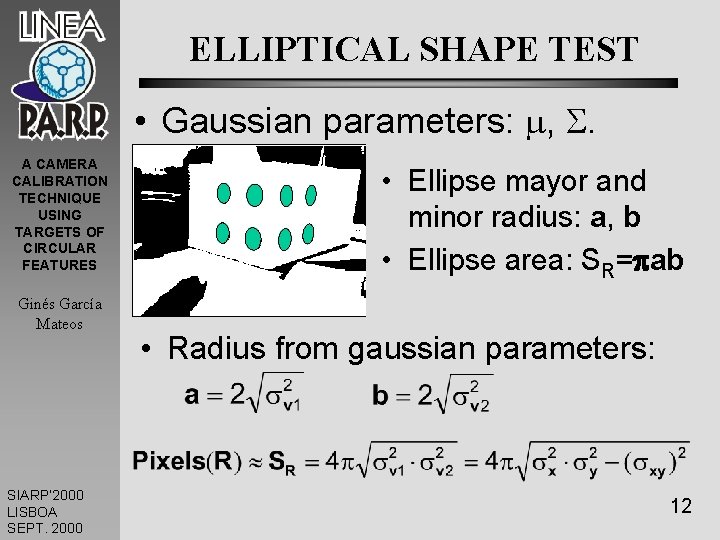
ELLIPTICAL SHAPE TEST • Gaussian parameters: , . A CAMERA CALIBRATION TECHNIQUE USING TARGETS OF CIRCULAR FEATURES Ginés García Mateos SIARP’ 2000 LISBOA SEPT. 2000 • Ellipse mayor and minor radius: a, b • Ellipse area: SR= ab • Radius from gaussian parameters: 12
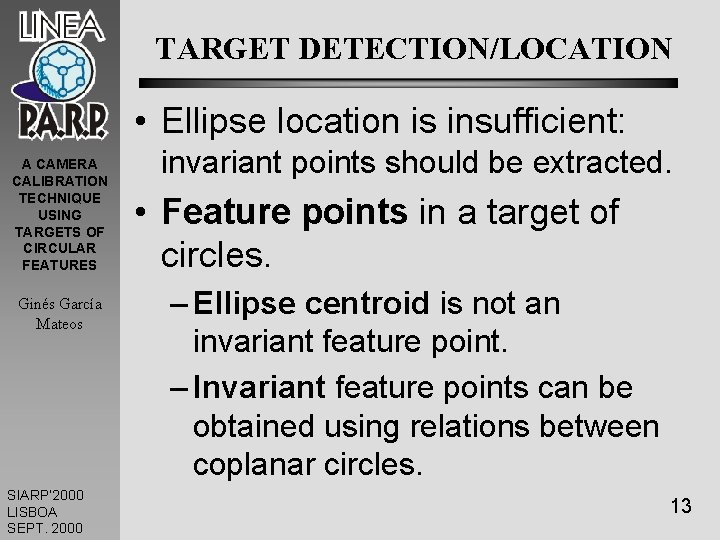
TARGET DETECTION/LOCATION • Ellipse location is insufficient: A CAMERA CALIBRATION TECHNIQUE USING TARGETS OF CIRCULAR FEATURES Ginés García Mateos SIARP’ 2000 LISBOA SEPT. 2000 invariant points should be extracted. • Feature points in a target of circles. – Ellipse centroid is not an invariant feature point. – Invariant feature points can be obtained using relations between coplanar circles. 13
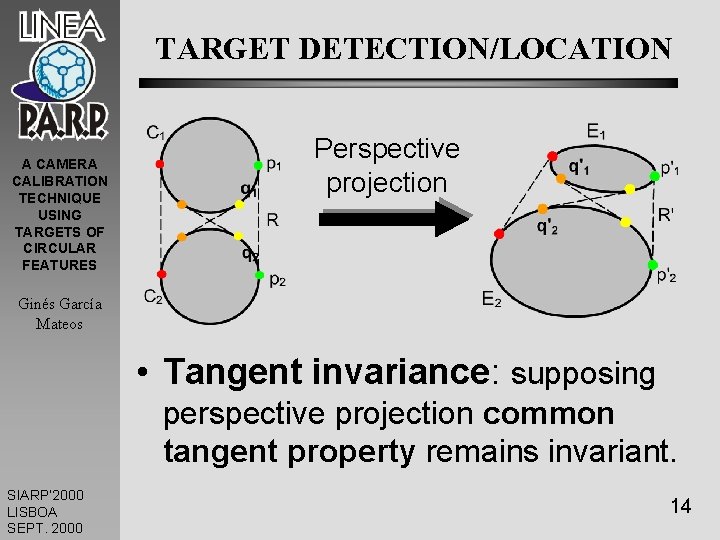
TARGET DETECTION/LOCATION A CAMERA CALIBRATION TECHNIQUE USING TARGETS OF CIRCULAR FEATURES Perspective projection Ginés García Mateos • Tangent invariance: supposing perspective projection common tangent property remains invariant. SIARP’ 2000 LISBOA SEPT. 2000 14
TARGET DETECTION/LOCATION A CAMERA CALIBRATION TECHNIQUE USING TARGETS OF CIRCULAR FEATURES Ginés García Mateos SIARP’ 2000 LISBOA SEPT. 2000 • Some conclusions don’t held when radial distortion is considered. • Dealing with distortion: – Iterative method: parameter calculation/image correction. – Independent estimation (and correction) of distortion. 15
EXPERIMENTAL RESULTS A CAMERA CALIBRATION TECHNIQUE USING TARGETS OF CIRCULAR FEATURES Ginés García Mateos SIARP’ 2000 LISBOA SEPT. 2000 • Tests are centered on the target detection/location procedure. – Accuracy: feature point location. – Robustness: defocusing and noise. – Efficiency: computation time. • Acquisition: low-cost videoconference camera Quick. Cam Pro (Logitech). • Computer: off-the-self PC, with K 6 at 350 Mhz. 16
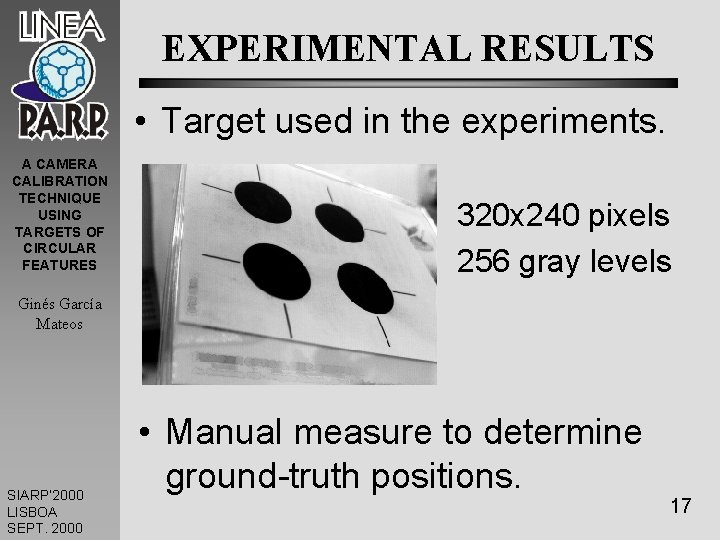
EXPERIMENTAL RESULTS • Target used in the experiments. A CAMERA CALIBRATION TECHNIQUE USING TARGETS OF CIRCULAR FEATURES 320 x 240 pixels 256 gray levels Ginés García Mateos SIARP’ 2000 LISBOA SEPT. 2000 • Manual measure to determine ground-truth positions. 17
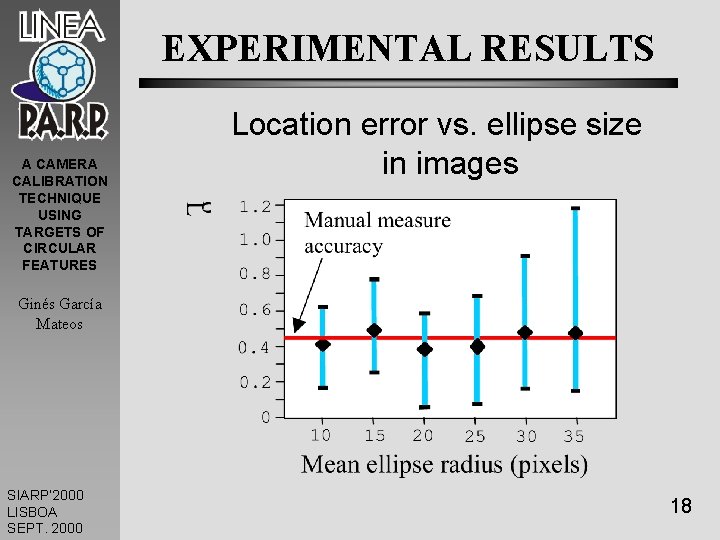
EXPERIMENTAL RESULTS A CAMERA CALIBRATION TECHNIQUE USING TARGETS OF CIRCULAR FEATURES Location error vs. ellipse size in images Ginés García Mateos SIARP’ 2000 LISBOA SEPT. 2000 18
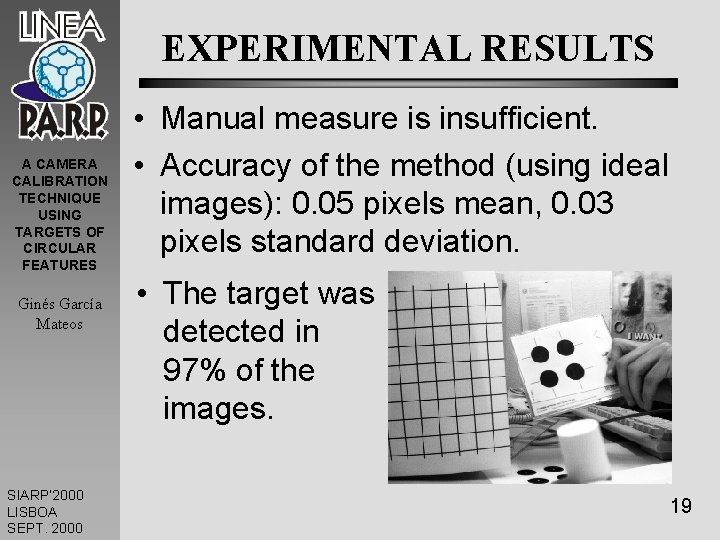
EXPERIMENTAL RESULTS A CAMERA CALIBRATION TECHNIQUE USING TARGETS OF CIRCULAR FEATURES Ginés García Mateos SIARP’ 2000 LISBOA SEPT. 2000 • Manual measure is insufficient. • Accuracy of the method (using ideal images): 0. 05 pixels mean, 0. 03 pixels standard deviation. • The target was detected in 97% of the images. 19
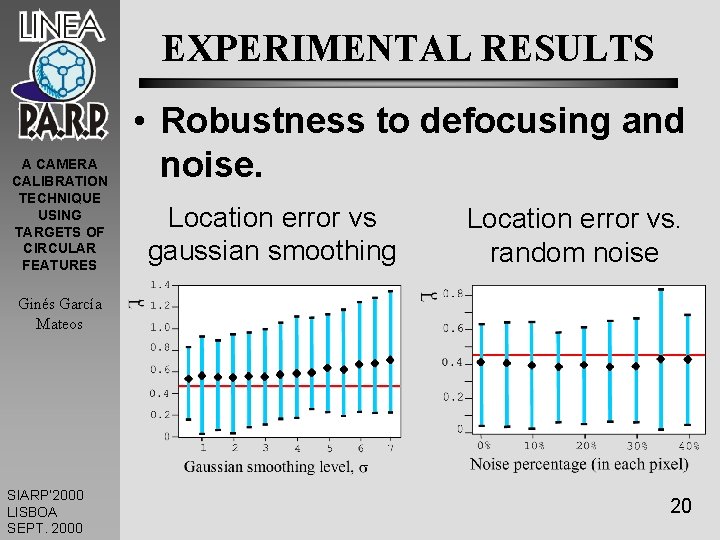
EXPERIMENTAL RESULTS A CAMERA CALIBRATION TECHNIQUE USING TARGETS OF CIRCULAR FEATURES • Robustness to defocusing and noise. Location error vs gaussian smoothing Location error vs. random noise Ginés García Mateos SIARP’ 2000 LISBOA SEPT. 2000 20
EXPERIMENTAL RESULTS • Efficiency: A CAMERA CALIBRATION TECHNIQUE USING TARGETS OF CIRCULAR FEATURES Ginés García Mateos SIARP’ 2000 LISBOA SEPT. 2000 – The main process is a connected component labeling algorithm. – This requires a single scanning of the image, with a constant cost per pixel. – The whole process can be made at approx. 10 Hz. 21
CONCLUSIONS A CAMERA CALIBRATION TECHNIQUE USING TARGETS OF CIRCULAR FEATURES Ginés García Mateos SIARP’ 2000 LISBOA SEPT. 2000 • A technique for camera calibration is proposed based in the use of circles as target features. • This contribution is centered in target detection/location. • Process of detection and location: – Gaussian description of connected component. – Feature point calculation and matching. 22
CONCLUSIONS A CAMERA CALIBRATION TECHNIQUE USING TARGETS OF CIRCULAR FEATURES Ginés García Mateos SIARP’ 2000 LISBOA SEPT. 2000 • The method is simple and lowlevel, which implies efficiency and robustness. • Subpixel accuracy is clearly reached. • High robustness to noise and defocusing. • The technique is suited for automated systems. 23

LAST A CAMERA CALIBRATION TECHNIQUE USING TARGETS OF CIRCULAR FEATURES Ginés García Mateos • This work has been supported by CICYT project TIC 98 -0559. • Línea PARP web page: http: //www. dis. um. es/parp • Muito obrigado SIARP’ 2000 LISBOA SEPT. 2000 24
- Slides: 24