
A briefing tool for managers WORKING AT HEIGHT
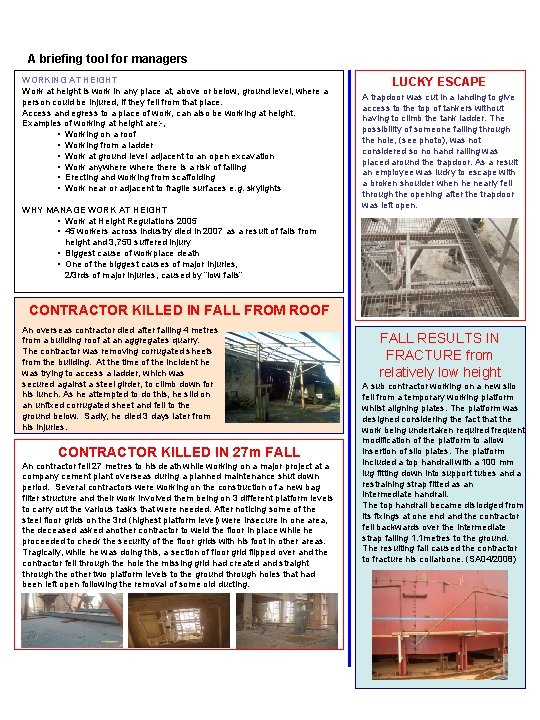
A briefing tool for managers WORKING AT HEIGHT Work at height is work in any place at, above or below, ground level, where a person could be injured, if they fell from that place. Access and egress to a place of work, can also be working at height. Examples of working at height are: -, • Working on a roof • Working from a ladder • Work at ground level adjacent to an open excavation • Work anywhere there is a risk of falling • Erecting and working from scaffolding • Work near or adjacent to fragile surfaces e. g. skylights WHY MANAGE WORK AT HEIGHT • Work at Height Regulations 2005 • 45 workers across industry died in 2007 as a result of falls from height and 3, 750 suffered injury • Biggest cause of workplace death • One of the biggest causes of major injuries, 2/3 rds of major injuries, caused by “low falls” LUCKY ESCAPE A trapdoor was cut in a landing to give access to the top of tankers without having to climb the tank ladder. The possibility of someone falling through the hole, (see photo), was not considered so no hand railing was placed around the trapdoor. As a result an employee was lucky to escape with a broken shoulder when he nearly fell through the opening after the trapdoor was left open. CONTRACTOR KILLED IN FALL FROM ROOF An overseas contractor died after falling 4 metres from a building roof at an aggregates quarry. The contractor was removing corrugated sheets from the building. At the time of the incident he was trying to access a ladder, which was secured against a steel girder, to climb down for his lunch. As he attempted to do this, he slid on an unfixed corrugated sheet and fell to the ground below. Sadly, he died 3 days later from his injuries. CONTRACTOR KILLED IN 27 m FALL An contractor fell 27 metres to his death while working on a major project at a company cement plant overseas during a planned maintenance shut down period. Several contractors were working on the construction of a new bag filter structure and their work involved them being on 3 different platform levels to carry out the various tasks that were needed. After noticing some of the steel floor grids on the 3 rd (highest platform level) were insecure in one area, the deceased asked another contractor to weld the floor in place while he proceeded to check the security of the floor grids with his foot in other areas. Tragically, while he was doing this, a section of floor grid flipped over and the contractor fell through the hole the missing grid had created and straight through the other two platform levels to the ground through holes that had been left open following the removal of some old ducting. FALL RESULTS IN FRACTURE from relatively low height A sub contractor working on a new silo fell from a temporary working platform whilst aligning plates. The platform was designed considering the fact that the work being undertaken required frequent modification of the platform to allow insertion of silo plates. The platform included a top handrail with a 100 mm lug fitting down into support tubes and a restraining strap fitted as an intermediate handrail. The top handrail became dislodged from its fixings at one end and the contractor fell backwards over the intermediate strap falling 1. 1 metres to the ground. The resulting fall caused the contractor to fracture his collarbone. (SA 04/2008)
Working at Height Preparation This stop and think talk can be used individually or with a group of people. It could be delivered in the workplace where examples of Working at Height can be observed or where equipment used in Working at Height is stored. If you are carrying out a practical demonstration, take care that the area is suitable for people to hear and see what you are doing. Participants should receive a copy of the talk for their CPD files as well as signing the training declaration. Introduction (After reading out the case studies) Work at height can and does take the form of many activities, even when working on purpose made platforms or in buildings there is the potential to create a working at height risk by the removal of flooring or barriers. The use of mobile elevated platforms, tower scaffolding, ladders and other work with the potential to fall from height MUST be assessed and planned to eliminate (or minimise), the possibility of anyone falling from that height. THE TALK Use the questions below to open the discussion under each heading and then go through the lists explaining in detail each hazard / control and what is expected Hazards Question 1 – What are the hazards of working from Controls height? Question 6 – How would you control work at height? • Falling • Risk Assessment • Someone being struck by falling object • Worksafe Both aspects have to be considered when working at height. It • Permit to Work is not just about the protection of the persons at height but • Effective supervision also the potential affect on those below. Consideration must be given to: • The potential for working in a safer, alternative way to eliminate Question 2 – What is “work at height”? Where are you the need for access at height. required to "work at height“? • The potential for objects as well as personnel to fall, always • Working on a roof considering people below. • Working from a ladder • Selection of correct and effective control measures and • Work at ground level adjacent to an open excavation appropriate equipment. • Work anywhere there is a risk of falling • The possibility of adverse weather conditions and other • Erecting and working from scaffolding changes that may influence the working conditions. • Work near or adjacent to fragile surfaces e. g. skylights • Selection of approved and suitable anchor points for equipment There is no specific height where the term working at height and the condition of any supporting structures. applies. Work where any fall could result in injury is considered • All equipment to be checked prior to each use working at height. • The requirement to wear safety harnesses, with effectively anchored fall arrest equipment, whenever working from Risk Assessment temporary mobile access platforms. Question 3 – Who should assess the work at height? Anyone undertaking or planning to undertake work at height Question 7 – Can ladders be used? The answer is yes, but any proposed work form ladders should Question 4 – When assessing work at height, what are the only be considered where a risk assessment has shown that factors to consider? the risk is low and duration of the task is short and the use of • Avoid work from height where you can other access equipment is not more appropriate. It is • Collective protective measures must take priority over important that risk assessment considers whether the person individual protection – For example barriers are preferred to can maintain 3 points of contact and the ladder can be secured. harnesses and lanyards The use of ladders should be controlled by securing them • All work is properly planned and organised and only permitting use by authorised personnel for properly • Those involved in the work are competent and trained. assessed tasks. • Equipment is properly selected, inspected and maintained AND FINALLY. . . • Clarify any points as required. Question 5 – Who should erect / use access equipment • Ask if there any other safety related issues that such as scaffolds and elevated work platforms? should be discussed. Only competent personnel who have been suitably trained • Get everyone to sign the training declaration. should operate any elevated work platforms or erect / modify • Thank everyone for their participation scaffolding, including tower scaffolds.
Working at Height – Training Record The people listed below have received instruction in Working at Height as detailed on the previous pages. By signing below they are confirming that they understand the safe systems of working discussed and will adhere to these in the workplace. Date Name Signature Instructed by
- Slides: 3