
A Brief Summary of World Nuclear Power Development
A Brief Summary of World Nuclear Power Development and Projection 世界核�� 展的回� 和展望 Pujing Pan Chengdu University of Technology
Outline 1. 2. 3. 4. 5. 6. 7. 8. 9. 10. 11. 12. Early development Manhattan project End of WWII and start of peaceful use of nuclear energy Early Prototype Reactors US Nuclear Submarine Program Generations of Reactors (G 1 -G 3) Energy and Electricity Demand Analysis Generation IV Reactors and Beyond Nuclear and Radiological Accidents Nuclear Energy - Today Nuclear Energy – Outlook Conclusions
Condensed History of Nuclear Energy l l The science of atomic radiation, atomic change and nuclear fission was developed from 1895 to 1945, much of it in the last six of those years. Over 1939 -45, most development was focused on the atomic bomb. From 1945 attention was given to harnessing this energy in a controlled fashion for naval propulsion and for making electricity. Since 1956 the prime focus has been on the technological evolution of reliable nuclear power plants.
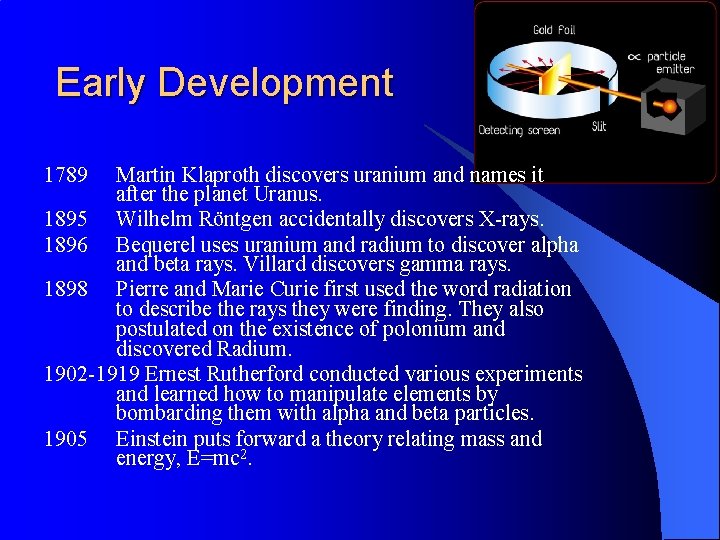
Early Development 1789 Martin Klaproth discovers uranium and names it after the planet Uranus. 1895 Wilhelm Röntgen accidentally discovers X-rays. 1896 Bequerel uses uranium and radium to discover alpha and beta rays. Villard discovers gamma rays. 1898 Pierre and Marie Curie first used the word radiation to describe the rays they were finding. They also postulated on the existence of polonium and discovered Radium. 1902 -1919 Ernest Rutherford conducted various experiments and learned how to manipulate elements by bombarding them with alpha and beta particles. 1905 Einstein puts forward a theory relating mass and energy, E=mc 2.
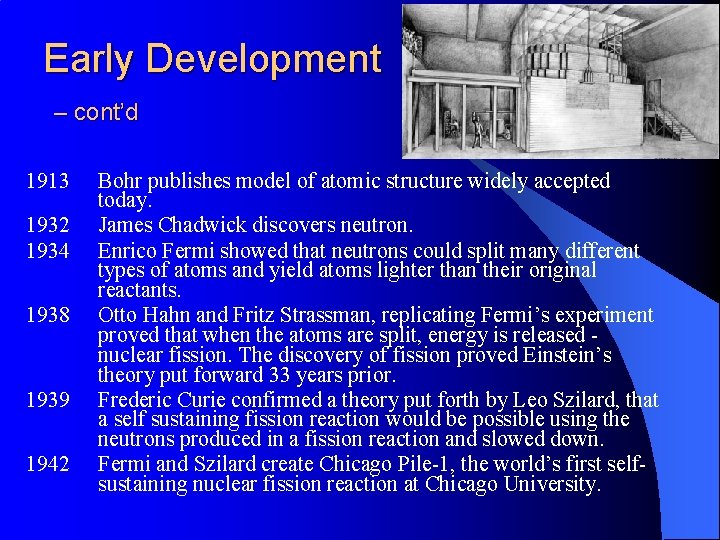
Early Development – cont’d 1913 1932 1934 1938 1939 1942 Bohr publishes model of atomic structure widely accepted today. James Chadwick discovers neutron. Enrico Fermi showed that neutrons could split many different types of atoms and yield atoms lighter than their original reactants. Otto Hahn and Fritz Strassman, replicating Fermi’s experiment proved that when the atoms are split, energy is released nuclear fission. The discovery of fission proved Einstein’s theory put forward 33 years prior. Frederic Curie confirmed a theory put forth by Leo Szilard, that a self sustaining fission reaction would be possible using the neutrons produced in a fission reaction and slowed down. Fermi and Szilard create Chicago Pile-1, the world’s first selfsustaining nuclear fission reaction at Chicago University.
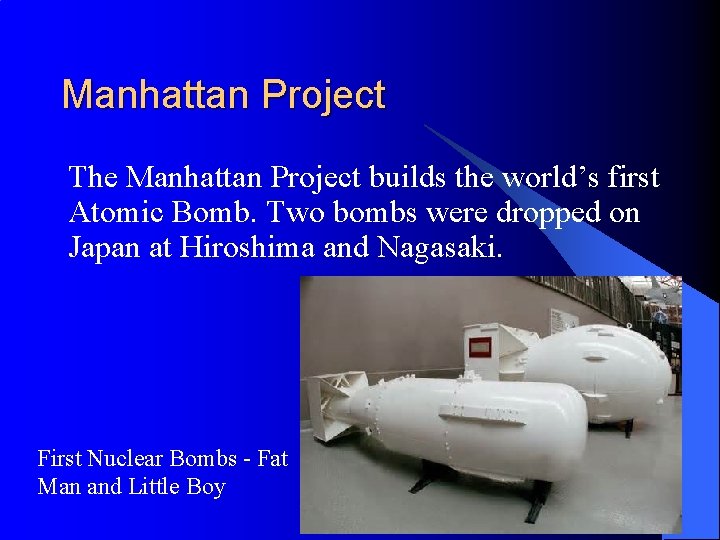
Manhattan Project The Manhattan Project builds the world’s first Atomic Bomb. Two bombs were dropped on Japan at Hiroshima and Nagasaki. First Nuclear Bombs - Fat Man and Little Boy
Manhattan Project – cont’d l l 1939 - 1946, >130, 000 people, US$2 billion (~$26 billion in 2013$). A R&D project that produced the first atomic bombs during WWII. US led, with the support of UK and Canada. Two types of atomic bomb were developed: – gun-type fission weapon using U-235 – more complex implosion-type weapon using Pu-239, produced with reactors l l The first nuclear device ever detonated was an implosion-type bomb at the Trinity test on 16 July 1945. In the immediate postwar years the Manhattan Project promoted the development of the network of national laboratories, supported medical research into radiology and laid the foundations for the nuclear navy.

Calutron control panels at Y-12. Gladys Owens, the woman seated in the foreground, did not know what she had been involved with until seeing this photo in a public tour of the facility fifty years later.
End of WWII and Start of Peaceful Use of Nuclear Energy 1951 1954 1955 1956 1957 1962 Experimental Breeder Reactor I starts up in Idaho. EBR -I generated the first energy created by nuclear power. The USSR completes Obninsk Nuclear Power Plant, the first nuclear power plant to produce electricity for a power grid. First nuclear powered submarine, USS Nautilus launches. Calder Hall in England opens, it is the first commercial nuclear power station. Shippingport Atomic Power Station is the first full-scale nuclear power generating station in the United States. NPD at Rolphton, Ontario, 1 st CANDU started supplying electricity to the grid on June 4.
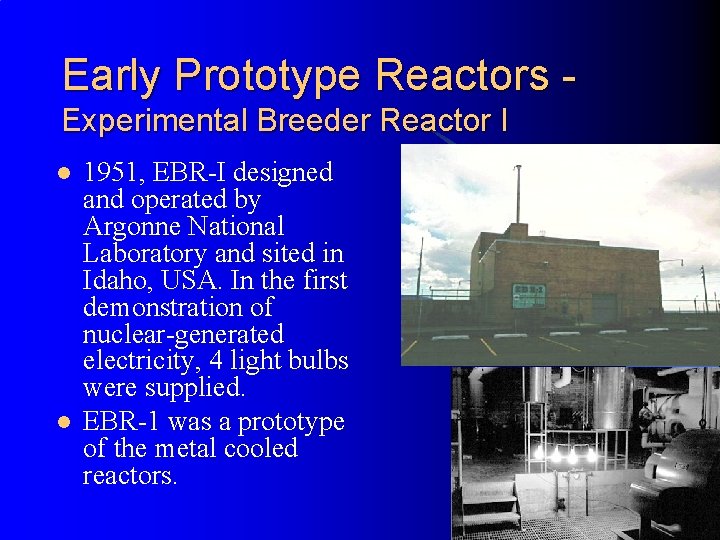
Early Prototype Reactors Experimental Breeder Reactor I l l 1951, EBR-I designed and operated by Argonne National Laboratory and sited in Idaho, USA. In the first demonstration of nuclear-generated electricity, 4 light bulbs were supplied. EBR-1 was a prototype of the metal cooled reactors.
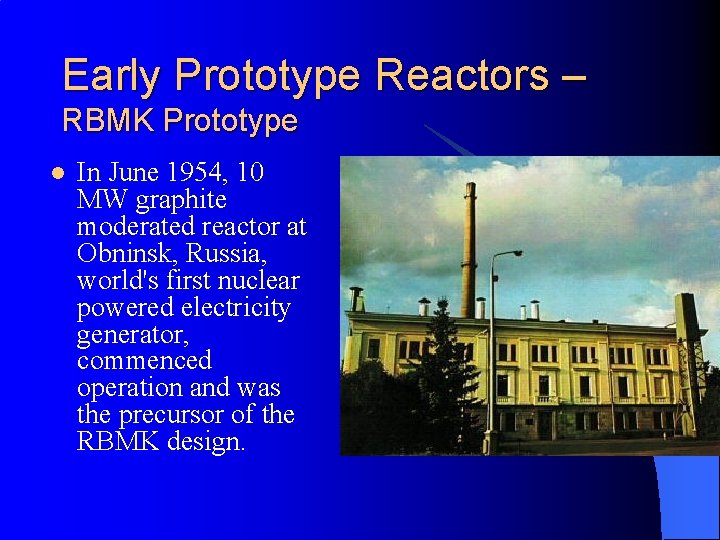
Early Prototype Reactors – RBMK Prototype l In June 1954, 10 MW graphite moderated reactor at Obninsk, Russia, world's first nuclear powered electricity generator, commenced operation and was the precursor of the RBMK design.
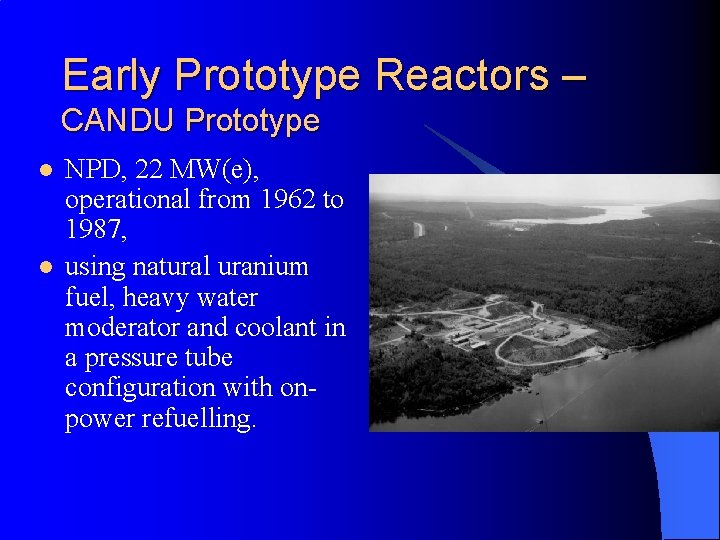
Early Prototype Reactors – CANDU Prototype l l NPD, 22 MW(e), operational from 1962 to 1987, using natural uranium fuel, heavy water moderator and coolant in a pressure tube configuration with onpower refuelling.
US Nuclear Submarine Program l l l l 1955, 1 st nuclear-powered vessel, the submarine USS Nautilus, powered by a PWR. 1957, 2 nd nuclear submarine was USS Seawolf, was initially powered by a sodium-cooled reactor, but plagued by superheater problems. While Nautilus delivered far superior performance and the risks posed by liquid sodium, Admiral Rickover selected the PWR as the standard US naval reactor type. Seawolf was refit with a PWR, and all subsequent US naval reactors have been PWRs, Experience with the Nautilus led to the parallel development of further (Skate-class) submarines, and an aircraft carrier (USS Enterprise) powered by eight reactors in 1960, and a cruiser (USS Long Beach), in 1961 powered by two reactors. By 1962, the US Navy had 26 nuclear submarines operational and 30 under construction. Nuclear power had revolutionized the Navy. At the end of the Cold War in 1989, there were over 400 nuclearpowered submarines operational or being built, almost all propelled by PWRs.
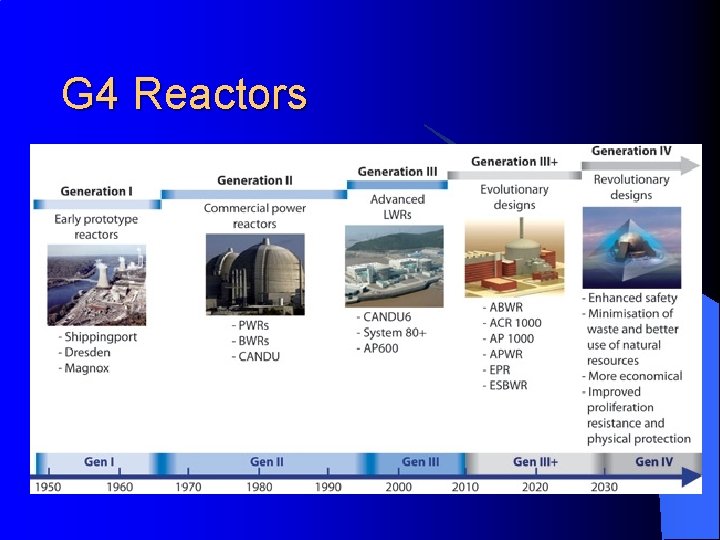
Generations of Reactors l Generation I reactor early prototypes, research reactors, non-commercial power producing reactors l Generation II reactor most current nuclear power plants 1965– 1996 l Generation III reactor evolutionary improvements of existing designs 1996 -now l Generation IV reactor technologies still under development unknown start date, possibly 2030
G 1 Reactors Designed and built in the ‘ 50 s and ‘ 60 s, with a capacity reaching about 200 MW l Examples include Shippingport, Magnox, Fermi 1 (BWR), and Dresden (BWR, 1 st privately funded). l
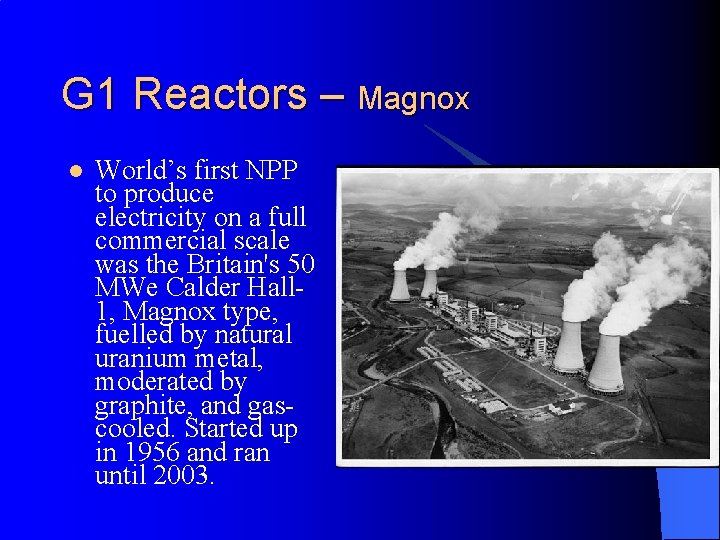
G 1 Reactors – Magnox l World’s first NPP to produce electricity on a full commercial scale was the Britain's 50 MWe Calder Hall 1, Magnox type, fuelled by natural uranium metal, moderated by graphite, and gascooled. Started up in 1956 and ran until 2003.
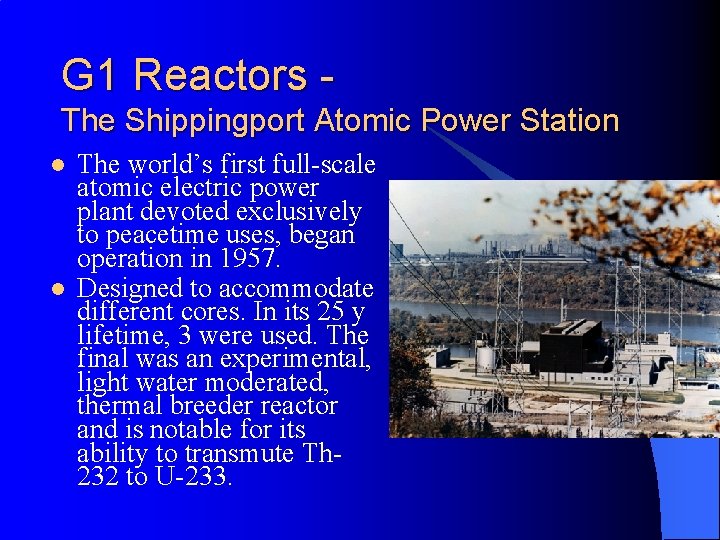
G 1 Reactors The Shippingport Atomic Power Station l l The world’s first full-scale atomic electric power plant devoted exclusively to peacetime uses, began operation in 1957. Designed to accommodate different cores. In its 25 y lifetime, 3 were used. The final was an experimental, light water moderated, thermal breeder reactor and is notable for its ability to transmute Th 232 to U-233.
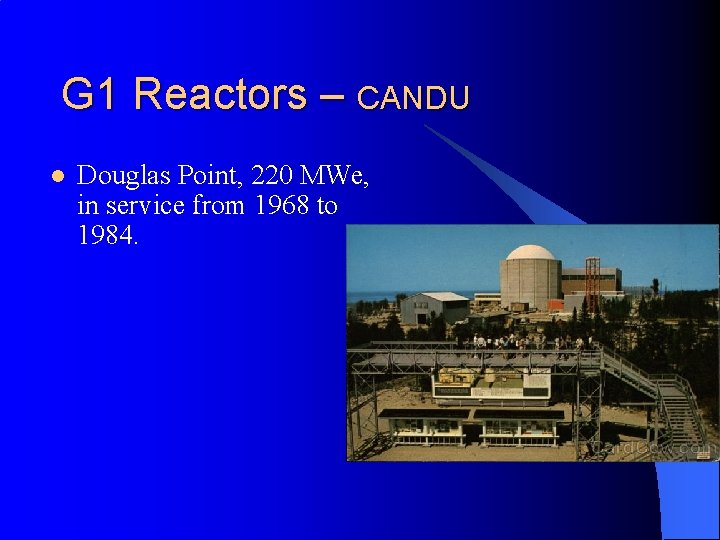
G 1 Reactors – CANDU l Douglas Point, 220 MWe, in service from 1968 to 1984.
G 2 Reactors – refers to the class of commercial reactors built in the ‘ 70 s and ‘ 80 s, up to the end of the 1990 s, with much a higher capacity (between 600 and 1, 000 MW) and, most important, higher security levels. – Prototypical generation II reactors include the PWR, CANDU, BWR, AGR, and VVER.
G 3 Reactors l Specifically, there has been an improvement of additional reactor shut-down systems, which turn on automatically in case of emergency, without any need for the operators to take action. Finally, the fuel is used more efficiently, and therefore less waste is produced. l The EPR, of which the first models are under construction in Olkiluoto (Finland), Flamanville (France) and Taishan (China), is an advanced third generation reactor.
Energy Demand l l l Energy consumption rate has risen by over 50% in the past 20 years. renewable energy sources (solar, wind, hydro etc. ) are not providing sufficient energy to meet demand non-renewable sources (Coal, Crude Oil etc. ) are inevitably coming to an end. Furthermore the production of greenhouses gases impacts the climate thus further complicating matters and adding to the problem. Therefore, there has never been a more crucial time for the utilization of nuclear energy.
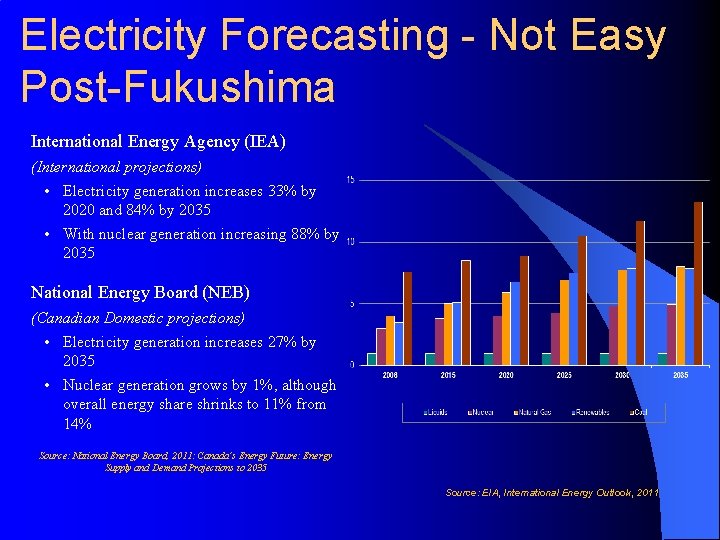
Electricity Forecasting - Not Easy Post-Fukushima International Energy Agency (IEA) (International projections) • Electricity generation increases 33% by 2020 and 84% by 2035 • With nuclear generation increasing 88% by 2035 National Energy Board (NEB) (Canadian Domestic projections) • Electricity generation increases 27% by 2035 • Nuclear generation grows by 1%, although overall energy share shrinks to 11% from 14% Source: National Energy Board, 2011: Canada’s Energy Future: Energy Supply and Demand Projections to 2035 Source: EIA, International Energy Outlook, 2011
G 4 Reactors l Fourth generation reactors are presently being studied, and it is considered that they will be available starting from 2050. They will include wideranging innovations particularly regarding efficiency, fuel use and waste production. – Secure—Providing diversification of supply – Affordable—Keeping energy costs competitive – Clean—Delivering a major non-emitting source l l l Many reactor types were considered initially; however, the list was downsized to focus on the most promising technologies and those that could most likely meet the goals of the Gen IV initiative. 3 are nominally thermal reactors and 3 are fast reactors. The Very High Temperature Reactor (VHTR) is also being researched for potentially providing high quality process heat for hydrogen production. The fast reactors offer the possibility of burning actinides to further reduce waste and of being able to "breed more fuel" than they consume. These systems offer significant advances in sustainability, safety and reliability, economics, proliferation resistance and physical protection.
G 4 Reactors Goals Sustainability 1. 2. Generate energy sustainably, and promote long-term availability of nuclear fuel Minimize nuclear waste and reduce the long term stewardship burden Safety & Reliability 3. 4. 5. Excel in safety and reliability Have a very low likelihood and degree of reactor core damage Eliminate the need for offsite emergency response Economics 6. 7. Have a life cycle cost advantage over other energy sources Have a level of financial risk comparable to other energy projects Proliferation Resistance & Physical Protection 8. 9. Be a very unattractive route for diversion or theft of weapons-usable materials, and provide increased physical protection against acts of terrorism
G 4 Reactors
G 4 Reacotrs Six systems were selected: – Gas-Cooled Fast Reactor (GFR) – Lead-Cooled Fast Reactor (LFR) – Molten Salt Reactor (MSR) – Sodium-Cooled Fast Reactor (SFR) – Supercritical-Water Reactor (SCWR) – Very-High-Temperature Reactor (VHTR)
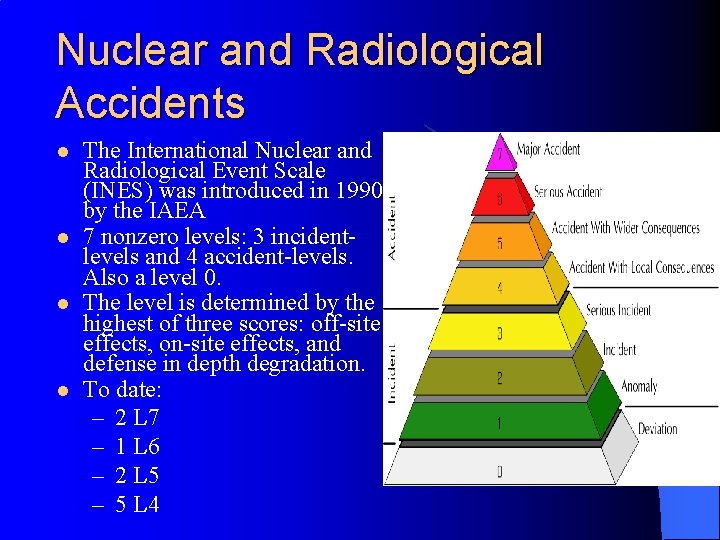
Nuclear and Radiological Accidents l l The International Nuclear and Radiological Event Scale (INES) was introduced in 1990 by the IAEA 7 nonzero levels: 3 incidentlevels and 4 accident-levels. Also a level 0. The level is determined by the highest of three scores: off-site effects, on-site effects, and defense in depth degradation. To date: – 2 L 7 – 1 L 6 – 2 L 5 – 5 L 4
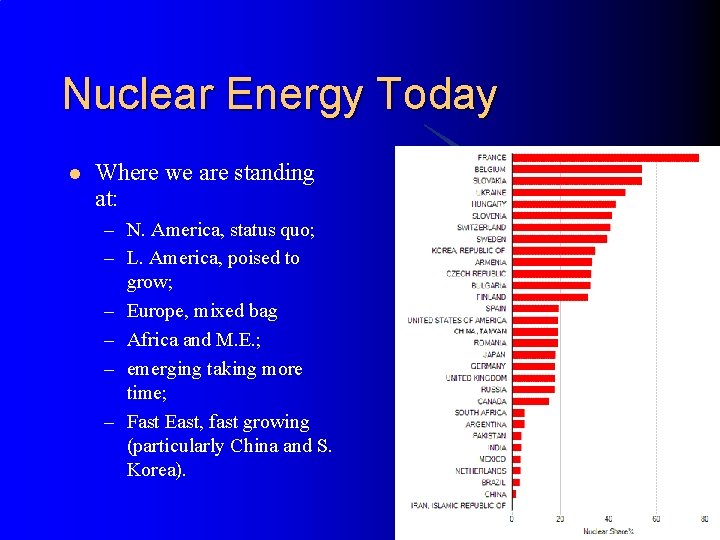
Nuclear Energy Today l Where we are standing at: – N. America, status quo; – L. America, poised to grow; – Europe, mixed bag – Africa and M. E. ; – emerging taking more time; – Fast East, fast growing (particularly China and S. Korea).
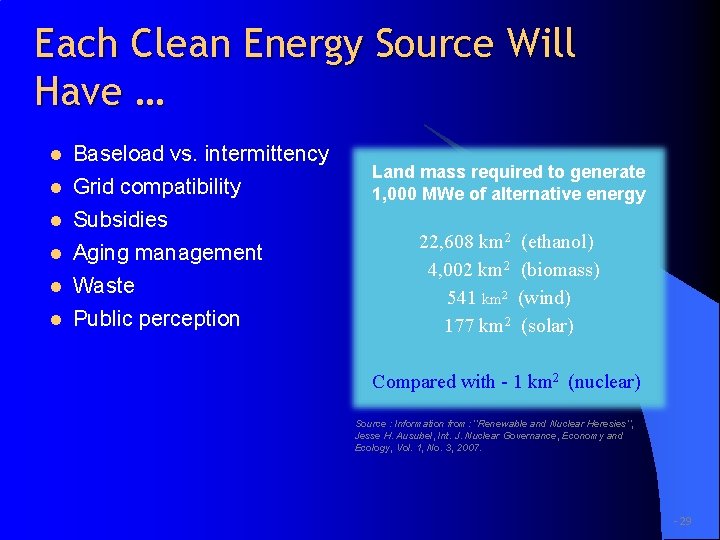
Each Clean Energy Source Will Have … l l l Baseload vs. intermittency Grid compatibility Subsidies Aging management Waste Public perception Land mass required to generate 1, 000 MWe of alternative energy 22, 608 km 2 4, 002 km 2 541 km 2 177 km 2 (ethanol) (biomass) (wind) (solar) Compared with - 1 km 2 (nuclear) Source : Information from: ‘’Renewable and Nuclear Heresies’’, Jesse H. Ausubel, Int. J. Nuclear Governance, Economy and Ecology, Vol. 1, No. 3, 2007. - 29
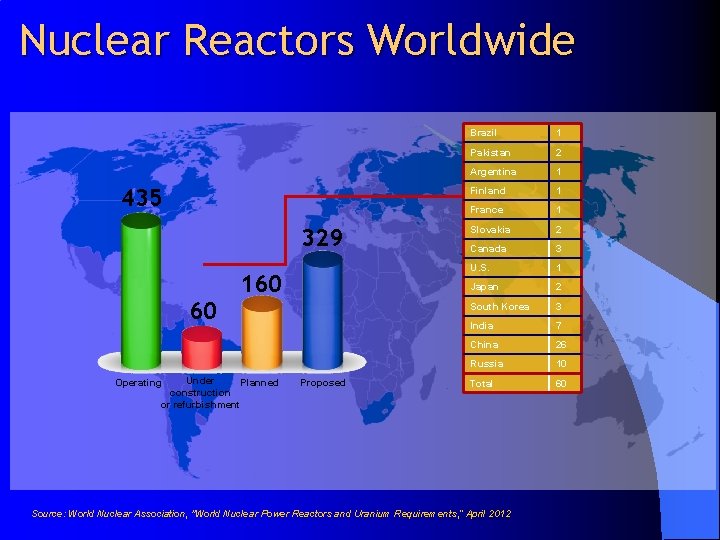
Nuclear Reactors Worldwide 435 329 60 160 Under Planned construction or refurbishment Operating Proposed Brazil 1 Pakistan 2 Argentina 1 Finland 1 France 1 Slovakia 2 Canada 3 U. S. 1 Japan 2 South Korea 3 India 7 China 26 Russia 10 Total 60 Source: World Nuclear Association, "World Nuclear Power Reactors and Uranium Requirements, ” April 2012
Nuclear Energy, Some Recent Developments l l l l Germany legislated no permanently, all existing NPPs shut down by 2020 Switzerland to phase out by 2029 Italy voted to reject nuclear plan Japan is seriously considering the option Most EU countries are slashing back US and Canada, poised for new builds but facing tremendous resistance UAE’s 1 st NPP is under construction Several other developing countries are jointing the club including, Thailand, Vietnam, Saudi Arabic
Nuclear Energy Outlook l l l No reversal after Fukushima. nuclear energy will remain an important option for many countries A steady rise in the number of NPPs in the world in the next 20 yrs. developing countries continue to show keen interest in nuclear power. At a rate lower than estimated previously, a 10 -year delay in the pre-Fukushima anticipated growth By 2030, an increase of 25% low projection and by 100% high projection. According to IAEA (2012, the world's installed nuclear power capacity: – low projection, from 370 gigawatts today to 456 GW(e) in 2030, – high projection, grows to 740 GW(e) in 2030.
Conclusions Nuclear power technologies are mature – safe, reliable, affordable l It’s as critical to establish a nuclear safety culture as to employ the best technology l After Fukushima, there is no reversal in adopting nuclear power l However, all countries are taking a critical look, and world nuclear power map is changing significantly l
- Slides: 33