
A BRIEF OVERVIEW OF PREVENT TEACH REINFORCE A
A BRIEF OVERVIEW OF PREVENT, TEACH, REINFORCE A SCHOOL BASED MODEL OF INDIVIDUALIZED POSITIVE BEHAVIOR SUPPORT Selected slides based on presentation from the 2010 PBIS Leadership Forum Chicago, IL Rose Iovannone, Ph. D. , BCBA-D University of South Florida
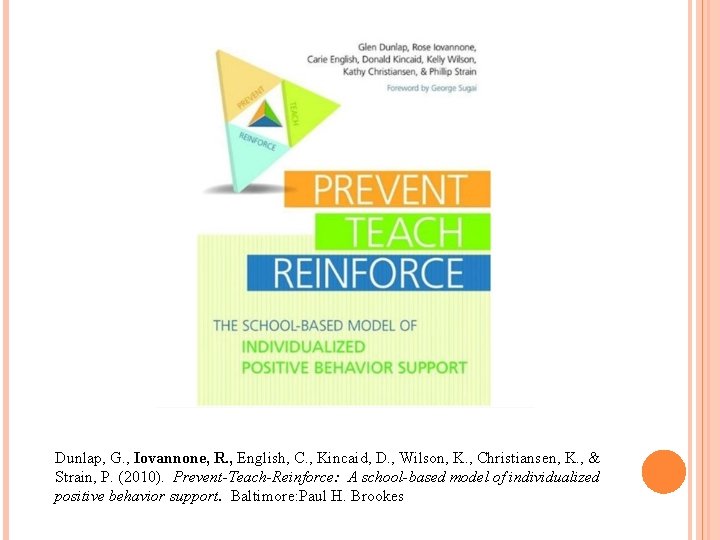
Dunlap, G. , Iovannone, R. , English, C. , Kincaid, D. , Wilson, K. , Christiansen, K. , & Strain, P. (2010). Prevent-Teach-Reinforce: A school-based model of individualized positive behavior support. Baltimore: Paul H. Brookes

OBJECTIVES Participants will: Describe the 5 -step PTR Tier 3 support model Identify the critical components that enhance the success of Tier 3 behavior supports
STEP 1: TEAMING Purpose: Evaluate strengths and weaknesses of team functioning � Outline roles and responsibilities- transdisciplinary � Determine a consensus-making process � Members (desired) Person with knowledge of student (e. g. , Classroom teacher, parent, related service provider, paraeducator, ) � Someone with expertise in functional assessment, behavioral principles (school psychologist, behavior specialist, counselor, etc. ) � Someone with knowledge of context/resources (administrator or designee) � Tools � Classroom Team Survey � Work Style Survey (teacher and paraeducator)
STEP 2: GOAL SETTING Purpose: Identify behaviors of greatest concern to the team and possible replacement behaviors (teach) Prioritize and operationalize behaviors Develop teacher friendly baseline data collection system Targeted Areas: Problem behaviors Social skills Academic behaviors Tools Goal-Setting Form

EXAMPLE: OPERATIONAL DEFINITIONS Problem behaviors Screaming—loud, high pitched noise heard outside the classroom Hitting—anytime Mike touches peers or adults with an open hand, fist, foot, or object while screaming or protesting Replacement/Appropriate Behaviors Express frustration appropriately using Dynamite, pictures, or signs to ask for a break or attention Transition to non-preferred activities: Moving to nonpreferred activity and engaging with appropriate verbal expression
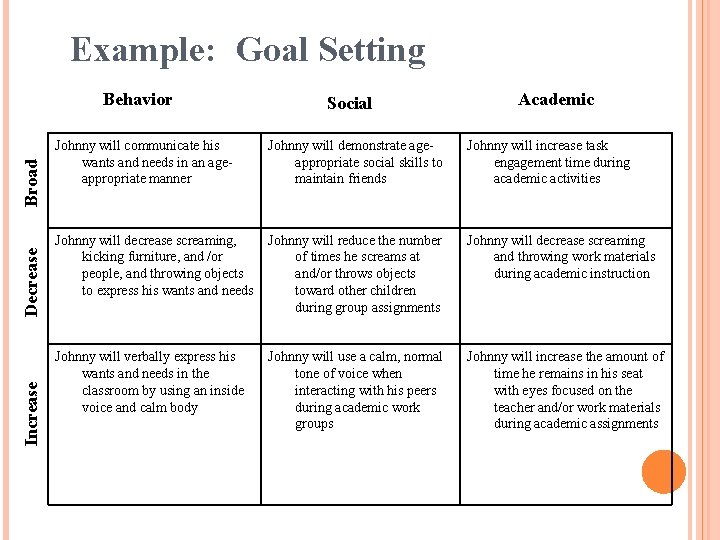
Example: Goal Setting Increase Decrease Broad Behavior Social Academic Johnny will communicate his wants and needs in an ageappropriate manner Johnny will demonstrate ageappropriate social skills to maintain friends Johnny will increase task engagement time during academic activities Johnny will decrease screaming, kicking furniture, and /or people, and throwing objects to express his wants and needs Johnny will reduce the number of times he screams at and/or throws objects toward other children during group assignments Johnny will decrease screaming and throwing work materials during academic instruction Johnny will verbally express his wants and needs in the classroom by using an inside voice and calm body Johnny will use a calm, normal tone of voice when interacting with his peers during academic work groups Johnny will increase the amount of time he remains in his seat with eyes focused on the teacher and/or work materials during academic assignments
STEP 2 PART 2: DATA COLLECTION SYSTEM Behavior Rating Scale Direct Behavior Rating (DBR)—Hybrid assessment combining features of systematic direct observations and rating scales Efficient and feasible for teacher use Provides data for decisions Prioritized and defined behaviors measured Can be used as a perceptual scale or to collect actual direct observational data Can collect frequency, duration, and/or intensity data all on one form Visually displays information
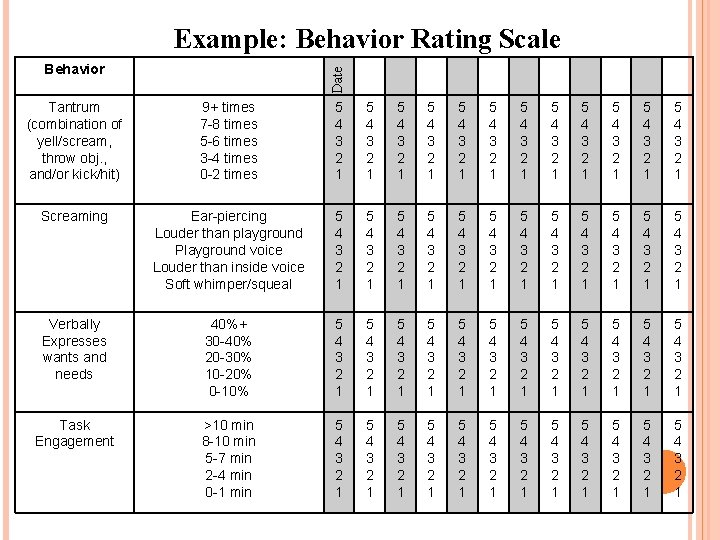
Example: Behavior Rating Scale Date Behavior Tantrum (combination of yell/scream, throw obj. , and/or kick/hit) 9+ times 7 -8 times 5 -6 times 3 -4 times 0 -2 times 5 4 3 2 1 5 4 3 2 1 5 4 3 2 1 Screaming Ear-piercing Louder than playground Playground voice Louder than inside voice Soft whimper/squeal 5 4 3 2 1 5 4 3 2 1 5 4 3 2 1 Verbally Expresses wants and needs 40%+ 30 -40% 20 -30% 10 -20% 0 -10% 5 4 3 2 1 5 4 3 2 1 5 4 3 2 1 Task Engagement >10 min 8 -10 min 5 -7 min 2 -4 min 0 -1 min 5 4 3 2 1 5 4 3 2 1 5 4 3 2 1
STEP 3: PTR ASSESSMENT (FBA) PTR Assessment (FBA) Each team member independently answers a series of questions (5+ pages for EACH target) related to: Observed antecedents/triggers of problem behaviors Functions of the problem behaviors Consequences ordinarily associated with the problem behaviors PTR facilitator summarizes input and develops draft hypothesis- based on patterns of response Team reaches consensus Tools Functional Behavior Assessment Checklist Functional Behavior Assessment Summary Table
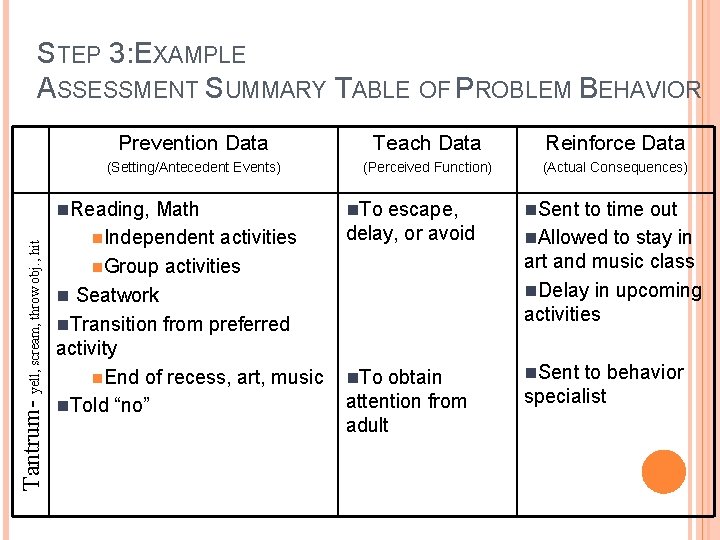
STEP 3: EXAMPLE ASSESSMENT SUMMARY TABLE OF PROBLEM BEHAVIOR Prevention Data Teach Data Reinforce Data (Setting/Antecedent Events) (Perceived Function) (Actual Consequences) Tantrum- yell, scream, throw obj. , hit n. Reading, Math n. Independent activities n. Group activities n Seatwork n. Transition from preferred activity n. End of recess, art, music n. Told “no” n. To escape, n. Sent to time out delay, or avoid n. Allowed to stay in art and music class n. Delay in upcoming activities n. To obtain attention from adult n. Sent to behavior specialist
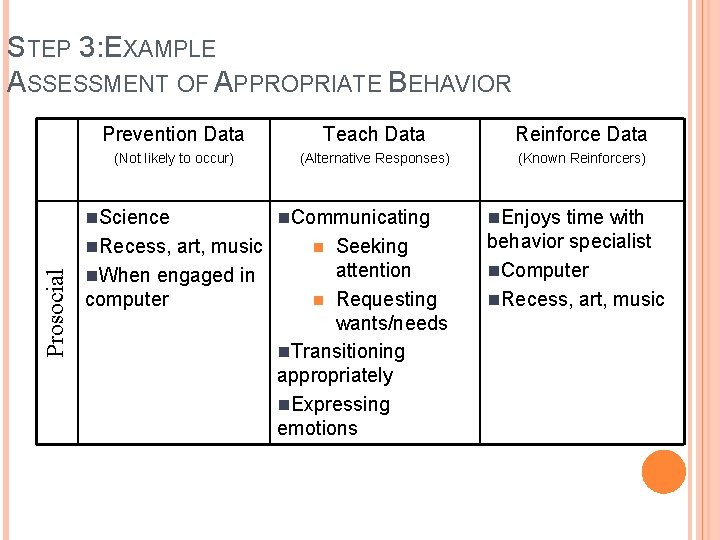
Prosocial STEP 3: EXAMPLE ASSESSMENT OF APPROPRIATE BEHAVIOR Prevention Data Teach Data Reinforce Data (Not likely to occur) (Alternative Responses) (Known Reinforcers) n. Science n. Communicating n. Enjoys time with n. Recess, art, music Seeking attention n Requesting wants/needs n. Transitioning appropriately n. Expressing emotions behavior specialist n. Computer n. Recess, art, music n. When engaged in computer n
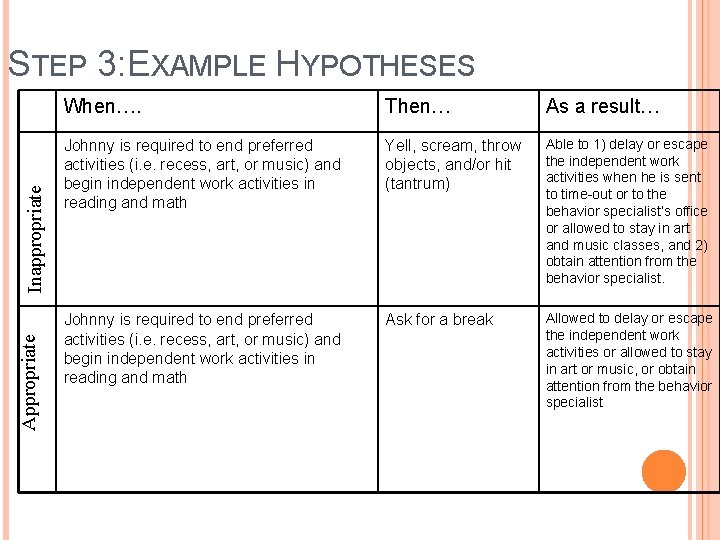
Appropriate Inappropriate STEP 3: EXAMPLE HYPOTHESES When…. Then… As a result… Johnny is required to end preferred activities (i. e. recess, art, or music) and begin independent work activities in reading and math Yell, scream, throw objects, and/or hit (tantrum) Able to 1) delay or escape the independent work activities when he is sent to time-out or to the behavior specialist’s office or allowed to stay in art and music classes, and 2) obtain attention from the behavior specialist. Johnny is required to end preferred activities (i. e. recess, art, or music) and begin independent work activities in reading and math Ask for a break Allowed to delay or escape the independent work activities or allowed to stay in art or music, or obtain attention from the behavior specialist
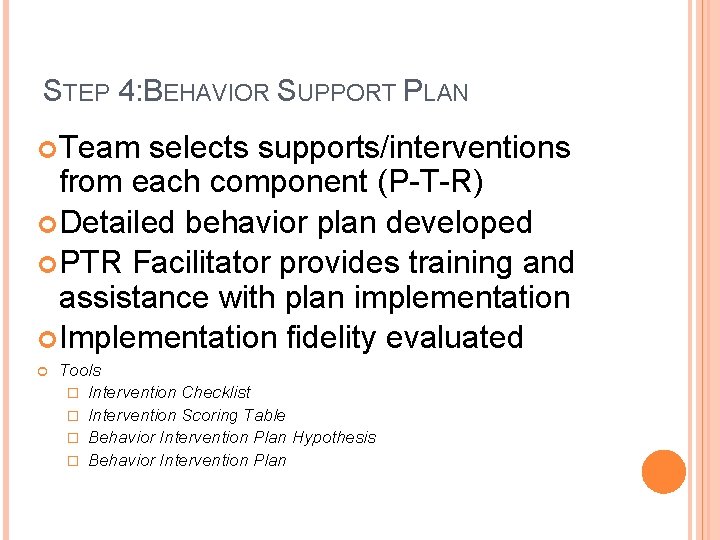
STEP 4: BEHAVIOR SUPPORT PLAN Team selects supports/interventions from each component (P-T-R) Detailed behavior plan developed PTR Facilitator provides training and assistance with plan implementation Implementation fidelity evaluated Tools � Intervention Checklist � Intervention Scoring Table � Behavior Intervention Plan Hypothesis � Behavior Intervention Plan
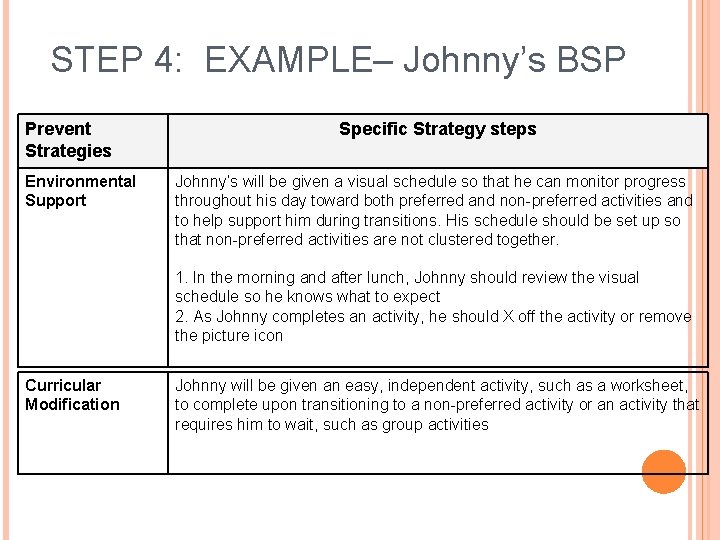
STEP 4: EXAMPLE– Johnny’s BSP Prevent Strategies Environmental Support Specific Strategy steps Johnny’s will be given a visual schedule so that he can monitor progress throughout his day toward both preferred and non-preferred activities and to help support him during transitions. His schedule should be set up so that non-preferred activities are not clustered together. 1. In the morning and after lunch, Johnny should review the visual schedule so he knows what to expect 2. As Johnny completes an activity, he should X off the activity or remove the picture icon Curricular Modification Johnny will be given an easy, independent activity, such as a worksheet, to complete upon transitioning to a non-preferred activity or an activity that requires him to wait, such as group activities
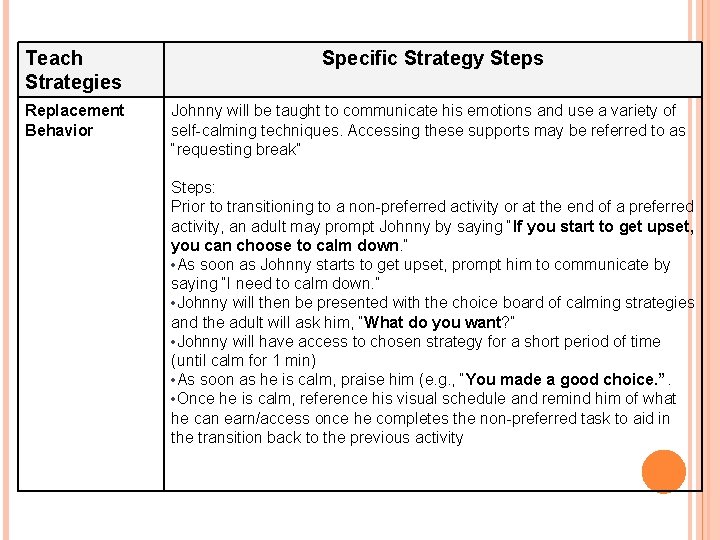
Teach Strategies Specific Strategy Steps Replacement Behavior Johnny will be taught to communicate his emotions and use a variety of self-calming techniques. Accessing these supports may be referred to as “requesting break” Steps: Prior to transitioning to a non-preferred activity or at the end of a preferred activity, an adult may prompt Johnny by saying “If you start to get upset, you can choose to calm down. ” • As soon as Johnny starts to get upset, prompt him to communicate by saying “I need to calm down. ” • Johnny will then be presented with the choice board of calming strategies and the adult will ask him, “What do you want? ” • Johnny will have access to chosen strategy for a short period of time (until calm for 1 min) • As soon as he is calm, praise him (e. g. , “You made a good choice. ”. • Once he is calm, reference his visual schedule and remind him of what he can earn/access once he completes the non-preferred task to aid in the transition back to the previous activity
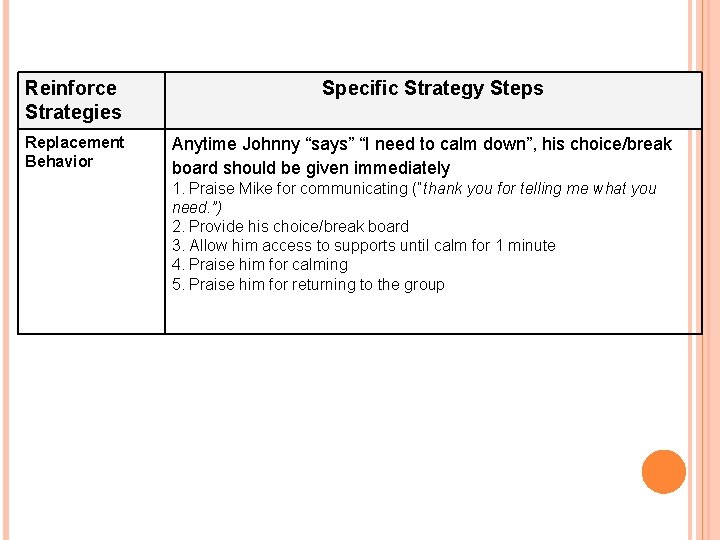
Reinforce Strategies Replacement Behavior Specific Strategy Steps Anytime Johnny “says” “I need to calm down”, his choice/break board should be given immediately 1. Praise Mike for communicating (“thank you for telling me what you need. ”) 2. Provide his choice/break board 3. Allow him access to supports until calm for 1 minute 4. Praise him for calming 5. Praise him for returning to the group
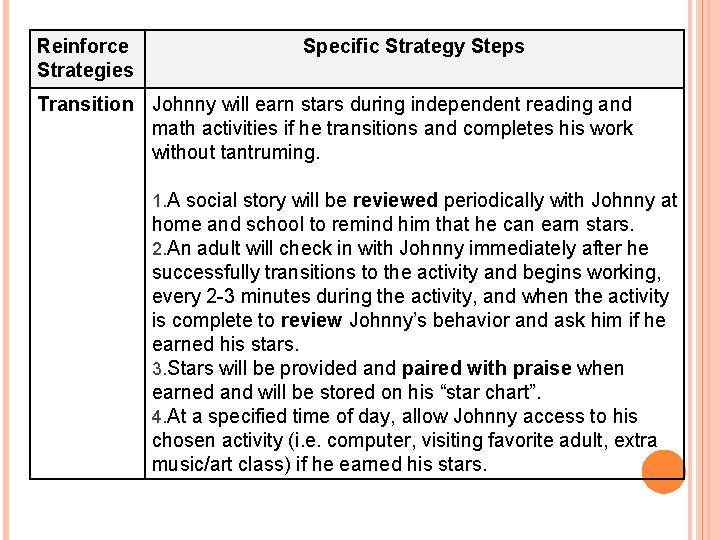
Reinforce Strategies Specific Strategy Steps Transition Johnny will earn stars during independent reading and math activities if he transitions and completes his work without tantruming. 1. A social story will be reviewed periodically with Johnny at home and school to remind him that he can earn stars. 2. An adult will check in with Johnny immediately after he successfully transitions to the activity and begins working, every 2 -3 minutes during the activity, and when the activity is complete to review Johnny’s behavior and ask him if he earned his stars. 3. Stars will be provided and paired with praise when earned and will be stored on his “star chart”. 4. At a specified time of day, allow Johnny access to his chosen activity (i. e. computer, visiting favorite adult, extra music/art class) if he earned his stars.
STEP 4: PART 2 -PTR INTERVENTION COACHING/FIDELITY Provide training to practice the plan without student (30 -90 min. ) PTR facilitator present first day of implementation with student Provide support in the classroom Model the plan Provide feedback Discuss need for modifications if applicable Tools Training Checklist Fidelity of Implementation
EXAMPLE: SAMPLE COACHING CHECKLIST/FIDELITY FOR MIKE
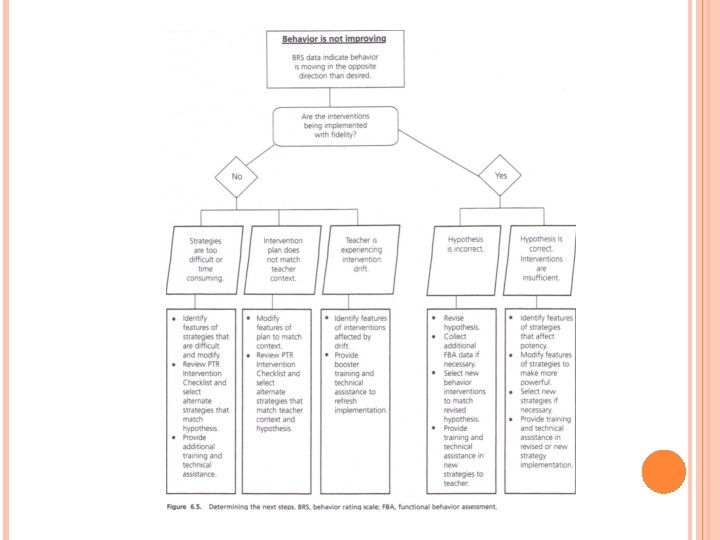
STEP 5: EVALUATION Is it working? Daily ratings of behavior Continuous progress monitoring BRS Other data collection forms Is it being implemented consistently and accurately? Fidelity ratings Do we need more data? Does the plan need to be modified or expanded? Plan for generalization and maintenance
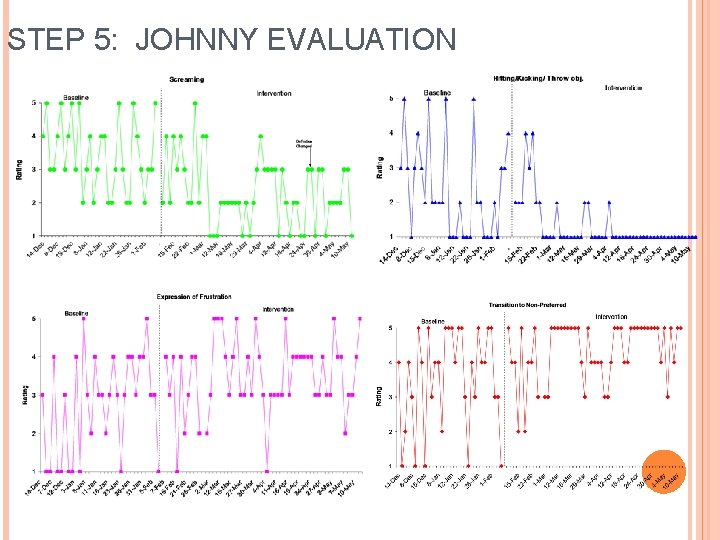
STEP 5: JOHNNY EVALUATION
MATCHING TRIGGERS AND FUNCTIONS TO INTERVENTIONS AND SUPPORTS Not an exhaustive list but based on components of behavior support plans from PTR chapter 5 A possible resource or starting point when choosing interventions and supports A support for ensuring that we are linking what is learned in the FBA process to choices made in the BSP
- Slides: 24