
A Brief Introduction to Z 39 50 Protocol

A Brief Introduction to Z 39. 50 Protocol A. R. D. Prasad Documentation Research and Training Centre Indian Statistical Institute Bangalore ard@isibang. ac. in
Advantages of web ØUser friendly ØAllows multimedia components ØCan deal with unstructured data ØWeb spiders can collect index terms ØAllows database interface with CGI scripts

Disadvantages of HTTP ØDoes not support “sessions” ØDeals with unstructured data that results poor indexing ØCan not handle multiple databases with varied structures
Z 39. 50 versions Version 1 (1988) Ø OSI application layer protocol Ø Developed by ANSI’s NISO Version 2 (1992) Ø Z 39. 50 Inter-operability Testbed (ZIP) Ø Host to host interface Version 3 (1995) Ø Supports access to a variety of data types. Ø Supports the display of holdings information and circulation status
ØANSI/NISO standard. Officially referred as Information Retrieval (Z 39. 50): Application Service Definition and Protocol Specification ØISO 23950 ØZ 39. 50 Maintenance Agency at the Library of Congress
Apprehensions about Z 39. 50 Ø It is still under development ØNot widely used ØIt is too complex to implement ØIt is not required any more as we have web ØIt does not work
But ØIt is a fairly matured standard ØFairly widely implemented for LIS work ØOrganizations like museums, art galleries, archives have started using it. Latest version supports nonbibliographic information Cont…
But ØIt is still useful in web environment. In fact, Web provides access to more than one Z 39. 50 enabled backend databases ØIt promises interoperability across databases ØSupports maintenance of centralized union catalogs
Origin The source of the Z 39. 50 request/query. In clientserver terminology this would be the client. The origin can be any system on the Internet interested in accessing information on server systems on the Internet.
Target In client-server terminology this is nothing but a server, which can provide accessibility to a client. Obviously, these servers make their databases accessible to Internet clients.

Version The information about the Z 39. 50 version implements in either Z 39. 50 compliant client or server is important in resolving compatibility issues. The version 1 which was basically WAIS-based, is obsolete. As on today majority of Z 39. 50 software conform to Version 2.
Gateway means a Web to Z 39. 50 style implementation. A gateway allows anyone with a Web browser to access Z 39. 50 compliant databases.
Profiles provide information on the search attributes like author, title etc. and the types of records that can be returned like USMARC, GRS (Generic Record Syntax), SUTRS (Simple Unstructured Text Record Syntax - text only).
The Z 39. 50 protocol should help in ØIdentifying the characteristics of the server data base ØLocating the databases distributed across the Internet

Domain Specific Attribute sets ØBib-1 – Bibliographic ØGILS - Government Information Locator Service ØSTAS - Scientific and Technical ØDL - Digital Library Collections ØCIMI - Museum Collection Information ØGEO - Digital Geospatial Metadata etc…
Facility specific Attribute sets ØCCL-1 - Common Command Language ØExp-1 - for use with an Explain database ØExt-1 - for use with an Extended Service database
Important facilities : Browse Allows the client to scan the contents of wordlists or indices on the server. This can be particularly useful in the case of controlled keyword lists or facets. Cont…
Important facilities : Access control and resource control Allows authentication of users, and cost control and online charging for commercial services. Cont…
Important facilities : Sort Allows the client to request different orderings of query results, eg. relevance ranking, sorting by date or version number, etc. Cont…
Important facilities : Explain Allows the client to interrogate the server about a number of details about its contents and its level of support for the application profile. Cont…
Important facilities : Item Order Allows offline ordering of materials in cases where they cannot be delivered electronically, or where per-unit charging (eg. online charging) is required. Such services are being supplied in an ad-hoc fashion by online Webbased component repositories such as ASSET. The item order service provides a ready-made, and semantically standardised version of this service. Cont…
Important facilities : Item Update Permits an authorised client to update the contents of the remote database.
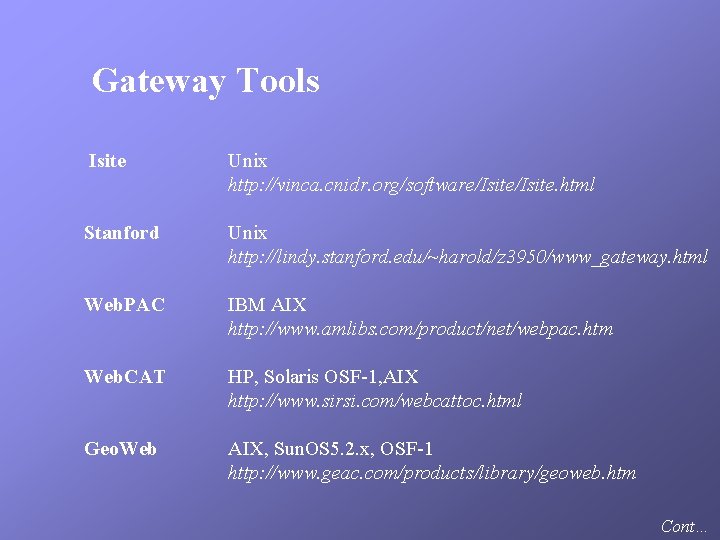
Gateway Tools Isite Unix http: //vinca. cnidr. org/software/Isite. html Stanford Unix http: //lindy. stanford. edu/~harold/z 3950/www_gateway. html Web. PAC IBM AIX http: //www. amlibs. com/product/net/webpac. htm Web. CAT HP, Solaris OSF-1, AIX http: //www. sirsi. com/webcattoc. html Geo. Web AIX, Sun. OS 5. 2. x, OSF-1 http: //www. geac. com/products/library/geoweb. htm Cont…
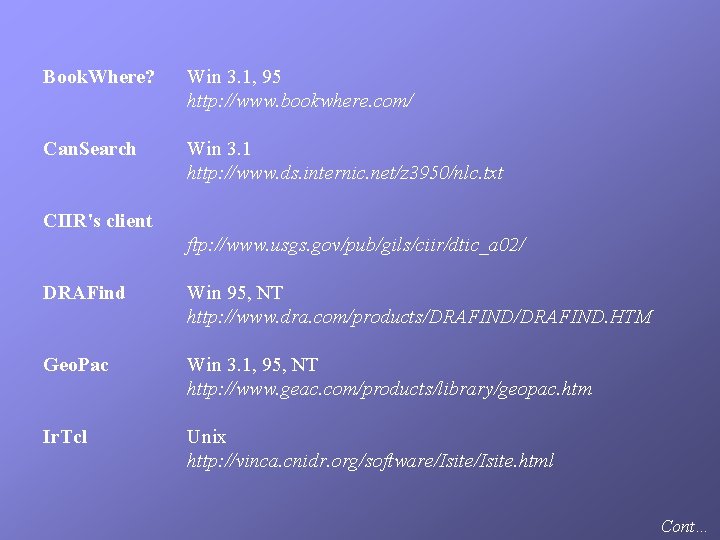
Book. Where? Win 3. 1, 95 http: //www. bookwhere. com/ Can. Search Win 3. 1 http: //www. ds. internic. net/z 3950/nlc. txt CIIR's client ftp: //www. usgs. gov/pub/gils/ciir/dtic_a 02/ DRAFind Win 95, NT http: //www. dra. com/products/DRAFIND. HTM Geo. Pac Win 3. 1, 95, NT http: //www. geac. com/products/library/geopac. htm Ir. Tcl Unix http: //vinca. cnidr. org/software/Isite. html Cont…
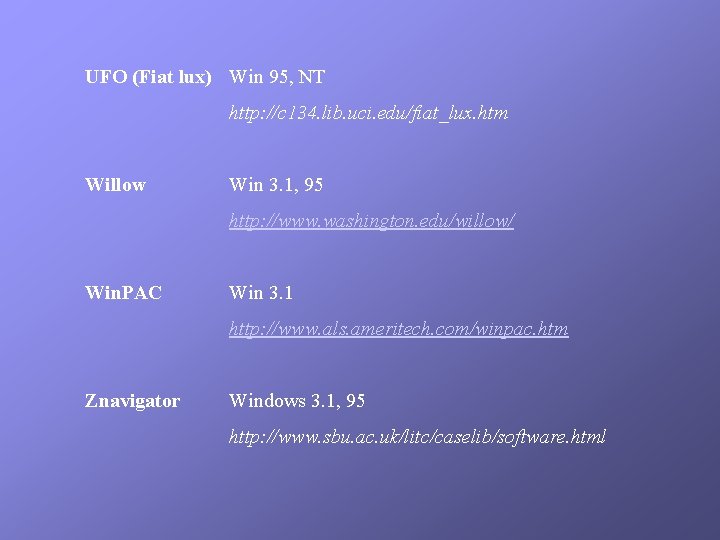
UFO (Fiat lux) Win 95, NT http: //c 134. lib. uci. edu/fiat_lux. htm Willow Win 3. 1, 95 http: //www. washington. edu/willow/ Win. PAC Win 3. 1 http: //www. als. ameritech. com/winpac. htm Znavigator Windows 3. 1, 95 http: //www. sbu. ac. uk/litc/caselib/software. html
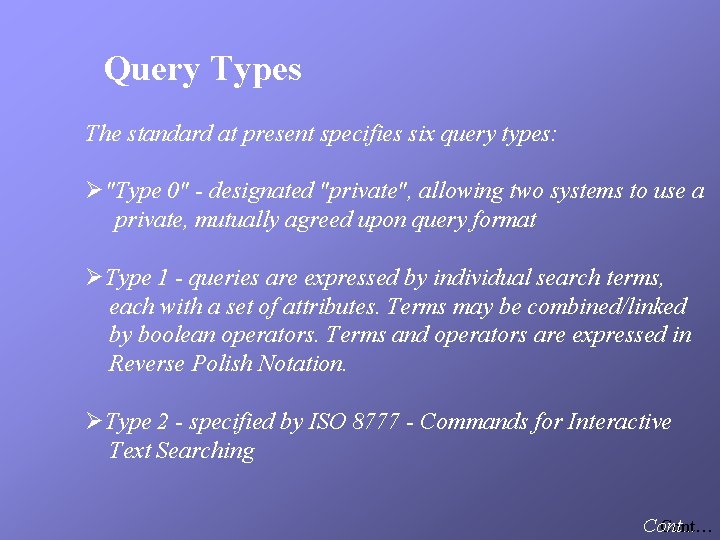
Query Types The standard at present specifies six query types: Ø"Type 0" - designated "private", allowing two systems to use a private, mutually agreed upon query format ØType 1 - queries are expressed by individual search terms, each with a set of attributes. Terms may be combined/linked by boolean operators. Terms and operators are expressed in Reverse Polish Notation. ØType 2 - specified by ISO 8777 - Commands for Interactive Text Searching Cont…
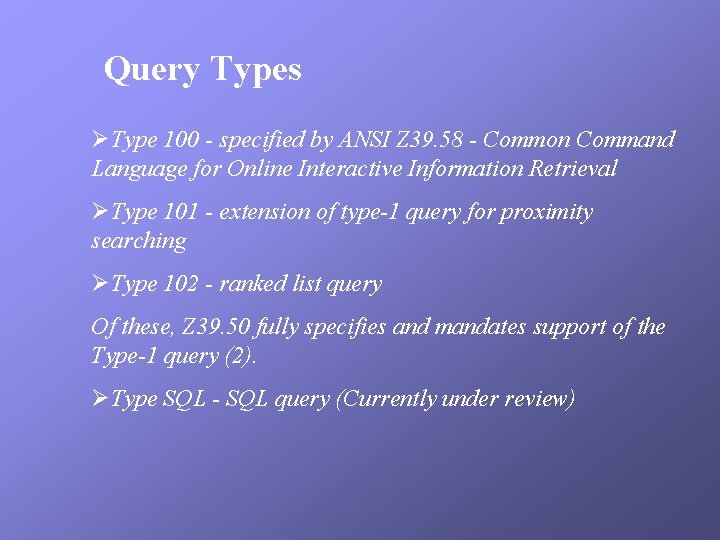
Query Types ØType 100 - specified by ANSI Z 39. 58 - Common Command Language for Online Interactive Information Retrieval ØType 101 - extension of type-1 query for proximity searching ØType 102 - ranked list query Of these, Z 39. 50 fully specifies and mandates support of the Type-1 query (2). ØType SQL - SQL query (Currently under review)
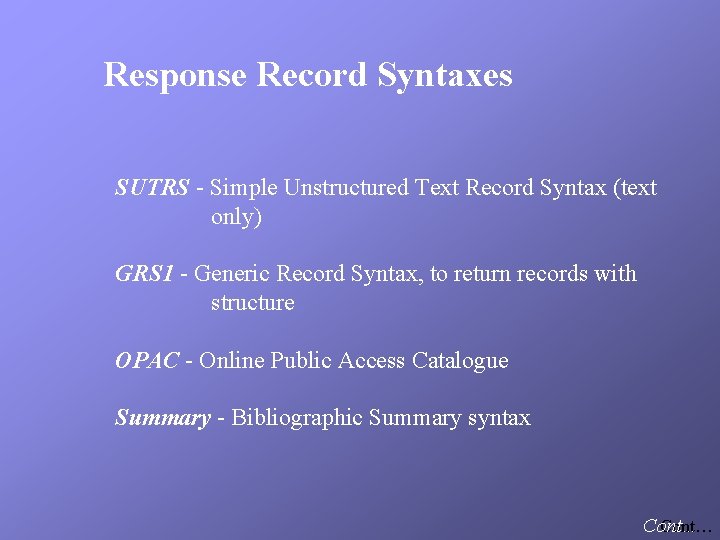
Response Record Syntaxes SUTRS - Simple Unstructured Text Record Syntax (text only) GRS 1 - Generic Record Syntax, to return records with structure OPAC - Online Public Access Catalogue Summary - Bibliographic Summary syntax Cont…

Response Record Syntaxes MARC formats - USMARC, UNIMARC, UKMARC, and CANMARC Explain - Server Information syntax Extended - Extended Services record syntax (Under review ) SQL-RS - SQL record syntax supporting SQL 3 datatypes
Connecting to Target Sites ØDoes the client provide a menu of pre-configured targets so that the user can connect by selecting an entry? ØCan you easily add, delete, or modify target information on the list? ØWill the software ask for user/password information if required by the target? Cont…
Connecting to Target Sites ØCan the client connect to multiple sites at the same time? ØCan you select more than one database within the server to send the same query? ØDoes it display any messages regarding the connection to the target?
Searching 1. Does the client have a simple or novice search screen? Are the attributes presented for the simple search changeable? For example, if you often use ISBN, can it be one of the main search keys? 2. Does the client support advance searching? 3. Can you customize the query screen based on the attributes supported by the target? Cont…
Searching 4. Does the client allow you to specify different record syntaxes? ØMARC Record Syntax-The variations of MARC are numerous and include UNIMARC, USMARC, UKMARC, etc. ØGeneric Record Syntax (GRS)-GRS is a general-purpose record syntax that allows for the retrieval of different types of structured records, whether they are full text or mixed media. Support for GRS is becoming increasingly important with the growth of Z 39. 50 servers containing non-MARC records. It is also being recommended as the syntax for the return of records containing holdings and circulation information. Cont…
Searching 4. Does the client allow you to specify different record syntaxes? ØSimple Unstructured Record Syntax (SUTRS)SUTRS allows the return of record as unstructured text without specified data elements. As few servers support SUTRS, this is not an important immediate feature to look for in a client. However, in the future, it may become a feature of fee-based servers who will opt for sending SUTRS records for free and MARC records for a charge. Cont…
Searching 5. Can you specify the return of different record contents (such as full record or brief record)? 6. Can you specify the number of records received in response to a query? 7. Does the client support query management (i. e. sessions feature)? 8. Can you cancel a search that has been sent? 9. Is there help formulating a query?
Search Response and Record Display 1. Is there a summary screen of records from which to request the full display of the record? 2. Is it possible to get a MARC display of the record? 3. Does the textual (non-MARC) display of the record include holdings? 4. Can the client merge the records received from different targets for the same query? Can it perform deduplication? Cont…
Search Response and Record Display 5. Does the client allow you to save the records or export them to another application? 6. Are informative messages displayed when searches fail? 7. Other Z 39. 50 Services Supported Cont…
Search Response and Record Display 8. How much customization is possible? Screens and search forms (color, logo, font type and size, format of screen, button or tab names), ØSearch keys on search forms, ØTarget information in the list of server sites, ØCreation of local lists of preferred server sites, ØUser identification and password information for specific servers, ØLimiting the search attributes to only those supported by the selected target, ØSpecifying the fields within the MARC record to be presented in the textual display of the record, ØFilters for refining the set of records returned, ØIdentifying printers and other applications for output, and ØLinks to other files such as a local directory of libraries or library symbols. Cont…
Search Response and Record Display 9. Can you create a hypertext link from within the received record? 10. What client administration features are available? 11. How easy is it to install and set up a client or gateway? 12. On what platform does the client run? 13. How good is the documentation? Cont…
The Vendor and Cost ØDoes the vendor have a good track record based on other library software products? ØIs the vendor committed to upgrading the client? ØWhat type of service support is the vendor prepared to provide? ØDoes the vendor have a Web site and evaluation software? ØIs the vendor active in the Z 39. 50 community? ØWhat is the price of the Z 39. 50 client?

Thank You
- Slides: 41