
A Brief Introduction to the Chinese Language A
A Brief Introduction to the Chinese Language
A very old yet still living language: n Several thousand years long history, ever changing, but never interrupted. n Belong to the “Sino-Tibetan” language system. n More people speak Chinese than any other language in the world. n One of the five official languages of UN. n About 2 million American residents are Chinese home speakers.
n 60% of Korean vocabulary comes from Chinese. n Written Japanese has several thousand characters borrowed from Chinese. n It has been estimated that until the 18 th century more than half of the world's printed books were in Chinese.
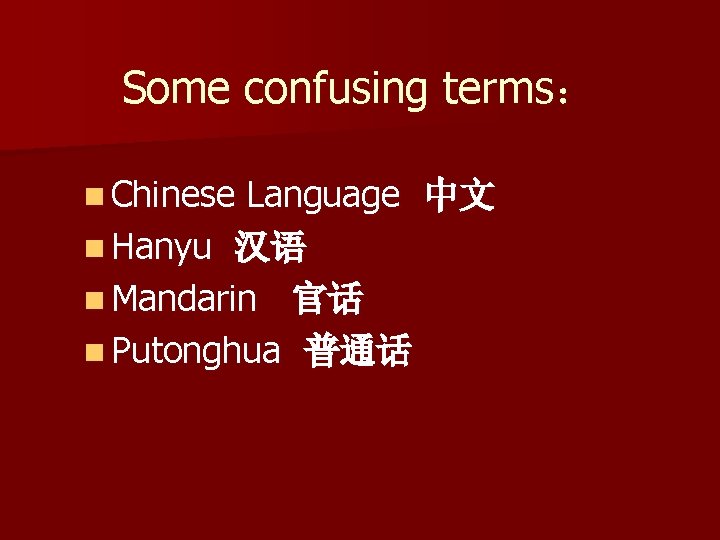
Some confusing terms: n Chinese Language 中文 n Hanyu 汉语 n Mandarin 官话 n Putonghua 普通话
Is Cantonese Chinese? n Yes! n It’s only one of the many dialects of Chinese (Yue Dialect). n The difference is mainly in pronunciation, slightly in vocabulary and grammar, but not in writing system.
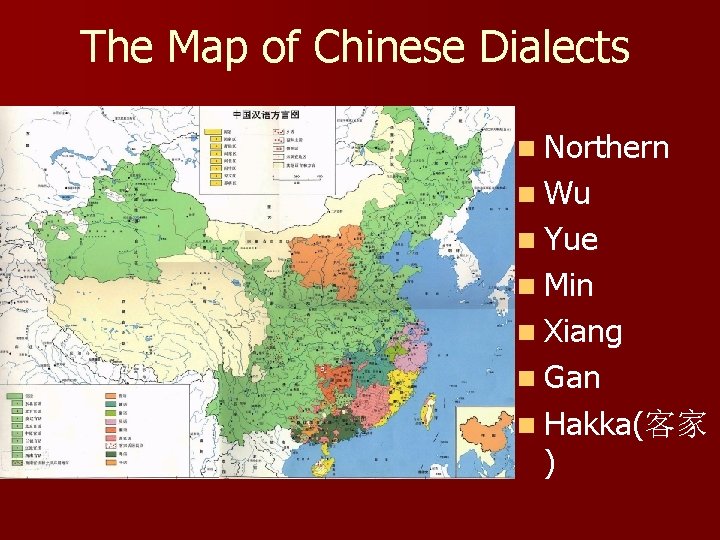
The Map of Chinese Dialects n Northern n Wu n Yue n Min n Xiang n Gan n Hakka(客家 )
What is “Pin Yin”? n The Romanized phonetic spelling system created in 1950’s for Mandarin or standard Chinese (Putonghua) n It is based on Beijing Dialects, a branch of the Northern dialects of Chinese language n It uses 25 letters in English except “ V ”.
Chinese (Mandarin) Phonetics n Initials (consonants) n Finals (a vowel, or a combination of vowels, sometimes with a nasal at the end) n Tones (four distinct and one light tones) n Each Chinese character corresponds to one syllable. A syllable is consist of an initial, a final and a tone.
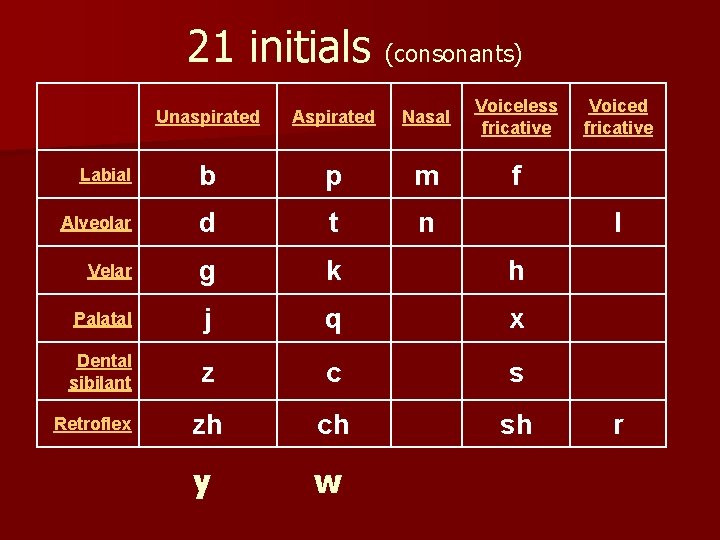
21 initials (consonants) Unaspirated Aspirated Nasal Voiceless fricative Labial b p m f Alveolar d t n Velar g k h Palatal j q x Dental sibilant z c s zh ch sh y w Retroflex Voiced fricative l r
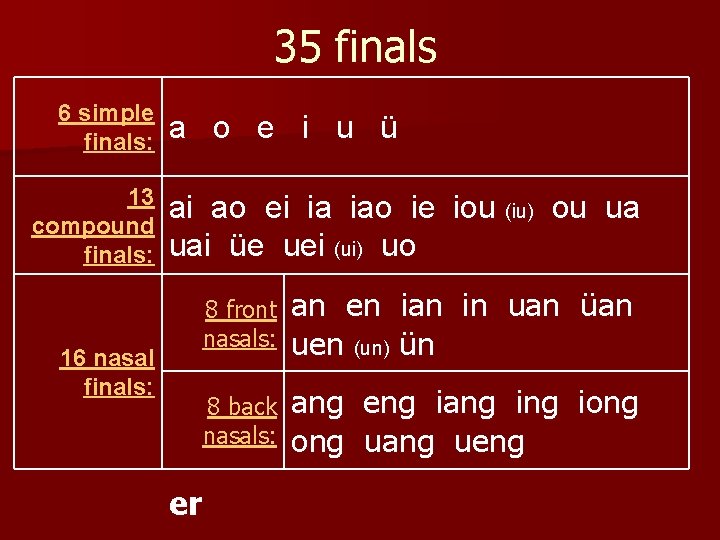
35 finals 6 simple finals: 13 compound finals: 16 nasal finals: a o e i u ü ai ao ei ia iao ie iou (iu) ou ua uai üe uei (ui) uo 8 front nasals: an en ian in uan üan uen (un) ün 8 back nasals: ang eng iang iong uang ueng er
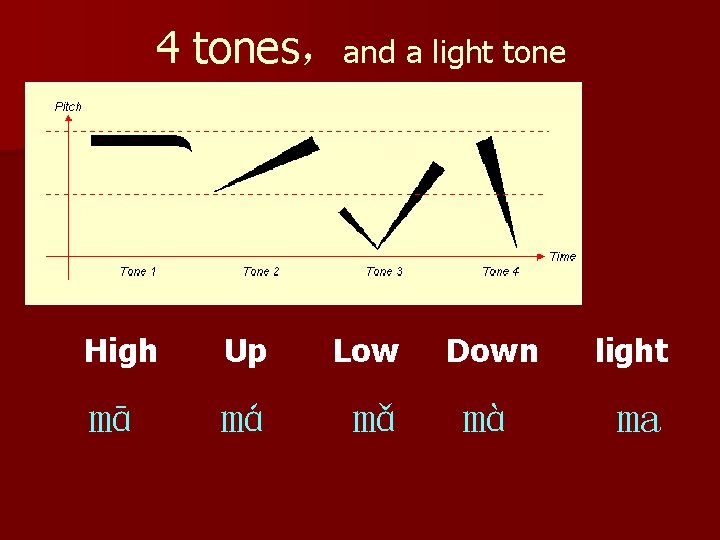
4 tones,and a light tone High Up Low Down light mā má mǎ mà ma
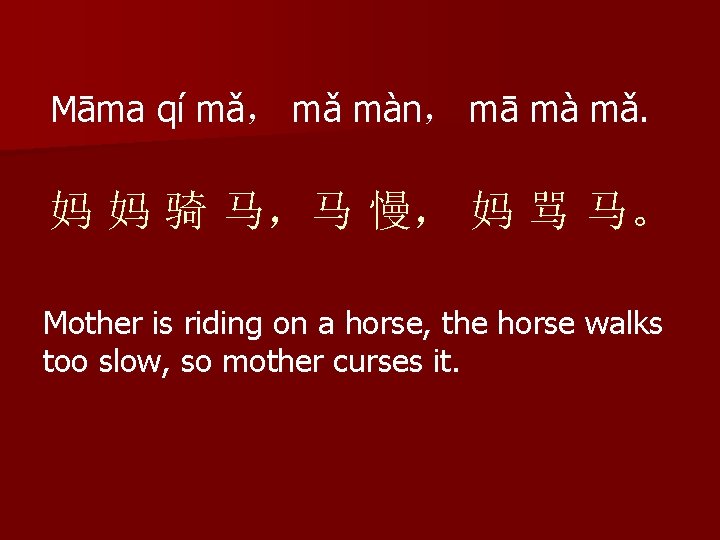
Māma qí mǎ, mǎ màn, mā mà mǎ. 妈 妈 骑 马,马 慢, 妈 骂 马。 Mother is riding on a horse, the horse walks too slow, so mother curses it.
n Combinations of initials and finals, plus several special cases, result in 411 possible combinations. n Applying the four tones, we get a total of around 1, 600 unique syllables.
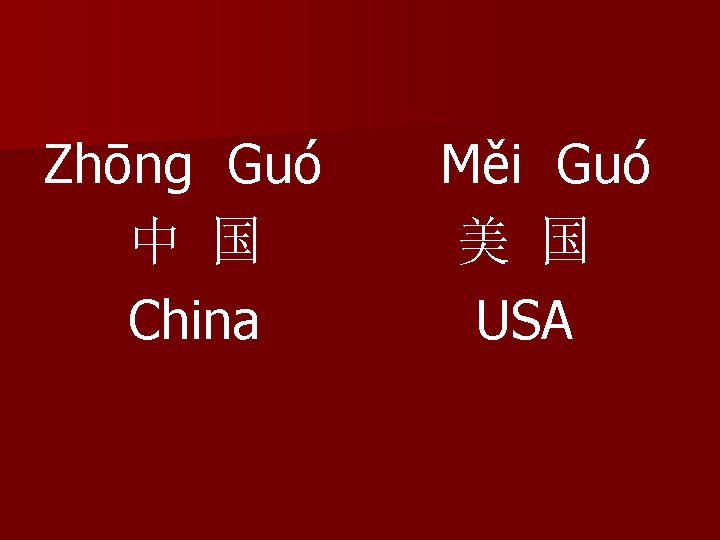
Zhōng Guó 中 国 China Měi Guó 美 国 USA
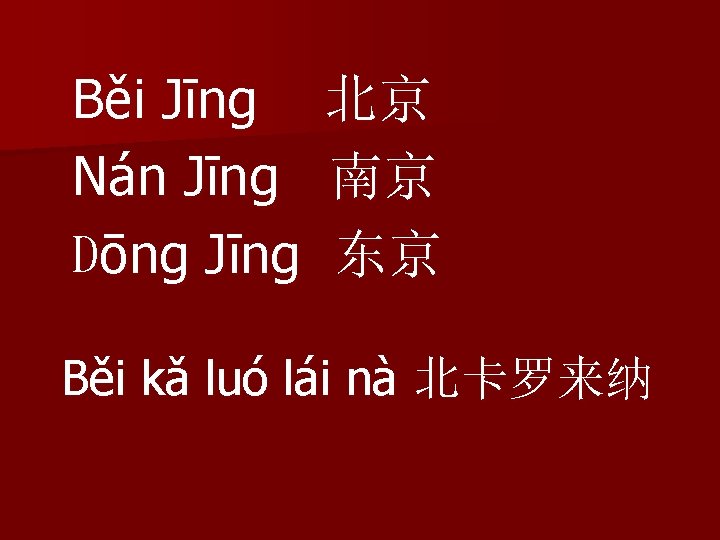
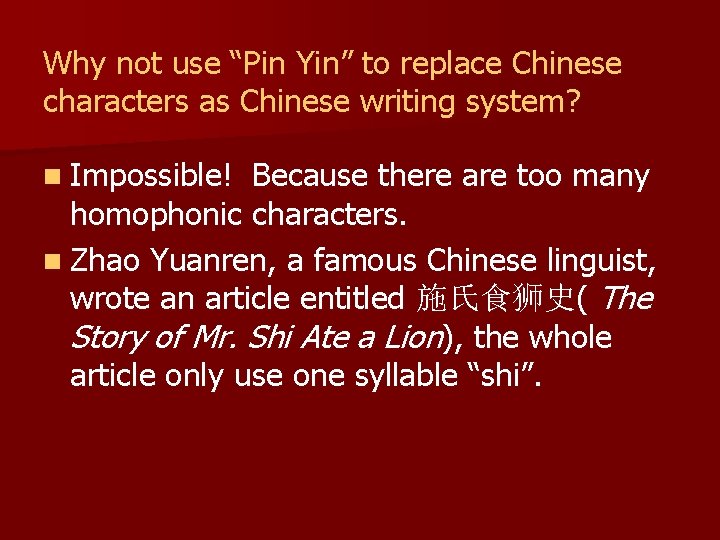
Why not use “Pin Yin” to replace Chinese characters as Chinese writing system? n Impossible! Because there are too many homophonic characters. n Zhao Yuanren, a famous Chinese linguist, wrote an article entitled 施氏食狮史( The Story of Mr. Shi Ate a Lion), the whole article only use one syllable “shi”.
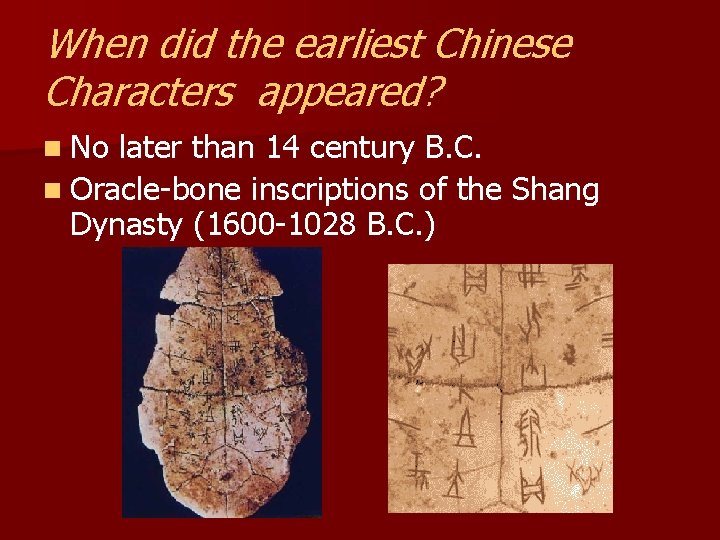
When did the earliest Chinese Characters appeared? n No later than 14 century B. C. n Oracle-bone inscriptions of the Shang Dynasty (1600 -1028 B. C. )
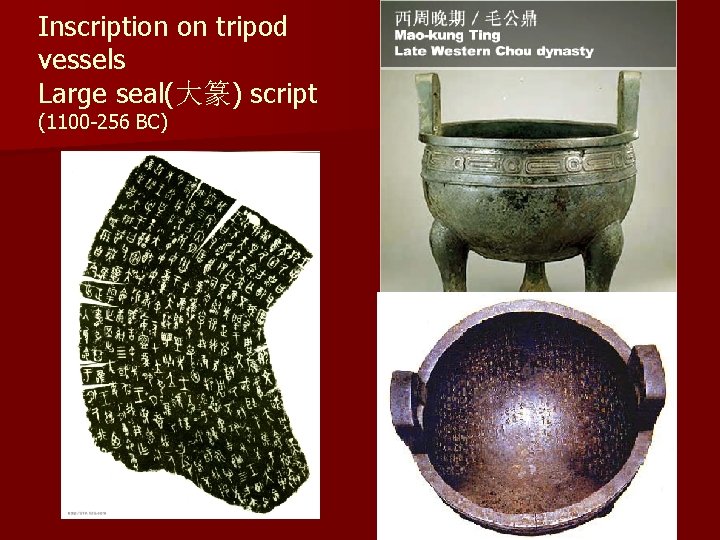
Inscription on tripod vessels Large seal(大篆) script (1100 -256 BC)
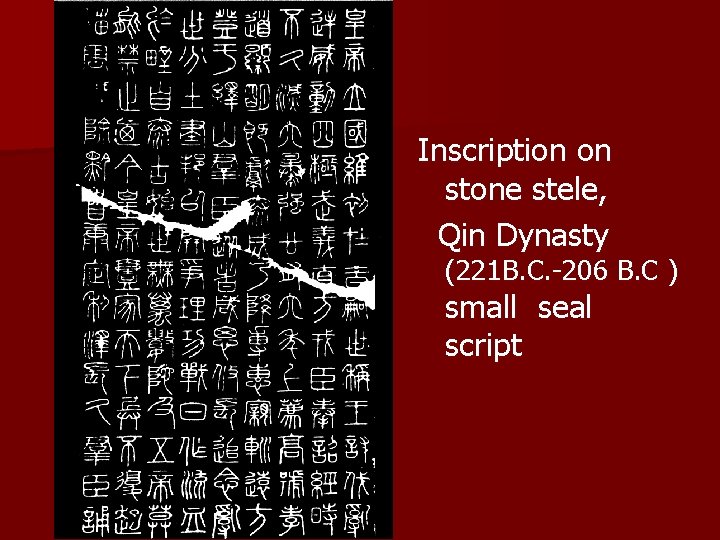
Inscription on stone stele, Qin Dynasty (221 B. C. -206 B. C ) small seal script
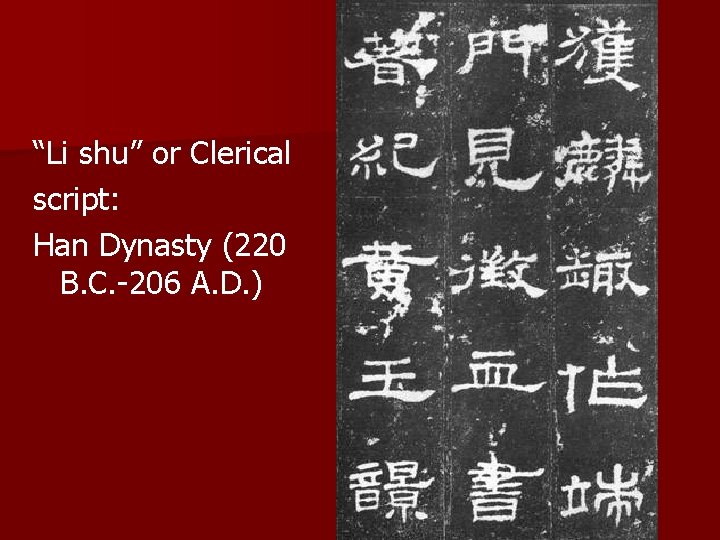
“Li shu” or Clerical script: Han Dynasty (220 B. C. -206 A. D. )
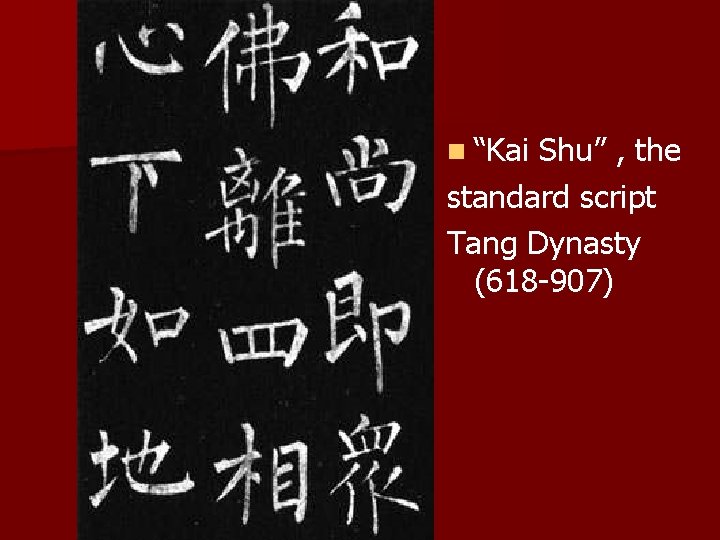
n “Kai Shu” , the standard script Tang Dynasty (618 -907)
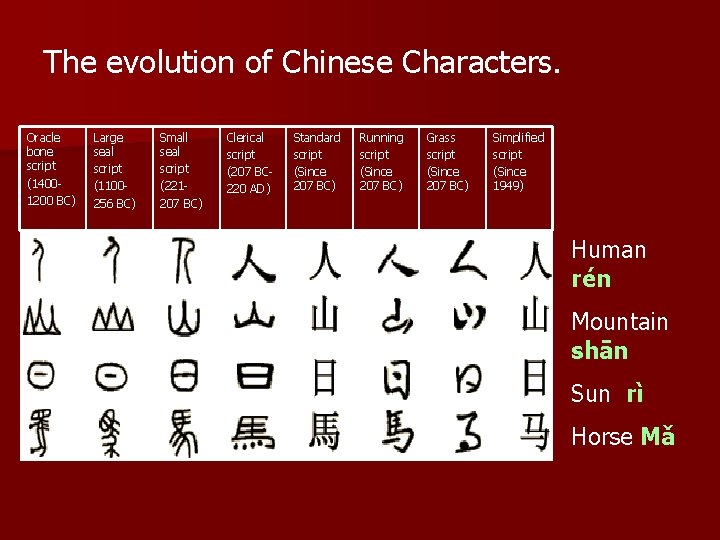
The evolution of Chinese Characters. Oracle bone script (14001200 BC) Large seal script (1100256 BC) Small seal script (221207 BC) Clerical script (207 BC 220 AD) Standard script (Since 207 BC) Running script (Since 207 BC) Grass script (Since 207 BC) Simplified script (Since 1949) Human rén Mountain shān Sun rì Horse Mǎ
![字体流变示意图[Development of Chinese Characters] 商[Shang dynasty] 魏晋[Wei & 战国 秦[Qin 汉[Han 春秋 Jin dynasty]](http://slidetodoc.com/presentation_image_h2/3c6682844ecaaa1e65cdf2ecb5a3a620/image-23.jpg "字体流变示意图[Development of Chinese Characters] 商[Shang dynasty] 魏晋[Wei & 战国 秦[Qin 汉[Han 春秋 Jin dynasty]")
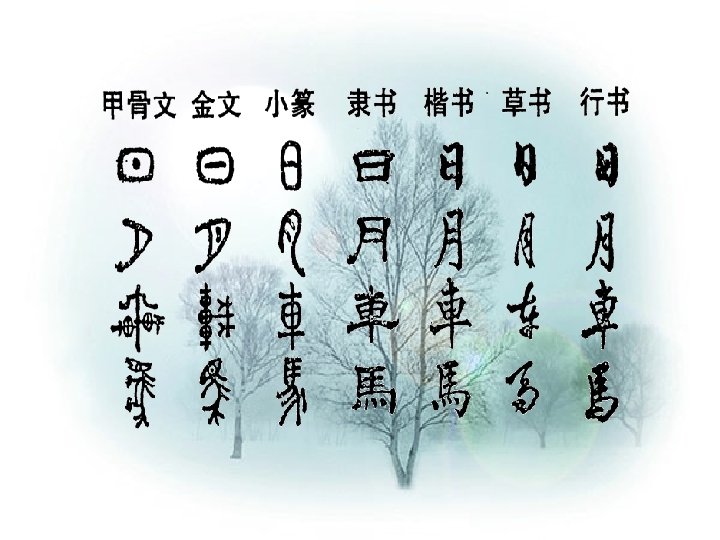
字体流变示意图[Development of Chinese Characters] 商[Shang dynasty] 魏晋[Wei & 战国 秦[Qin 汉[Han 春秋 Jin dynasty] [warrior’s dynasty [later dynasty 220 -439 A. D time] Zhou ] ] dynasty ] 行书[running 小篆[later 大篆[early hand] seal characters] 西周 [early 1600 -1060 B. C. Zhou dynasty] 甲骨文[scripts on bones or shells] 金文[scripts on bronze] 隶书[official scripts] Ancient characters 楷书[regular scripts] Modern characters
Are all the Chinese characters pictographs(象形文字)? n No! Only some basic words are. n Chinese works pictographically as well as phonetically.
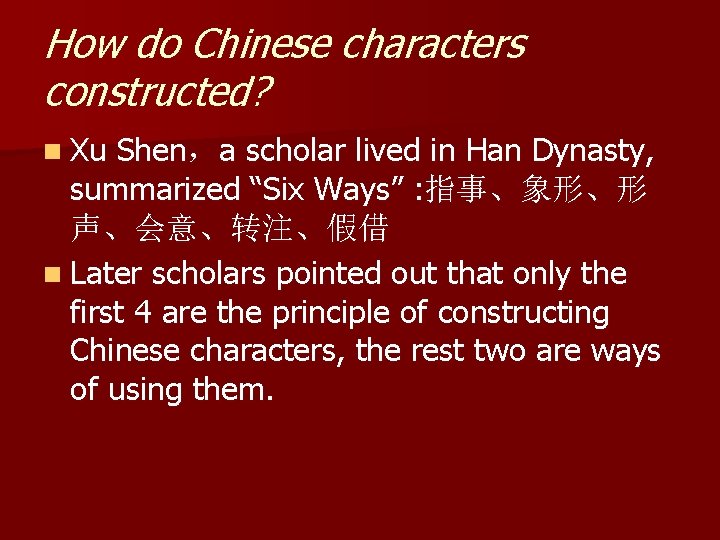
How do Chinese characters constructed? n Xu Shen,a scholar lived in Han Dynasty, summarized “Six Ways” : 指事、象形、形 声、会意、转注、假借 n Later scholars pointed out that only the first 4 are the principle of constructing Chinese characters, the rest two are ways of using them.
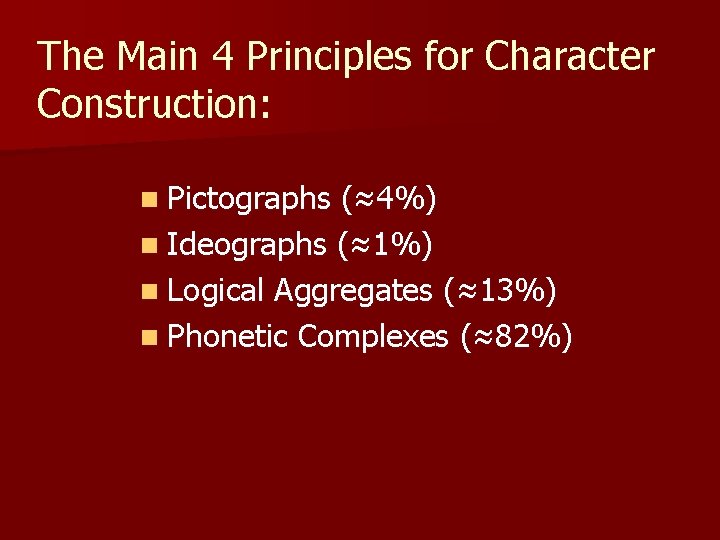
The Main 4 Principles for Character Construction: n Pictographs (≈4%) n Ideographs (≈1%) n Logical Aggregates (≈13%) n Phonetic Complexes (≈82%)
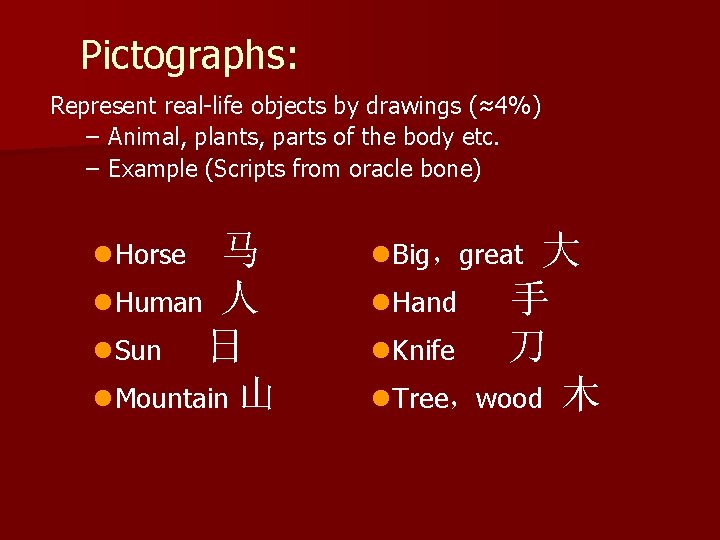
Pictographs: Represent real-life objects by drawings (≈4%) – Animal, plants, parts of the body etc. – Example (Scripts from oracle bone) 马 l. Human 人 l. Sun 日 l. Mountain 山 l. Horse 大 l. Hand 手 l. Knife 刀 l. Tree,wood 木 l. Big,great
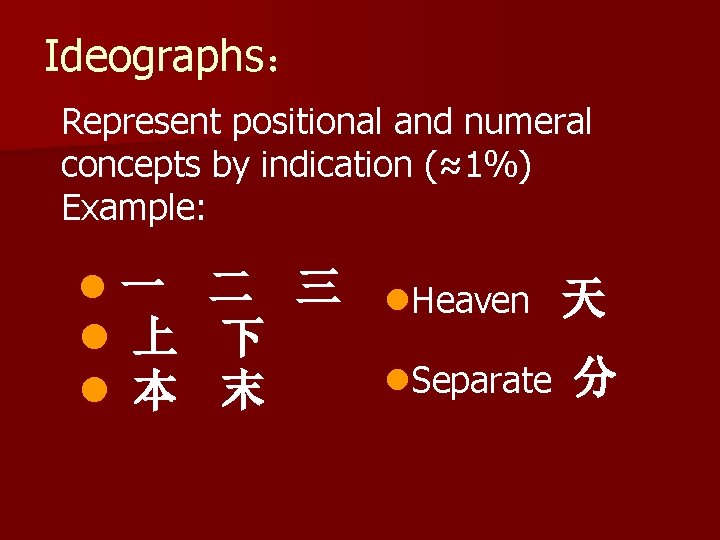
Ideographs: Represent positional and numeral concepts by indication (≈1%) Example: l一 二 三 l. Heaven 天 l 上 下 l. Separate 分 l 本 末
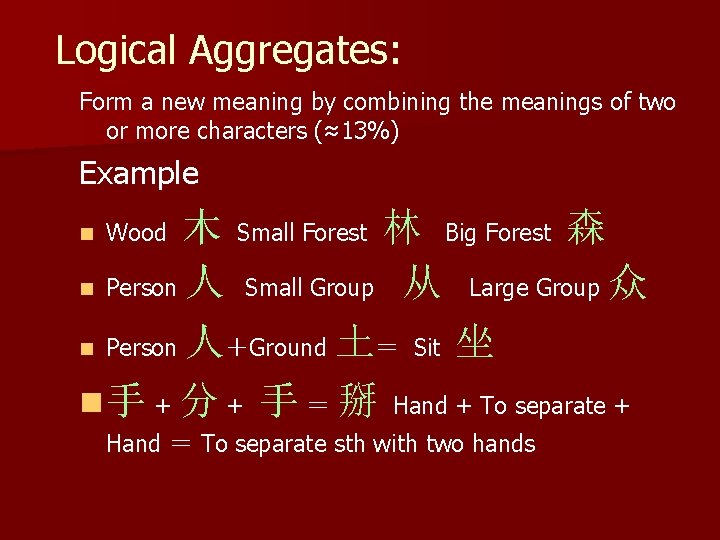
Logical Aggregates: Form a new meaning by combining the meanings of two or more characters (≈13%) Example 木 Small Forest 林 Big Forest 森 n Person 人 Small Group 从 Large Group 众 n Person 人+Ground 土= Sit 坐 n 手 + 分 + 手 = 掰 Hand + To separate + n Wood Hand = To separate sth with two hands
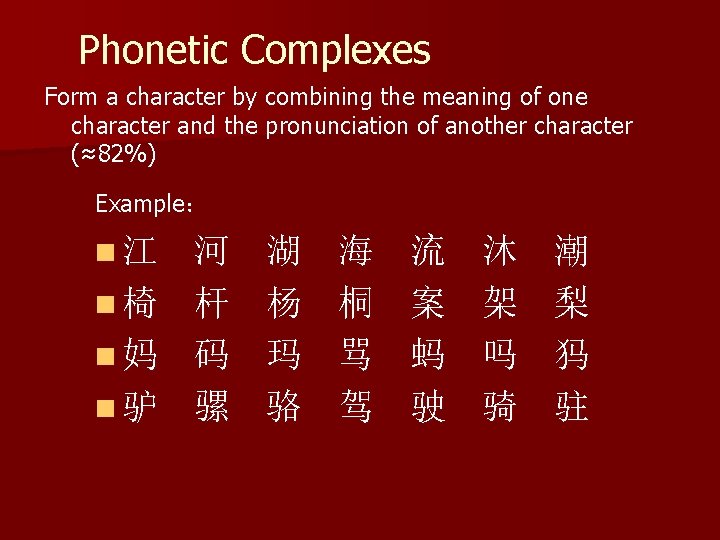
Phonetic Complexes Form a character by combining the meaning of one character and the pronunciation of another character (≈82%) Example: n江 n椅 n妈 n驴 河 杆 码 骡 湖 杨 玛 骆 海 桐 骂 驾 流 案 蚂 驶 沐 架 吗 骑 潮 梨 犸 驻

9 basic stokes 书
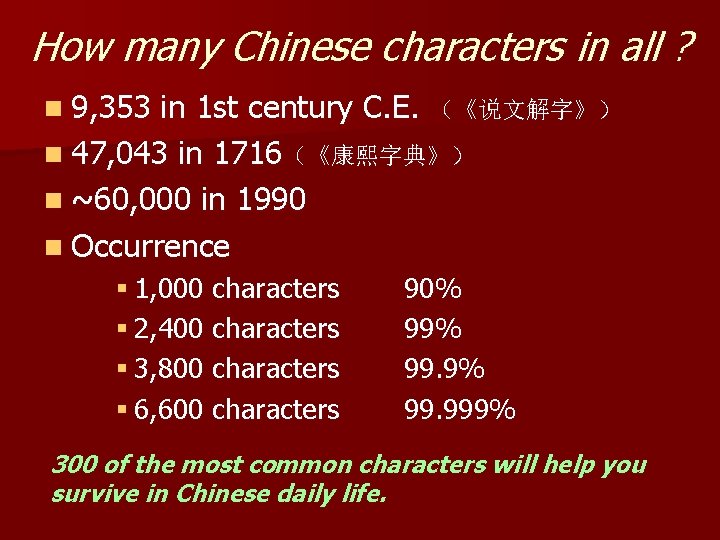
How many Chinese characters in all ? n 9, 353 in 1 st century C. E. (《说文解字》) n 47, 043 in 1716(《康熙字典》) n ~60, 000 in 1990 n Occurrence § 1, 000 characters § 2, 400 characters § 3, 800 characters § 6, 600 characters 90% 99. 9% 99. 999% 300 of the most common characters will help you survive in Chinese daily life.
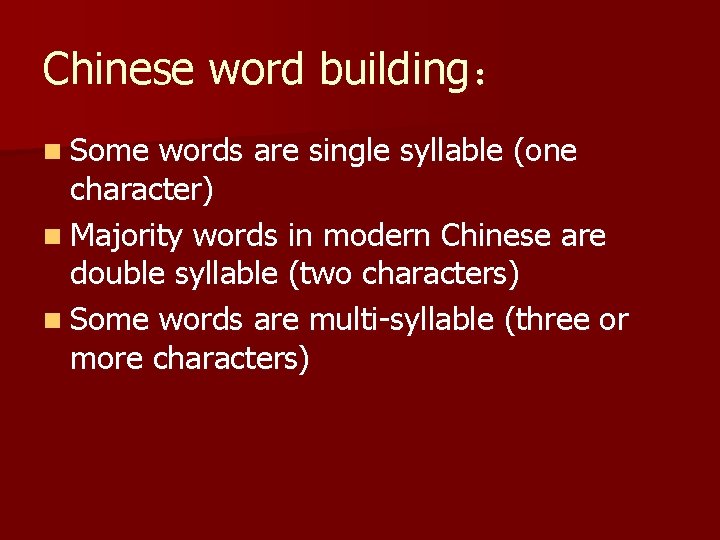
Chinese word building: n Some words are single syllable (one character) n Majority words in modern Chinese are double syllable (two characters) n Some words are multi-syllable (three or more characters)
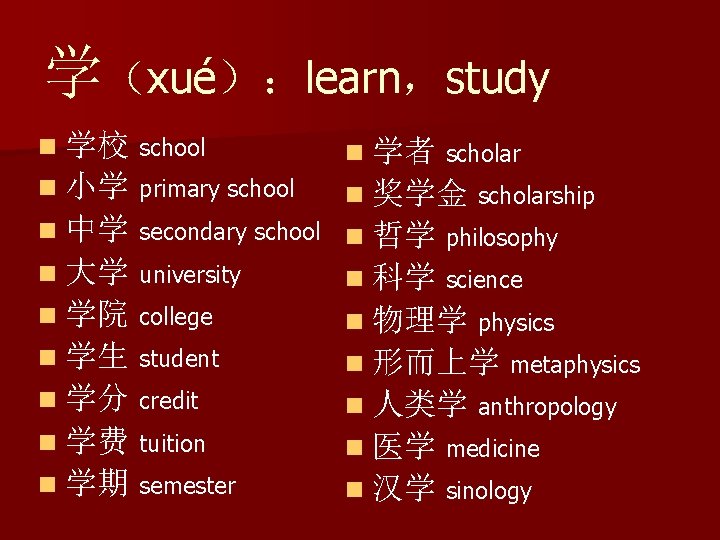
学(xué):learn,study n 学校 school n 学者 scholar n 小学 primary school n 奖学金 scholarship n 中学 secondary school n 哲学 philosophy n 大学 university n 科学 science n 学院 college n 物理学 physics n 学生 student n 形而上学 metaphysics n 学分 credit n 人类学 anthropology n 学费 tuition n 医学 medicine n 学期 semester n 汉学 sinology
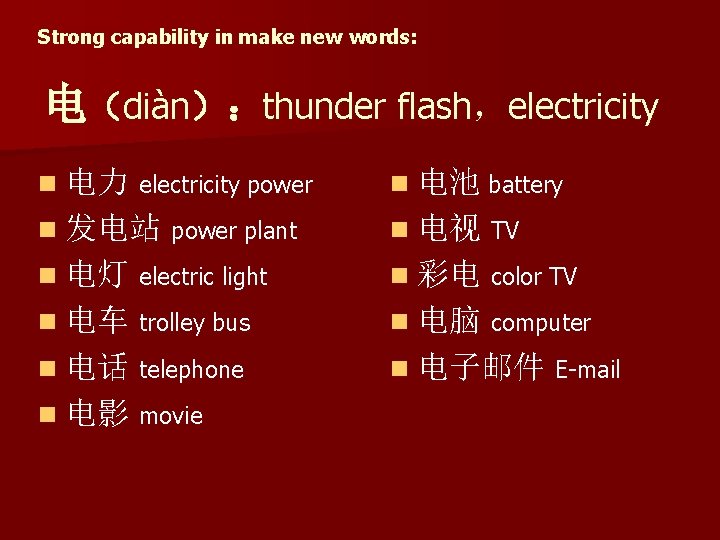
Strong capability in make new words: 电(diàn):thunder flash,electricity n 电力 electricity power n 电池 battery n 发电站 power plant n 电视 TV n 电灯 electric light n 彩电 color TV n 电车 trolley bus n 电脑 computer n 电话 telephone n 电子邮件 E-mail n 电影 movie
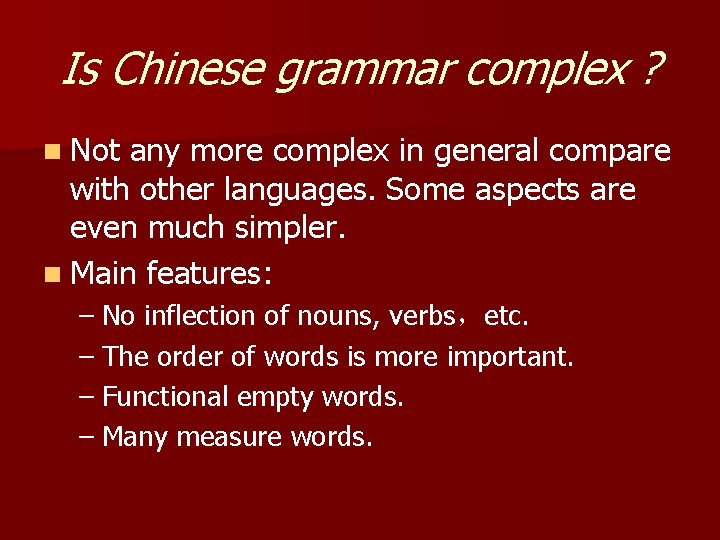
Is Chinese grammar complex ? n Not any more complex in general compare with other languages. Some aspects are even much simpler. n Main features: – No inflection of nouns, verbs,etc. – The order of words is more important. – Functional empty words. – Many measure words.
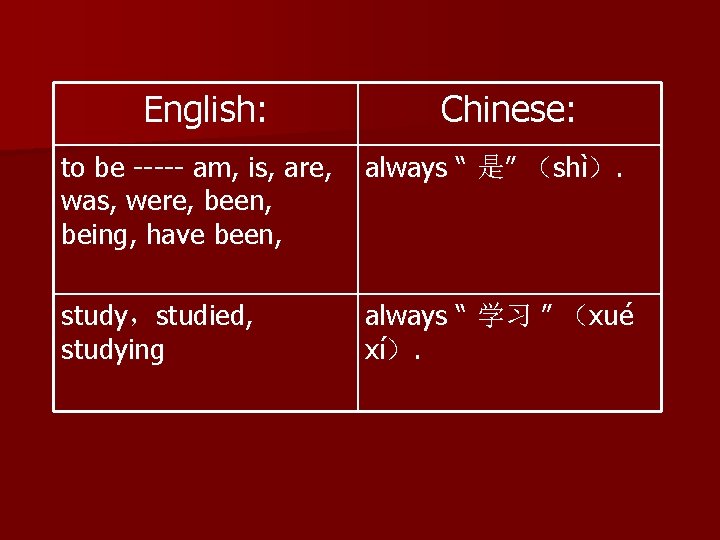
English: Chinese: to be ----- am, is, are, was, were, been, being, have been, always “ 是” (shì). study,studied, studying always “ 学习 ” (xué xí).
I am in auntie's home. n 姑妈在我家。Auntie is in my home. n 我姑妈在家。My auntie is at home. n 我家姑妈在。My auntie is right here. n 我在姑妈家。
Learning Chinese:A rewardable long-term investment n If my kids were of very young ages today, I would be asking them, and encouraging them, to learn Chinese. (Howard Schultz,Chairman, Starbucks - Seattle Times, 12/25/2005) n If you want to get ahead, learn Mandarin…learning Chinese will provide an edge in the 21 st. (Time magazine, June 19, 2006).
Some useful internet resource index web pages: n Ocrat. com http: //www. ocrat. com/ n Leaning Chinese Online http: //www. csulb. edu/~txie/online. htm n MERLOT (Multimedia Educational Resource for Learning and Online Teaching) http: //www. merlot. org
Thank you!
- Slides: 42