
A Brief Introduction to Statistics Luca Lista Universit

A Brief Introduction to Statistics Luca Lista Università Federico II INFN Naples Mario Pelliccioni INFN Torino
Introduction to probability • Probability can be defined in different ways • The applicability of each definition depends on the kind of claim we are considering to applying the concept of probability • One subjective approach expresses the degree of belief/credibility of the claim, which may vary from subject to subject • For repeatable experiments, probability may be a measure of how frequently the claim is true CMS DAS Pisa Luca Lista 2
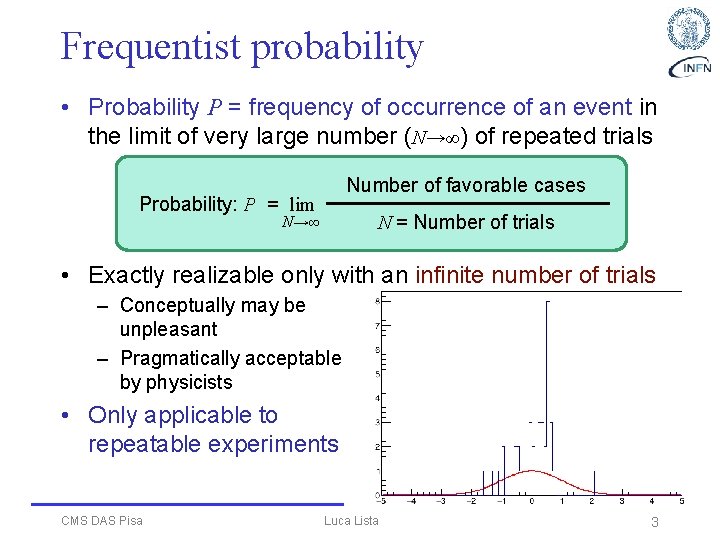
Frequentist probability • Probability P = frequency of occurrence of an event in the limit of very large number (N→∞) of repeated trials Number of favorable cases Probability: P = lim N = Number of trials N→∞ • Exactly realizable only with an infinite number of trials – Conceptually may be unpleasant – Pragmatically acceptable by physicists • Only applicable to repeatable experiments CMS DAS Pisa Luca Lista 3
Subjective (Bayesian) probability • Expresses one’s degree of belief that a claim is true – How strong? Would you bet? – Applicable to all unknown events/claims, not only repeatable experiments – Each individual may have a different opinion/prejudice • Quantitative rules exist about how subjective probability should be modified after learning about some observation/evidence – Consistent with Bayes theorem ( will be introduced in next slides) – Prior probability Posterior probability (following observation) – The more information we receive, the more Bayesian probability is insensitive on prior subjective prejudice (unless in pathological cases…) CMS DAS Pisa Luca Lista 4
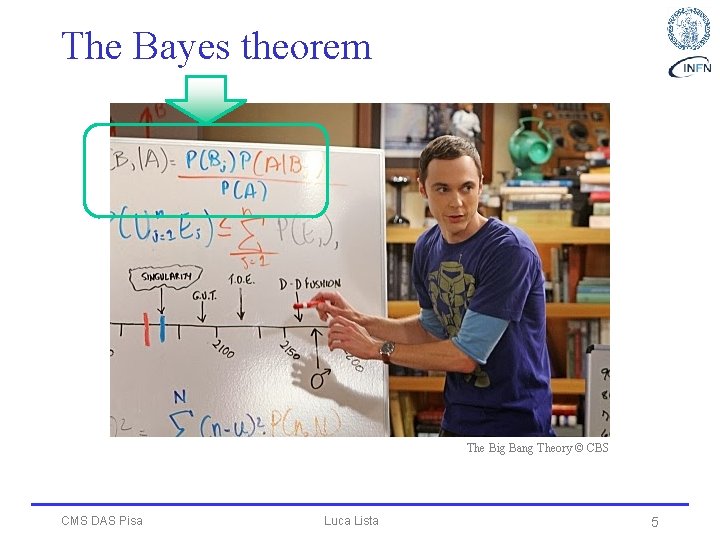
The Bayes theorem The Big Bang Theory © CBS CMS DAS Pisa Luca Lista 5
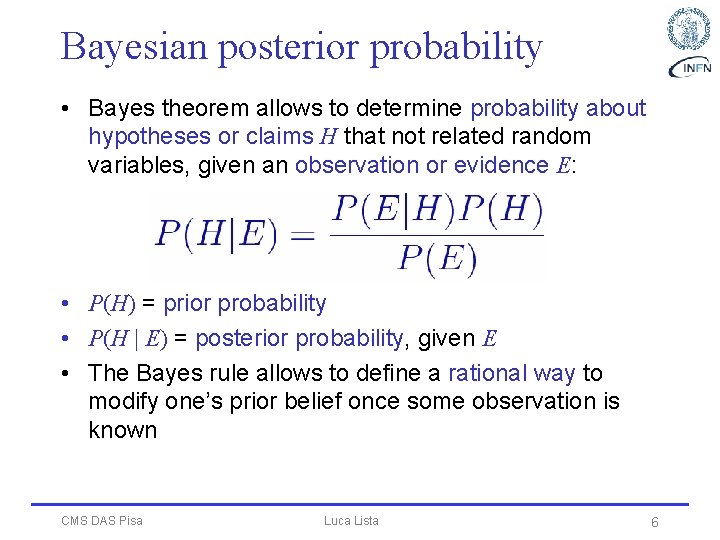
Bayesian posterior probability • Bayes theorem allows to determine probability about hypotheses or claims H that not related random variables, given an observation or evidence E: • P(H) = prior probability • P(H | E) = posterior probability, given E • The Bayes rule allows to define a rational way to modify one’s prior belief once some observation is known CMS DAS Pisa Luca Lista 6
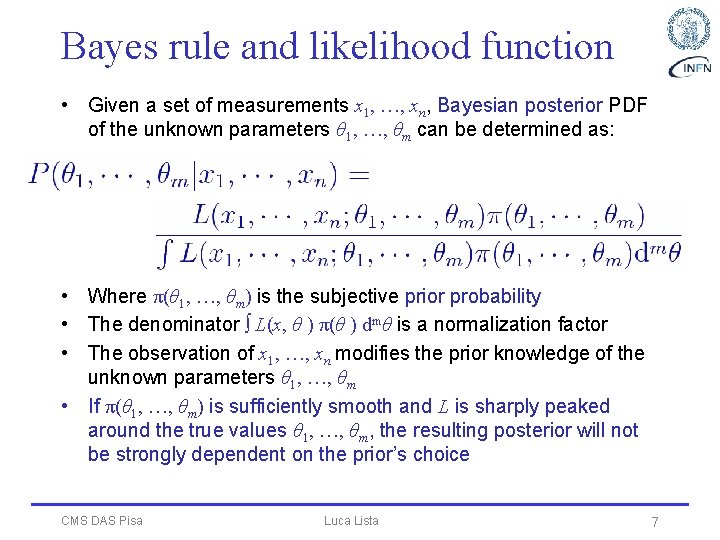
Bayes rule and likelihood function • Given a set of measurements x 1, …, xn, Bayesian posterior PDF of the unknown parameters θ 1, …, θm can be determined as: • Where π(θ 1, …, θm) is the subjective prior probability • The denominator ∫ L(x, θ ) π(θ ) dmθ is a normalization factor • The observation of x 1, …, xn modifies the prior knowledge of the unknown parameters θ 1, …, θm • If π(θ 1, …, θm) is sufficiently smooth and L is sharply peaked around the true values θ 1, …, θm, the resulting posterior will not be strongly dependent on the prior’s choice CMS DAS Pisa Luca Lista 7
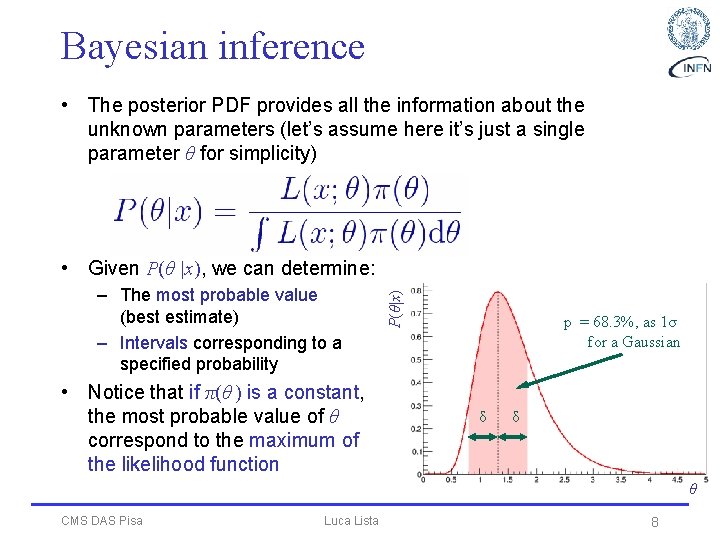
Bayesian inference • The posterior PDF provides all the information about the unknown parameters (let’s assume here it’s just a single parameter θ for simplicity) – The most probable value (best estimate) – Intervals corresponding to a specified probability • Notice that if π(θ ) is a constant, the most probable value of θ correspond to the maximum of the likelihood function P(θ|x) • Given P(θ |x), we can determine: p = 68. 3%, as 1σ for a Gaussian δ δ θ CMS DAS Pisa Luca Lista 8
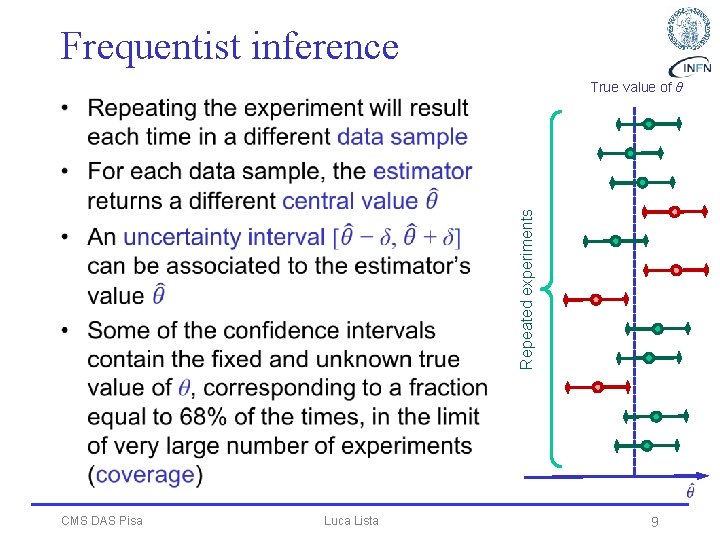
Frequentist inference True value of θ Repeated experiments • CMS DAS Pisa Luca Lista 9
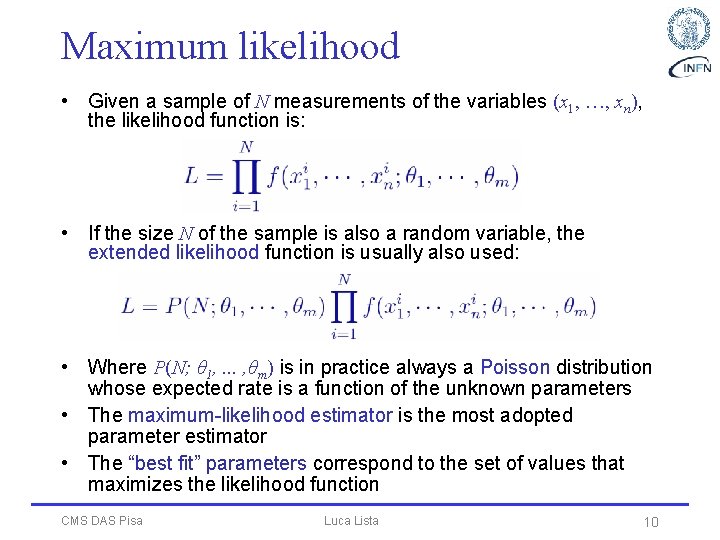
Maximum likelihood • Given a sample of N measurements of the variables (x 1, …, xn), the likelihood function is: • If the size N of the sample is also a random variable, the extended likelihood function is usually also used: • Where P(N; θ 1, . . . , θm) is in practice always a Poisson distribution whose expected rate is a function of the unknown parameters • The maximum-likelihood estimator is the most adopted parameter estimator • The “best fit” parameters correspond to the set of values that maximizes the likelihood function CMS DAS Pisa Luca Lista 10
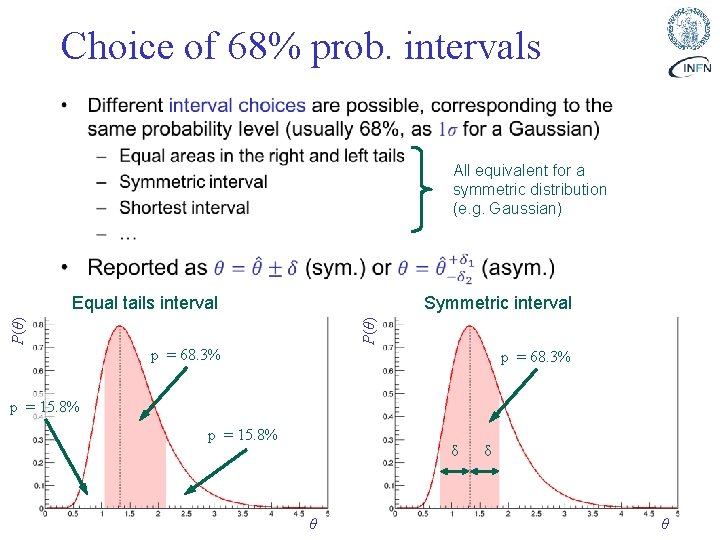
Choice of 68% prob. intervals • All equivalent for a symmetric distribution (e. g. Gaussian) Symmetric interval P(θ) Equal tails interval p = 68. 3% p = 15. 8% CMS DAS Pisa δ θ Luca Lista δ 11 θ
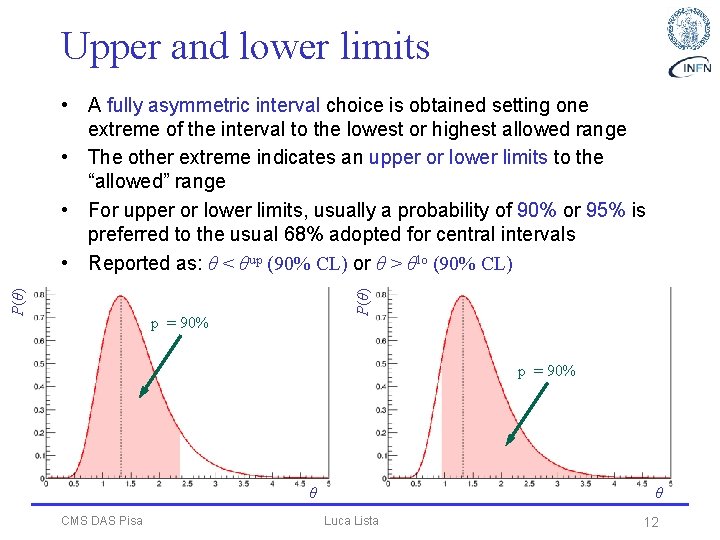
Upper and lower limits P(θ) • A fully asymmetric interval choice is obtained setting one extreme of the interval to the lowest or highest allowed range • The other extreme indicates an upper or lower limits to the “allowed” range • For upper or lower limits, usually a probability of 90% or 95% is preferred to the usual 68% adopted for central intervals • Reported as: θ < θup (90% CL) or θ > θlo (90% CL) p = 90% θ CMS DAS Pisa θ Luca Lista 12
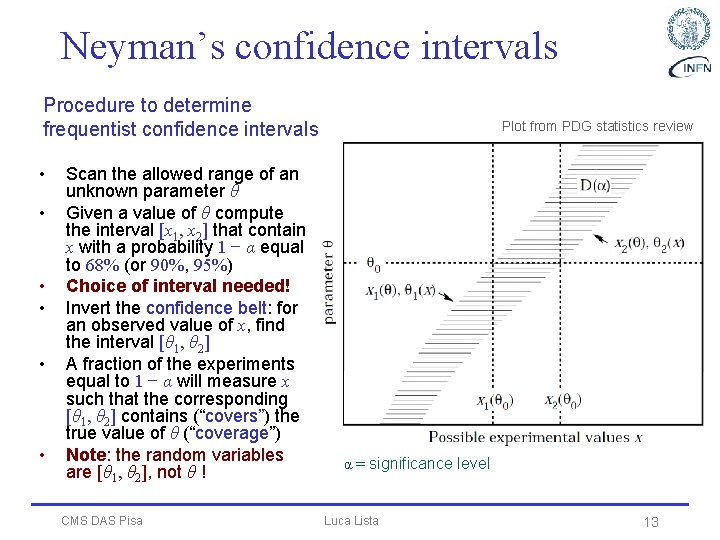
Neyman’s confidence intervals Procedure to determine frequentist confidence intervals • • • Scan the allowed range of an unknown parameter θ Given a value of θ compute the interval [x 1, x 2] that contain x with a probability 1 − α equal to 68% (or 90%, 95%) Choice of interval needed! Invert the confidence belt: for an observed value of x, find the interval [θ 1, θ 2] A fraction of the experiments equal to 1 − α will measure x such that the corresponding [θ 1, θ 2] contains (“covers”) the true value of θ (“coverage”) Note: the random variables are [θ 1, θ 2], not θ ! CMS DAS Pisa Plot from PDG statistics review α = significance level Luca Lista 13
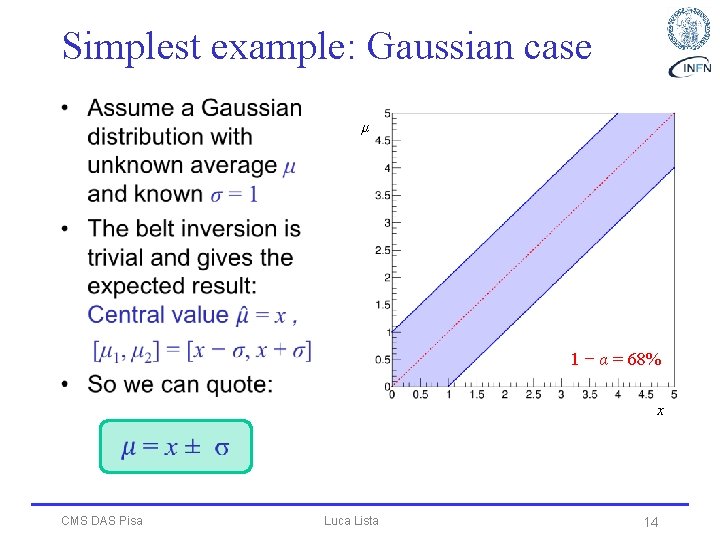
Simplest example: Gaussian case • μ 1 − α = 68% x CMS DAS Pisa Luca Lista 14
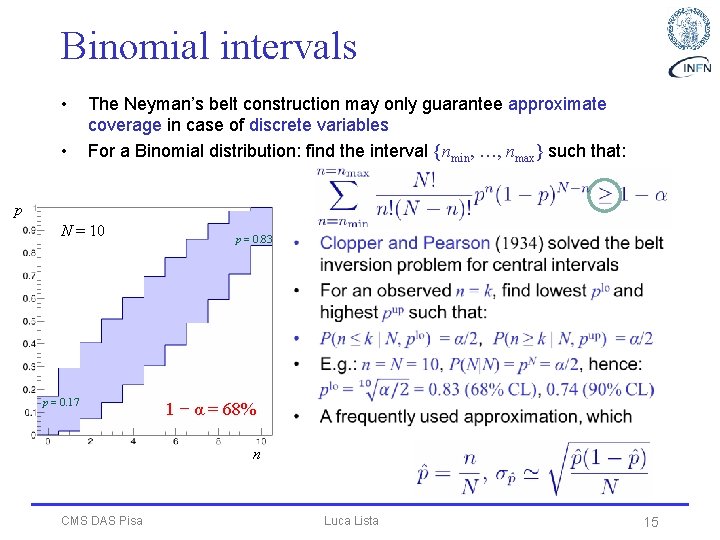
Binomial intervals • • The Neyman’s belt construction may only guarantee approximate coverage in case of discrete variables For a Binomial distribution: find the interval {nmin, …, nmax} such that: p N = 10 p = 0. 17 p = 0. 83 1 − α = 68% n CMS DAS Pisa Luca Lista 15
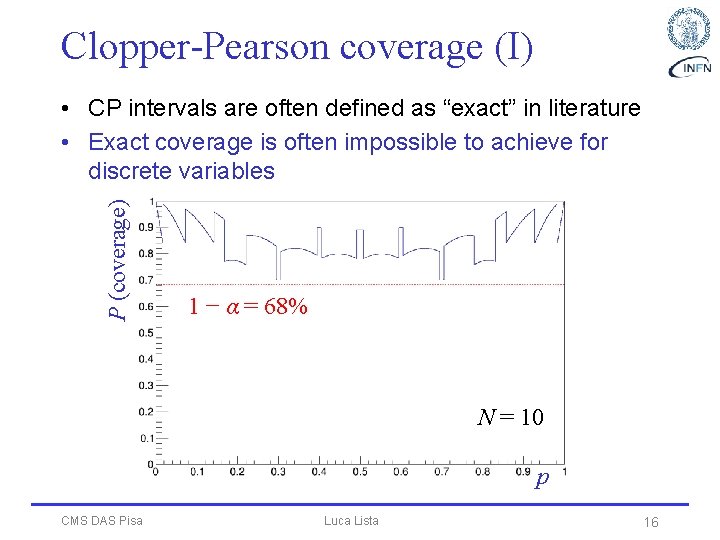
Clopper-Pearson coverage (I) P (coverage) • CP intervals are often defined as “exact” in literature • Exact coverage is often impossible to achieve for discrete variables 1 − α = 68% N = 10 p CMS DAS Pisa Luca Lista 16
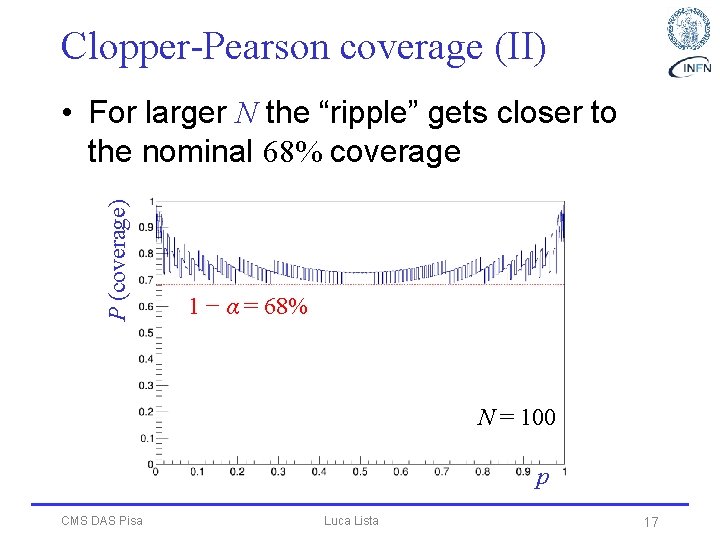
Clopper-Pearson coverage (II) P (coverage) • For larger N the “ripple” gets closer to the nominal 68% coverage 1 − α = 68% N = 100 p CMS DAS Pisa Luca Lista 17
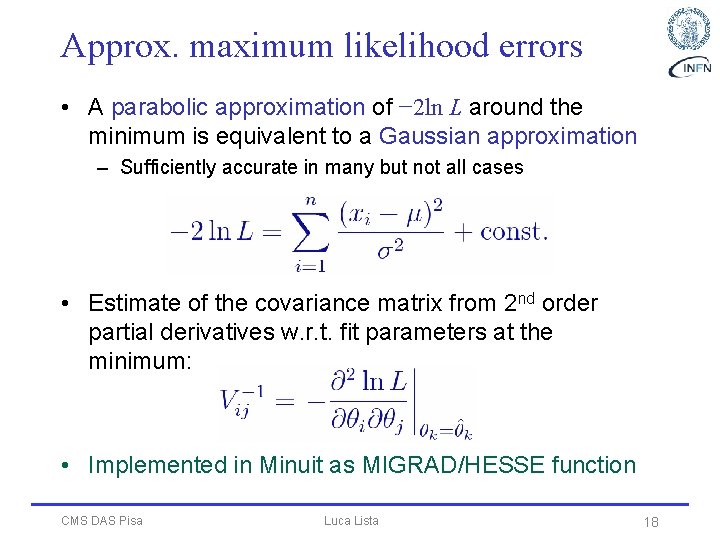
Approx. maximum likelihood errors • A parabolic approximation of − 2 ln L around the minimum is equivalent to a Gaussian approximation – Sufficiently accurate in many but not all cases • Estimate of the covariance matrix from 2 nd order partial derivatives w. r. t. fit parameters at the minimum: • Implemented in Minuit as MIGRAD/HESSE function CMS DAS Pisa Luca Lista 18
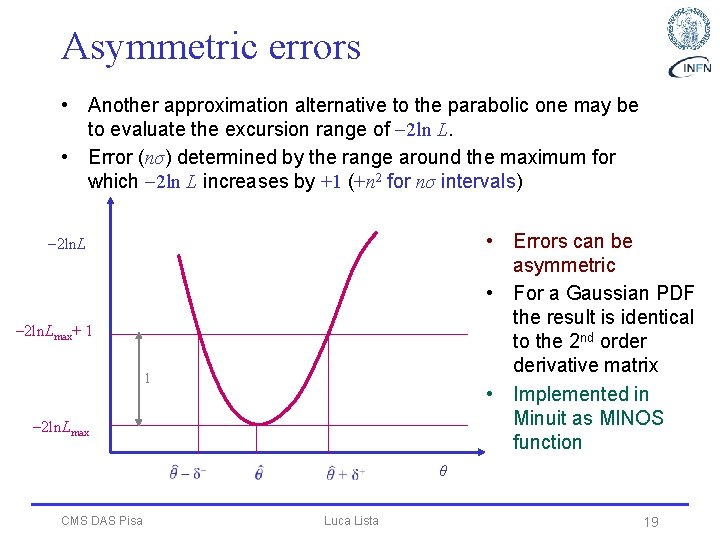
Asymmetric errors • Another approximation alternative to the parabolic one may be to evaluate the excursion range of -2 ln L. • Error (nσ) determined by the range around the maximum for which -2 ln L increases by +1 (+n 2 for nσ intervals) • Errors can be asymmetric • For a Gaussian PDF the result is identical to the 2 nd order derivative matrix • Implemented in Minuit as MINOS function -2 ln. Lmax+ 1 1 -2 ln. Lmax θ CMS DAS Pisa Luca Lista 19
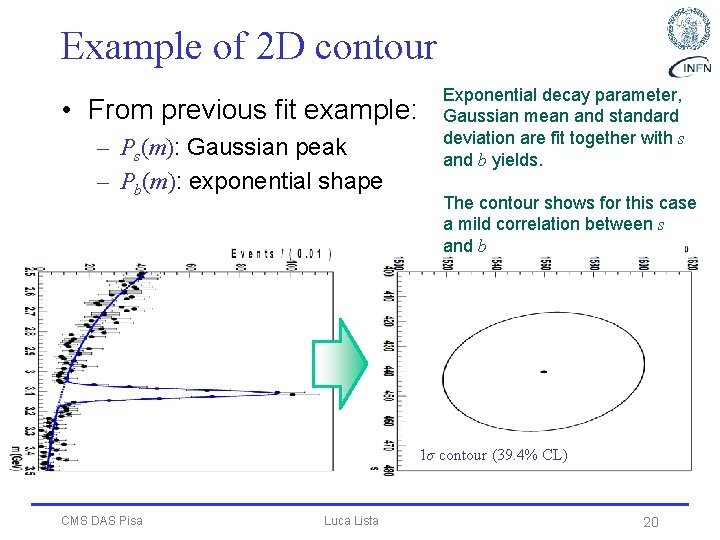
Example of 2 D contour • From previous fit example: – Ps(m): Gaussian peak – Pb(m): exponential shape Exponential decay parameter, Gaussian mean and standard deviation are fit together with s and b yields. The contour shows for this case a mild correlation between s and b 1σ contour (39. 4% CL) CMS DAS Pisa Luca Lista 20
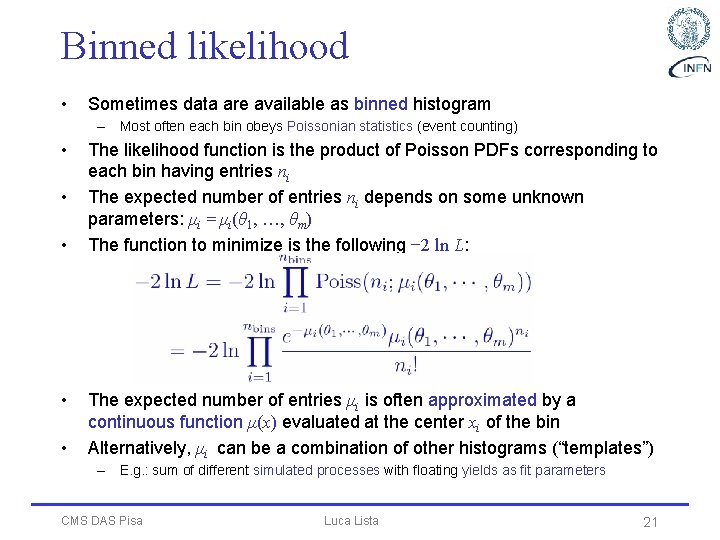
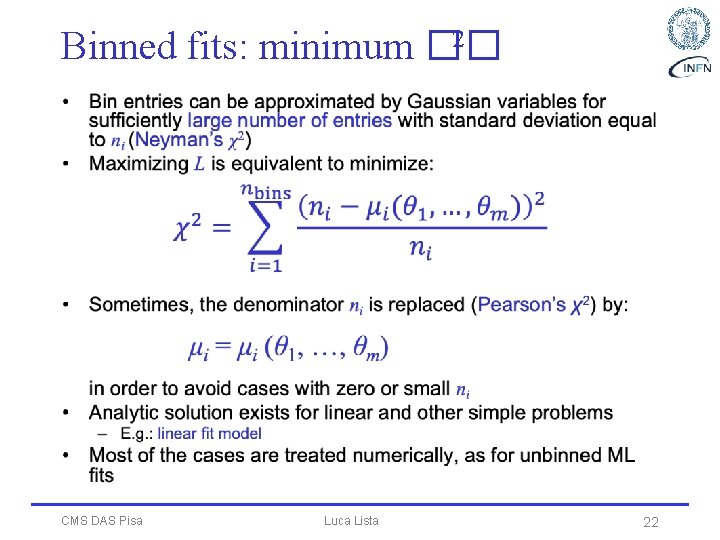
Binned likelihood • Sometimes data are available as binned histogram – Most often each bin obeys Poissonian statistics (event counting) • • • The likelihood function is the product of Poisson PDFs corresponding to each bin having entries ni The expected number of entries ni depends on some unknown parameters: μi = μi(θ 1, …, θm) The function to minimize is the following − 2 ln L: The expected number of entries μi is often approximated by a continuous function μ(x) evaluated at the center xi of the bin Alternatively, μi can be a combination of other histograms (“templates”) – E. g. : sum of different simulated processes with floating yields as fit parameters CMS DAS Pisa Luca Lista 21
2 Binned fits: minimum �� • CMS DAS Pisa Luca Lista 22
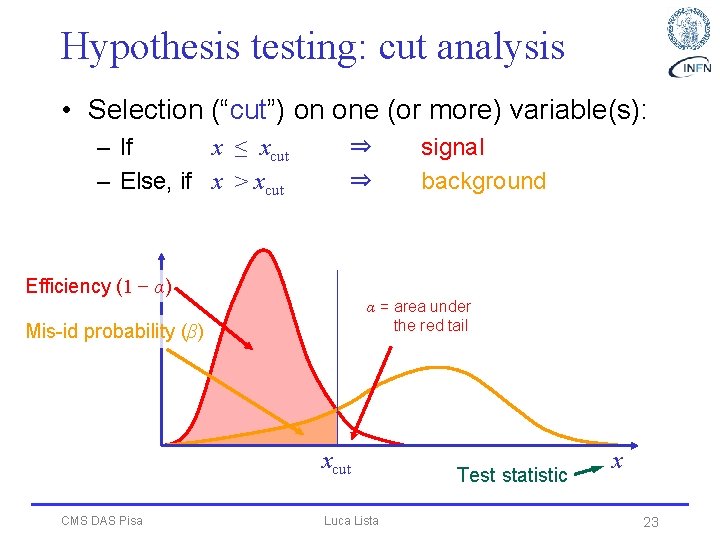
Hypothesis testing: cut analysis • Selection (“cut”) on one (or more) variable(s): – If x ≤ xcut – Else, if x > xcut ⇒ ⇒ signal background Efficiency (1 − α) α = area under the red tail Mis-id probability (β) xcut CMS DAS Pisa Luca Lista Test statistic x 23
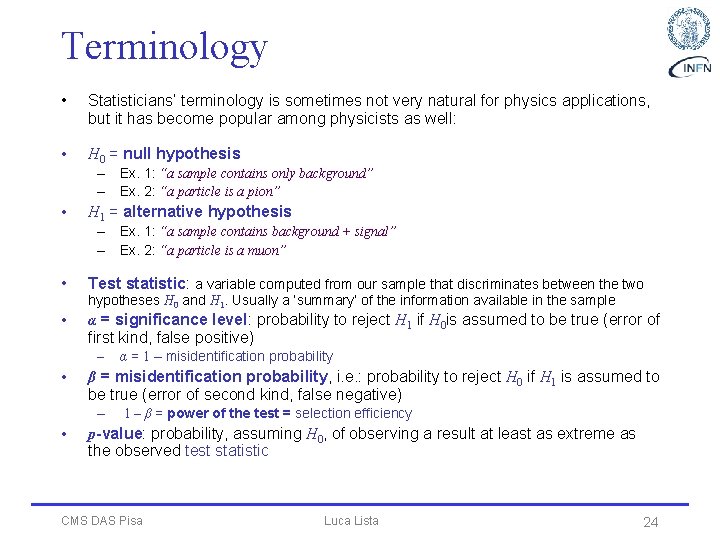
Terminology • Statisticians’ terminology is sometimes not very natural for physics applications, but it has become popular among physicists as well: • H 0 = null hypothesis – Ex. 1: “a sample contains only background” – Ex. 2: “a particle is a pion” • H 1 = alternative hypothesis – Ex. 1: “a sample contains background + signal” – Ex. 2: “a particle is a muon” • Test statistic: a variable computed from our sample that discriminates between the two • α = significance level: probability to reject H 1 if H 0 is assumed to be true (error of first kind, false positive) hypotheses H 0 and H 1. Usually a ‘summary’ of the information available in the sample – • β = misidentification probability, i. e. : probability to reject H 0 if H 1 is assumed to be true (error of second kind, false negative) – • α = 1 – misidentification probability 1 – β = power of the test = selection efficiency p-value: probability, assuming H 0, of observing a result at least as extreme as the observed test statistic CMS DAS Pisa Luca Lista 24
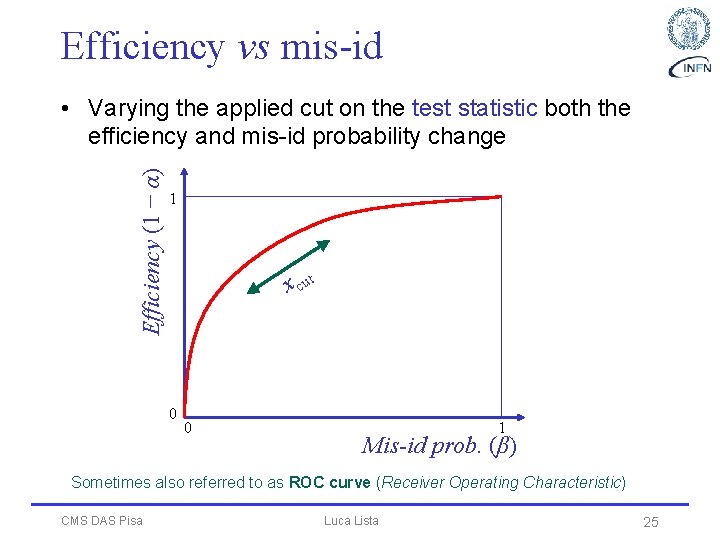
Efficiency vs mis-id Efficiency (1 − α) • Varying the applied cut on the test statistic both the efficiency and mis-id probability change 1 x cut 0 0 1 Mis-id prob. (β) Sometimes also referred to as ROC curve (Receiver Operating Characteristic) CMS DAS Pisa Luca Lista 25
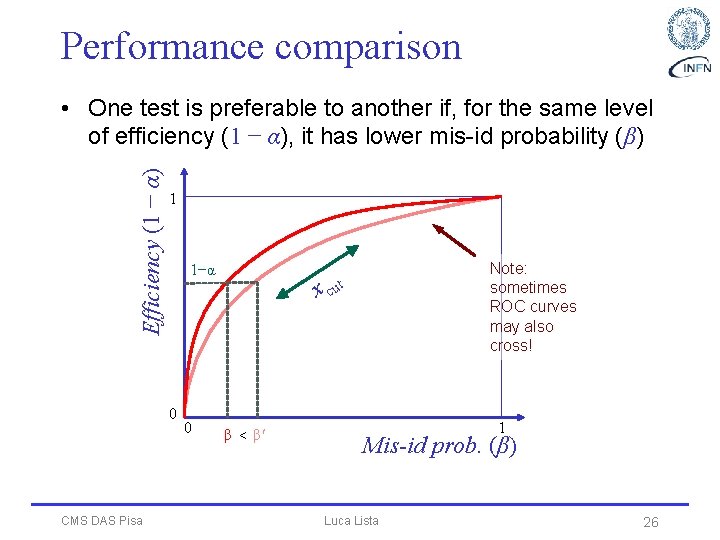
Performance comparison Efficiency (1 − α) • One test is preferable to another if, for the same level of efficiency (1 − α), it has lower mis-id probability (β) 1 1−α 0 CMS DAS Pisa 0 Note: sometimes ROC curves may also cross! x cut β < βʹ 1 Mis-id prob. (β) Luca Lista 26
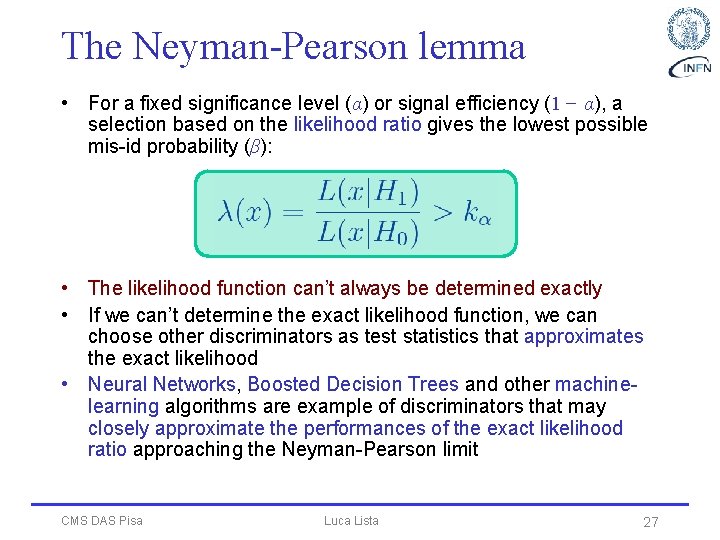
The Neyman-Pearson lemma • For a fixed significance level (α) or signal efficiency (1 − α), a selection based on the likelihood ratio gives the lowest possible mis-id probability (β): • The likelihood function can’t always be determined exactly • If we can’t determine the exact likelihood function, we can choose other discriminators as test statistics that approximates the exact likelihood • Neural Networks, Boosted Decision Trees and other machinelearning algorithms are example of discriminators that may closely approximate the performances of the exact likelihood ratio approaching the Neyman-Pearson limit CMS DAS Pisa Luca Lista 27
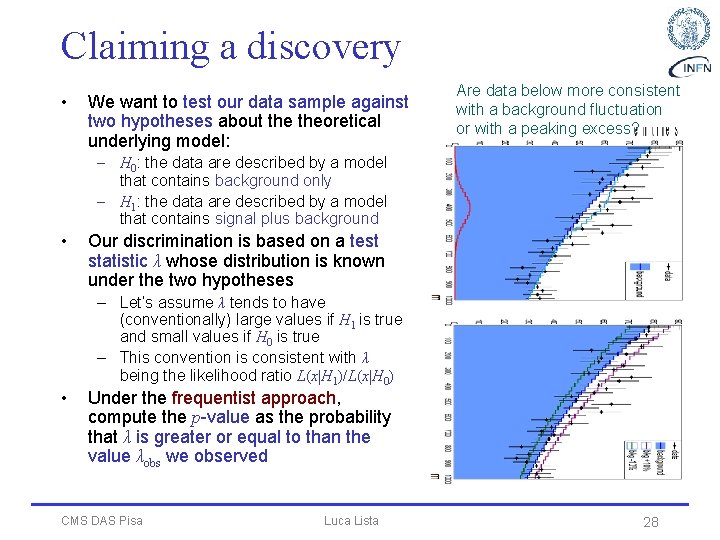
Claiming a discovery • We want to test our data sample against two hypotheses about theoretical underlying model: Are data below more consistent with a background fluctuation or with a peaking excess? – H 0: the data are described by a model that contains background only – H 1: the data are described by a model that contains signal plus background • Our discrimination is based on a test statistic λ whose distribution is known under the two hypotheses – Let’s assume λ tends to have (conventionally) large values if H 1 is true and small values if H 0 is true – This convention is consistent with λ being the likelihood ratio L(x|H 1)/L(x|H 0) • Under the frequentist approach, compute the p-value as the probability that λ is greater or equal to than the value λobs we observed CMS DAS Pisa Luca Lista 28
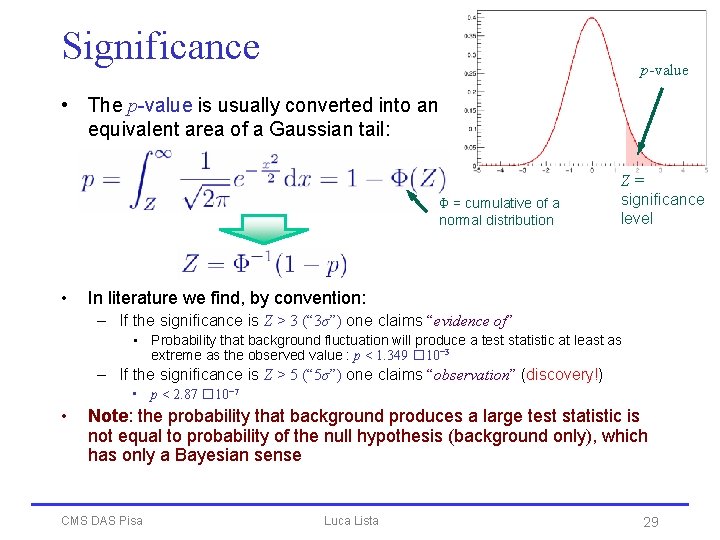
Significance p-value • The p-value is usually converted into an equivalent area of a Gaussian tail: Φ = cumulative of a normal distribution • Z= significance level In literature we find, by convention: – If the significance is Z > 3 (“ 3σ”) one claims “evidence of” • Probability that background fluctuation will produce a test statistic at least as extreme as the observed value : p < 1. 349 � 10− 3 – If the significance is Z > 5 (“ 5σ”) one claims “observation” (discovery!) • p < 2. 87 � 10− 7 • Note: the probability that background produces a large test statistic is not equal to probability of the null hypothesis (background only), which has only a Bayesian sense CMS DAS Pisa Luca Lista 29
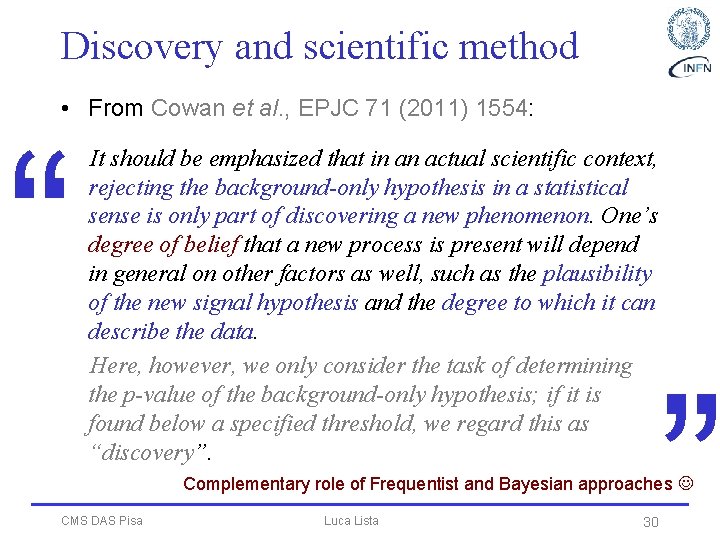
Discovery and scientific method • From Cowan et al. , EPJC 71 (2011) 1554: “ It should be emphasized that in an actual scientific context, rejecting the background-only hypothesis in a statistical sense is only part of discovering a new phenomenon. One’s degree of belief that a new process is present will depend in general on other factors as well, such as the plausibility of the new signal hypothesis and the degree to which it can describe the data. Here, however, we only consider the task of determining the p-value of the background-only hypothesis; if it is found below a specified threshold, we regard this as “discovery”. ” Complementary role of Frequentist and Bayesian approaches CMS DAS Pisa Luca Lista 30
![Upper limits s ∈ [s 1, s 2] ⇒ s ∈ [0, sup] xmin](http://slidetodoc.com/presentation_image_h2/7c1d2a0d8b5679dba10fabde675de729/image-31.jpg "Upper limits s ∈ [s 1, s 2] ⇒ s ∈ [0, sup] xmin")
Upper limits s ∈ [s 1, s 2] ⇒ s ∈ [0, sup] xmin ≤ x ≤ ∞ 0 ≤ sup • Building a fully asymmetric Neyman confidence belt based on the considered test statistic x • Invert the belt, find the allowed interval: , θ=s • Measure the amount of excluded region resulting from our (negative) search for a new signal • Upper limit = upper extreme of the asymmetric interval [0, sup] • In case the observable x is discrete (e. g. : the number of events n in a counting experiments), the coverage may not be exact CMS DAS Pisa Luca Lista 31
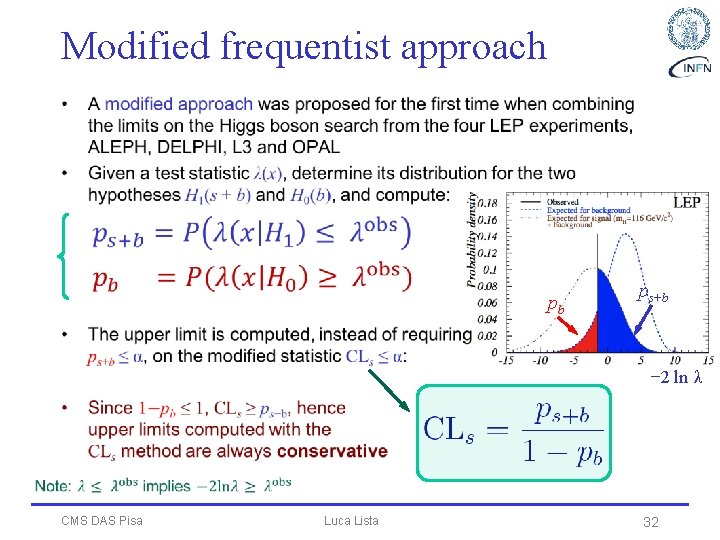
Modified frequentist approach • pb ps+b − 2 ln λ CMS DAS Pisa Luca Lista 32
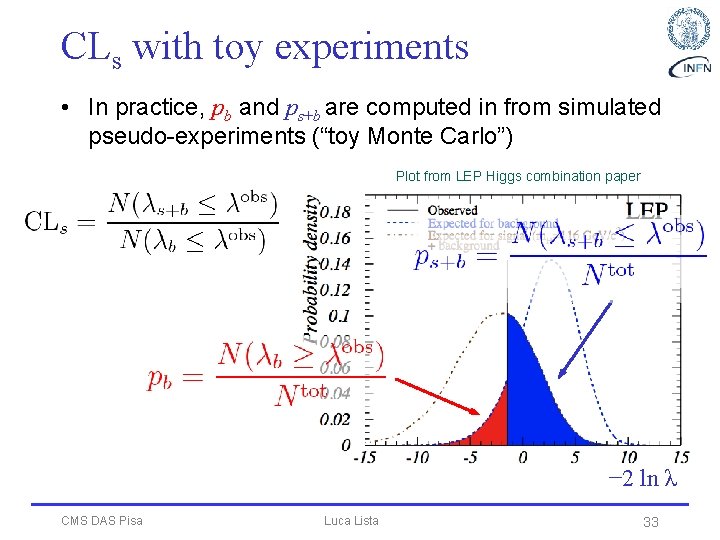
CLs with toy experiments • In practice, pb and ps+b are computed in from simulated pseudo-experiments (“toy Monte Carlo”) Plot from LEP Higgs combination paper − 2 ln λ CMS DAS Pisa Luca Lista 33
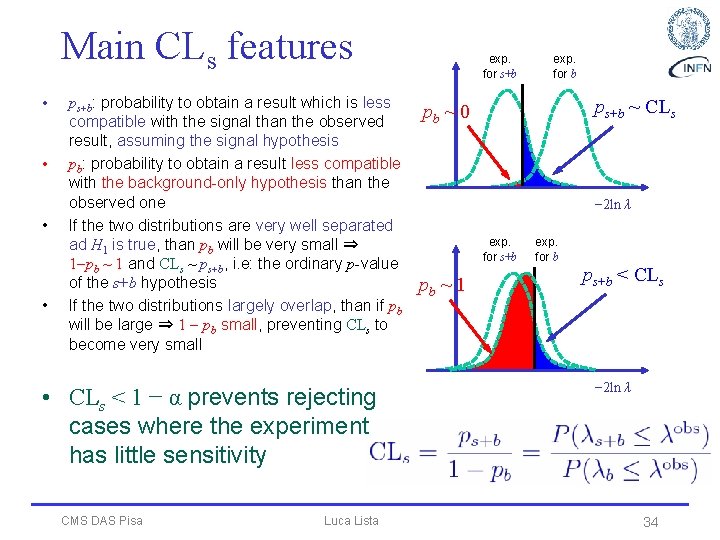
Main CLs features • • ps+b: probability to obtain a result which is less compatible with the signal than the observed result, assuming the signal hypothesis pb: probability to obtain a result less compatible with the background-only hypothesis than the observed one If the two distributions are very well separated ad H 1 is true, than pb will be very small ⇒ 1 -pb ~ 1 and CLs ~ ps+b, i. e: the ordinary p-value of the s+b hypothesis If the two distributions largely overlap, than if pb will be large ⇒ 1 - pb small, preventing CLs to become very small • CLs < 1 − α prevents rejecting cases where the experiment has little sensitivity CMS DAS Pisa Luca Lista exp. for s+b exp. for b ps+b ~ CLs pb ~ 0 − 2 ln λ exp. for s+b pb ~ 1 exp. for b ps+b < CLs − 2 ln λ 34
Observations on the CLs method • “A specific modification of a purely classical statistical analysis is used to avoid excluding or discovering signals which the search is in fact not sensitive to” • “The use of CLs is a conscious decision not to insist on the frequentist concept of full coverage (to guarantee that the confidence interval doesn’t include the true value of the parameter in a fixed fraction of experiments). ” • “confidence intervals obtained in this manner do not have the same interpretation as traditional frequentist confidence intervals nor as Bayesian credible intervals” A. L. Read, Modified frequentist analysis of search results (the CLls method), 1 st Workshop on Confidence Limits, CERN, 2000 CMS DAS Pisa Luca Lista 35
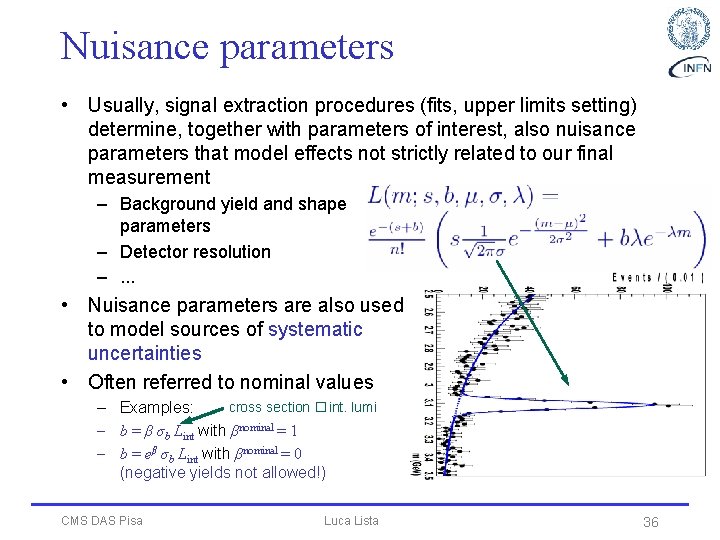
Nuisance parameters • Usually, signal extraction procedures (fits, upper limits setting) determine, together with parameters of interest, also nuisance parameters that model effects not strictly related to our final measurement – Background yield and shape parameters – Detector resolution –. . . • Nuisance parameters are also used to model sources of systematic uncertainties • Often referred to nominal values cross section �int. lumi – Examples: – b = β σb Lint with βnominal = 1 – b = eβ σb Lint with βnominal = 0 (negative yields not allowed!) CMS DAS Pisa Luca Lista 36
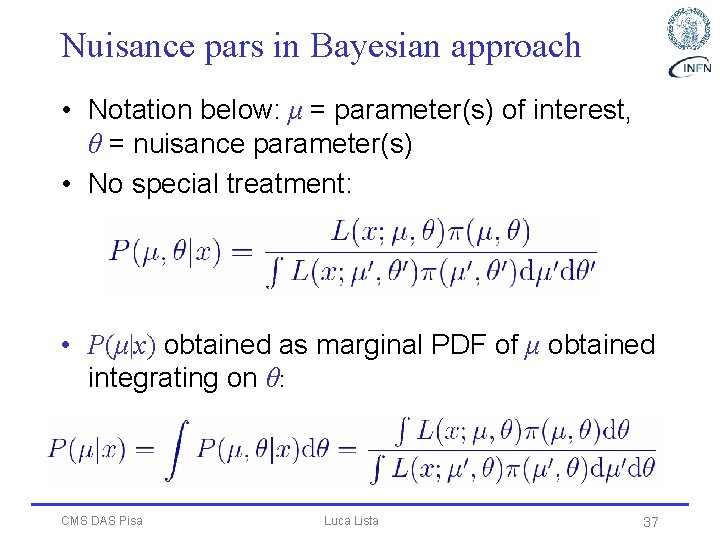
Nuisance pars in Bayesian approach • Notation below: μ = parameter(s) of interest, θ = nuisance parameter(s) • No special treatment: • P(μ|x) obtained as marginal PDF of μ obtained integrating on θ: CMS DAS Pisa Luca Lista 37
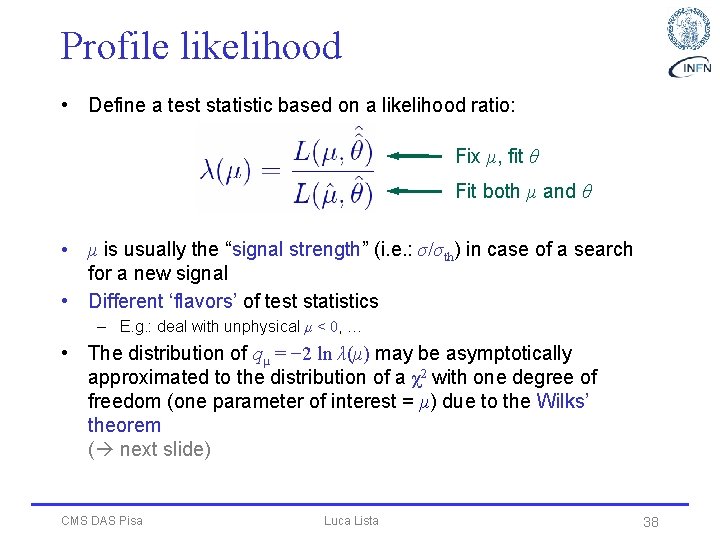
Profile likelihood • Define a test statistic based on a likelihood ratio: Fix μ, fit θ Fit both μ and θ • μ is usually the “signal strength” (i. e. : σ/σth) in case of a search for a new signal • Different ‘flavors’ of test statistics – E. g. : deal with unphysical μ < 0, … • The distribution of qμ = − 2 ln λ(μ) may be asymptotically approximated to the distribution of a χ2 with one degree of freedom (one parameter of interest = μ) due to the Wilks’ theorem ( next slide) CMS DAS Pisa Luca Lista 38
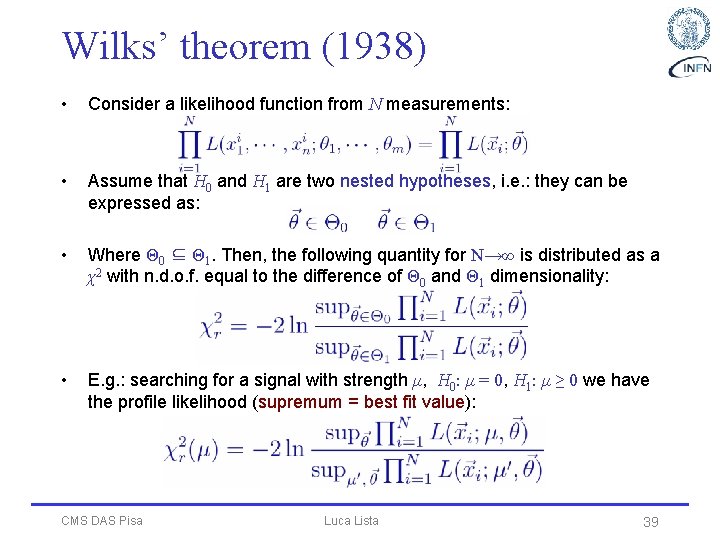
Wilks’ theorem (1938) • Consider a likelihood function from N measurements: • Assume that H 0 and H 1 are two nested hypotheses, i. e. : they can be expressed as: • Where Θ 0 ⊆ Θ 1. Then, the following quantity for N→∞ is distributed as a χ2 with n. d. o. f. equal to the difference of Θ 0 and Θ 1 dimensionality: • E. g. : searching for a signal with strength μ, H 0: μ = 0, H 1: μ ≥ 0 we have the profile likelihood (supremum = best fit value): CMS DAS Pisa Luca Lista 39
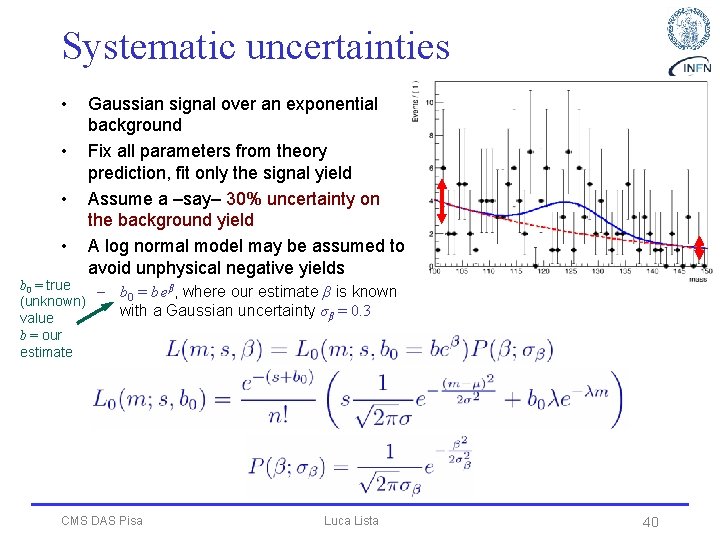
Systematic uncertainties • • Gaussian signal over an exponential background Fix all parameters from theory prediction, fit only the signal yield Assume a –say– 30% uncertainty on the background yield A log normal model may be assumed to avoid unphysical negative yields b 0 = true – (unknown) value b = our estimate b 0 = b eβ, where our estimate β is known with a Gaussian uncertainty σβ = 0. 3 CMS DAS Pisa Luca Lista 40
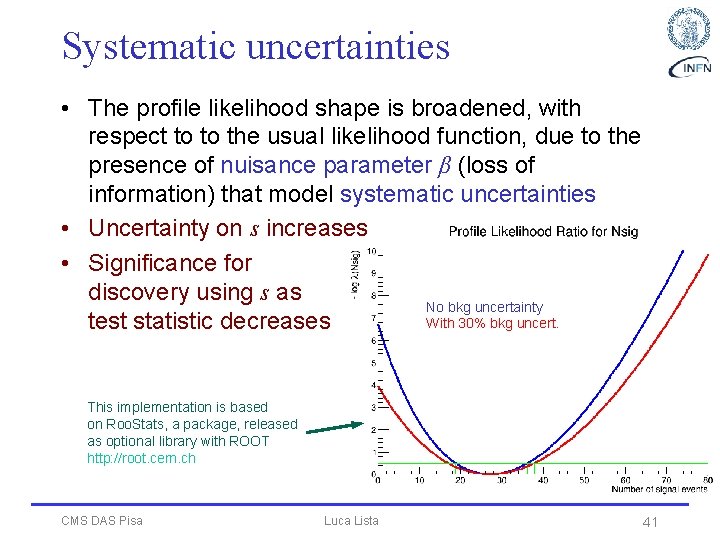
Systematic uncertainties • The profile likelihood shape is broadened, with respect to to the usual likelihood function, due to the presence of nuisance parameter β (loss of information) that model systematic uncertainties • Uncertainty on s increases • Significance for discovery using s as No bkg uncertainty With 30% bkg uncert. test statistic decreases This implementation is based on Roo. Stats, a package, released as optional library with ROOT http: //root. cern. ch CMS DAS Pisa Luca Lista 41
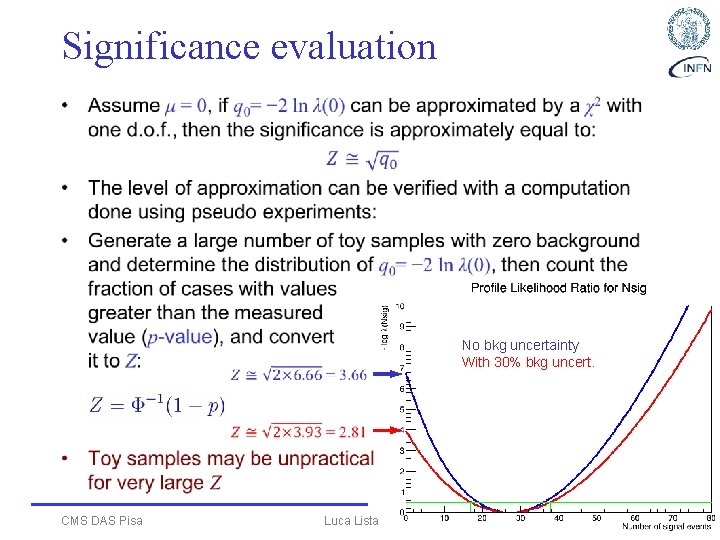
Significance evaluation • No bkg uncertainty With 30% bkg uncert. CMS DAS Pisa Luca Lista 42
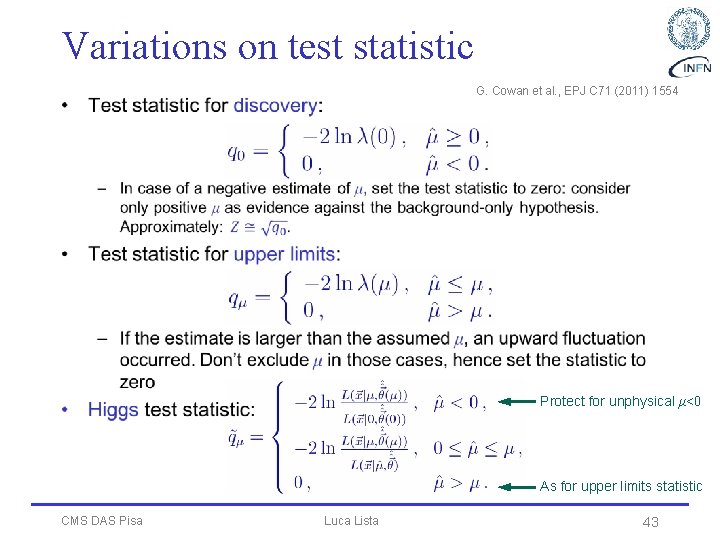
Variations on test statistic G. Cowan et al. , EPJ C 71 (2011) 1554 • Protect for unphysical μ<0 As for upper limits statistic CMS DAS Pisa Luca Lista 43
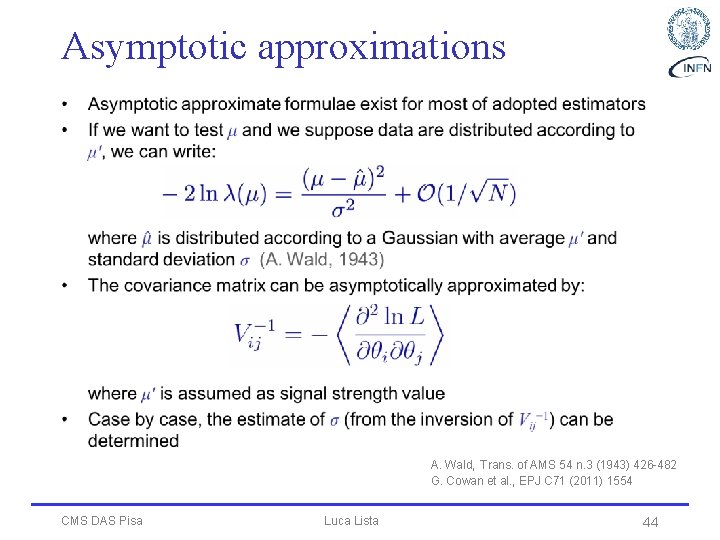
Asymptotic approximations • A. Wald, Trans. of AMS 54 n. 3 (1943) 426 -482 G. Cowan et al. , EPJ C 71 (2011) 1554 CMS DAS Pisa Luca Lista 44
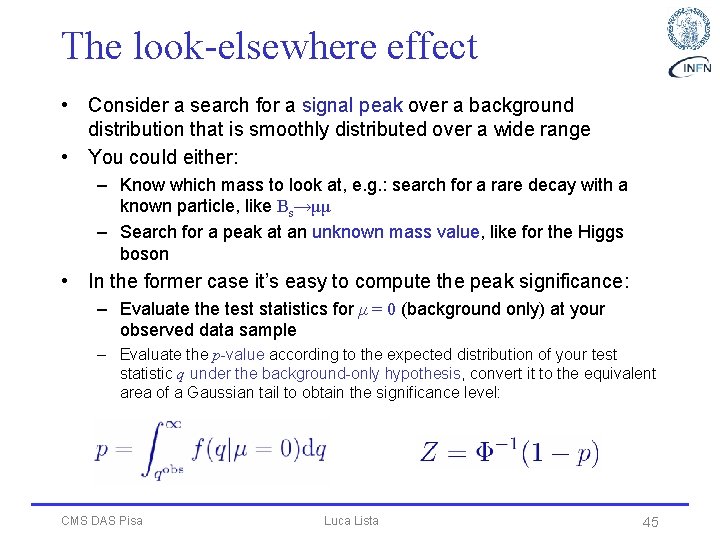
The look-elsewhere effect • Consider a search for a signal peak over a background distribution that is smoothly distributed over a wide range • You could either: – Know which mass to look at, e. g. : search for a rare decay with a known particle, like Bs→μμ – Search for a peak at an unknown mass value, like for the Higgs boson • In the former case it’s easy to compute the peak significance: – Evaluate the test statistics for μ = 0 (background only) at your observed data sample – Evaluate the p-value according to the expected distribution of your test statistic q under the background-only hypothesis, convert it to the equivalent area of a Gaussian tail to obtain the significance level: CMS DAS Pisa Luca Lista 45
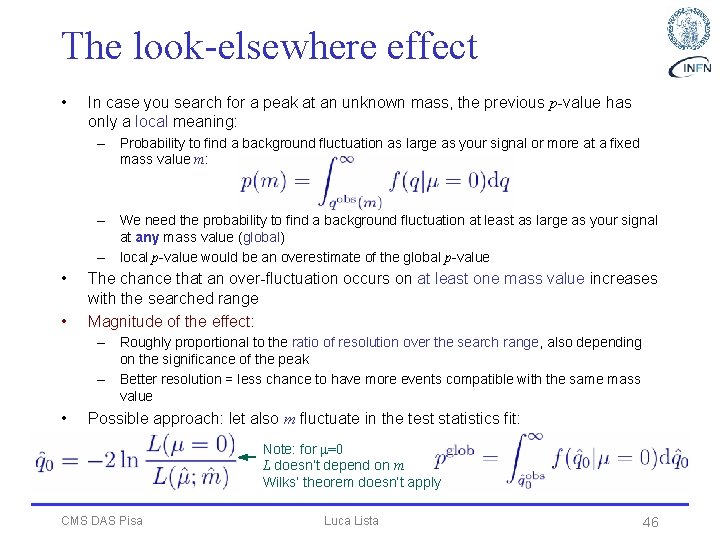
The look-elsewhere effect • In case you search for a peak at an unknown mass, the previous p-value has only a local meaning: – Probability to find a background fluctuation as large as your signal or more at a fixed mass value m: – We need the probability to find a background fluctuation at least as large as your signal at any mass value (global) – local p-value would be an overestimate of the global p-value • • The chance that an over-fluctuation occurs on at least one mass value increases with the searched range Magnitude of the effect: – Roughly proportional to the ratio of resolution over the search range, also depending on the significance of the peak – Better resolution = less chance to have more events compatible with the same mass value • Possible approach: let also m fluctuate in the test statistics fit: Note: for μ=0 L doesn’t depend on m Wilks’ theorem doesn’t apply CMS DAS Pisa Luca Lista 46

The End. CMS DAS Pisa Luca Lista 47
- Slides: 47