
A BRIEF INTRODUCTION TO SOCIAL SCIENCE A course
A BRIEF INTRODUCTION TO SOCIAL SCIENCE: A course for physical scientists John F. Weaver, CIRA/CSU Lindsey K. Fast, Western State Colorado University Dan Bikos, Olivia Vila, CIRA/CSU Dan Lindsey, NOAA/NESDIS@CIRA
OVERVIE W • Defining social science – What is it!? -- How social scientists study people and populations • Comparing physical and social science -- Different focus variables -- Different data collection methods -- Different analysis techniques -- Different sources of error
Defining Social Science A branch of science that deals with: 1) understanding individual and societal behaviors 2) interpersonal relationships of individuals as members of society • Communication (conveying information) • Psychology (both individual and group behavior) • Anthropology (for us cultural differences) • Sociology (institutional characteristics) • Economics (infrastructure cost-to-benefit)
Communications- a biggie • Does your target audience hear you? Target audiences might include individuals, the general public, public officials, emergency responders, the media • Do they understand you? • Do you understand them? • Do they care?
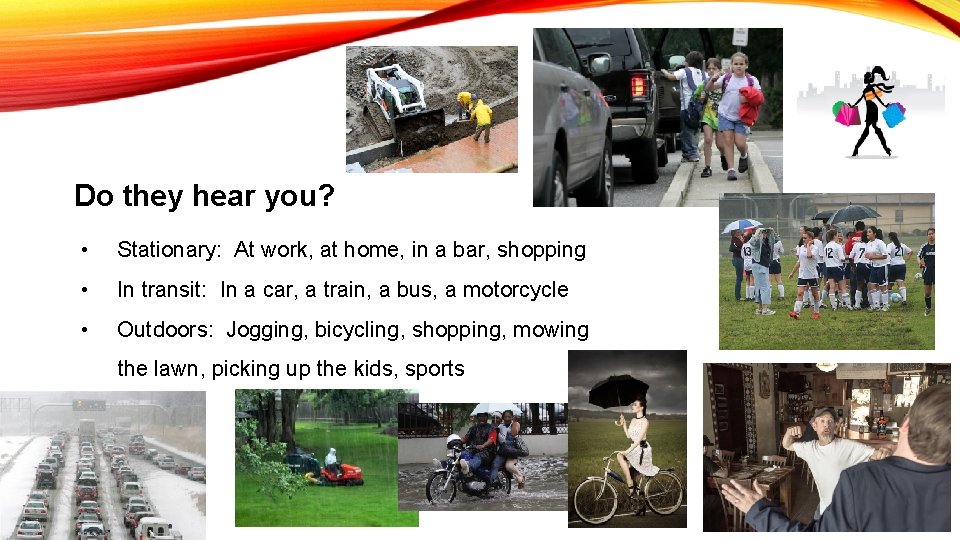
Do they hear you? • Stationary: At work, at home, in a bar, shopping • In transit: In a car, a train, a bus, a motorcycle • Outdoors: Jogging, bicycling, shopping, mowing the lawn, picking up the kids, sports
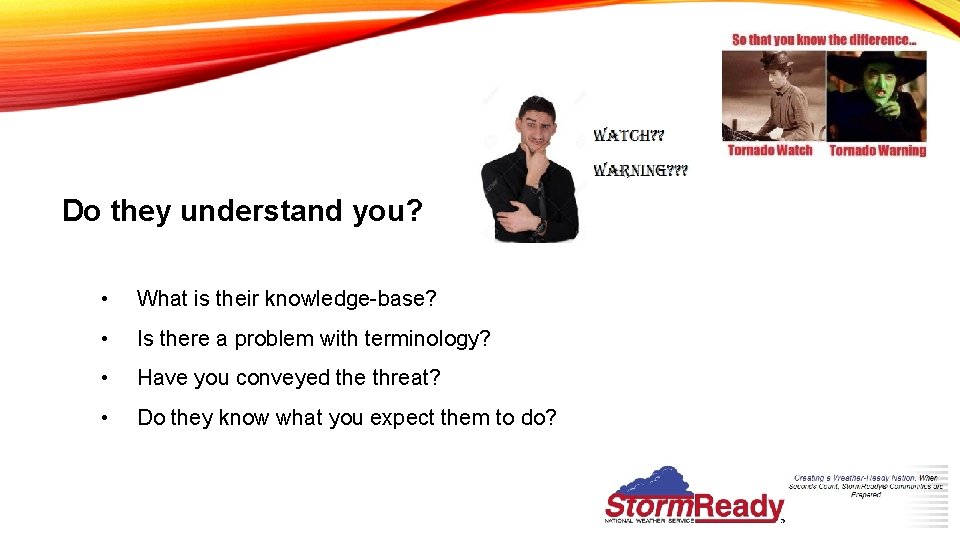
Do they understand you? • What is their knowledge-base? • Is there a problem with terminology? • Have you conveyed the threat? • Do they know what you expect them to do?
It’s a Two-way Street Do you understand them? • How do people think about your topic? • Do you have preconceived ideas about their motivations? • Also, we must never assume that because we have seen people react in the past, we understand their motivation and know how they will react in the future
Apathy, priorities & social factors Do They Care? • Previous experience plays a role “It’s always hot in Phoenix” … “It always snows in Colorado” … “Lightning has never scared me. ” • Life priorities play a role “I’ve need to pick up the kids” … “I’ve got to get to my meeting” • Social factors play a role Groupthink, bandwagon effect, illusion of control, over-confidence, prefer the status quo
COMPARING TWO SCIENCES A look at the similarities and differences between atmospheric and social science
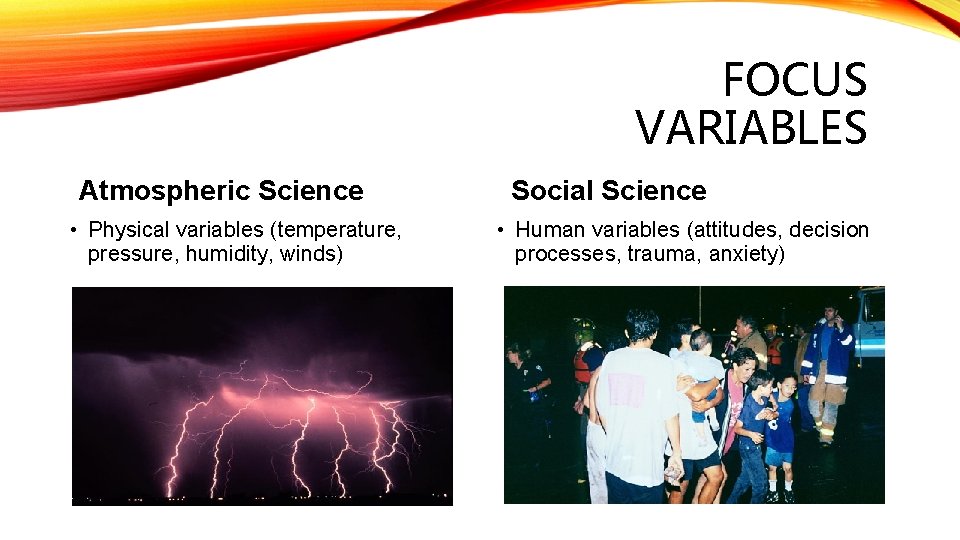
FOCUS VARIABLES Atmospheric Science • Physical variables (temperature, pressure, humidity, winds) Social Science • Human variables (attitudes, decision processes, trauma, anxiety)
Focus Variables - Social Science • Individual behaviors and traits Agreeability, resilience, intelligence, decisiveness, personality • There are many pre-established tests available for individual traits • • Individual within groups How people act within various groups • Family, friends, co-workers, social groups, etc. • Cultural differences, socio-economic status, age, gender, etc. • • Group dynamics - institutional • Groups include organizations such as police officers, firefighters, schools teachers/officials), and even National Weather Service forecasters. • Differing missions, expectations, procedures, and prejudices
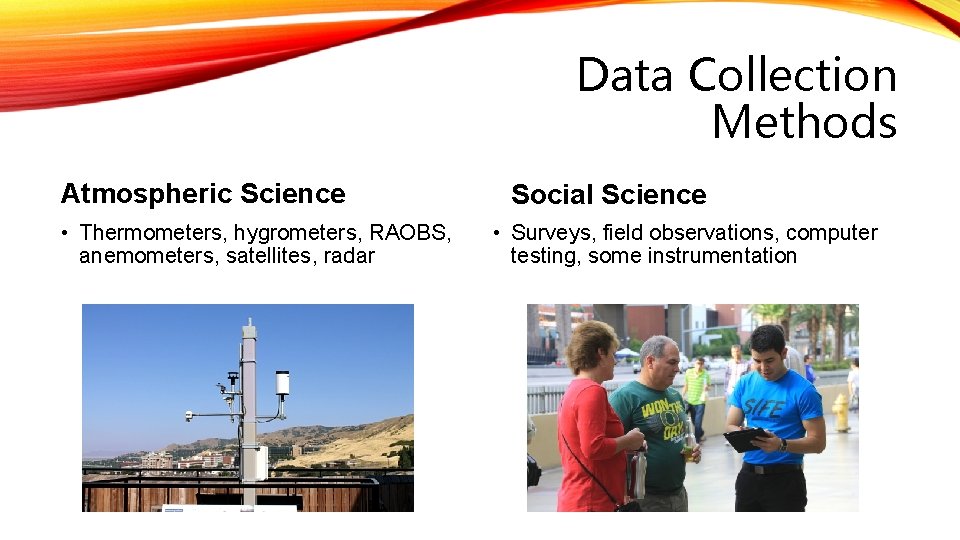
Data Collection Methods Atmospheric Science • Thermometers, hygrometers, RAOBS, anemometers, satellites, radar Social Science • Surveys, field observations, computer testing, some instrumentation
Analysis Techniques Atmospheric Science • Most processes of interest defined by the so-called governing equations. • Analysis based on principals of physics and can be expressed as differential and integral equations, vectors, etc. Social Science • Most processes of interest are statistically distributed amongst populations. • Analysis depends on statistical techniques for qualitative and quantitative studies
Sources of Error Atmospheric Science Social Science • Many processes not fully understood • Equations too complex to solve explicitly • Human behavior too complex to define mathematically • Initial observations may not be representative • Difficult to obtain representative observations • Dropping 2 nd order terms might be a problem • Confounding variables are a problem • Parameterized processes (e. g. , solar, clouds) are a function of individual choices • Biases (experimenter, selection, individual) can introduce unexpected error • Computer modeling problems (finite differencing techniques, assumptions) • Statistical analysis and regression techniques are not exact and involve assumptions
Descriptive versus Experimental Descriptive studies • Interviews, questionnaires, natural observations • Provide simple answers and/or correlations between variables • Cannot establish cause-effect Experimental studies • Designed to establish cause-effect between various behaviors • Works by creating manipulations within the study • Question variation in a survey, different conditions in natural settings
Questions, Questions … how social scientists carry out their work Useful results depend on careful experimental design • A Long list of potential biases can destroy results • The proper formatting of questions is tricky • Designs must always be done with analysis in mind • Be mindful of your study’s limitations
Questions, Questions … how social scientists carry out their work Human biases can ruin an otherwise great study • Sampling biases • Self-reporting and volunteer biases • Cultural biases • Participant versus experimenter bias • Extraneous variables
Formatting Questions – more complicated than you think • Use clear and unambiguous language • Keep questions short and concise • Don’t frame questions to get the answer you want Loaded questions – “How often do you ignore those irritating weather warnings? ” Leading questions – “Should responsible people heed weather warnings? ”
Formatting Questions – more to think about • Vague questions -- Do you attend church regularly? • Limited options – Is this product; excellent, very good, fair. If you don’t want to hear the truth, why do the survey? • Double barrel questions – How satisfied are you with weather forecasts and severe weather warnings? • The order you ask the questions can be important Bethlehem & Jelke (2009), Applied Survey Methods, Wiley, p. 56
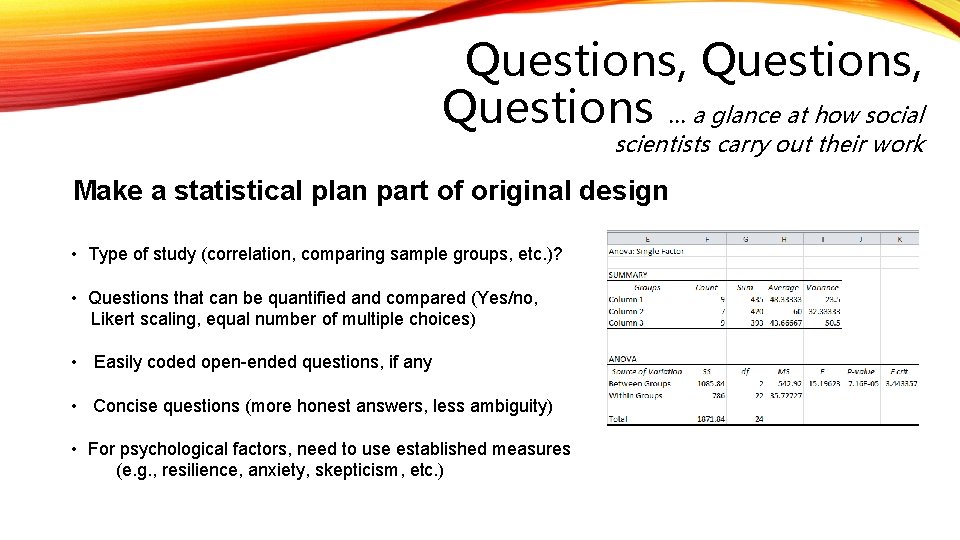
Questions, Questions … a glance at how social scientists carry out their work Make a statistical plan part of original design • Type of study (correlation, comparing sample groups, etc. )? • Questions that can be quantified and compared (Yes/no, Likert scaling, equal number of multiple choices) • Easily coded open-ended questions, if any • Concise questions (more honest answers, less ambiguity) • For psychological factors, need to use established measures (e. g. , resilience, anxiety, skepticism, etc. )
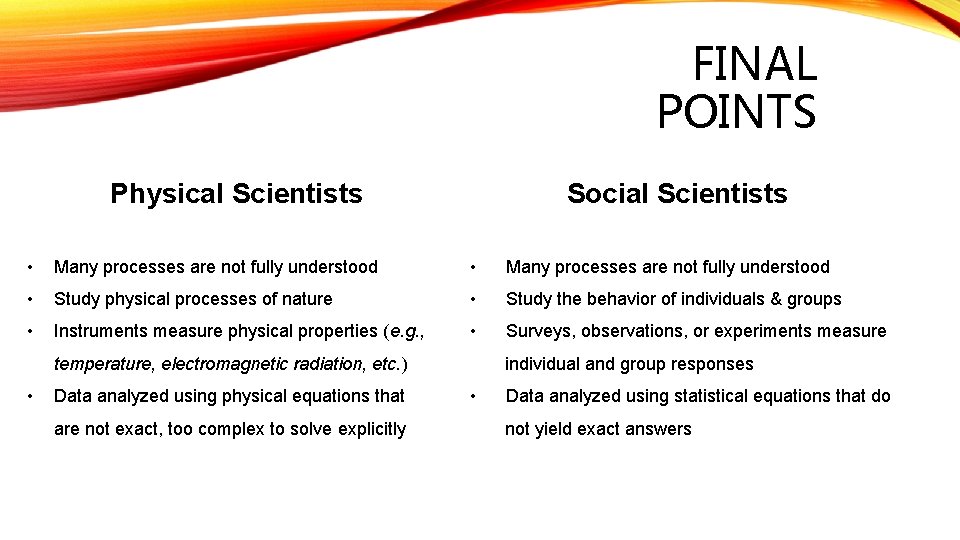
FINAL POINTS Social Scientists Physical Scientists • Many processes are not fully understood • Study physical processes of nature • Study the behavior of individuals & groups • Instruments measure physical properties (e. g. , • Surveys, observations, or experiments measure temperature, electromagnetic radiation, etc. ) • Data analyzed using physical equations that are not exact, too complex to solve explicitly individual and group responses • Data analyzed using statistical equations that do not yield exact answers
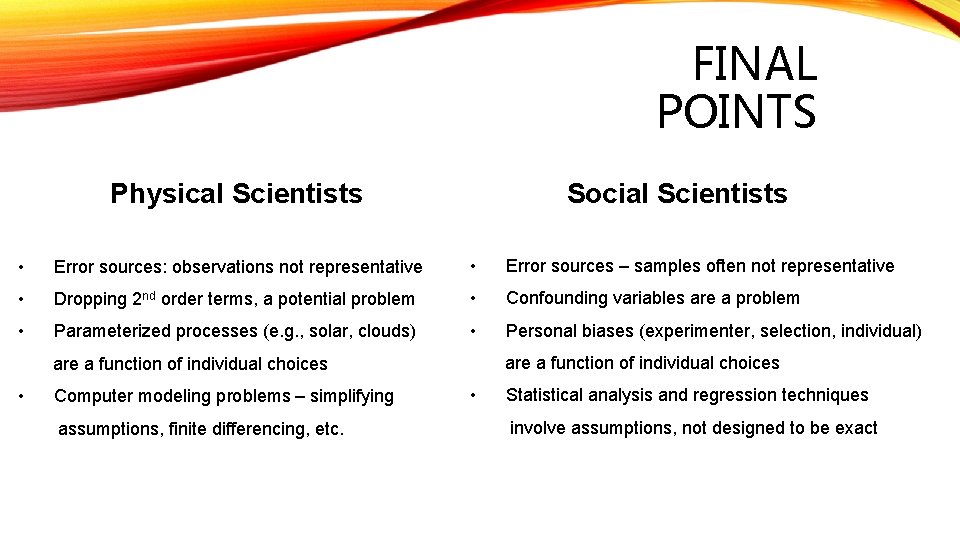
FINAL POINTS Social Scientists Physical Scientists • Error sources: observations not representative • Error sources – samples often not representative • Dropping 2 nd order terms, a potential problem • Confounding variables are a problem • Parameterized processes (e. g. , solar, clouds) • Personal biases (experimenter, selection, individual) are a function of individual choices • Computer modeling problems – simplifying assumptions, finite differencing, etc. • Statistical analysis and regression techniques involve assumptions, not designed to be exact
FINAL POINTS • Both the physical and social sciences utilize the scientific method to collect data and test hypotheses. • Both physical and social science depend on rigorous adherence to the scientific method • Finally, we want to emphasize that social science can help physical scientists carry out the parts of their job dealing with individuals, groups, and members organizations
Much, Much More … This course has been a very brief overview • If you should have further interest: → Read some social science literature → Take a course in social science research methods → Watch for our course on designing a survey
- Slides: 24