
A BRIEF INTRODUCTION TO RADIOFREQUENCY SYSTEMS FOR PARTICLE
A BRIEF INTRODUCTION TO RADIOFREQUENCY SYSTEMS FOR PARTICLE ACCELERATORS Alessandro Gallo e David Alesini INFN-LNF I) Introduction – RF System Anatomy; II) Standing-wave (SW) and Travelling-wave (TW) accelerating structures; III) RF power distribution; IV) RF power sources V) Low Level RF
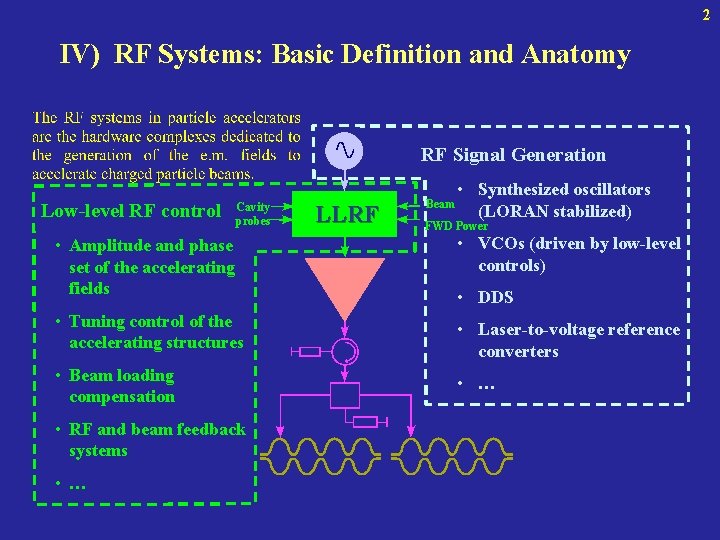
2 IV) RF Systems: Basic Definition and Anatomy RF Signal Generation Low-level RF control Cavity probes LLRF Beam • Synthesized oscillators (LORAN stabilized) FWD Power • Amplitude and phase set of the accelerating fields • VCOs (driven by low-level controls) • Tuning control of the accelerating structures • Laser-to-voltage reference converters • Beam loading compensation • … • RF and beam feedback systems • … • DDS
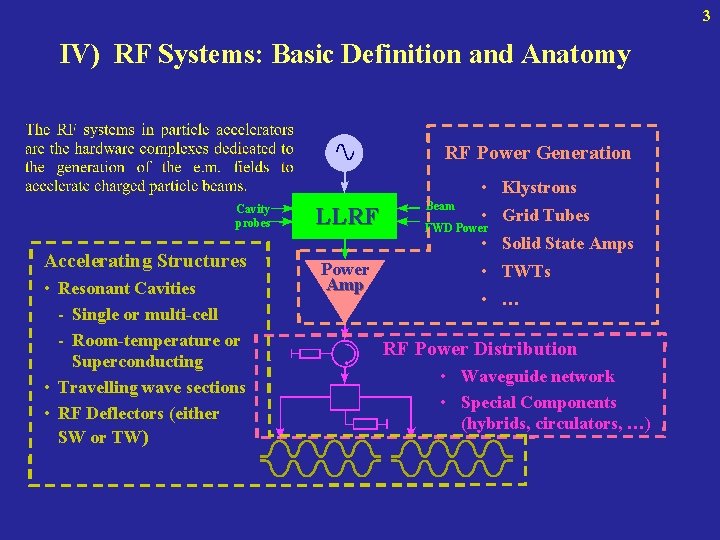
3 IV) RF Systems: Basic Definition and Anatomy RF Power Generation • Klystrons Cavity probes Accelerating Structures • Resonant Cavities - Single or multi-cell - Room-temperature or Superconducting • Travelling wave sections • RF Deflectors (either SW or TW) LLRF Beam • Grid Tubes FWD Power • Solid State Amps Power Amp • TWTs • … RF Power Distribution • Waveguide network • Special Components (hybrids, circulators, …)
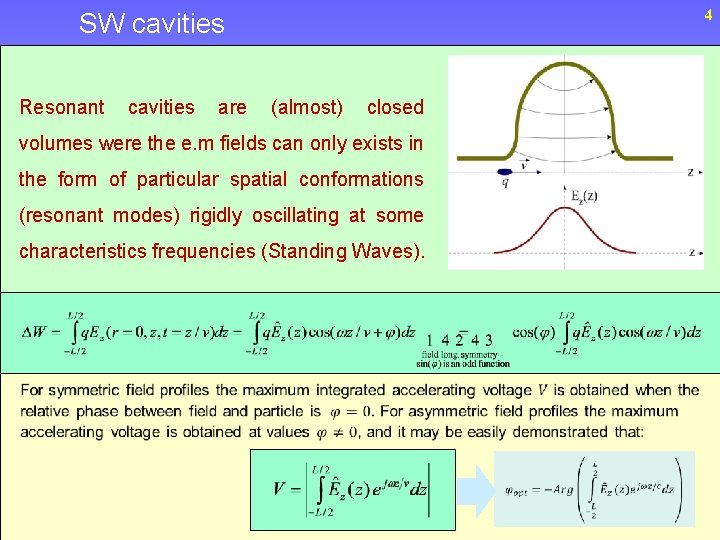
4 SW cavities Resonant cavities are (almost) closed volumes were the e. m fields can only exists in the form of particular spatial conformations (resonant modes) rigidly oscillating at some characteristics frequencies (Standing Waves).
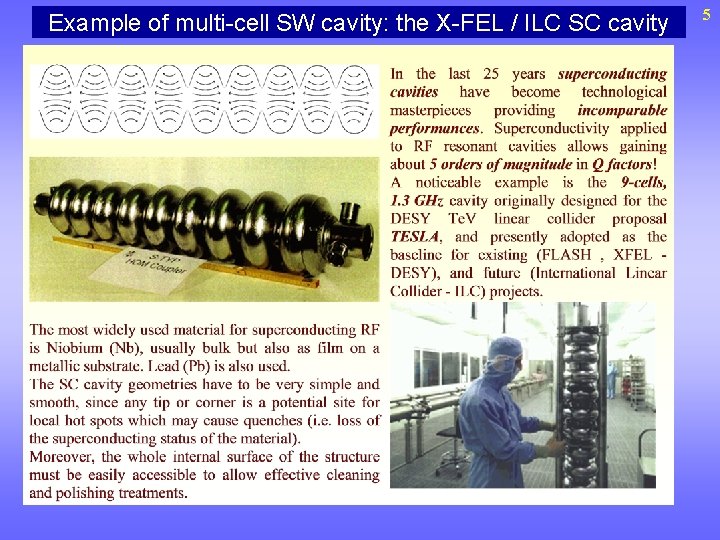
Example of multi-cell SW cavity: the X-FEL / ILC SC cavity 5

Standing wave cavities vs. Travelling wave acceleration Standing wave - SW Travelling wave - TW 6
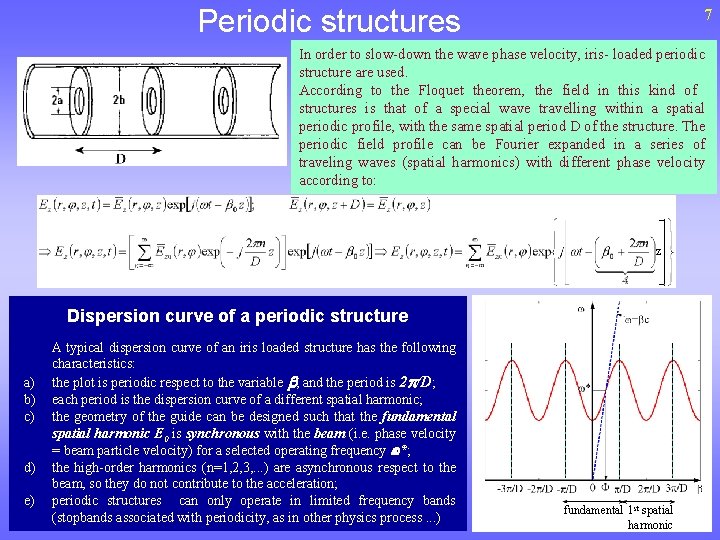
Periodic structures 7 In order to slow-down the wave phase velocity, iris- loaded periodic structure are used. According to the Floquet theorem, the field in this kind of structures is that of a special wave travelling within a spatial periodic profile, with the same spatial period D of the structure. The periodic field profile can be Fourier expanded in a series of traveling waves (spatial harmonics) with different phase velocity according to: z Dispersion curve of a periodic structure a) b) c) d) e) A typical dispersion curve of an iris loaded structure has the following characteristics: the plot is periodic respect to the variable , and the period is 2 /D; each period is the dispersion curve of a different spatial harmonic; the geometry of the guide can be designed such that the fundamental spatial harmonic E 0 is synchronous with the beam (i. e. phase velocity = beam particle velocity) for a selected operating frequency *; the high-order harmonics (n=1, 2, 3, . . . ) are asynchronous respect to the beam, so they do not contribute to the acceleration; periodic structures can only operate in limited frequency bands (stopbands associated with periodicity, as in other physics process. . . ) fundamental 1 st spatial harmonic
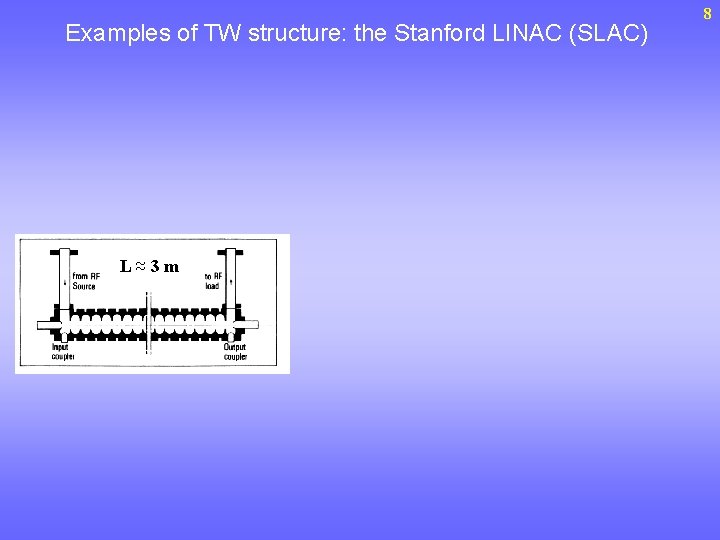
Examples of TW structure: the Stanford LINAC (SLAC) L≈3 m 8
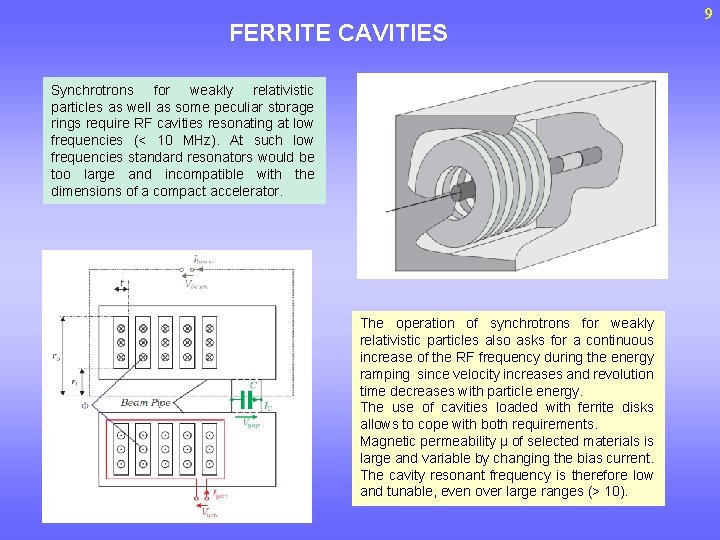
FERRITE CAVITIES Synchrotrons for weakly relativistic particles as well as some peculiar storage rings require RF cavities resonating at low frequencies (< 10 MHz). At such low frequencies standard resonators would be too large and incompatible with the dimensions of a compact accelerator. The operation of synchrotrons for weakly relativistic particles also asks for a continuous increase of the RF frequency during the energy ramping since velocity increases and revolution time decreases with particle energy. The use of cavities loaded with ferrite disks allows to cope with both requirements. Magnetic permeability μ of selected materials is large and variable by changing the bias current. The cavity resonant frequency is therefore low and tunable, even over large ranges (> 10). 9
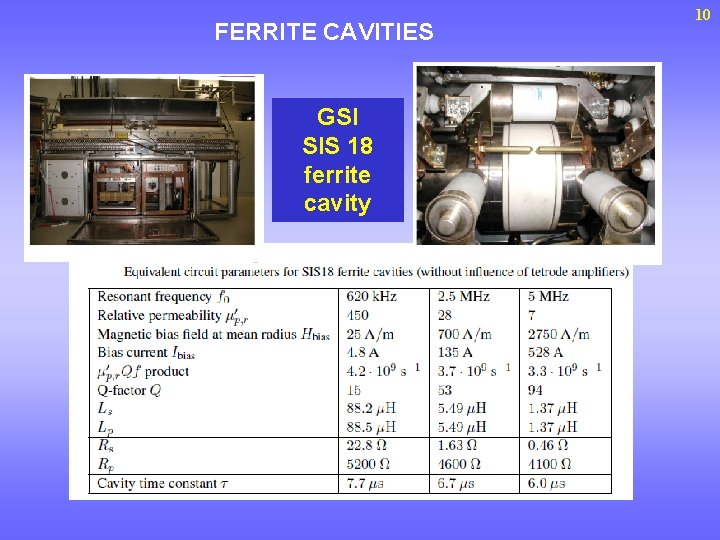
FERRITE CAVITIES GSI SIS 18 ferrite cavity 10
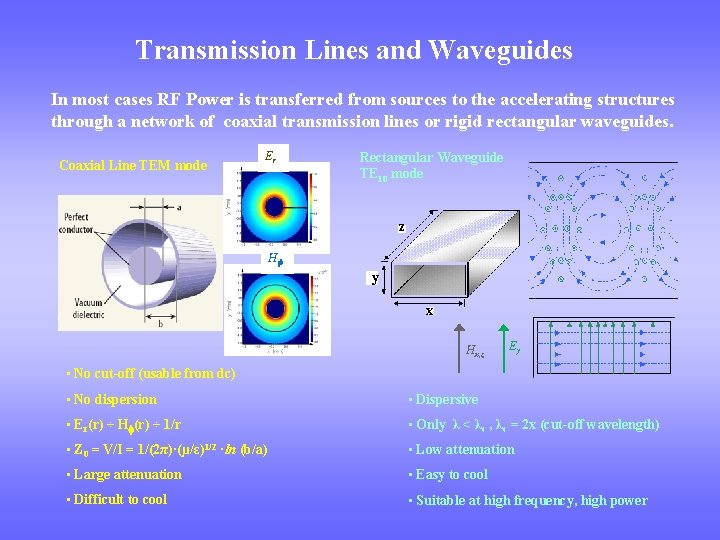
Transmission Lines and Waveguides In most cases RF Power is transferred from sources to the accelerating structures through a network of coaxial transmission lines or rigid rectangular waveguides. Coaxial Line TEM mode Er Rectangular Waveguide TE 10 mode z H y x Hx, z Ey • No cut-off (usable from dc) • No dispersion • Dispersive • Er(r) ÷ H (r) ÷ 1/r • Only λ < λc , λc = 2 x (cut-off wavelength) • Z 0 = V/I = 1/(2π)·(µ/ε)1/2 ·ln (b/a) • Low attenuation • Large attenuation • Easy to cool • Difficult to cool • Suitable at high frequency, high power
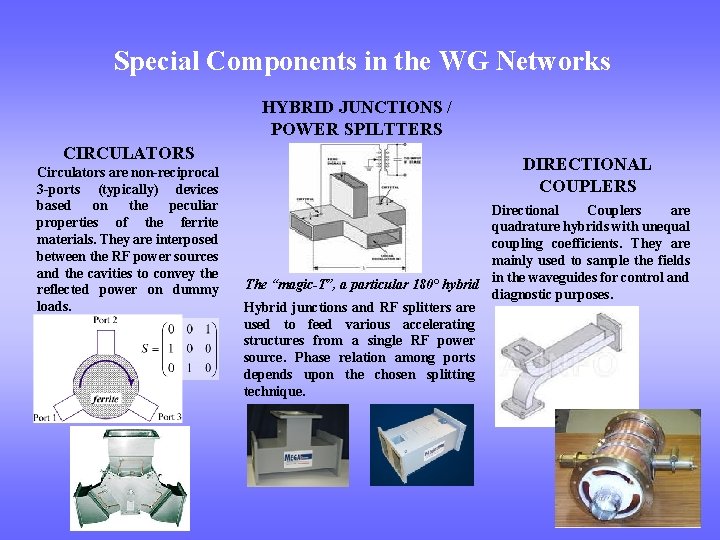
Special Components in the WG Networks HYBRID JUNCTIONS / POWER SPILTTERS CIRCULATORS Circulators are non-reciprocal 3 -ports (typically) devices based on the peculiar properties of the ferrite materials. They are interposed between the RF power sources and the cavities to convey the reflected power on dummy loads. DIRECTIONAL COUPLERS Directional Couplers are quadrature hybrids with unequal coupling coefficients. They are mainly used to sample the fields in the waveguides for control and The “magic-T”, a particular 180° hybrid diagnostic purposes. Hybrid junctions and RF splitters are used to feed various accelerating structures from a single RF power source. Phase relation among ports depends upon the chosen splitting technique.
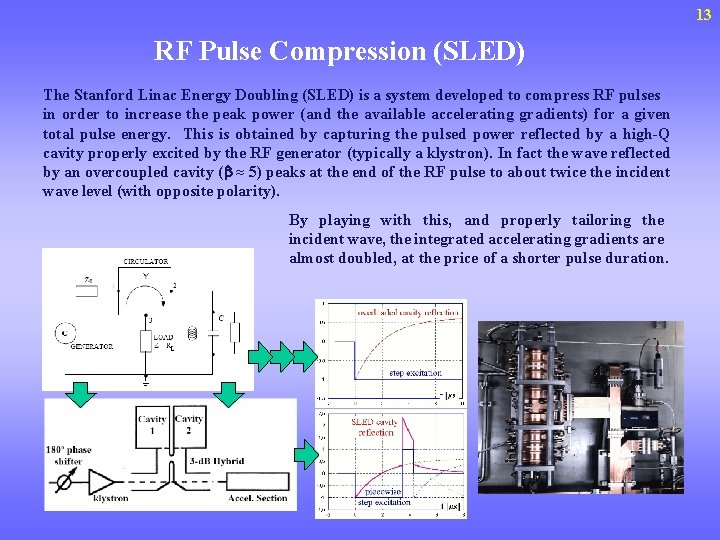
13 RF Pulse Compression (SLED) The Stanford Linac Energy Doubling (SLED) is a system developed to compress RF pulses in order to increase the peak power (and the available accelerating gradients) for a given total pulse energy. This is obtained by capturing the pulsed power reflected by a high-Q cavity properly excited by the RF generator (typically a klystron). In fact the wave reflected by an overcoupled cavity (b ≈ 5) peaks at the end of the RF pulse to about twice the incident wave level (with opposite polarity). By playing with this, and properly tailoring the incident wave, the integrated accelerating gradients are almost doubled, at the price of a shorter pulse duration.
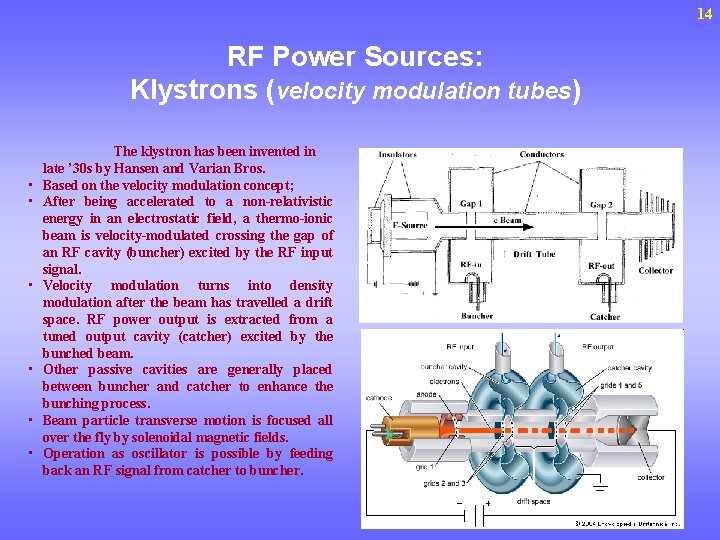
14 RF Power Sources: Klystrons (velocity modulation tubes) • • • The klystron has been invented in late ’ 30 s by Hansen and Varian Bros. Based on the velocity modulation concept; After being accelerated to a non-relativistic energy in an electrostatic field, a thermo-ionic beam is velocity-modulated crossing the gap of an RF cavity (buncher) excited by the RF input signal. Velocity modulation turns into density modulation after the beam has travelled a drift space. RF power output is extracted from a tuned output cavity (catcher) excited by the bunched beam. Other passive cavities are generally placed between buncher and catcher to enhance the bunching process. Beam particle transverse motion is focused all over the fly by solenoidal magnetic fields. Operation as oscillator is possible by feeding back an RF signal from catcher to buncher.
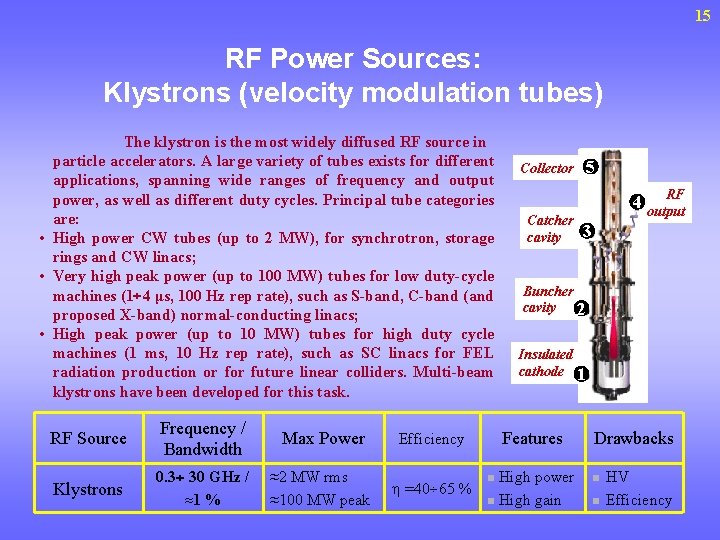
15 RF Power Sources: Klystrons (velocity modulation tubes) The klystron is the most widely diffused RF source in particle accelerators. A large variety of tubes exists for different applications, spanning wide ranges of frequency and output power, as well as different duty cycles. Principal tube categories are: • High power CW tubes (up to 2 MW), for synchrotron, storage rings and CW linacs; • Very high peak power (up to 100 MW) tubes for low duty-cycle machines (1 4 μs, 100 Hz rep rate), such as S-band, C-band (and proposed X-band) normal-conducting linacs; • High peak power (up to 10 MW) tubes for high duty cycle machines (1 ms, 10 Hz rep rate), such as SC linacs for FEL radiation production or future linear colliders. Multi-beam klystrons have been developed for this task. RF Source Frequency / Bandwidth Max Power Efficiency Klystrons 0. 3 30 GHz / ≈1 % ≈2 MW rms ≈100 MW peak =40 65 % RF Catcher cavity 4 output 3 Buncher cavity 2 Insulated cathode 1 Features High power n High gain n 5 Collector Drawbacks n n HV Efficiency
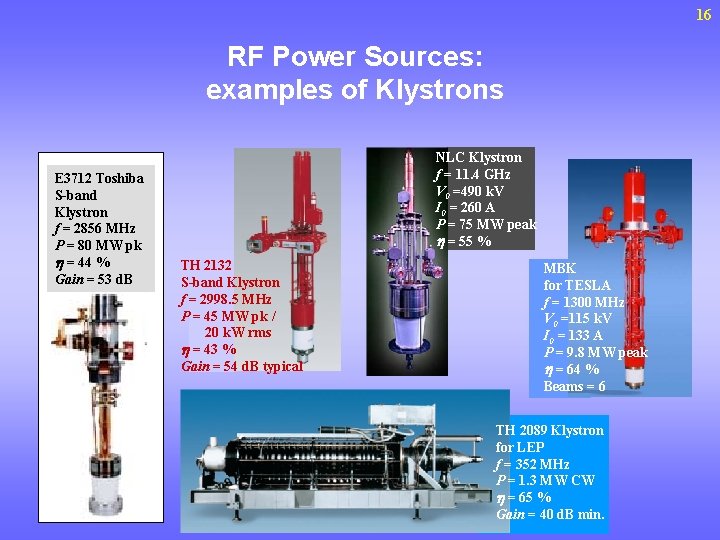
16 RF Power Sources: examples of Klystrons E 3712 Toshiba S-band Klystron f = 2856 MHz P = 80 MW pk = 44 % Gain = 53 d. B NLC Klystron f = 11. 4 GHz V 0 =490 k. V I 0 = 260 A P = 75 MW peak = 55 % TH 2132 S-band Klystron f = 2998. 5 MHz P = 45 MW pk / 20 k. W rms = 43 % Gain = 54 d. B typical MBK for TESLA f = 1300 MHz V 0 =115 k. V I 0 = 133 A P = 9. 8 MW peak = 64 % Beams = 6 TH 2089 Klystron for LEP f = 352 MHz P = 1. 3 MW CW = 65 % Gain = 40 d. B min.
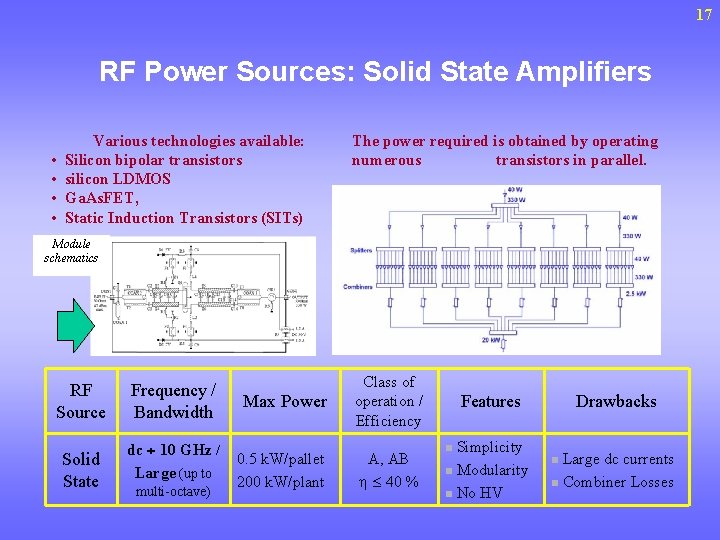
17 RF Power Sources: Solid State Amplifiers • • Various technologies available: Silicon bipolar transistors silicon LDMOS Ga. As. FET, Static Induction Transistors (SITs) The power required is obtained by operating numerous transistors in parallel. Module schematics RF Source Solid State Frequency / Bandwidth dc 10 GHz / Large (up to multi-octave) Max Power Class of operation / Efficiency 0. 5 k. W/pallet 200 k. W/plant A, AB 40 % Features Simplicity n Modularity n No HV n Drawbacks Large dc currents n Combiner Losses n
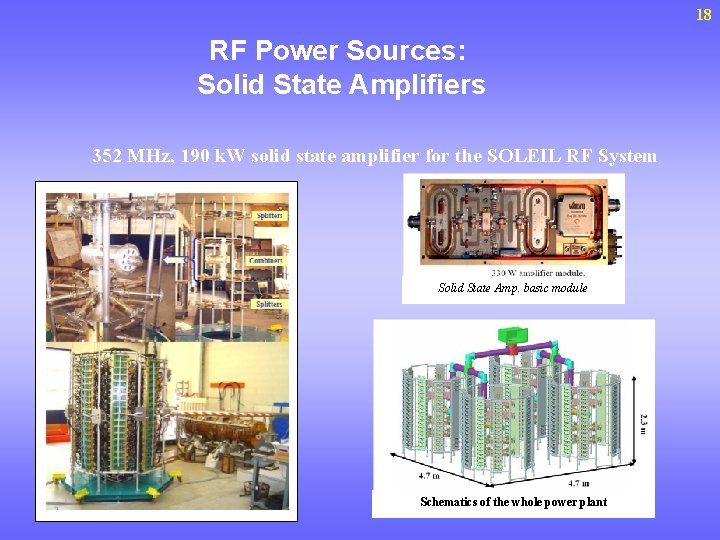
18 RF Power Sources: Solid State Amplifiers 352 MHz, 190 k. W solid state amplifier for the SOLEIL RF System Solid State Amp. basic module Schematics of the whole power plant
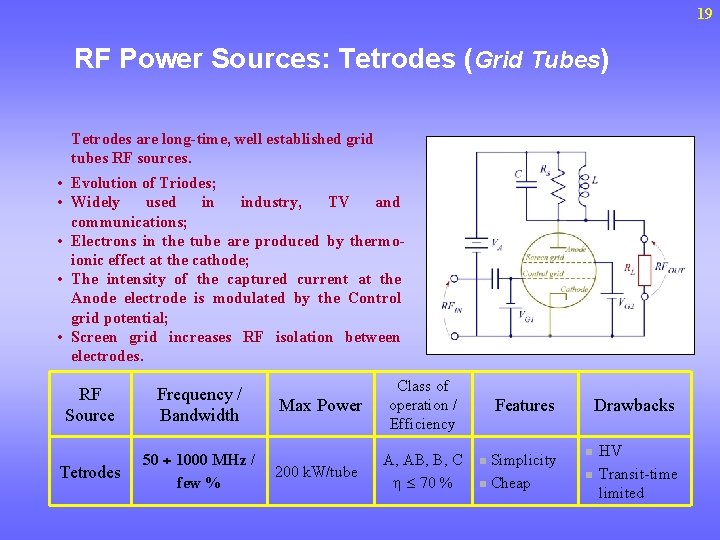
19 RF Power Sources: Tetrodes (Grid Tubes) Tetrodes are long-time, well established grid tubes RF sources. • Evolution of Triodes; • Widely used in industry, TV and communications; • Electrons in the tube are produced by thermoionic effect at the cathode; • The intensity of the captured current at the Anode electrode is modulated by the Control grid potential; • Screen grid increases RF isolation between electrodes. RF Source Frequency / Bandwidth Tetrodes 50 1000 MHz / few % Max Power Class of operation / Efficiency 200 k. W/tube A, AB, B, C 70 % Features Simplicity n Cheap n Drawbacks n n HV Transit-time limited
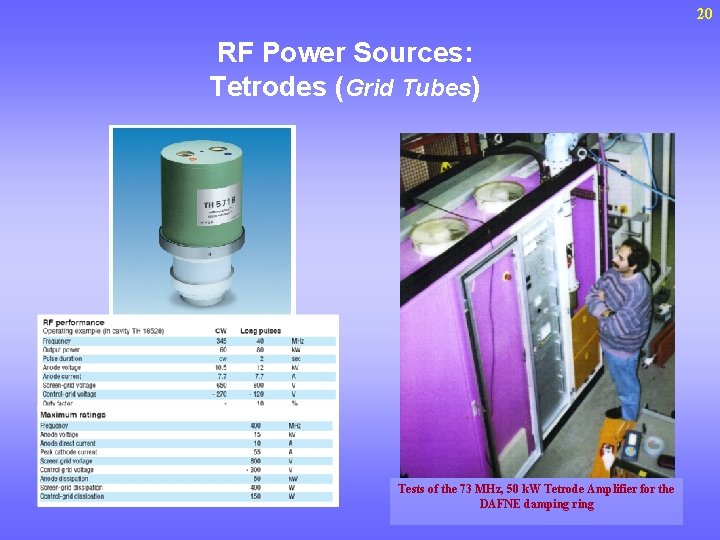
20 RF Power Sources: Tetrodes (Grid Tubes) Tests of the 73 MHz, 50 k. W Tetrode Amplifier for the DAFNE damping ring
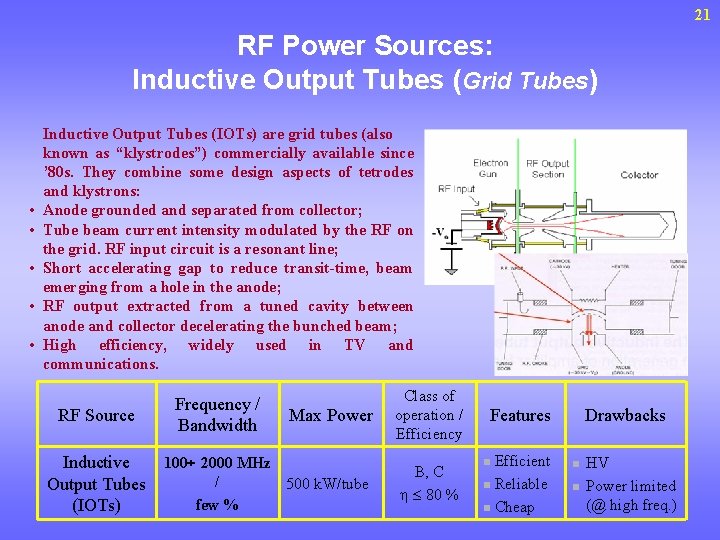
21 RF Power Sources: Inductive Output Tubes (Grid Tubes) • • • Inductive Output Tubes (IOTs) are grid tubes (also known as “klystrodes”) commercially available since ’ 80 s. They combine some design aspects of tetrodes and klystrons: Anode grounded and separated from collector; Tube beam current intensity modulated by the RF on the grid. RF input circuit is a resonant line; Short accelerating gap to reduce transit-time, beam emerging from a hole in the anode; RF output extracted from a tuned cavity between anode and collector decelerating the bunched beam; High efficiency, widely used in TV and communications. RF Source Inductive Output Tubes (IOTs) Max Power Class of operation / Efficiency 100 2000 MHz / 500 k. W/tube few % B, C 80 % Frequency / Bandwidth Features Efficient n Reliable n Cheap n Drawbacks n n HV Power limited (@ high freq. )
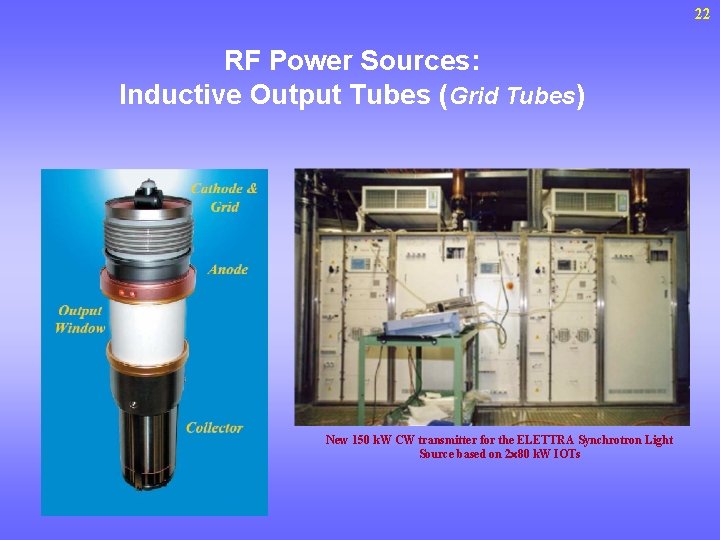
22 RF Power Sources: Inductive Output Tubes (Grid Tubes) New 150 k. W CW transmitter for the ELETTRA Synchrotron Light Source based on 2 80 k. W IOTs
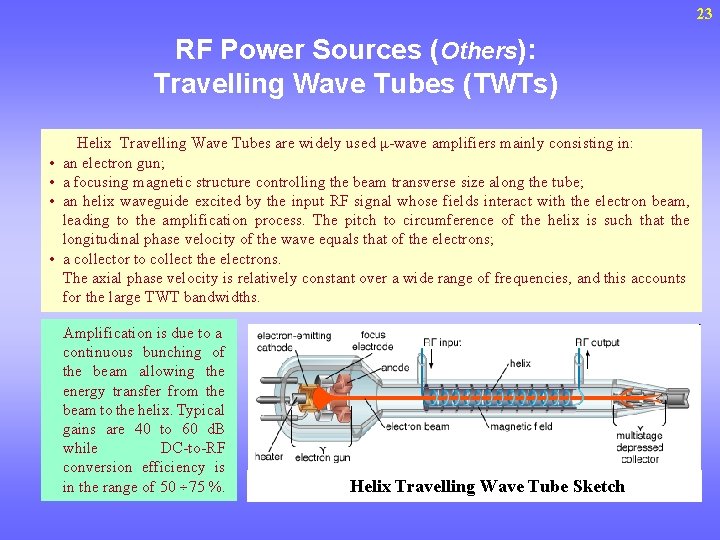
23 RF Power Sources (Others): Travelling Wave Tubes (TWTs) • • Helix Travelling Wave Tubes are widely used μ-wave amplifiers mainly consisting in: an electron gun; a focusing magnetic structure controlling the beam transverse size along the tube; an helix waveguide excited by the input RF signal whose fields interact with the electron beam, leading to the amplification process. The pitch to circumference of the helix is such that the longitudinal phase velocity of the wave equals that of the electrons; a collector to collect the electrons. The axial phase velocity is relatively constant over a wide range of frequencies, and this accounts for the large TWT bandwidths. Amplification is due to a continuous bunching of the beam allowing the energy transfer from the beam to the helix. Typical gains are 40 to 60 d. B while DC-to-RF conversion efficiency is in the range of 50 75 %. Helix Travelling Wave Tube Sketch
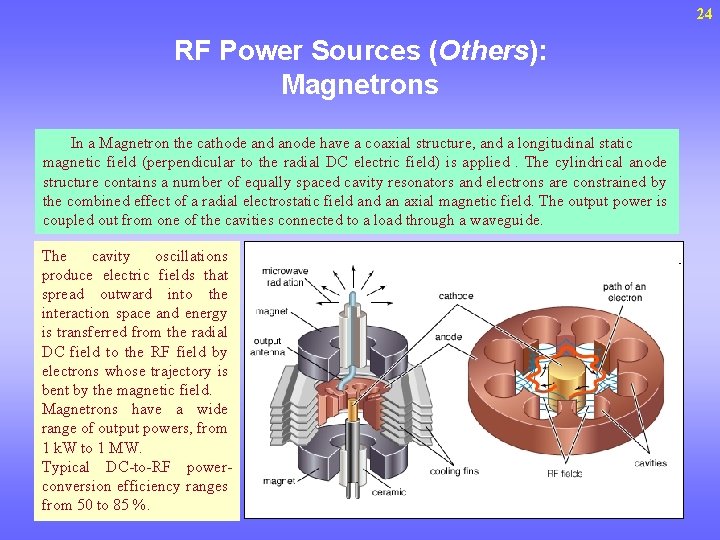
24 RF Power Sources (Others): Magnetrons In a Magnetron the cathode and anode have a coaxial structure, and a longitudinal static magnetic field (perpendicular to the radial DC electric field) is applied. The cylindrical anode structure contains a number of equally spaced cavity resonators and electrons are constrained by the combined effect of a radial electrostatic field an axial magnetic field. The output power is coupled out from one of the cavities connected to a load through a waveguide. The cavity oscillations produce electric fields that spread outward into the interaction space and energy is transferred from the radial DC field to the RF field by electrons whose trajectory is bent by the magnetic field. Magnetrons have a wide range of output powers, from 1 k. W to 1 MW. Typical DC-to-RF powerconversion efficiency ranges from 50 to 85 %.
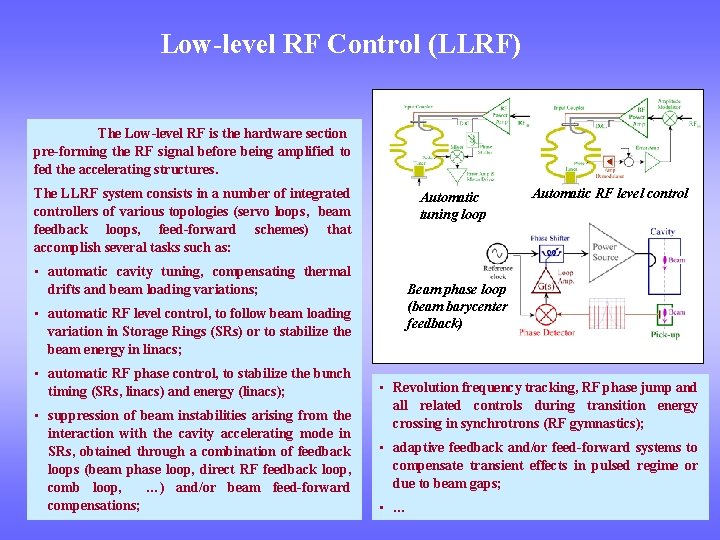
Low-level RF Control (LLRF) The Low-level RF is the hardware section pre-forming the RF signal before being amplified to fed the accelerating structures. The LLRF system consists in a number of integrated controllers of various topologies (servo loops, beam feedback loops, feed-forward schemes) that accomplish several tasks such as: • automatic cavity tuning, compensating thermal drifts and beam loading variations; • automatic RF level control, to follow beam loading variation in Storage Rings (SRs) or to stabilize the beam energy in linacs; • automatic RF phase control, to stabilize the bunch timing (SRs, linacs) and energy (linacs); • suppression of beam instabilities arising from the interaction with the cavity accelerating mode in SRs, obtained through a combination of feedback loops (beam phase loop, direct RF feedback loop, comb loop, …) and/or beam feed-forward compensations; Automatic tuning loop Automatic RF level control Beam phase loop (beam barycenter feedback) • Revolution frequency tracking, RF phase jump and all related controls during transition energy crossing in synchrotrons (RF gymnastics); • adaptive feedback and/or feed-forward systems to compensate transient effects in pulsed regime or due to beam gaps; • …
- Slides: 25