
A Brief Introduction of Existing Big Data Tools
A Brief Introduction of Existing Big Data Tools Bingjing Zhang
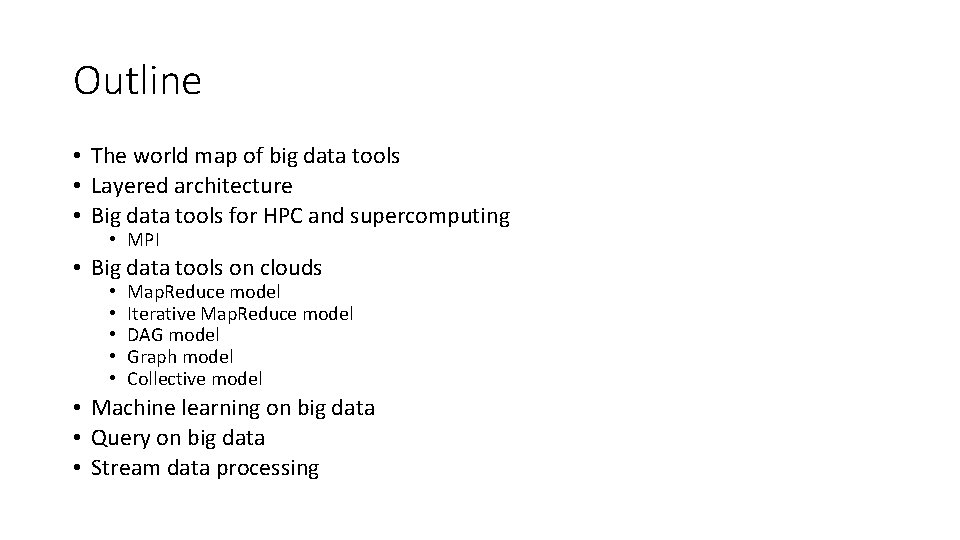
Outline • The world map of big data tools • Layered architecture • Big data tools for HPC and supercomputing • MPI • Big data tools on clouds • • • Map. Reduce model Iterative Map. Reduce model DAG model Graph model Collective model • Machine learning on big data • Query on big data • Stream data processing
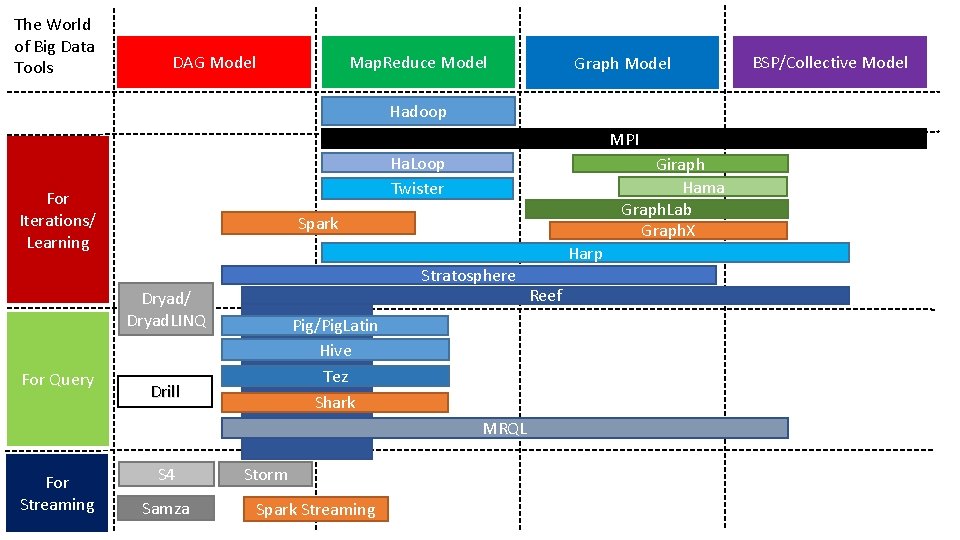
The World of Big Data Tools Map. Reduce Model DAG Model Graph Model Hadoop MPI Ha. Loop Twister For Iterations/ Learning Giraph Hama Graph. Lab Graph. X Spark Harp Stratosphere Dryad/ Dryad. LINQ For Query Pig/Pig. Latin Hive Tez Shark Drill MRQL For Streaming S 4 Samza Storm Spark Streaming Reef BSP/Collective Model
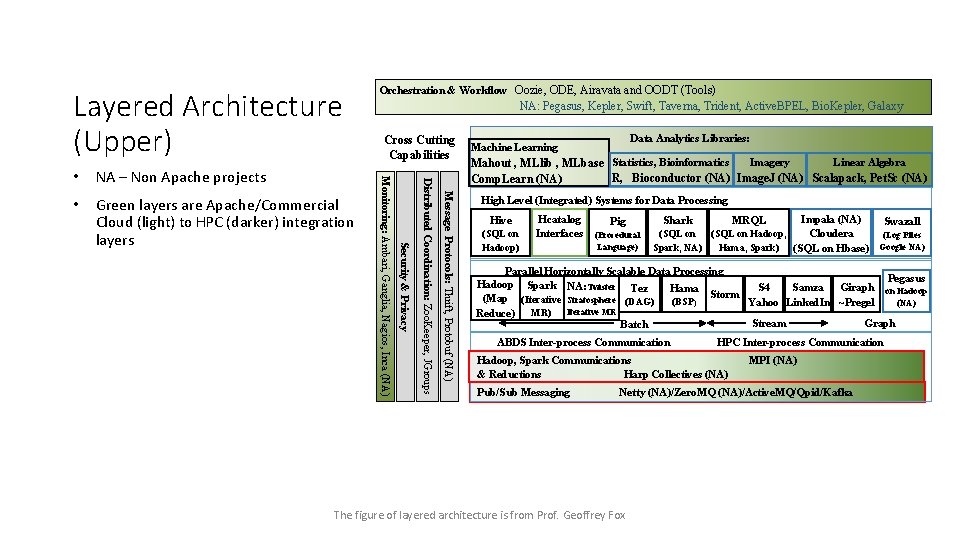
Layered Architecture (Upper) Message Protocols: Thrift, Protobuf (NA) Green layers are Apache/Commercial Cloud (light) to HPC (darker) integration layers Distributed Coordination: Zoo. Keeper, JGroups • Cross Cutting Capabilities Security & Privacy NA – Non Apache projects NA: Pegasus, Kepler, Swift, Taverna, Trident, Active. BPEL, Bio. Kepler, Galaxy Monitoring: Ambari, Ganglia, Nagios, Inca (NA) • Orchestration & Workflow Oozie, ODE, Airavata and OODT (Tools) Data Analytics Libraries: Machine Learning Linear Algebra Imagery Mahout , MLlib , MLbase Statistics, Bioinformatics R, Bioconductor (NA) Image. J (NA) Scalapack, Pet. Sc (NA) Comp. Learn (NA) High Level (Integrated) Systems for Data Processing Hive (SQL on Hadoop) Hcatalog Interfaces Pig (Procedural Language) Impala (NA) Swazall Cloudera (SQL on Hadoop, (Log Files Spark, NA) Hama, Spark) (SQL on Hbase) Google NA) Shark MRQL Parallel Horizontally Scalable Data Processing Pegasus Hadoop Spark NA: Twister Tez S 4 Samza Giraph on Hadoop Hama Storm (Map (Iterative Stratosphere (DAG) (BSP) Yahoo Linked. In ~Pregel (NA) Iterative MR MR) Reduce) Stream Graph Batch ABDS Inter-process Communication HPC Inter-process Communication Hadoop, Spark Communications & Reductions Harp Collectives (NA) Pub/Sub Messaging MPI (NA) Netty (NA)/Zero. MQ (NA)/Active. MQ/Qpid/Kafka The figure of layered architecture is from Prof. Geoffrey Fox
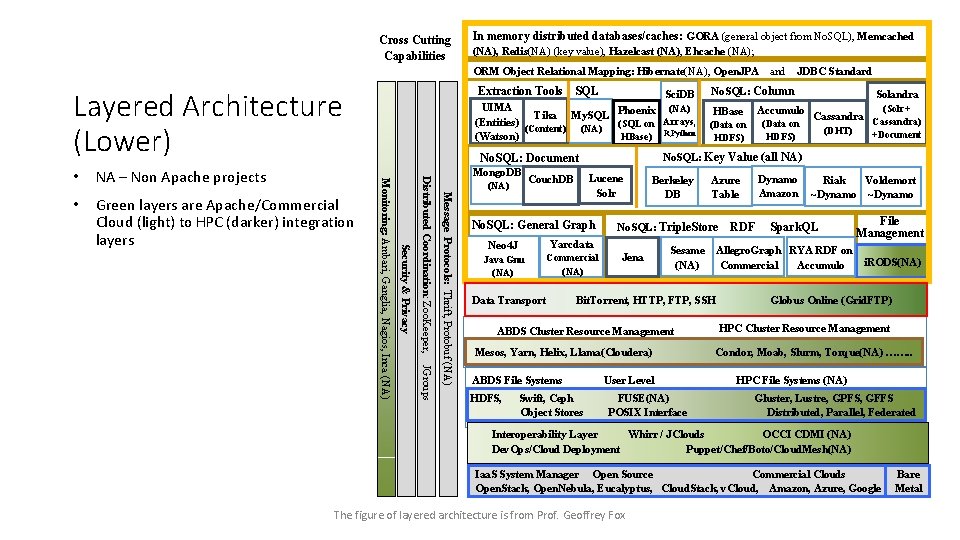
Cross Cutting Capabilities In memory distributed databases/caches: GORA (general object from No. SQL), Memcached (NA), Redis(NA) (key value), Hazelcast (NA), Ehcache (NA); ORM Object Relational Mapping: Hibernate(NA), Open. JPA Extraction Tools SQL Layered Architecture (Lower) (NA) JGroups Message Protocols: Thrift, Protobuf (NA) Green layers are Apache/Commercial Cloud (light) to HPC (darker) integration layers Distributed Coordination: Zoo. Keeper, • Mongo. DB Lucene Solr Couch. DB No. SQL: General Graph Neo 4 J Yarcdata Java Gnu (NA) Commercial (NA) Data Transport Berkeley DB HBase Accumulo (Data on HDFS) Jena Sesame (NA) Mesos, Yarn, Helix, Llama(Cloudera) Swift, Ceph Object Stores User Level FUSE(NA) POSIX Interface Dynamo Amazon Azure Table No. SQL: Triple. Store ABDS Cluster Resource Management HDFS, No. SQL: Column Bit. Torrent, HTTP, FTP, SSH ABDS File Systems JDBC Standard Solandra (Solr+ Cassandra) (DHT) +Document No. SQL: Key Value (all NA) No. SQL: Document Security & Privacy NA – Non Apache projects UIMA (NA) Tika My. SQL Phoenix (Entities) (SQL on Arrays, (NA) (Content) (Watson) HBase) R, Python Monitoring: Ambari, Ganglia, Nagios, Inca (NA) • Sci. DB and RDF Riak Voldemort ~Dynamo Spark. QL Allegro. Graph RYA RDF on Commercial Accumulo File Management i. RODS(NA) Globus Online (Grid. FTP) HPC Cluster Resource Management Condor, Moab, Slurm, Torque(NA) ……. . HPC File Systems (NA) Gluster, Lustre, GPFS, GFFS Distributed, Parallel, Federated Interoperability Layer Whirr / JClouds OCCI CDMI (NA) Dev. Ops/Cloud Deployment Puppet/Chef/Boto/Cloud. Mesh(NA) Iaa. S System Manager Open Source Commercial Clouds Open. Stack, Open. Nebula, Eucalyptus, Cloud. Stack, v. Cloud, Amazon, Azure, Google The figure of layered architecture is from Prof. Geoffrey Fox Bare Metal
Big Data Tools for HPC and Supercomputing • MPI(Message Passing Interface, 1992) • Provide standardized function interfaces for communication between parallel processes. • Collective communication operations • Broadcast, Scatter, Gather, Reduce, Allgather, Allreduce, Reduce-scatter. • Popular implementations • MPICH (2001) • Open. MPI (2004) • http: //www. open-mpi. org/
Map. Reduce Model • Google Map. Reduce (2004) • Jeffrey Dean et al. Map. Reduce: Simplified Data Processing on Large Clusters. OSDI 2004. • Apache Hadoop (2005) • http: //hadoop. apache. org/ • http: //developer. yahoo. com/hadoop/tutorial/ • Apache Hadoop 2. 0 (2012) • Vinod Kumar Vavilapalli et al. Apache Hadoop YARN: Yet Another Resource Negotiator, SOCC 2013. • Separation between resource management and computation model.
Key Features of Map. Reduce Model • Designed for clouds • Large clusters of commodity machines • Designed for big data • Support from local disks based distributed file system (GFS / HDFS) • Disk based intermediate data transfer in Shuffling • Map. Reduce programming model • Computation pattern: Map tasks and Reduce tasks • Data abstraction: Key. Value pairs
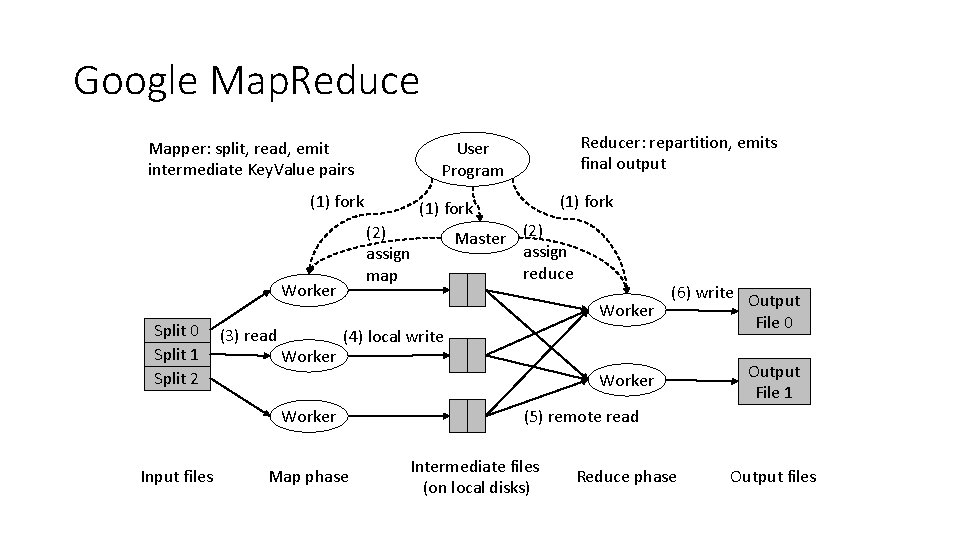
Google Map. Reduce Mapper: split, read, emit intermediate Key. Value pairs (1) fork Split 0 Split 1 Split 2 (3) read Worker Master (2) assign reduce (4) local write (6) write Output Worker File 0 Worker Input files (1) fork (2) assign map Worker Reducer: repartition, emits final output User Program Map phase Output File 1 (5) remote read Intermediate files (on local disks) Reduce phase Output files

Iterative Map. Reduce Model •
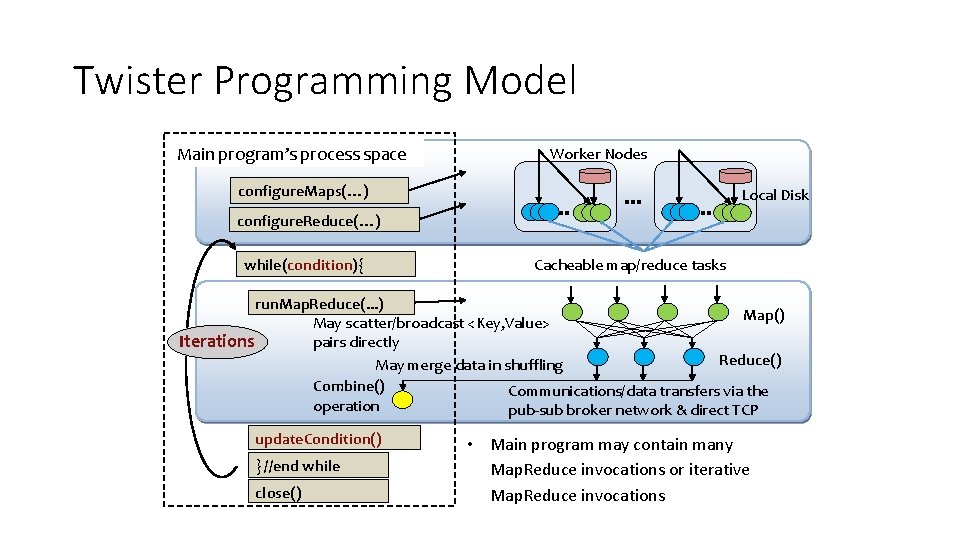
Twister Programming Model Main program’s process space Worker Nodes configure. Maps(…) Local Disk configure. Reduce(…) while(condition){ Cacheable map/reduce tasks run. Map. Reduce(. . . ) Map() May scatter/broadcast <Key, Value> Iterations pairs directly Reduce() May merge data in shuffling Combine() Communications/data transfers via the operation pub-sub broker network & direct TCP update. Condition() } //end while close() • Main program may contain many Map. Reduce invocations or iterative Map. Reduce invocations
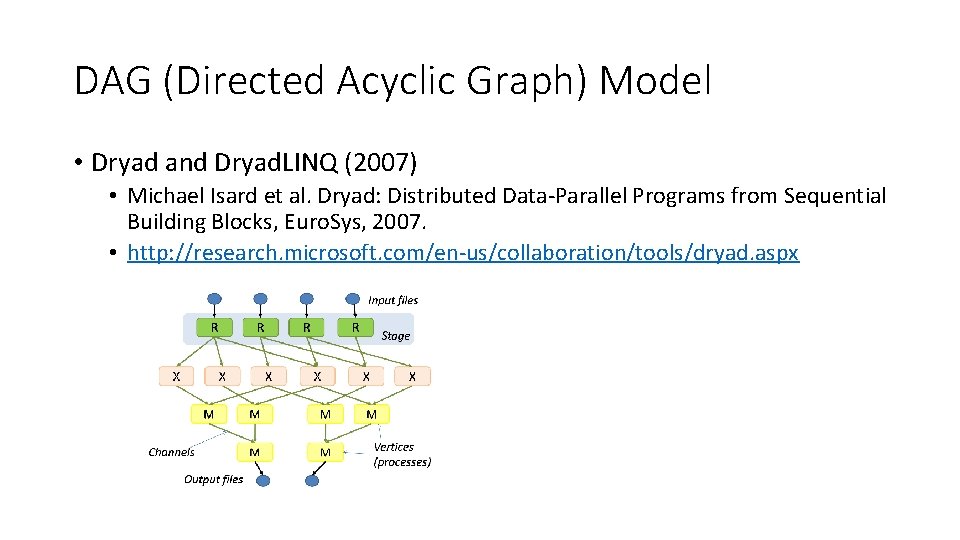
DAG (Directed Acyclic Graph) Model • Dryad and Dryad. LINQ (2007) • Michael Isard et al. Dryad: Distributed Data-Parallel Programs from Sequential Building Blocks, Euro. Sys, 2007. • http: //research. microsoft. com/en-us/collaboration/tools/dryad. aspx
Model Composition • Apache Spark (2010) • Matei Zaharia et al. Spark: Cluster Computing with Working Sets, . Hot. Cloud 2010. • Matei Zaharia et al. Resilient Distributed Datasets: A Fault-Tolerant Abstraction for In-Memory Cluster Computing. NSDI 2012. • http: //spark. apache. org/ • Resilient Distributed Dataset (RDD) • RDD operations • Map. Reduce-like parallel operations • DAG of execution stages and pipelined transformations • Simple collectives: broadcasting and aggregation
Graph Processing with BSP model • Pregel (2010) • Grzegorz Malewicz et al. Pregel: A System for Large-Scale Graph Processing. SIGMOD 2010. • Apache Hama (2010) • https: //hama. apache. org/ • Apache Giraph (2012) • https: //giraph. apache. org/ • Scaling Apache Giraph to a trillion edges • https: //www. facebook. com/notes/facebook-engineering/scaling-apache-giraph-to-a-trillionedges/10151617006153920
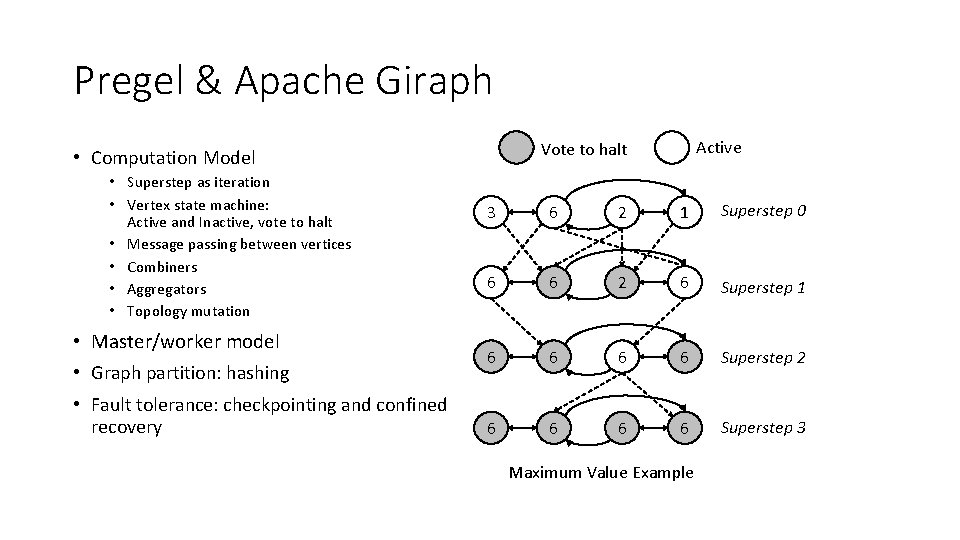
Pregel & Apache Giraph • Superstep as iteration • Vertex state machine: Active and Inactive, vote to halt • Message passing between vertices • Combiners • Aggregators • Topology mutation • Master/worker model • Graph partition: hashing • Fault tolerance: checkpointing and confined recovery Active Vote to halt • Computation Model 3 6 2 1 Superstep 0 6 6 2 6 Superstep 1 6 6 Superstep 2 6 6 Superstep 3 Maximum Value Example
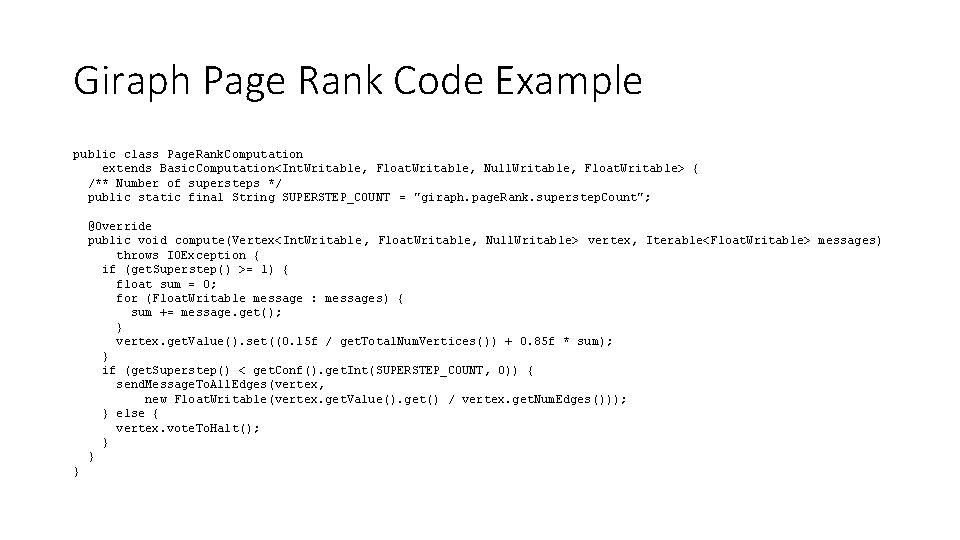
Giraph Page Rank Code Example public class Page. Rank. Computation extends Basic. Computation<Int. Writable, Float. Writable, Null. Writable, Float. Writable> { /** Number of supersteps */ public static final String SUPERSTEP_COUNT = "giraph. page. Rank. superstep. Count"; @Override public void compute(Vertex<Int. Writable , Float. Writable, Null. Writable> vertex, Iterable<Float. Writable> messages) throws IOException { if (get. Superstep() >= 1) { float sum = 0; for (Float. Writable message : messages) { sum += message. get(); } vertex. get. Value(). set((0. 15 f / get. Total. Num. Vertices()) + 0. 85 f * sum); } if (get. Superstep() < get. Conf(). get. Int(SUPERSTEP_COUNT, 0)) { send. Message. To. All. Edges(vertex, new Float. Writable(vertex. get. Value(). get() / vertex. get. Num. Edges())); } else { vertex. vote. To. Halt(); } } }
Graph. Lab (2010) • Yucheng Low et al. Graph. Lab: A New Parallel Framework for Machine Learning. UAI 2010. • Yucheng Low, et al. Distributed Graph. Lab: A Framework for Machine Learning and Data Mining in the Cloud. PVLDB 2012. • http: //graphlab. org/projects/index. html • http: //graphlab. org/resources/publications. html • Data graph • Update functions and the scope • Sync operation (similar to aggregation in Pregel)
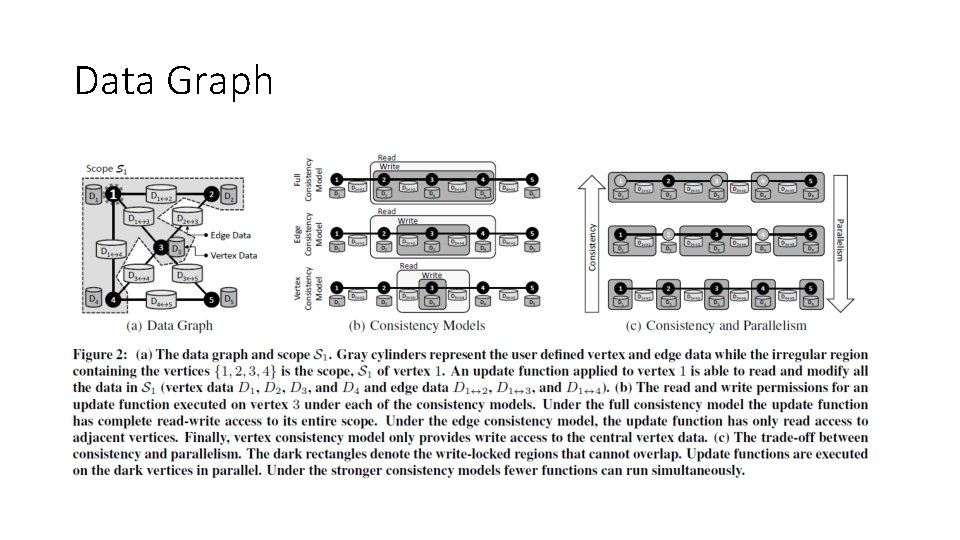
Data Graph
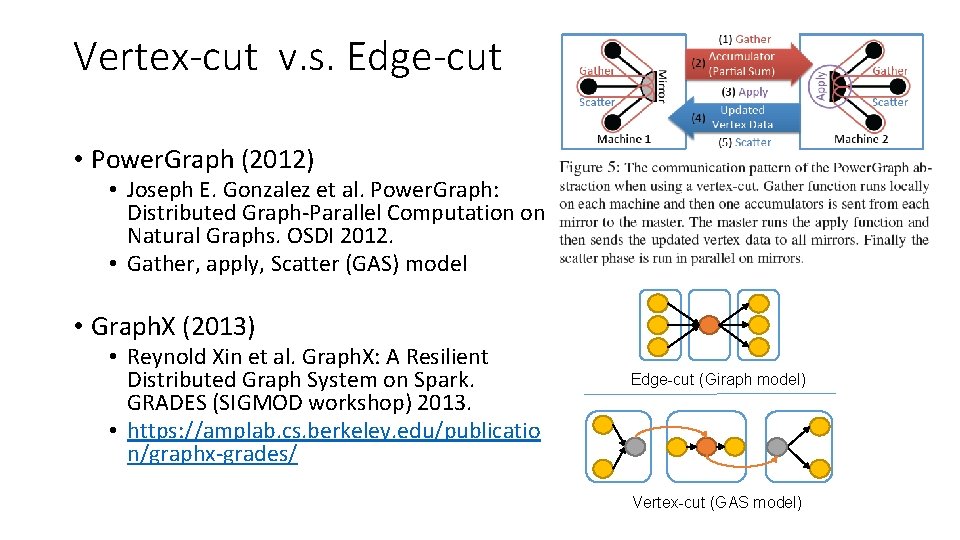
Vertex-cut v. s. Edge-cut • Power. Graph (2012) • Joseph E. Gonzalez et al. Power. Graph: Distributed Graph-Parallel Computation on Natural Graphs. OSDI 2012. • Gather, apply, Scatter (GAS) model • Graph. X (2013) • Reynold Xin et al. Graph. X: A Resilient Distributed Graph System on Spark. GRADES (SIGMOD workshop) 2013. • https: //amplab. cs. berkeley. edu/publicatio n/graphx-grades/ Edge-cut (Giraph model) Vertex-cut (GAS model)
To reduce communication overhead…. • Option 1 • Algorithmic message reduction • Fixed point-to-point communication pattern • Option 2 • Collective communication optimization • Not considered by previous BSP model but well developed in MPI • Initial attempts in Twister and Spark on clouds • Mosharaf Chowdhury et al. Managing Data Transfers in Computer Clusters with Orchestra. SIGCOMM 2011. • Bingjing Zhang, Judy Qiu. High Performance Clustering of Social Images in a Map. Collective Programming Model. SOCC Poster 2013.
Collective Model • Harp (2013) • https: //github. com/jessezbj/harp-project • Hadoop Plugin (on Hadoop 1. 2. 1 and Hadoop 2. 2. 0) • Hierarchical data abstraction on arrays, key-values and graphs for easy programming expressiveness. • Collective communication model to support various communication operations on the data abstractions. • Caching with buffer management for memory allocation required from computation and communication • BSP style parallelism • Fault tolerance with check-pointing
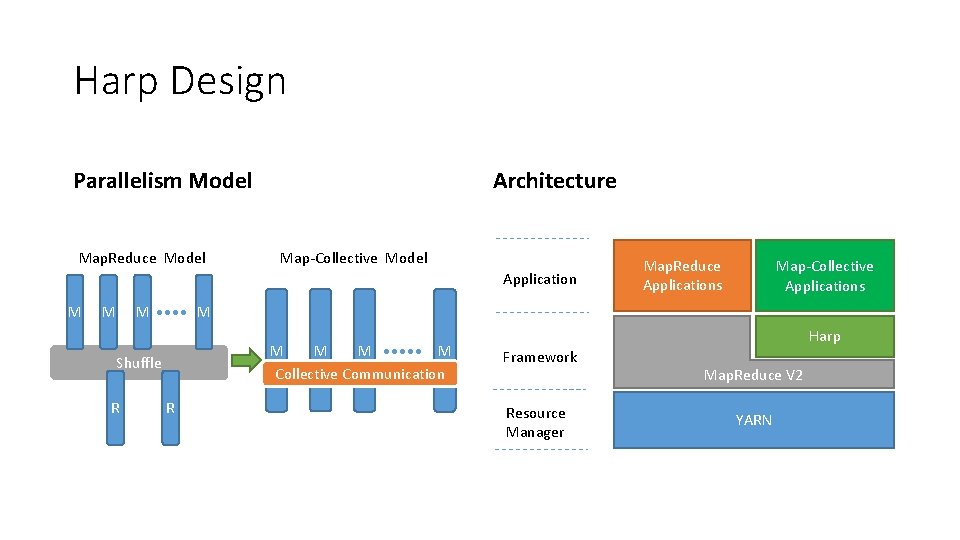
Harp Design Parallelism Model Map. Reduce Model Architecture Map-Collective Model Application M Map-Collective Applications M M M Collective Communication Shuffle R Map. Reduce Applications R Harp Framework Resource Manager Map. Reduce V 2 YARN
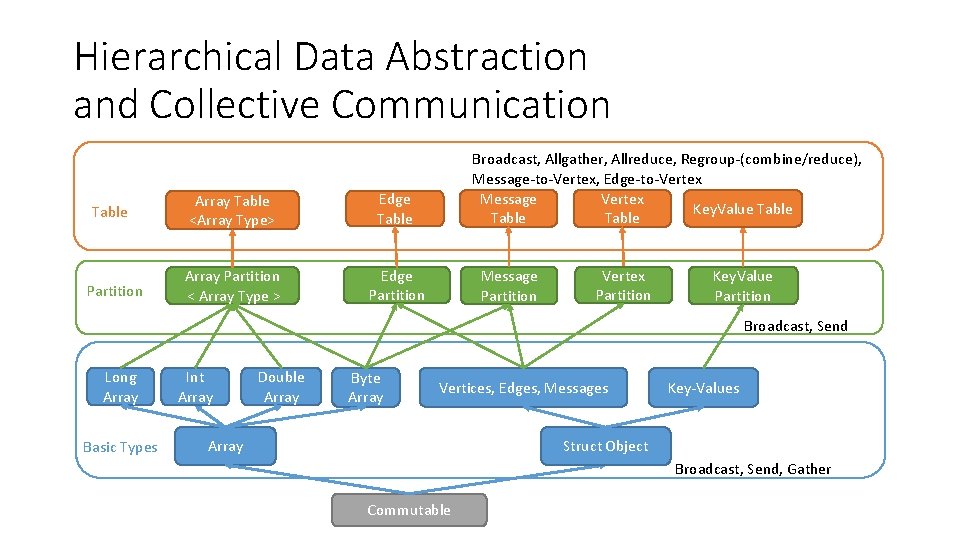
Hierarchical Data Abstraction and Collective Communication Table Array Table <Array Type> Edge Table Partition Array Partition < Array Type > Edge Partition Broadcast, Allgather, Allreduce, Regroup-(combine/reduce), Message-to-Vertex, Edge-to-Vertex Message Vertex Key. Value Table Message Partition Vertex Partition Key. Value Partition Broadcast, Send Long Array Basic Types Int Array Double Array Byte Array Vertices, Edges, Messages Array Key-Values Struct Object Broadcast, Send, Gather Commutable
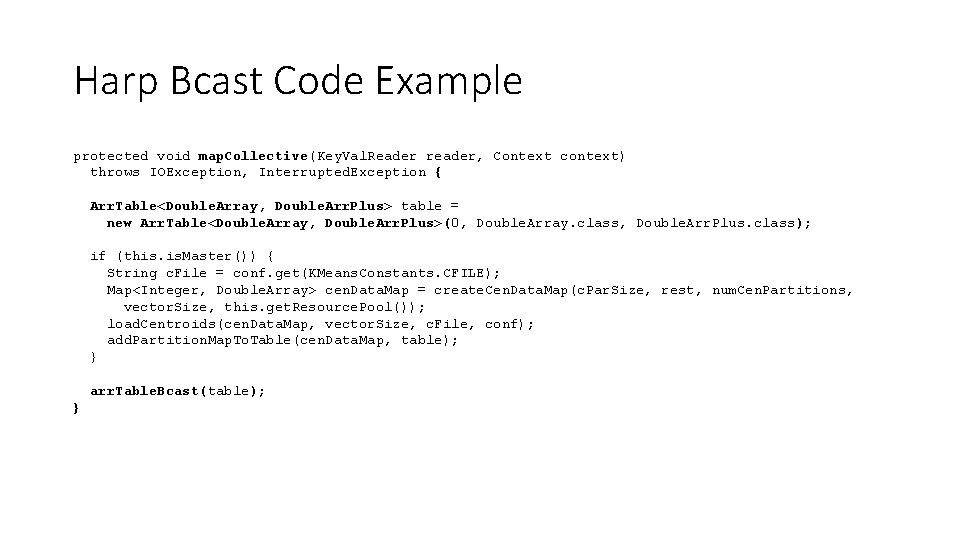
Harp Bcast Code Example protected void map. Collective(Key. Val. Reader reader, Context context) throws IOException, Interrupted. Exception { Arr. Table<Double. Array, Double. Arr. Plus> table = new Arr. Table<Double. Array, Double. Arr. Plus>(0, Double. Array. class, Double. Arr. Plus. class); if (this. Master()) { String c. File = conf. get(KMeans. Constants. CFILE); Map<Integer, Double. Array> cen. Data. Map = create. Cen. Data. Map(c. Par. Size, rest, num. Cen. Partitions, vector. Size, this. get. Resource. Pool()); load. Centroids(cen. Data. Map, vector. Size, c. File, conf); add. Partition. Map. To. Table(cen. Data. Map, table); } arr. Table. Bcast(table); }
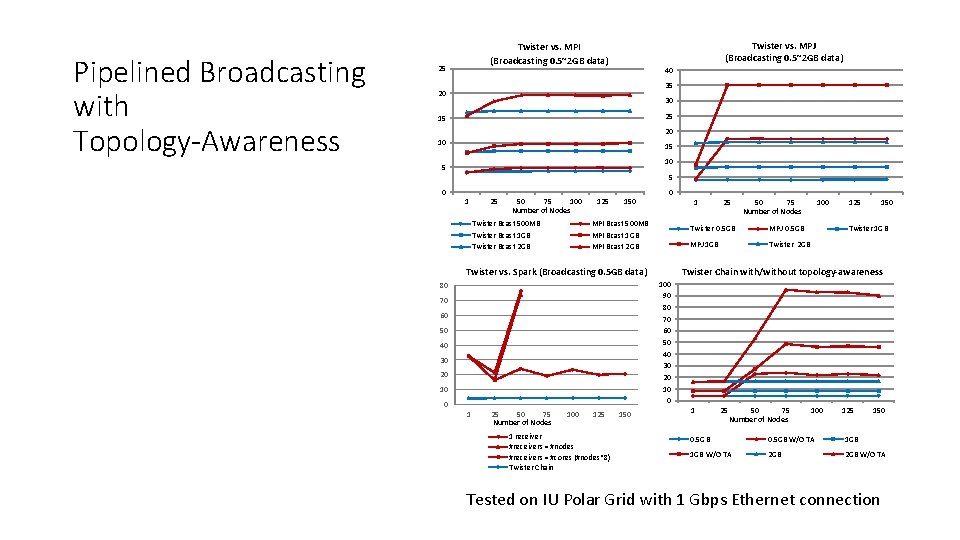
Pipelined Broadcasting with Topology-Awareness Twister vs. MPJ (Broadcasting 0. 5~2 GB data) Twister vs. MPI (Broadcasting 0. 5~2 GB data) 25 40 35 20 30 25 15 20 10 15 10 5 5 0 1 25 50 75 100 Number of Nodes Twister Bcast 500 MB Twister Bcast 1 GB Twister Bcast 2 GB 125 150 0 1 MPI Bcast 500 MB MPI Bcast 1 GB MPI Bcast 2 GB Twister vs. Spark (Broadcasting 0. 5 GB data) 25 50 75 Number of Nodes Twister 0. 5 GB MPJ 1 GB Twister 2 GB 100 125 150 Twister 1 GB Twister Chain with/without topology-awareness 100 90 80 70 60 50 40 30 20 10 0 1 25 50 75 Number of Nodes 100 125 1 receiver #receivers = #nodes #receivers = #cores (#nodes*8) Twister Chain 150 1 25 50 75 Number of Nodes 100 125 150 0. 5 GB W/O TA 1 GB W/O TA 2 GB W/O TA Tested on IU Polar Grid with 1 Gbps Ethernet connection
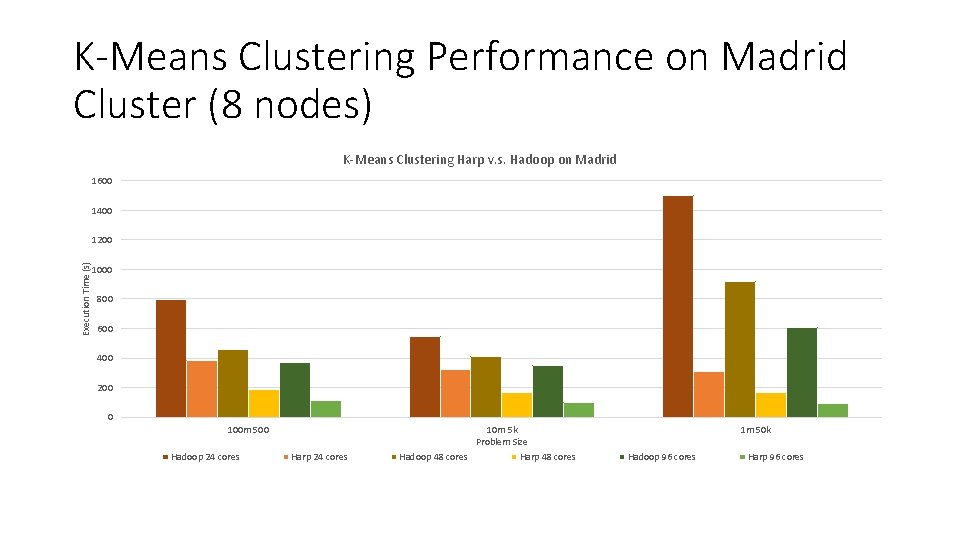
K-Means Clustering Performance on Madrid Cluster (8 nodes) K-Means Clustering Harp v. s. Hadoop on Madrid 1600 1400 Execution Time (s) 1200 1000 800 600 400 200 0 100 m 500 Hadoop 24 cores 10 m 5 k Problem Size Harp 24 cores Hadoop 48 cores Harp 48 cores 1 m 50 k Hadoop 96 cores Harp 96 cores
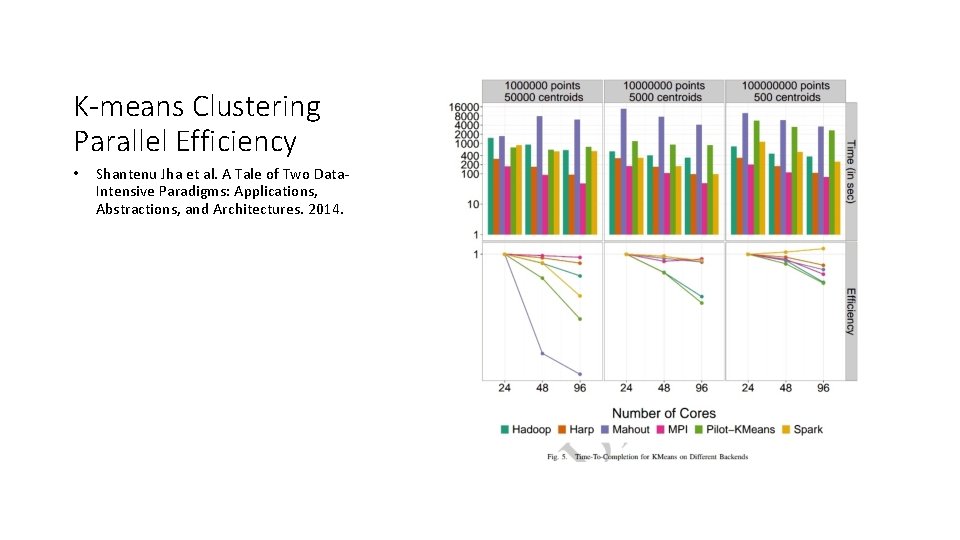
K-means Clustering Parallel Efficiency • Shantenu Jha et al. A Tale of Two Data. Intensive Paradigms: Applications, Abstractions, and Architectures. 2014.
WDA-MDS Performance on Big Red II • WDA-MDS • Yang Ruan, Geoffrey Fox. A Robust and Scalable Solution for Interpolative Multidimensional Scaling with Weighting. IEEE e-Dcience 2013. • Big Red II • http: //kb. iu. edu/data/bcqt. html • Allgather • Bucket algorithm • Allreduce • Bidirectional exchange algorithm
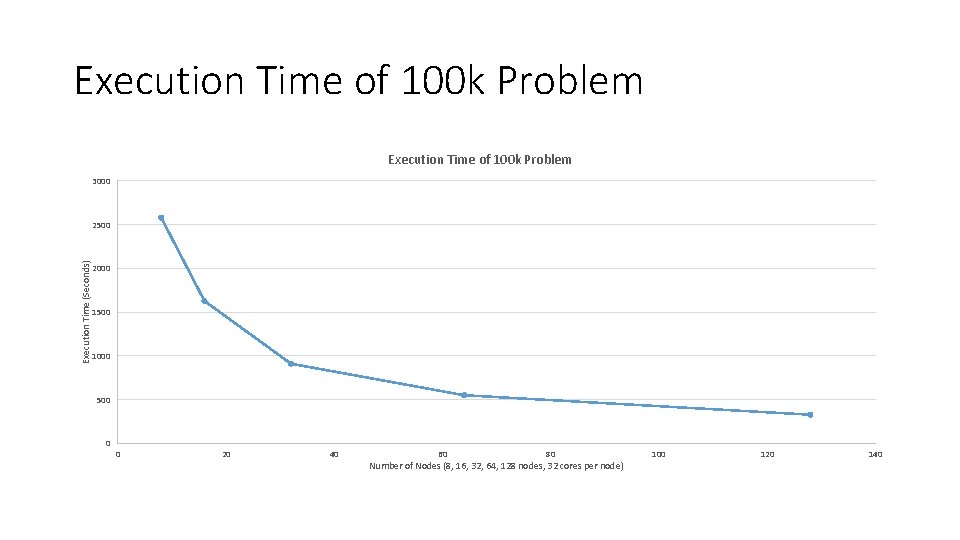
Execution Time of 100 k Problem 3000 Execution Time (Seconds) 2500 2000 1500 1000 500 0 0 20 40 60 80 Number of Nodes (8, 16, 32, 64, 128 nodes, 32 cores per node) 100 120 140
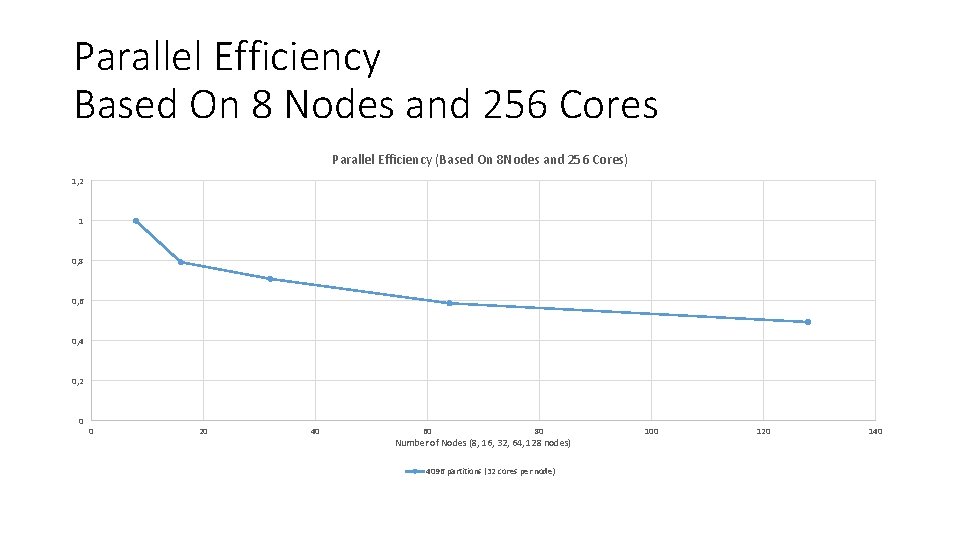
Parallel Efficiency Based On 8 Nodes and 256 Cores Parallel Efficiency (Based On 8 Nodes and 256 Cores) 1, 2 1 0, 8 0, 6 0, 4 0, 2 0 0 20 40 60 80 Number of Nodes (8, 16, 32, 64, 128 nodes) 4096 partitions (32 cores per node) 100 120 140
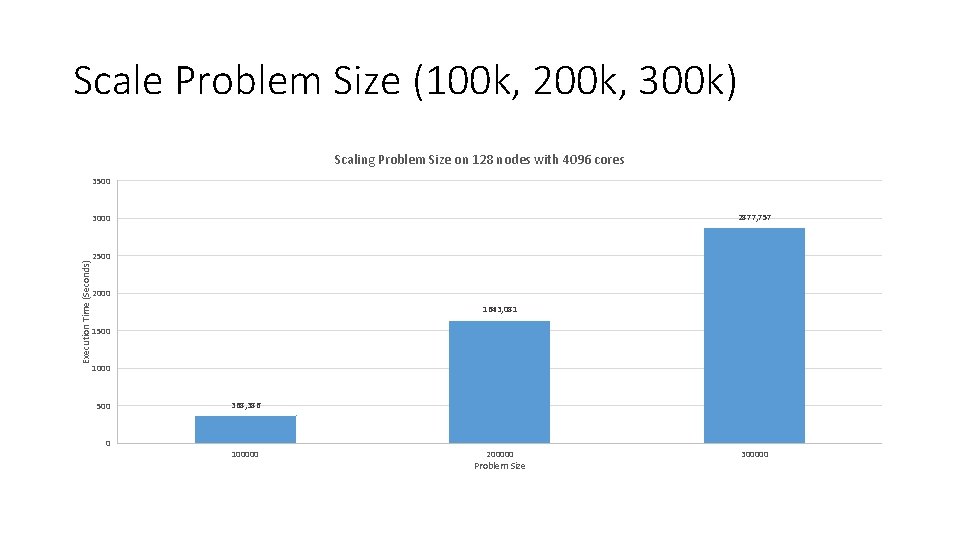
Scale Problem Size (100 k, 200 k, 300 k) Scaling Problem Size on 128 nodes with 4096 cores 3500 2877, 757 3000 Execution Time (Seconds) 2500 2000 1643, 081 1500 1000 500 0 368, 386 100000 200000 Problem Size 300000
Machine Learning on Big Data • Mahout on Hadoop • https: //mahout. apache. org/ • MLlib on Spark • http: //spark. apache. org/mllib/ • Graph. Lab Toolkits • http: //graphlab. org/projects/toolkits. html • Graph. Lab Computer Vision Toolkit
Query on Big Data • Query with procedural language • Google Sawzall (2003) • Rob Pike et al. Interpreting the Data: Parallel Analysis with Sawzall. Special Issue on Grids and Worldwide Computing Programming Models and Infrastructure 2003. • Apache Pig (2006) • Christopher Olston et al. Pig Latin: A Not-So-Foreign Language for Data Processing. SIGMOD 2008. • https: //pig. apache. org/
SQL-like Query • Apache Hive (2007) • Facebook Data Infrastructure Team. Hive - A Warehousing Solution Over a Map. Reduce Framework. VLDB 2009. • https: //hive. apache. org/ • On top of Apache Hadoop • Shark (2012) • Reynold Xin et al. Shark: SQL and Rich Analytics at Scale. Technical Report. UCB/EECS 2012. • http: //shark. cs. berkeley. edu/ • On top of Apache Spark • Apache MRQL (2013) • http: //mrql. incubator. apache. org/ • On top of Apache Hadoop, Apache Hama, and Apache Spark
Other Tools for Query • Apache Tez (2013) • http: //tez. incubator. apache. org/ • To build complex DAG of tasks for Apache Pig and Apache Hive • On top of YARN • Dremel (2010) Apache Drill (2012) • Sergey Melnik et al. Dremel: Interactive Analysis of Web-Scale Datasets. VLDB 2010. • http: //incubator. apache. org/drill/index. html • System for interactive query
Stream Data Processing • Apache S 4 (2011) • http: //incubator. apache. org/s 4/ • Apache Storm (2011) • http: //storm. incubator. apache. org/ • Spark Streaming (2012) • https: //spark. incubator. apache. org/streaming/ • Apache Samza (2013) • http: //samza. incubator. apache. org/
REEF • Retainable Evaluator Execution Framework • http: //www. reef-project. org/ • Provides system authors with a centralized (pluggable) control flow • Embeds a user-defined system controller called the Job Driver • Event driven control • Package a variety of data-processing libraries (e. g. , high-bandwidth shuffle, relational operators, low-latency group communication, etc. ) in a reusable form. • To cover different models such as Map. Reduce, query, graph processing and stream data processing

Thank You! Questions?
- Slides: 38